MANDARIN-POPPY SEED MADELEINES

I have been attending a creative writing class for several years. The group meets once a week and is led by a young woman who is an incredibly gifted poet. A new group enrolls every four to six weeks, and although there are always new members, there are several regulars who have become good friends. The class includes a professional actress whose writing is filled with beautiful language and images; a retired Orthodox priest who tells and writes wonderful stories about his adventures among Native American tribes throughout the West; a scientist who writes passionately about the environment and climate change; a retired journalist who makes us laugh with his stories about growing up; and a political activist who has a famously unfinished novel about feral pythons in the Everglades.

Our current series of workshops comes to a close this week. I thought some kind of snack would be a good way to say goodbye to all of the current participants. It seemed to me that nothing would be more appropriate for the group than some Proustean Madeleines. We won’t have any tea to dip them in and will have to make do with bottled water. I decided, though, that maybe rather than ordinary vanilla-flavored cookies the group might enjoy some made with Mandarin orange (actually “Halos” from my refrigerator) and poppy seed. Here’s the recipe. It is amazingly easy, and the only challenge is to find a French Madeleine pan. Never mind if you don’t have or can’t find one. Muffin tins will serve as fine substitutes. The batter is, after all, a French Genoise

RECIPE

Mandarin-Poppy Seed Madeleines

Ingredients

  • 2 large eggs, room temperature
  • ½ cup sugar
  • zest from one clementine
  • ¼ teaspoon salt
  • ½ teaspoon vanilla extract
  • 1 teaspoon orange blossom water
  • 1 tablespoon orange liqueur
  • 1 tablespoon poppy seeds
  • 1 cup flour
  • 8 tablespoons unsalted butter, melted and cooled slightly + 2 tablespoons for preparing Madeleine molds
  • juice from one clementine, strained
  • ½ cup confectioner’s sugar

Method

  1. In a large bowl, whisk the eggs until smooth. Add the sugar and orange zest. Using an electric mixer, beat the mixture on high speed until it is foamy and has expanded at least three times in volume, about 5 minutes.
  2. Stir in the salt, vanilla extract, orange blossom water, orange liqueur, and poppy seeds.
  3. Pour the flour into a large sieve, and sift about half of the flour into the batter. Fold in. Then add the 8 tablespoons of melted butter, and stir to incorporate. Sift in the remaining flour and fold in until well mixed. Let the batter rest at room temperature for 30 minutes.
  4. In the meantime, heat the oven to 400°F and prepare the Madeleine mold by brushing the remaining melted butter into the mold cups, making sure that the surfaces are well coated.
  5. By tablespoonfuls, transfer the batter into the prepared Madeleine molds. There should be enough for 24 individual Madeleines.
  6. Bake in the middle of the pre-heated oven for 10 minutes or until the edges of the Madeleines are golden brown. Remove from the oven, loosen the edges of the individual cakes with a fork, and transfer to a cooling rack.
  7. Prepare the glaze by mixing the clementine juice and confectioner’s sugar to form a smooth liquid about the consistency of heavy cream.
  8. With a pastry brush, paint one side of each cooled Madeleine with the glaze. Let rest until the glaze has firmed, about 30 minutes. Serve immediately or store in an air-tight container for up to 2 days.

10 Comments

Filed under Recipes

BOGUS BOLOGNESE

I’ve been home alone for several days. Times like that call for lots of restaurant visits or eating out of cans and making a lot of popcorn. They are also times to toss together whatever leftovers there are in the refrigerator before it’s time to toss them out permanently. This recipe is inspired by that latter need. It turned out to be a fair approximation of the real thing, but I am certain that Marcella Hazan is looking down and howling with disdain. This recipe should serve one or two persons.

RECIPE

Bogus Spaghetti Bolognese

Bogus spaghetti Bolognese

Bogus spaghetti Bolognese

Ingredients

  • 3 tablespoons olive oil
  • ½ medium yellow onion, diced
  • 1 rib celery, diced
  • 8 peeled “baby” carrots, cut crosswise in thin coins
  • 4 medium crimini mushrooms, sliced
  • ½ cup packaged diced boneless ham
  • ½ cup milk
  • ½ cup dry white vermouth
  • 1 cup mixed vegetable juice (V-8 or equivalent)
  • 8 cherry tomatoes, sliced in half
  • salt and pepper to taste
  • 1/8 teaspoon grated nutmeg
  • good pinch of sugar
  • 1/3 to 1/2 pound of dry spaghetti
  • Parmesan cheese, freshly grated

Method

  1. Heat the olive oil in a large sauté pan over medium heat. Add the onions and sauté until translucent but not browned. Stir in the celery and carrots. Sauté for another 5 minutes. Then stir in the mushroom and ham, continuing to cook until the mushrooms are soft.
  2. Stir in the milk and bring to a low boil. Cook until the milk has been almost completely reduced, but be careful not to burn. Stir in the vermouth and simmer until the wine has almost completely reduced.
  3. Stir in the tomato juice and tomatoes. Adjust the seasoning with salt and pepper. Stir in the nutmeg and sugar. Simmer for another 15 minutes until the tomatoes are soft and slightly falling apart. If needed, add more liquid.
  4. While the tomatoes are simmering, cook the spaghetti in a large pot of boiling salted water. Cook to al dente, about 10 to 12 minutes. With tongs or a spaghetti tool, transfer the strands of cooked spaghetti directly into the sauce, mixing thoroughly until the ratio of sauce and pasta is to your taste.
  5. Top with grated Parmesan cheese and serve immediately.

6 Comments

Filed under Food, Photography, Recipes

TWICE-BAKED POTATOES

There were a few more items in our fairly bare cupboard when we returned from our Colorado visit. Besides, I was holding off a trip to the grocery store for a number of reasons, not the least of which is that I felt a bit lazy.

I found two russet potatoes, and baked potatoes came to mind. They are certainly easy, but they also seemed a little boring. Twice-baked potatoes use almost exactly the same ingredients, but somehow they seem a little more festive, so that’s what I decided to do.

Just out of the oven

Just out of the oven

Ready to eat

Ready to eat

RECIPE

Twice-Baked Potatoes

Ingredients

  • 2 large russet potatoes, scrubbed
  • vegetable shortening
  • 2 slices bacon
  • 4 crimini mushrooms, chopped coarsely
  • 4 tablespoons butter + more for the topping
  • ¼ cup cream
  • ¼ cup sour cream
  • 1 small shallot, finely diced
  • 2 cloves garlic, minced
  • 2 ounces Gruyère cheese, grated
  • salt and pepper
  • ¼ cup bread crumbs
  • ¼ cup  freshly grated Parmesan cheese

Method

  1. Rub the potatoes all over with vegetable shortening, pierce on both sides in several places with a kitchen fork and place on a baking rack in the middle of an oven preheated to 350°F. Bake for 1 hour and 20 minutes, turning once halfway through the baking. Remove from the oven and cool until the potatoes are easy to handle.
  2. Cut the potatoes in half lengthwise, and with a large spoon, scoop out the flesh, leaving about ¼ inch rim intact. Try not to pierce the skin. Transfer the scooped out flesh to a large bowl. Mash coarsely with a table fork.
  3. In the meantime, sauté the bacon in a small pan over medium-low heat until crisp. Drain the bacon on several layers of paper towelling and crumble when cooled. Set aside.
  4. Drain all but about 1 tablespoon of the rendered bacon fat in the still hot pan. Add the mushrooms and sauté until cooked through. Drain and set aside.
  5. Melt the butter, and stir it into the mashed potatoes along with the cream and sour cream. Then add the shallot, garlic and Gruyère cheese. Correct the seasoning with salt and pepper.
  6. Divide the mixture evenly among the hollowed potato shells. Smooth the tops, paint with more melted butter using a pastry brush. Sprinkle evenly with bread crumbs and grated Parmesan cheese.
  7. Bake in the middle of the oven at 350°F for 20 minutes. Then increase the oven temperature to 400°F and continue to bake until the tops of the stuffed potatoes are browned, about 10 more minutes. Watch closely to prevent burning.
  8. Remove from the oven and serve immediately. Two potato halves make a light dinner or lunch. One potato half is a good side dish.

11 Comments

Filed under Food, Photography, Recipes

FRENCH ONION SOUP AND COLORADO’S MOUNTAIN MEN

We spent a few days in Estes Park giving our sister-in-law/sister a helping hand during her recovery. Before it was time to go, we drove around town. There were sights to behold. The Stanley Hotel sits high over the town. It is a beautifully preserved white clapboard hotel of the same era as the Coronado Hotel in  San Diego and the Mount Washington Hotel in New Hampshire. It has one further attraction – it served as the inspiration for Stephen King’s The Shining, even though the very scary movie was filmed at the Timberline Lodge at Mount Hood with interiors styled after the Ahwahnee Hotel in Yosemite. Every room in the Stanley is said to be haunted, but room 217 where King stayed is the epicenter of supposed paranormal activity.

The Stanley Hotel. Ask for room 271.

The Stanley Hotel. Ask for room 271.

The other sight we enjoyed was the herds of elk grazing on the lawns of various homes in the city. The elk are not tame, but you certainly wouldn’t know it. I’m not sure that I would like elk in my front yard, especially during rutting season, although they probably enrich the soil.

Elk herd grazing in the subdivision

Elk herd grazing in the subdivision

Front yard grass is the best

Front yard grass is the best

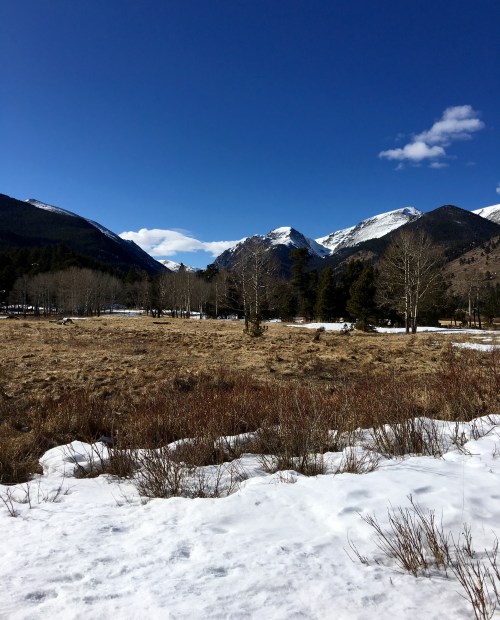
We left Estes Park by way of the Peak-to-Peak Highway, a winding but excellent road that clings to the Front Range, including the spectacular 14’er, Long’s Peak. The day was warm; the skies were clear and deep blue; so the white snow on the peaks and the dark green of the conifer forests was truly breath-taking. We saw herds of deer and even a flock of big horn sheep.

Along the Peak-to-Peak Highway

Along the Peak-to-Peak Highway

Long's Peak

Long’s Peak

After a short bypass on I70, we headed off into South Park (the real South Park), an enormous valley surrounded by snow-capped peaks including the Collegiate Range – Mt Princeton, Mt. Harvard, and Mt. Yale. Then we headed over the pass into the San Luis Valley decorated with a wall of several 14 thousand foot peaks of the Sangre de Cristos. It was humbling to think that the famous Mountain Men were the first Europeans to see this country, but the names of rivers – St. Vrain , Platte – reminded us of them.

Then on to New Mexico where Kit Carson hung out, and the mountains were every bit as beautiful. When we got home we discovered catkins on our backyard aspen. Spring cannot be far away.

Aspen catkins

Aspen catkins

Unfortunately, the cupboard was bare. We had a few onions, so I decided to make French onion soup. I took some modest shortcuts with Julia Child’s recipe. It turned out to be remarkably easy, and the result was delicious. It is hard to understand why French onion soup in restaurants often tastes so bland and watery.

RECIPE

French Onion Soup

Ingredients

  • 3 medium yellow onions
  • 3 tablespoons butter
  • 1 tablespoon olive oil + some for croutons
  • 1 teaspoon salt
  • ¼ teaspoon sugar
  • 3 tablespoons flour
  • 42 ounces beef stock
  • ½ cup dry vermouth
  • salt and pepper to taste
  • 2  ½-inch slices good quality bread
  • garlic powder
  • 4 ounces Gruyère cheese, grated

Method

  1. Peel the onions, and with a mandoline slice into thin rounds.
  2. In a heavy pot over medium-low heat, cook the onions, covered,  in the butter and oil for 15 minutes until they are wilted and translucent but not browned.
  3. Remove the lid, stir in the salt and sugar, and continue to cook over medium heat, stirring frequently, until the onions are caramelized and golden brown. Stir in the flour, and cook for a few minutes to remove the raw taste of the flour.
  4. Stir in the beef stock and vermouth. Bring to the boil, and then reduce to a simmer for 45 minutes. Adjust the seasoning with salt and pepper. Add water if the soup gets too concentrated.
  5. In the meantime, use a pastry brush to coat both sides of the bread slices with olive oil. Sprinkle on garlic powder. Cut into ½-inch cubes and arrange on a baking sheet. Bake in the middle of a 170°F oven for 30 minutes or until the bread cubes are thoroughly dry. Stir frequently to prevent burning.
  6. Ladle the soup into individual soup bowls. Arrange croutons on top. Sprinkle with the grated Gruyère and set on a baking pan. Place in the middle of an oven heated to 400°F and warm until the cheese is lightly browned and bubbling, about 5 to 15 minutes. Watch carefully to prevent burning.
  7. Remove from the oven and serve immediately. Makes 4 servings.

9 Comments

Filed under Food, Photography, Recipes, Travel

KING RANCH CHICKEN

We have gone to Colorado to visit my sister-in-law who is recovering from a hospital stay. Since she grew up in Texas, we thought some easy-to-eat Texas comfort food would welcome her back home.

If you have ever lived in Texas, you have probably eaten King Ranch Chicken. If you have never lived in Texas, it’s likely you have not even heard of the dish. King Ranch Chicken is served at Texas weddings, funerals, conferences, and of course women’s luncheons. It has even been suggested that the Texas State Legislature should designate KRC as the official State Casserole. A major function of the legislature seems to be to recognize the official state bird, fish, tree, etc. Some wags would  suggest that that is the most important thing they do.

In spite of all this fame, it is unknown how KRC got its name. One thing seems certain: it was not invented on the legendary King Ranch in Far South Texas. That assertion has been steadfastly denied by the wife of one of the past owners. A more likely explanation seems to me to be that it was invented and named by a home cook in the 1940s or 1950s during the heyday of The Joy of Cooking and Betty Crocker when a can of condensed soup was the key to elegance. Perhaps the inventor developed the recipe for her local Junior League cookbook. Versions of the recipe are certainly legion in all sorts of community cookbooks.

The first time I remember eating KRC was at a noon conference for students at a West Texas university many years ago. I don’t recall the topic of the conference, but I do remember that not a speck of the KRC remained. I also remember that it was tasty, gooey, and a little bit spicy.

There are probably as many recipes for KRC as there are Texas home cooks, but there are six key components: chicken of course, corn tortillas (though recent recipes substitute Doritos – a heresy as far as I’m concerned), cheese (some recipes swear by Velveeta), canned cream of mushroom soup, canned cream of chicken soup, and Ro*Tel. If you absolutely can’t stand the thought of canned soup, you can substitute your own homemade béchamel, but then your KRC would not be completely authentic.

Ro*Tel is another Texas invention. It was created during the 1930s in a small town near the Texas-Mexico border and not far from the King Ranch. It is a secret mix of tomatoes, green chiles, and spices. It is a key ingredient of queso dip and for years was only available in Texas. The tiny company was eventually sold to Con Agra, so now Ro*Tel should be available in every grocery store.

This version of the recipe includes two other ingredients that are not always in the recipe, but in my opinion they are both essential to Tex-Mex cooking: Mexican oregano and ground cumin. If you are not accustomed to their flavors you may find them objectionable. In that case, leave then out. Mexican oregano is different from Mediterranean oregano, and the best comes as leaves, stems, and flowers that you crush between the palms of your hands,

Some folks think KRC is too mushy. If you worry about that, cut back on the liquid. One of the beauties of KRC is that you can make the recipe your own. Then you will enjoy widespread fame throughout your neighborhood.

RECIPE

King Ranch Chicken

Ingredients

  • 1 whole chicken
  • 18 day-old corn tortillas
  • 2 tablespoons vegetable oil
  • 1 medium yellow onion, diced
  • 6 crimini mushrooms, torn into pieces
  • 10.5 ounce can condensed cream of mushroom soup
  • 10.5 ounce can condensed cream of chicken soup
  • 1 can Ro*Tel
  • 4 ounces canned chopped green chiles
  • 1 cup chicken stock (optional)
  • 2 tablespoons Mexican oregano, crushed
  • 1 teaspoon ground cumin
  • salt and pepper
  •  4 ounces Cheddar cheese, grated
  • 4 ounces Monterey Jack cheese, grated
  • sour cream
  • green bell pepper, seeded and sliced into rounds (optional)
  • red bell pepper, seeded and sliced into rounds (optional)

Method

  1. In a large pot, cover the chicken with salted water and bring to the boil. Cook at a low boil for 45 minutes or until the chicken is completely cooked. Cool until it is easy to handle. Then remove the skin, bones, fat, and any gristle. Cut the chicken meat into bite-sized pieces or shred with two forks. Set aside.
  2. Toast the tortillas for 15-20 seconds on both sides in a dry, hot skillet. Cut the heated tortillas in half and set aside.
  3. In a large skillet, heat the oil over medium heat. Add the onions and stir for a few minutes until translucent. Then stir in the mushroom pieces and continue to cook until the mushrooms are heated through and well-cooked. Stir in the mushroom soup, chicken soup,, Ro*Tel, green chiles, optional chicken stock, oregano, and cumin. Adjust seasoning with salt and pepper. Stir well and simmer for 15 minutes. Remove from the heat and set aside for assembly of the casserole.
  4. Prepare a 9″ x 13″ x 4″ glass baking dish by spraying the inside with baking spray. Ladle a scant half cup of the soup mixture into the baking dish and spread across the bottom of the dish. Arrange 12 tortilla halves to completely cover the bottom of the dish.
  5. Arrange about half of the cut-up chicken to cover the tortillas. Then top with a little less than half of the soup mixture. Top with about one-third of the grated cheeses.
  6. Arrange another layer of tortilla halves, topped with the remaining chicken and more soup mixture, reserving about 3/4 cup for the top, and half the remaining cheeses. Dot with teaspoonfuls of sour cream.
  7. Arrange a final layer of tortilla halves. Top with the remaining soup mixture and cheeses.
  8. Decorate if desired with the optional bell pepper rings.
  9. Bake for one hour in the middle of an oven preheated to 350ºF, until the top is well-browned and bubbling. Remove from the oven, cool for 5 minutes, and serve immediately.

26 Comments

Filed under Food, Photography, Recipes

COEUR À LA CRÈME WITH STRAWBERRY COULIS AND FRESH STRAWBERRIES

There are two days of the year when we never go to a restaurant: Mothers’ Day and Valentine’s Day. There are several reasons, and they are all very simple. First and most important, everyone else goes out to eat on those days. The effects of that are that one absolutely must have a reservation; even with a reservation it is guaranteed that you will have to wait – sometimes for hours; the menu is usually limited and often with nothing that is appealing; even in the best of restaurants the rush impacts the quality of service and the execution of the meal – to suggest that it may taste like cafeteria food is probably an overstatement, but not much; and finally, none of the staff really wants to be there – they would rather be at their own table – and you can sense that in their lack of smile and even civility.

That’s a long-winded way to say that we always cook dinner at home on Valentine’s Day. This year it was pan-sautéed beef filet, french fries,  asparagus with aioli, hard rolls, and dessert.

Dessert was coeur â la crème made in a beautiful French ceramic mold that we have had for as long as we have been married. The Americanized version of the dish uses cottage cheese, sour cream, yogurt, and whipped cream. Since that didn’t seem like enough calories, I topped it with a fresh strawberry coulis, and fresh strawberries. The heart-shaped mold was a perfect ending to a quiet Valentine’s Day dinner at home.

RECIPES

Coeur à la Crème

Ingredients

  • 1 cup small-curd cottage cheese
  • ½ cup sour cream
  • 2 tablespoons plain yogurt
  • ½ cup heavy cream

Method

  1. Place the cottage cheese, sour cream, and yogurt in the beaker of a food processor
  2. Blend thoroughly until the mixture is smooth.
  3. Pour into a medium bowl
  4. Whip the heavy cream and then stir into the mixture.
  5. Line a porous mold with three layers of moistened cheese cloth.
  6. Pour the mixture into the mold. Cover with the ends of the cheese cloth and place the mold in a rimmed plate.
  7. Refrigerate overnight.
  8. Unmold on a plate. Top with strawberry coulis. Garnish with fresh strawberries. Serve.

Strawberry Coulis

Ingredients

  • 1 pint fresh strawberries + more for garnish
  • 4 tablespoons sugar
  • 4 teaspoons fresh lemon juice

Method

  1. Place all of the ingredients in the beaker of a food processor and blend until smooth.
  2. Use immediately or refrigerate for up to three days until ready to use.


10 Comments

Filed under Food, Photography, Recipes

SPUDS ‘N’ WHISKEY CHEESE

When we arrived back home, I downloaded my camera to see if I had managed to capture any images of our visit to California. Here are a few of those memories:

Among the things we found in our cooler from the trip were some fragments of cheese that we had bought in Lodi. The night before our return home, Peter and his family stopped by our apartment on their way back to the Bay Area from a ski day in Kirkwood. We enjoyed some local wine and a plate of cheese before we went out to dinner.

We had found the cheese at a great little cheese shop on School Street, the main drag of Lodi’s charming historic downtown. Cheese Central is owned by a very pleasant woman, Cindy Della Monica, who clearly enjoys what she is doing. Most cheesemongers seem to have a good time and love to talk about cheese. That, and free samples, helps them sell their products. Karen, Cindy’s very knowledgeable assistant, was happier and more enthusiastic than any other cheesemonger I have ever met. She shared some excellent samples and gave us some very good suggestions.

We wound up buying a French epoisse cut fresh from a three-pound log, a Spanish cinco lanzas, and a Welsh cheddar, along with some crackers and a bit of quince paste membrillo. The cinco lanzas is made  by Queso García Baquero in La Mancha in the style of manchego (even with a similar dark grass imprint on the rind) but instead of sheep milk, it is made from a secret blend of cow, sheep, and goat milk. It went well with the membrillo. The Welsh cheddar was the big surprise. It is called “Amber Mist” and is made by the Snowdonia Cheese Company. The surprise is that the cheese is soft and crumbly because of added Scotch whiskey which adds to the flavor without being overpowering.

We had a wonderful time with Peter’s family; the two girls loved the membrillo and all of the cheeses along with some heart-shaped water biscuits. Even at that, there were leftovers. But not enough for another cheese party when we got home. Still, the cheeses wouldn’t last forever, and they were too delicious to throw out. That’s when I decided to use them for a special mac and cheese. Our three cheeses went well together, but you should be careful with your choices. The cheese should melt, so no hard cheeses. Blue cheeses might overpower any others. Stinky cheese should not be included, and after a two-day road trip the epoisse came close to disqualifying itself.

Somehow mac and cheese seemed to be a bit prosaic. I substituted potatoes for pasta, added some more ingredients, and poured in a little extra whiskey to flavor things a bit more.  I used some Italian guanciale (cured hog cheek) but you can easily substitute pancetta or bacon or even nothing. Here’s the ad hoc recipe. It turned out pretty good, I think.

RECIPE

Spuds ‘n’ Whiskey Cheese

Ingredients

  • 2 large russet potatoes, peeled and diced, ½ inch cubes
  • 4 ounces guanciale, trimmed of skin and diced (Use pancetta or bacon if you prefer, or omit)
  • 2 medium crimini mushrooms, sliced
  • 3 scallions sliced (include green tops)
  • 3 tablespoons unsalted butter
  • 3 tablespoons all-purpose flour
  • 1½ cups milk
  • 2 ounces Scotch whiskey (don’t use your 18-year-old single malt) or other whiskey*** Optional
  • salt and pepper
  • leftover cheeses (about 4 ounces)
  • butter for preparing baking dish and topping the casserole filling
  • panko
  • 3 tablespoons freshly grated Parmesan

Method

  1. In a heavy pot, cover the cubed potatoes with well salted water, bring to the boil, and cook for 10-12 minutes until the potatoes have softened but not cooked through. Remove from the heat, drain, and set aside.
  2. In the meantime, sauté the guanciale over medium heat until it is crispy. Drain on several thicknesses of paper towel and set aside. Pour off all but about 1 tablespoon of the rendered fat; add the sliced mushrooms and sauté until cooked through. Drain and set aside.
  3. Prepare the scallions and set aside.
  4. In a medium saucepan over medium-low heat, melt the butter until it has stopped foaming. Add the flour and stir while cooking another 5 minutes until the mixture is cooked but not browned. Stir in the milk and continue to stir until the mixture thickens and comes to a simmer. Stir in the whiskey, and adjust the seasoning with salt and pepper.
  5. Over low heat, add the leftover pieces of cheese to the white sauce. Grate the cheese if it is in large chunks. Stir until the cheese is completely melted.
  6. Stir in the sautéed guanciale,, mushrooms, and scallions.
  7. Combine the potatoes and sauce.
  8. Prepare a baking dish by liberally buttering the inside of a baking dish and coating the inside with panko. Transfer the potato-sauce mixture to the baking dish, and top with more panko and grated Parmesan. With a pastry brush, paint the top of the casserole with melted butter.
  9. Bake in the middle of an oven preheated to 350°F for one hour until the top is browned and bubbling. Serve while still warm.


16 Comments

Filed under Food, Photography, Recipes, Travel

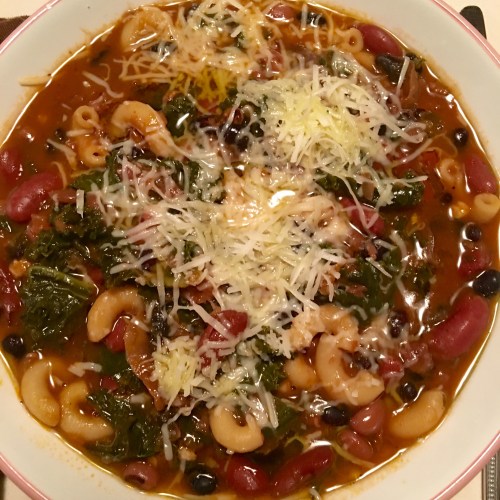
HOMECOMING BEAN AND KALE SOUP

We are back from our long visit to Lodi, California. We had a great time and returned with a trunk filled with bottles of wine that we found at some of the more than 80 wineries in the Lodi area. We plowed through two days of rain and snow with tense times on the passes in Tehachapi, California and Flagstaff, Arizona.

When we got home, the cupboard was bare – or nearly so – requiring a little innovation on my part to come up with something to eat. I fell back on a post that I had just read a few days before. Diane Darrow writes an interesting blog, Another Year in Recipes. She lives in New York City but has spent much time in Italy and has authored two Italian cookbooks. She wrote of making a bean soup from one of her cookbooks when she was snowed in during the recent NYC blizzard. You should definitely check out her blog.

This is not Diane’s recipe, but it is certainly inspired by hers. I confess that I had run out of ditali and had to turn to elbow macaroni. I also had to run to the market for a bunch of kale, but otherwise everything else was in the pantry or in the little cooler we always carry in our car. The next day I went back to the store for a marathon journey through the aisles.

image

 RECIPE

Bean and Kale Soup

Ingredients

  • 2/3 cup dry black-eyed peas
  • 2/3 cup dry black beans
  • 2/3 cup dry red beans
  • olive oil
  • 1 medium yellow onion, diced
  • ½ cup celery chopped
  • ½ cup carrots, grated
  • 1 quart beef stock
  • 8 ounces canned tomato sauce
  • 2 cloves garlic, minced
  • 4 ounces white mushrooms, sliced
  • 2 teaspoons Italian seasoning blend
  • 1 tablespoon rubbed sage
  • salt and pepper
  • 1 bunch kale
  • ½cup elbow macaroni
  • 2/3 cup Parmesan, freshly grated
  • extra virgin olive oil (your best)

Method

  1. Pick over the beans, removing any stones, and place in a large, lidded, heavy pot. Cover with at least 2 inches of water. Bring to a boil and cook, uncovered, for two minutes. Turn off the heat, cover the pot, and set aside until the pot has cooled. Drain the beans and set aside.
  2. Rinse and dry the pot. Heat 2 or 3 tablespoons of olive oil over medium heat. Add the onions and sweat, covered, for about 5 minutes. Do not brown. Stir in the celery, carrots, reserved beans, beef stock, and tomato sauce. Bring to the boil and then simmer covered for about 1 hour.
  3. Add the garlic, mushrooms, seasoning blend, sage, and salt and pepper to taste. Continue to simmer, covered. Add water if needed.
  4. Meanwhile, wash the kale. Remove the stems and center ribs, soaking the leaves in cold water for an hour. Cut the kale into 3 x 3 inch pieces and add to the soup pot. Cover and continue to cook for another hour, stirring occasionally. About 15 minutes before you are ready to serve, stir in the macaroni.
  5. When the beans are soft, and the kale has cooked down, correct the seasoning with salt and pepper. Ladle into serving bowls, top with grated Parmesan and a drizzle of extra virgin olive oil. Serve immediately.

8 Comments

Filed under Food, Photography, Recipes, Travel

SEARCHING FOR THE MOTHER LODE

Our month-long visit to Lodi, California, has provided us an excellent base to explore the foothills of the Sierra Nevada and the area that was the center of the feverish gold rush that began in 1849. We have visited Sacramento, now the capital of California, but at one time a center for transportation during the gold rush as well as serving as the western terminus (San Francisco notwithstanding) of the great race between the Central and Union Pacific Railroads to meet up to create the first transcontinental railroad. We have also visited some of the historic towns in the foot hills and taken back roads into the mountains and the areas of devastation from the “Butte Fire” of last summer. All of it has been a learning experience.

Sacramento is much like any big city. It has around a half million residents and traffic to match. The capital building is a replica (smaller of course) of the national Capitol in Washington DC and it has its own beautiful mall. The riverfront has been restored into “Old Sacramento” which, like most “Old [fill in the blank]” is filled with Victorian-era buildings, bars, restaurants, and gift shops.

But one place in Old Sacramento that shouldn’t be missed is the Railroad Museum. The place has accumulated engines and rail cars that capture the entire history of California railroading. The rolling stock has all been carefully restored. The museum goer can walk through many of the exhibits. Some of the restored cars even replicate the rocking motion of a speeding train. We spent several hours in the museum and then decided that we didn’t need to see any more of Sacramento.

We explored several mining towns and soon learned that you have to get off of the main highway. The main drags are universally lined with the usual  gas stations, McDonald’s, hardware stores and Dollar Generals. The old town Main Streets are the places to experience the real feel of the communities.

One of our first visits was to Murphy’s. The main landmark of the street is “Murphy’s Historic Hotel” which advertises itself as having served the town since 1850. That claim does not make it clear whether the current building is the original, but that doesn’t really matter. The building is old enough and run down enough that you can picture it as the background of a gun fight during gold rush days. There is a bar in the front of the building where locals hang out. In the back, the dining room has been fixed up to capture Victorian styles. It looks like a good place to enjoy a leisurely lunch or a fancier dinner. There are white linen tablecloths and comfortable chairs. Lots of good California wine choices. The food turned out to be “ok” with a badly over-cooked hamburger supposedly topped with blue cheese crumbles that turned out to be a grayish unpleasant-tasting blob that could only be salvaged by scraping it off. Perhaps the “chef” (who had just started work that day according to the slightly deaf server) put the blue cheese on the burger too early in the cooking process. The bacon-wrapped shrimp po’boy special turned out to be a better choice.

Another stop was Sonora. The guidebook informed us that the town had been named by homesick Mexicans for their home state in Mexico. They had apparently come to California during the gold rush to make their fortunes. Our food discovery in that quaint little town was Talulah’s Restaurant, named by the woman owner just because she thought the name sounded cute. The Victorian storefront was painted in bright chartreuse, and the inside also had touches of chartreuse. Not a big place, it had a surprisingly large menu with, of course, a good selection of California wines.  The mushroom soup was so flavorful and aromatic that I started to eat it before I remembered to make an image. The complementary garlic bread turned out to be picture perfect and delicious to boot. The marinara on the spaghetti was not my recipe, but it was flavorful and tasted of fennel and just a hint of cinnamon and cloves. (I know what you’re thinking – no, it was not Cincinnati five-way chili. It was really quite tasty.) The grand finish was a delicate lemon cake filled with a light-as-a-feather lemon mousse and topped with a warm lemon sauce.

We drove through Angel’s Camp, named after Mr. Angel, not the celestial variety. Angel’s Camp is home to Mark Twain’s “Jumping Frog of Calaveras County”, so everything was named, “Frog”, including the high school mascot.

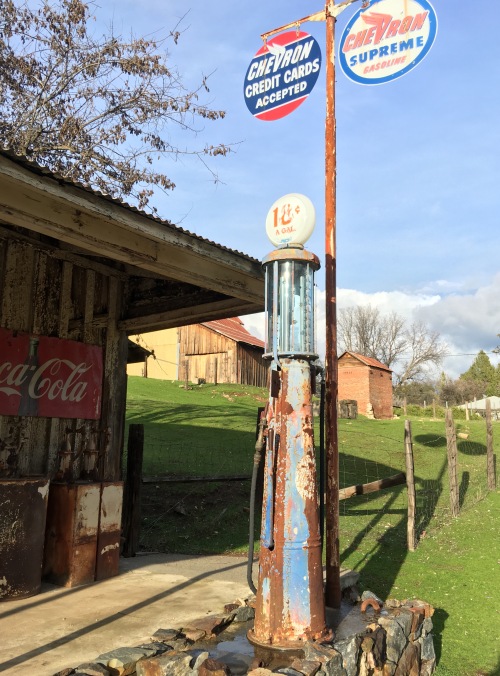
My favorite place was Sheep Ranch (the name of the town, population 32) located on Sheep Ranch Road and former headquarters for the Sheep Ranch Mine. There was a large, still well-preserved but unoccupied white hotel nestled in the pines at the end of the main street. There were no restaurants in town, but the abandoned general store still advertised gasoline at 18 cents a gallon. Unfortunately there was none for sale.

Sheep Ranch

Sheep Ranch

Up Swiss Ranch Road, after the pavement had turned to gravel, we discovered an ornate iron gate that looked as though it was the entrance to a great English country house. Its story remains a mystery to us, but I am certain it would be very interesting.

The saddest part of our trip was to see the devastation caused by the “Butte Fire” of October, 2015. Miles of forest were burned and over 500 homes were destroyed. Most of the ruined buildings had nothing above the foundation, and they were surrounded by the shells of burned-out cars and trucks. It will be years before the forests and hazardous materials are cleared, decades – if ever – before the forests come back, and probably never for families to put their lives back together.


9 Comments

Filed under Food, Photography, Restaurants, Travel

DEVILED EGGS

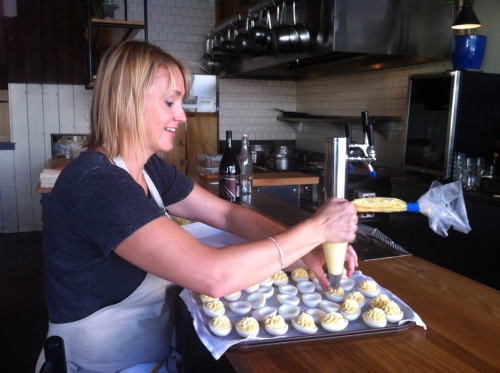
Deviled eggs seem to be enjoying a renaissance. They are on many menus these days. Sarah often makes them for catered dinners as well as for family occasions. Sometimes she stuffs them with smoked trout or other delicious fillings.

Sarah piping deviled eggs

Sarah piping deviled eggs

But in their simplest form, how difficult can deviled eggs be to make? Hard boiled eggs cut in half; yolk mashed with a little mayonnaise, mustard, lemon, salt and pepper; yolk mixture spooned or piped into the egg white halves; maybe a little garnish of paprika, snipped chives, or crumbled bacon. Simple is not always easy.

During this visit to California, deviled eggs have been on many menus. I have eaten many of them because I like them when they are good.

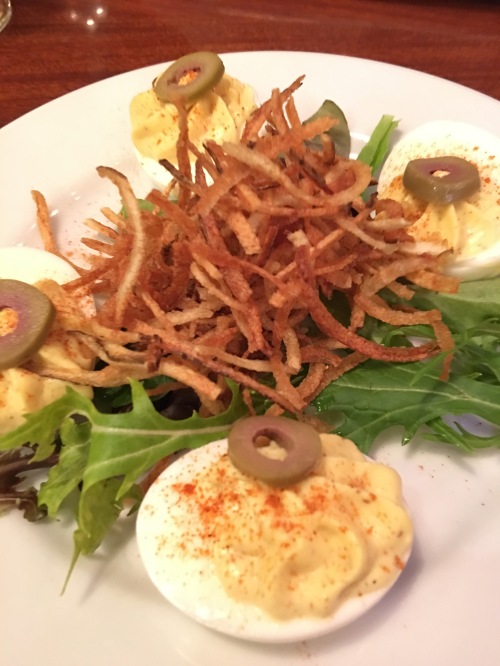
The best ones so far were served at the School Street Bistro in Lodi. My very minor quibbles were that the yolk filling was too runny (Too much mayonnaise?) and had too much mustard. Otherwise they were delicious, and their garnish of house-made French-fried potato straws was outstanding  I could have eaten a plate of the potato straws by themselves.

Sunday deviled eggs with potato straws at the School Street Bistro, Lodi, CA

Sunday deviled eggs with potato straws at the School Street Bistro, Lodi, CA

Some of the eggs have had a rubbery texture undoubtedly from the eggs being boiled too hard and/or too long.

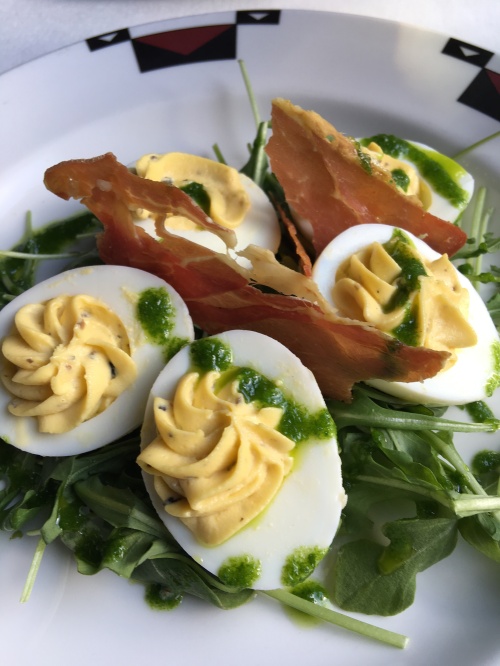
The ones I liked the least were the ones that were supposed to be the fanciest. The word, “truffles”, seems to make something more luxe. Visions of pigs rooting up fungi at the base of a French hazelnut tree come into play, or a liveried waiter shaving little shards with his special knife onto a perfect French omelet. That’s not the same as truffle oil. This condiment has been banned from many a high-end kitchen. The well-known San Francisco chef and writer, Daniel Patterson, has written a great piece in the New York Times about why truffle oil does not find favor with professional chefs.

The main reason is that almost no commercial truffle oil contains actual truffles. The fragrance and taste of real truffles come from a complex array of compounds. The most prominent appears to be a chemical, 2,4-dithiapentane, that can be synthesized in a laboratory or factory. And that is the chemical that is added to truffle oil to give it flavor. Small wonder that foods which incorporate commercial truffle oil take on a chemical flavor; some would even say petroleum-like.

Deviled eggs with truffle oil

Deviled eggs with truffle oil

Here is a basic recipe for deviled eggs, perhaps of the Southern variety. If you don’t like it, experiment by adjusting the amounts of the basic ingredients and add any extras that sound appealing to you. Just – please – don’t add truffle oil.

RECIPE

Basic Deviled Eggs

Ingredients

  • eggs, at room temperature
  • 1 teaspoon mayonnaise for each egg
  • 1/8 teaspoon dry mustard for each egg
  • few drops fresh lemon juice for each egg
  • salt and pepper to taste
  • paprika

Method

  1. Pierce the large end of each egg with an egg piercer and place in a single layer in a saucepan with enough water to cover the eggs by at least an inch. Bring to the boil over high heat, just until large bubbles begin to appear around the eggs. Cover, remove from the heat, and let stand, undisturbed, for 10 to 18 minutes, depending on the size of the eggs and the altitude.* You should work out the time beforehand. Transfer the eggs to a large bowl filled with ice and water. Chill for the same amount of time as you used for the cooking.
  2. Peel the eggs by cracking them all over and, starting at the big end, peeling them under a small stream of running water. The longer the eggs sit in the refrigerator before peeling them, the harder it will be to peel them and the more likely you are to get the dreaded green ring around the yolks, so it is best to prepare them immediately.
  3. Slice the cooled eggs in half lengthwise and gently remove the cooked yolk. Press the yolk through a fine-mesh sieve or strainer into a medium bowl. Stir in the mayonnaise, mustard, and lemon juice. If the mixture is too stiff, very slowly stir in more mayonnaise by half teaspoonfuls until the consistency suits you.  Adjust the mustard and lemon juice to please you. Correct the seasoning with salt and pepper.
  4. Spoon or pipe the yolk mixture into the empty halves of cooked egg white. Garnish with a sprinkle of paprika and serve.

* At 7000 feet, a jumbo egg takes 18 minutes to cook; a large egg takes 16 minutes. Probably at sea level you should deduct about 2 minutes for each cooking time, but it is best to work out specific times for your cooking conditions.

15 Comments

Filed under Food, Photography, Recipes, Restaurants, Travel