Category Archives: Photography

TAKE-AWAY CASSOULET

If you have ever made cassoulet from Julia Child’s recipe in Mastering the Art of French Cooking, you know how delicious it is. You also know how laborious it is. You need to cancel all of your calendar for a week and take a couple of days off from your job. On the other hand, Mark Bittman in How to Cook Everything says that cassoulet is not much more than pork and beans and that you should not be intimidated. I was looking for some middle ground for a dish that evoked the real thing without all of the effort.

The reason for my search was that my wife was going out of town to spend time with her sister who had been ill for a while. She (my wife) wanted to spend her time visiting and not cooking. She asked if I could make some dishes that she could take with her to warm up for evening meals. I agreed and then faced the challenge of making things that could be transported and that had enough variety so the two ladies would not turn to TV dinners. Of course, the proteins needed to be different, but it would be a good idea if the starches were different, too. Thus came the menu.

First dish was an old standby: ham, mushroom, and potato casserole. We had just had a new version a couple of weeks ago, and it was a big hit. My wife suggested that a redo of the recipe would be a good idea.
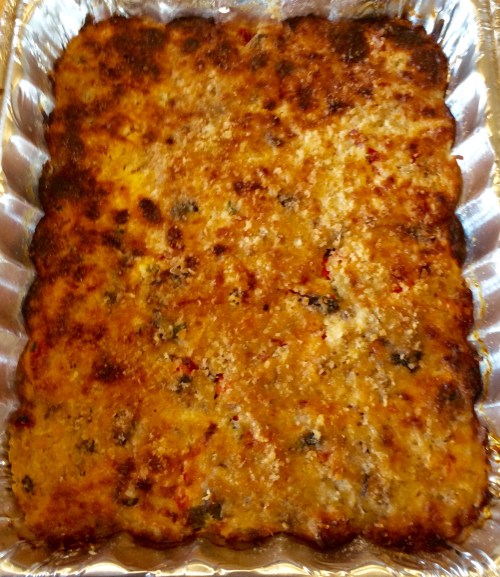
Ham, mushroom, potato casserole

Ham, mushroom, potato casserole

The second dish was something that I hadn’t made for a long time, my mother’s version of goulash. I’ve posted the recipe in the past. It is really not goulash, but that’s what my mother called it. It was one of her most successful dishes and was often requested by out-of-town family visitors. Ground beef and pasta seemed like a good idea.
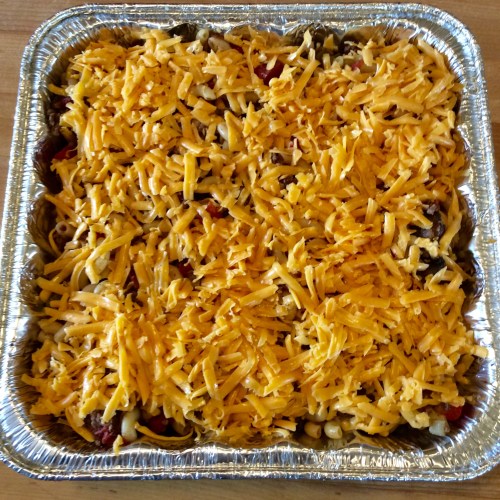
Goulash. Just heat until warm and the cheese melts.

Goulash. Just heat until warm and the cheese melts.

Finally, beans are always a good choice for pot luck dinners, and  my cooking project was really a long distance potluck. A bowl of Texas red with beans sounded good, but that would be more ground beef and might be too much for sensitive digestive systems. My goal was to make a cassoulet that wouldn’t wear me about. The result turned out to be fairly easy and fast. Impartial diners will have to be the judges of taste.

Cassoulet ready for travel

Cassoulet ready for travel

RECIPE

Take-Away Cassoulet

Ingredients

  • 2 cups Great Northern beans
  • 3 slices pre-sliced salt pork
  • 1 medium onion, halved and sliced
  • bouquet garni (3 sprigs parsley, 3 sprigs thyme, 2 cloves garlic, 2 bay leaves, 2 cloves tied in cheesecloth)
  • 2 tablespoons vegetable  oil
  • 1 pound boneless pork ribs, cut in 2 inch cubes
  • 1 pound lamb shoulder, bones removed and cut in chunks
  • 1 large bratwurst, cut in 1½inch slices
  • 6 ¾ inch rounds of packaged bulk sausage (Jimmy Dean or similar brand)
  • 4 cups beef broth
  • 1 cup dry vermouth
  • 3 tablespoons tomato paste
  • 2 garlic cloves, minced
  • ¼ teaspoon ground thyme
  • 1/8 teaspoon ground bay (or 2 bay leaves)
  • salt and pepper to taste
  • ½ cup panko
  • ½ cup dried bread crumbs
  • ½ cup fresh parsley leaves, finely chopped
  • extra virgin olive oil

Method

  1. Pick over the beans for stones and shriveled beans. Place in a large, heavy-bottomed pot, cover with water to a level at least 1 inch above the beans, and soak over night.
  2. In the meantime, cover the salt pork with water in a small pan. Bring it to the boil for 2 minutes. Drain and cool. Cut the salt pork strips in half lengthwise and then cut the pork into triangles. Set aside.
  3. In the morning, make sure the beans are covered with water. Add the prepared salt pork, onions, and bouquet garni. Bring to the boil and then reduce to a very low boil. Cook uncovered until the beans are tender, about 2 hours. Add water as needed so that the beans remain well covered.
  4. When the beans are done, remove from the heat, and let stand in the cooking water until you are ready to combine with the cooked meats.
  5. While the beans are cooking prepare the meats. In a large skillet, heat the vegetable oil. Then, in batches brown the pork pieces on all sides. Transfer browned pieces to a deep plate. Repeat the process with the pieces of lamb shoulder, bratwurst, and bulk sausage. Cut the browned sausage rounds into quarters.
  6. When you are ready to assemble the cassoulet, drain the beans, reserving the liquid. Return the beans to the large cooking pot. Add the beef broth, vermouth,  and enough of the cooking liquid to cover the beans. Stir in the tomato paste, garlic, thyme, and bay. Bring to the boil and add the pork, lamb, bratwurst, and sausage. Reduce to the simmer, and cook for 30 minutes. Add more beef broth or cooking liquid to make certain that the beans are just barely covered. Adjust seasoning with salt and pepper.
  7. Remove from the heat and allow to cool for 10 minutes. Then transfer to an aluminum container suitable for travel. If you have used whole bay leaves, remove them.  The liquid should just barely cover the bean and meat mixture.
  8. Mix the panko, bread crumbs, and parsley together and then sprinkle over the top of the bean and meat mixture. Drizzle with olive oil. Cool completely and then cover for travel.
  9. When you are ready to serve, remove the cover used for travel and place in the upper third of an oven preheated to 375°F.After 15 minutes, a crust should form. Break the crust with the back of a large spoon and reduce the oven to 350°F Continue to bake for 30 more minutes, breaking the crust with a spoon from time to time.
  10. When the cassoulet is heated completely through and the crust is well formed and browned, remove from the oven and serve immediately. Should serve 4 to 6 persons, easily.

4 Comments

Filed under Food, Photography, Recipes

LEEK AND POTATO SOUP – VITA-MIX VERSION

My Vita-Mix is a new gadget that I have had a good time learning about. It is very efficient in chopping. Instructions call for using small volumes of food to chop. That is important because the chopped pieces are thrown against the sides of the container, and chopping stops before the food is turned into mush. That means that chopping large amounts of food requires several passes. That slows down the process, but still – 10 seconds to chop a cup of carrots is a remarkable efficiency. The big bonus is puréeing large volumes of soup into the smoothest dish one can imagine. You get to do both of those processes with the recipe for leek and potato soup. Actually, I think you could do the same thing with a food processor or an old-fashioned blender. For that matter, you could even use a knife and chop things by hand. But then it wouldn’t be as much fun.

RECIPE

Leek and Potato Soup

Ingredients

  • 3 large leeks, cut into 1 inch slices, white and pale green parts only
  • 1 large onion, peeled and cut into 1 inch pieces
  • 4 tablespoons unsalted butter
  • 2 medium russet potatoes, peeled and cut into 1 inch pieces
  • 5 cups chicken broth
  • 1 cup heavy cream
  • 3 sprigs parsley
  • 3 sprigs fresh thyme
  • bay leaf
  • 1 teaspoon kosher salt
  • ¼ teaspoon white pepper

Method

  1. Set Vita-Mix controls to Variable and speed 3. Fasten the lid with the center cap removed. Turn on the machine and by cupfuls, pour the cut-up leeks through the opening. Pulse 10 times. Turn off the motor. Transfer the chopped leeks to a bowl. Repeat the process until the leeks have all been chopped.
  2. Repeat the above steps to chop the onion.
  3. In a large pot, melt the butter over medium heat. Add the leeks and onion, stir and cover. Sweat the vegetables until they are translucent but not browned, about 5 minutes.
  4. Add the potatoes, chicken broth, cream, parsley, thyme, and bay leaf. Correct seasoning with salt and pepper. Use more if needed for taste. Bring the mixture to a boil and then reduce to a simmer for 4o minutes or until the potatoes are cooked through. Remove from the heat.
  5. Cool the soup mixture until it is easy to work with. Remove the parsley, thyme and bay leaf. Then, in three divided portions, add the mixture to the Vita-Mix container. Make sure the top and top are well seated on the container. With the settings on “Variable” and “8” speed, process the mixture for 30 seconds until it is smooth. Combine the three batches. Reheat, garnish with minced scallion greens or chives if desired, and serve immediately. You may also refrigerate and then serve chilled. Makes about 12 cups.

11 Comments

Filed under Food, Photography, Recipes

SANTA FE ARTS

There are many celebrities who live in Santa Fe or have a second (or third or fourth) home here. But there are many more non-celebrities who are potters, painters, sculptors, musicians, and writers who also live here. Even though they may not be household names, many of these artists are well known in their respective circles. They have clients from all over the world.

Recently, I have had a chance to get to know some of these very interesting people almost accidentally. My father was a wood carver. He worked in various woods and carved representations of many wild animals in natural settings. I inherited his collection, and one of the prizes was an elk head carved from walnut. The antlers were elaborately and intricately carved, so much so that it was difficult to figure out how my father was able to carve them. I took the carving off its resting spot on the wall in my study to show a friend. When I returned the piece to its hangar, it fell to the floor, and the intricate antlers were smashed into a dozen pieces. Fortunately I was able to find an expert in art restoration, Matthew Horowitz, who works with his father, David, at their gallery, Goldleaf Framemakers of Santa Fe. Matthew also has his own place, Revive Art Restoration. He has skills beyond his years and was able to restore the elk without a trace of the disaster. During my visits to the shop, I also got the opportunity to see some of his and his father’s work. They use gold leaf in extremely creative and beautiful ways. Some of their notable pieces are a gold-plated napalm bomb (real but deactivated), a giant roll of dynamite held together with gold barbed wire, and a gold-plated Kalashnikov (You might have concluded they are very much anti-war believers).

The restored wood carving

The restored wood carving

Matthew’s skill inspired me to find someone to repair a 1920s Santo Domingo Pueblo pot that had been broken during one of our moves. I found Heidi Loewen, who turned out to be a potter – really a ceramicist – of great skill as well as a porcelain restorer with experience in Europe and New York City. Heidi agreed to take on the project even though she is working on many commissions for her own original and beautiful pieces. During the repair process, Heidi has kept me apprised of her progress through a series of images sent by text message. After only a couple of weeks, Heidi let me know that the pot had been repaired. When I got to her studio to pick up the pot, my jaw dropped. The restoration was beautiful, and the many shards had been brought back together with the cracks completely hidden and the original charm of the bowl preserved. Just as with the elk, I was thrilled that I had discovered an artist who was clearly a professional. I visited Heidi in her gallery several times during the project. That gave me a chance to see some of Heidi’s work. She has beautiful pots, enormous plates, and many are finished in breathtaking gold. She also has a series of women’s shoes in all sizes ranging from Lilliputian to Brobdinagian. She clearly enjoys life and art.

Restored Santo Domingo bowl

Restored Santo Domingo bowl


My other encounter with visual artists was working with Vincent Faust, a sculptor whose medium is industrial metal. He shows his work at ViVO Contemporary Gallery on Canyon Road. Each year, the gallery sponsors a show in which local poets are teamed up with members of the gallery co-op. The poets write works inspired by the creations of the visual artists. Then there is the festive opening with the added touch of the poets reading their contributions. This year, I was fortunate to be teamed with Vincent. I wrote a poem about his bold and colorful piece made from industrial iron and coated in a brilliant metallic powder. The sculpture and the poem are both entitled, “Excision.””

EXCISION

Cut from steel.

Hammer, anvil, fire.

Pounded, twisted,

bent into a skeleton.

I gaze through ribs, thorax.

Chrome yellow, it will not

melt into the desert floor

like faded bones of

a frightened deer

or iris arc into the ochre cliff.


It stands firm, strong,

defiant against soft hills

forged in fire

on their own ancient anvil,

now dissolved into the arroyo

with each cool summer rain

or garlanded under velvet

of new snow until both

cascade – rivulets destined

for some faraway place.


It tests my strength:

I cannot lift it,

turn it in my hands,

capture hidden glints;

only look from a distance,

ponder meaning

hidden in

a lifeless shell

created by

a sentient being.

4 Comments

Filed under Photography

CHIMICHURRI AND VITAMIX

Recently I celebrated my birthday. I was surprised when a big box came from my family. It turned out to be a gleaming Vitamix food machine. I can hear some of you asking, “What will the old goat do with that?”  It seems akin to buying $2000 skis for a duffer who only skis greens or a Sunday driver receiving a Ferrari. Still others are thinking that, after all,  its only a blender.  A Vitamix is way more than a blender – it has a full 2 horsepower motor with speeds up to 37,000 rpm and variable speeds between 12,000 and 24,000 rpm. It will grind up just about anything without a single whine. It  sounds like those are specs straight out of a Ferrari ad. Now if I can only learn to drive it like a Ferrari.

I spent the first day reading all of the manuals and recipe books. I definitely did not want to destroy the machine during its first outing in the kitchen. Then, I had to think of something to make. Creamed soups prepared in a Vitamix are supposed to be so smooth that they don’t require  straining through a sieve or chinois. Soups are definitely on my list of things to make, but I wanted something to go with the meal I had already planned: pot roast and roasted potatoes. Some sort of sauce seemed like a good choice. Salsa verde and romesco came to mind. One of my food blogger friends , writing with the title of Back Road Journal, had provided a great recipe for the Dominican sauce, wasakaka (Isn’t that a great word to say?). That struck me as very similar to one of my favorites, the Argentinian chimichurri that goes so well with roasted beef.

The Vitamix cook book didn’t have the recipe, but I found one to modify in the Joy of Cooking. For a first pass, the chimichurri turned out to be easy and flavorful, but I will probably add some tweaks for my next effort. If you don’t have a Vitamix, you can use a food processor fitted with a metal blade. Pulse until you get the right consistency, and be careful not to blend for too long.  Of course, you can always chop things by hand. You’ll just have to do it more finely. Also, there is a severe sensitivity to chiles in our household, so I usually omit them, but you can definitely mince some jalapeño or add some cayenne.

Finally, a big THANKS to all my family for such a thoughtful gift.

RECIPE

Chimichurri

Ingredients

  • ¼ cup red wine vinegar (If you don’t have red wine vinegar, another vinegar will do.)
  • ½ cup extra virgin olive oil
  • ½ cup parsley leaves, washed and stems removed
  • 3 cloves garlic, chopped coarsely
  • 1 medium onion, chopped coarsely
  • 2 tablespoons fresh oregano leaves OR 1 tablespoon dry Mexican oregano.
  • salt and pepper to taste
  • 1/8 teaspoon cayenne pepper (optional or to taste)

Method

  1. Pour the vinegar and olive oil into the Vitamix container. Make sure the cover is in place. Set the speed indicator to High. Turn the machine on and process for about 15 seconds or until the vinegar-oil mixture is emulsified. Turn off the machine.
  2. Add the parsley, garlic, onion, oregano, salt, pepper, and optional cayenne pepper. Set the speed indicator to Variable and Variable knob to 3. Make sure the cover is in place, turn on the machine and as you process gradually turn up the rate to 6. Process for 20 seconds or until the mixture is the desired consistency. Be careful not to over-process. Turn off the machine. Transfer the chimichurri to a bowl, adjust the seasoning if needed, and let stand at room temperature for at least 30 minutes before serving.


14 Comments

Filed under Food, Photography, Recipes

SHAKSHOUKA

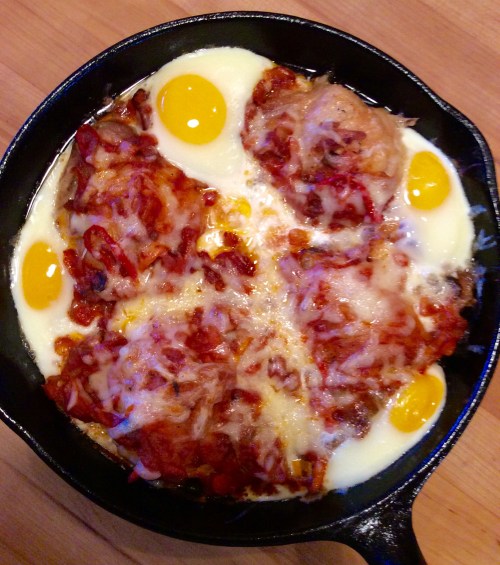
Disclaimer: This is not an authentic recipe for shakshouka. For one thing, it includes fried chicken. For another, it uses Swiss cheese. Also, I do not plan to take sides in the various controversies as to whether the dish should be viewed as Tunisian or Israeli or whether it should be viewed as a breakfast dish or served at an evening meal. I can only reaffirm that shakshouka is easy to make and delicious.

RECIPE

Shakshouka

Shakshouka

Shakshouka

Ingredients

  • 4 chicken thighs
  • olive oil
  • ½ yellow onion,, chopped
  • ¼ cup diced carrots
  • ¼ cup diced celery
  • 6-8 miniature sweet peppers, sliced into rings
  • 4 medium crimini mushrooms sliced
  • ½ cup dry vermouth
  • 8 ounces tomato sauce
  • 8 ounces chicken stock
  • ¼ teaspoon ground sage
  • ¼ teaspoon ground thyme
  • ¼ teaspoon ground cumin
  • ¼ teaspoon powdered lemon peel
  • salt and pepper to taste
  • 2 ounces Swiss cheese, coarsely grated
  • 4 eggs

Method

  1. In an oven-proof skillet (cast iron is perfect), brown the chicken thighs in a couple of tablespoons of olive oil over medium heat. Drain off the rendered fat and transfer the pan to the middle of an oven preheated to 250°F.
  2. In a separate skillet, sweat the onions in a couple of tablespoons of olive oil over medium-low heat. Stir in the carrots, celery, and sweet papers, and continue to sauté for 10 minutes until the vegetables are softened. Stir in the mushrooms and cook for another 5 minutes until the mushrooms are cooked through. Add the vermouth and continue to simmer until the vermouth has almost completely reduced.
  3. Stir in the tomato sauce, chicken stock, sage, thyme, cumin, and lemon peel. Adjust seasoning with salt and pepper. Simmer for another 5 minutes.
  4. Remove the chicken thighs from the oven. Cover with the sauce. Sprinkle with the grated Swiss cheese and return to the oven.
  5. When the cheese has melted, remove the pan from the oven. Increase the oven temperature to 350°F. Crack the eggs and place them in the spaces between the chicken thighs. Return to the oven and bake for another 5 to 10 minutes until the egg whites have set but the yolks are still runny. Watch carefully so that you don’t overcook the eggs.
  6. When the eggs are done to your liking, remove from the oven and serve immediately.

12 Comments

Filed under Food, Photography, Recipes

CALIFORNIA DREAMIN’ AND SOUR CREAM COFFEE CAKE

Our daughter in Los Angeles invited us to join her family for Easter. The visit would include holiday activities along with birthday celebrations, real estate adventures, and lots of cooking. On Saturday, the ritual dying of Easter eggs was completed. At dawn, the traditional Easter egg hunt was finished in record time.

Easter breakfast was an event that we could never have experienced in Santa Fe. The meal included something that could only be enjoyed in a few places across the country – most notably California and Florida. Our daughter’s husband and son went out into the backyard to harvest oranges for freshly squeezed juice. Meanwhile, she stirred up a delicious coffee cake and fried some link sausages.  She served it all with a fresh berry and kiwi fruit compote. Here’s the recipe for the coffee cake, copied from her hand-written recipe card.

RECIPE

Sour Cream Coffee Cake

Ingredients

  • ¾  cup flour
  • ¾ cup sugar
  • ½ cup brown sugar
  • 2 tablespoons cinnamon
  • 2 tablespoons cold unsalted butter
  •  1 cup pecans, chopped
  • 12 tablespoons unsalted butter + 2 tablespoons for greasing pan
  • 4 large eggs
  • 1½ cups sour cream
  • 1 tablespoon vanilla
  • 2¼ cups flour
  • 1¼ cups sugar
  • 1 tablespoon baking powder
  • ¾ teaspoon baking soda
  • ¾ teaspoons salt

Method

  1. In a food processor, combine flour, sugar, ¼ cup brown sugar, and cinnamon. Process for 15 seconds. Transfer 1¼ cups of the mixture to small bowl, and stir in the remaining brown sugar. Set aside for filling.
  2. Add butter and chopped pecans to the mixture remaining in the food processor. Pulse to a coarse pebbly consistency. Set aside for topping.
  3. Grease a 10 inch tube pan. Preheat oven to 350ºF.
  4. In a medium bowl, whisk together eggs, one cup of sour cream, and vanilla.
  5. In the bowl of a stand mixer, combine flour, sugar, baking powder, baking soda, and salt. Add butter and remaining ½  cup of sour cream. Beat on low until the mixture resembles wet sand, about 1½ minutes. Increase speed to medium and beat for 10 seconds. Scrape down.
  6. Lower the mixer speed to medium low and add the egg and sour cream mixture in three additions. Increase speed to medium high and beat for about 1 minute, until light and fluffy.
  7. Using a rubber spatula, spread 2 cups of batter on the bottom of the pan, smoothing the surface. Sprinkle evenly with ¾ cup filling. Repeat and then spread remaining batter over top. Sprinkle with topping.
  8. Bake for 50-60 minutes, until the cake is firm to touch and a skewer comes out clean. Cool in pan on cooling rack for 30 minutes. Then invert onto plate, removing the baking pan. Invert again onto the cooling rack, and cool to room temperature. Serves 12-16


9 Comments

Filed under Food, Photography, Recipes

BOGUS BOLOGNESE

I’ve been home alone for several days. Times like that call for lots of restaurant visits or eating out of cans and making a lot of popcorn. They are also times to toss together whatever leftovers there are in the refrigerator before it’s time to toss them out permanently. This recipe is inspired by that latter need. It turned out to be a fair approximation of the real thing, but I am certain that Marcella Hazan is looking down and howling with disdain. This recipe should serve one or two persons.

RECIPE

Bogus Spaghetti Bolognese

Bogus spaghetti Bolognese

Bogus spaghetti Bolognese

Ingredients

  • 3 tablespoons olive oil
  • ½ medium yellow onion, diced
  • 1 rib celery, diced
  • 8 peeled “baby” carrots, cut crosswise in thin coins
  • 4 medium crimini mushrooms, sliced
  • ½ cup packaged diced boneless ham
  • ½ cup milk
  • ½ cup dry white vermouth
  • 1 cup mixed vegetable juice (V-8 or equivalent)
  • 8 cherry tomatoes, sliced in half
  • salt and pepper to taste
  • 1/8 teaspoon grated nutmeg
  • good pinch of sugar
  • 1/3 to 1/2 pound of dry spaghetti
  • Parmesan cheese, freshly grated

Method

  1. Heat the olive oil in a large sauté pan over medium heat. Add the onions and sauté until translucent but not browned. Stir in the celery and carrots. Sauté for another 5 minutes. Then stir in the mushroom and ham, continuing to cook until the mushrooms are soft.
  2. Stir in the milk and bring to a low boil. Cook until the milk has been almost completely reduced, but be careful not to burn. Stir in the vermouth and simmer until the wine has almost completely reduced.
  3. Stir in the tomato juice and tomatoes. Adjust the seasoning with salt and pepper. Stir in the nutmeg and sugar. Simmer for another 15 minutes until the tomatoes are soft and slightly falling apart. If needed, add more liquid.
  4. While the tomatoes are simmering, cook the spaghetti in a large pot of boiling salted water. Cook to al dente, about 10 to 12 minutes. With tongs or a spaghetti tool, transfer the strands of cooked spaghetti directly into the sauce, mixing thoroughly until the ratio of sauce and pasta is to your taste.
  5. Top with grated Parmesan cheese and serve immediately.

6 Comments

Filed under Food, Photography, Recipes

TWICE-BAKED POTATOES

There were a few more items in our fairly bare cupboard when we returned from our Colorado visit. Besides, I was holding off a trip to the grocery store for a number of reasons, not the least of which is that I felt a bit lazy.

I found two russet potatoes, and baked potatoes came to mind. They are certainly easy, but they also seemed a little boring. Twice-baked potatoes use almost exactly the same ingredients, but somehow they seem a little more festive, so that’s what I decided to do.

Just out of the oven

Just out of the oven

Ready to eat

Ready to eat

RECIPE

Twice-Baked Potatoes

Ingredients

  • 2 large russet potatoes, scrubbed
  • vegetable shortening
  • 2 slices bacon
  • 4 crimini mushrooms, chopped coarsely
  • 4 tablespoons butter + more for the topping
  • ¼ cup cream
  • ¼ cup sour cream
  • 1 small shallot, finely diced
  • 2 cloves garlic, minced
  • 2 ounces Gruyère cheese, grated
  • salt and pepper
  • ¼ cup bread crumbs
  • ¼ cup  freshly grated Parmesan cheese

Method

  1. Rub the potatoes all over with vegetable shortening, pierce on both sides in several places with a kitchen fork and place on a baking rack in the middle of an oven preheated to 350°F. Bake for 1 hour and 20 minutes, turning once halfway through the baking. Remove from the oven and cool until the potatoes are easy to handle.
  2. Cut the potatoes in half lengthwise, and with a large spoon, scoop out the flesh, leaving about ¼ inch rim intact. Try not to pierce the skin. Transfer the scooped out flesh to a large bowl. Mash coarsely with a table fork.
  3. In the meantime, sauté the bacon in a small pan over medium-low heat until crisp. Drain the bacon on several layers of paper towelling and crumble when cooled. Set aside.
  4. Drain all but about 1 tablespoon of the rendered bacon fat in the still hot pan. Add the mushrooms and sauté until cooked through. Drain and set aside.
  5. Melt the butter, and stir it into the mashed potatoes along with the cream and sour cream. Then add the shallot, garlic and Gruyère cheese. Correct the seasoning with salt and pepper.
  6. Divide the mixture evenly among the hollowed potato shells. Smooth the tops, paint with more melted butter using a pastry brush. Sprinkle evenly with bread crumbs and grated Parmesan cheese.
  7. Bake in the middle of the oven at 350°F for 20 minutes. Then increase the oven temperature to 400°F and continue to bake until the tops of the stuffed potatoes are browned, about 10 more minutes. Watch closely to prevent burning.
  8. Remove from the oven and serve immediately. Two potato halves make a light dinner or lunch. One potato half is a good side dish.

11 Comments

Filed under Food, Photography, Recipes

FRENCH ONION SOUP AND COLORADO’S MOUNTAIN MEN

We spent a few days in Estes Park giving our sister-in-law/sister a helping hand during her recovery. Before it was time to go, we drove around town. There were sights to behold. The Stanley Hotel sits high over the town. It is a beautifully preserved white clapboard hotel of the same era as the Coronado Hotel in  San Diego and the Mount Washington Hotel in New Hampshire. It has one further attraction – it served as the inspiration for Stephen King’s The Shining, even though the very scary movie was filmed at the Timberline Lodge at Mount Hood with interiors styled after the Ahwahnee Hotel in Yosemite. Every room in the Stanley is said to be haunted, but room 217 where King stayed is the epicenter of supposed paranormal activity.

The Stanley Hotel. Ask for room 271.

The Stanley Hotel. Ask for room 271.

The other sight we enjoyed was the herds of elk grazing on the lawns of various homes in the city. The elk are not tame, but you certainly wouldn’t know it. I’m not sure that I would like elk in my front yard, especially during rutting season, although they probably enrich the soil.

Elk herd grazing in the subdivision

Elk herd grazing in the subdivision

Front yard grass is the best

Front yard grass is the best

We left Estes Park by way of the Peak-to-Peak Highway, a winding but excellent road that clings to the Front Range, including the spectacular 14’er, Long’s Peak. The day was warm; the skies were clear and deep blue; so the white snow on the peaks and the dark green of the conifer forests was truly breath-taking. We saw herds of deer and even a flock of big horn sheep.

Along the Peak-to-Peak Highway

Along the Peak-to-Peak Highway

Long's Peak

Long’s Peak

After a short bypass on I70, we headed off into South Park (the real South Park), an enormous valley surrounded by snow-capped peaks including the Collegiate Range – Mt Princeton, Mt. Harvard, and Mt. Yale. Then we headed over the pass into the San Luis Valley decorated with a wall of several 14 thousand foot peaks of the Sangre de Cristos. It was humbling to think that the famous Mountain Men were the first Europeans to see this country, but the names of rivers – St. Vrain , Platte – reminded us of them.

Then on to New Mexico where Kit Carson hung out, and the mountains were every bit as beautiful. When we got home we discovered catkins on our backyard aspen. Spring cannot be far away.

Aspen catkins

Aspen catkins

Unfortunately, the cupboard was bare. We had a few onions, so I decided to make French onion soup. I took some modest shortcuts with Julia Child’s recipe. It turned out to be remarkably easy, and the result was delicious. It is hard to understand why French onion soup in restaurants often tastes so bland and watery.

RECIPE

French Onion Soup

Ingredients

  • 3 medium yellow onions
  • 3 tablespoons butter
  • 1 tablespoon olive oil + some for croutons
  • 1 teaspoon salt
  • ¼ teaspoon sugar
  • 3 tablespoons flour
  • 42 ounces beef stock
  • ½ cup dry vermouth
  • salt and pepper to taste
  • 2  ½-inch slices good quality bread
  • garlic powder
  • 4 ounces Gruyère cheese, grated

Method

  1. Peel the onions, and with a mandoline slice into thin rounds.
  2. In a heavy pot over medium-low heat, cook the onions, covered,  in the butter and oil for 15 minutes until they are wilted and translucent but not browned.
  3. Remove the lid, stir in the salt and sugar, and continue to cook over medium heat, stirring frequently, until the onions are caramelized and golden brown. Stir in the flour, and cook for a few minutes to remove the raw taste of the flour.
  4. Stir in the beef stock and vermouth. Bring to the boil, and then reduce to a simmer for 45 minutes. Adjust the seasoning with salt and pepper. Add water if the soup gets too concentrated.
  5. In the meantime, use a pastry brush to coat both sides of the bread slices with olive oil. Sprinkle on garlic powder. Cut into ½-inch cubes and arrange on a baking sheet. Bake in the middle of a 170°F oven for 30 minutes or until the bread cubes are thoroughly dry. Stir frequently to prevent burning.
  6. Ladle the soup into individual soup bowls. Arrange croutons on top. Sprinkle with the grated Gruyère and set on a baking pan. Place in the middle of an oven heated to 400°F and warm until the cheese is lightly browned and bubbling, about 5 to 15 minutes. Watch carefully to prevent burning.
  7. Remove from the oven and serve immediately. Makes 4 servings.

9 Comments

Filed under Food, Photography, Recipes, Travel

KING RANCH CHICKEN

We have gone to Colorado to visit my sister-in-law who is recovering from a hospital stay. Since she grew up in Texas, we thought some easy-to-eat Texas comfort food would welcome her back home.

If you have ever lived in Texas, you have probably eaten King Ranch Chicken. If you have never lived in Texas, it’s likely you have not even heard of the dish. King Ranch Chicken is served at Texas weddings, funerals, conferences, and of course women’s luncheons. It has even been suggested that the Texas State Legislature should designate KRC as the official State Casserole. A major function of the legislature seems to be to recognize the official state bird, fish, tree, etc. Some wags would  suggest that that is the most important thing they do.

In spite of all this fame, it is unknown how KRC got its name. One thing seems certain: it was not invented on the legendary King Ranch in Far South Texas. That assertion has been steadfastly denied by the wife of one of the past owners. A more likely explanation seems to me to be that it was invented and named by a home cook in the 1940s or 1950s during the heyday of The Joy of Cooking and Betty Crocker when a can of condensed soup was the key to elegance. Perhaps the inventor developed the recipe for her local Junior League cookbook. Versions of the recipe are certainly legion in all sorts of community cookbooks.

The first time I remember eating KRC was at a noon conference for students at a West Texas university many years ago. I don’t recall the topic of the conference, but I do remember that not a speck of the KRC remained. I also remember that it was tasty, gooey, and a little bit spicy.

There are probably as many recipes for KRC as there are Texas home cooks, but there are six key components: chicken of course, corn tortillas (though recent recipes substitute Doritos – a heresy as far as I’m concerned), cheese (some recipes swear by Velveeta), canned cream of mushroom soup, canned cream of chicken soup, and Ro*Tel. If you absolutely can’t stand the thought of canned soup, you can substitute your own homemade béchamel, but then your KRC would not be completely authentic.

Ro*Tel is another Texas invention. It was created during the 1930s in a small town near the Texas-Mexico border and not far from the King Ranch. It is a secret mix of tomatoes, green chiles, and spices. It is a key ingredient of queso dip and for years was only available in Texas. The tiny company was eventually sold to Con Agra, so now Ro*Tel should be available in every grocery store.

This version of the recipe includes two other ingredients that are not always in the recipe, but in my opinion they are both essential to Tex-Mex cooking: Mexican oregano and ground cumin. If you are not accustomed to their flavors you may find them objectionable. In that case, leave then out. Mexican oregano is different from Mediterranean oregano, and the best comes as leaves, stems, and flowers that you crush between the palms of your hands,

Some folks think KRC is too mushy. If you worry about that, cut back on the liquid. One of the beauties of KRC is that you can make the recipe your own. Then you will enjoy widespread fame throughout your neighborhood.

RECIPE

King Ranch Chicken

Ingredients

  • 1 whole chicken
  • 18 day-old corn tortillas
  • 2 tablespoons vegetable oil
  • 1 medium yellow onion, diced
  • 6 crimini mushrooms, torn into pieces
  • 10.5 ounce can condensed cream of mushroom soup
  • 10.5 ounce can condensed cream of chicken soup
  • 1 can Ro*Tel
  • 4 ounces canned chopped green chiles
  • 1 cup chicken stock (optional)
  • 2 tablespoons Mexican oregano, crushed
  • 1 teaspoon ground cumin
  • salt and pepper
  •  4 ounces Cheddar cheese, grated
  • 4 ounces Monterey Jack cheese, grated
  • sour cream
  • green bell pepper, seeded and sliced into rounds (optional)
  • red bell pepper, seeded and sliced into rounds (optional)

Method

  1. In a large pot, cover the chicken with salted water and bring to the boil. Cook at a low boil for 45 minutes or until the chicken is completely cooked. Cool until it is easy to handle. Then remove the skin, bones, fat, and any gristle. Cut the chicken meat into bite-sized pieces or shred with two forks. Set aside.
  2. Toast the tortillas for 15-20 seconds on both sides in a dry, hot skillet. Cut the heated tortillas in half and set aside.
  3. In a large skillet, heat the oil over medium heat. Add the onions and stir for a few minutes until translucent. Then stir in the mushroom pieces and continue to cook until the mushrooms are heated through and well-cooked. Stir in the mushroom soup, chicken soup,, Ro*Tel, green chiles, optional chicken stock, oregano, and cumin. Adjust seasoning with salt and pepper. Stir well and simmer for 15 minutes. Remove from the heat and set aside for assembly of the casserole.
  4. Prepare a 9″ x 13″ x 4″ glass baking dish by spraying the inside with baking spray. Ladle a scant half cup of the soup mixture into the baking dish and spread across the bottom of the dish. Arrange 12 tortilla halves to completely cover the bottom of the dish.
  5. Arrange about half of the cut-up chicken to cover the tortillas. Then top with a little less than half of the soup mixture. Top with about one-third of the grated cheeses.
  6. Arrange another layer of tortilla halves, topped with the remaining chicken and more soup mixture, reserving about 3/4 cup for the top, and half the remaining cheeses. Dot with teaspoonfuls of sour cream.
  7. Arrange a final layer of tortilla halves. Top with the remaining soup mixture and cheeses.
  8. Decorate if desired with the optional bell pepper rings.
  9. Bake for one hour in the middle of an oven preheated to 350ºF, until the top is well-browned and bubbling. Remove from the oven, cool for 5 minutes, and serve immediately.

26 Comments

Filed under Food, Photography, Recipes