Category Archives: Photography

CFS: CHICKEN-FRIED STEAK WITH MASHED POTATOES AND CREAM GRAVY

Who doesn’t like CFS (chicken-fried steak)? Our older daughter, Carol, for one.  That is a surprise since she has roots in East Texas and Shreveport (There are credible claims that Shreveport is actually just an extension of East Texas)

She loves steak, but she believes that all that bread stuff just spoils a good piece of meat. I certainly agree with her point of view when some fancy pants restaurant does a chicken-fried rib eye or tenderloin. In that setting, I just want the real thing.

Chicken-fried steak, on the other hand, is a food of the people: a piece of round steak usually tough as a boot unless it is cooked for hours can be turned into a fork-tender delicacy through systematic pounding, breading, and frying. It becomes a distant relative of the more elegant Wiener schnitzel and veal alla Milanese.

Then there are the required accompanying mashed potatoes. They serve as the base for pouring on the cream gravy. In many a roadside diner they come from a box or are  lumpy, having sat for hours in a steam table. Really good mashed potatoes raise the  stakes (No pun intended) to something bordering on ethereal.

Finally, there is the cream gravy. No self-respecting CFS appears on the table without a good lacing of cream gravy. Unfortunately, many versions of cream gravy resemble, in both taste and consistency, library paste. In fact, you could probably use it as such when  it gels on the plate in a white, immobile blob. But again, there are few things as tasty as a well-made gravy studded with bits of crispy crust and a rich flavor from the fond of the cast iron frying pan.

My mother – who had never been to Texas until I was an adult – made a great CFS. She had her own little secrets. She pounded the floured raw meat with a saucer. She used crushed saltine crackers for the breading. And after browning the meat in a hot skillet with plenty of oil, she simmered the steaks for a half-hour or longer until the meat was tender. Then she raised the heat to get a crisp, brown exterior. I’ve never mastered those final steps, so this version relies on thin steak to be tender.

For mashed potatoes, I have used Sarah’s recipe as printed in the San Francisco Chronicle. For the gravy, I have used the decades-old recipe from our family cookbook.

Steamed broccoli with btter makes a good vegetable accompaniment.

RECIPES

Chicken Fried Steak

Ingredients

  • 1 pound round steak, thinly sliced (cubed beef should NOT be considered an acceptable substitute)
  • salt and pepper
  • all-purpose flour
  • 1 cup buttermilk
  • 1 large egg (I wound up using a double yolked jumbo)
  • 1 sleeve saltine crackers
  • peanut oil for frying

Method

  1. Trim any fat and silver skin from the steak and, if necessary, cut into serving-sized pieces. Season with salt and pepper.
  2. Dredge the pieces of steak on both sides with flour. Using the edge of a small plate or saucer, pound each steak in one direction and then at 90°. Turn over, and repeat the pounding process.
  3. Combine the buttermilk and egg in a pie plate, mixing vigorously to make sure the egg is completely incorporated. Individually, dip each floured steak in the mixture and then transfer to a second pie plate filled with crushed cracker crumbs.
  4. Coat both sides of each steak generously with the cracker crumbs, making sure that the meat is completely covered. Transfer to a drying rack.
  5. When you are ready to cook the steaks, heat the largest cast iron skillet that you have over a medium-high flame. Add about 1 inche of peanut oil (canola is also good) and heat until the oil is shimmering but not smoking. If you have a thermometer, heat to 350°F.
  6. Add enough steaks to fill the pan. Fry for a few minutes on one side until browned, about 5-10 minutes. Then turn and fry on the other side. If you are cooking in batches, transfer to a warming plate in a 170°F oven until all of the meat is cooked. You will also need to keep warm while you make gravy.
  7. Make gravy according to the following directions. Then serve immediately while still warm with mashed potatoes and cream gravy.

Mashed Potatoes

Ingredients

  • 2 pounds Yukon gold potatoes (about 5-6 medium potatoes), peeled and quartered
  • salt
  • 1 cup milk
  • ½ cup heavy cream
  • 2 sticks (½ pound) unsalted butter, softened
  • salt and pepper to taste

Method

  1. Place the potatoes in a large pot and cover with heavily salted water. Bring to the boil. Then reduce to a brisk simmer for 15-20 minutes or until the potatoes are pierced easily with a kitchen fork. Overcooked is better than undercooked. Drain.
  2. Transfer to a potato ricer in batches. Rice the potatoes into a medium saucepan. Over low heat, stir the potatoes with a wooden spoon until excess water is boiled out, about 2-3 minutes.
  3. Combine the milk and cream in a small pan and heat until they are just at a simmer.
  4. Add the butter to the potatoes and stir until completely incorporated. Stir in the milk/cream mixture slowly while stirring until the desired consistency is reached. Adjust seasoning with salt and pepper if needed. Serve immediately. If you are serving with chicken-fried steak, you will want to make a well in the middle of each serving to hold some of the gravy.

    Yukon gold potatoes

    Yukon gold potatoes

Cream Gravy

Ingredients

  • ¾ cup milk
  • ¼ cup cream
  • 1 cup chicken stock
  • 2 tablespoons flour
  • pan drippings from fried steak
  • ¼ cup dry white wine or dry white vermouth
  • salt and pepper

Method

  1. In a jar with tight lid (a pint Mason jar works well) combine the milk, cream, chicken stock, and flour. Cover and shake until the ingredients are well mixed. Set aside.
  2. Drain all but 2 tablespoons of the cooking oil from the pan used to fry the steak. Deglaze the pan with the wine, scraping loose any brown bits.
  3. Over medium heat, stir in the milk mixture, shaking it first to make sure it is well mixed.
  4. Stirring constantly, incorporate any loosened brown bits and bring the mixture to a low boil, continuing to cook until the gravy is thickened. If too thick, dilute with a little bit of milk. If too thin, stir in a bit of Wondra flour, stirring vigorously to prevent lumps. Adjust seasoning with salt and pepper. Serve immediately. Be sure to make a well in the middle of the heap of mashed potatoes on each plate to get some extra gravy; Put some gravy on top of the steak, too, if you want to feel real down-home.

    A traditional down home plate

    A traditional down home plate


14 Comments

Filed under Food, Photography, Recipes

SANTA FE STYLE CHICKEN AND WAFFLES

Chicken and waffles has become a trendy dish often featured in trendy restaurants. Supposedly it had its origins in soul food. There are definitely clues that reinforce that attribution: fried chicken and waffles is apparently a stand-by in Baltimore, there is a temple of the dish in South Los Angeles, and at least two places in Harlem have built their reputation on fried chicken and waffles. Honestly, I have never understood the enthusiasm. I love fried chicken as much as the next person, and waffles can be a terrific breakfast or dinner. But crisp fried chicken and sweet-sticky maple syrup together just doesn’t sound like a combination I want to give a try.

Turns out there is another version of chicken and waffles. It traces its origins to the Pennsylvania Dutch area around Lancaster, Pennsylvania. The dish is essentially the filling for chicken pot pie served on top of a waffle. To me, that is an interesting concept, and one that sounds like it might be delicious. My mother’s family traces its origins from Pennsylvania Dutch country through Wisconsin, Iowa, and eventually South Dakota. My wife’s family hails from Wilmington, Delaware, just a short drive to Lancaster. I don’t remember chicken and waffles ever showing up on either family table.

That made me think that maybe a Southwestern version of chicken and waffles incorporating some regional ingredients would make a good alternative to either of the better known traditions. Blue cornmeal waffles seemed like a good starting place. Green chiles and piñon nuts would serve as tasty additions. To brighten up an otherwise monochromatic dish, I topped it all with pico de gallo. For that, you probably have your own recipe. If you don’t, I’ve added one without the kick (There is a serious medical reaction to capsaicin in our household) but you are encouraged to zip it up to your own tastes.  So here it is: Santa Fe Style Chicken and Waffles with blue cornmeal waffles and green chile chicken sauce. If you can’t find blue cornmeal at your local store, you can order some from Talon de Gato farms. Otherwise, substituting yellow or white cornmeal is perfectly acceptable.

RECIPES

Blue Cornmeal Waffles with Pine Nuts

Ingredients

  • 1 cup all-purpose flour
  • 1 cup blue cornmeal
  • 2 teaspoons baking powder
  • ½ teaspoon baking soda
  • ¾ teaspoon salt
  • 2 cups buttermilk
  • ¼ cup maple syrup
  • 5 tablespoons unsalted butter, melted
  • 2 large eggs, separated
  • ½ cup pine nuts

Method

  1. In a large bowl, combine the dry ingredients: flour, cornmeal, baking powder, baking soda, and salt.
  2. In a separate medium bowl, combine the buttermilk, maple syrup, and melted butter. Whisk in the separated egg yolks until completely incorporated
  3. In a small bowl, beat the separated egg whites to stiff peaks. Fold into the batter in thirds.
  4. Stir in the pine nuts.
  5. Spoon into a heated waffle iron using slightly more than the amount recommended by the manufacturer. Bake until golden brown. Bake the remaining batter.

Green Chile Chicken Sauce

Ingredients

  • 2 tablespoons vegetable oil (chicken fat if you have it)
  • 1 large onion, diced
  • 4 ounces canned chopped green chiles (choose your heat)
  • 3 tablespoons all-purpose flour
  • 2 cups chicken stock + more as needed
  • 1 tablespoon dried Mexican oregano
  • ½ teaspoon ground cumin
  • salt and pepper
  • 1 whole chicken breast, cooked and shredded

Method

  1. In medium saucepan, heat the oil over medium-low heat. Add the onions, cover and sweat the onions for 5 minutes, stirring occasionally so as not to brown.
  2. When the onions are translucent, stir in the green chiles and cook, uncovered for an additional 5 minutes.
  3. Stir in the flour and cook for 5 additional minutes to remove the raw flavor of the flour. Add the chicken stock, stirring to remove any lumps. The sauce should be about as thick as a medium white sauce.
  4. Add the oregano by crumbling it between your hands over the pan. Add cumin and adjust seasoning with salt and pepper.
  5. Stir in the shredded chicken and simmer for 15 minutes more, or until the mixture is heated through.

Pico de Gallo

Ingredients

  • 1 large ripe tomato, seeded and coarsely chopped
  • 3 scallions including green tops, chopped
  • ½ onion, coarsely chopped
  • ¼ cup chopped green bell pepper (substitute jalapeño for more heat)
  • ¼ cup coarsely chopped cilantro leaves
  • juice of 1 large lime
  • salt and pepper

Method

  1. Combine all of the ingredients in a small bowl. Adjust seasoning with salt and pepper
  2. Cover tightly and refrigerate for at least 30 minutes. Serve.

Assembly

Place two waffles on each plate. Top with about 1½ cups of the green chile chicken sauce. Garnish with pico de gallo. Serve immediately with more optional Cholula sauce, if desired.

9 Comments

Filed under Food, Photography, Recipes

ROTISSERIE-ROASTED CHCKEN

When you are down-sizing and decluttering as we are right now, you open a lot of boxes that haven’t been opened since the day they were packed. You also dust off a lot of things that have been lurking on a high shelf in the garage. The most common response to a new discovery is probably to ask why in the world did you save [fill in the blank] in the first place. There are some items that you are pleased to see, and that bring back fond memories. The initial response is usually to keep such treasures even though the more reasoned reaction should be to toss them out or at least give them away.

There is another category of stuff: things that you want to try out or take on another spin before you make a decision. We found one of those in the garage. We had already brought it with great care from the family farm several years ago, and we had even used it several times before banishing it to the garage.

It was my mother-in-law’s Sunbeam Carousel Rotisserie Broiler, complete with a pamphlet of recipes and illustrations of happy chickens, pigs, and cows. I’m not sure how old the broiler is, but I would guess that it came from the 1960s. You can buy one on eBay or from Amazon, complete with original box, for $90-125. Mom-Mom’s is in remarkably good shape. The electrical cord, although old and without any of the modern safety features, is not frayed. The broiler turns and heats up when you plug it in.

The process for broiling chicken with this device is amazingly simple: Truss the chicken as you might for roasting it in the oven. If you’ve never trussed a chicken, Julia Child describes a method in volume I of Mastering the Art of French Cooking and Jacques Pepin describes three methods in his classic, La Technique. Two of those methods require a trussing needle, but the task can be done simply with kitchen twine.  Put your favorite flavorings in the body cavity before you truss it. I used butter, lemons and freeze-dried lemon powder. Slather the bird with melted butter. Put it on the rotisserie, legs down. Put on the lid, and plug it in. The suggested cooking times are even printed on the metal and glass-domed lid, so you don’t have to do much thinking. You can use a roasting thermometer if you prefer. For that, you will need to unplug the rotisserie, take off the lid, and preferably use an instant-read probe thermometer.

We had a five-pound chicken in the freezer. That’s about as big a bird as you can cook with the rotisserie. The chicken cooked to a beautiful golden brown and was juicy and delicious.

One thing is certain: if we spend as much time with every re-discovered treasure in our garage as we have with the rotisserie broiler we will never get down-sized or decluttered.

RECIPES

Trussing Poultry


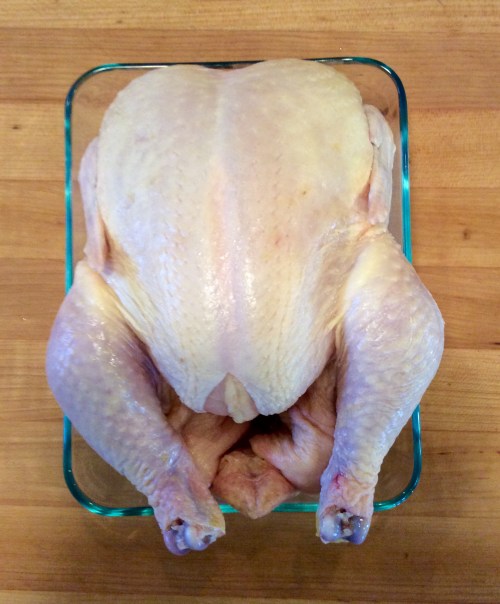
  1. Rinse and pat dry with paper towels a good-sized chicken, making sure that the bird has been completely defrosted and the gizzard, liver, heart, and neck have been removed from the body cavity.

    Good-sized roasting chicken

    Good-sized roasting chicken

  2. Remove the first joint of the wings with poultry shears.

    Cut off the first joint of the wings

    Cut off the first joint of the wings

  3. Salt and pepper the body cavity generously, and, if you like, stuff it loosely with sliced lemons.
  4. Holding a piece of kitchen twine in your fingers, stretch out both arms. Cut the string to that length.
  5. Find the middle of the string and catch it under the tail. Cross the string to both drumsticks. Wrap the string around both drumsticks and pull tight so that the drumsticks come together and the body cavity closes.
  6. Pass the two ends of the sting up the sides of the bird. Then turn the bird over and fasten the wings against the body with loops of the string in the bend of the wing. Make sure the wing is held tightly against the body. Tie the two ends of the string together and trim off long ends. The bird should be a compact packet that will fit on the rotisserie spit safely.

Carousel Rotisserie Broiled Chicken

Ingredients

  • 5 pound chicken
  • salt and pepper
  • lemons
  • melted butter

Method

  1. Rinse the chicken and pat dry. Season the cavity with salt, pepper, sliced lemons and melted butter
  2. Remove the tips of the wings of the chicken at the first joint. Truss the chicken with kitchen twine according to instructions above. Make sure that the chicken is a compact bundle so that it can turn freely in the rotisserie without brushing against the heating element. Brush the whole surface generously with melted buter. Add ½ cup water or chicken stock to the drip pan that holds the spit and basket. Put the chicken, legs down, on the spit. You may need to use the basket accessory to stabilize the bird. Cover with the domed lid. Turn on the broiler by plugging it in. Make sure the chicken turns freely and clears the burner element.
  3. Broil for 15-17 minutes per pound, checking through the dome frequently
  4. When the chicken is done, unplug the rotisserie; remove the chicken from the spit being careful not to burn yourself; remove the string and lemons if you are using them; let rest for 5 minutes; carve and serve. .

10 Comments

Filed under Food, Photography, Recipes

50 YEARS: TIME FLIES WHEN YOU’RE HAVING A GOOD TIME

We just got back from Carmel, California where all of our family helped us celebrate our fiftieth wedding anniversary. Outside of driving through 115°F heat in the Mojave Desert, it was a wonderful experience. As proof of that, I gained 5 pounds in one week, because it seems like we ate a lot. I’m not counting stops on the Mother Road or travel snacks, although undoubtedly both contributed greatly to my calorie count.

Our first “real restaurant” break was at Rich Table in San Francisco. Sarah stayed home with the boys, and Evan was expediting. That meant that even though we ordered a light meal, Evan sent us out a lot of extras. Honestly, I’m glad that he did, because the dishes were all outstanding. Sarah is back doing all of the desserts on the menu, so Evan made certain that we got to taste every one of them – along with his savory creations.  We sat at the bar until our table was ready. The bartender is very creative, so he always has some new drinks to try. “Suns n’ Roses”  with bourbon, dried stone fruit, vanilla and lemon is a riff on an old fashioned. The “Puddle Jump” contains rum and a rhubarb syrup. Since it is in season, rhubarb enjoys several prominent places throughout the men.

When we got to our table, we started out with sardine chips. They’ve been on the menu since Rich Table opened. Customers keep asking for them. They really are delicious: a white sardine woven into a big potato chip and served with a delicious horseradish sauce. A little amuse bouche that Evan sneaked in was a tiny panna cotta topped with a jewel-like cucumber and parsley gelée and a savory crumble. Delicious!

Sardine chips, horseradish créme fraiche

Sardine chips, horseradish créme fraiche

Amuse bouche: panna cotta, cucumber gelee, and crumble,

Amuse bouche: panna cotta, cucumber gelee, and crumble,

Of course, we had an order of the famous and popular Douglas fir levain with house-cultured butter. The bread comes out in thick, warm slices, and the tang of the cultured butter complements the Douglas fir scent and subtle taste of the bread. The sourdough starter originally came from our house and it is many years old.

The foie gras torchon with blueberries, and puffed sorghum sounded like a wild combination, but it was delicious when paired with slices of perfectly toasted brioche. Smoked white fish was tasty. Big chunks of Maine lobster were served with a house-made chitarra pasta, corn bisque, and plum was delicious. And who would believe that a fresh peach would taste as complex as the one we were served.

I had a beautifully cooked pork chop with cucumber, avocado, and crisp rice noodles. Susan enjoyed a grilled ribeye topped with salsa roja, corn, aioli, and lobster butter. We did not count calories or measure cholesterol levels.

We finished up with Sarah’s desserts: cherry ice with sorrel and almond milk ice cream; and dark chocolate pudding with summer berries and yogurt ice cream. After that, there were still honeycomb bites, chocolate nibbles, and wrapped candies to take home with us. (Susan took the candies home for the boys.)

After that bacchanal, we headed down to Carmel where we met all of our family. Everyone – adults and children – went to a popular Italian/French restaurant. A good time was had by all except for one of the little girls who developed a belly ache from eating too many goldfish crackers on the trip from Silicon Valley. René missed the meal because she was dealing with the goldfish overdose. Carol, Peter, Kevin, Sarah and Evan all seemed to have a good time.

The next evening turned out to be an event to remember. The adults and teenagers walked down the street from our hotel to a very nice restaurant, Aubergine. The men all wore ties – unheard of in California – and the women dressed up. First, we gathered at the fire pit on the patio of the hotel for a toast. Sarah had tracked down a bottle of red burgundy with a vintage the same as the year of our wedding. Evan struggled with the fifty-year-old cork, and then the wine was poured looking like Coca Cola. We were all surprised when it turned red after a little aeration. The wine was surprisingly good for being 50 years old, and it was certainly good enough for a toast. Carol and Peter contributed long-forgotten anecdotes from their childhood.

After a brief walk, we convened in the wine cellar of the restaurant for what turned out to be a lavish chef’s tasting menu. Highlights included Kumamoto oysters wrapped like little packages with string. When we lifted off the top shell with the string we were surprised to find a plump oyster topped with a tasty mignonette and caviar.  Green strawberries with seaweed and strawberry snow was delicious, as was a grilled slice of avocado. Lobster with fish sauce and pink fish roe was stunning in presentation and taste. Locally harvested abalone in a tea sauce was fork-tender and delicious. Even roasted kohlrabi was a success. One of the highlights  was perfectly cooked Wagyu beef. Then there were dessert(s) including Cameron’s favorite chocolate ganache tart with honeycomb ice cream. There were macarons, sablés, and chocolate cookies to make sure we made it back to the hotel without starving.

We’re home, now, working on dealing with our weight gain. Currently we are subsisting on salad, but we have some wonderful memories to treasure.


13 Comments

Filed under Food, Photography, Restaurants

SALLY HURRICANE’S SOUTHERN FRIED CHICKEN

If you have read this blog for any length of time, you know that our daughter and son-in-law, Sarah and Evan Rich, run a popular restaurant in San Francisco named Rich Table. The food there has been described as “New American” and generally  is based on the current offerings available in the bounteous farmers’ markets of the Bay Area.

But Sarah has roots in the South as well as having two grandmothers who were excellent home cooks. Both grandmothers took pride in their fried chicken. Fried chicken, mashed potatoes and cream gravy along with home-baked biscuits were staples on the Sunday dining room table at our family farm in East Texas.

That’s also where Sarah got the nickname, Sally Hurricane. As a two-year-old she ran the show. One family photograph shows her wearing her great aunt’s wig borrowed from a wig stand in a back bedroom.

Hurricane Sally

Hurricane Sally

Sally Hurricane has been cooking fried chicken from the recipe in our family cookbook since before she went to culinary school. She has made her version (now revised and considerably improved) for family meals at upscale restaurants in New York City and San Francisco. Inevitably, regardless of the restaurant, when fried chicken and biscuits were the family meal menu, cheers went up from both the front of the house and kitchen staffs.

This week, Sally Hurricane is revealing some treasured family secrets in the food section of the San Francisco Chronicle.  She also gives the recipe for mashed potatoes that she learned when she worked for David Bouley. You might enjoy a preview.

http://www.sfchronicle.com/recipes/article/Sarah-Rich-taps-family-recipe-for-Southern-style-8313792.php?t=e37fe5da3d8cb1714c&cmpid=twitter-premium#photo-10076970


20 Comments

Filed under Food, Photography, Recipes, Restaurants

THE STORK HAS LANDED

Well, not exactly. But there are certainly lots of bird families in our back yard. We have had a bluebird box for many years, and for many years pairs of bluebirds would use it for their home to raise a brood of fledglings. For some reason,  for some time the box was not sufficiently attractive to bluebirds that inspected it in the early spring. This year that trend has been reversed, and a pair is now in a relay to keep their new hatchlings fed with insects. They started out with a clutch of six beautiful blue eggs. We’re not sure how many babies there are.

Bluebird box occupied for the first time in years

Bluebird box occupied for the first time in years

They are not the only birds, probably attracted by water in our fountains and birdbaths in the surrounding desert environment. Lesser goldfinch are feasting on niger thistle seeds. House finches have nested under one of the eaves. They try to crowd out the goldfinches on the feeder. A pair of mourning doves often sit on the garden wall. A pair of ladder back woodpeckers drill on a post that once supported our bat house. Black-chinned hummingbirds are at the feeders, and they will soon be joined by broadtails. A pair of barn swallows are scoping out a place next to our front door to build their nest under an overhang. We hope that our hawk and owl friends will visit our fountain, as well. Unfortunately we no longer see night hawks at dusk, perhaps because of the serious drought we have had for at least six years.

Hawk and owl in a water standoff

Hawk and owl in a water standoff

In the meantime, the herb garden is filled with flowers, some of them already fading. Our not-so-wild flowers are in full bloom. Columbines, wine cups, penstemons, buckwheat, paintbrush, gay feather, mallows, and many others make the courtyard look like a meadow. All in all, a great foreground for the beautiful Sangre de Cristo Mountains in the east and the Jemez Mountains in the west. It is a wonderful time of year, and a wonderful place to be.

Sangre de Cristo Mountains across the trail

Sangre de Cristo Mountains across the trail

Sunset over the Jemez Mountains

Sunset over the Jemez Mountains

15 Comments

Filed under Photography

RHUBARB STRAWBERRY PIE

It’s actually a little late in the season for rhubarb, but I saw some in the market. It looked so good, that I bought it along with a quart of strawberries. To my way of thinking, rhubarb and strawberries make a perfect combination – in a sauce, a cake, or a tasty pie.

I have great memories of eating raw rhubarb straight out of my grandmother’s garden. I pulled off the leaves, peeled the skin from the flat side of the stalk, shook on some salt, and ate the whole thing, shaking on more salt as I went. My grandmother cautioned me not to eat the leaves as they were poisonous. That was good advice because rhubarb leaves are rich in oxalic acid (along with greens like sorrel) and oxalic acid can precipitate in the kidneys causing kidney failure. The stalks have oxalic acid, too, but not so much to be dangerous. That was good for me as a child. I was never poisoned, but I often had a belly ache.

The recipe I used is based on one from that great baking book, The Fanny Farmer’s Baking Book by Marion Cunningham (Alfred A. Knopf, New York, 1984)

RECIPE

Rhubarb Strawberry Pie

Ingredients

  • 4 large stalks rhubarb, trimmed and cut into 3/8 inch dice
  • 1 quart strawberries, washed, hulled, and sliced
  • 1½ cups sugar
  • 1/3 cup flour
  • 1/8 teaspoon salt
  • ½ teaspoon vanilla extract
  • pie dough for a two-crust pie, rolled into two circles for a 9-inch pie (commercial prepared pie crust is perfect)
  • 2 tablespoons unsalted butter
  • 1 egg
  • 1 tablespoon whole milk
  • turbinado sugar

Method

  1. In a large bowl, combine the diced rhubarb and slice strawberries and set aside.
  2. In another large bowl, combine the sugar, flour, salt, and vanilla extract. Stir in the rhubarb and strawberries, mixing gently until the fruit is well coated (I know – rhubarb is technically not a fruit)
  3. Line a 9-inch pie pan with one of the circles of dough. Distribute the filling mixture evenly.
  4. Cut the butter into 16 pieces and dot the top of the filling.
  5. Cover with the second circle of dough. Seal and crimp the edges. Cut several vents in top crust.
  6. Mix thoroughly the egg and milk. Using a pastry brush, paint the mixture on the crust and then sprinkle with turbinado sugar
  7. Bake in the middle of an oven preheated to 450°F for 15 minutes. Lower the oven temperature to 350°F and bake for an additional 35 minutes. Anticipate spillovers by placing the pie pan on a cookie sheet.
  8. When the crust is golden brown, remove from the oven and cool on a baking rack.
  9. Serve warm, preferably with a scoop of ice cream.

9 Comments

Filed under Food, Photography, Recipes

MEATLOAF BY ANY OTHER NAME IS…

…still meatloaf.

We are in the process of “decluttering” After one has lived in the same house for many years that becomes a big project. We have gotten rid of clothes, but the greatest challenge has been our books. Even though we have tried to be ruthless,  getting rid of a book – no matter how old and how unread it has been for awhile – is like getting rid of an old friend. Included in the books up for consideration for banishment are our cookbooks. Some choices have been easy. Who needs two copies of anything? Others have been more difficult. Even minus the rejects, we still have more than enough cookbooks for one couple.

Now we have started on kitchen gear. We have already given our croquembouche molds to our daughters. (Doesn’t every kitchen need two croquembouche molds?) The corn mill that I used when I wrote about making your own nixtamalized corn did not make the cut. Neither did the deep fryer nor the cheese-making kit.

One prize that I had totally forgotten about is an enameled cast-iron terrine mold. It is such a beautiful piece of cookware, that I couldn’t resist polishing it up. I checked out a number of recipes for patés and terrines. Most called for ingredients that I didn’t have or sounded like more trouble than I wanted to expend. Maybe that explains why the bakeware was hidden away.

Instead, I decided to make a meatloaf. After all, lots of folks declare American meatloaf to be the poor country cousin to fancy French paté. I used a very basic, simple recipe. I didn’t have any bacon for lining the terrine or topping the meatloaf. You can be as elaborate as you wish.  I baked my meatloaf a little longer than I should have, so watch your cooking time. My end result, topped with tomato sauce and served with broccoli, turned out to be a good middle-of-the-week meal.

RECIPE

Meatloaf Made in a French Terrine

Ingredients

  • 1 thick slice sourdough bread, crusts removed and cubed
  • ½ cup whole milk
  • dried bread crumbs
  • 2 large eggs
  • 1 pound ground beef
  • 1 small onion, chopped
  • 3 crimini mushrooms, chopped
  • ¼ teaspoon ground thyme
  • 1/8 teaspoon ground bay leaf
  • ¼ teaspoon garlic powder
  • 2 tablespoons tomato ketchup
  • salt and pepper

Method

  1. Grease a terrine and its cover heavily and set aside.
  2. In a large bowl, soak the bread cubes in the milk until they are well moistened and can be broken apart with a fork. Add just enough dried bread crumbs to absorb any excess moisture
  3. Break the eggs into the mixture and stir well until completely combined. Add the ground beef, onion, mushrooms, thyme, bay leaf, garlic powder, and ketchup. Stir until well combined
  4. Correct seasoning with salt and pepper.
  5. Pack the mixture into the well-greased terrine. Cover and bake in the middle of an oven pre-heated to 350°F for 45-50 minutes.
  6. Remove from the oven and cool for 5 minutes. Slice the meatloaf  while still in the pan. Serve with tomato sauce.

4 Comments

Filed under Food, Photography, Recipes

BRAISED BABY BOK CHOY AND GARLIC SCAPES

I went to our local farmers’ market this last weekend. Spring is just now beginning to ease into summer here, so the choices in the stalls at the market have been relatively few. Next week the vendors will move from their winter locations to their summer spots. That means that this week they began to offer the first of their usual summer bounty. There was some asparagus, a few root vegetables that had been wintered over, and a lot of greens and lettuces. One farmer was offering some succulent baby bok choy. Several vendors had baskets overflowing with garlic and shallot scapes. Garlic has become a very popular local crop, but farmers need to trim off the tops with the flower buds to encourage fuller garlic bulbs. These tops are called scapes. I wrote about cooking with them last year (June 20, 2015) – a garlic scape frittata.  This past weekend I was pleased to find the scapes, as the “season” for them lasts at most two or three weeks. I wasn’t sure exactly what I would do with them, and then I thought of those bok choy and what a good combination the two would make. They turned out to be perfect accompaniment to butter-fried salmon. This is a vegetarian dish and can easily be made vegan by omitting the butter or substituting vegetable oil.

RECIPE

Braised Baby Bok Choy and Garlic Scapes

Ingredients

  • 2-4 baby bok choy
  • 1-2 good handfuls of garlic scapes
  • 1 cup vegetable stock
  • 2 tablespoons butter
  • sesame oil to taste
  • salt and pepper to taste

Method

  1. Trim any roots from the bok choy and discard. Cut leaves off of the bulbs and set aside to be braised at the last minute. Cut garlic scapes into pieces sized to your preference.
  2. Add the bok choy bulbs and garlic scapes to boiling vegetable stock in a small braising pan or saucepan with tight-fitting lid. Cover the pan and reduce the heat to a simmer.
  3. Simmer, covered, for 20 minutes or until the bok choy is pierced easily with a kitchen fork. Add the greens and cover. Cook for an additional 2 minutes or until the greens are completely wilted.
  4. Season with a dash or two of sesame oil. Remember, it is easy to overdo sesame oil.
  5. Adjust seasoning with salt and pepper. Drain and serve immediately. Plate the greens and arrange the bulbs and then the scapes on top. Serves 2-4 persons depending on how many bok choy you braise.

8 Comments

Filed under Food, Photography, Recipes

PEELING A HARD-BOILED EGG

I have been boiling eggs for 70 years, and I have made all the mistakes. For a long time, I would put the eggs in cold water, turn the heat to high, and let them boil away until I thought they were done – sometimes for as long as a half hour. The results were always the same: rubbery whites, tough yolks and a thick shell of green on the yolks. I just thought that was the way boiled eggs were supposed to be.

Eventually I learned that a well-boiled egg required scrupulous timing and careful temperature control. Those two changes improved my hard-boiled eggs, but I was still plagued by peeling the little gems. Sometimes, the egg would peel perfectly, but the next time with the same cooking conditions – I thought – great chunks of white would come off with the clinging shell. I read all sorts of treatises on eggs that guaranteed a “perfect” method for removing the shell. They all failed. Some talked about freshness of the egg being key. Others talked about chilling or heating. Sometimes the “no fail” method worked. Sometimes it didn’t. Julia Child, in her informative little book, Julia’s Kitchen Wisdom (Alfred A. Knopf, New York, 2000), cited a method that she got from the State of Georgia Egg Board. The technique was very elaborate. You boiled the eggs, chilled them, brought the boiling water back up to temperature, boiled the eggs for a few seconds, and then chilled them again. I had a hard time remembering the instructions Even when I was sure that I had followed it exactly, the method sometimes worked, sometimes it didn’t.

Recently, I read of a technique, again “no fail”, in which you add baking soda to the boiling liquid. The explanation for the method is that the alkaline baking soda hastens congealing of the white and separates it from the membrane that lines the shell. I confess that I have not tried the method, but I am a bit skeptical that the baking soda penetrates the shell. Still…

The method that I have used at least a dozen times with unfailing success has appeared in the magazine, Cook’s Illustrated and in a report on the internet. The method benefits from ease and reliable guidelines. I wouldn’t presume to write about the science behind the method. For one thing, I wouldn’t understand it; for another, there’s a good chance that the explanation has just been made up.  If you try cooking hard-boiled eggs by this technique, let me know your results.

METHOD

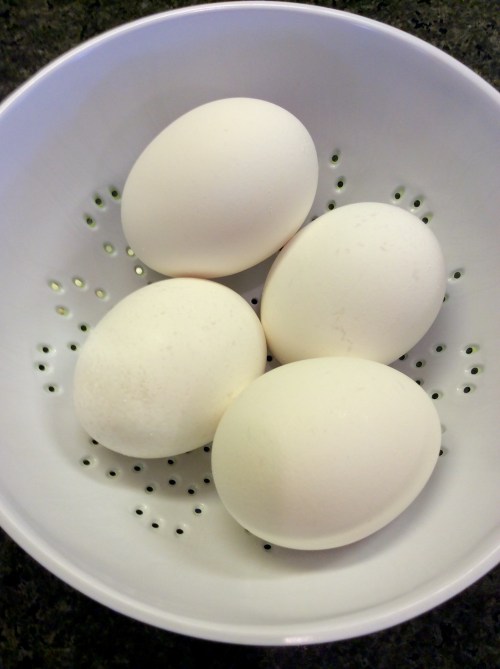
  1. Bring the eggs to room temperature. Set them out of the refrigerator at least 2 hours before you plan to cook them.

    Eggs at room temperature

    Eggs at room temperature

  2. Pierce the large ends of the eggs with an egg piercer. This will let air escape from the air sac within the egg so that the egg will not crack while cooking. If you don’t have one of these handy gadgets, you can buy one at Amazon for $2-10.

    Two styles of egg piercers

    Two styles of egg piercers

  3. In a saucepan that has a tight-fitting lid and is large enough to hold the eggs in a single layer, add about 1 to 2 inches of water and a steamer basket that will hold the eggs above the level of the water.

    Saucepan with steamer basket

    Saucepan with steamer basket

  4. Bring the water to the boil. Place the eggs in a single layer in the steamer basket. Cover. Adjust the heat so that the water continues to boil but not so vigorously. Immediately start the timer.
    Eggs in the steamer basket ready to be cooked

    Eggs in the steamer basket ready to be cooked

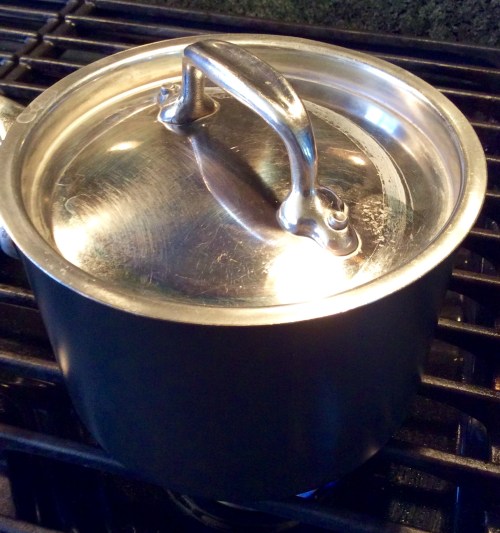
    Tightly covered pot steaming away

    Tightly covered pot steaming away

  5. I cook the eggs for exactly 15 minutes, but I live at 7,000 feet above sea-level where water boils at 198°F instead of 212°F at sea-level. There, the cooking should take less time – perhaps as little as 10 minutes. – but you will have to do a little experimentation, depending upon the altitude where you live.

    Cook the eggs for 15 minutes at 7,000 feet above sea-level

    Cook the eggs for 15 minutes at 7,000 feet above sea-level

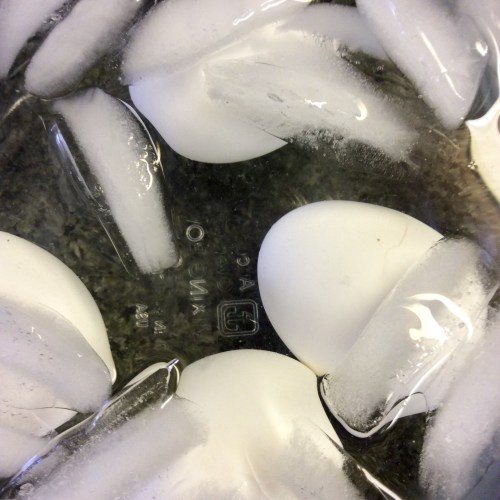
  6. When the timer goes off, transfer the eggs to a large bowl filled with ice and water. Cool the eggs for the same length of time as the cooking.

    Eggs chilled in ice water for as long as they cooked

    Eggs chilled in ice water for as long as they cooked

  7. Peel the eggs by cracking them all over on a hard surface. Then, under a thin stream of cold running water, peel the eggs, one at a time, beginning at the large end. You should be able to peel the eggs easily and with a smooth surface.
    The shell peels off in large, smooth pieces

    The shell peels off in large, smooth pieces

    The perfect peeled egg ready to be sliced

    The perfect peeled egg ready to be sliced

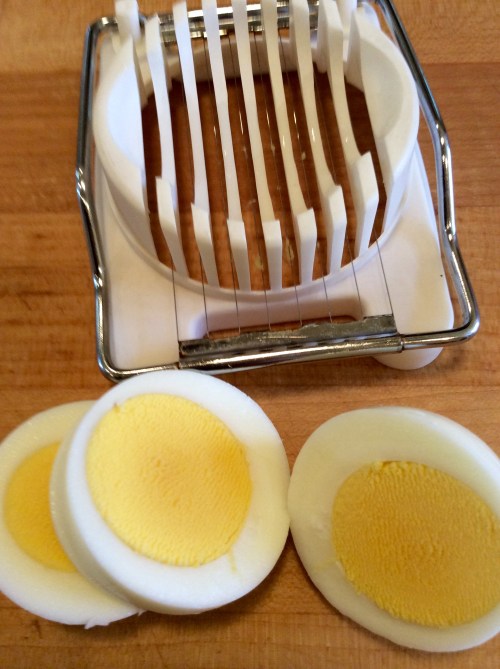
    Delicate golden yolks with no green ring!

    Delicate golden yolks with no green ring!

21 Comments

Filed under Food, Photography, Recipes