Tag Archives: San Francisco

CORZETTI WITH SAUSAGE AND CLAMS

Our daughter, Carol, has been visiting us for a few days without her family. For her it has been a relaxing time with no chauffeuring duties to swimming, school meetings, the morning school rush, and cooking. She has been doing some work from her office, but she has also found time to sleep a little late, to shop, and to eat out.

Carol has her own big library of cookbooks, but it is different from my collection, so she has spent time leafing through some of my newer acquisitions. She also enjoys working in the kitchen with Susan and me, and we enjoy that, too.  We agreed to cook together on a recipe that appealed to her. She found a recipe in Flour + Water (Ten Speed Press, Berkeley, 2014), the eponymous cookbook from the San Francisco restaurant owned by Thomas McNaughton, a friend of Sarah and Evan.

The recipe she chose was entitled, “Corzetti with Sausage, Clams, and Fennel”, page 186. It involved making pasta – which sounded like fun. The challenge was to re-create the corzetti. Oretta Zanini de Vita (Encyclopedia of Pasta, translated by Maureen B. Fant, University of California Press, Berkeley, 2009) describes the pasta dating back to the thirteenth century and consisting of a bit of pasta dough with two thumb indentations to resemble an “8”. That shape was apparently for commoners because by the Renaissance the pasta was often pressed with special wooden stamps that included coats of arms and other designs. These days you can buy corzetti stamps on the Internet. They are designed to cut the pasta into circles with an imprint on both sides. The little devices are often made of exotic woods and quite beautiful. Trouble is, you have to make a lot of corzetti to justify the purchase as the stamps run $60 or more.

We made do with what I had: a 1½ inch ring from my nest of pastry cutters and a wooden mold that I use for butter and springerle cookies. Carol and I wound up imprinting only one side of the pasta, but that was effort enough for two cooks. The finished pasta, though, cooked beautifully, and the sauce was delicious. It all turned out to be a perfect meal with a nice Italian red, a tossed salad, and a fresh baguette. Pistachio gelatto finished it off. This recipe should serve four generously.

Note: Fennel “pollen” is a common ingredient on the West Coast as wild fennel grows prolifically along the roadsides from south of Big Sur to north of the Bay Area. The yellow “pollen” (I think it is actually the flowers and seeds) is often foraged by chefs from the Bay Area. Ground toasted fennel seeds will make an adequate substitute.

RECIPES

Pasta

Ingredients

  • 2 cups all-purpose flour
  • 1 teaspoon kosher salt
  • 2 large eggs
  • 3 egg yolks
  • 1½ teaspoons extra virgin olive oil
  • water

Method

  1. Heap the flour in the middle of a large, flat, clean surface. Form a well in the middle. Add the salt
  2. Add the eggs, egg yolks, and olive oil to the well, and with a fork, combine the eggs and oil, being careful not to incorporate any of the flour. When the eggs are combined, gradually pull bits of the flour into the mixture until it is completely incorporated. Sprinkle in a few drops of water if you cannot incorporate all of the flour.
  3. Draw the mixture into a ball. Knead for 10 minutes until the dough is smooth and slightly shiny. Add a few more drops of water if necessary. Wrap with plastic film and let rest at room temperature for at least 30 minutes.
  4. When you are ready to roll out the pasta, cut the dough in fourths, working with one piece at a time and rewrapping the remaining pieces.
  5. Pat the piece of dough into a flattened, elongated piece and run it through the pasta machine rollers at the widest setting. Fold in thirds and run through the rollers once more. Repeat the process one more time. Then run the dough through the rollers, decreasing the setting by steps until you have reached the thickness you desire.  (Different machines will have different settings.) You shouldn’t need to flour the dough, but if it is too sticky, lightly dust it while you roll it out.
  6. Place the rolled dough under a clean kitchen towel while you roll out the remaining pieces of dough.
  7. With a 1½ inch circular pastry cutter, cut the sheets of pasta. Then, using a stamp of the same diameter, press firmly on each dough circle to form an imprint. Separate the imprinted circles from the remaining dough (Save that for some other use.) and let rest until you are ready to boil it.

Sausage and Clam Sauce

Ingredients

  • 3 pounds Little Neck clams
  • 1 tablespoon olive oil + more for sautéing the sausage
  • 1 shallot, thinly sliced
  • 1 garlic clove, thinly sliced
  • 2 cups + ½ cup white wine
  • 8 ounces bulk pork sausage
  • 1 medium red onion, diced
  • ½ teaspoon fennel pollen (if you can’t harvest your own fennel pollen, dry-toast fennel seeds and grind finely in a spice grinder. Substitute ½ teaspoon of the ground fennel
  • 2 garlic cloves, minced
  • 1 cup chicken stock
  • juice of ½ lemon
  • salt and pepper to taste
  • extra virgin olive oil
  • 1 tablespoon chopped Italian parsley
  • 1 tablespoon snipped chives
  • grated Romano cheese (optional)

Method

  1. Scrub the clams and let them stand in cold water in a colander for a few minutes to give up their sand. Drain.
  2. In a large sauté pan, heat the olive oil over a high flame. Stir in the shallot and cook until translucent. Add the sliced garlic, 2 cups of white wine, and the washed clams. Cover and cook until the clams open, about 10 minutes. Remove the clams and continue to boil the liquid until it has reduced by half. Cool the liquid completely.
  3. Remove the clams from their shells and return to the cooled liquid. Refrigerate until ready to use.
  4. Wipe the sauté pan clean and return to high heat. Add a tablespoon or so of the olive oil. Then stir in the sausage and brown on all sides, breaking it up as you cook it. Stir in the red onion. Cook until the onion is translucent, about 2 minutes.
  5. Stir in the fennel and minced garlic. Continue to cook until the garlic is lightly browned (Do not burn!). Add ½ cup of white wine and boil until it has almost completely evaporated.
  6. Add the chicken stock, the clams, and their cooking liquid. Bring to the simmer.

Assembly

  1. Cook the pasta by adding it to a large pot of boiling, well-salted water. Return to the boil and cook for 3 – 5 minutes or until the pasta is al dente. Be careful not to overcook.
  2. Drain the pasta and add to the sausage and clam sauce. Simmer the mixture for 2 to 3 minutes until the sauce thickens a bit. Adjust the seasoning with lemon juice, salt, and pepper. Drizzle with extra virgin olive oil.
  3. Divide the pasta and sauce between four plates, top with parsley and chives, and serve immediately. Top with optional grated Romano cheese.
7 Comments

Filed under Food, Photography, Recipes, Restaurants

THANKS ARE ALWAYS WELCOME

We’re back home at last from our 5-weeks child-ending adventure. We have rested a few days, done the household chores that needed to be done after a long absence, paid bills, and caught up on 700+ e-mails.

I have to admit that another reason for my absence from posting lately is a certain loss of enthusiasm. I have 300 posts over four and a half years, and some readers may think that I have run out of things to say along with needing some new recipes. But the main reason I have been a little quiet is receiving a couple of snarky comments that made me wonder, at my age, if I really need that. The way I look at it, if you don’t like my blog, just don’t read it. After some soul-searching, I have decided to write at least a few more posts. To do otherwise would let the boo-birds win, and I have never been inclined to do that.

So…

This post is to thank all of our children for their gracious ways of thanking my wife and me for our efforts.

The Los Angeles family made a point to go to a nice restaurant. Unfortunately, I missed the event so there are no images of food, but they took my wife to Bashi, the Asian-inspired restaurant at Terranea Resort. It has a wonderful ocean view, great service, a lovely dining space and delicious food. The only thing I can report is that they had a great time.

The San Francisco family made sure we had an evening at Rich Table. Evan was cooking that evening, so he pulled out all the stops. The list of things he sent out included:

Sarah’s popular fennel pollen levain served with house-cultured butter. The warm slabs of bread smeared with a delicious butter could be a meal by themselves.

An amuse that was just a bite, but a delicious bite.

image

Octopus with grapefruit, hearts of palm, and sansho pepper.

image

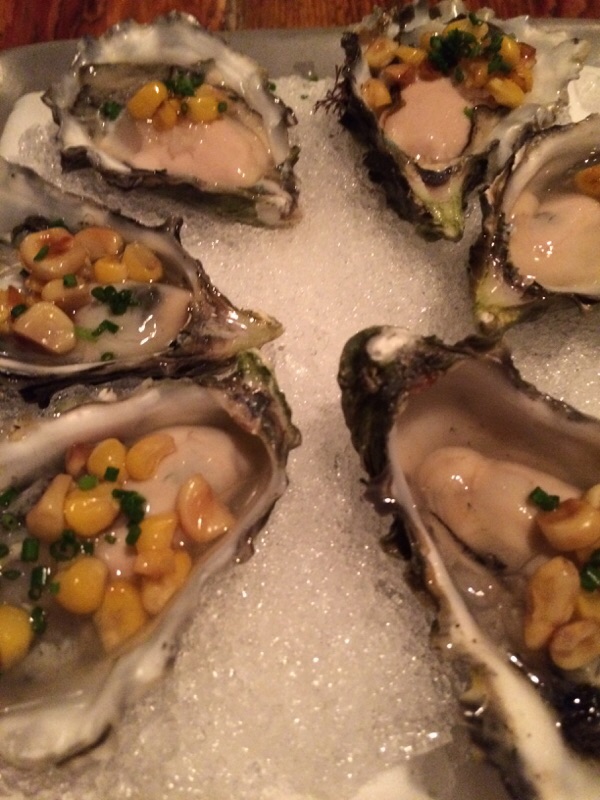
Oysters on the half shell with charred corn mignonette. Rich Table oysters always come well-scrubbed so there are no fragments of shells that you often encounter at some of the best seafood restaurants.

image

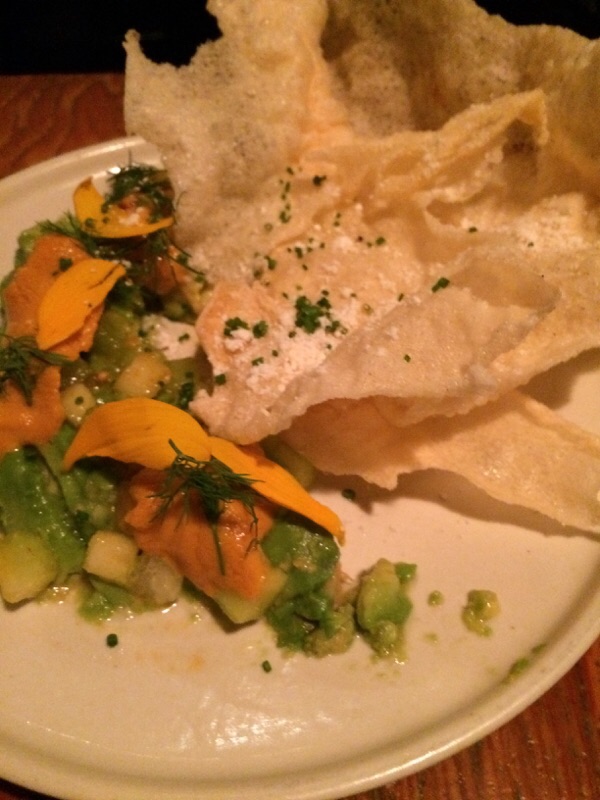
Avocado, sea urchin, fermented jalapeño, prawn crackers. I couldn’t even think of such a combination of flavors, but it definitely worked.

image


“Green juice” granite, avocado mousse, Stobe fruit, and brown butter ice cream.

image

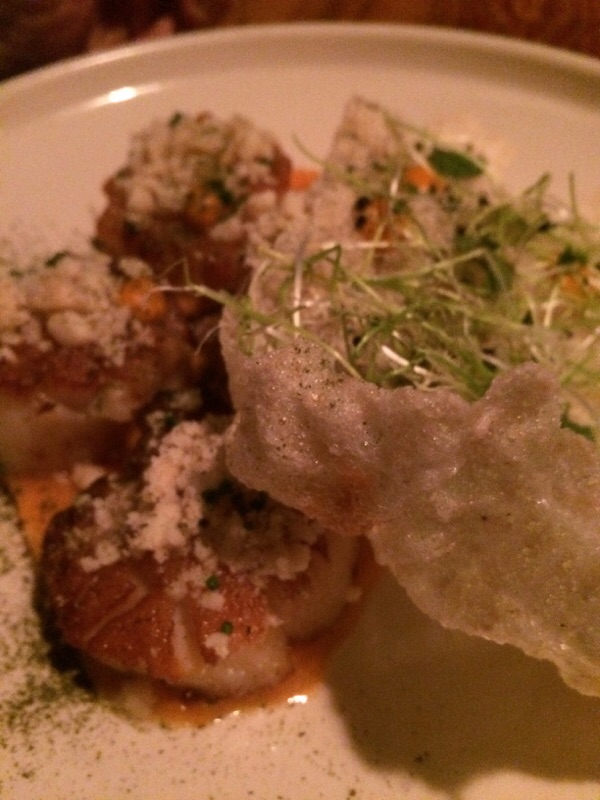
Scallops, sweet potato, red curry, macadamia nut, brown rice. Again, a combination that defied our imagination. The predominant flavor, of course, was the sweet scallops.

image

Grilled rib-eye with roasted cauliflower, almond, and sake lees. The steak is heavily marbled with a lot of fat. Whatever you do, don’t cut off the fat, but pop it in your mouth. The fat has absorbed all of the other flavors and just melts away as a delicious extra treat.

image

A dessert of sweet corn pot de creme with creme fraiche, strawberries, and lemon crumble. A little vegetal, but surprisingly sweet and refreshing.

image

The Silicon Valley family sent us some beautiful artisanal chocolates and a beer mug from Prague where our daughter-in-law had gone to a business meeting.

image

All of that was so unnecessary because taking care of the kids was gift enough, but it made us feel truly thanked and truly blessed.

19 Comments

Filed under Food, Restaurants

HUEVOS ROTOS (BROKEN EGGS)

Last week while we were in San Francisco, our son and his family came up from Silicon Valley to spend Sunday with us. Susan rested to catch up with a week of intense child watching while René generously took the four kids to one of the playgrounds on the Presidio.

That gave me an opportunity to take Peter to brunch. We haven’t had a time alone for a long time, so both of us seemed to relish the opportunity. We went to the Presidio Social Club, which has become one of our favorite restaurants on the Presidio. It is housed in a very old barracks building that has been restored and filled with pictures and memorabilia from the days when the building served as a canteen during the Second World War. We enjoy everything about the place: the atmosphere is inviting, the service is good, and the food is very good without being too expensive. Besides all that, it is a short drive through the woods of the Presidio so you don’t have to get out on the busy streets of the city and spend a long time looking for a rare parking space.

The brunch menu is filled with the usual sorts of things that people order on a lazy late Sunday morning. Peter ordered a PSC Spritzer and I got a PSC Bloody Mary. Then we checked out the menu. Both of us focused on the chilaquiles as they are a favorite of everyone in our family. Peter and I have this funny custom that if one orders a dish, the other does not. We agreed that he should order the chilaquiles. Then I saw the huevos rotos. The dish was described as eggs, potatoes, and chorizo. It sounded sort of like my usual, huevos rancheros, and had the additional intrigue that I had never heard of it before. So I ordered it. In El Paso, I had eaten huevos divorciados – two eggs separated by chilaquiles or refried beans and topped one with green sauce and one with red. I had eaten huevos revueltos – scrambled eggs – and migas – eggs with chorizo and crisp tortilla strips. There’s machaca with eggs – shredded beef and eggs. And of course, the ubiquitous breakfast burrito. I had never eaten or heard of huevos rotos. In part that’s probably because it is originally a Spanish dish.

The version of huevos rotos served by the Social Club was so good, that I decided to try to replicate it at home. Here’s my version for 2 persons, but you should be as creative as you want with additional ingredients. I think you will find the dish so good, and so easy, that you will make it often for breakfast, lunch, or a snack.

RECIPE

Huevos Rotos (Broken Eggs)

Ingredients

  • 5 small Yukon Gold potatoes
  • vegetable oil for frying
  • ½ medium white onion, peeled and chopped very coarsely
  • 1 link Spanish chorizo (Do not use Mexican chorizo for this dish), casing removed, crumbled and chopped coarsely
  • hot Spanish paprika
  • salt and pepper to taste
  • Sriracha (optional, to taste)
  • 4 eggs

Method

  1. In a saucepan, boil the potatoes, unpeeled in salted water for about 10 minutes or until slightly soft but not cooked through. Remove from the heat, drain, and cut the potatoes into ½ inch chunks.
  2. In a skillet over medium heat, sauté the potatoes in enough oil to coat them. Toss frequently until lightly browned.
  3. Stir in the chopped onions and crumbled chorizo. Continue to sauté. Sprinkle with hot paprika, and adjust the seasoning with salt and pepper.
  4. Drain off any extra fat, transfer to a plate, and keep warm, covered loosely with foil, in a 170°F oven until ready to assemble the dish.
  5. Divide the potato-chorizo mixture equally between two warm serving plates. Top with Sriracha if desired.
  6. In a small non-stick frying pan, fry the eggs in oil over medium-low heat, turning once so that they are over-easy and the yolks remain runny.
  7. Top each plate with two over-easy fried eggs. Pierce the eggs with a knife so that the yolks run over the top of the dish.  Serve immediately.


4 Comments

Filed under Food, Photography, Recipes, Restaurants

HOG ISLAND OYSTER COMPANY

Hog Island Oyster Company is on Tomales Bay, just a short, beautiful drive north of San Francisco. Once there, you can buy unshucked oysters and other shellfish to take back home with you, or you can have all varieties of raw and cooked oysters, clams, and mussels in a spacious restaurant with great views of the bay.

Don’t worry if you can’t make the time to take the drive. You can still get fresh oysters at the Hog Island Oyster Company at the Ferry Building in San Francisco. The Ferry Building is one of the great destinations for visitors to the city. It has been lovingly renovated and occupies a dominant place on the Embarcadero. On Saturdays it serves as home for a huge farmers market where all of the city’s chefs shop. You are likely to catch a glimpse of someone you have seen on television or in whose restaurant you have eaten.

The Ferry Building is lined with shops filled with hard-to-find food, well-known products like Cowgirl Creamery cheeses, pottery, jewelry, and expensive one-of-a-kind kitchen gadgets.

The building sits right on the water because in times past it served as the terminal for the many ferries that crossed San Francisco Bay. Now the Oakland Ferry has a berth just a few steps away from the restaurant of the Hog Island Oyster Company. The beautiful new Bay Bridge makes a perfect backdrop, so that Hog Island is a popular stop for locals and tourists alike.

The Oakland Ferry and the Bay Bridge in the background

The Oakland Ferry and the Bay Bridge in the background

Expect a crowd on the weekend or when the weather is beautiful. That means you will have to wait, but the line moves quickly. It moves even more quickly if you get a bloody mary from the bar to pass the time.

Waiting in line

Waiting in line

Of course, outdoor seats are at a premium, so you may have to wait a little longer for them. But seats at the counter are often available, and to me they are preferable. You can watch the woman who runs the garde manger station as she whips up salads with blinding speed. Her knife skills are amazing as she cuts fresh basil into a fine chiffonade while she surveys the dining room. You can also watch the three oyster shuckers working non-stop to fill all the orders for oysters on the half shell.

Non-stop oyster shucking

Non-stop oyster shucking

Whenever we visit San Francisco, we almost always make at least one pilgrimage to Hog Island, and we almost always order their biggest tray of raw oysters – 2 dozen, mixed.

This time there were seven different kinds of oysters, so they sent out four each of six kinds. We asked for Kumomotos, our favorite, but they did not include Hog Island’s own Kumomotos. They are beautifully fluted and much smaller than other varieties, but they have a sweetness, brininess, and flavor that are unique. When we complained to the waiter, he promised to bring out some more, and he did. Then we recognized him as a server who had worked at Rich Table when it first opened.

Acme bread

Acme bread

Raw oysters

Raw oysters

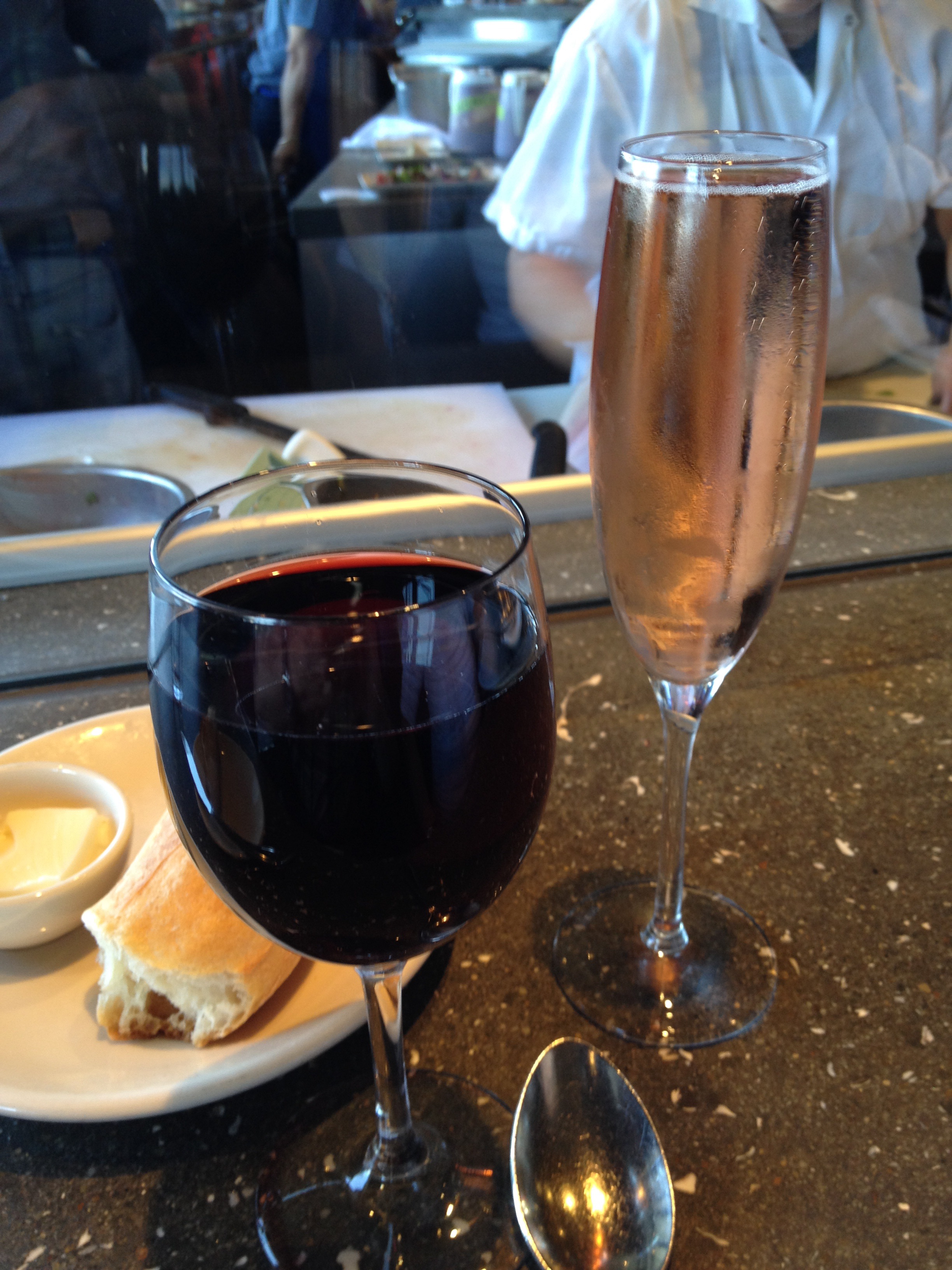
You need a glass of wine to wash down the oysters

You need a glass of wine to wash down the oysters

We had a nice visit with Charles and then got down to business: eating all of those oysters with a tasty mignonette along with glasses of refreshing wine. Next came a plate of yellow fin crudo prepared by the garde manger lady and topped with her incredibly fine basil chiffonade.

Yellow fin crudo

Yellow fin crudo

Susan had an oyster roast instead of her usual clam chowder. I finished up with rustic seafood stew. I asked why, if this is San Francisco, it’s not called ciappino. The reply was that it didn’t have the crab required to call it that. It had everything else. Tentacles of the calamari, heads on the shrimp, clams, mussels, chunks of white fish, savory broth, and toasted Acme bread to soak up any leftover broth.  If there would have been.

Rustic seafood stew

Rustic seafood stew

Then home to catch a quick nap before it was time to pick up they boys.

4 Comments

Filed under Food, Photography, Restaurants, Travel

OCTAVIA

When we’re in San Francisco, Sarah always suggests restaurants for us to try. There are so many places that one never runs out of first-time experiences, but it is always especially interesting to try out a new spot.

Sarah and Evan’s friend, Melissa Perello, has operated Frances for a number of years. When the restaurant first opened it was a sensation on the local food scene and was a nominee for James Beard Best New Restaurant. It remains a very popular place.

Now Melissa and her fiance, Robert, have embarked on a new venture, taking over the space that was once occupied by Quince when Evan worked there as chef de cuisine.

Melissa and Robert have transformed the place. It is filled with light from the floor-to-ceiling windows, and the casual tables and warm but muted colors have made the restaurant inviting and comfortable.

image

Sarah wanted to take me to dinner while Susan got to babysit. That turned out to be what I consider a perfect division of labor. I got to eat – which I love to do – and Susan got to mind the grandchildren – which is one of her very favorite activities.

The service was warm and welcoming. Kim, our excellent server, had made a conscious decision to move from another San Francisco standby where she had worked for nine years. She was happy with her decision. All of the other servers seemed as happy, friendly and efficient.

Of course, surroundings and service are both essential to a good experience, but in the end it is all about the food. Octavia did not disappoint.

As with so many contemporary restaurants, the Octavia menu is designed to encourage sharing of several small plates before the main course. With Sarah’s professional guidance, we chose a half dozen or so small plates to share.

First was the “Deviled Egg” with Fresno chile relish, marash pepper and spice. The quotation marks indicated it was not a real deviled egg, and that was so. It was a perfectly peeled mollet egg (That is so hard to do – have you ever tried it?) topped with a spicy red chile sauce. The yolk ran out a golden yellow with my fork attack, mixing with the chiles to form a creamy sauce.

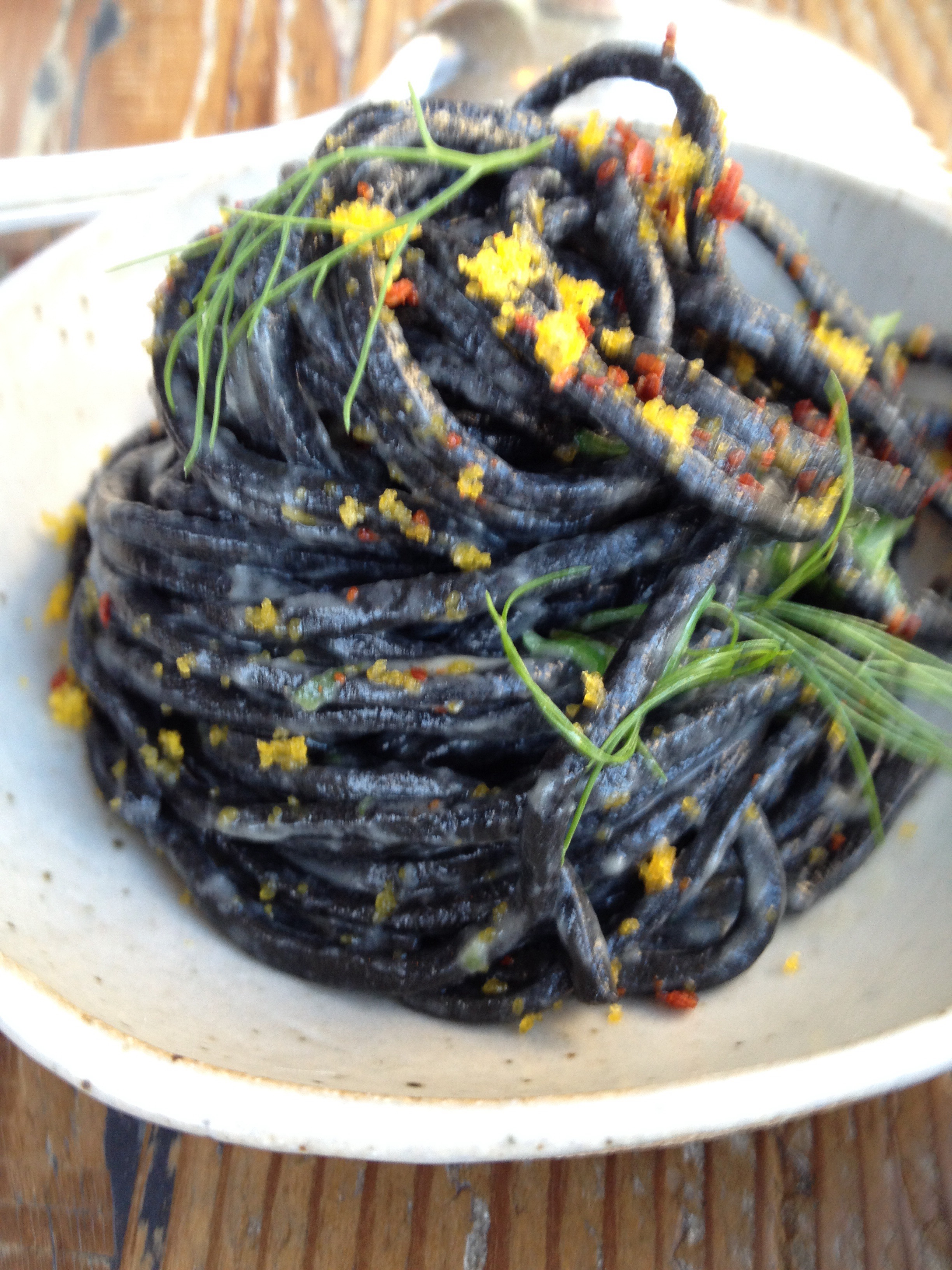
Chilled squid ink noodles with Cortez bottarga (salted fish roe), lemon oil, and green garlic came as a beautiful mound of black noodles dusted with gold. The chill took the edge off of the flavor that can sometimes doom a dish made with squid ink. The flavors of the ingredients came together. All I could think of was that I wanted more.

image

Mushrooms “A La Grecque” were a mix of hens of the woods, trumpets, and shiitakes in a light pickle and served with thick slabs of toasted house-made levain.

image

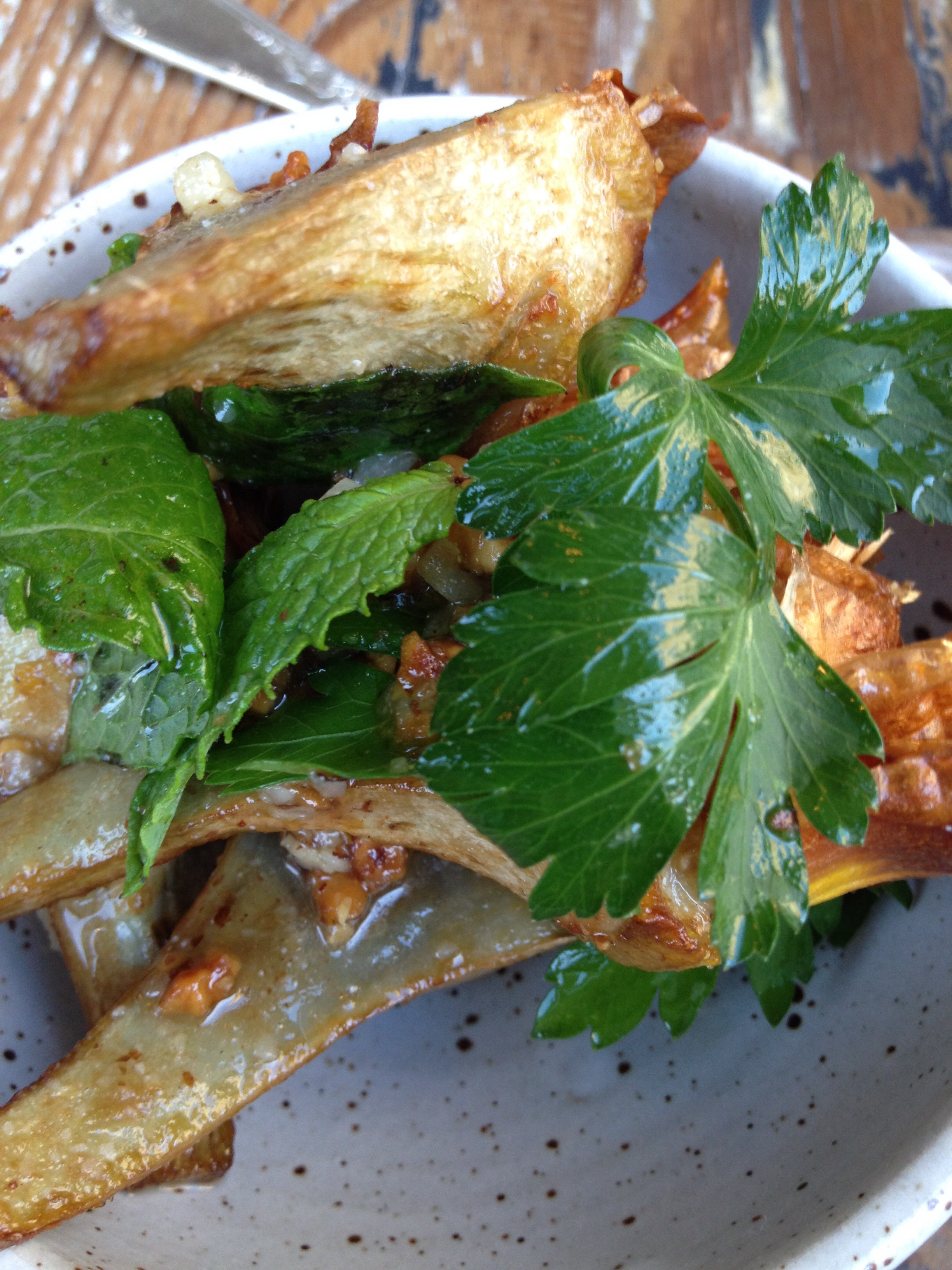
Fried artichokes were crispy on the outside and tender inside with thin shavings of Pecorino Siciliano, walnuts, and mint. If you like artichokes, you would love these.

image

Beef tongue with charred broccoli, toasted garlic, and marrow broth was flavorful. The tongue was so tender and well-cooked that it literally fell apart in my mouth. Some folks are squeamish about tongue, but when it is well prepared it is a great delicacy in the same way that sweetbreads are a special treat. With both, though, you should not plan on having your cholesterol measured the next day.

image

The salad was based on a local favorite lettuce, Little Gems, and tossed with Point Reyes blue cheese, grilled red onions, ramps (at the height of their too-short season right now) and buttermilk.

image

Sarah ordered the quail with morel mushrooms, spinach, and English peas. The quail was perfectly cooked, one of the best signs of an accomplished chef.

image

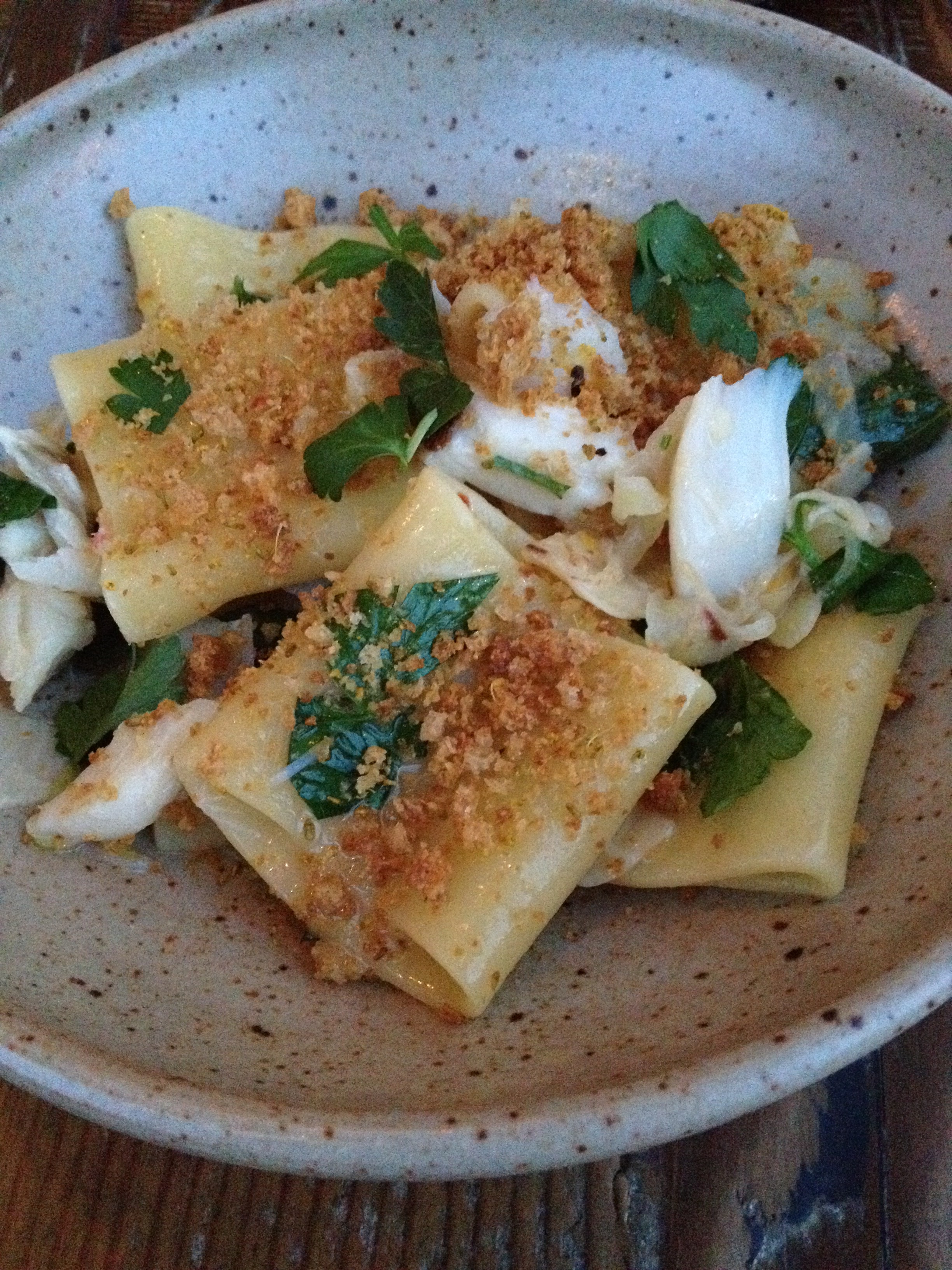
I ordered the paccheri pasta – great big rings – with olive-oil-poached bacalao (salt cod) and fennel pollen.

image

We ordered three different desserts. They were all delicious, but we saved them to take back to Susan, the Dessert Queen, as our thanks for being the resident baby sitter.

After dinner, Sarah had a nice visit with a well-known local restaurant reviewer and food critic and her son, a well-known Master Sommelier, who had been sitting at the next table. Chef Melissa also came out and visited with Sarah. It was a very special evening in a new San Francisco restaurant that promises to be a big success.

4 Comments

Filed under Food, Photography, Restaurants, Travel

ON BOARD THE COAST STARLIGHT

It seemed like the natural thing to do. We still hadn’t seen enough scenery, and a leisurely ride in a sleeper between Seattle and Los Angeles with a break in the Bay Area sounded like a lot of fun and a good way to relax. (Do you need to relax when you’re retired?)

We left our hotel before rush hour for a short taxi ride to the carefully restored Amtrak station. Our train from Vancouver, BC, pulled up to the gates, a good-sized crowd loaded up, and at exactly the designated hour we departed downtown Seattle.

There is always the mystique that trains take you to scenic places – and often that is true – but in big cities, you frequently see things that have been carefully hidden: truck terminals, rows of box cars and tank cars, and hobo camps filled with crumpled sleeping bags, cardboard boxes, and plastic crates.

At the same time, it is interesting to look out at the panoramas of the city and scenes that you would miss from the freeway. Soon enough, the messiness of the city gives way to the countryside, with lush trees, hillsides of yellow-flowered shrubs, and fields in every imaginable shade of green.

We missed breakfast at the hotel, so we were looking forward to lunch in the dining car. The steward came by and gave us a slip of paper with our time to show up in the dining car.  Then, at the appointed time, we heard an announcement that we should make our way to the dining car.

If you have never eaten in a dining car, there is a very fixed ritual, which the server will describe with a certain fatigue and indignation that must come from having done the same thing with thousands of past passengers. You sign your name and fill in the blanks for your car number and room. The server fills in everything else after you have chosen your meal.

Unlike Agatha Christie’s Orient Express, you should not anticipate fine dining. After all, the main reasons you take a train are the scenery and the leisurely pace. In fairness, though, the experience beats the current state of airline food (Is there such a thing any more?)

As is customary, we were seated with two strangers: one was a very pleasant middle-aged man who was on his way to help his niece celebrate her college graduation; the other was a college-aged young man who had absolutely no interest in engaging in conversation with old galoots. He wolfed down his sandwich as soon as it was delivered, mumbled something about how nice it was to meet us, and hastily beat an exit out the door.

We selected the sautéed chicken special. It came with a salad composed of the white ends of iceberg lettuce leaves (How did they manage to buy nothing but white ends?) and two cherry tomatoes that rolled around on the thin plastic plate with every lurch of the car, defying my best efforts to spear them with the little salad fork. The main dish was a breaded chicken breast that looked suspiciously like a chicken tender and had a similar taste. It was accompanied by a mound of mashed potatoes decorated with yet another cherry tomato. Dessert was a choice of cheesecake, cheesecake with strawberries, chocolate mousse, or ice cream. They all came in little plastic cups.

The food highlight of the day was a wine tasting in the parlour car mid-afternoon. It was very pleasant and cost only $7.50 per person. The steward gave everyone good pours of actually not-too-bad wine. Our experience was so good that we decided to change our dinner reservations from the dining car to the parlour car. That was a good choice because we got a table by ourselves, and the pepper steak was not too bad. Dessert choices were the same, but this time they were removed from the plastic cups and served on little plastic plates with the Amtrak logo.

image

Never mind. The scenery, especially in the Cascade Mountains was spectacular, and we stayed up, looking out the window until dark.

Then the car attendant made up our beds, and we settled in for the night. Sleeping was not too bad. We woke up with the train in the station at Sacramento. We dressed, went to breakfast in the parlour car, and sat in the comfortable chairs next to the tables, watching the scenery until it was time to get off th train in Emeryville.

The best food of the trip was a hamburger that our daughter prepared for lunch when we got to her apartment  – mushrooms, Swiss cheese, bacon, arugula, shallots, and dill pickles. Good food at the end of an interesting trip.

image

6 Comments

Filed under Food, Photography, Restaurants, Travel

FOLLOWING FAMILY ADVENTURES

Over the years, I have often written about the food adventures of my various family members. In particular, you have read about our daughter and son-in-law, Sarah and Evan Rich, as they have gone from working in the restaurants of others to trying out a pop-up in a borrowed restaurant, Radius, in the Folsom Street area of San Francisco, to opening their own restaurant, not knowing if anyone would show up.

Since then Sarah and Evan and their restaurant, Rich Table have become successful. The restaurant is busy, and Sarah and Evan have had the opportunity to create some delicious food like their sardine chips, porcini donuts, deconstructed ice box pies, and tagliatelle with strawberry-braised pork Bolognese.

Along the way, they have been recognized by the San Francisco food scene along with Star Chefs magazine, Food and Wine, the James Beard Foundation and others. They have been invited to cook in New York, Chicago, Dallas, Shreveport, Louisiana, Mumbai, Hawaii, Mexico, and Yosemite.

If you watch Top Chef, Iron Chef, or Chopped, you know that professional cooking has become a competitive sport. Not surprisingly, Sarah and Evan are in the competition. Right now, they are competing in Food and Wine magazine’s annual competition, in contention for People’s Choice for Best New Chef, 2015. If you want to read about the contenders (or even vote) check out the web site. Voting ends April 8.

Leave a comment

Filed under Food, Photography, Restaurants

STRAWBERRY GALETTE

It’s beginning to be the season for fresh strawberries in California, but not here in New Mexico where we still anticipate at least one more hard freeze. Even though the grocery store versions of strawberries lack the sweetness and flavor of those at San Francisco’s Ferry Building, they have the advantage of being available year around. That is good, because this beautiful dessert is worth the effort any time of year. If you prefer, you can substitute your choice of other berries or any combination of berries.

Although I have tweaked it a bit, the original recipe comes from one of Deborah Madison’s excellent cookbooks: Seasonal Fruit Desserts From Orchard, Farm, and Market (Broadway Books, New York, 2010, p. 119). Deborah Madison now lives in Santa Fe and is viewed as the doyenne of the local food-writing community  even though she is not nearly old enough for such a title. She began her cooking career in the Bay Area, working at Alice Waters’s Chez Panisse and then eventually serving as the founding chef of what has been called the first high-end vegetarian restaurant, Greens. The restaurant is still popular and definitely worth a visit at its beautiful site on the edge of San Francisco Bay. Since then her cookbooks, including Vegetarian Cooking for Everyone, have won many awards including the James Beard Foundation Book Award.

This dessert fulfills that well-earned reputation.

Just a few minute last-minute pointers: Resist the temptation to overfill the galette with fresh fruit. Make certain that the edges of the dough are well-sealed. Otherwise, it may leak, and you could face a major oven cleanup.

RECIPES

Pastry for Galette

Ingredients

  • 1 cup all-purpose flour
  • 1 cup pastry flour
  • ½ teaspoon salt
  • 1 tablespoon sugar
  • ¾ cup (1½ sticks) chilled unsalted butter, cut in pieces
  • 1 egg yolk
  • 1 teaspoon fresh lemon juice
  • 5-6 tablespoons ice water

Method

  1. In a bowl large enough that you will be able to mix the dough with your hands, mix together the flours, salt and sugar.
  2. With a pastry blender, cut in the chilled butter until the mixture resembles coarse meal. The crust will be flakier if some larger pieces of fat are left unblended.
  3. In a small bowl, combine the egg yolk, lemon juice, and 4 tablespoons ice water. Pour over the dough mixture and work in with your hands.
  4. Add remaining ice water, 1 tablespoon at a time, until the dough comes together. It should not be sticky. Knead lightly; divide into two equal balls. Pat into discs about an inch thick, wrap with plastic wrap, and refrigerate for at least 30 minutes.

Strawberry Galette

Ingredients

  • 4 cups strawberries, washed, hulled, and halved
  • 1/3 cup maple syrup
  • ½ teaspoon lemon juice
  • 2 teaspoons cornstarch
  • 1 teaspoon vanilla extract
  • ½ pastry recipe (above)
  • 1 tablespoon unsalted butter, melted
  • 1 tablespoon cream
  • 1 tablespoon turbinado sugar

Method

  1. In a large bowl, combine the halved strawberries, maple syrup, lemon juice, cornstarch, and vanilla extract.
  2. On a well-floured work surface, roll out one of the chilled discs of dough into a circle at least 13 inches in diameter.
  3. Arrange the rolled-out crust on a rimmed 13 x 18 inch baking pan lined with parchment. Top the crust with the strawberry mixture, leaving a 2-inch margin around the filling.
  4. Fold the edge of the crust over the filling so that it drapes over the filling and any folds are sealed.
  5. Sprinkle the melted butter over the filling.
  6. Brush the crust with cream and sprinkle with turbinado sugar.
  7. Bake in the middle of an oven preheated to 425°F for 35 minutes or until the crust is golden.
  8. Serve warm or cold with heavy cream, whipped cream, or vanilla ice cream.

8 Comments

Filed under Food, Photography, Recipes

ALCATRAZ AND AI WEI WEI

I had meant to post something on Saint Patrick’s Day – for certain NOT corned beef and cabbage, but maybe something about Irish soda bread. But we were traveling back from San Francisco, and then my friend and fellow blogger, Jim Hastings, the Gringo Gourmet, wrote about his mother’s recipe for soda bread.  I still haven’t given up on a southwestern version of soda bread, but I’ve been so busy since we got home that I haven’t had time to cook, and anyway I am once again on a diet. Susan assures me that the reason I can’t lose any weight is that I wind up eating whatever it is that I’ve cooked for my blog postings.

So, needing something to write about, I thought of our trip the other day to Alcatraz. I couldn’t think of any prison food to go with the text, especially anything that would interest folks who like to read about food. That’s the reason that this is just a travelogue.

If you have never been to Alcatraz during a visit to San Francisco, it is something that you should do. Be advised that same-day tickets are usually impossible to get, so you should make reservations ahead. The ferry leaves Pier 33 about every half hour during the day, and  takes about 15 minutes. You should plan at least 2 hours on “the Rock” before you catch the return boat. You may also be able to plan your trip around a meal at the nearby Fog City Diner.

A special feature right now  through part of April is an exhibit of the work of Ai Wei Wei, the dissident Chinese artist who has spent much of his life in a Chinese prisons. It seems appropriate that Alcatraz is the site of the exhibit.

A centerpiece of the exhibition is a massive Chinese dragon that stretches surely over a hundred feet in one of the main exhibit halls – part of the old Laundry Building. Another of the key displays includes portraits of political prisoners from throughout the world. The portraits are arranged across the floor reminiscent of the AIDS quilt. The most amazing thing about the portraits is that they are all made of Legos carefully pieced together but with remarkable detail.

Alcatraz is pretty much a ruin. It was a military prison for many decades before it became the federal high-security prison. Then it was abandoned on  March 21, 1963. 1963. It was briefly occupied in 1964 by a small group of Sioux Indians. Then, from 1969 to 1971 it was occupied by a group known as Indians of All Tribes. Subsequently it has just sat, crumbling into ruins. Now the place is part of the Golden Gate National Recreation Area, and many of the buildings are being restored. Still, the ruins are very interesting and also very photogenic. One could easily spend many hours with a camera.

At the very top of the hill sits the main cell block. The cells remain intact, and there are a few furnished to show the not-so-luxurious accommodations.  One stop on the tour is the dining hall along with the accompanying kitchen. The breakfast menu for the closing day is still posted on the wall. It includes choice of cereal, juice, coffee, fruit, eggs, and breakfast meat. Sounds ok, but my guess is that it was slung out of the kitchen where outlines of the terrifying knives used by the cooks still cover the walls.

It is not for nothing that Alcatraz is nicknamed “the Rock”. That’s all that it was until soil was brought in to  make it a more pleasant place to live for the families of the guards and other prison employees. Now there are lots of flowers around the grounds, but they are all invasive species, and there are no native plants.

5 Comments

Filed under Photography, Travel

PLAY WITH YOUR FOOD – PLEASE

When our kids were growing up, I sometimes fussed at them at the dinner table, “Don’t play with your food!” That was usually when they didn’t want to eat the broccoli and so moved it back and forth on the plate.

We’ve been in the Bay Area (again) for the last several days. As usual, that has given us the opportunity to eat out a lot, as well as to do some cooking for our family. What I have taken away from all of this is that you want professional chefs to be creative while – even if the cook wants to experiment – home meals suggest not so much.

One night I made bucatini all’Amatriciana for my son’s family including 7- and 9-year old girls. The recipe was from Diane Darrow’s wonderful Italian cookbook, La Tavola Italia. I knew it was delicious because I had made it before. I also knew that the girls preferred very little to no tomato sauce, so I cut back on the tomatoes. At the same time, they both insisted that they loved pasta, so I felt reassured. When the dish arrived at the table (delicious, I might add) they both recoiled in horror. Bucatini was not pasta to them, and so they wound up eating something else.

The next experience was at a wonderful bistro, Cuisinett, in one of the towns of Silicon Valley. It is run by two French ex-pats, one of them a classically trained chef who simply grew tired of cooking in white-linen-tablecloth restaurants. The two owners take pride in offering French comfort food along with a big selection of French wines by the glass. They usually have croque monsieur on the lunch menu, but the day we visited, they did not. The waitress said that they did not have the appropriate ingredients. Instead, they had what they called a French-style grilled cheese sandwich. It turned out to be thick slices of crunchy French bread filled and topped with melted Brie. Lamb merguez on a bun was slathered with mustard. Salmon was served with a sauce Provencal. Delicious and creative! That’s what I call playing with your food.

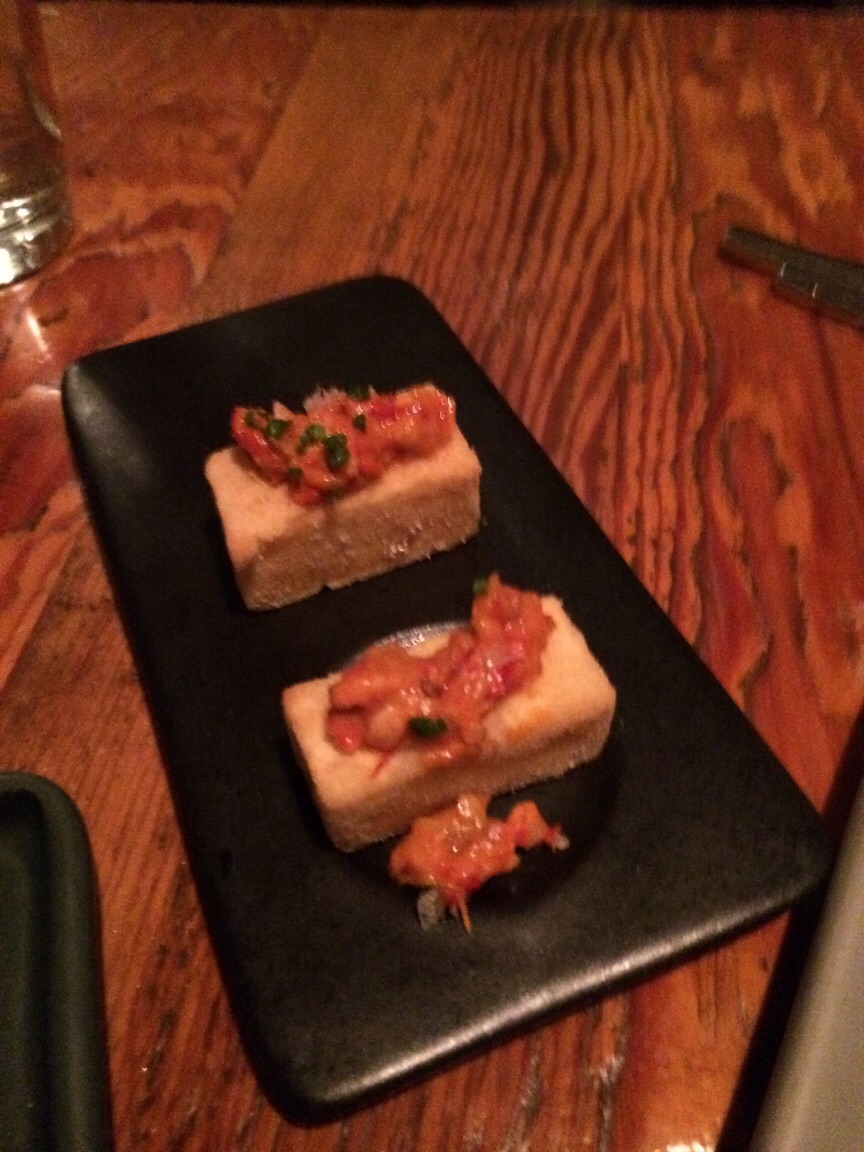
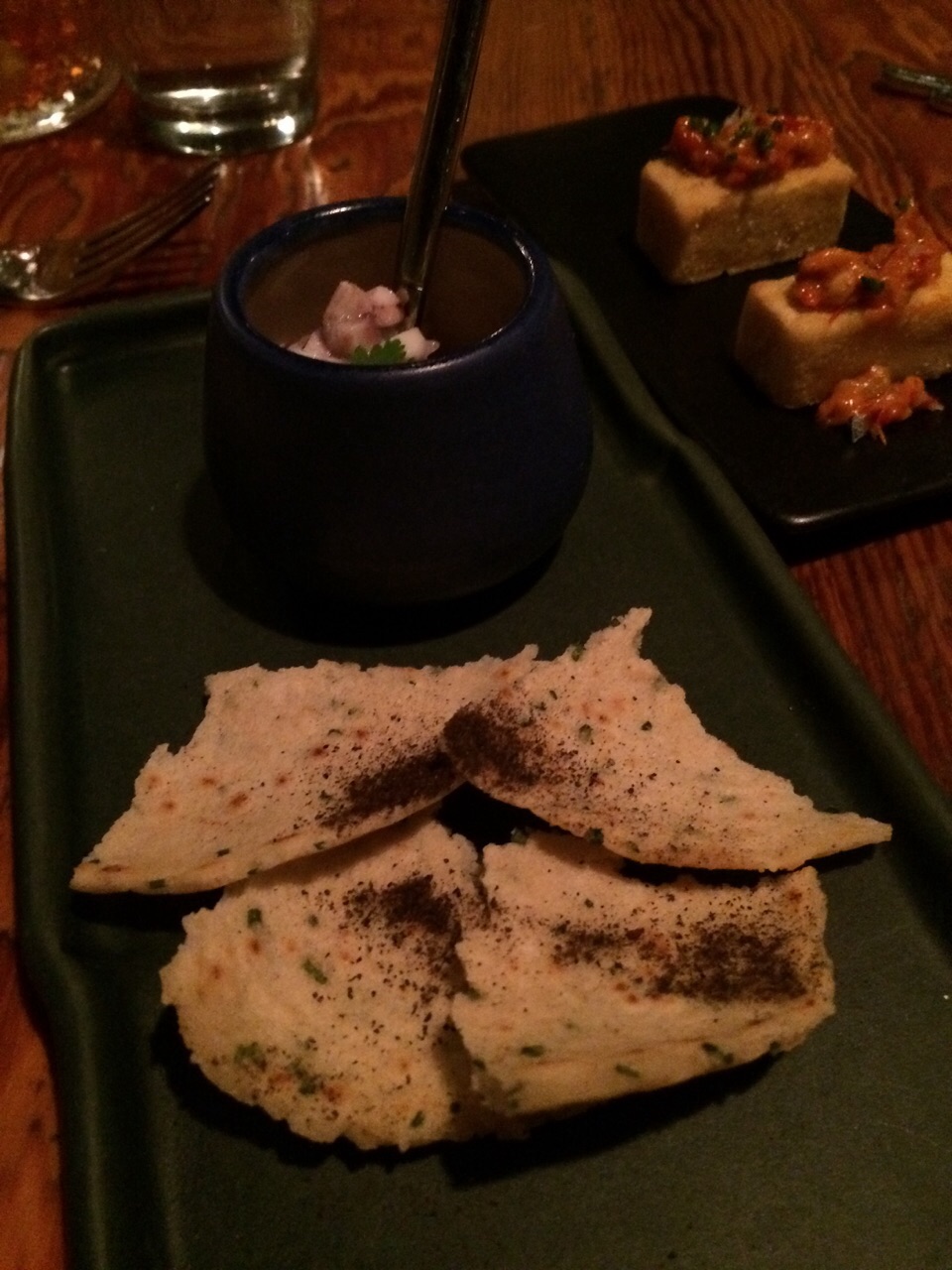
Finally, we ate one evening at Rich Table. Everything was excellent, and everything was a play on old standards: the “carrot cake” was deconstructed and unlike any carrot cake I had ever tasted, topped with a carrot ribbon turned into fruit leather; the New York strip steak was topped with broccoli chimichurri , shaved crispy caramelized onions, and coriander flowers; their signature chocolate sable came with drops of chocolate ganache that looked like Hershey kisses; chicken liver mouse served on plancha bread with fruit preserves and micro greens did not taste like my mother’s chopped chicken livers; avocado and trout roe was delicious; sea urchin was almost too beautiful to eat. But perhaps the most creative dish was the “fish and chips”. The fish was a creamy brandade de morue made with cod and potato and seasoned beautifully. The chips were kale, but not your usual kale chips. The kale had been lightly steamed, then pureed and mixed with a tapioca binder, dehydrated on parchment, and seasoned with a dried malt-vinegar powder to capture all of the flavors of traditional English fish and chips. That I call playing with your food – all with a special outcome.

I think that all of this is well beyond my skills, but for the home cook, regular kale chips and brandade would likely be a delicious and worthwhile substitute.

6 Comments

Filed under Food, Photography, Restaurants