Tag Archives: Louisiana

BAKED STUFFED TOMATOES: STOPPING BY A TEXAS FRUITSTAND

We are back home after a very long two weeks in Shreveport, Louisiana. We had a good time and enjoyed seeing old friends, but taking care of two young children is not in the usual job description for folks as old as my wife and me.

Susan had driven her car all the way from Santa Fe, so we knew that we had a long drive back. We decided we were not going through the Dallas-Fort Worth Metroplex even though it was probably the shortest and fastest return. There is too much traffic; we have been there before many, many times; and the cityscape is, well frankly, boring.

Instead, we left the interstate at Tyler and headed up to Sherman, the home  of a beautiful small liberal arts college, Austin College. The road was like so many country roads in Louisiana and Texas: well paved, not much traffic, and lines with farms and big stands of pines and hardwoods. The further west we got, the smaller the trees became. There were several towns along the way, but most were no bigger that a few hundred people. Every town, though, had an enormous high school and an even bigger football stadium. Every town also had several churches. Some had tall spires while others looked like they were just hanging on.

Still steeped in farm-to-table enthusiasm, we stopped at a small roadside stand several miles from any town. They were advertising fresh homemade ice cream along with fresh produce. We certainly helped their cash-flow that day. Susan bought several jars of homemade preserves, honey, pinto and Anasazi beans, sweet potatoes, cantaloupes, watermelon, sweet cherries, fresh peaches, and bright red tomatoes.  We had to re-arrange our already crowded back seat to make room for everything.

We resumed our travel, stopping in Amarillo overnight (That is another story, but probably not appropriate for a blog) and then got back on the interstate to complete our trip home.

Since then, we have been enjoying all of the fruits and vegetables from Shreveport along with more from the fruit stand. We’ve had fresh tomatoes sliced, in a salad, and along with avocado so it occurred to me that a tasty meal might include mashed sweet potatoes, a big slice of ham from the store, and baked tomatoes.  That’s what we had last night.

RECIPE

Baked Stuffed Tomatoes

Ingredients

  • 2 large ripe tomatoes
  • 3 crimini mushrooms, chopped
  • 2 tablespoons extra virgin olive oil + more to drizzle on top of the tomatoes
  • 3 scallions including green tops, chopped finely
  • ½ cup finely chopped flat-leaf parsley
  • ½ cup panko
  • ½ teaspoon Italian seasoning
  • 1 tablespoon white wine vinegar
  • salt and pepper
  • ½ cup freshly grated Parmesan cheese

Method

  1. Cut off the stem ends of the tomatoes. If needed, cut a very thin slice off the blossom end so that the tomato will sit flat. With a grapefruit knife or grapefruit spoon, remove the pulp from the tomatoes, leaving a rim of about ¼ inch of the flesh. Rinse, drain, and set aside.
  2. Rinse any seeds from the pulp, sprinkle with salt, chop finely, and set aside to drain any excess water.
  3. In a small pan, heat the olive oil and sauté the mushrooms until they have given up their liquid and it has evaporated, about three minutes. Set aside.
  4. In a small bowl, combine the mushrooms with their cooking oil, scallions, parsley, panko, Italian seasoning, and vinegar. Blot the chopped tomato pulp dry with paper towels and add it to the mixture.
  5. Correct the seasoning with salt and pepper.
  6. Stuff the tomato shells with the mixture, packing it firmly. Top with the Parmesan cheese, drizzle with olive oil, and place in the middle of an oven preheated to 350° F. Bake for 30 minutes. Using a spatula, transfer the tomatoes to plates and serve immediately.


7 Comments

Filed under Food, Photography, Recipes, Travel

LETTER FROM UNSCENE SHREVEPORT: PURPLE HULL PEAS, TASSO AND COLLARDS

Last night we ate at our apartment after Sarah, Evan, and Van went fishing with Jason Brady and his family. It seemed like a perfect time to cook up some purple hull peas I had bought at the farmers market.  I went to the grocery store to get some salt pork and tasso, but I probably could have found those at the farmers market, too.

You can’t have peas, tasso, and collards without some cornbread to sop up all of the juices, but none of us was in the mood to bake cornbread in our understocked apartment kitchen. Fortunately we had  some leftover corn muffins that had been served with our chicken fried steak at Strawn’s for lunch. The muffins were sweet (Yankee cornbread in Louisiana!?) but they would have to do.

I cooked the meal while the fisher persons were out on the lake.

RECIPE

Cookin'

Cookin’

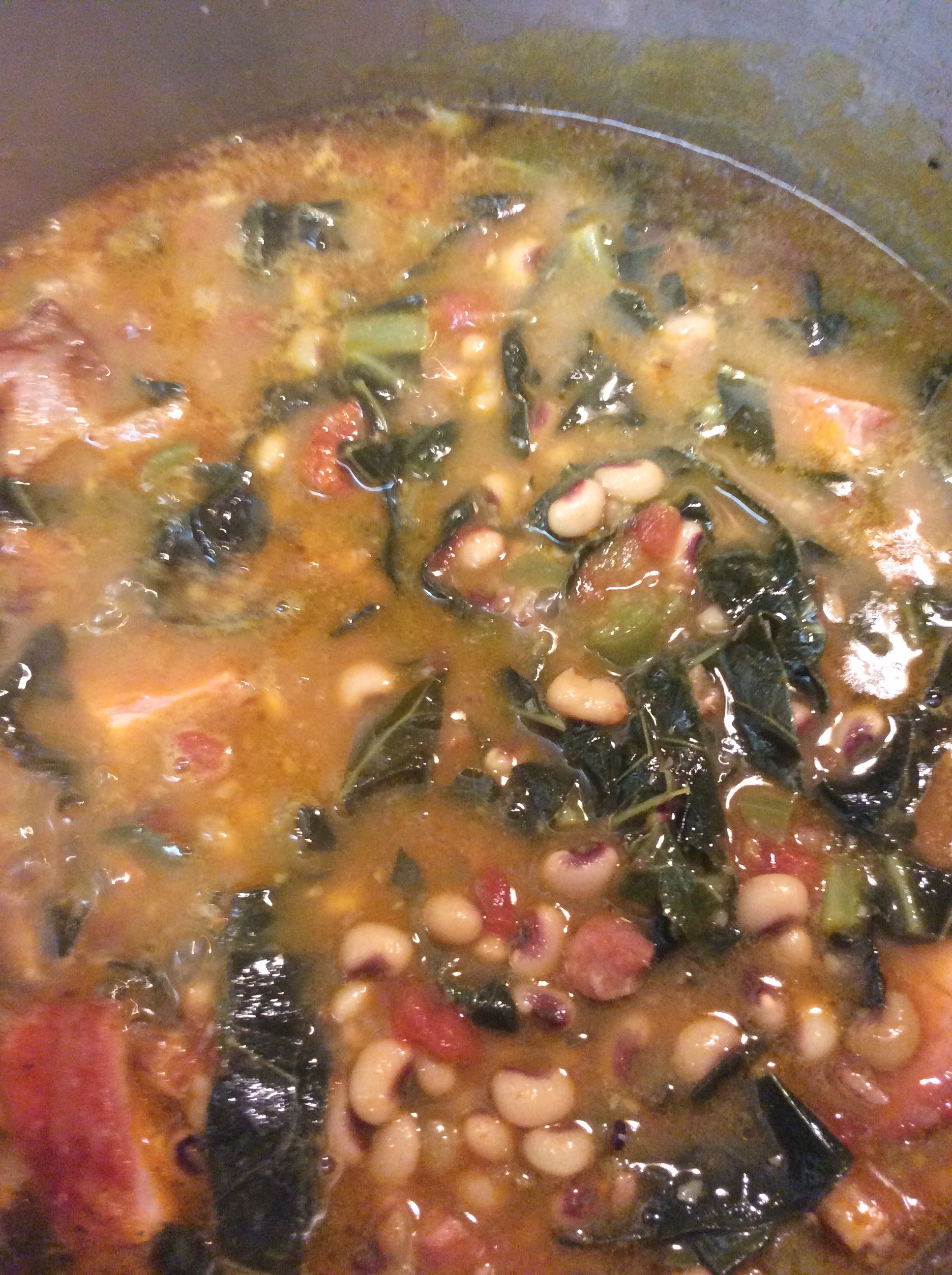
Purple Hull Peas, Tasso and Collards

Ingredients

  •  2 tablespoons vegetable oil
  • 1 large onion, chopped
  • 8 ounces salt pork, cut into a large dice
  • enough water to cover the salt pork in a small saucepan
  • 32 ounces chicken stock
  • 1 quart shelled purple hull peas, fresh or frozen
  • 1 large green bell pepper, seeded, deveined, and chopped
  • 14 1/2 ounces canned, diced tomatoes (fresh tomatoes would be great, but I forgot to buy them at the farmers market)
  • 3 cloves garlic, minced
  • 1/2 teaspoon sugar
  • 1 1/2 tablespoons vinegar or lemon juice
  • salt and pepper
  • 8 ounces Cajun-style tasso ham, cut into bite-sized chunks
  • 1 large bunch fresh collard greens, washed, trimmed, and cut into a coarse chiffonade
  • Louisiana Hot Sauce to taste (optional)

Method

  1. In a large, covered pot heat the oil over medium-low heat. Add the onions, cover, and sweat until the onions are soft and translucent. Transfer to a bowl.
  2. Bring water to a boil in a small saucepan and add the salt pork. Return to the boil and boil for 5 minutes to remove any excess salt.. Drain and transfer to the large pot over medium heat. Stir frequently to allow light browning.
  3. Return the onions to the pot. Add chicken stock and bring to the boil. Stir in the peas, bell pepper, and garlic. Adjust seasoning with salt and pepper. Return  to a boil and then adjust the heat to a simmer. Simmer, covered for 1 hour or until the peas are soft.
  4. Stir in the tasso and simmer for another 30 minutes.
  5. Add the collard greens and simmer for another 30 minutes or until the greens are thoroughly cooked but not limp. Adjust the seasoning. Be sure to use hot sauce if you like it.
  6. Serve in large soup bowls.

2 Comments

Filed under Food, Photography, Recipes, Travel

LETTER FROM UNSCENE SHREVEPORT: TOMATO AND SQUASH SHOWDOWN

Today is the day of the amateur cook-off. The contestants have had the weekend to think about what they would cook, using either tomatoes or squash. There have been over seventy entrants, more than twice as many as anyone thought. Even at that, there were several who chose not to enter because they couldn’t think of anything to make with tomatoes or squash. One woman asked what the ingredients were. She declined tomato. When she found out the other choice was squash, she said, “I don’t do vegetables,” and left. So much for the farm-to-table movement.

Our guess was that there would be a lot of stewed tomatoes and okra (This is Louisiana, after all.) There would also be a lot of zucchini bread. We’ll see. Turn in time was 5 PM and at 3PM entries were already starting to arrive.

On the way to the place where the contest was to be held, we stopped for barbecue. Big D’s Barbecue has been smokin’ for over 30 years. It is quintessential Louisiana barbecue although too much ketchup for my taste. Still, it is worth the trip. I’ve included an image of their smoker and outdoor dining area (if you can stand the heat) along with their delivery vehicle.

Sarah and Evan’s menu included:

  • Sliced tomatoes with grilled corn, popped sorghum, and white chocolate
  • Green bean salad with raw pecans, coffee vinaigrette, and green-bean chimichirri
  • Honey-roasted potatoes with sunflowers
  • Plum-glazed pork roast

The contest turned out to be an exciting event. Over 70 cooks along with families showed up, so there were nearly 300 people jammed into the hall. The contestants were intense and clearly there to win. Contrary to our expectations, there was not a single serving of tomatoes and okra or zucchini bread, although a 10-year old girl made an elegant squash cake with an elaborate squash glaze. Choosing winners turned out to be more difficult than anyone had thought, but among the winners were a fancy pizza with lots of toppings, a tomato pie, and a squash appetizer. After the judges – Sarah, Evan, and Jason – had sampled everything. (Yes, you read that right.) everyone in the audience stormed the tables to get their own taste of the various entries.

Following the announcement of the winners, Sarah and Evan’s dinner was served, and folks were still hungry! Then there was a lively panel of local food experts talking about the next steps toward getting Shreveport more farm-to-table friendly.

A long evening, but everyone went home well-fed and happy.

Leave a comment

Filed under Food, Photography, Travel

THE MUFFULETTA AND THE CENTRAL GROCERY IN NEW ORLEANS

A while back I posted a recipe for olive salad that approximates the one that is used at the Central Grocery in New Orleans. Then I started reading Yelp reviews (which I try to avoid at all costs) and recipes on the Internet. All of that inspired me to write about what is said to be the “Original Muffuletta” and the Central Grocery.

First, there are Yelp complaints that the Central Grocery is dirty. C’m’on folks, the store is on Decatur Street in the Vieux Carre (the French Quarter). It is as old and as down at the heels as all of the other buildings in the neighborhood. At least one history says that the store was founded in 1906. It has probably operated non-stop ever since, except during severe hurricanes. Besides, a visit gives you the opportunity to wander the aisles and see some amazing food choices, like Bombay duck – not a duck at all, but rather a long dried fish with fearsome eyes and teeth – sticking out of a barrel,  and Italian delicacies hard to find elsewhere.

Then, some yelpers complain about rudeness of the men who make the sandwiches. I guess those reviewers have never been to Katz’s or Russ and Daughters on East Houston in Lower Manhattan. It is true that you need to be ready to order when you get to the front of the line, but the men are as friendly as I would be if I made sandwiches all day long.

Some recipes on the Internet call for lettuce or tomato. That doesn’t work, because then the sandwich becomes a sub or a hero. Some say that there are better versions elsewhere. I don’t know about that, but remember that the original is the original. The only place I know of that has a comparable sandwich is Fertitta’s in a seedy part of Shreveport, LA. Fertitta’s calls its sandwich “the Muffy”, and they make claims to being the original.

Whichever, the tale about the Central Grocery is that around 1906, Italian workers started coming to the grocery with lunches of cheese and meat. The owner of the Central grocery suggested putting the lunches in loaves of muffuletta, a Sicilian bread, and the muffulletta sandwich was born. Probably apocryphal, but it makes a good story.

These days the sandwich is sold as a whole or a half, and the whole is cut into fourths before being wrapped in butcher paper.  That’s really enough for four people, but many customers eat the whole thing. The paper gets olive oil stains all over, and that’s when you know the sandwich is ready to eat. Boxes and barrels are used as seats and  scattered around the crowded store, but you probably want to take a brief walk to Jackson Square and enjoy your lunch al fresco on a sunny day.

Bread. To me, the bread is an essential part of the successful muffuletta. The loaves at the Central Grocery are delicious, and in my experience only available in Louisiana, especially New Orleans. Schlotzky’s makes a reasonable substitute. Recently I discovered that the 9 inch focacchia loaf from Panera Bread makes another suitable choice.

Meat. You can choose whatever you like. Mortadella – a good mortadella and not plain “baloney” – is almost a requirement as is salami (I used Genoa). Ham is also important. A good Italian coppacola is my favorite, but any thinly sliced delicatessen-style ham can be used.

Cheese. Provolone and/or mozzarella are classic choices.

RECIPE

Central Grocery Style Muffuletta

Ingredients

  • 1 loaf, Panera Bread loaf, split in half
  • 1 batch Louisiana olive mix
  • ½ pound each, mortadella, salami, and ham
  • ¼ pound Provolone or mozzarella

Method

  1. Spread the cut halves of the bread generously with olive salad mix
  2. Add generous layers of meat and cheese and top with the top half of the bread loaf.
  3. Cut in four quarters. One quarter should serve most adults.

16 Comments

Filed under Food, Photography, Recipes, Restaurants

DR. D’S LOUISIANA ANDOUILLE AND CHICKEN GUMBO

During this Christmas holiday, we were fortunate to have visits from two of our children and their families. Christmas is always a time to enjoy old family favorites, and since our youngest spent most of her growing-up years in Louisiana, we decided to make gumbo for our first evening. We lived long enough in Louisiana to learn how to make some of its classic dishes. We also benefited from lessons from some great cooks among our friends, some of them Cajuns. Nothing says “Cajun” quite as much as gumbo, and the great thing about the dish is that you can make it with whatever you like: oysters, shrimp, a mixture of seafood, duck, alligator, or whatever. This version, chicken and andouille sausage, is one of the most popular because the ingredients are readily available and taste so good together.

I don’t know where I got this recipe. Certainly it has been influenced by my friends, Reggie Graves and Ronnie George, but over the years I have tuned it and tweaked it so that I feel like it is “mine”.

When our daughter, Sarah, was in cooking school at the French Culinary Institute in Manhattan, as with all of the students she was responsible for preparing one family meal for her classmates. She chose to make this gumbo, and it was so popular that it was included in the official recipe book of the school. They called it, “Dr. D’s Gumbo”, and so here it is. It’s really very simple, but there are a lot of individual steps. You can take shortcuts, but if you do, it just won’t be real Louisiana gumbo.

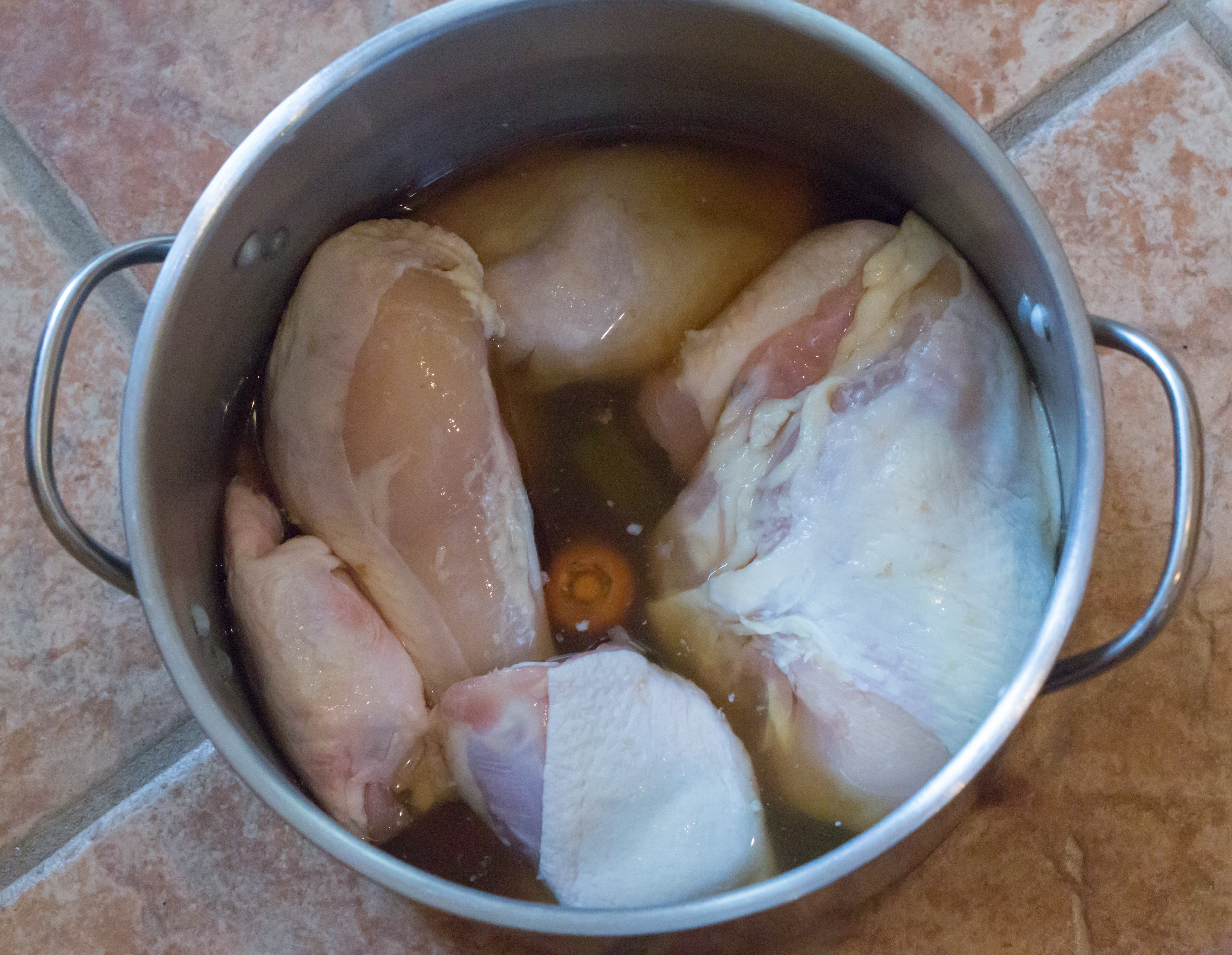
Chicken stock. First, you make your own chicken stock. Actually, you start out with commercial chicken stock, but with your own vegetables, seasonings, and chicken, it becomes home-made and doubly rich. You will need chicken, commercial chicken stock, yellow onion, carrot, celery, garlic, and fresh tomato along with salt and black peppercorns.

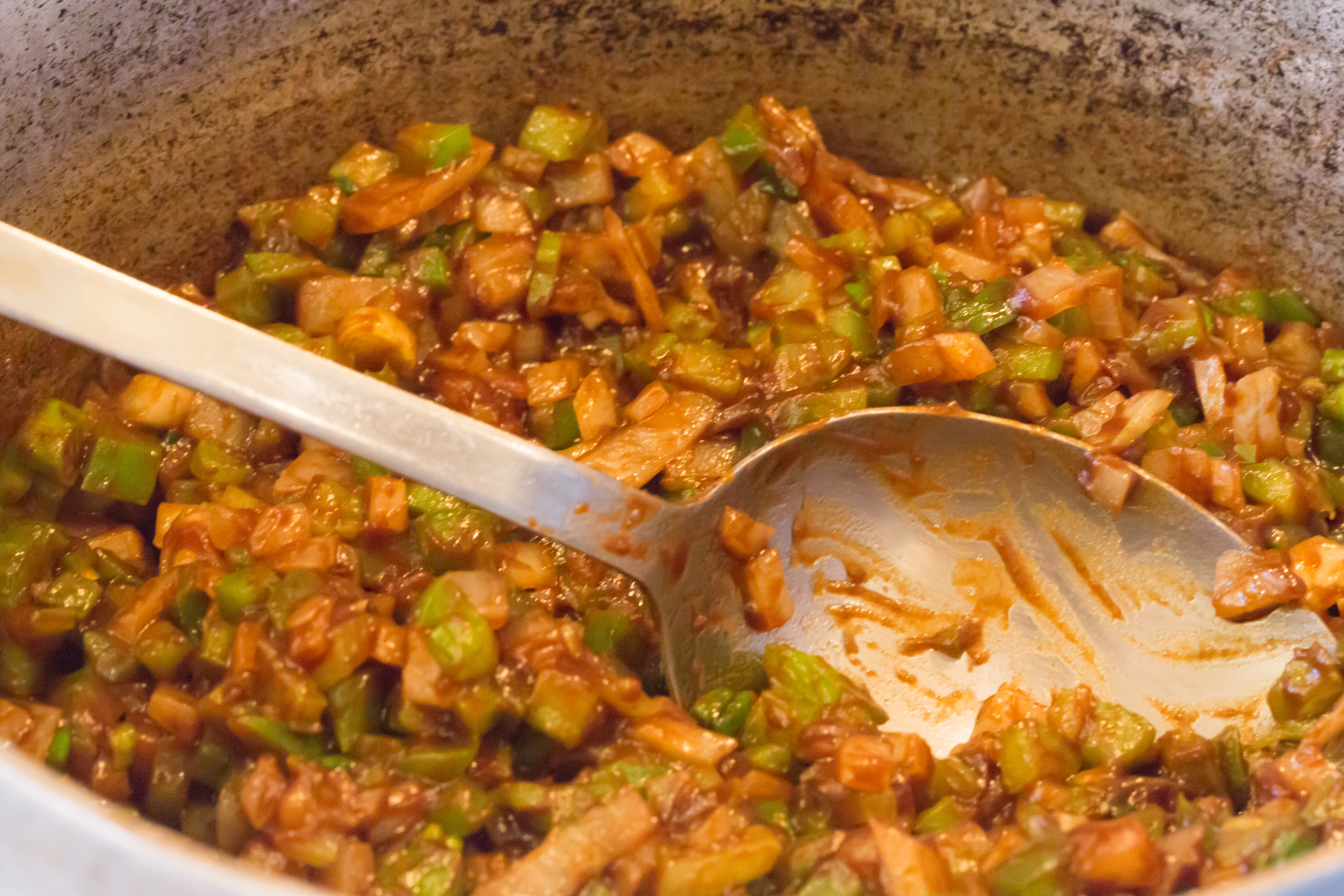
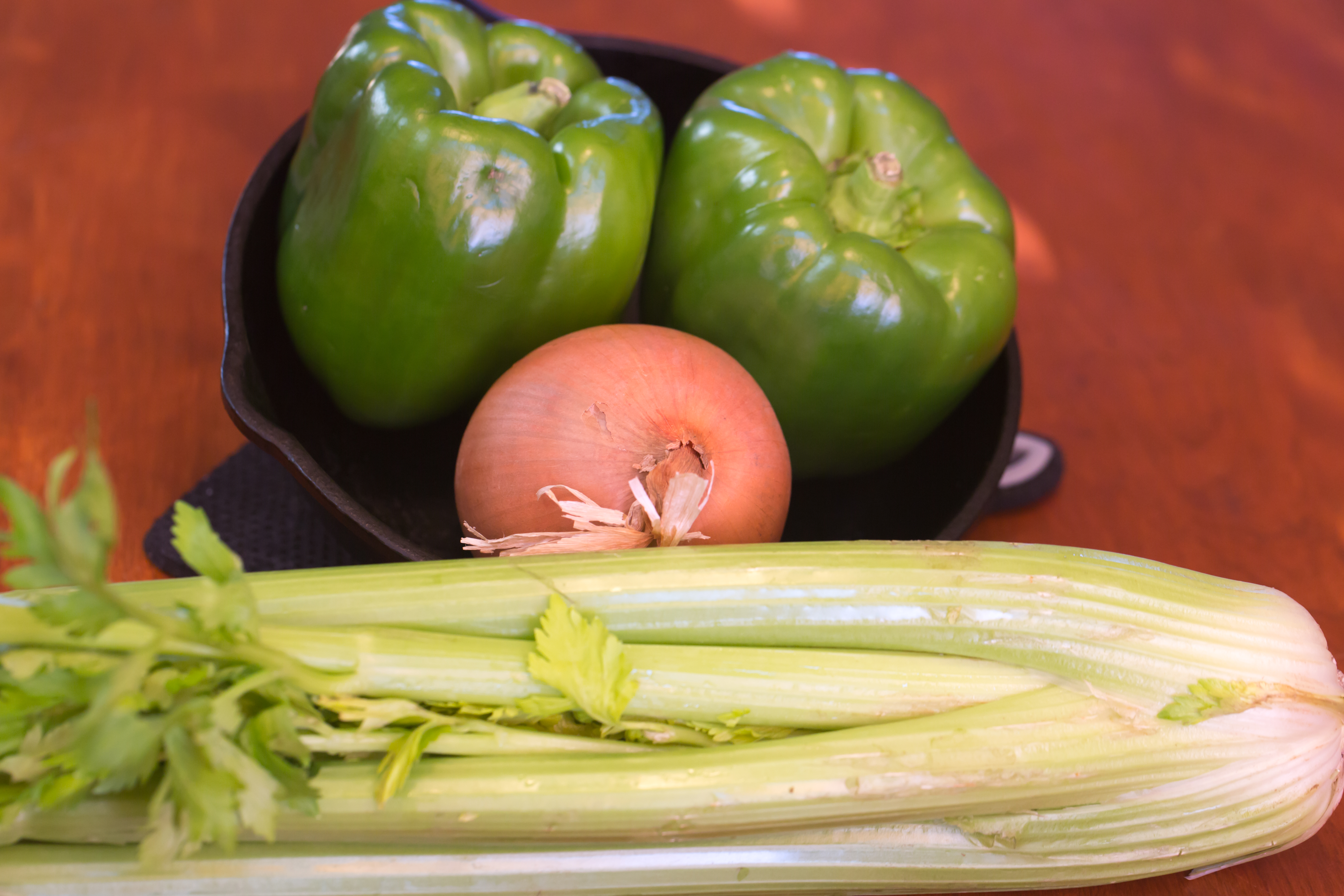
The Cajun Holy Trinity. Second, you need to prepare your vegetables – the so-called Cajun Holy Trinity of onion, green pepper, and celery – before you start to cook. When you make the roux, you will be skating on the edge of disaster. It must be just the right color – as dark as you can make it – but if it burns, you will need to start over. The cut vegetables serve several important parts of the recipe. Of course, flavor is a major purpose, but stopping the roux from further cooking is equally important. That’s why you need to have it at your elbow to dump in the pot just when you think the roux is finished.

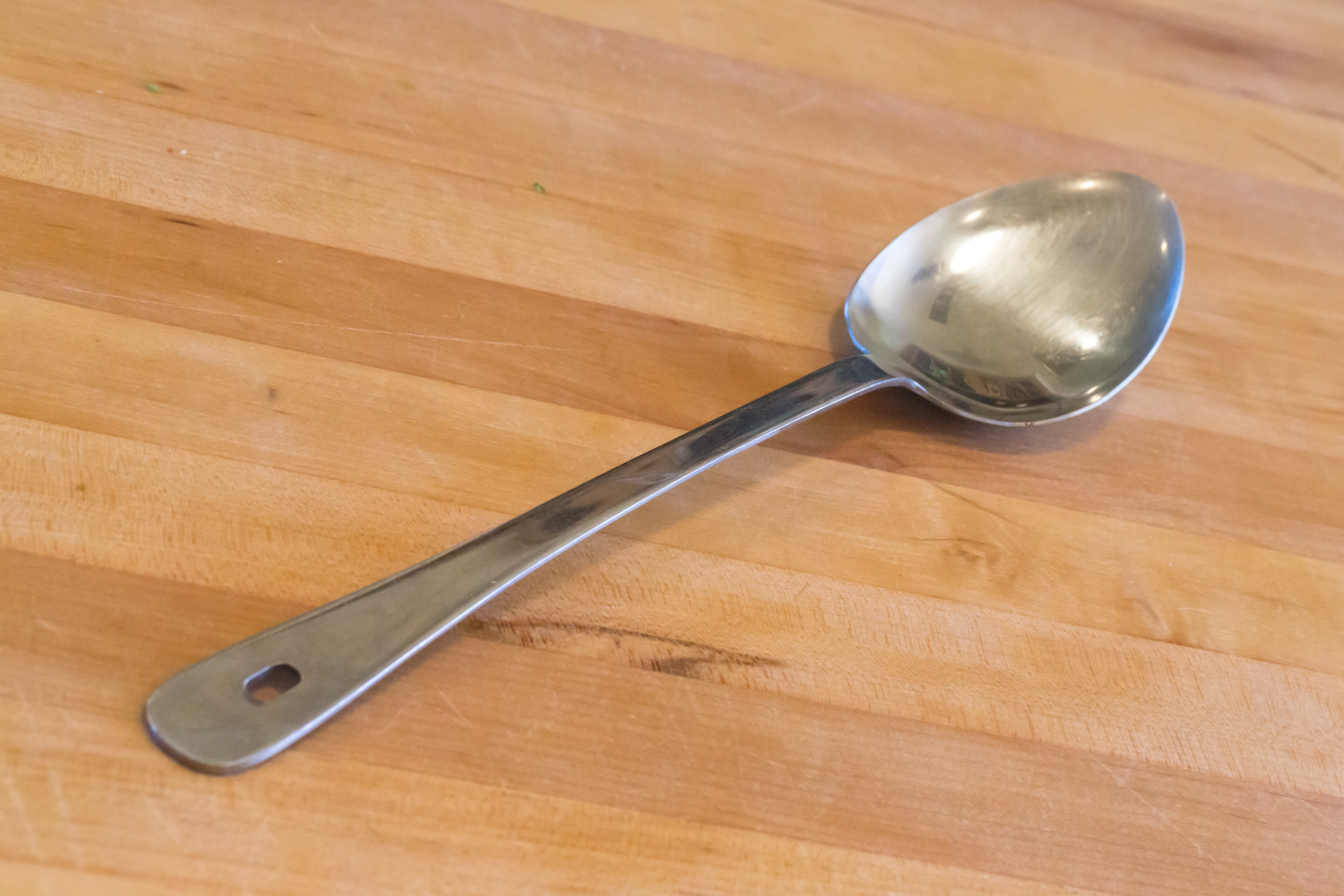
Roux. Third, you need to find the heaviest pot you have and the biggest metal spoon. Undoubtedly you have made a traditional French roux for béchamel or as thickening for various soups and sauces. That is not Cajun roux. The whole idea is to get the roux as dark as you can so that the rich smokiness flavors the soup. That requires constant stirring in a heavy-bottomed pot until your level of fear overtakes you. Any black bits – in other words, if it burns – you have to start over from the beginning.

Thickening.  As the roux darkens,  the flour loses its thickening power while adding to its flavoring power. As a result, there are two other ingredients used to thicken the soup.

First is okra. In fact the OED says that the word, “gumbo” comes from the Angolan word for okra. Many cooks prefer okra in the gumbo during the growing season. In the winter, when gumbo is guaranteed to take the edge from a cold day, filé becomes the preferred ingredient. There are many Cajuns who prefer filé for thickening all year long.

Filé is ground up dried sassafras leaves. If you live in the US South, you probably know where there is a nearby sassafras tree, and you can make your own filé. Aficionados swear it is by far the best to make your own. For the rest of us, there are several Louisiana food companies that sell filé in bottles. Once you buy your filé, the first thing to do is to transfer it to an empty Old Crow half-pint whiskey bottle to serve as your decanter on the dining room table.  Tightly stoppered, the filé keeps for a long time, but if you notice it has lost some of its thickening power, buy a fresh bottle.

Sausage. Traditionally, gumbo is made with andouille sausage. The Louisiana version is made with pork; the French version is made with chitterlings (I think you know what they are) so be sure you know what you are buying.  These days, most large super markets have andouille in the meat section, but if you have a hard time finding it you can substitute Polish kielbasa.

Spice. Gumbo can be as mild or spicy as you like. most folks from Louisiana like it on the spicy side, but food sensitivities in our family dictate a mild version. Fortunately you can add your favorite chile sauce to give the gumbo you prefer. Traditionally, Tabasco is often favored, but it has a vinegary punch that some don’t like. There are any number of other Louisiana hot sauces you can choose, or you can opt for Cholula from Mexico, or the current popular hot sauce, sriracha.

RECIPE

Louisiana Andouille and Chicken Gumbo

Ingredients

  • 32 ounce container of commercial chicken stock
  • 1 whole chicken, giblets and neck removed
  • 1 large yellow onion, halved
  • 2 ribs celery cut in thirds
  • 1 large carrot, cut in thirds
  • 2 cloves garlic
  • 3 or 4 stems of parsley
  • 1 teaspoon salt
  • 12 whole black pepper corns
  • water to cover
  • 1 ripe tomato
  • 1½ pounds andouille sausage
  • 1 large yellow onion, chopped
  • 3 ribs celery chopped
  • 2 large green bell peppers, seeds removed and chopped
  • 5 scallions with green tops chopped + more for garnish
  • 2/3 cup vegetable oil (You may use lard if you want to be authentic)
  • 2/3 cup all-purpose flour
  • Louisiana hot sauce (optional)

Method

  1. In a large stock pot, pour in the chicken stock. Add the chicken, onion, celery, carrot, garlic, salt and pepper. Add water to cover the chicken. Then bring to a boil, and reduce the heat to a simmer. Cook until the chicken is done, about 45 minutes. With your hand, squeeze in the tomato, seeds and all. Simmer for an additional 10 minutes. Remove from the heat. Remove the chicken to cool until it is easy to handle. Strain the stock into a large bowl, and set aside.
  2. When the chicken is cool enough to handle, remove the skin. bones, and any veins you might see. Cut the chicken meat into bite sized pieces and set aside.
  3. Cut the andouille sausage into 1 inch sections and then quarter each section. Set aside.
  4. Combine the chopped onion, celery, green pepper, and scallions in a large bowl. Place next to the roux pot so you can add it quickly to the roux before it burns.
  5. Using a very heavy pot and long-handled metal spoon, place the oil over high heat. As the oil begins to shimmer and just before it smokes, sprinkle the flour gradually into the oil while stirring constantly. The flour should sizzle as it hits the hot oil. It will start to darken immediately. Constant stirring is essential, being ure to scrape the corners of the pot. You can stop whenever the roux is colored to your liking, but Cajun moms will push it until it is almost black (ALMOST black – if you get some black flecks, it means that you have burned the roux and need to start over)
  6. Immediately dump in the chopped vegetables to stop the roux from darkening further. Stir. Reduce the heat to medium-low, and continue to cook until the vegetables are soft and translucent.
  7. Stir in enough of the chicken stock to get the consistency you want. Return to the boil. Add the chicken and andouille and simmer for another 30 minutes to meld the flavors.
  8. Correct the seasoning with salt, pepper, and hot sauce.
  9. Serve in a large soup bowl over a heap of cooked white rice. Pass chopped scallions, filé, and more hot sauce so that all can suit themselves.


A bowl of chicken and andouille gumbo

A bowl of chicken and andouille gumbo


File in the obligate Old Crow bottle

File in the obligate Old Crow bottle


Your choice of Louisiana hot sauces

Your choice of Louisiana hot sauces


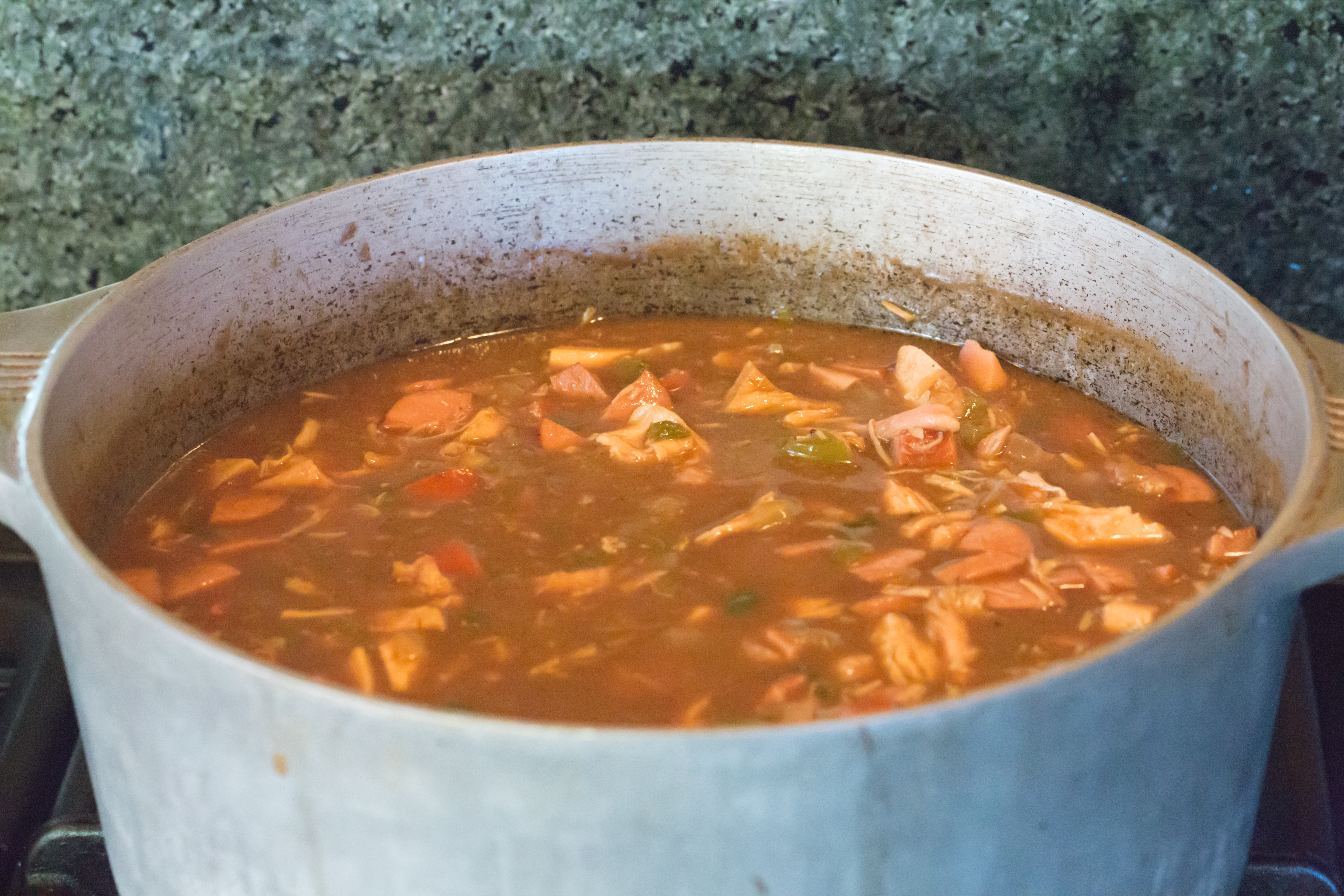
Apot of gumbo ready to be served over rice

Apot of gumbo ready to be served over rice


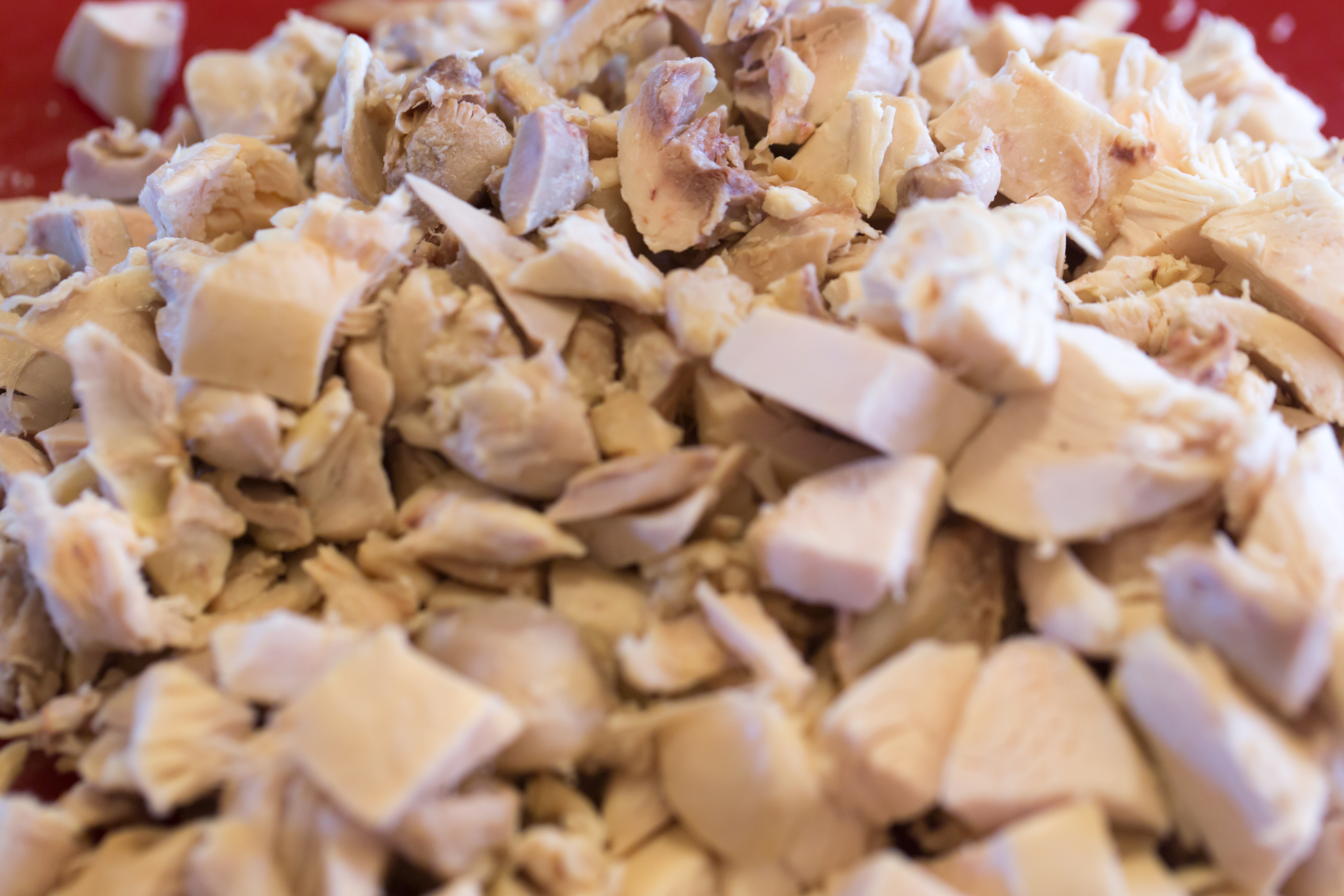
Cooked chicken ready for the gumbo pot

Cooked chicken ready for the gumbo pot


Andouille sausage

Andouille sausage


Gumbo base simmering

Gumbo base simmering


The Cajun Holy Trinity stirred in to stop the roux from darkening too mucn

The Cajun Holy Trinity stirred in to stop the roux from darkening too mucn


Roux beginning to cook but it needs to get a lot darker than this

Roux beginning to cook but it needs to get a lot darker than this


You need the biggest metal spoon you can find to keep you from getting burned with Cajun napalm

You need the biggest metal spoon you can find to keep you from getting burned with Cajun napalm


The bowl of chopped vegetables ready to be dumped into the roux

The bowl of chopped vegetables ready to be dumped into the roux


Chopped vegetables

Chopped vegetables


The Cajun Holy Trinity

The Cajun Holy Trinity


Cooking the chicken to also make a double-rich chicken stock

Cooking the chicken to also make a double-rich chicken stock

This recipe should easily serve 8 to 12 hungry people

5 Comments

Filed under Food, Photography, Recipes

ANDOUILLE SAUSAGE

A while back, my friend, John Ed, and I made a batch of Andouille sausage. We used a recipe from an excellent book, Charcuterie: The Craft of Salting, Smoking, and Curing, Michael Ruhlman and Brian Polcyn, W.W. Norton and Co., New York and London, 2005. We wound up with more than we had anticipated, so I put some of it in the freezer. The other night when I woke at 3 AM and couldn’t get back to sleep, I decided to reorganize the freezer. (What else is there to do at three in the morning?) I came across the Andouille and thought a bowl of gumbo would be good during the changing fall season.

I wasn’t sure, though, how the sausage would taste after those many month of storage, so I made a quicky throw-together meal to try it out. The meal turned out better than I expected, and the Andouille was in good shape. Next on the schedule, then, is chicken and Andouille gumbo.

For making the sausage, you should have a stand mixer which can be fitted with a meat grinder/sausage stuffer attachment. You will also need some sausage-making supplies including “pink salt” (DQ Curing Salt, aka DC Curing Salt, aka Prague Powder #1, aka Insta-Cure, aka Modern Cure.) Whatever the name, the salt is a mixture of regular salt and 6.25% sodium nitrite. The sodium nitrite prevents bacterial growth, especially the organism that cause botulism. You will also need sausage casings, preferably medium natural hog. If you live in a big city you can probably find those things in a local meat-packing or butcher supply house. If you can’t find them, you can get them on-line from Butcher and Packer

The quick dish is basically tomato sauce and cooked spaghetti, but the flavorings from the Andouille season the mixture beautifully. Few dishes to wash, and you can get back to whatever you are doing.

RECIPES

Andouille Sausage

Ingredients

  • 5 pounds boneless pork shoulder, cut into chunks
  • 3 tablespoons kosher salt
  • 2 teaspoons cayenne pepper
  • 1 teaspoon pink salt *(see above)
  • 1 teaspoon dried thyme
  • ½ teaspoon ground mace
  • ½ teaspoon ground cloves
  • 1/8 teaspoon ground allspice
  • 3/4 teaspoon dry mustard
  • 1 cup yellow onions, diced
  • 1 tablespoon minced garlic
  • 10 feet of medium hog casings , rinsed free of preservative salt and soaked for 30 minutes

Method

  1. In a large bowl, combine all the ingredients and chill until ready to grind.
  2. Using the meat grinder attachment of your stand mixer, fitted with the small die, grind the mixture into the mixer  bowl that has been set in a larger bowl filled with chopped ice.
  3. On medium speed, using the paddle beater, mix the ground meat mixture for about 1 minute until it becomes sticky.
  4. Correct seasoning by frying a small piece of the ground meat in a small skillet, tasting it, and adjusting seasonings as needed to suit your taste.
  5. Change the meat grinder so that it has the sausage stuffing horn attached.
  6. Thread the hog casing onto the stuffing horn, and working slowly but smoothly, fill the hog casing with sausage mixture.
  7. Twist the filled casing into 6-inch links.
  8. Hand the sausage string on a hook or stick and let dry for 2 hours at room temperature.
  9. Smoke the sausages in a Bradley stove-top smoker or in a charcoal grill with damp wood chips added. Internal temperature should reach 150°F (65°C)
  10. When the sausages are smoked, cool in an ice bath, and then refrigerate or freeze until ready to use.

Sausage and Mushrooms with Quick Tomato Sauce

Ingredients

  • 3 smoked Andouille sausages
  • 2 tablespoons olive oil
  • ½ yellow onion, diced
  • 4 medium crimini mushrooms, sliced
  • 1 41.5 ounce can, tomato sauce
  • 2 cloves garlic, minced
  • 1 cup cut dry spaghetti

Method

  1. In a heavy-bottomed medium pot, brown the sausages and set aside.
  2. In the same pot, cook the onions and mushrooms, being careful not to burn. Return the sausage to the pot.
  3. Stir in the tomato sauce and minced garlic. Simmer for 15 minutes.
  4. Stir in the cut spaghetti, and cook at a slow boil until the spaghetti is tender, about 10 minutes.
  5. Adjust the seasoning with salt and pepper. Serve while still hot.

3 Comments

Filed under Food, Photography, Recipes

CAJUN CRAWFISH BOIL – IN SILICON VALLEY??

Our children grew up in Louisiana, and now they all live in California.They still love authentic Creole and Cajun cooking, but it is definitely hard to come by in the Golden State. For the last several years, my son and his wife have tried to change that. Every spring – crawfish season – they have a backyard crawfish boil for their friends, neighbors, co-workers, and their families. As is usual with crawfish boils, it has become a bigger and bigger production each year.

As an aside, there is a strict Louisiana terminology for the crustaceans: crayfish are what you dissect in high school biology classes; crawdads are what you catch for fishing expeditions; crawfish are what you eat. Often the experience of the boil participants becomes evident depending upon what they call the main dish. In Louisiana, mudbug is a perfectly acceptable alternative term, but in other places, the name causes a bit of squeamishness.

In preparation for the party, my son has consulted  one of friends from Louisiana known for his crawfish cooking skills. Peter has read lots of recipes in cookbooks and online. Most importantly, he has identified a reputable and reliable source for authentic Louisiana mudbugs. Then, there is the ordering process to make certain that the crawfish are shipped at the right time and arrive as scheduled so that they are still lively. Crawfish season starts during the winter months. Then, the critters are small but with soft shells. By now, almost the end of the season, the crawfish are much bigger, but their shells are often hard enough that novice eaters have problems getting to the succulent tail meat.

When the date of the party is set, my son places his order with Louisiana Crawfish Company in Natchitoches, LA.  The crawfish cost from $3.50 to $6.00 a pound depending upon size and quality and how many you order.  (Crawfish cost 89 cents a pound for our first crawfish boil 40 years ago.)  At this point, the key question is always how many should you order? For a novice crowd, allow 1 pound per person. For crawfish fans, allow 2 pounds per person. For aficionados (just about everyone in Louisiana) allow 5 pounds per person. Remember, if there are leftovers – unlikely – you can harvest the tail meat and freeze it for crawfish étoufée at some later time.  Of course, there are overnight shipment expenses, so the cost for crawfish for an average-sized party will run to close to $300.

The next step is to plan the rest of the menu. There are some absolutely necessary items: ice-cold beer, corn on the cob, new potatoes, onions, ice-cold beer, and ice-cold beer. Then there are optionals: something to eat while you wait for the crawfish to cook, bread or corn bread, coleslaw, watermelon, and desserts. Guests usually volunteer to bring a dessert. By all means, take them up on their offer.

There are certain equipment requirements for  a successful boil. You will need a large plastic or galvanized tub to purge the crawfish before you cook them. A high temperature propane burner will get the water boiling as quickly as possible. You also need to have a very sturdy stand that will hold a very heavy pot of water. The largest cooking pot and lid that you can find – 50 gallons is common – will let you cook a good-sized batch at one time. Find a canoe paddle for stirring the pot. You will need a large strainer with handle in order to scoop out the crawfish and vegetables when they are cooked.  A table covered with newspapers  will hold a batch of food for guests to get to. With a genteel group, paper plates should be in abundance. For serious crawfish eaters, cardboard flats of the sort you get with cases of beer work better.


STARTING THE BOIL

Remember, it takes a lot of heat and a long time to bring 30-40 gallons of water to the boil, so start this step several hours before you plan on eating. If the water boils too soon, you can always turn the temperature down for a time. Light the fire on the burner and adjust it to a hot flame. Be sure to have enough propane. There is nothing worse than running out of propane in the midst of a boil.  Fill the cooking pot with water from your garden hose. You will probably need two people to lift the pot; one gallon of water weighs 8.35 pounds. Season the water with enough salt to taste briny – a cup or two should be enough. Add two lemons cut in half. Drop in two bags of Zatarain’s Crawfish and Crab Boil. If you can’t find the bags, a bottle of the liquid variety should be enough. If you want, you can add some paprika and chile powder.  With most orders, Louisiana Crawfish Company will include a container of their Creole seasoning. It is really not necessary to add any more seasoning to the water, because you’ll be sprinkling on the cooked crawfish.

PURGING THE CRAWFISH

The crawfish will arrive in large sacks with lots of ice packed around them. Since they are cold-blooded, the crawfish will be alive but not very lively. You need to wake them up in a tub of water to which you have added a goodly amount of salt – half a box should be enough. The salt will cause the crawfish to empty their alimentary tract, so the water will become very dirty looking. You can drain the water and do a second treatment until the water clears, but be sure to drain the water as the crawfish will die if left in the water. Pick out any crawfish that float to the surface of the water, as they have most likely died in transit. Alton Brown declares that there are better ways to accomplish this step, but hey, he’s from Georgia and not a real Cajun.

PREPARING VEGETABLES

While the water is heating and crawfish are purging, prepare the vegetables that will cook with the crawfish. Remove the husks  and silks of fresh ears of corn. Break each ear in half. Allow 1 to 2 ears per guest. If necessary, scrub baseball-sized red potatoes. If you can only find larger potatoes, cut them in half. Allow 1 to 3 potatoes for each guest. Remove the outer husk from golf ball to baseball sized onions.  Allow 1 to 2 onions for each guest.

COOKING

The water must be at a full boil when you are ready to cook. Add the onions and potatoes first, as they will take the longest to cook. After about 15 minutes, add crawfish and corn. Add enough that the guests already in line can get several. From time to time, stir the pot with your paddle. When you think the crawfish are done, around 15 minutes (just to be sure, the cook usually samples from time to time), snag one and test for doneness. When everything is cooked, use your strainer to retrieve everything and dup  it out on the newspaper-covered table. Sprinkle with chile powder or Creole seasoning. Then encourage folks to help themselves while you get ready for your next batch. If you want, you can increase the spiciness of subsequent batches by adding  chile powder or Creole seasoning as you start each batch. This is often a good idea if not everyone likes spicy crawfish, so by this technique, the first batches are not as spicy, and they get spicier as time goes on, to go with the ice-cold beer.

HOW TO EAT A CRAWFISH

Eating your first crawfish is a little intimidating, especially if you have never had instruction. It’s actually very easy: just pull the crawfish apart at the joint between the body and the tail; then pry open the first ring of the tail shell with your thumbnail, squeeze  the tail fan firmly between the thumb and index finger of your other hand; and the tail meat will slide into your waiting mouth. The process is not always that easy and smooth, but with a little practice you will be eating crawfish as fast as you can pull them apart,

More advanced eaters relish the little morsel of fat that stays in the thorax shell and will “suck the head” to extract the tasty treat.

CLEANING UP

In preparing a crawfish boil, you will wind up using a lot of heavily salted water. Never empty the leftover water on the lawn or in your flower beds or you will wind up with a yellow spot in the grass or dead peonies.

As to the shells, it is a good idea to station plastic-lined garbage cans around the yard.  Then, when the party is over, you can just tie up the bags and dispose of them. Be aware that there is nothing that smells as bad as day-old crawfish bodies, so dispose of them as quickly as you can. They do not make good compost.
11 Comments

Filed under Food, Photography, Recipes

REGGIE’S AMAZING MICROWAVE PRALINES

Reggie Graves, one of our best friends from our days in Louisiana, recently paid us a visit. Reggie is well-known for his championship chili – I have written about it in the past – but he is an excellent cook besides that.  Whenever we have a chance to visit with Reggie, you can be sure that there will be good food and lots of talk about food.
We were definitely not disappointed on this visit. Reggie brought us a huge bag of shelled pecans and the promise to make his favorite microwave pralines.

During one evening of reminiscing about old times, we talked about a famous praline shop in the New Orleans French Quarter on Decatur between Jackson Square and the French Market. I am not sure that the shop still exists, especially after the devastation of Hurricane Katrina. The memory lingers on, beginning with the fragrance of caramel and roasted pecans drifting out onto the street for blocks around the shop. The accompanying visual is of a huge woman hovered over an equally huge copper pan filled with bubbling caramel and pecans. The woman would stir and stir the mixture until it was just right, and then she would ladle dollops of the blazing hot mixture onto a cool marble table. When the pralines had cooled, she would wrap them in squares of waxed paper, ready for sale to the many tourists who had lined up to watch her. Of course, the taste memory is biting into a golden brown praline filled with pecans and cooked so perfectly that the caramel was soft and chewy without any sugary texture.

Making pralines at home can be a challenge. First, you probably don’t have a big copper vat. Then there is the matter of getting the caramel cooked just right so that it is creamy without a trace of sugar crystals. That means that many home cooks – this one included – prefer to buy their pralines from a good candy store.

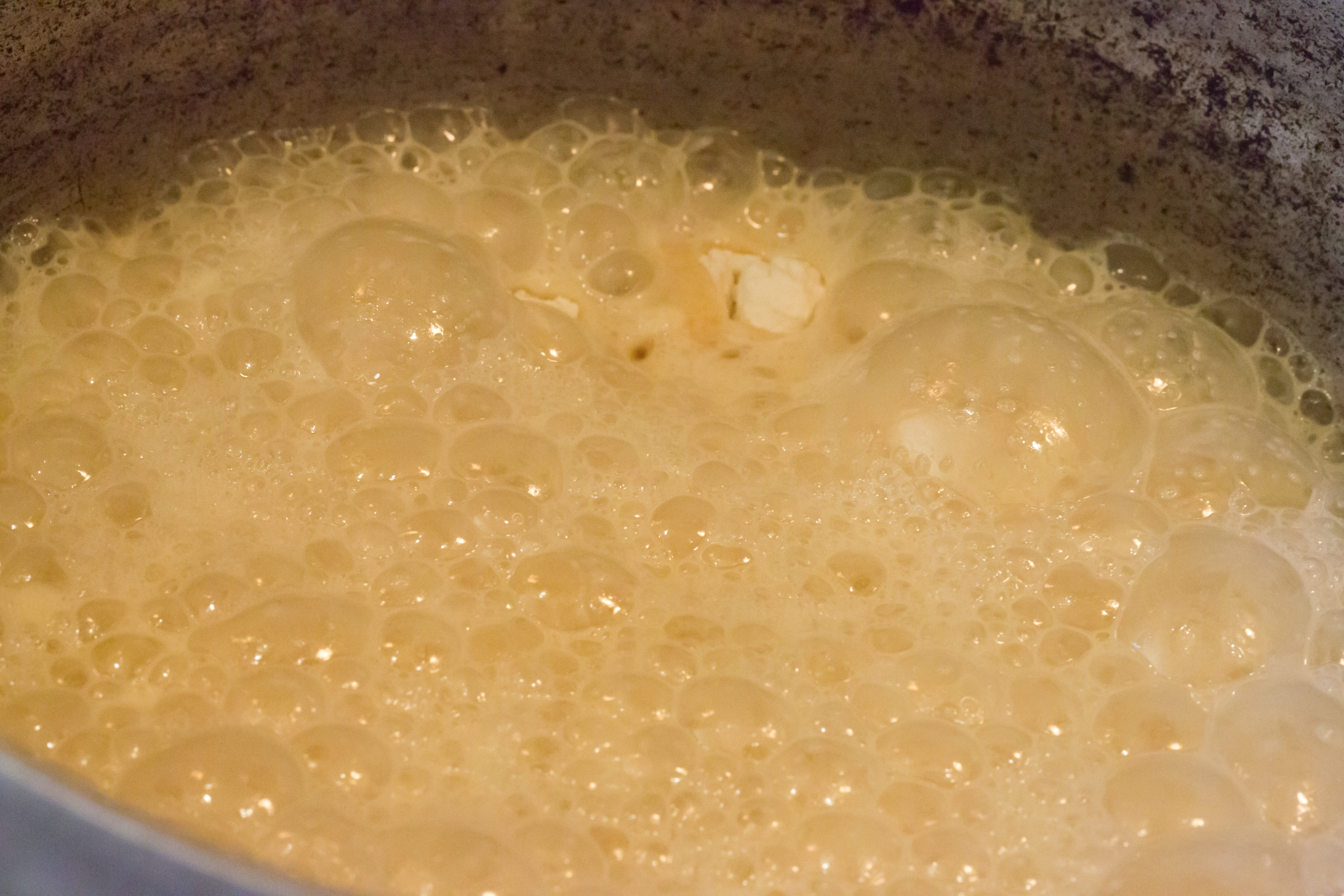
Those challenges are what makes this recipe so great. You can make perfect pralines in just a few minutes using your microwave. The biggest problem is to make certain that the time of cooking is tied to the wattage of your microwave oven. This recipe is designed for a 1000 watt appliance. To make it a general recipe, I tried to see if there are tables or graphs to suggest how you should adjust cooking time according to oven wattage. Indeed, there are lots of tables available, but I found most of them confusing and difficult to use. Instead, I developed a simple formula which you can use as a beginning guideline. You will probably need to experiment to find the ideal time for your oven, but a beginning point is to divide 1000 by the wattage of your oven and multiply the cooking time in this recipe (12.5 minutes) to find the approximate correct cooking time for your oven.

The other essential secret is to use a large enough (eight cups at least) microwave-proof bowl to boil the praline mixture.

With that, here is the recipe:

RECIPE

Ingredients

  • 1 pound light brown sugar
  • 1 cup heavy cream
  • 2 cups shelled pecan halves
  • 2 tablespoons butter
  • enough softened butter to grease a large baking sheet

Method

  1. In the large microwave-proof bowl or pitcher, combine the brown sugar and cream.
  2. Using a 1000 watt microwave oven with turntable, cook the brown sugar and cream mixture on High for exactly 12.5 minutes
  3. Using a hot pad, transfer the bowl with the cooked mixture to a heat-proof surface.
  4. Stir in the pecan halves and the butter,
  5. Working quickly, when the pecans are completely coated and the butter is melted and incorporated, form the pralines
  6. With a soup spoon or tablespoon, ladle spoonfuls of the mixture onto the buttered baking sheet.
  7. Cool enough before eating so that you don’t burn your tongue, but pralines are delicious warm or cold.
  8. If you get tired of eating just the pralines, try crushing them before sprinkling them over dishes of vanilla ice cream

2 Comments

Filed under Food, Photography, Recipes

RED BEANS AND RICE

Whenever our children visit us with their families, as they did this Christmas season, we try to make old favorites from their childhood. Often the food is drawn from the Southwest, but all three of them grew up in Louisiana, so Cajun and Creole dishes are high on the list of favorites. Gumbo is popular, and boiled crawfish in the spring is almost required. Bread pudding and shrimp creole are also on the list, along with red beans and rice.

For as long as anyone can remember, Monday has been laundry day in New Orleans. For as long as anyone can remember, red beans and rice has been the standard Monday supper in New Orleans because it can be started when the wash is started, stirred from time to time during the day, and finished when everyone is ready to gather around the table in the evening. We didn’t live in New Orleans, but the custom is common throughout the entire state of Louisiana.

An essential part of the dish is the meat that is used in the red beans. Traditionally a ham hock is tossed in – mostly for flavor – but also for the morsels of ham that are closest to the bone. Andouille sausage is popular as is Tasso ham. Sometimes you will see whole pork chops swimming in the stew. For this version, I chose boneless pork loin which gives good flavor and tenderness without bones. The chunks of pork fit perfectly on the fork and make a single melt-in-your-mouth bite.

Usually red beans and rice have the spiciness that is famous in Cajun and Creole cooking, but because one of our family members has severe reactions to hot spices, we make it without red pepper or chiles. Not to worry, because it is easy to add your preferred level of hotness at the table with Tabasco or Louisiana hot sauce.


RECIPE

Red Beans and Rice

Ingredients

  • 1 pound dry small red beans
  • water to cover the beans for cooking
  • 3 tablespoons olive oil
  • 1 medium onion, chopped
  • 3 ribs celery, chopped
  • 1 large bell pepper, seeded and membranes removed, chopped
  • 2 cloves garlic, minced
  • 2 pounds boneless pork loin, cut into ¾ inch cubes
  • 1 bunch green scallions including green stems, chopped
  • 2 bay leaves or ¼ teaspoon ground bay leaves
  • ¼ teaspoon ground thyme
  • salt and pepper to taste
  • Louisiana hot sauce to taste
  • 1 cup long-grain rice, rinsed in a fine sieve with cold water
  • 1½ cups water

Method

  • Pour the beans into a heavy-bottomed pot and cover with water. Bring to the boil and then reduce heat to a ver slow boil. Cover and cook the beans for 1½ to 2 hours or until they are tender. Stir the bottom occasionally and add more water if needed.
  • When the beans are tender, transfer them and the cooking liquid to a large bowl Rinse and dry the pot. Then return the pot to a medium flame and add the olive oil.
  • When the olive oil is just shimmering, add the chopped onions, lower the heat and cover so that the onions “sweat” (become soft and translucent and give up some of their moisture). Do not let them brown.
  • Remove the lid, turn up the heat to medium and stir in the celery, green pepper, and garlic. Cook, stirring frequently until the vegetables are throughly wilted. Then transfer them and their juices to a plate.
  • Return the pot to the stove. Add the cubes of pork and brown them. Use more oil if needed.
  • When the meat is evenly browned, return the beans and their liquid, along with the vegetables, and bring the mixture to the boil. Add the scallions, bay leaves, and thyme.
  • Simmer the mixture, covered, for an additional hour. Adjust the seasonings with salt, pepper and, if desired, hot sauce. Remove the bay leaves
  • While the red beans are cooking, prepare the rice by combining the rice and water in a small covered pot. Bring to the boil. Stir. Cover and reduce the flame to very low. Do not remove the cover, but cook for 20 minutes. Test for doneness. The water should be completely absorbed, and the rice should be fluffy with individual grains.
  • Serve by placing a scoop of rice in the middle of a wide-mouthed bowl. Top with the red bean mixture, and serve with additional hot sauce.

Should serve 6 to 8

6 Comments

Filed under Food, Photography, Recipes