Category Archives: Recipes

PAIN PERDU – NEW ORLEANS-STYLE FRENCH TOAST

We have been spending several days in San Francisco, watching two of our grandsons while their parents are off to London and Paris for a cooking demonstration along with “professional observation and study” of some amazing restaurants in both cities. I have been in charge of packing lunches, and each evening I look at the lunch boxes to see what has been eaten. It is usually a big let-down but also a stimulus to pack something they will eat. Pirate’s Booty seems to be a sure-fire winner. Keep in mind that they are six and three years old. Still.

Susan and I have been sharing breakfast duties. Of course, there are always toast soldiers and dry (no milk!!) Cheerios to proffer, but that gets monotonous, even for the cook. So far, Susan has been the winner with plates that include maple syrup or – the kids’ favorite – Louisiana cane syrup from Shreveport. Taking a cue, and wondering what to do with a dried-out hard loaf of French bread that Sarah had left after using part of it for Thanksgiving dressing, I decided to make French toast.

“French toast” apparently got its name in England; there are other names for the dish in other countries. In France and New Orleans it is known as “pain perdu” i.e. “lost bread”. I’m not sure about Paris, but I am certain that it is a staple in New Orleans. Most of the cafes and bistros that are open for breakfast in the French Quarter feature it.

Honestly, I am not a big fan of French toast like my mother used to make. Slices of store-bought sandwich bread dipped in egg and fried always seemed like  a soggy egg and toast. But pain perdu is a totally different experience. Done properly the dish should be puffy and golden with a crisp outside and a custardy inside. The secret is to use good-quality dry bread and give it enough time to soak up the egg and cream bath.

RECIPE

Pain Perdu

Ingredients

  • slices of dried French bread
  • eggs (one egg for each slice of bread)
  • cream (½ cup for each slice of bread)
  • Vanilla sugar (1 tablespoon for each slice of bread) Note: you can make vanilla sugar by placing a vanilla bean in a covered container filled with sugar and letting stand overnight. Alternatively, you can substitute  plain sugar and ¼ teaspoon vanilla extract.
  • unsalted butter (1 tablespoon for each slice of bread)

Method

  1. Arrange bread slices in a pan large enough to hold them in a single layer
  2. Beat the eggs well and then combine with cream, sugar, and if needed, vanilla extract.
  3. Pour the egg mxture over the bread slices, turning the bread once before covering with plastic wrap and refrigerating overnight. Turn occasionally to make sure both sides of bread absorb the egg mixture.
  4. Heat a large skillet over medium-low flame. Add butter and heat until the butter stops foaming. Add the soaked bread and fry until both sides are golden. Serve immediately with syrup or fruit compote.

10 Comments

Filed under Food, Recipes

VITAMIX CRANBERRY-ORANGE RELISH

This dish has been on our family’s Thanksgiving table for as long as I can remember. We have chilled canned cranberry sauce, too. That way everyone can admire the indented rings that come from the can when the cranberry jelly slides onto the serving plate. But no one would consider eating turkey without cranberry-orange relish. The recipe comes from Helen Corbitt’s Cookbook, published in 1957. Helen Corbitt was the doyenne of Texas dining and is widely considered to have single-handedly  changed Texan tastes from exclusively chicken fried steak (Nothing the matter with that, I might add.) to things like asparagus and fancy desserts. She was from New York where she got a degree in home economics before becoming a therapeutic dietician at two of New York City’s most prestigious hospitals. From there she moved to the University of Texas at Austin to teach and run a laboratory kitchen. She was recruited away from that to star in several country club and hotel restaurants before landing at Nieman-Marcus’ flagship store in Dallas. She established her celebrity there, and was regarded to be the arbiter of good cooking in all of Texas.

For our version, we follow Helen Corbitt’s original recipe almost exactly – except we add a cup of chopped Texas pecans. It is my observation that at Thanksgiving, everything should contain a few pecans. Usually we grind the cranberries and oranges in a meat grinder as instructed by herself, but in this latest cross-country move we have squirreled away the grinder, not sure where in the unpacked boxes. Besides, when we did it that way, orange juice always ran out of the back end of the grinder requiring a pan on the floor to catch the mess. I thought my Vitamix might work well as a substitute, and I was right. The relish turned out just as I remembered it, and the cleanup was much easier.

Here’s a wish for all of my blogging friends: Have a Happy Thanksgiving.

RECIPE

Vitamix Cranberry-Orange Relish

Ingredients

  • 1 quart whole cranberries (about 1½ packages of commercial cranberries)
  • 2 large navel oranges, cut into eighths
  • 1½ cups sugar
  • 1 cup pecans, chopped coarsely

Method

  1. With the Vitamix setting on VARIABLE and power at 3, add the cranberries to the beaker. Pulse and use the plunger to move the cranberries to the blades of the mixer. When the cranberries are chopped to your liking, transfer them to a large bowl.
  2. Working in three batches, add the orange pieces to the beaker. Pulse at the same settings, using the plunger to ensure even chopping. Transfer the chopped oranges to the bowl. Stir in the sugar and pecans until the mixture is evenly combined.
  3. Chill for a couple of hours or overnight. Serve the chilled relish as part of your Thanksgiving table.

4 Comments

Filed under Food, Photography, Recipes

DILLY BREAD

This recipe came as a wedding gift. It was given to Susan by Mrs. Murray, the wife and mother of the family with whom I lived for a while during professional school. Mrs. Murray was a good baker, but dilly bread was one of her specialties. I asked her for the recipe every time she made it, but she always declined or “forgot.” It was an old family secret, she explained, but when Susan and I were married, she gave Susan an index card with the hand-written recipe inscribed on it. She presented the card with great flourish and the admonition not to pass the instructions along as it was a real family secret. For a few years, Susan honored the request until she was asked to contribute a recipe to a fund-raising collection that was being assembled by the Housestaff Wives’ Club! (Do they even have such a thing these days? And it is probably called Spouses’ Club.) In any event, Susan inadvertently omitted a key instruction about letting the bread dough rise. If one is a baker, one would probably have figured that out, but many in the group of newly- and recently-wed women did not. They accused Susan of intentionally leaving out key instructions. That’s what some home cooks, protecting their prowess and their secrets, did in those days. Susan has never again contributed a recipe to a cookbook project.

I believe that Mrs. Murray’s family recipe may not have been as old as she suggested.  The Pillsbury Company sponsored an annual Bake-Off® * which was very popular with home cooks in the 1950s and 1960s. The events were always held in big cities, and the winners took away a lot of prizes including cash, new stoves, and mixers. Leona Schnuelle was declared the Grand Champion at the 1960 Bake-Off® in Washington, D.C., with her recipe, “Dilly Casserole Bread.” The win must have been very exciting for Mrs. Schnuelle who lived on a farm near Crab Orchard, Nebraska, a town of around 40 southeast of Lincoln. In my efforts to track down the dilly bread history, I keep coming back to Mrs. Schnuelle, so I guess she must be considered the inventor of dilly bread. I say that with a little uncertainty because dilly bread has been described as “Amish dill bread”, and there are others who claim invention. All of the claims that I have found come after 1960, so in my opinion Mrs. Schnuelle can still claim inventorship.

This recipe has several differences from the original prize winner. It uses fresh onion instead of dehydrated onion; amounts of ingredients have been doubled; a brief kneading has been added; and loaf pans are used for baking instead of a casserole. You will note that I have included instructions for rising. The cottage cheese may retard rising, so it might take longer than with regular bread. Be careful not to kill the yeast with too-hot water, as I did in one try for the blog.  In spite of all these changes, it is basically the same recipe as Mrs. Schnuelle’s, and the end result is the same – tender, delicious, fragrant bread that you might wind up eating at one sitting.

*Pillsbury is trying to resume the event in cooperation with Rhee Drummond and the Food Network. Deadline for entries was November 10.

RECIPE

Dilly Bread

Ingredients

  • 2 tablespoons butter
  • ¼ cup finely chopped onion
  • 2 envelopes active dry yeast
  • ½ cup warm water (105-115°F)
  • 2 cups small curd cottage cheese
  • ¼ cup sugar
  • 2 teaspoons salt
  • ½ teaspoon baking soda
  • 2 teaspoons dill seed + some to sprinkle on top before baking
  • 2 teaspoons dill weed (If you like, substitute finely chopped fresh dill fronds)
  • 2 large eggs
  • 5 cups all-purpose flour
  • melted butter
  • Kosher salt

Method

  1. In a small pan, melt butter over medium-low heat. Add the chopped onion and cook slowly until translucent. Do not allow to brown. Set aside to cool.
  2. In a large bowl, add warm water and sprinkle the yeast. Stir until completely dissolved and let stand for 5 minutes.
  3. Add the cooked onion, cottage cheese, sugar, salt, baking soda, dill seed, and dill weed. Mix thoroughly. Then stir in the eggs until they are fully incorporated.
  4. Add the flour, a cup at a time, mixing it thoroughly after each addition. Use a large spoon for mixing at first, but as the dough becomes stiff, use your hands to mix in the flour. When the flour is completely incorporated, knead the dough for about 5 minutes until it is smooth and elastic. If the bowl is large enough, you may knead the dough in it. You can also knead the dough on a floured surface.
  5. Wash, dry, and oil the mixing bowl. Return the kneaded dough to the bowl, cover with plastic wrap, and place in a warm place to rise until doubled in size, about 1 – 2 hours.
  6. Punch down the risen dough. Divide in half and shape into smooth loaves. Put the loaves in two well-greased  9 inch x 5 inch bread pans. Cover and let rise for the second time in a warm place until doubled in size. The dough should just about reach the edge of the pan. Immediately before putting them in the oven, brush the tops of the loaves with melted butter, and sprinkle with dill seeds and Kosher salt (I use Welsh smoked sea salt – Halen Môn – but any coarse salt will do.)
  7. Bake in a pre-heated oven at 350°F for about 50 minutes or until the loaves are well browned and sound hollow when tapped on the bottom. Turn out of the pans and cool on a baking rack.

4 Comments

Filed under Food, Photography, Recipes

GREEN CHILI CHEESE CORNBREAD

The big day arrived on Saturday. An electrician came and moved the electrical receptacle so that the range could be pushed into the waiting space. After shoving, lifting, adjusting, etc. the range was declared installed. The burners came on. The oven heated up. There was no alarm or error message. All of that happened just in time because it was our turn to host our family Sunday dinner. I had already planned to make chili in the slow cooker as a fall-back, so I went ahead with that plan. I had promised my grandson some cornbread to go with the chili if the stove wound up being installed. Cornbread turned out to be the inaugural dish cooked/baked in the new stove. The stove is great. There are just enough bells and whistles to let you know it is a new stove, but not so many that you can’t figure out how to operate it without a degree in electrical engineering. Most importantly, the stove has KNOBS that you turn to start a burner or the oven. There are no electronic touch panels that would almost certainly short out at some time to require an expensive electronic replacement.

The chili bubbled away for hours in the slow cooker. Spoiler alert for all Texans. I added pinto beans, and they required the extra hours of simmering. In line with the theme for the night, I made a jicama and kumquat salad with a light dusting of ground chiles along with queso fundido with chorizo on tortillas for snacks with drinks. A chili night, even though we had all the windows open.


Per our custom, Carol’s contribution to the meal was dessert. She planned on using apples as it is now apple season, but she could not decide on a French apple tart or an American apple pie. Her family is fond of both, so she decided to make one of each and have a vote of preference by the family. The desserts were both beautiful and both delicious, but the French tart won, hands down. Carol was pleased with the outcome because she said the tart was much easier to make. We did not do a calorie comparison. No one wanted to know.


As to the cornbread, the oven worked beautifully. I added green chiles and cheddar cheese to the standard family cornbread recipe. I did not use sugar, but if you are one of those folks who believe that cornbread needs a touch of sweetening, you can add 1 tablespoon of sugar to the dry mixture. I also baked the bread in a cast iron skillet. I believe that makes a crisper crust, but you can use a well-greased baking pan instead. A 9×9 or 9×13 inch pan should do, although the bread will be thinner and crisper with the larger pan. You may need to cut the baking time a little short.

RECIPE

Green Chili Cheese Cornbread

Ingredients

  • 1 cup all-purpose flour
  • ¾ cup yellow cornmeal
  • 1½ teaspoons baking powder
  • ½ teaspoon baking soda
  • 1 teaspoon salt
  • 4 tablespoons unsalted butter, melted
  • 1½ cups buttermilk
  • 2 eggs, lightly beaten
  • 1 4 ounce can chopped green chiles, rinsed and drained
  • ½ cup grated sharp cheddar cheese

Method

  1. In a large bowl, combine the flour, cornmeal, baking powder, baking soda and salt.
  2. In a small bowl, combine the melted butter, buttermilk, and beaten eggs.
  3. Pour the liquid ingredients into the dry ingredients and combine with a fork or spatula until they are evenly mixed. Stir in the green chiles and grated cheese.
  4. Pour the batter into a well-greased cast iron skillet that has been heated in an oven pre-heated to 425°F. Bake in the middle of the oven for 25 minutes or until the top of the cornbread is evenly browned.
  5. Cool on a baking rack for 5 minutes. Cut into eight wedges and serve while still warm.

5 Comments

Filed under Food, Photography, Recipes

HAMBURGER SOUP

Back to the slow cooker; next step in the stove saga (epic?) is set for Saturday. We shall see. One thing about it, using the cooker for most meals encourages creativity. What can you put in the crock that will not taste the same as the last thing you cooked? Even though there are libraries full of slow cooker recipes, for me there are only a few things you can put in the pot and cook all day. I confess. I have gotten better at it, and I have figured out how to use lots of things from the refrigerator. Still…  I would be willing to bet that every slow-cooker aficionado out there has a recipe for hamburger, broth, and vegetables so this will not be an exciting post. But the recipe is very easy – and better than I had hoped.

RECIPE

Hamburger Soup

A bowl of soup

Ingredients

  • 2 tablespoons olive oil
  • 1 medium onion, diced
  • 1 pound ground beef
  • 1 large carrot, peeled and diced
  • 2 medium russet potatoes, peeled and diced
  • 2 stalks celery, chopped coarsely
  • 4 cups beef stock
  • 14.5 ounce can diced tomatoes
  • 2 bay leaves
  • ¼ teaspoon ground thyme
  • 3 cloves garlic, minced
  • juice of ½ lemon
  • salt and pepper to taste

Method

  1. Add the olive oil to slow cooker set at LOW. Stir in the onions, cover, and cook for a few minutes until the onions are translucent.
  2. Stir in everything else: ground beef, carrot, potato, celery, beef stock, canned tomatoes, bay leaves, thyme, garlic, lemon juice. Cook on LOW for 4 hours, longer on SIMMER or until the carrots and potatoes are fork-tender. Adjust seasoning with salt and pepper. Remove bay leaves. Serve.

5 Comments

Filed under Food, Photography, Recipes

SLOW COOKER BRISKET

I have written about the family recipe for braised brisket before. The previous time, two years ago, I combined it with latkes in honor of a family celebration. This time, I have modified the recipe for the slow cooker. That requires essentially no modification, the difference being that you braise a smaller brisket in a slow cooker rather than a larger brisket in the oven. It works just as well, and the results are always the same. Cheers go up from the crowd when the brisket is sliced, and no one needs encouragement to go back for seconds. That’s the same reaction Sarah gets when she does a brisket for family meal in whichever restaurant she might be cooking.

A good friend of Susan shared the recipe over 50 years ago. That was an act of regard and true friendship, because the recipe had been passed down in that family for years and, in the custom of the day, was considered to be a “family secret”. Actually, that’s how we treated the recipe for many years.

There are only a few rules to follow in preparing brisket by this method.

First, you will need to have the butcher cut the brisket to order, as a whole brisket is way too large to fit in the usual slow cooker. If your pot is smaller, you probably only need a 2-pound piece.  If the pot is larger, a 3-pound piece is a good size. That presents the problem as to what to tell the butcher. One end of a full brisket is called the “first cut” or “flat cut”. The meat is leaner and may require longer braising. The other end has more fat and is called “second cut” or “point”. During braising, the fat will render and the remaining shards of meat will be tender and can easily be shredded.

Second, it is important to marinate the brisket over night. This recipe uses a marinade that includes liquid smoke and is then used as the braising liquid. If you have your own favorite marinade, by all means use it.

Third, lower is better, and so is slower. It is hard to get the temperature too low although you shouldn’t try for anything lower than 170°F. Keep in mind that you will need to cook the brisket longer the lower the temperature. At 170°F you should plan on at least 12 hours cooking.  If the cooking is not long enough, the meat will be done but not as tender as you might like. Fortunately, it is hard to ruin the brisket by cooking it too long.

When you are ready to serve the brisket, let it rest on a cutting board for 5 minutes and then slice it thinly on the diagonal with the grain of the meat and with a 45° angle with the cutting board. It should be fork-tender. Shred it, using two forks, if you prefer.

RECIPE

Slow Cooker Brisket

Ingredients

  • 2 tablespoons liquid smoke
  • 2 tablespoons Worcestershire sauce
  • 1 teaspoon garlic salt
  • 1 teaspoon onion salt
  • 1 teaspoon celery seed
  • 2-3 pound brisket
  • salt and pepper to taste

Method

  1. Combine the liquid smoke, Worcestershire sauce, and seasonings in a metal pan. Add the brisket, and cover with aluminum foil.  You can use a large zippered freezer bag if you prefer. Marinate overnight in the refrigerator, turning occasionally.
  2. Place the marinated brisket in a slow cooker large enough to hold it flat. Cover. Set the cooker on LOW (about 200°F in my slow cooker) or SIMMER (about 185°F in my slow cooker) and cook for at least 10 hours, turning frequently during the cooking process.
  3. When the brisket is done to your satisfaction, remove from the oven to a cutting board. Let rest for 5 minutes. Then slice on a diagonal with the grain of the meat. Serve immediately.

4 Comments

Filed under Food, Photography, Recipes

OSSO BUCO IN A SLOW COOKER

We bought our own slow cooker so that we could return the one we had borrowed from Carol. Susan found a large one because she wanted to try it with brisket. Dutifully, I went to the butcher shop and bought a beautiful 3 pound brisket that was just the right size for the cooker. (I’ll post the family recipe for that at a later date. ) While I was waiting for the butcher to cut the brisket to order, my eye caught some meaty veal shanks lined up in pairs in one corner of the display case. To my way of thinking, shanks of any sort – lamb, veal, beef – are delicious and perfect for braising. They turn out fork-tender and suffused with the herbs and liquids that you use to braise them. Another perfect meal for the slow cooker. I had two wrapped up with plans for dinner for the evening. Those plans would include topping the braised veal with the traditional gremolata, a distant cousin of chimichurri and Italian salsa verde, and scooping out the braised marrow to spread on toast soldiers. I wound up serving the mirepoix – onion, celery, and carrot – but you can strain it out. I think that would be too bad because the braised vegetables are so flavorful. You can also add tomatoes, anchovies, and different herbs – or not. There are many recipes and variations for osso buco, so unless you’re a purist you can take some liberties with the preparation to make it your own.

RECIPES

OSSO BUCO

Ingredients

  • 2 tablespoons olive oil
  • 2 cross-cut veal shanks
  • ½ cup carrots, coarsely chopped
  • ½ cup celery, coarsely chopped
  • ½ cup white onion, coarsely chopped
  • 4 cloves garlic, smashed
  • bouquet garni ( 3 sprigs parsley, bay leaf, 3 sage leaves, 3 branches thyme in cheesecloth packet)
  • ½ cup chicken stock
  • ½ cup dry white wine
  • salt and pepper

Method

  1. Heat the olive oil in the slow cooker set at LOW. Add the veal shanks, turning them until they are lightly browned on both sides, about 5 minutes. Don’t worry if they don’t brown fully on the low temperature of the cooker.
  2. Add the carrots, celery, onion, smashed garlic, bouquet garni, chicken stock, and white wine. Cook, covered, for 3 hours with the cooker set on SIMMER if you have that setting, otherwise, set on LOW. Check periodically and add more chicken stock if needed.
  3. Remove the bouquet garni and correct seasoning with salt and pepper. Serve the lamb shanks on a bed of the vegetables on individual plates with the braising liquid ladled over them. You can make a thicker sauce if you wish to use another pan. Transfer the braising liquid to a small saucepan over a medium flame to reduce the liquid by half. Top with the gremolata.

GREMOLATA

Ingredients

  • 12 sprigs of parsley, stems removed and leaves chopped very finely
  • 1 large clove garlic, base and green sprout – if any – removed
  • 1 lemon, zest + 1 tablespoon juice
  • salt and pepper

Method

  1. On a cutting board, chop the parsley finely and push it into a compact pile.
  2. Using a micro plane, grate the garlic onto the pile of parsley.
  3. Again using the micro plane, zest the lemon onto the parsley.
  4. Add 1 tablespoon lemon juice.
  5. With your fingers, combine the ingredients. Adjust seasoning with salt and pepper. Transfer to small bowl.
  6. Serve on top of the braised veal shank, and pass any extra at the table.

4 Comments

Filed under Food, Photography, Recipes

MILE-HIGH STRAWBERRY PIE

One thing I have learned during the stove outage is that it is very difficult to make dessert without a stove and oven. Not impossible, of course, but difficult. You need to bake cakes and most pie crusts. Fillings sometimes need to be cooked on the stove. Even the custard for ice cream needs to be cooked. Since the breakdown, I have made a cheese plate with grapes and sliced pears. The grandchildren thought that was too fancy and not sweet.  I have served ice cream from the store, but that doesn’t count. This week was my turn for dessert for Sunday family dinner. I looked through several recipe books but had difficulty in finding a cooking-free recipe that sounded delicious. This comes from Marion Cunningham’s The Fannie Farmer Baking Book (Alfred A. Knopf, New York, 1984). I have freed the original recipe from the oven by using a packaged graham cracker crust from the grocery shelf. I have also added gelatin so that the filling holds its shape. Key tips that don’t appear in the recipe and that you should follow include making certain that you beat the egg whites so they form stiff peaks. Any less and the filling will collapse. If you need it, a pinch of cream of tartar might help. The cream should also be beaten so that it holds peaks. Chilling overnight is highly recommended.

RECIPE

Mile-High Strawberry Pie

Ingredients

  • 5 egg whites
  • 1/8 teaspoon cream of tartar (optional)
  • ¾ cup sugar
  • 10 ounce package frozen strawberries, thawed
  • 1 envelope unflavored gelatin
  • 2/3 cup heavy cream
  • 1 9-inch prepared graham cracker crust
  • 1 quart fresh strawberries, washed, hulled, and sliced in half

Method

  1. In a large bowl, beat the egg whites with an electric mixer until they form soft peaks. Add the cream of tartar if you are using it. Gradually add the sugar and continue to beat until they hold stiff peaks.
  2. Set aside ½ cup of juice from the frozen strawberries before beating the berries and remaining juice into the egg whites. Continue beating until the mixture becomes fluffy and stands in soft peaks.
  3. Place ¼ cup of the reserved juice in a small bowl, sprinkle with the gelatin and let stand for 5 minutes until the gelatin has bloomed. Meanwhile, heat the remaining ¼ cup juice in the microwave, about 15 seconds on high. Stir the hot juice into the gelatin mixture, stirring until the gelatin is completely dissolved. Beat into the egg white mixture.
  4. Whip the cream until it forms stiff peaks. Fold into the egg white mixture.
  5. Pile the mixture into the prepared crust. Chill overnight in the refrigerator. Arrange fresh strawberries over the top and serve.

7 Comments

Filed under Food, Photography, Recipes

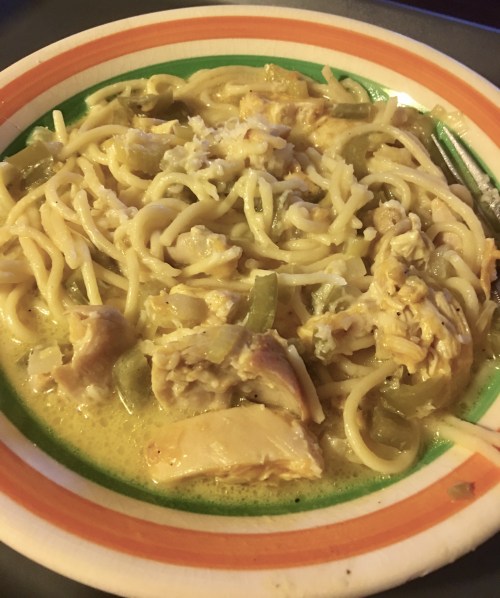
SLOW COOKER CHICKEN SPAGHETTI

Our stove is still unrepaired so I continue using my daughter’s slow cooker. I hope that she doesn’t ask for it back any time soon as we’re still uncertain about how much longer the stove will be out of commission.  The rotisserie chicken for Sunday dinner turned out well. I had done two chickens so there were lots of leftovers for us and for Carol. I tried to think of how I could use the chicken in some slow cooker recipe. Soup immediately came to mind, but it seemed too hot outside for soup. I couldn’t figure out how to make chicken pot pie or chicken and dumplings without a stove. Old-fashioned chicken spaghetti sounded like a good option. We ate chicken spaghetti at the East Texas farm for as far back as I can remember. The recipe was a treasure of Susan’s mother and included a generous amount of Velveeta. I suspect the original recipe came from a Velveeta box and that it has been copied onto 3 x 5 cards in many families. This is not the authentic recipe. I used sharp Cheddar instead of Velveeta. I also wound up cleaning out the vegetable drawer in the refrigerator along with using up all of the leftover chicken.  Since the leftover chicken had been topped with garlic butter, I did not add garlic, but you could if you like. The slow cooker was the perfect utensil for the project.

RECIPE

Slow Cooker Chicken Spaghetti

Ingredients

  • 2 tablespoons olive oil
  • ½ medium onion, chopped
  • 1 green bell pepper, seeded and chopped
  • 2 ribs celery, chopped
  • 2 cloves garlic, minced (optional)
  • 4 cups chicken stock
  • 8 ounces spaghetti
  • 4 ounces Cheddar cheese, shredded
  • leftover roasted chicken, bones and skin removed, cut into bite-sized pieces (about 4 cups)
  • salt and pepper

Method

  1. Sweat onions in olive oil for about 5 minutes with slow cooker set on High. Add pepper, celery, and optional garlic. Cook for another 10 minutes. Then add chicken stock and cook for 1 hour or until the vegetables are tender.
  2. Break the spaghetti into pieces that will fit into the slow cooker and stir into the pot. Cook for 20 minutes on High or until the spaghetti is just al dente.
  3. Reduce the heat to Low. Stir in the grated cheese until it is melted. Add the chicken and cook just long enough to warm it thoroughly. Adjust seasoning with salt and pepper. Serve immediately.

12 Comments

Filed under Food, Photography, Recipes

BUTTERMILK-BRAISED ROAST CHICKEN

It’s been six weeks since our stove and oven quit working. The saga of the long delay will have to wait for another blog – when and if the stove gets repaired. This time I will deal with how someone who likes to cook copes without a stove.

Six weeks is a long time to go without cooking for some households, at least ours.  During this time, we have eaten some delicious meals at Carol’s house, and for that we thank her. We have eaten at some little neighborhood restaurants across the street. But we have also depended upon our supply of plug-in appliances, along with a slow cooker that we borrowed from Carol. Waffles with the waffle iron, panini from the George Forman grill, and rice from the rice cooker have all been on the menu. The main thing I have done, though, is to use the slow cooker. It works beautifully and confirms all of the enthusiasm for its utility for busy people. You toss some things in the pot, turn it on, leave it unattended for a few hours, and return to a delicious dish just waiting to be served. The only problem, in my hands at least, is that everything comes out looking and tasting like stew. I know that there are myriad cookbooks filled with interesting recipes. I know that there are even some enthusiasts who claim you can bake a cake! I have not succumbed.

The one appliance I haven’t used since the demise of household fire is our Sunbeam rotisserie. I have written about it in the past; it really does do a good job of roasting things as if they were on a spit. It’s my turn for Sunday family dinner, so I thought it would be a good time to get out the rotisserie. It also seemed like the opportune time to try out Sarah and Evan’s recipe for roasted chicken that appeared in this month’s issue of Food and Wine. (Check out “Winner, Winner” on page 46 of the October, 2017 issue.) Since Douglas fir trees don’t grow at this altitude in Southern California, I substituted rosemary. Also, since the original recipe was for oven roasting, I have made a few changes to accommodate the absence of the stove and the demands of the rotisserie. Otherwise, everything is the same. The chicken is brined over night in a bath of buttermilk, salt, sugar, garlic and rosemary with the secret ingredient of porcini mushroom powder. The mushroom powder adds distinct umami to the mixture. The final touch of roasted garlic oil is also an important taste profile. Without a stove, I had to use the microwave to heat the garlic slices in olive oil.  Surprisingly, the garlic browned, although I am sure it could easily burn and become bitter. In any event, the process worked well, and the family had a pleasant Sunday dinner.

I will be glad when we get our stove back.

RECIPE

Buttermilk-Brined Roast Chicken

Ingredients

  • Kosher salt
  • 11 garlic cloves, 9 smashed and 2 thinly sliced
  • 2 tablespoons sugar
  • 2 tablespoons rosemary leaves
  • 1 bay leaf
  • ½ cup dried porcini mushrooms
  • 1 quart buttermilk
  • 1 chicken, 3 to 5 pounds
  • 2 teaspoons unsalted butter, softened
  • 2 tablespoons extra virgin olive oil

Method

  1. Combine ¼ cup Kosher salt, smashed garlic, sugar, rosemary and bay leaves in a large microwave-proof bowl. Stir in 2 cups of water. Heat in the microwave on high for 6 minutes. Remove from the microwave, stir to dissolve any undissolved sugar and salt. Add 2 cups of water and cool.
  2. Transfer the mixture to a large container big enough to hold the brine and the chicken. (I used an 8 quart plastic bread-proofing container.)
  3. Grind the porcini mushrooms to a powder using an electric spice grinder.
  4. Whisk the ground mushrooms and buttermilk into the salt and sugar mixture. Place the chicken in the mixture, cover, and refrigerate overnight. Be sure to remove any giblets that have been packaged inside the chicken.
  5. When you are ready to roast the chicken, remove it from the buttermilk brine, drain it well, and pat it dry with paper towels. With kitchen string, truss the bird: tie the legs together; tuck the wings behind the back and tie them firmly. You should wind up with a compact package that will fit easily on the rotisserie spit. Season all over with salt.
  6. Arrange the chicken on the spit so that it is firmly seated and will not come in contact with the heating element. Cover the rotisserie with the protective lid and turn on the spit.
  7. After 15 minutes, stop the rotisserie, brush the chicken all over with the softened butter.  Restart the rotisserie, and roast for an additional 50 minutes or until the temperature of the thickest part of the breast reaches 165°F as measured with an instant-read probe thermometer.
  8. Transfer the roasted chicken to a cutting board. Cover loosely with aluminum foil and let rest for 15 minutes.
  9. Meanwhile, combine the sliced garlic and olive oil in a small microwave-proof cup or bowl. Heat the bowl in the microwave on high for 2 minutes. The garlic should brown. Check to make sure it does not burn. Remove from the microwave.
  10. Remove the trussing from the bird. Cut into serving pieces. Brush lightly with the garlic oil. Serve immediately, passing the remaining oil at the table.

1 Comment

Filed under Food, Photography, Recipes