Category Archives: Recipes

RICOTTA PIE WITH ASPARAGUS, MUSHROOMS, AND PROSCIUTTO

Our ovens recently went on the blink, and we had to do without baking for over two weeks while the repairman ordered parts. We made it through the crisis – with some withdrawal symptoms – and our ovens were finally restored to working order. To celebrate, I decided to make a couple of quiches using some shrimp and fresh Spring asparagus from the grocery store. I made the quiches only to discover that I had left out the asparagus. My fall-back plan was to use the asparagus the next night in something else. The plan wound up to be an exercise in cleaning out the refrigerator. I came up with what is not really a quiche, so I called it a ricotta pie. Regardless of the name, it turned out to be a good use for the asparagus.

RECIPES

Pie Crust

Ingredients

  • 1 Cup all-purpose flour
  • ½ teaspoon salt
  • 1/3 Cup vegetable shortening
  • 2 2/3 Tablespoons (8 teaspoons) ice water
  1. Combine the flour and salt in a medium bowl
  2. Add the shortening and cut it into the flour mixture with a pastry blender until it resembles coarse corn meal
  3. Make a well in the center of the mixture and pour in the water, mixing with a table fork until the mixture comes together in a ball.
  4. Knead gently for just a few seconds, shape into a ball, wrap in plastic wrap, and chill in the refrigerator for at least 30 minutes

Pie Filling

Ingredients

  • 16 ounces low-fat ricotta
  • 3 large eggs, lightly beaten
  • 1 Tablespoon Pernod
  • 1 teaspoon Kosher salt
  • ¼ teaspoon finely ground white pepper
  • 1 pound fresh asparagus
  • 6 crimini mushrooms
  • 2 Tablespoons extra virgin olive oil
  • 3 ounces Swiss cheese, shredded
  • 3 ounces prosciutto, thinly sliced
  • 2 ounces Parmesan cheese, freshly and finely grated
  1. In a large bowl, combine the ricotta, eggs, Pernod, salt, and pepper until smooth and well blended. Set aside.
  2. Wash the asparagus, trim the woody ends (saving them for stock), and cut into 1-inch pieces. Set aside.
  3. Clean and slice the mushrooms. Sauté them in olive oil until they have given up their liquid. Drain and set aside.

Just out of the oven

Final Assembly

  1. Remove the chilled pie crust dough from the refrigerator and roll it into a circle large enough to line a 9 inch pie pan with enough to crimp the top edge.
  2. Ladle half of the ricotta mixture into the bottom of the prepared pie shell.
  3. Arrange the asparagus pieces over the filling. Then add the mushrooms, Swiss cheese, and prosciutto in layers.
  4. Cover with the remaining ricotta mixture and sprinkle with the grated Parmesan cheese.
  5. Bake in the middle of an oven pre-heated to 425° for 10 minutes. Then lower the oven temperature to 350° for an additional 60 minutes. Turn the baking pie front to back in the oven about half way through the baking. Watch carefully toward the end of baking and remove from the oven if the pie becomes too brown.
  6. Place the finished pie on a cooling rack for 5 minutes. Then slice into 6 or 8 pieces. Serve while still warm.

Ready to eat

4 Comments

Filed under Food, Photography, Recipes

CORRECTION ABOUT SARAH AND EVAN’S KICKSTARTER

Mea culpa!!

I gave you the wrong URL for checking out Sarah and Evan’s Kickstarter page. Here’s the right information directly from Sarah and Evan:

If you haven’t heard already…we’ve signed a lease for our restaurant at 199 Gough St! We’ve been working hard for this for many years now and are so excited that it’s this close!

We thank you for all of the support you’ve given us, we wouldn’t be where we are now without it.

We’ve opened a Kickstarter project, so if you or your friends are interested in being contributors to our new restaurant you can find us at http://www.kickstarter.com/projects/1777795794/rich-table We’d love to get our supporters involved, and we’re offering great rewards.

We will be planning a future pop-up prior to opening and will let you all know more about that soon.

Thank you again,

Sarah and Evan Rich

Leave a comment

Filed under Recipes

WEST TEXAS COWBOY SOURDOUGH BISCUITS

A few months ago I wrote about Carol’s favorite biscuit recipe, the Southern classic “Touch of Grace Biscuits”.  This post is about sourdough biscuits. When we lived in West Texas, for several years I attended an annual all-male overnight fishing trip held by some rancher friends  on the banks of one of the branches of the Brazos River running through a parcel of one of the legendary West Texas cattle ranches. Menus included classic ranch fare – grilled steaks, beans, fish (if we caught enough), hamburgers,  barbecue of all sorts, and of course lots of beer. The highlight, though, was a chuck wagon breakfast. The cooks would arise before everyone else, stir up the fires that had been stoked for the night, and begin to cook huge slabs of sliced bacon and scrambled eggs in surplus Army ammunition cans set over the open fires. They also stirred up the dough for sourdough biscuits to be baked in old-fashioned spiders (three-legged Dutch ovens with flat lids) that would be buried in the coals of the campfires. This was a feast for a king, or at least some satisfied West Texas cowmen.

Three-legged spider Dutch oven

Sourdough biscuits need to be started the night before you serve them at a cowboy breakfast out on the range, so be sure to get things going before the libations and campfire stories move into full pace. Hopefully you will have a sourdough starter that you have been treasuring and “feeding” for a long time, but don’t despair if you don’t. You can start your own in a week or two before the cookout. Yeast is a fall back, but it is definitely not viewed with favor out on the ranch. Depending upon how many mouths there are to feed, you will need to increase the recipe. Allow for at least three apiece, because even modern cowboys are hungry.  If you want to bake these at home, you don’t need to dig a fire pit, you can just use your oven. However, the instructions change a bit.

A pan full of biscuits about to go into the oven

A pan full of biscuits about to go into the oven

Cowboy Sourdough Biscuits

Sourdough biscuits fresh out of the oven

Ingredients

½ Cup                    sourdough starter

1 Cup                     milk

2 ½ Cups              all-purpose flour

¾ teaspoon         salt

1 Tablespoon      sugar

1 teaspoon          baking powder

½ teaspoon         baking soda

                             bacon grease from bacon cooked earlier (or 2 tablespoons of salad oil and 2 tablespoons of melted butter)

  1. The night before, dissolve the starter thoroughly in the milk. Be sure to use a large metal container that can be covered securely to keep out any varmints – human or otherwise – during the night.
  2. Thoroughly stir in one cup of flour, cover securely, and set in a warm place: not too close to the fire, but also not out in the cold night air.
  3. In the morning, combine the remaining 1½ cups of flour, salt, sugar, baking powder, and soda.  Then add to the starter mixture from the night before, and using clean hands (!?), combine into a soft dough. Knead in the metal container for a few minutes and let rest.
  4. In the meantime, prepare the fire: quench any active flames and with a hoe or shovel pull the coals to the edge of the fire pit so that your spider or Dutch oven will fit easily into the hole.
  5. On a flat, lightly floured surface, pat the dough into a round about ½ inch thick. Then cut individual biscuits. If this is a high-class cookout use a 2½ inch biscuit cutter. Otherwise use your cleanest knife to cut 2 inch squares.
  6. Dip each biscuit in bacon grease and place it in the bottom of the cast iron pot until the pot is completely full. Put the lid on the pot and lower the whole thing into the prepared cooking pit using the bale attached to the pot and a hook or hoe.
  7. With the hoe or shovel, layer some of the coals on the top of the cast iron pot – enough to evenly cover the lid.
  8. Bake for about 30 to 35 minutes.  It is very hard to check the baking, but you can try to remove the coals from the lid to check. Just remember to put them back on top if you bake some more. It is more likely that you will just have to take pot luck (so to speak), but my observation is that the usual crowd is just happy to get something to eat.
  9. If you are baking at home, dip each biscuit in melted bacon grease or a combination of oil and melted butter (bacon grease may be too strong a flavor for a home meal). Arrange the biscuits in a 10 inch cast iron frying pan. Bake in a preheated oven at 375° for 30 to 35 minutes.
  10. Serve immediately. Cold cowboy sourdough biscuits get as hard as a rock.

Yield: About 10 to 15 biscuits

Hot sourdough biscuits ready to eat
SOURDOUGH STARTER

Sourdough starter bubbling and ready to use

Sourdough starter can last a long time if it is properly cared for. We got one from a neighbor in Utah nearly forty years ago. That starter subsequently traveled to Texas, back to Utah, on to Louisiana, back to Texas again, and now New Mexico. Starter can be easily kept out-of-the-way in a closed jar in the back of the refrigerator for years. If you haven’t used it for several months it will have to be revived before using it.  If you can’t revive it, never mind. It is easy enough to start a new one. But don’t expect your friends to help.  Years ago we gave a starter to my brother and his wife.  They enjoyed it for some time and even gave some to their friends. Calamity struck and their jar of starter got thrown out when an unknowing individual cleaned out the refrigerator.  When my sister-in-law asked her friend for a new starter batch, the “friend” refused! It’s always better to be independent of others. Sourdough is slower than commercial yeast so breads made with it often do not rise as much. For that reason, breads made with sourdough alone require a long rise or fermentation, but starter can still be used for flavoring.  The most successful recipes are for biscuits, cornbread, pancakes, traditional country loaves, and French bread.

TRADITIONAL METHOD I

Ingredients

2 Cups   milk

2 Cups   all-purpose flour

  1. Mix the milk and flour together in a large ceramic bowl until smooth. Set uncovered in a warm kitchen for 2 to 5 days, stirring occasionally.  When the mixture is bubbly and has a yeasty, sour smell, the starter is ready.
  2. Store well covered in a glass or ceramic container on the counter or in the middle of the refrigerator.  Keep at least 3 cups on hand.
  3. Replenish by stirring in equal portions of milk and flour


TRADITIONAL METHOD II

Ingredients

1 Cup                     all-purpose flour

1 Cup                     water

  1. In a 4 cup or larger clear glass jar, mix the flour and water into a smooth paste. Set uncovered in a warm place. The kitchen is usually the best choice.
  2. Every day, check the mixture for bubbles, remove any tough skin that has formed on the top, pour off about half of the mixture, and add an additional ½ cup of flour and ½  cup of water, stirring to form a smooth paste.
  3. Repeat this process each day until the mixture is covered with bubbles and expands to double size or so. You should observe frequently during the day and evening because a good starter will eventually collapse from its own weight and lose volume.
  4. You will probably need to repeat the process for a week or more before you have established a good starter.
  5. After that, you should repeat the replenishment process for at least a couple of days before you plan to bake.
  6. You may store the starter in the refrigerator, but that is not necessary and even encourages less desirable things to grow and discolor the mix. If that happens, pour off the discolored top part, keeping just a few tablespoons of the starter to rejuvenate your stock.


NEW METHOD

Ingredients

2 Cups                   all-purpose flour

2 Cups                   water or milk

1 Tbsp                   sugar

½ pkg                    dry yeast

  1. Mix the flour, milk and sugar together into a smooth batter. Sprinkle the yeast over the surface and stir in. Allow to stand uncovered in a warm kitchen until the mixture is bubbly and with good aroma. The starter is ready.
  2. Store and replenish as above.
  3. If you have not used the starter for a long time, you may need to add milk and flour in equal amounts with a tablespoon of sugar, and let the mixture stand overnight before using.

 A LITTLE SOMETHING EXTRA (IN LOUISIANA IT’S LAGNIAPPE)

Sarah and Evan cooking at one of their popular pop-up dinners

For those of you who have been wondering about Sarah and Evan’s restaurant, it is moving closer to reality. They have signed a lease on space at 199 Gough in San Francisco’s Hayes Valley. Now they are waiting on the liquor license before they start renovation and moving in. You can read all about the venture on Kickstarter and at the same time have an opportunity to participate in the project. http://www.kickstarter.com/projects/1777795794/rich-table

1 Comment

Filed under Food, Photography, Recipes

MORE SAUERKRAUT: THE REUBEN SANDWICH

A while back I wrote about making sauerkraut. The recipe called for two heads of red cabbage. Even that small amount of cabbage makes a lot of sauerkraut, especially if you are eating other things during the long winter.  Such surplus calls for creativity in what to do with all of the sour cabbage.

One thing comes to mind immediately: make some Reuben sandwiches. These are a real delicatessen classic, and if you have ever been close to the Lower Eastside in Manhattan, guaranteed you have had a Reuben. Katz’s Delicatessen on East Houston is one of the most famous purveyors, but that is not where the sandwich got its start.

As a matter of fact, nobody is exactly certain as to the origins of the Reuben. There are at least three stories about the creation of the sandwich. The Oxford Companion to American Food and Drink, edited by  Andrew F. Smith and Arthur Schwartz’s New York City Food contain the most authoritative descriptions of the history and the controversy surrounding the sandwich.

The most likely explanation seems tied to the famous New York delicatessen, Reuben’s Restaurant, on East Fifty-eighth Street. Arnold Reuben, the owner, reportedly created a huge sandwich for Annette Selo (variously described as making a Charlie Chaplin movie or as an out-of-work actress) who came in one day asking for something to eat. Reuben created a big sandwich which Annette suggested should be called an “Annette Special”. The reply came back something like, “Fat chance,” from Reuben, and the sandwich became so popular that it wound up on the menu as “Reuben’s Special”. It consisted of rye bread, Virginia ham, sliced roast turkey, Swiss cheese, cole slaw, and Russian dressing..

The second explanation is that the original was created in the 1920’s for some hungry poker players at the Blackstone Hotel in Omaha Nebraska, by Reuben Kolakofsky. The sandwich included corned beef, Swiss cheese, sauerkraut, and Russian dressing. An  employee of the hotel or maybe one of the poker players entered the recipe in a sandwich contest, winning the contest and ensuring the fame of the sandwich.

The third explanation is that the sandwich was created in 1937 at the Cornhusker Hotel in Lincoln, Nebraska. The hotel has reportedly produced a menu which includes the name of the sandwich and its ingredients along with the date, thus providing the only written documentation for the creation of the sandwich.

Over time, the stories have become interwoven and the dates have changed in various tellings of the stories. So, it seems likely that the real origin of the Reuben sandwich will never be known with reliability. Still, there is no doubt that the Reuben has become one of the all-time favorite American sandwiches. These days, the ingredients usually include rye bread, Russian dressing, Swiss cheese, sauerkraut, and thinly sliced corn beef. Pastrami and Thousand Island dressing are common substitutes. The sandwich is often grilled and best when it is hot.

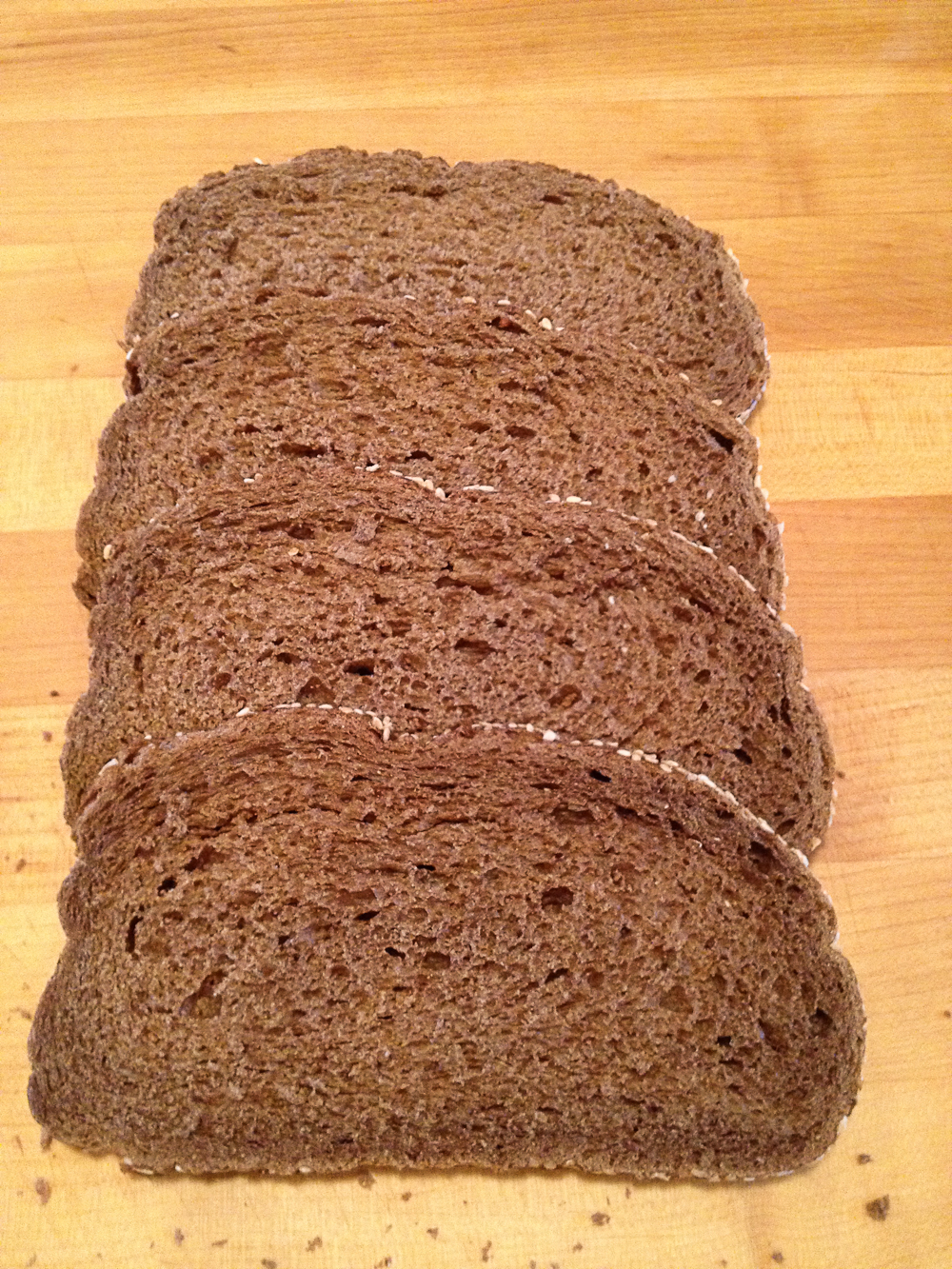
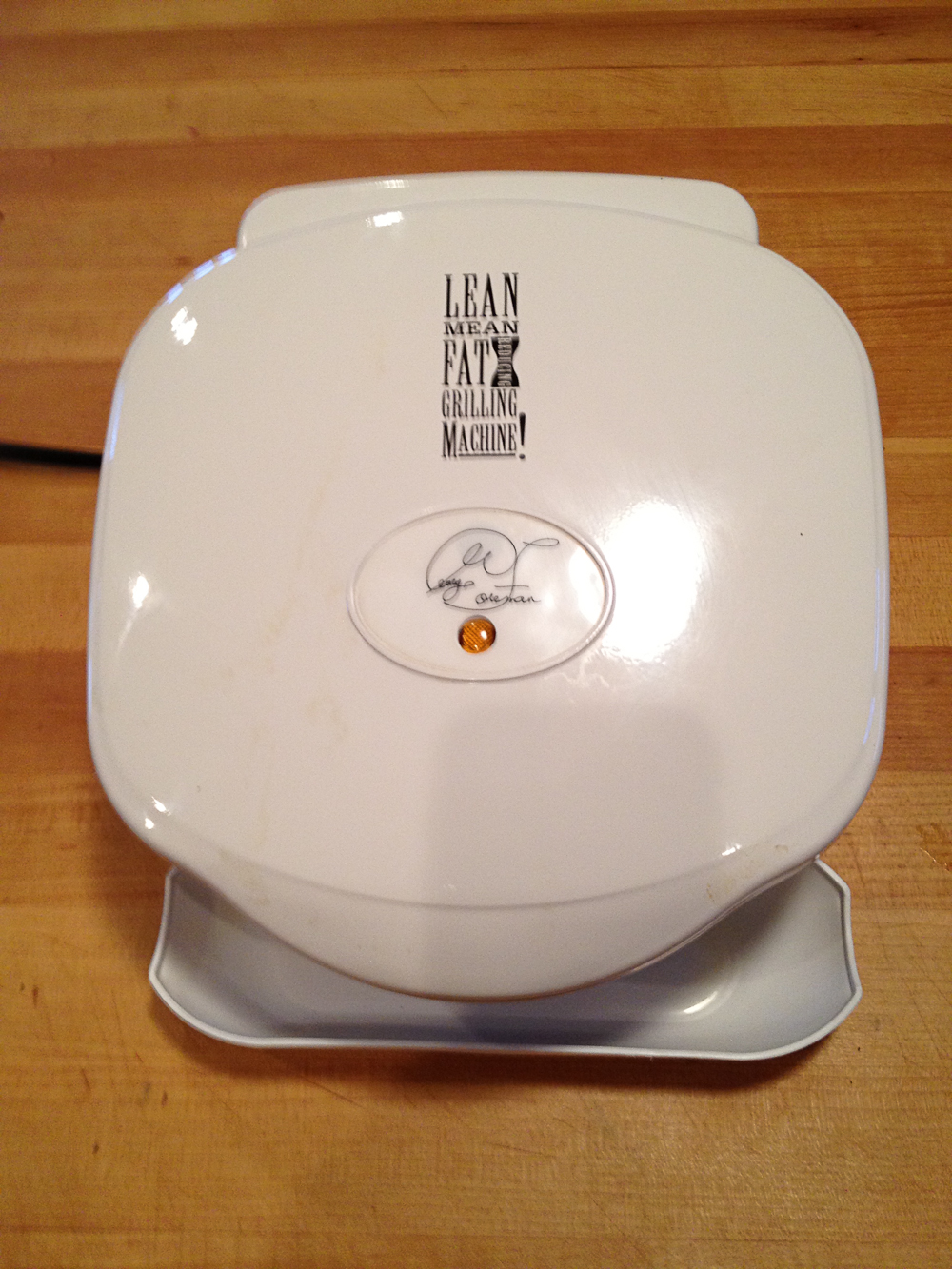
My version substitutes dark pumpernickel bread for the rye and pastrami for corned beef. Also, I am not a big fan of Russian dressing, so I have made my own sauce. The recipes that follow reflect those preferences.  But the sine qua non to me is the sauerkraut, so this is a perfect place to use that kraut you made in your own crock. I used our George Forman grill to toast the sandwiches, but you can use a panini press or a skillet. This recipe makes two large sandwiches.

RECIPES

Reuben Sandwich Sauce

Ingredients 

¼ Cup mayonnaise

2 Tablespoons Dijon mustard

2 Tablespoons ketchup

2 teaspoons grated horseradish

2 Tablespoons dill pickle relish

1 hard-boiled egg, chopped

  1. Combine all the ingredients in a small bowl, mix, and set aside.

Reuben Sandwich

Ingredients

4 slices pumpernickel bread

Reuben sandwich sauce

½ pound shaved delicatessen-style pastrami

1 Cup sauerkraut, preferably home-made, well-drained

6 slices Swiss cheese

½ Cup thinly sliced white onion

2 Tablespoons butter melted

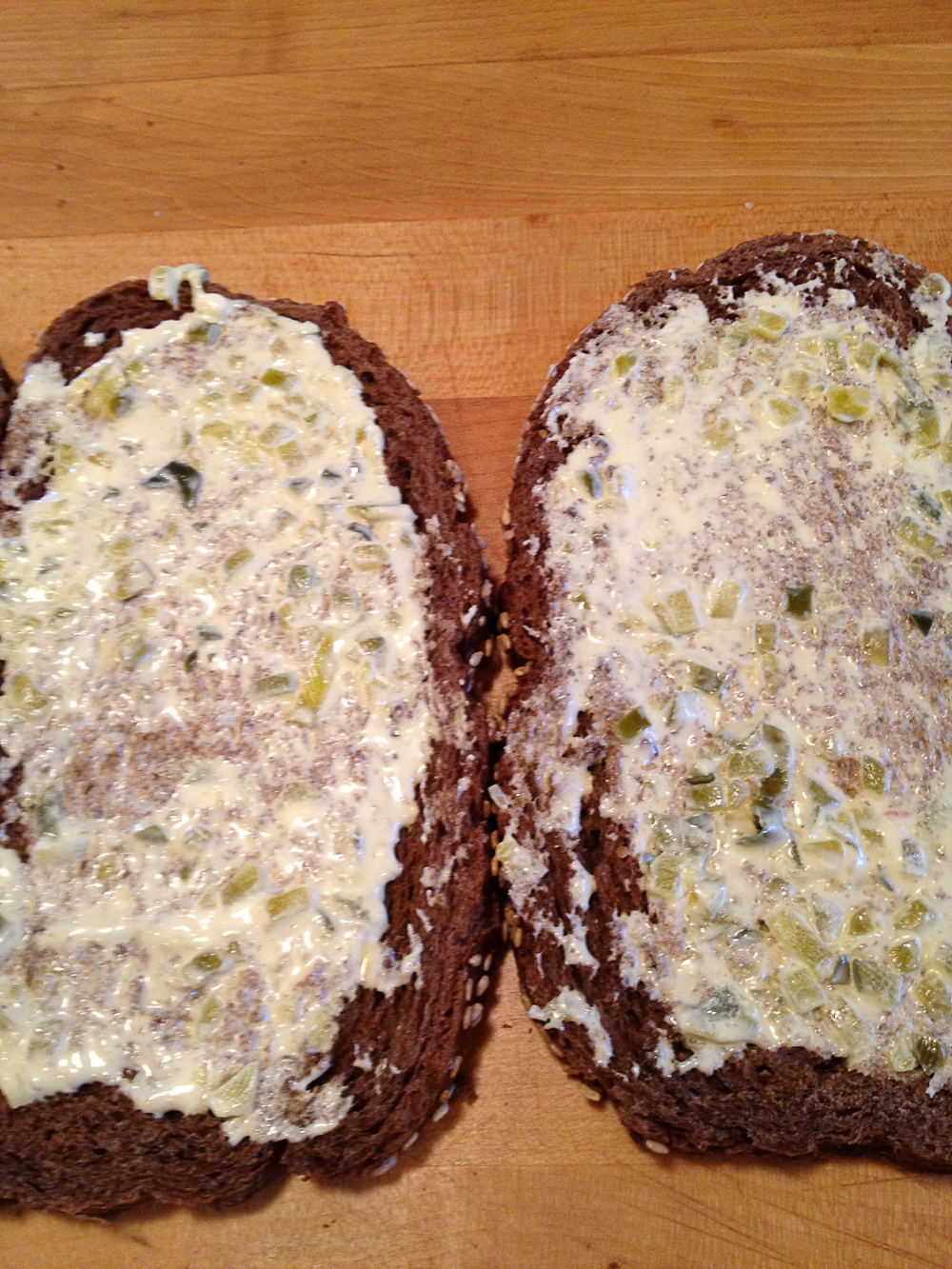
  1. Spread sauce on each slice of bread, one side only
  2. Arrange half of the pastrami on two of the slices of bread, and top with half of the sauerkraut
  3. Arrange three slices of Swiss cheese over a bed of sliced onion on each of the remaining two slices of bread and form two sandwiches.
  4. Brush the tops of both sandwiches with half of the melted butter and place the sandwiches, butter side down, in a skillet over medium heat. Press down occasionally with a spatula until the bottom is well-toasted. Alternatively, butter both sides and toast in a George Forman grill or a panini press.
  5. Brush tops of the sandwiches with the remaining butter, turn the sandwiches in the skillet, and continue toast until the sandwich is well-done on both sides.
  6. Serve immediately, preferably with a large whole dill pickle and potato chips or potato salad.

Leave a comment

Filed under Food, Photography, Recipes

SARAH COOKS IN SANTA FE

This last week, our daughter Sarah and her 10 month old son, Van, visited us from San Francisco. Since she is a chef, we spent a lot of time eating at some of our favorite restaurants as well as doing a lot of home cooking. Without doubt, the food highlight of the week was the dinner which Sarah cooked for us. The menu was designed to feature the foods that Susan and I especially like, but they were all done with a restaurant-quality twist.

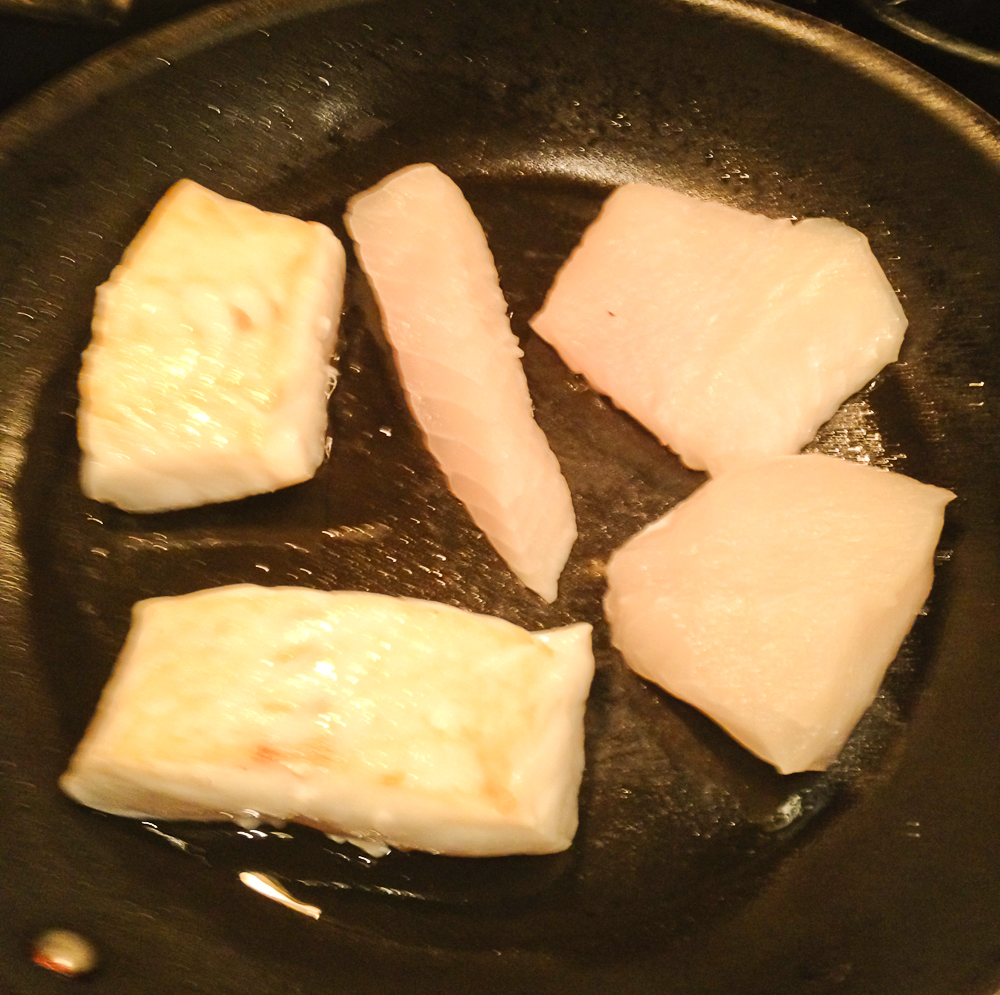
The feature of the main course was halibut. Sarah brined thick slices of the beautiful fish for just a few minutes to remove the extra moisture that you often see when a fish like halibut is cooked. Then she sautéed serving-sized fillets in butter to just underdone, finishing off by topping each piece with herb panade (more butter along with bread crumbs, garlic, salt, and herbs) and broiling for just a couple of minutes until the fish was perfectly cooked and the panade was golden brown.

Sautéing halibut filets

The starch was a delicate purée of smoked parsnips. First, Sarah smoked the parsnips along with cream in our handy Cameron stove-top smoker. She chose hickory chips to give the parsnips a definite but subtle smoky taste. Then she simmered the parsnips until they were fork tender, puréed them with a hand-held blender, and combined them with the cream and more butter until they were smooth and silky.

Cooking the smoked parsnip purée

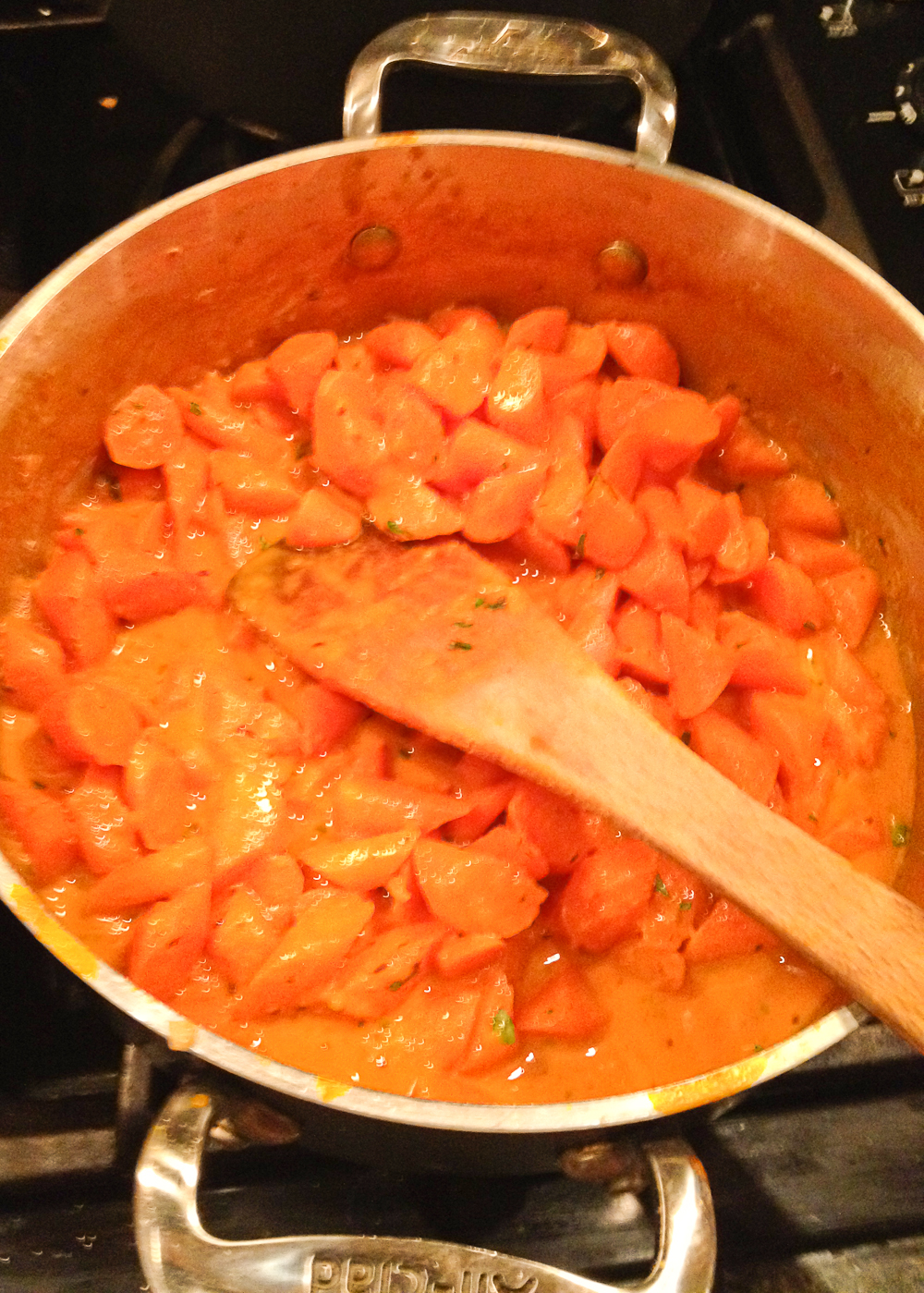
The vegetable was carrot stew: baby carrots simmered in fresh carrot juice that was then reduced to make a thick sauce. The sugar of the carrots and the carrot juice made the dish sweet – but not too sweet – without the addition of any sugar.

Carrot stew

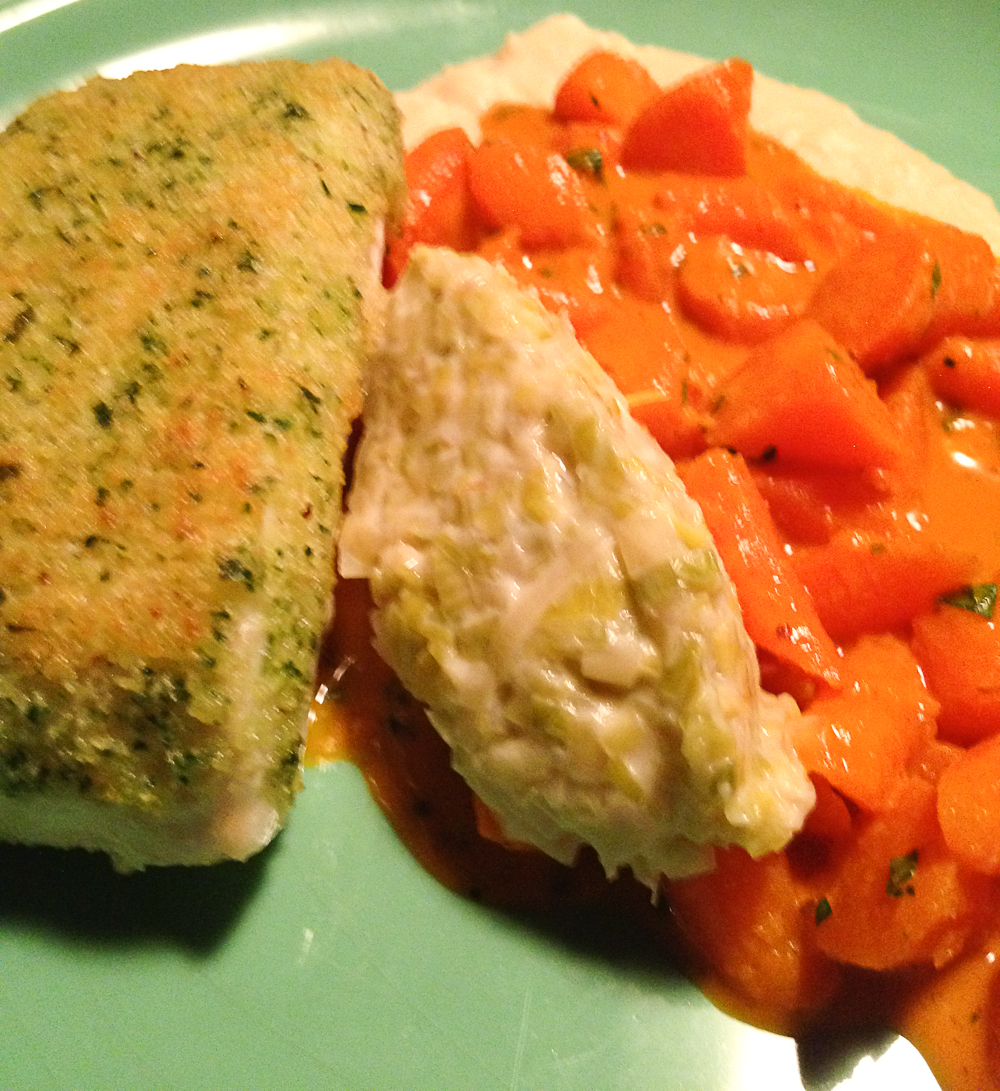
As an added touch, “melted” leeks were chopped finely and cooked into a smooth, savory dish which could be shaped into quenelles to top the vegetables. Then everything came together into a beautiful presentation.

The final plate with halibut, parsnips, carrot stew and melted leeks

For Sarah, probably the best part of the week was the news she had been anxiously awaiting for months. She and her chef husband, Evan, had been working on securing space for their own restaurant in San Francisco. The contract finally was settled, so she spent time at the kitchen table reviewing and signing the documents before faxing them back to Evan. We had a celebratory dinner at Terra (I’ll say more about that in another post).

Sarah signing the lease

Later in the week, Sarah returned to San Francisco to help post the sign in the window of the new place.

Sarah and Evan getting ready to post the sign

If you want to read more about their new restaurant, check it out at the following link:

http://insidescoopsf.sfgate.com/blog/2012/02/05/sarah-and-evan-rich-ink-a-deal-for-a-hayes-valley-restaurant/

1 Comment

Filed under Food, Photography, Recipes

MAKING SAUERKRAUT

When I was a little boy, we lived next to my grandparents. It was the Second World War, so everyone had a Victory Garden. We were no exceptions, and we even had a chicken coop where I collected eggs each morning. My grandparents, though, were serious about feeding themselves. In addition to a big garden, they had a small barn and a pond complete with ducks and a hissing goose.  Both grandparents had grown up on farms in the Dakotas, so they were used to putting up quarts and quarts of tomatoes, pickles, string beans, peas, cherries, and peaches beginning in the early spring and continuing until the first frost in the autumn.  

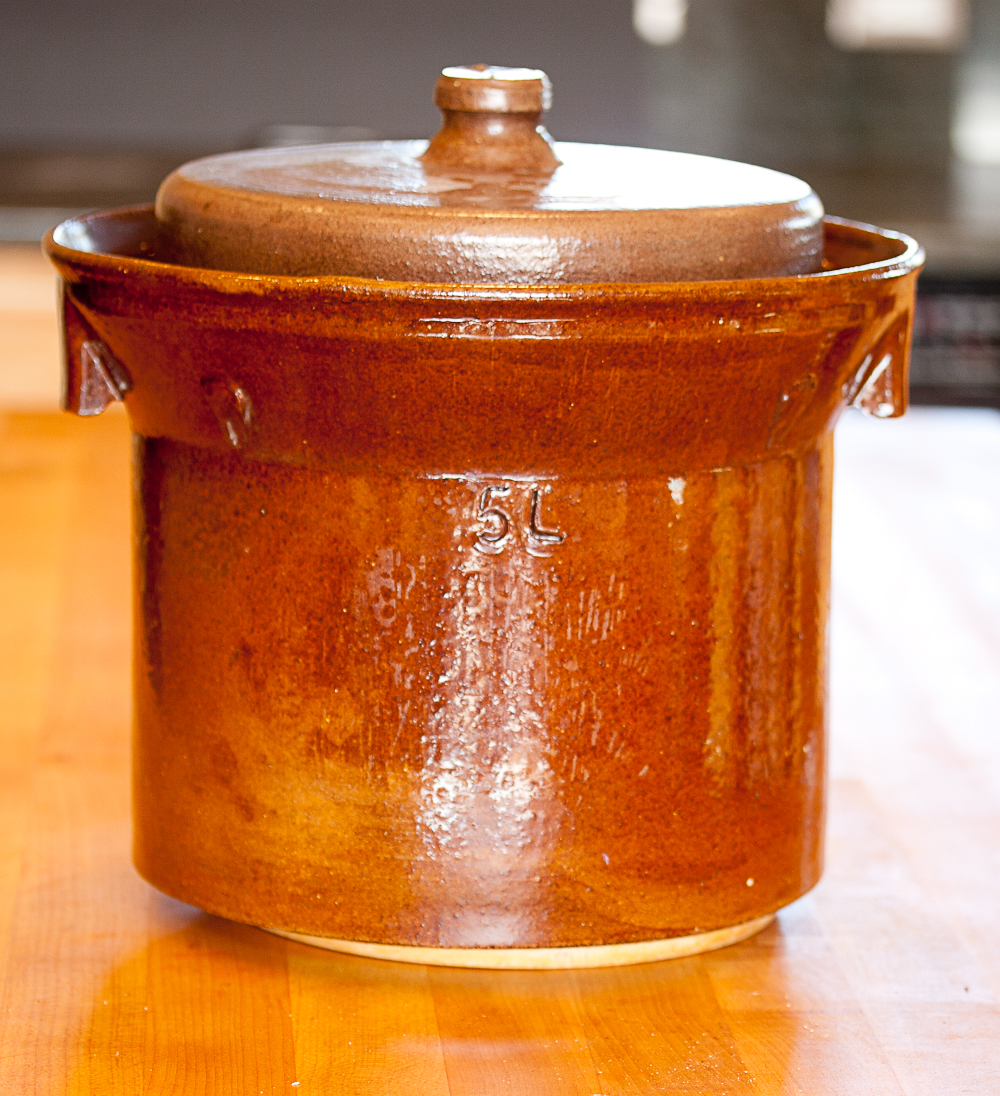
Harsch Steinzeug crock

My grandmother, though, had even more preserving to do when the rest of the harvest was over. She came from a large German family who had immigrated to North Dakota from Russia in the 1880s. German farmers had lived in Russia since the days of Catherine the Great, but when the Russians made it uncomfortable for them, the emigrated by the thousands to the Great Plains – especially to North Dakota. There they continued their German ways, including the production of huge quantities of sauerkraut to see them through the long winter.  

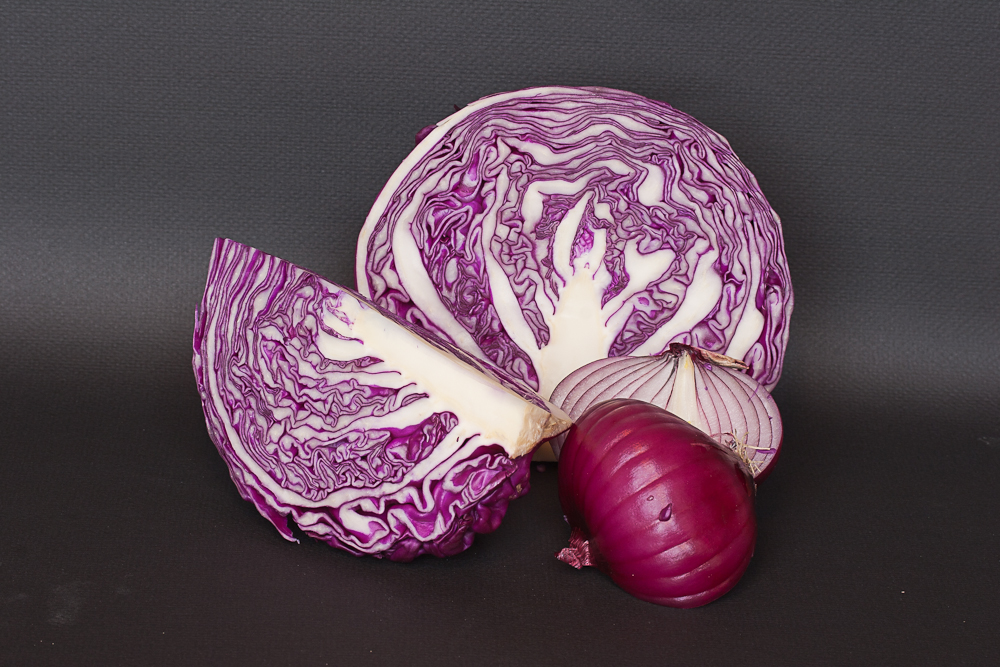
Red cabbage and red onions

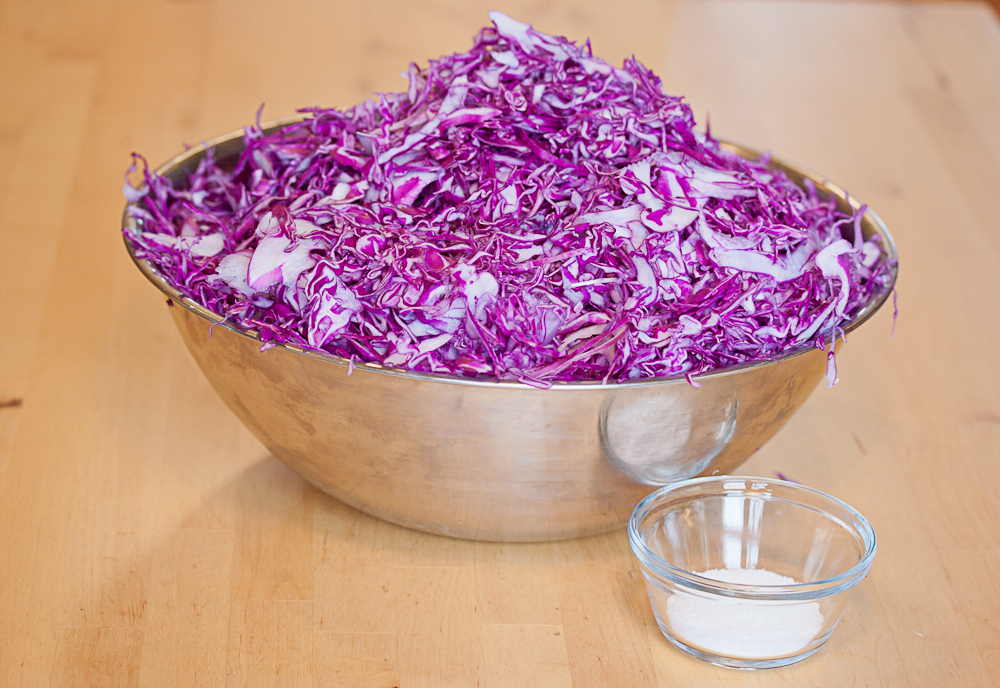
Grandma continued that tradition in her back yard, so in the early fall bushels of giant cabbage heads would magically appear between her garden and the garage door. That would then become the place for an organized production line. A big wooden kraut slicer would be hauled down from storage in the garage. Big 25 gallon crocks would be brought up from the basement to be scrubbed clean. Boxes of salt would be brought from the kitchen. A kitchen chair was moved out to sit in front of a huge bowl where the cabbages would be shredded into heaping mounds. Then the packing began: shredded cabbage was layered into the crocks, salt was sprinkled on top, and the process was repeated until the crocks were completely full. Then the crocks would be lined up along a cool wall in the garage, covered with cheesecloth and big plates. Bricks would be placed on the plates for weights, and the real process began.  

Various utensils for slicing slaw

Fermenting the cabbage went on for weeks, and it was my job to check the crocks daily, skim off any scum, and add water if they looked too dry. During those days the garage was not a good place to spend much time because the dense smell of fermenting cabbage hung in the air. Finally, my grandmother pronounced the process done. At that point all of the women fired up their canning equipment and filled dozens of quart jars with the fragrant kraut until the crocks had been emptied.  

Slaw and salt ready to go in the crock

To my dismay, the supply of sauerkraut lasted all winter, and at least once a week we had the same meal for supper – sauerkraut, bland mashed potatoes, and a big sausage.  As much as I dreaded that menu, it left a lasting impression and surprisingly fond memories.  

The finished sauerkraut

For that reason, I decided to make some sauerkraut in the butler’s pantry in our home in Shreveport. All of the children were school age, and all of them regularly brought home their friends who wanted to know what was in the crock sitting on the counter.  When the children announced that it was sauerkraut their dad was making, there came a long pause and shoulder shrugs. The episode also became the basis for a favorite family story – one in which Dad gets a lot of laughs.

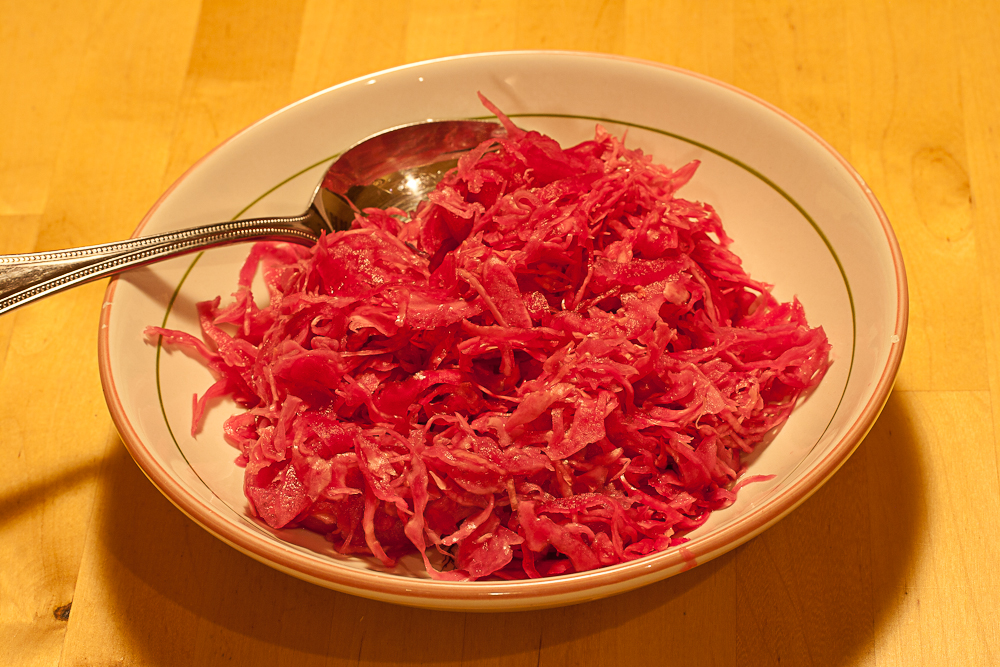
A bowl of sauerkraut ready to serve

I have never made sauerkraut again, so I was surprised when my Christmas gift from Susan was a beautiful had-crafted sauerkraut crock made by Harsch Steinzeug in Germany along with instructions for how to make sauerkraut. My crock is the five-liter size. You can get them up to 50 liter, but unless you have a big German family and eat sauerkraut every day, the 5-liter size seems perfect for home use.  

Once again, I am making sauerkraut. I have adapted the recipe that came with the crock into the one that follows. 

RECIPE

Ingredients

2 medium heads, red cabbage

2 medium red onions

10 grams coarse kosher salt for each kg of sliced cabbage + 15 grams for brine

water


  1.  Remove the outer leaves of the cabbages, quarter, and remove the core.
  2. Shred the quartered cabbage as thinly as possible. You may use an authentic wooden slaw cutter, a French-style mandoline, a plastic mandoline, or a very sharp chef’s knife. Each implement has distinct advantages and disadvantages. The wooden cutter is the most authentic, but the blade must be sharp, and it requires a lot of muscle. The French-style mandoline works very well and is adjustable, but with all of its parts it needs a lot of cleanup afterward. The plastic mandoline is inexpensive and usually not adjustable, but the slices are fine, and the blade is very sharp.  Cleanup is easy. The knife must be very sharp, and it is hard to get the cabbage shreds as thin as you would like. I prefer the plastic mandoline.
  3. Shred the red onion and combine with the cabbage.
  4. Weigh the shredded cabbage and onion. Weigh separately 10 grams of salt for each kg of cabbage and onion.
  5. Arrange a layer of shredded cabbage and onions in the bottom of the crock. Sprinkle with salt. Continue the process, alternating cabbage and onions with salt until you have filled the crock no more than four-fifths full. This is important. Otherwise you will not be able to fit the weight stones into the pot.
  6. Press down so that liquid is released and rises an inch or so above the weight stones. If it does not, pour in brine prepared by boiling then cooling 15 grams of salt in 1 liter of water.
  7. Cover the crock with the lid, Seal the lid by pouring water in the groove to that it is above the notches in the sides of the lid, and set in a cool place.
  8. In 2 or 3 days you should hear bubbling as the kraut begins to ferment. This will continue for a week or so. Do not open the crock, but continue to make sure to keep the water seal refreshed.
  9. After three weeks or so, open the crock, remove the weight stones, and dish out your first sauerkraut. Replace the weight stones and reseal to use again at another time. 

Red cabbage sauerkraut, bratwurst, German-fried potatoes, and fresh bread

Around my grandmother’s table, we had sauerkraut, sausage, and mashed potatoes at least once a week. With my first batch of kraut, I tried to reproduce that meal, substituting German-fried potatoes for the mashers. The crispy red sauerkraut was much better than that of my memories, the freshly made bratwurst from the butcher was flavorful, and the meal turned out to be a big success with everyone.


4 Comments

Filed under Food, Photography, Recipes

GREEN CHILE CHICKEN STEW

Our family has lived in the Southwest for so long that we have adopted many of its traditions. For years we have made tamales on Christmas Eve, and now that is also a tradition for our children and their families, regardless of where they live. Making tamales from scratch is fun, and the fresh, finished product always tastes better than even the best store-bought versions. Posole warms the body and the soul on a cold winter evening, and it is perfect for a family gathering on New Year’s Eve. Biscochos (in El Paso) or biscochitos (in Santa Fe) have to be homemade and – like the tamales – have to be made with lard to taste like the real thing. The crisp anise-flavored cookies compete with my grandmother’s anise-flavored German springerle when it comes to dipping into a cup of hot chocolate or a glass of milk.

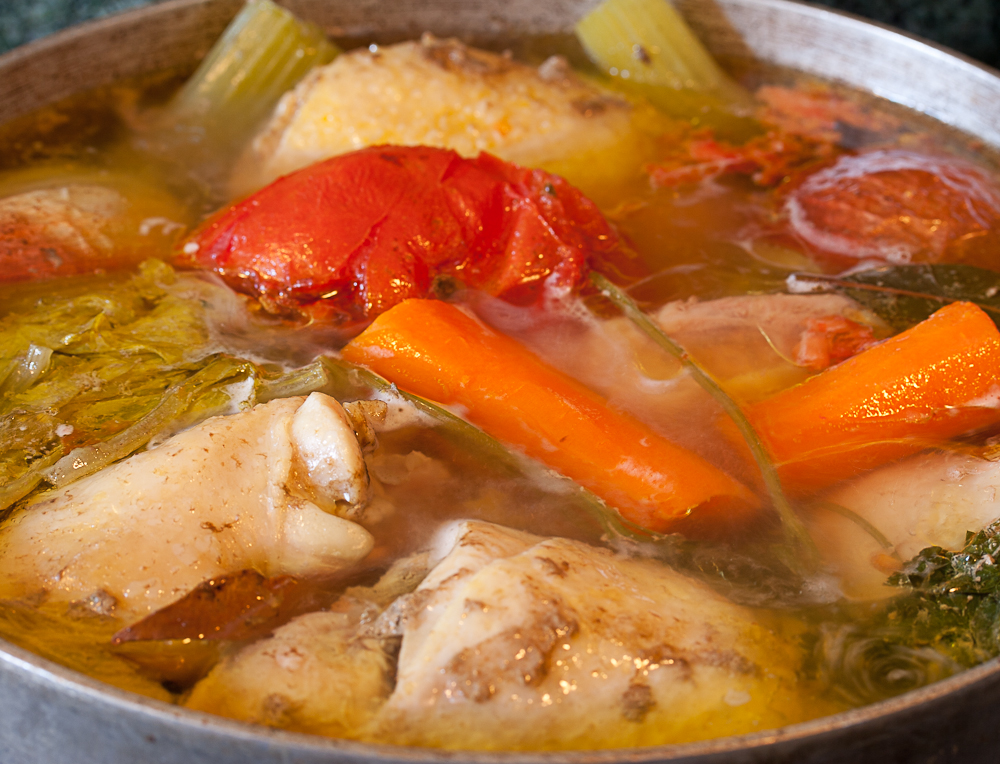
Chicken thighs cooking in stock with vegetables

Green chile chicken stew is in a class by itself. A hot bowl always reminds me of long-ago lunches in the lodges at the top of the runs at Taos Ski Valley or Ski Apache in Ruidoso. Our kids always ask for it when they visit us in Santa Fe, and so we try to have a pot on the stove for them when they arrive from a long cross-country drive. Our usual recipe calls for a whole chicken and makes enough for a large group. This version is quick, but by cooking the chicken in stock along with vegetables the broth becomes especially rich. If you are in a hurry, just skip adding the vegetables. The recipe makes enough for four adults. It is ideal for the late evening arrival of tired travelers.

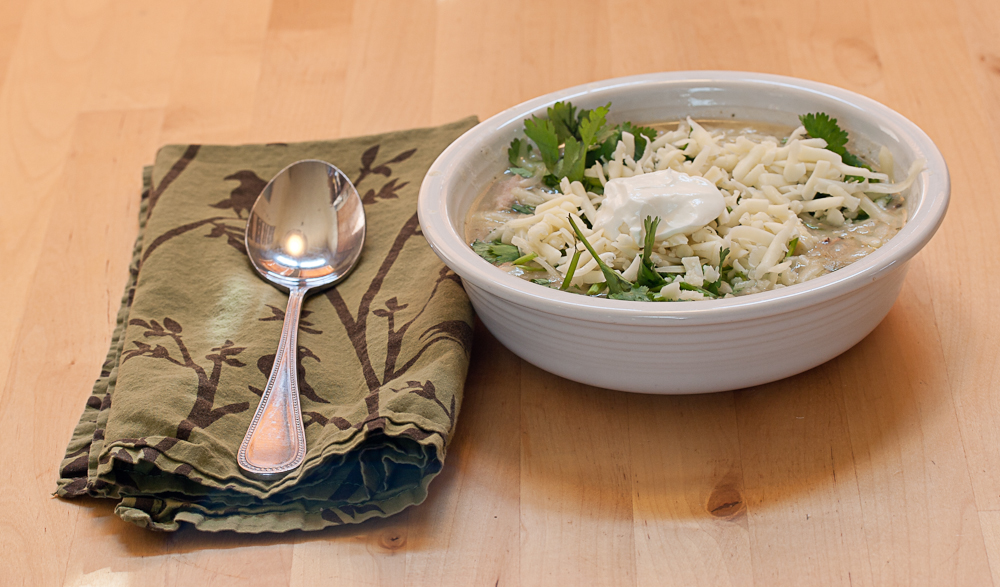
Ready for your choice of garnishes

RECIPE

 Ingredients

4 Cups chicken stock

4 chicken thighs

1 medium onion, cut in quarters

1 medium carrot, cut in thirds

1 stalk celery cut in thirds

1 handful fresh celery leaves

3 stems fresh parsley

12 whole peppercorns

1 Roma tomato

2 Tablespoons cooking oil

1 medium yellow onion, diced

4 ounces chopped green chiles

2 cloves garlic, minced or pressed

3 Tablespoons all-purpose flour

2 russet potatoes, peeled and cut into ¾ inch cubes

¼ teaspoon ground cumin

2 Tablespoons dried Mexican oregano, crushed

1 teaspoon kosher salt

½ teaspoon ground black pepper

  1. In a large, heavy-bottomed pot, bring the chicken stock to the boil. Add the chicken thighs, onion, carrot, celery, celery leaves, parsley, and peppercorns. Continue to cook at a very low boil for about 45 minutes or until the chicken is cooked through.
  2.  About 10 minutes before the chicken is cooked, squeeze the Roma tomato into the stock and add the pulp.
  3.  Remove from the heat. Strain the stock into a container and allow to cool so that you can remove the fat that gathers on the top. Set aside.
  4.  Remove the skin and bones from the thigh meat, chop the meat into bite-sized pieces and set aside.
  5. Clean the pot and return it to the stove over a medium flame. Heat the oil, and then add the diced onions. Cover and sweat the onions for 5 minutes or until they are soft and translucent. Do not allow them to brown.
  6. Add the green chiles and minced garlic and continue to cook, uncovered. Stir frequently until the moisture has evaporated from the mixture. Add the flour and stir continuously for about 3 minutes so that the onions and chiles are completely coated and the flour has lost its raw taste.
  7. Add the strained, cooled chicken stock and cubed potatoes. Return to the boil, stirring frequently. Continue to cook at a low boil until the potatoes are soft and cooked through – about 20 to 30 minutes.
  8. Stir in the cumin, oregano, salt and pepper. Adjust the seasoning with more salt and pepper if needed and continue to simmer for 10 minutes.
  9. Add the chicken pieces, simmer for another 10 minutes, and then serve in large soup bowls along with your choice of garnishes.

Green chle stew with the garnishes our family likes

Garnishes

There are lots of traditional choices for garnish. We always like to pass bowls of chopped fresh cilantro leaves, thin-sliced, baked corn tortilla strips, grated Monterrey jack cheese, and diced avocados along with hot sauce for those who like their soup spicier. We also like to serve hot tortillas (corn or wheat) or cornbread fresh out of the oven.

2 Comments

Filed under Food, Photography, Recipes

CHICKEN ENCHILADA CASSEROLE WITH MOLÉ ROJO

The other night we were aware that LSU was playing for the national championship in football. As former Louisianans with direct ties to LSU, we should have been planning a big TV watching party complete with gumbo or that Monday night standby in New Orleans, red beans and rice. Instead we watched an old movie and enjoyed the last of some molé rojo which one of our daughters had sent to us as a Christmas gift. To be honest, we enjoyed the old movie more than watching the drubbing administered by the Crimson Tide, and the molé made a quick meal outstanding.

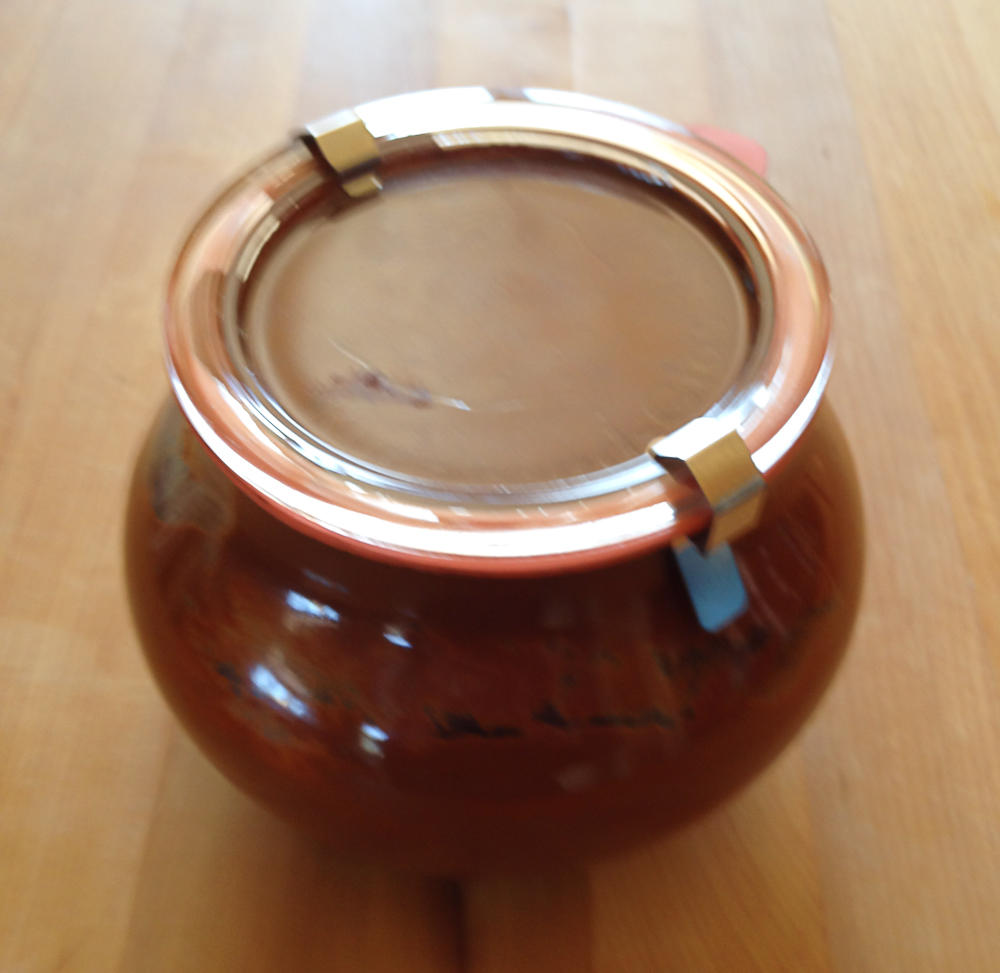
Pot of freshly made molé rojo

Classic molés have the reputation of requiring many ingredients and a long cooking process. Indeed, Rick Bayless presents his “streamlined” version in his excellent cookbook, “Authentic Mexican: Regional Cooking from the Heart of Mexico,” William Morrow and Company, New York, 1987, pp 201-203. For the recipe, go to the book, but I thought it would be interesting to provide the list of ingredients. The process involves many steps.

Ingredients

4 medium dried ancho chiles, stemmed seeded and deveined

2 medium dried mulatto chiles, stemmed seeded and deveined

1 medium dried pasilla chile, stemmed seeded and deveined

1½ Tablespoons sesame seeds

⅓ Cup lard

2 heaping Tablespoons unskinned peanuts

2 Tablespoons raisins

½ medium onion, thickly sliced

1 clove garlic, peeled

½ stale corn tortilla

1 slice dried, firm white bread

1 ripe medium tomato

3 medium tomatillos

¾ ounce Mexican chocolate, chopped

½ teaspoon dried oregano

¼ teaspoon dried thyme

1 bay leaf 8 peppercorns

3 cloves

1 inch cinnamon stick

5 Cups chicken broth

1 teaspoon salt

1 Tablespoon sugar

Clearly, the real thing is a labor of love and considerable skill. If you can’t or don’t want to go to all the trouble, bottled versions are at hand. But you will have to be satisfied with second best. Still a handy jar serves as the basis for a quick meal.

Here is my version of quick chicken enchilada casserole – certainly not authentic – but a good supper dinner for a chilly winter evening.

Chicken enchilada casserole ready for the oven

Ingredients

2 chicken thighs

4 Cups chicken stock

1 Tablespoon Mexican oregano leaves, crumbled

¼ teaspoon ground cumin

2 ounces cheddar cheese, coarsely grated + more for sprinkling on top of the casserole

2 ounces Monterey jack cheese, coarsely grated + more for sprinkling on top of the casserole

½ medium onion, chopped

salt and pepper to taste

8 fresh corn tortillas

2 Cups molé rojo Sour cream for topping

1. In a medium sauce pan, place chicken thighs in the stock, bring to a boil, reduce to a low boil, and cook for 30 to 40 minutes until the chicken is cooked. Strain the stock and reserve for another purpose. Cool the cooked chicken, remove the meat from the bones, and chop coarsely.

2. In a medium mixing bowl, combine the chicken, oregano, cumin, cheeses, and onion. Adjust the seasonings with salt and pepper.

3. Meanwhile wrap the tortillas in aluminum foil and heat for about 10 minutes at 180° in the oven until soft.

4. One at a time, fill the tortillas with the chicken mix, roll, and place seam-side down in a greased 8 x 8 inch baking dish.

5. When you have filled all of the tortillas, cover them with the molé rojo, sprinkle with the remaining grated cheese, cover the pan with aluminum foil and bake in the middle of a pre-heated oven at 300° until the enchiladas are completely heated and the cheese has melted.

6. Serve immediately with a generous tablespoonful of sour cream.

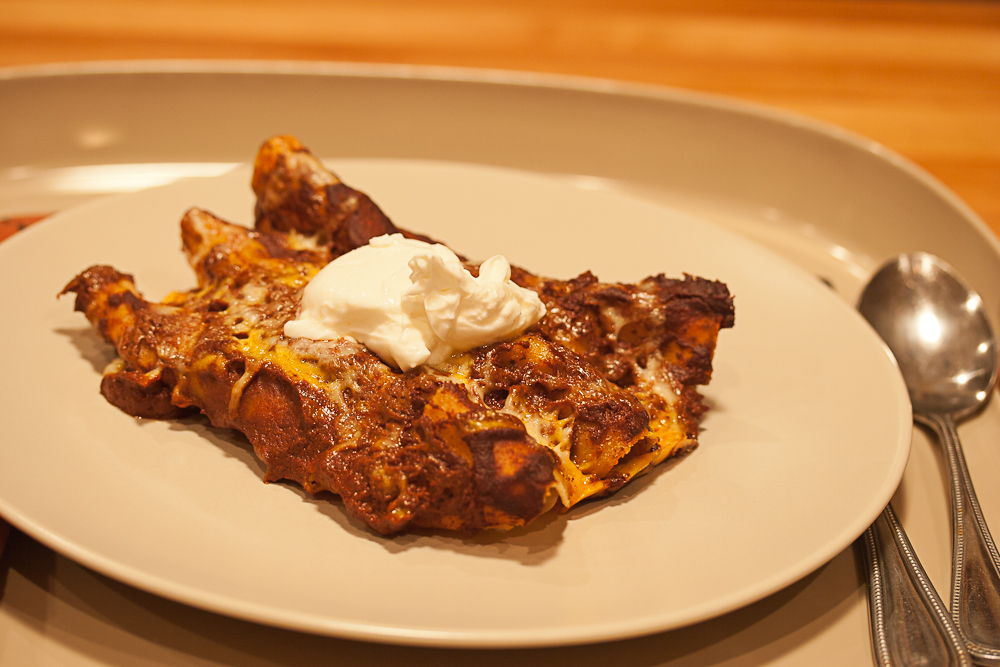
Chicken enchilada with molé rojo and sour cream ready to eat

Serves 2

2 Comments

Filed under Food, Photography, Recipes

RED OR GREEN? CHRISTMAS IN NEW MEXICO

The standard question in Santa Fe when you order chile is “Red or green?” If you have a hard time deciding, you can just say, “Christmas”, and they will bring out a dish slathered in both colors of chiles. This week’s  cookie recipe picks up on that theme. Linzer cookies are traditional for Christmas – a tender sandwich of almond or hazelnut cookie filled with raspberry jam pushing through a hole in the top. They remind some people of eyes, and  so the cookies are also called Linzer Augen (eyes). Authentic Linzer cookies are delicious, but for a Santa Fe Christmas, they almost beg for a little chile kick.

Rolling and cutting the cookies

As the name of the cookie suggests, it had its origins in Linz, Austria. Lenz is an ancient city founded by the Romans and home to luminaries like the mathematician Johannes Kepler, the composer Anton Bruckner, and unfortunately Adolf Hitler. But it may be more famous as the home of the Linzer Torte, a delicious pastry that can be traced back to the 1600’s and is now a feature of many of the great pastry shops of Vienna. It has become popular throughout Austria as well as the world, and especially at Christmas. The Linzer cookie uses all of the same ingredients.

Jars of chile-flavored jam

For the Santa Fe version, there are local products that let the baker add that chile kick without changing the basic recipe too much. Heidi’s Raspberry Farm makes a raspberry-red chile jam that fits the bill. In New Mexico, you can find it at farmers’ markets or in specialty grocery stores. You can also order it from Heidi’s Raspberry Farm, P.O. Box 1329, Corrales, NM 87048. Green chile jam is harder to find, but you can make your own from roasted sweet green chile sauce made by Desert Gardens, Comfort Foods, Inc., 9900 Montgomery Blvd, NE, Albuquerque, NM 87111, www.comfortfoods.com. I’ll tell you how to transform the sauce into jam as well as giving you the basic recipe for the cookies. You will see that there are a lot of steps in making the cookies, but it can all be done in a morning of busy baking.

RECIPES

Sweet Green Chile Jam

Ingredients

9 ounce jar sweet green chile (see sources)

1 Tablespoon sugar

1 teaspoon low- or no-sugar pectin

  1. Empty the jar of green chile in a small saucepan. Stir in the sugar, pectin, and water, and bring to a boil, stirring frequently.
  2. Boil for two minutes. Then remove from heat and allow to  cool partly
  3. Return the mixture to the jar. Cool completely, and then store in the refrigerator until ready to use.

Almond Flour

Ingredients

½ Cup almonds

4 Cups boiling water

  1. Place the raw almonds in a large heat-resistant bowl.
  2. Pour the hot water over the almonds and let steep for 5 minutes.
  3. In batches, remove the almonds from the hot water. Slip the skins off the almonds.
  4. Spread the peeled almonds on clean paper towels and allow to dry completely for about two hours.
  5. Ad the completely dried almonds to a spice grinder or small food processor. Grind the nuts using pulses of the low power. Watch carefully as too vigorous grinding can turn the almonds into almond butter. Remove and set aside when the almonds resemble coarse cornmeal.

Icing

Ingredients

1 Tablespoon unsalted butter,melted

1 Cup confectioners’ sugar

¼ teaspoon almond extract

2 Tablespoons cream

  1. In a small bowl, combine the butter, sugar, almond extract, and cream.
  2. Transfer to a plastic, zipper sealed sandwich bag and cut a 1/16 inch piece from one corner of the bag. When ready to ice the cookies, squeeze the icing through the hole to form patterns of your choice on the cookie top.

Linzer Cookies

Ingredients

½ Cup vegetable shortening

¼ Cup unsalted butter

¼ Cup sour cream

½ Cup sugar

½ Cup brown sugar, packed

½ teaspoon salt

1 teaspoon baking powder

1 teaspoon vanilla extract

1 large egg

2½ Cups all-purpose flour

½ Cup almond flour

½ Cup cornstarch

  1. In the bowl of a stand mixer, combine the shortening, butter, sour cream, sugar, brown sugar, salt, baking powder, and vanilla extract. Beat at slow to medium speed until the ingredients are well mixed.
  2. Add the egg, and continue to mix at medium speed until the batter is light and fluffy.
  3. In a separate bowl, combine the flour, almond flour, and cornstarch.
  4. Add the dry mix to the batter and continue to beat until the ingredients are well combined and you have a smooth dough.
  5. Divide the dough in two equal portions. Form the portions into balls, wrap them in plastic wrap, and chill them for at least one hour in the refrigerator. If the dough is too soft, it will stick to the rolling-pin when you try to roll out the cookies.
  6. Roll the chilled dough, one ball at a time,  on a lightly floured work surface to about 1/8 inch thick. Using a 2¼ inch round cutter, cut rounds in the dough. Then using a 1 inch cutter, cut holes in the center of half of the rounds.
  7. Gather up any scraps of dough and shape them into a ball. Chill, roll, and cut cookies until all of the dough is used.
  8. Bake the cookies  for about 10 minutes or until lightly browned around the edges, on parchment-lined baking sheets in an oven preheated to 350º. Cool on a mesh rack.
  9. Ice the tops of the cookies with the hole in the center. Alternatively, and more classically, sprinkle them with confectioners’ sugar. Turn the solid cookies over and place about ½ teaspoon of jam in the middle. Then top with the frosted cookies.

Baked, decorated cookies

Makes about 4 dozen cookies

1 Comment

Filed under Food, Photography, Recipes

FRITO PIE AND BLUE CORN-GREEN CHILE CORN BREAD

A couple of weeks ago I wrote about the Terlingua International Chili Cook Off.  It was an interesting event with lots of cooks who live and breathe competition chili. I decided right away that I would never be in a chili cook off much less as champion. Still, the excitement got me to thinking about making chili. This is the perfect time of year to make a pot. Nearly everyone has his or her own recipe, and probably everybody believes that his or hers is the best. No doubt that’s how the Terlingua cook off got its start in the first place.

Frito pie with blue corn-green chile corn bread

To me, a bowl of chili is not complete without a handful of Fritos sprinkled on the top, along with chopped onion, grated cheddar cheese and maybe some sour cream and jalapeño slices on top of the Fritos. Hey – I’ve just described one version of Frito pie.

No one knows for sure when Frito pie was invented, but one story traces its start in the 1960s  to the F. W. Woolworth store on the Plaza in Santa Fe. For many years, the Woolworth store was an iconic tourist Mecca because of the pie. Unfortunately, the store is long gone, but Frito pie continues as one of the quintessential dishes of Santa Fe. Many restaurants offer their own version, and people love most of them.  Many charity fund-raisers sell Frito pies with great success.

Frito pie has spread across America, and each region has its claim as to the best and most traditional version. You can put the Fritos on the top; you can put them on the bottom. You can bake a casserole. You can dump some chili in a bag of Fritos. Every version has its proponents. Sadly, you can even use canned chili. But for me the quality of the dish is totally dependent upon the chili you put in it. So I am sharing my recipe for chili. Didn’t I already say that everybody thinks his or her is best?

Frito pie can be eaten by itself, but a warm tortilla or a piece of cornbread put the finishing touch on the meal. So I am also providing a recipe for cornbread made with another New Mexico tradition, blue corn meal. Green chiles, onion, cheese, and piñon nuts combine to make a unique Santa Fe cornbread. The recipe also contains powdered gluten. These days it should be easy to find in the baking section of a large grocery store. Gluten is not necessary, but it gives the cornbread a better rise and lighter texture. Corn contains no gluten, and blue corn meal is very fine so that those two characteristics sometimes make a cornbread that is flat and very crumbly. Gluten gives a crusty loaf with a light, well-textured inside.

RECIPES

Chili

Ingredients

2 Cups dried pinto beans

6 Cups water

1 Tablespoon cooking oil

1 medium onion, chopped

1 pound ground beef, 15% fat

4 Cups beef stock

1 can (14 ½ oz) diced tomatoes

2 cloves, garlic, minced

1 packet (5 grams) Sazón Goya

½ teaspoon ground cumin

2 Tablespoons whole dried Mexican oregano

1-3 Tablespoons chili powder (or more according to taste)

1 teaspoon sugar

2 Tablespoons freshly squeezed lemon juice

3 Tablespoons corn meal

salt and pepper to taste

  1. Soak the dry beans overnight in the water.
  2. In the morning, heat the oil over medium heat  in a heavy-bottomed pot. Add the chopped onions, and cook, covered, until translucent. Do not let them brown.
  3. Add the ground beef, breaking it up as you stir, and brown it completely.
  4. Add the beans with their soaking liquid and stir in the beef stock. Bring to the boil.
  5. Stir in the tomatoes, garlic, Sazón Goya, and cumin. Add the oregano by crushing finely with your hands over the pot. Stir in the desired amount of chili powder and return to the boil, immediately reducing the heat to a simmer.
  6. Simmer, covered,  for two hours or until the beans are soft. Stir frequently, and add water if needed.
  7. About a half hour before you are ready to serve, add the sugar, lemon juice, and corn meal. Simmer uncovered until the corn meal has thickened the gravy.  Adjust the seasonings with salt, pepper, and more cumin and chili powder if desired.
  8. Serve in bowls and pass Frito chips, grated Cheddar cheese, chopped onions, and sour cream for toppings.

Blue Corn Meal Cornbread with Green Chiles, Cheese, and Piñon Nuts

Ingredients

½ Cup piñon nuts

1 Cup all-purpose flour

1 Cup blue corn meal (Do not use atole. It is too finely ground.)

1 Tablespoon gluten powder

1 teaspoon baking powder

½ teaspoon baking soda

1 teaspoon salt

4 oz canned chopped green chiles (choose your heat – mild to hot)

½  Cup grated sharp Cheddar cheese

½ Cup chopped green onions including the tops

1½ Cups buttermilk

2 eggs, lightly beaten

4 Tablespoons butter, melted

  1. Grease a heavy 8 inch cast iron skillet generously and place it in the middle of the oven as you preheat the oven to 425°. Meanwhile prepare the batter.
  2. In a dry skillet over high heat, toast the piñon nuts until the oils are released and the nuts have begun to brown slightly. Be careful not to burn them. Allow them to cool and then chop them coarsely. Set aside.
  3. In a large bowl, combine the corn meal, flour, baking soda, salt, and baking powder.  Add the chopped, toasted nuts, green chiles, grated Cheddar cheese, and green onion. Mix well.
  4. In another bowl, combine the buttermilk, beaten eggs, and melted butter.
  5. Pour the liquid ingredients into the dry mixture and stir together until they are well blended. Do not overbeat.
  6. Remove the preheated skillet from the oven and pour in the batter, working quickly. Return the skillet to the oven and bake for 25 minutes.
  7. Cut into wedges and serve immediately with plenty of butter and honey on the side.

Leave a comment

Filed under Food, Photography, Recipes