Category Archives: Recipes

HAUTE CUISINE IN THE WILDERNESS

Beginning of small rapids

Running the rapids

This last weekend we spent three days on a raft trip down a wild part of the Rio Chama in northern New Mexico. The trip was sponsored by the New Mexico Wilderness Alliance., who are working to preserve the river.  The river and its immediate environs are currently a federal wilderness study area. If the Congress approves the plan, this beautiful river and the surrounding mountains will be designated a Federal Wilderness Area which will ensure protection of the unique, fragile, and beautiful environment. We tagged along for the adventure and to see the scenery The Wilderness Alliance is working hard to obtain wilderness designation, so their staff also wanted to look at the river.

The raft trip was run by an outfitter from Taos, New Mexico, named Far-Flung Adventures.They brought a virtual flotilla for our trip, including three paddle boats, a supply boat, and four inflatable kayaks. There were three boatmen and a single boatwoman, all of whom were extremely friendly, helpful, and competent. The trip was filled with relaxing floats, shite water rapids, sunny skies, and spectacular scenery.

What we were not expecting was the food. All of the supplies, including the food itself and the portable kitchen had to be carried with us on the river and through the rough water. Our anticipation was that we would get a lot of cold sandwiches, hot dogs, and hamburgers. Wow, were we in for a surprise.

Our first lunch was a delicatessen spread just an hour or so after we first boarded the boats. That evening we had a wide selection of cheese and dips to go with wine or beer. Then there were grilled chicken tacos with fresh-made pico de gallo along with fresh spinach, almond, and mandarin orange salad. To top it off, there was a chocolate cake with icing, baked in a three-legged Dutch oven.

Big steaks ready to grill

Cooking

Then there were tabbouleh, pasta salad with artichoke hearts, tender steaks, grilled salmon, and a cherry cobbler – again done in the Dutch oven.

Ingredients for the cherry cobbler

Brent ready to serve the cherry cobbler

I wound up gaining 3 pounds on what I thought was a wilderness expedition.

On top of all that, we had live music and poetry recitations from the multiple-threat boat crew.

Brent playing his guitar

This turned out to be a memorable trip, and one that I would highly recommend. You are pampered as much as you would like, or you can be strenuous in the kayaks to work off all those good calories.

Fresh fruit
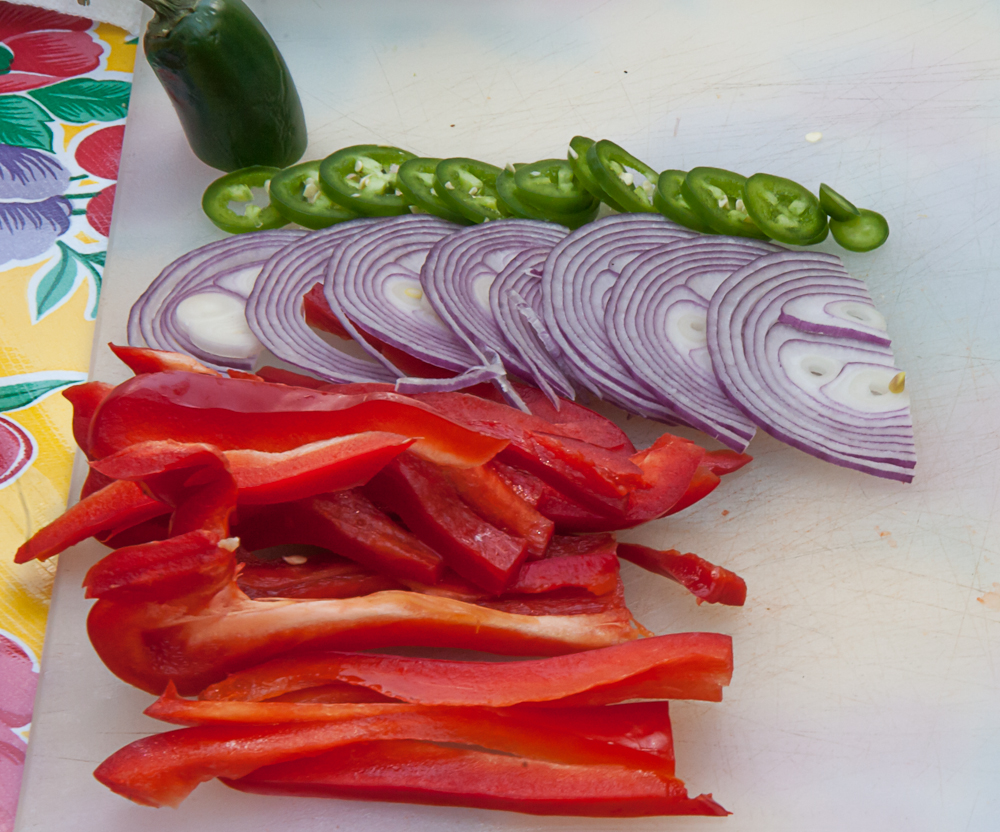
Vegetable garnish

Tabbouleh

RECIPE

Tabbouleh

Ingredients

  • ½ cup bulgur
  • 2 cups fresh parsley leaves, finely chopped
  • 1 cup fresh mint leaves, finely chopped
  • 2 large tomatoes, seeded and chopped
  • ½ large red onion, chopped
  • ½ cup extra virgin olive oil
  • juice of 2 lemons
  • salt and pepper to taste

Preparation

  • Cover the bulgur with boiling  water and let stand for ½ hour until soft. Place the soaked bulgur in a clean kitchen towel and squeeze as dry as possible
  • Combine the bulgur with all of the remaining ingredients, adjusting seasoning with salt and pepper. Toss lightly and serve.
3 Comments

Filed under Food, Photography, Recipes

TOSTONES AND GUACAMOLE

When our son, Peter, was in graduate school, he stayed in a run-down house with a number of Colombiano students. The house was on Hillmont Street, so they named the house “Casa Hillmont”. During his time at Casa Hillmont, Peter’s Spanish skills improved markedly, but he also learned to cook Colombian comfort food. One favorite was and is tostones. Tostones are the one way I know of to use plantain. This banana relative usually sits neglected in the produce section of the grocery store. Neglect those plantains no longer because tostones are easy to make,  delicious as a snack, and a great substitute for corn chips with guacamole.

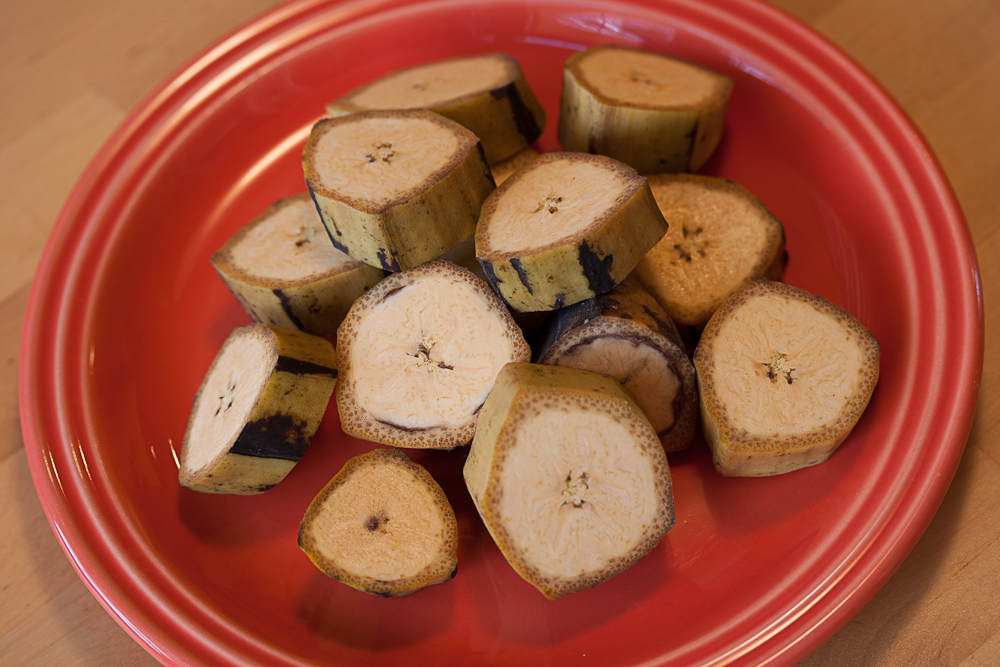
Plantain slices ready to fry

First frying of plantain slices

Smashing a cooked plantain slice with a can

Tostones ready to serve

Guacamole is a Central American dish which has been imported to the American Southwest and eventually to the whole world. Probably that’s because it is easy to make The mellow flavor of the obligate avocado balanced against citrus and chile accents is hard to resist, especially with a corn chip and cold margarita in hand. According to Diane Kennedy, the legendary Mexican cookbook writer, the word comes from two Nahuatl (Aztec) words, ahuacatl (avocado) and molli (mixture). Other authorities say that the word ahuacatl actually means “testicle” referring to the shape of the fruit and its tendency to grow in pairs. More than that, the Mesoamericans reportedly believed that eating the fruit contributed to sexual prowess. Those interesting facts aside, it is easy to eat a bowl of fresh guacamole by oneself.

Ingredients for my version of guacamole

There are probably as many recipes for guacamole as there are cooks who make it. Most traditional recipes include chopped tomato. For me, the version which tends to be favored in Santa Fe is the best. It uses coarsely mashed avocado, lime juice, a little chopped onion, salt, and pepper. Garlic and cilantro are acceptable additions, and chile depends upon your tolerance for heat. I do balk at one addition that you sometimes see – mayonnaise. The Aztecs never used mayonnaise! Honestly, I prefer guacamole with a kick, but because my wife has zero tolerance for chile, I make it without any zest and then sneak a little chile into my portion.

Guacamole in a molcajete ready to serve

The recipes to follow should be enough for two people. For larger groups, just increase proportions accordingly.

RECIPES

Tostones

  • cooking oil
  • 1 ripe plantain, unpeeled and cut in ½ inch  slices (about 12 slices)
  • salt
  • Add the oil to a ½ inch depth in a heavy pan and heat over a medium-high flame. Do not let it smoke
  • Peel the plantain slices and place them in the heated oil. Brown lightly, turn, and brown the other side
  • Remove the slices to absorbent paper, and using the flat end of a large can, smash each of the cooked slices
  • Immediately return the slices to the heated oil and continue frying them until they are browned on both sides
  • Remove again to the absorbent paper, sprinkle with salt, and serve while still warm

Guacamole

Ingredients

  • 1 large, ripe avocado
  • juice of 1 fresh lime
  • 2 scallions, trimmed and chopped finely
  • salt and pepper to taste
  • 1 small tomato, peeled, seeded, and chopped (optional)
  • cilantro leaves, chopped (optional)
  • hot sauce (eg Tabasco or Cholula) to taste (optional)
  • 1 jalapeño, seeded and chopped (optional)

Method

  • Place the avocado flesh in a medium bowl and mash coarsely with a table fork
  • Add the lime juice and combine with the mashed avocado.
  • Stir in the chopped scallions, adjust seasoning with salt and pepper, and serve
  • Add optional ingredients according to your own taste

7 Comments

Filed under Food, Photography, Recipes

LEFTOVER LAMB SHANKS

The day after our farmers market feast, Sarah went off to the restaurant where she was working. Evan slept in after his last night cooking at the restaurant where he worked. Around noon, he volunteered to make lunch and headed out to the kitchen. There were lots of leftovers from the night before, but when he had finished you would not have recognized at all that they were leftovers.

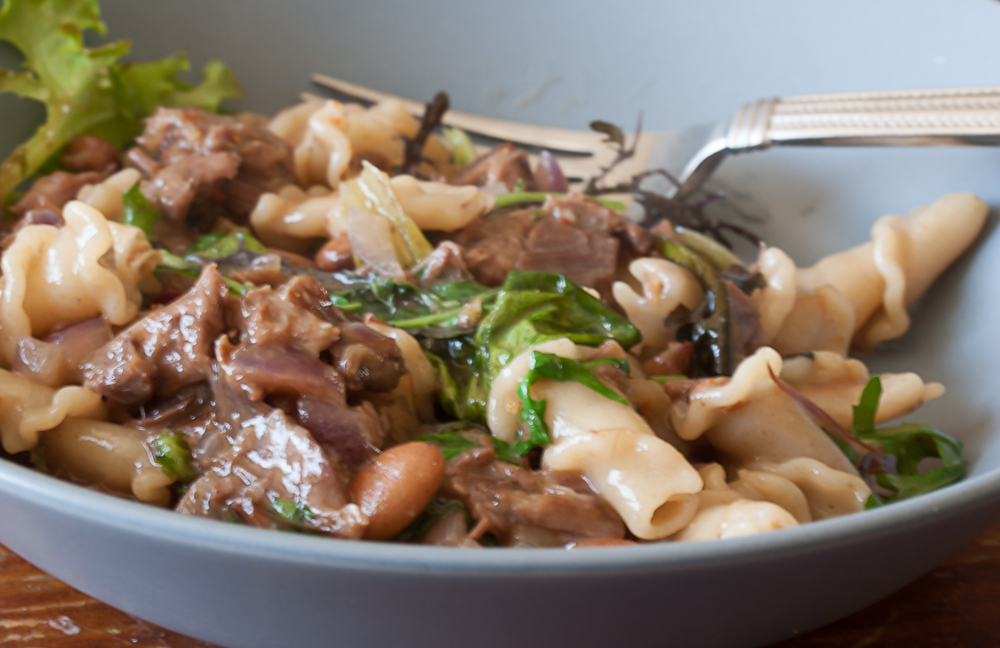
He whipped up a fragrant pasta dish which included the leftover lamb shanks, a reduction of the cooking liquid,  freshly cooked pasta, mushrooms, and some wilted baby salad greens.

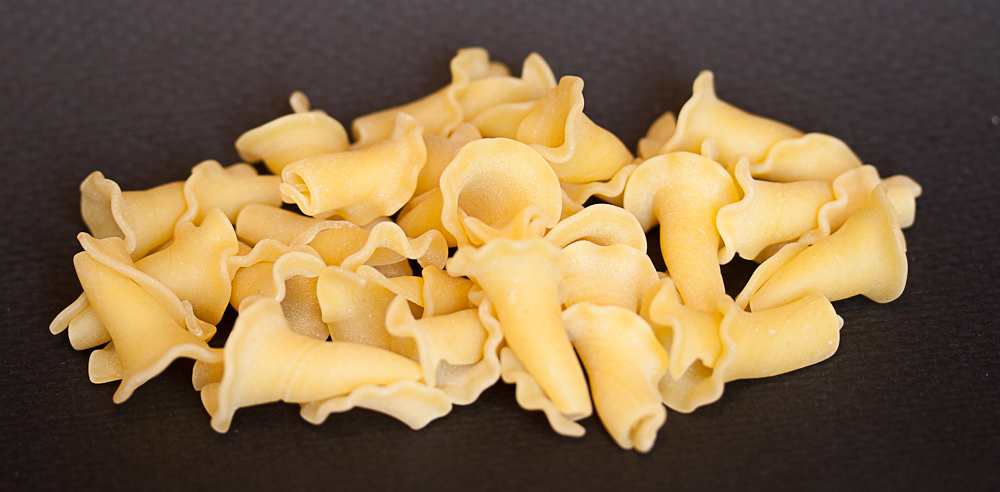
Uncooked campanelle pasta

The pasta he chose was campanelle which  with its bell shape and fluting was a perfect choice to hold the sauce. This unusual pasta shape was listed in a catalog of Sicilian pastas at the end of the nineteenth century. You can read more about it in an interesting book,  Encyclopedia of Pasta, written by Oretta Zanini de Vita and translated by Maureen B. Fant (University of California Press, Berkeley, 2009), which describes the history and  making of Italian pasta.

Lamb shanks, campanelle pasta, mushrooms and wilted greens

RECIPE

Ingredients

  • 2 cups leftover lamb braising liquid, strained and de-greased
  • 1 cup campanelle pasta
  • 1 cup leftover lamb shanks, cut into bite-sized pieces
  • 2 tablespoons olive oil
  • 1 cup mushrooms, trimmed and cut into bite-sized pieces
  • 1 cup baby salad greens
  • salt and pepper

Method

  • Bring the braising liquid to a boil and add the campanelle. Boil until the pasta is al dente.
  • Add the lamb  and warm over low heat until heated through.
  • While the pasta is boiling, heat the olive oil in a small sauté pan over medium heat. Add the mushrooms and sauté for 3 minutes.
  • Stir the mushrooms into the lamb and pasta.
  • Add the salad greens, toss lightly, correct the seasoning and serve immediately.

3 Comments

Filed under Food, Photography, Recipes

CUCUMBER-NORI-SESAME SALAD AND SAUTÉED ROYAL TRUMPET MUSHROOMS: THE FINISHING TOUCHES

Just two more dishes to finish the description of the celebratory meal we had from foods we collected at the Ferry Building Farmers Market. Both are easy to make but surprisingly unique.

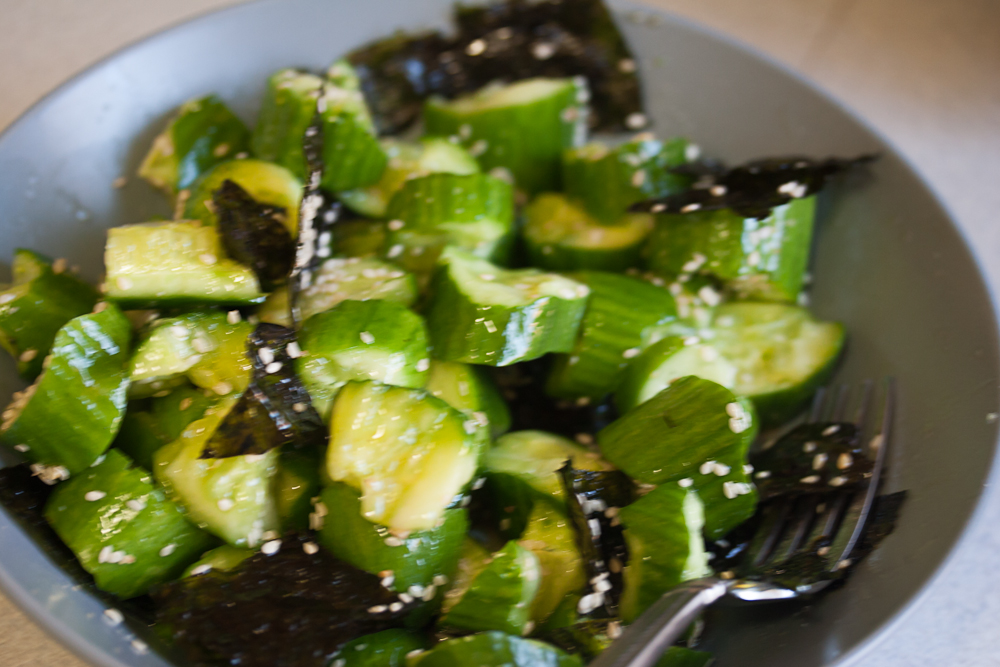
Cucumber-nori-sesame salad

The first was a refreshing salad made with amazingly crunchy and green baby cucumbers and fresh salad greens accented with bits of nori and toasted white sesame seeds.

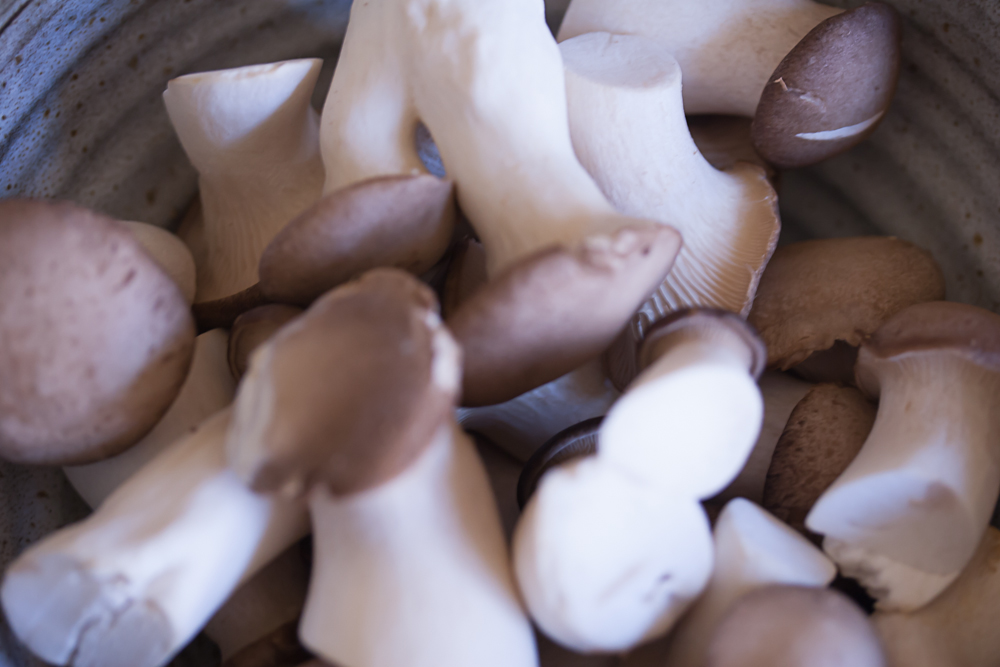
Royal trumpet mushrooms

The second was a delicate sauté of royal trumpet mushrooms with scallions.

Scallions

Sautéed mushrooms and scallions ready to serve

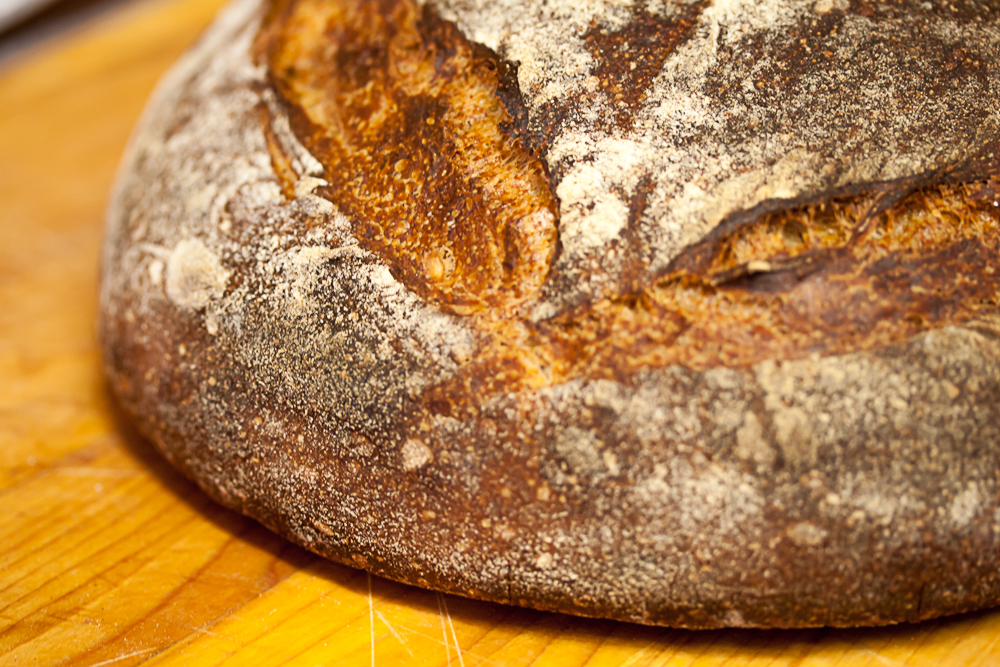
As a bonus not from the farmers market we had a fresh loaf of home-baked Tartine basic country bread made from the recipe in Chad Robertson’s elegant and detailed cookbook, Tartine Bread, Chronicle Books, Ltd, San Francisco, 2010, pages 41-79. (Yes, that’s a long recipe. I plan to post an abbreviated version soon. That should enable you to reproduce the absolutely best home-made bread I have ever tasted).

Fresh loaf of Tartine-style bread

RECIPES

Cucumber-Nori-Sesame Salad

Ingredients

  • 4 small, firm baby cucumbers cut crosswise into ½ inch slices
  • 2 Cups mixed baby salad greens
  • ½ 7 inch sheet of nori cut into ½ inch squares
  • vinaigrette (home-made is the best, but use your favorite)
  • ½ teaspoon sesame oil (optional)
  • salt and pepper to taste
  • 2 Tablespoons white sesame seeds, lightly toasted

Procedure

  • Combine the cucumbers, greens, and nori in a serving bowl.
  • Dress lightly with your favorite vinaigrette. If you like, add the optional sesame oil. Toss.
  • Adjust seasoning with salt and pepper.
  • Sprinkle with sesame seeds and serve immediately.

Should serve four

Sautéed Royal Trumpet Mushrooms with Scallions

Ingredients

  • 2 Tablespoons unsalted butter
  • 2 Tablespoons olive oil (use EVOO – extra virgin olive oil – if you like)
  • 1 small basket (about 2 Cups) fresh royal trumpet mushrooms, cleaned and trimmed
  • 1 bunch (6 to 8) scallions, trimmed and cut crosswise into ½ inch pieces, including the green tops
  • salt and pepper

Procedure

  • Heat the butter and olive oil in a medium sauté pan over medium-high heat.
  • Add the mushrooms and scallions and sauté until cooked through.
  • Correct seasonings with salt and pepper.
  • Serve immediately.

Table set with sweet peas

We set the table with the bouquet of multi-colored sweet peas bought from the flower stall, plated up the feast, and enjoyed it while Evan finished his last day at the restaurant.

Ready to eat

2 Comments

Filed under Food, Photography, Recipes

MORE FARMERS MARKET DINNER: BRAISED LAMB SHANKS

San Francisco’s Ferry Building Farmers Market is much more than the outdoor stalls which attract crowds a couple of days each week. There are all sorts of shops inside the building selling everything from kitchen gear to local caviar. The cheese shops are outstanding, the bakeries are great, and the mushroom place has a huge choice of the freshest specimens. For the carnivores, there are several great shops, but a favorite of both Sarah and me is Prather Ranch. We bought four succulent lamb shanks already done up in plastic, but clearly very fresh. These would be the centerpiece of our farmers market meal.

Turning the braising lamb shanks

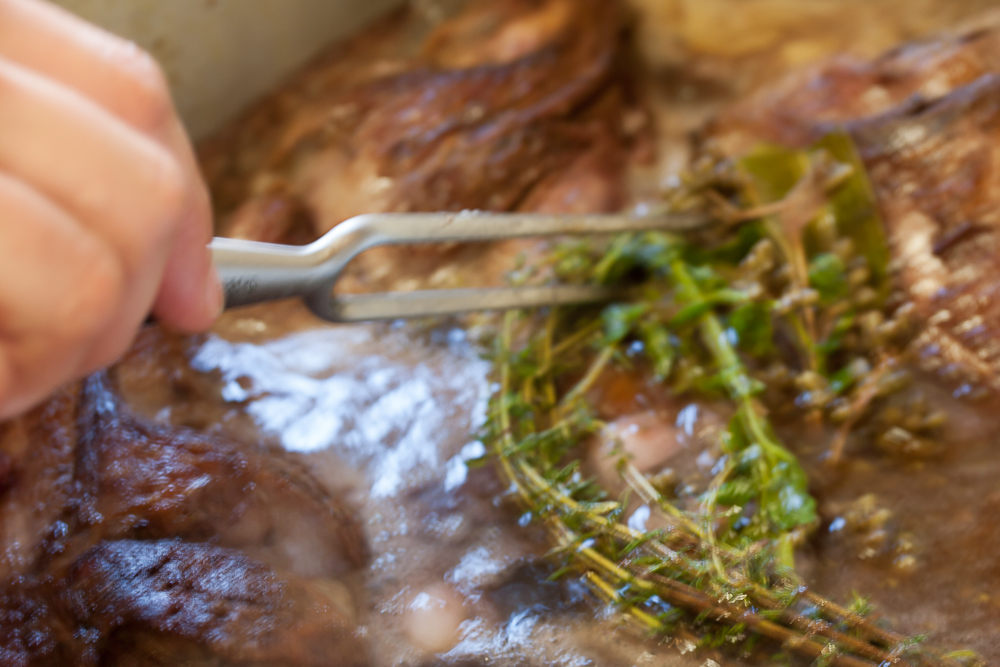
After getting the lamb shanks home, Sarah browned them in a huge Magnalite casserole along with a couple of cloves of smashed garlic and some aromatic vegetables: carrots and onions. Chefs seem divided over the use of celery in the classic mirepoix combination of onions, celery, and carrots. Some refuse to use celery as they think it is too bitter. Whatever your own personal bias might be, be sure to brown the lamb shanks in some oil and your choice of vegetables. Add some stock or water and a good slug of red wine. Season with salt and pepper. Toss in a generous handful of fresh thyme and Mediterranean (not Mexican) oregano. Bring to a boil, and then cover and reduce the heat to the lowest simmer.

Some purists insist on using rosemary and garlic as the classic seasoning for lamb. You can do that instead if you prefer, but I can guarantee that thyme and oregano work beautifully.

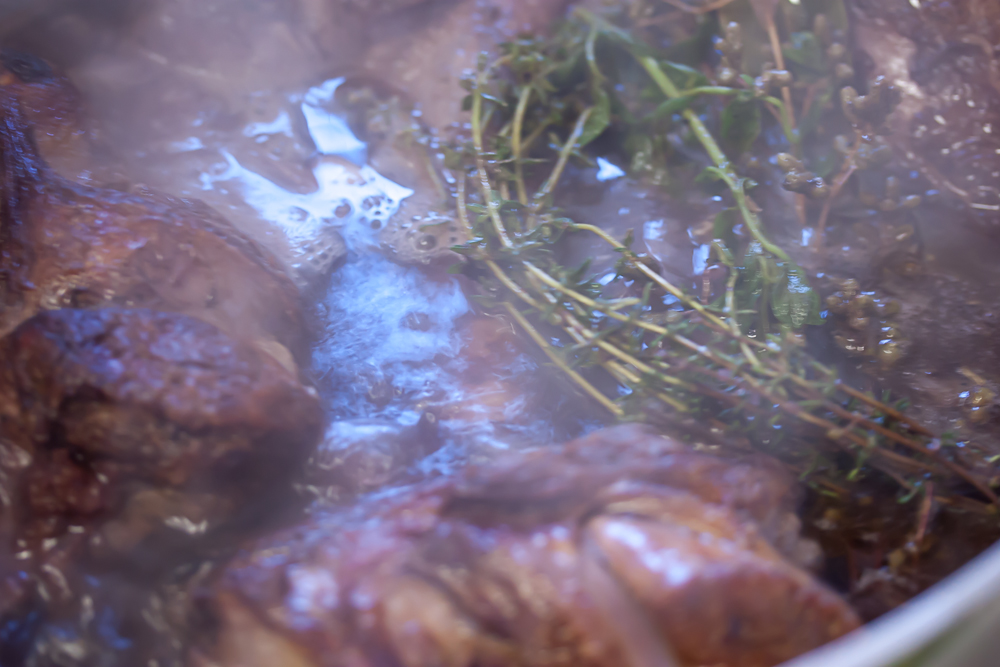
Steaming braising liquid with herbs

Sarah finished her dish over low heat on the stove top, turning and basting frequently as well as skimming off excess fat. If you prefer, you can braise the lamb shanks, covered,  in the oven at low heat – no more than 250°F. Be sure to check the pot frequently and skim the rendered fat. Plan to braise the shanks for at least 2 to 3 hours or until the meat is well done, tender, and falling off the bone.

When they are done to your liking, remove the lamb shanks to a platter and serve them immediately while still warm.

Finished lamb shanks

Lamb shanks vary greatly in size, but in most cases you should allow one for each diner. With only three of us and four lamb shanks we wound up with leftovers.

Ready to serve

3 Comments

Filed under Food, Photography, Recipes

THANKS TO SIBELLA

I want to thank Baking with Sibella http://bakingwithsibella.wordpress.com  for nominating me for the Liebster award. It is a special honor because Sibella has such a great blog filled not only with some of her beautiful baking efforts but also great photo images and examples of her varied artistic accomplishments. For certain you should check out her recipe for rhubarb and strawberry galette. If the images and recipe don’t make you salivate and pull out your baking gear, you are not a real food enthusiast!

The Liebster award is reserved for blogs of fewer than 50 followers, so my numbers definitely qualify me, but with friends like Sibella perhaps I can beat that limit.

1 Comment

Filed under Recipes

ASPARAGUS: LET IT STEW IN ITS OWN JUICE

Another part of our recent meal provided from our trip to the Ferry Building Farmers Market. Even though these days asparagus is available the year around, local, really fresh asparagus is still a harbinger to the spring in northern climes. It is then that it is at its best. There are lots of great ways to cook asparagus – steamed, boiled, baked, and grilled. This method taught to me by Sarah produces the greenest, freshest-tasting asparagus I’ve ever had.

Fresh asparagus spears

We bought three bundles of the thickest stalks we could find in the asparagus stall at the market.

Juicing the asparagus stems

When we were ready for dinner, Sarah cut the thick ends of the stalks where the tender flesh begins. You probably already do the same. I usually throw away those woody ends, but Sarah dropped them into her electric juicer and got the greenest asparagus juice I’ve ever seen. Actually, I’d never seen asparagus juice before.

Peeling the asparagus spears

Next, using a very sharp paring knife, Sarah made the very thinnest peelings of the skins of the asparagus spears.

Peeled asparagus spears ready to cook

Then she put the juice, seasoned with just a little salt and pepper, in a pan large enough to allow the spears to lie flat. She brought the juice to a boil, dropped in the spears, and cooked them for just a few minutes until the asparagus was tender. The finished spears were a bright green color and fragrant.

Asparagus spears cooking in asparagus juice

Sarah served the asparagus with just sections of lemon to squeeze over it, but you can use whatever is your favorite asparagus sauce – hollandaise, aioli, or home-made mayonnaise.

2 Comments

Filed under Food, Photography, Recipes

FERRY BUILDING FEAST: OYSTERS WITH CUCUMBER-DILL MIGNONETTE

Our trip to the Ferry Building Farmers Market coincided with the day that Sarah and Evan got the keys for their new restaurant space, so we were in a celebratory mood. Never mind that Evan had one last night at his current restaurant, Susan, Sarah, and I were going to have a party.

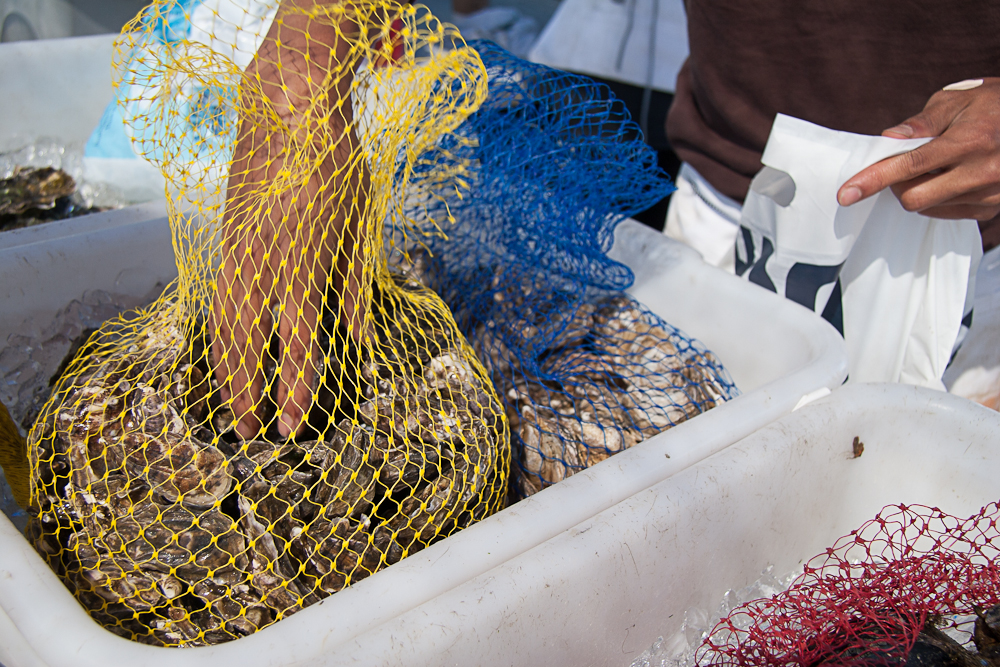
Selecting the best oysters

And what better way to begin the celebration than champagne and oysters on the half shell. Two dozen oysters sounded just about right for the three of us, and the oysters from Hog Island Oyster Company were fresh and just the right size. We brought home a mesh bag iced down for the short journey home.

Opening the oysters with an oyster knife

At dinner time, Sarah brought out her oyster knife and made short work of the shucking. Of course, she is a professional, so she knew what she was doing. She wrapped each shell in a kitchen towel and grabbed it firmly with one hand. Using an oyster knife, she slipped the point of the knife into the hinge of the shell, twisted the knife firmly, and popped open the innocent oyster. She cut the muscles holding the oyster in the shell, removed the top shell, and placed the fresh oyster on a bed of ice.

Opening the oysters with an oyster knife

If you have never opened an oyster on your own. There are a few important pointers. First, be sure to use a good-quality oyster knife. Regular knives can bend and break, and you can wind up plunging the blade into your hand. Serious injuries to blood vessels and tendons can result. Second, the towel is supposed to provide some protection so it should not be flimsy. If you are  a little nervous, Kevlar gloves are available and provide more safety. If you are still anxious, have your fish monger shuck the oysters before you bring them home.

Oysters on the half shell with lemon

You can eat raw oysters with no dressing. That’s the way real aficionados do it so they can taste the brine of the sea. For me, a little lemon juice brightens the taste. In Louisiana they douse with hot sauce. The classic accompaniment is a fresh mignonette sauce. The following recipe is for Sarah’s version based upon ingredients from the farmers market.

RECIPE

Cucumber-dill mignonette

Ingredients

  • ½ cup champagne vinegar
  • 4 teaspoons finely chopped shallots
  • 4 teaspoons finely diced cucumber
  • 2 teaspoons finely minced fennel fronds
  • 2 teaspoons finely minced dill weed
  • 2 teaspoons coarsely ground black pepper
  • salt to taste

Method

  1. In a small bowl, combine all of the ingredients with a wire whisk
  2. Serve immediately or chill until ready to serve

Oysters, mignonette, and sparkling wine ready for the celebration

We opened a bottle of California sparkling white wine, toasted the new restaurant, and enjoyed our raw oysters with cucumber-dill mignonette.

Toasting the new restaurant

2 Comments

Filed under Food, Photography, Recipes

ONION SOUP WITH GARLIC CROUTONS AND MELTED CHEESE

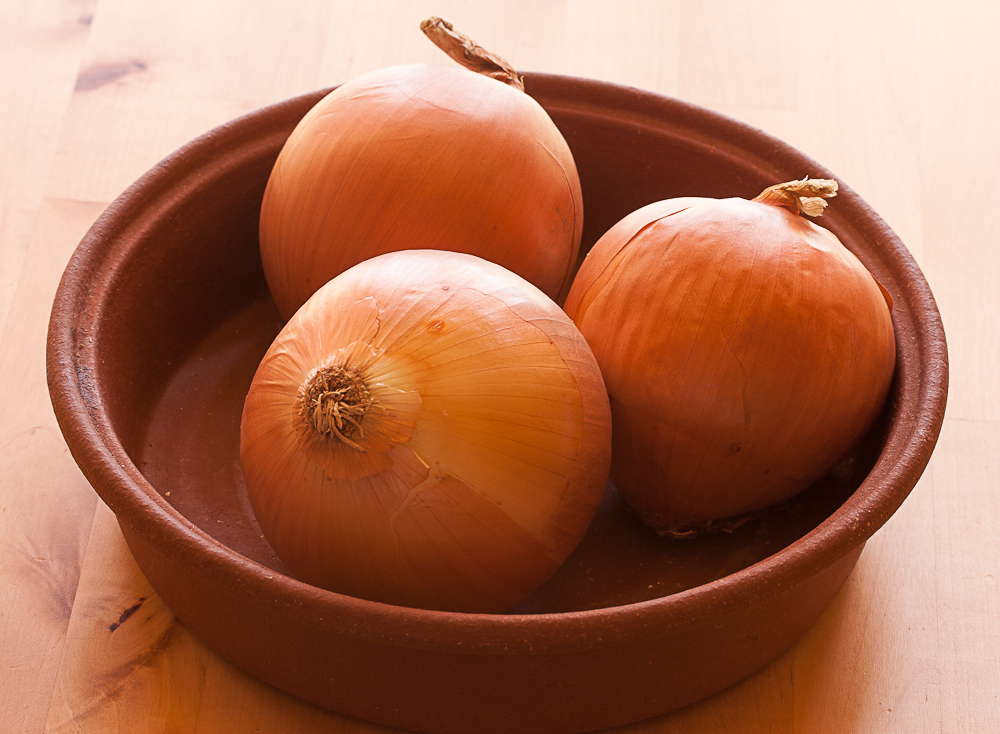
Yellow onions

Who doesn’t like onion soup? My older daughter for one. She actually doesn’t like anything with onions. I can’t understand her taste, because for me a well-made bowl of onion soup topped with a crisp round of garlic crouton and melted Gruyère cheese approaches the perfect simple evening meal. The problem is that there is many a bowl of not-well-made soup. The dehydrated variety doesn’t even really qualify as soup, and the canned sort is not much better. Sometimes you see a version of onion soup in the steam table on a buffet line. That, too, is usually not very appealing. And all of this is too bad because the real thing is so easy to make.

Thinly-sliced onions

Julia Child showed Americans how to make a good soup, along with a lot of her other revelations on good cooking. From time to time we still watch Julia making soup on a black-and-white DVD of her early shows I got as a gift from my children many years ago. I also check out her classic recipe in our tattered, disintegrating copy of Volume One of “Mastering the Art of French Cooking” (pages 43-45). As is always the case, Julia took no shortcuts, and her instructions can sometimes appear daunting.  Those may be the reasons that onion soup is not a mainstay of most kitchens. Another reason may be that the soup is viewed by  modern cooks as a bit old-fashioned. I say too bad to that! The final reason may be that many, like my daughter, don’t like onions. That remains a mystery to me.

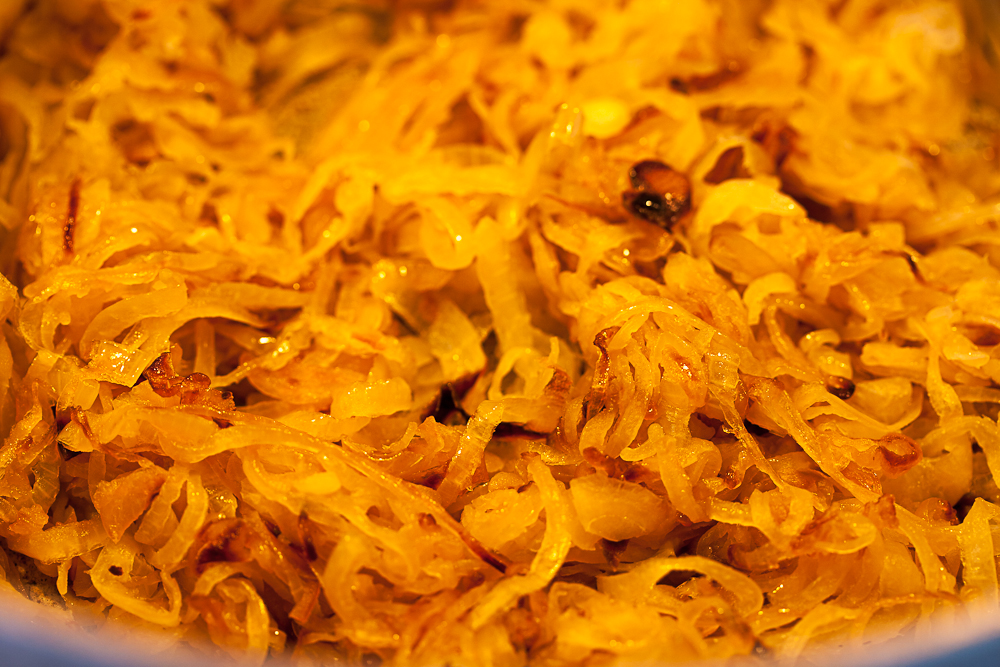
Caramelized onions

The version  that follows is a riff on Julia Child’s recipe, but I have tried to simplify preparation a bit so that you can whip up soup in the afternoon for dinner in the evening. Add some crusty French bread and fresh butter along with a bottle of chilled dry white wine, and you have everything you need for a relaxing evening at home.

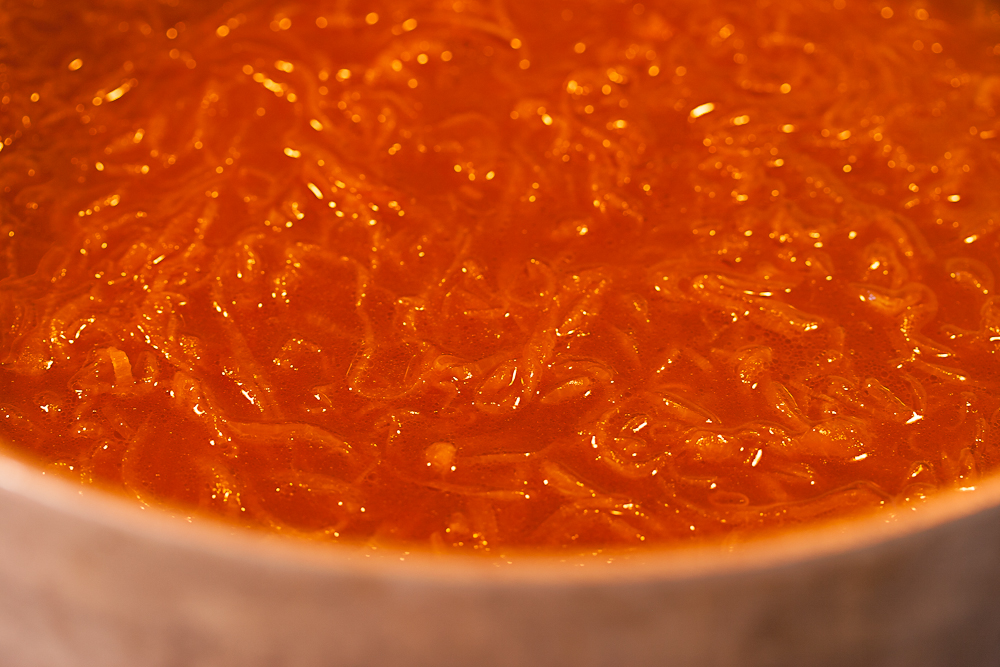
Soup at the simmer

RECIPE

Ingredients  

  • 3 Tablespoons olive oil
  • 3 medium yellow onions, slice as thinly as possible (use a mandoline)
  • ½ teaspoon salt
  • ½ teaspoon granulated sugar
  • 3 Tablesoons all-purpose flour
  • 4 Cups beef stock (home-made or packaged)
  • ½ Cup dry, white vermouth
  • pepper to taste
  • 4 half-inch slices of French baguette
  • 2 garlic cloves, peeled and sliced in half crosswise
  • 2 ounces Gruyère cheese, grated coarsely

Ready to pop under the broiler

Preparation

  1. Heat the olive oil over medium heat in a heavy-bottomed 4-quart saucepan with lid. Add the onions and salt. Stir and cover to sweat the onions. Be careful not to let them burn.
  2. When the onions are translucent and soft, remove the lid, turn up the heat to medium-high, and stir in the sugar.
  3. Stirring frequently with a wooden spoon, caramelize the onions until they are golden brown. They will not begin to brown until most of the liquid has boiled off. Be very careful not to let the onions burn.
  4. When you are satisfied with the color of the onions,  add the flour, stirring until the onions are completely coated. Cook a few minutes so that the flou loses its raw taste.
  5. Add the beef stock and vermouth; adjust the seasoning with salt and pepper. Stir well. Cover and turn the heat to simmer so that the mixture just barely bubbles every few seconds. Simmer for at least two hours.
  6. While the soup is simmering, prepare the croutons by placing the baguette slices on a sheet pan in an oven preheated to 200°. Bake until the bread has dried out a bit. Then remove from the oven and scrape the cut garlic over both sides of the bread slices. Return to the oven and continue to bake until the bread has completely dried and turned a light brown color. Remove from the oven, cool the croutons,  and set aside.
  7. When your soup has simmered long enough, ladle it into four oven-proof soup bowls. Top each bowl with a garlic crouton and cover with the grated cheese.
  8. Place the bowls on a sheet pan and slide under a pre-heated broiler for just a few minutes until the cheese is melted and – if you prefer – lightly browned.
  9. Serve immediately.

Is it soup yet? Definitely!

Serves two if you’re really hungry or four if you would rather enjoy the wine.

1 Comment

Filed under Food, Photography, Recipes

PIZZELLE

Special pizzelle iron

As Easter approaches, I remember a wonderful treat from my childhood.

Batter ready to be spooned into the baking iron

When I was about 10 years old, my family lived in an apartment in the midst of a big Italian family. The grandparents, known to all as “Ma and Pa”, lived in the “Big House” which was surrounded by the smaller homes of their many children and their families. Two unmarried daughters as well as the family of one of their brothers also lived in the Big House. It was clear that the Big House served as the social and communications center for the whole family.

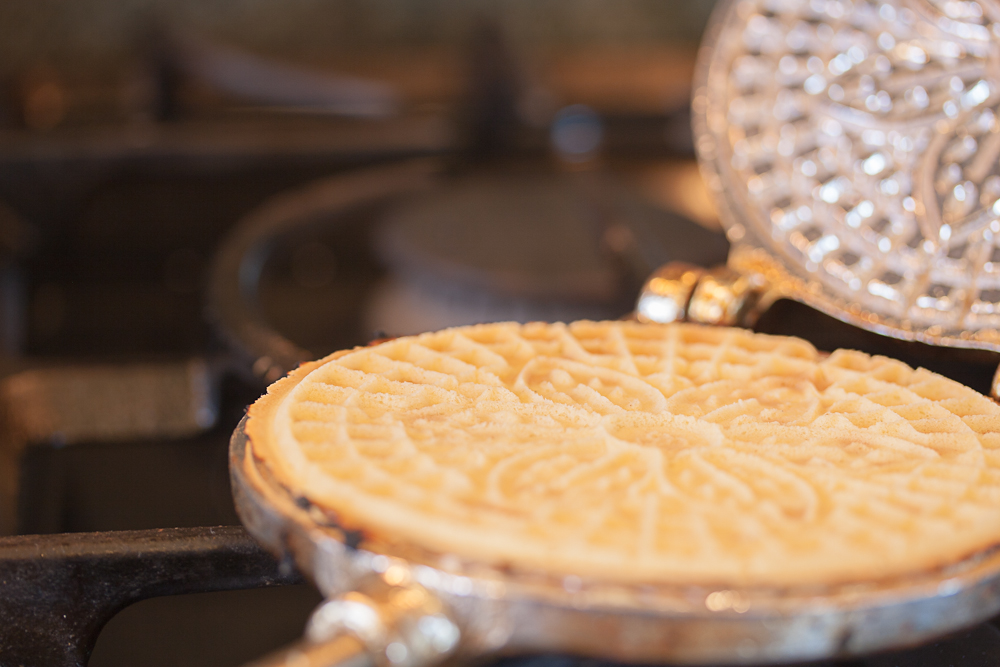
Heating the pizzelle iron

Evening meals were a gathering of the famíglia, with the women serving the meal to the men who ate at a long wooden table in the kitchen. Then the children took their turn, and finally the women ate and cleaned up. This family tradition carried over into many other activities, especially near the holidays. In the spring, before Easter, there was a great deal of cooking and baking in preparation for the celebration ahead.

A spoonful of batter ready to bake

A favorite during this baking spree was the pizzelle. These delicate cookies were baked outside over a hot stove.  Kids clustered around to get them still warm from the griddle. That’s still the best way to eat them. You can spread them with butter or jam while they are still warm, and they are so good. You can also form them around a conical wooden dowel (like the plunger in a chinois) while they are still soft and warm. As they cool, they will firm up and make a perfect cone for your gelato or ice cream.
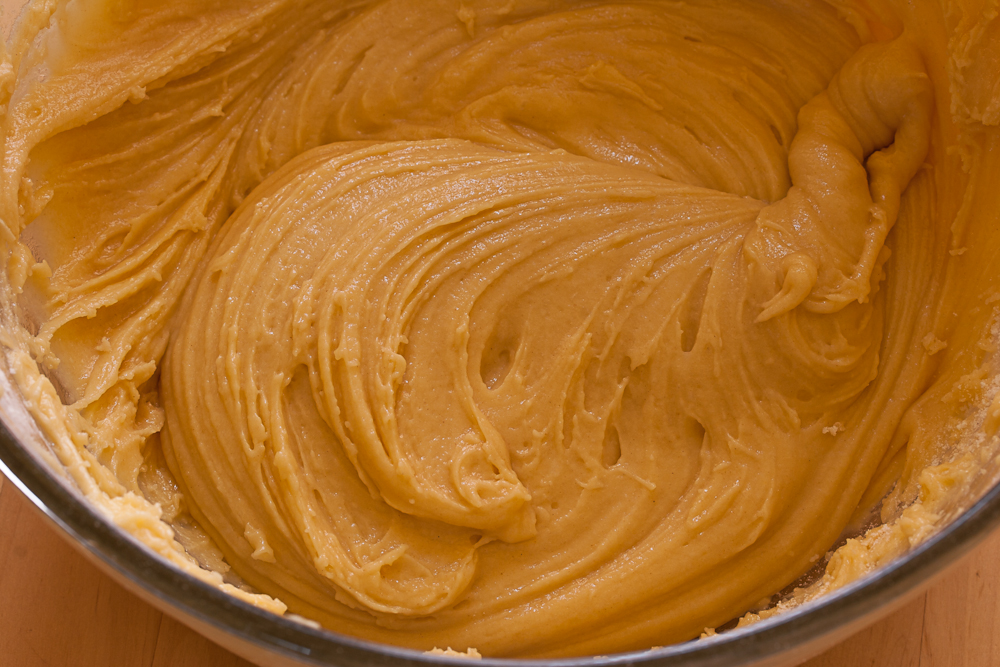
Nearly ready to take off the iron

You will need a special pizzelle baking iron, but you can find one in most specialty cooking stores or websites.

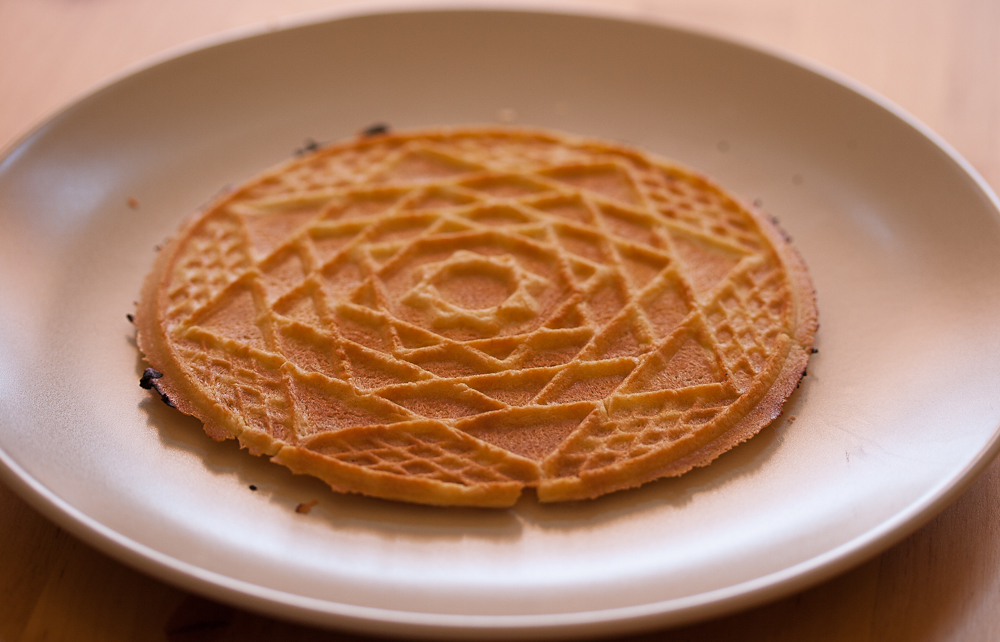
A crispy pizzelle

 Ingredients
1¾ Cups flour
1½ teaspoons baking powder
1 teaspoon lemon zest
3 eggs
½ Cup sugar
1 stick unsalted butter, melted
1 teaspoon vanilla
¼ teaspoon anise extract
melted butter to brush the pizzelle iron

Wrapping a still-warm pizzelle to make a cone

1. In a small bowl, combine the flour, baking powder, and lemon zest and set aside.
2. In a medium bowl, beat the eggs and sugar together with an electric mixer until pale yellow and smooth. Add the melted butter, vanilla, and anise extract and beat until completely combined.
3. Gradually stir in the flour, baking powder, and lemon zest mixture to form a smooth batter.
4. Heat the pizzelle iron on both sides until very hot. Brush both sides of the mold lightly with butter, spoon in about 1 tablespoon of batter, and close the iron. Trim off any batter that oozes out of the iron. Bake about 1 minute on each side or until the pizzelle is golden brown. Transfer the baked pizzelle to a cooling rack and repeat the process until the batter is used up.

A stack of pizzelles ready to eat

Yield: 24 to 30  5-inch cookies

2 Comments

Filed under Food, Photography, Recipes