Category Archives: Recipes

MEYER LEMON BAVARIAN CREAM PIE

I saved three of my farmers market Meyer lemons to make something sweet. I didn’t want to make lemon curd or a regular lemon chess pie, as those seem to be what most folks make. Instead, I decided to make a Bavarian cream and turn it into a pie, with a few modifications of Julia Child’s recipe in volume 1 of Mastering the Art of French Cooking. The Bavarian cream uses crème anglaise as the base so it takes a bit of effort.

I thought the pie turned out pretty well. The test of that was my wife, the Dessert Queen, who had a piece for breakfast, lunch, and dinner – with an occasional bedtime snack – until it was gone. The pie is not something you want to try in the afternoon before a dinner party. The good news is that it is so rich that it can easily serve 16 people.

RECIPES

Almond Pie Crust

Ingredients

  • butter to grease the cake pan and foil liner
  • 1½ cups all-purpose flour
  • ½ cup almond flour
  • 1 teaspoon salt
  • 1 teaspoon granulated sugar
  • 2/3 cup lard
  • 1/8 teaspoon almond extract
  • 1/3 cup ice water

Method

  1. Prepare an 8-inch  false-bottom cake pan by buttering the inside generously. Set aside.
  2. In a medium bowl, combine the flour, almond flour, salt, and sugar.
  3. With a pastry blender, cut in the lard until the mixture has the consistency of coarse corn meal
  4. Add the almond extract and ice water. With a dinner fork, blend until the mixture comes together. With your hands, gather up any loose crumbs and form a ball. Cover the ball with plastic wrap and refrigerate for at least 30 minutes.
  5. Divide the chilled dough in half. Because of the almond flour the dough may be slightly sticky, so work on a floured surface. Work quickly, rolling out the dough into a circle that is large enough to line the prepared cake pan. Save the remaining half of the dough for another pie.
  6. Line the buttered cake pan with the rolled dough, pressing it firmly against the sides and bottom of the pan. Prick the bottom and sides with a fork. With a paring knife, trim the top of the pie shell, tucking in edges and forming a decorative edge with the back of the knife. Then press a well-buttered sheet of aluminum foil against the dough, and fill the foil liner with pie weights or beans.
  7. Bake the pie shell in the middle of an oven for 10 minutes in a preheated 400°F oven. Remove the foil and beans. Prick the bottom and sides again with a fork, and return to the oven for 4 minutes or when the pie shell has begun to brown lightly. Remove from the oven, and set aside until you are ready to fill with the Bavarian cream.

Meyer Lemon Bavarian Cream Pie

Ingredients

  • 3 large Meyer lemons
  • 1 cup granulated sugar
  • 1 envelope unflavored gelatin
  • 7 egg yolks
  • 2 teaspoons cornstarch
  • 1½ cups milk
  • 5 egg whites
  • pinch of salt
  • 1 tablespoon granulated sugar
  • ½ cup whipping cream
  • 2 tablespoons Limoncello liqueur

Method

  1. The night before you plan to make the pie, wash and dry the lemons. Nestle them in a bowl containing the sugar and cover tightly. The lemons will perfume the sugar, but their moisture will also make it rock-hard, so you will need to break it up with a sharp knife.
  2. Zest all three lemons with a micro plane, and set aside.
  3. Juice the lemons. Strain the juice into a measuring cup. You should have about ¾ cup juice.
  4. Sprinkle the gelatin onto the juice and stir lightly so that the gelatin can bloom for 5 minutes or so.
  5. In a large bowl, beat the egg yolks with an electric mixer until smooth. Gradually beat in the sugar until the mixture is pale yellow and forms a ribbon. Beat in the cornstarch.
  6. In the meantime, bring the milk to the boil in a non-reactive 4-quart saucepan. Gradually pour the hot milk into the egg mixture, beating constantly. When the milk has been completely added, return the mixture to the saucepan over medium-low heat. Stir constantly with a wooden spoon, being careful to scrape the bottom of the pan, until the mixture is thickened and coats the spoon. Use a thermometer to make sure the mixture does not exceed 170°F, otherwise the eggs will scramble and you will have to start over.
  7. Remove from the heat and immediately stir in the lemon juice-gelatin mixture. Stir vigorously to make sure that the gelatin is completely dissolved. Rinse out the mixing bowl and return the cooked custard to the bowl. Stir in the lime zest.
  8. In a separate bowl, beat the egg whites and salt until they form stiff peaks. Beat in the sugar, and then fold gently into the custard. Cover with plastic wrap and set in the refrigerator. As the mixture thickens, stir occasionally to prevent separation.
  9. When the custard has nearly set, beat the whipping cream until well-thickened. Stir the whipped cream and liqueur into the custard.
  10. Fill the prepared pie shell with the custard. Return to the refrigerator and chill overnight or until set.
  11. Unmold the pie by loosening the edges of the false bottom and placing the pan on a small bowl so that the rim falls away. This may require a little encouragement. With a large spatula, remove the false bottom and transfer the pie to a serving plate.  Serve.

9 Comments

Filed under Food, Photography, Recipes

PRESERVED MEYER LEMONS

This is the time of year when you can find Meyer lemons in abundance in California, especially in the Bay Area. They are delicious and very different from the usual Eureka lemons you find in the grocery store. At their best, Meyer lemons are large, nearly the size of oranges, and a beautiful golden-yellow color richer than store-bought lemons. They have a citrus smell that seems like a cross between lemon and orange, and they are sweeter than Eureka lemons, though not so sweet that you would eat one out of hand.

With the abundance and special qualities of Meyer lemons, California chefs – and even those in Santa Fe – go crazy with Meyer lemon curd, Meyer lemon pie, Meyer lemon cake – you get the idea.

On our recent trip to San Francisco, I found some beautiful Meyer lemons at the Marin Farmers’ Market in San Rafael. I bought a couple of pounds, and brought them home in my checked bag. I didn’t have any specific plans for them, so I leafed through some of my new Christmas-gift cookbooks from the Bay Area. Thomas McNaughton, chef at Flour+Water, had an interesting recipe for preserved Meyer  lemons in his book, so I thought I would give that a try.

I followed McNaughton’s recipe (sort of) with the plan of making a gallon of preserved lemons. I had to buy a gallon-size glass jar, and unfortunately I wound up not having enough Meyer lemons. I found some at our local Whole Foods, offered in little net sacks. The lemons were literally a pale comparison with my California beauties. They were yellow, small, and blemished with soft spots. Still, I bought them, and wound up needing about 7 pounds of Meyer lemons in total to complete the recipe.

Preserved lemons are a tradition in the cuisines of North Africa. The basic preservation method is brining, so most cooks wind up not using the flesh or juice, but just the peels, finely cut, to provide a citrusy taste to many things including meats and stews. (there are some recipes for using the flesh, but it must be incredibly salty.)  Cookbooks provide an abundance of methods for preserving lemons. Sandor Katz describes the basics in his encyclopedic, The Art of Fermentation and Deborah Madison gives a simple recipe in Vegetarian Cooking for Everyone.

McNaughton’s recipe calls for way more salt than I used. Even at that, the undissolved salt sits at the bottom of my jar of lemons as they preserve away in the coolness of the garage. Sugar and spices make McNaughton’s recipe unique, and I followed his guidance.

RECIPE

Preserved Meyer Lemons

Ingredients

  • 7 pounds large Meyer lemons
  • 6 cups pickling and canning salt
  • 2 cups sugar
  • 2 pieces star anise, broken into smaller pieces
  • 1 teaspoon fennel seeds
  • 1 teaspoon coriander seeds
  • 1 teaspoon whole black peppercorns
  • 2 teaspoons red pepper flakes
  • 2 large bay leaves, crumbled

Method

  1. Sterilize a 1-gallon glass container with non-reactive lid by boiling in water for 10 minutes or washing in dishwasher set on hot.
  2. Wash and dry the lemons.
  3. In a large bowl, combine the salt, sugar, and spices.
  4. Prepare the lemons by slicing them in half from the pointed end to the stem end, stopping ½ inch from the base. Turn the lemon one-quarter turn, and make a similar cut so that each lemon has four quarters joined together by the uncut portion.
  5. Pour ¼ inch of salt-sugar mixture into the bottom of the glass jar.
  6. With a tablespoon, sprinkle a heaping tablespoon of the salt sugar mixture into the cut lemons, one by one, and then arrange them, cut-side up, in the jar. Pack tightly.
  7. When you have a layer of lemons packed in the jar, sprinkle more of the salt-sugar mixture on the top, pressing down with a potato masher to express as much juice as possible.
  8. Layer by layer, continue packing the jar with prepared lemons and adding a layer of salt-sugar mixture on top of each layer.  Continue to press down each layer with the potato masher. Top the lemons with more salt-sugar mixture, seal the jar, and set it aside for 48 hours.
  9. At that time, add more salt-sugar mixture and, if necessary, lemon juice so that the lemons are completely covered. Seal the jar tightly and set in a cool, dark place for three months.
  10. When the lemons have been completely preserved, store them in the refrigerator for up to a year.

Notes

  • Other recipes call for less salt, and I think you could cut back on the salt.
  • Use pickling and canning salt. Regular table salt may leave a residue from the anti-caking agent that is used.
  • The lemons must be completely covered with liquid, otherwise they are likely to spoil.
  • Use tongs when removing lemons for use. Hands, no matter how clean, may introduce organisms that can lead to spoiling.
  • Rinse the lemons well before use, as they will be quite salty. Use the rind and discard the flesh – unless of course you want to experiment with it.

4 Comments

Filed under Food, Photography, Recipes

LAMB MEATBALLS, MINT-PARSLEY PESTO, POTATO GNOCCHI

Every Friday evening, our village market holds a wine tasting which has become a neighborhood gathering. The market owners use the event as an opportunity to introduce new products. One that caught my eye recently was a package of potato gnocchi imported from Italy and made by Del Destino Foods with the advantage that they required no refrigeration and could be stored in the pantry.

I very much like well-made gnocchi, although they are somewhat hard to find, even in good restaurants. They are often too leaden or else disintegrate rather than being the fluffy cloud like pillows that they can be. I’ve tried to make my own, but they take a bit of work and mine have really been no better than others. I was inspired to buy a package of cellophane-wrapped gnocchi for a trial at home. I could have just opted to cook them according to directions and  top them with olive oil and grated Parmesan.

Instead, I decided to combine them with lamb in the form of meatballs along with mint pesto. (What’s a better combination than lamb and mint, right?)

To make the meatballs I used a #60 scoop. I didn’t know what that meant, so when I looked up scoops, I learned that they are assigned a number according to size, the number referring to how many scoops it takes to make a quart. So a #60 scoop holds about ½ ounce, level, and more when heaping. In this recipe, you should expect about 30 meatballs.

I liked the way everything turned out, and the gnocchi were good, not great. At least they were not sinkers, they had a good taste, and they were fast. In fact, they were good enough that I will try them again. However, I’ve also made a plan to make my own soon.

RECIPES

Lamb Meatballs

Ingredients

  • ½ cup bread crumbs
  • ½ cup milk
  • 1 pound ground lamb
  • 1 egg, lightly beaten
  • ¼ cup finely chopped shallots
  • 3 tablespoons finely chopped green bell pepper
  • salt and pepper
  • Italian seasoning to taste (optional)
  • pure olive oil

Method

  1. In a small bowl, combine the bread crumbs and milk. Stir to mix thoroughly and set aside.
  2. In a larger bowl, combine the ground lamb and egg. Stir in the milk-bread crumb mixture, shallots, and pepper. You may need to use your hands to get the meatball mixture well combined.
  3. Adjust the seasoning with salt, pepper, and, if desired, Italian seasoning.
  4. Form the meatballs to the size you desire. I think smaller is better.
  5. In a saucepan over a medium flame, heat the olive oil until it shimmers. Add the meatballs in batches, turning them until they are completely browned. Continue to sauté for an additional 5 minutes until they are cooked through. Keep warm until you are ready to compose the serving bowls.

Mint-Parsley Pesto

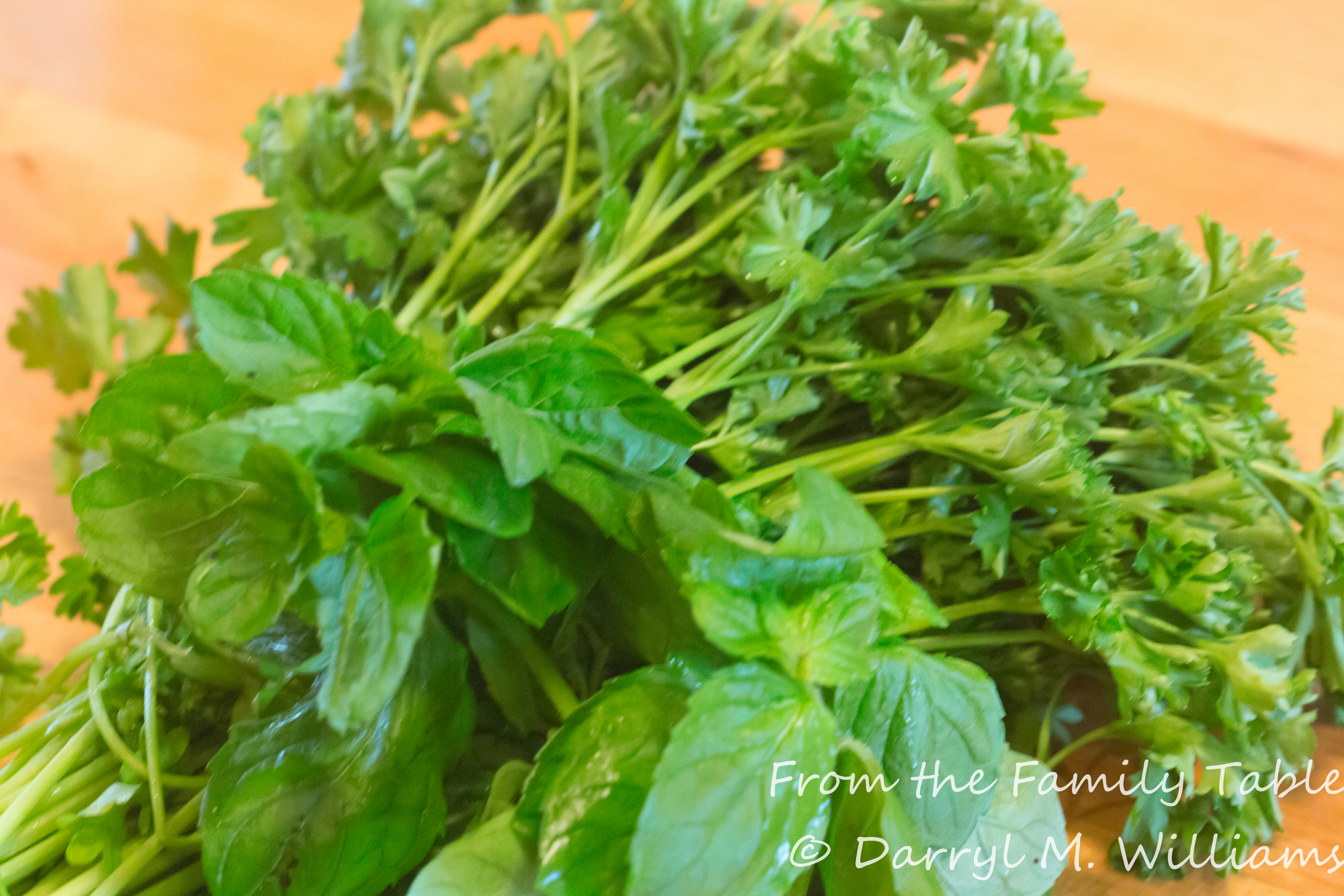
Mint and parsley for the pesto

Mint and parsley for the pesto

Ingredients

  • 1 bunch parsley, stems removed
  • 1 package mint, stems removed
  • 3 garlic cloves, peeled and stem and any green shoots removed
  • ½ cup grated fresh Parmesan cheese
  • 1 cup extra virgin olive oil
  • ¼ cup English walnuts
  • salt and pepper

Method

  1. Place the parsley, mint, garlic, and Parmesan cheese in the beaker of a food processor.
  2. Pulse, gradually adding olive oil and stopping occasionally to push down the sides with a spatula.
  3. When the pesto has reached the desired consistency, add the walnuts, pulse briefly, and adjust seasoning with salt and pepper.

Lamb Meatballs, Mint-Parsley Pesto, Potato Gnocchi

Ingredients

  • 1 package gnocchi cooked according to instructions
  • 1 batch mint-parsley pesto (see above)
  • 1 batch lamb meatballs (see above)
  • freshly grated Parmesan cheese

Method

  1. Boil and drain the packaged gnocchi according to instructions. Distribute among 4 pasta bowls
  2. Top with a desired amount of pesto. You may need to dilute it with a bit of the water reserved from boiling the gnocchi
  3. Arrange meatballs on top of the pesto. Serve immediately. Pass the grated Parmesan separately.

Leave a comment

Filed under Food, Photography, Recipes

ANOTHER YEAR IN YOSEMITE – PLANCHA BREAD

It has been nearly a year since I last reported from Yosemite. Sarah and Evan have been invited again to demonstrate the preparation of one of their dishes and to prepare a dinner at the Ahwahnee Hotel.

During the past year, things have changed in our family and with the park. Last year, Sarah was trying to cook while 8+ months pregnant. This year we were charged with watching a nearly four year old and a 10 month old while Sarah cooks.

The park is still suffering from the results of last summer’s fires. There are great stands of blackened tree skeletons, and huge logging trucks are pulling enormous tree trunk s down the road.  The drought and warm weather have both had their impact: there is no snow, and Yosemite Falls, usually frozen by this time of year, are without ice. In the Central Valley below, the reservoirs are nearly empty. Everyone is hoping for the rains and snows that don’t appear to be coming.

Perhaps the biggest current news is the successful climb of  the Dawn Wall of El Capitan by Tommy Caldwell and Kevin Jorgeson. Sarah and Evan’s demonstration was interrupted by the announcement, and since then the hotel has been abuzz with the news. All of the television networks appeared with cameras and had the climbers get up at 4 AM (After being on a sheer rock face for 19 days.) to give interviews for Good Morning America, Today, etc.

Today, Susan and I took a drive while Sarah, Evan, and the boys were taking a walk – the first time they have had a chance to get out of the hotel and the kitchen.

Our drive took us past El Capitan. There were still three bivouac tents hanging from the Dawn Wall, and there was a huge traffic jam of television trucks in the meadow where Caldwell and Jorgeson were giving yet more interviews. Then we drove past Bridal Veil Falls to the Tunnel View Point to get an obligate image of the whole valley including El Capitan and Bridal Veil Falls with Half Dome in the background. It is a cliché image, but it is so breathtaking that you can’t avoid it. Neither could a big crowd of people even in the middle of winter.

Tonight, Sarah and Evan will serve a wonderful dinner to include aged duck lasagna and an almond-chocolate dessert.

here’s the menu:

  • Onion soup: radish and dried plum salsa verde, fried shallots
  • Aged duck lasagna: chickories
  • Bone marrow roasted cauliflower: kumquat
  • New York strip steak: lemon verbena curry, pommes fondant
  • Bittersweet chocolate ganache: marshmallow fluff, citrus

But I thought I would share recipes from their demonstration:


RECIPES

Rich Table Plancha Bread

Ingredients

  • 1 1/2 cups water
  • 2 1/4 teaspoons dry yeast
  • 1 teaspoon honey
  • 1 1/2 cups whole wheat flour
  • 1 cup bread flour
  • 1 3/4 teaspoons salt
  • 2 tablespoons Sevillano olive oil

Method

  1. Mix together the water, yeast, honey, and olive oil.
  2. Add flour and salt to the bowl of a stand mixer. Using the dough hook, add the wet to the dry ingredients and mix to form a ball.
  3. Keep the dough in the mixing bowl and wrap the whole thing with plastic wrap. Let dough proof in a warm area of the kitchen for one hour.
  4. Once the dough has proofed, divide it into 70 g balls. Roll each ball out into an oblong about 1/4 inch thick.
  5. On a griddle or large cast iron pan heated to medium-high and seasoned with oil, sear each flat bread, cooking and browning on both sides.

Roasted Baby Cauliflower Dip

Ingredients

  •  1 head baby cauliflower
  • 3 tablespoons butter, browned and reserved
  • juice of 1/2 lemon
  • salt to taste

Method

  1. Clean cauliflower to remove most of the greens leaves and stem. Cut in half.
  2. Blanch cauliflower in boiling salted water until jus tender
  3. Sear the blanched cauliflower on a griddle or heavy cast iron pan until golden. Then bake in a 350 degree F oven until tender.
  4. Season cauliflower with lemon juice, brown butter, and salt. Puree if desired or serve as is.

Shelling Bean Dip

Ingredients

  • 1 pound fresh cranberry beans
  • 2 bay leaves
  • 3-4 tablespoons pure olive oil
  • salt to taste
  • 1 teaspoon Douglas fir powder
  • 1 teaspoon fennel pollen

Method

  1. Cook cranberry beans in water with bay leaves until soft. Strain beans and reserve the cooking water
  2. In a mixing bowl, season the beans with pure olive oil (e.g. Mission Trail from Sciabica), some of the reserved cooking water, salt, Douglas fir powder, and fennel pollen.
  3. Using a fork, mash everything together until the desired texture is reached. The puree should be as smooth as hummus.

Note: With both dips, you can spread them on pieces of reheated plancha bread and garnish with tiny cauliflower florets or thinly sliced radishes and caramelized finely sliced shallot.

Leave a comment

Filed under Food, Photography, Recipes, Restaurants, Travel

FISH STEW AND THE REDONDO PIER

During our recent visit to Los Angeles, we stayed just a short walk from the pier at Redondo Beach, so we made a family outing between the various  holidays. Everyone else for miles around decided to do the same thing, because the boardwalk was jammed with multi-generational families. Many of them were visiting with other multi-generational families giving a festive air to the occasion. The Redondo Pier is filled with attractions similar to those in other seaside tourist towns: restaurants, glass-bottomed boat tours, candy shops, and an arcade with an indoor Tilt-A-Whirl.

One attraction, though, stands out. The Quality Seafood Fish Market, “Largest and Finest Selection of Seafood on the Coast”. It stretches for much of the length of one side of the boardwalk, complete with its own  very popular seafood restaurant around the corner. The best part, though, is the seafood market where you can buy fresh fish and shell fish, some of them live. The place advertises albacore, anchovies, barracuda,  blue runner, bonito, bream, catfish, etc., etc., in alphabetical order. This is Dungeness crab season on the West Coast, and there were Dungeness crabs aplenty. But there were at least four other varieties of local crabs, wiggling in their watery holding tanks. There were also oysters from a number of places along with mussels, several kinds of clams, and even some geoduck – pronounced “gooey-duck”. (Which my daughter declared she would not eat. Not too surprising since she avoids  “objectionable” foods including all allia – onions, red onions, scallions, shallots, leeks – like the proverbial plague.)

Carol bought some live crabs, shrimp with their heads still on, clams, mussels and a couple of varieties of fish, planning to make a fish stew from one of her favorite cookbooks. New Classic Family Dinners, John Wiley and Sons, Hoboken, NJ, 2009, is written by Mark Peel, owner/chef of the Campanile, widely regarded as one of the best restaurants in Los Angeles but now closed while Peel gets involved in his next venture.

Recipes in the book are patterned after simpler meals Peel served in the Campanile on Monday nights (Family Night) and are supposed to be easy enough that the home cook can prepare them.

Carol did all the cooking, but as I peeked into the kitchen from time to time, it did not look that easy. Regardless, the end result was delicious, and there was plenty for 6 adults and 4 kids.  Note that Carol’s recipe has substituted crab for lobster and contains no onion or its relatives except for a bulb of garlic. Also, the recipe is considerably simplified from Mark Peel’s original. For my part, forgive the images. I only had my iPhone on our excursion.

RECIPE

Rich Fish Stew with Crab, Shrimp, Clams, and Sea Bass

Ingredients

BROTH

  • 3 medium Dungeness crabs
  • 1 quart boiling water
  • 3 tablespoons canola oil
  • 1 medium carrot, peeled and coarsely chopped
  • 2 stalks celery, chopped
  • ½ small fennel bulb, diced
  • salt
  • 1 14½ ounce can tomatoes with juice
  • 1 garlic head, cut in half crosswise
  • shells and heads from 2 pounds fresh shrimp
  • 1 cup dry white wine (Sauvignon blanc is a good choice)
  • bouquet garni of bay leaves, parsley, tarragon, and thyme
  • ½ teaspoon cracked peppercorns
  • 2 quarts of liquid: crab boiling liquid+water
  • 3 slices country bread, toasted

STEW

  • Crabs from above
  • ¾ pound Yukon gold potatoes,  boiled until tender and cut into chunks
  • 1 pound white-fleshed fish (sea bass, halibut, snapper), cut into bite-sized pieces
  • 2 dozen clams
  • 2 dozen mussels, de-bearded if necessary
  • 2 pounds shrimp, heads removed, shelled, and deveined
  • 3 tablespoons Italian parsley, chopped coarsely

Method

BROTH

  1. ALERT: DO NOT ASK YOUNG CHILDREN TO HELP WITH THIS STEP. In a large pot lined with a steamer basket, bring the water to a boil. With tongs, lower the crabs into the pot. (Be careful – they will fight back.) Cover tightly, and cook for 12 minutes. Remove the crabs from the pot being careful to save the liquid. Chill the crabs in ice water. Drain and set aside. Measure the cooking water and add more water if needed to make 2 quarts.
  2. Heat the canola oil in a large pot. Add the carrots, celery, and fennel, stirring for a few minutes until lightly browned. Then add the remaining broth ingredients. Bring to a boil, then reduce to a simmer, covered, for about 30 minutes
  3. Strain through a chinois or other strainer, pressing the solids to remove any additional liquid.
  4. Return the strained broth to the cooking pot.
  5. Add the potatoes to the broth; return to the simmer.
  6. Add the fish and simmer for an additional 5 minutes. Then add the clams, mussels, and shrimp and simmer until the clams and mussels have opened and the shrimp is pink, about 5 minutes.
  7. Add the crabs, breaking off the legs and claws. Adjust the seasoning and garnish with chopped parsley. Serve immediately with slices of toasted baguette seasoned with garlic and olive oil. Be sure to have some tools to break open the crabs along with a bowl for shells and plenty of napkins.


4 Comments

Filed under Food, Photography, Recipes, Restaurants

PORCUPINE MEATBALLS

When I was in my graduate program, I lived with the family of an old school friend. The mother was a good cook of the Betty Crocker/Good Housekeeping school, and there were still young kids living at home. We often had many of the classics – tuna-noodle casserole, macaroni and cheese, meat loaf – but a cheer would go up from the kids when they learned that dinner would include porcupine meatballs. It was even a celebratory dish for birthdays or good report cards.

The meatballs get their name not from being made from porcupine meat but from the rice on their surfaces that supposedly sticks up like the quills on a porcupine’s back. You clearly need the imagination of a child for this creation.

Honestly, I think that the reputation of the dish was overblown, but it really is something to make when you have run out of ideas for what to do with a pound of ground beef.  And that’s exactly what happened. I had a pound of ground beef to use up, and I didn’t feel like the usual hamburgers or pasta with meat sauce.

Then I thought of porcupine meatballs even though I hadn’t had them since my college days. They are easy to make with the single challenging step being the tomato sauce in which the meatballs cook. If you insist, you can make a very elaborate sauce. Alternatively, you can open a can of plain tomato sauce. Those two options run the gamut of hard to ridiculously easy and of tasty to why-bother. Fortunately, there is a middle road. I bought a large jar of Rao’s tomato/basil pasta sauce (straight from the world-famous Manhattan restaurant, according to the label), and that worked perfectly to make this an easy, one-pot meal.

Put a green salad on the side, and you have all your food groups.

RECIPE

Porcupine Meatballs

Ingredients

  • 1 thick slice sourdough bread, crusts removed
  • 1/2 cup whole milk
  • 1 pound ground beef
  • 1 egg
  • 1 tablespoon tomato paste
  • 1/4 cup diced green bell pepper
  • 1/4 cup chopped yellow onion
  • 1/4 teasoon garlic powder
  • 1/2 teaspoon salt
  • 1/4 teaspoon ground black pepper
  • 1/2 cup long grain white rice
  • 2 tablespoons vegetable oil
  • 1 quart jar commercial pasta sauce
  • grated Parmesan cheese

Method

  1. In a large mixing bowl, soak the bread, torn into pieces, in the milk. Use a fork to mash the bread into a paste.
  2. Add the ground beef, egg, and tomato paste, and with your hands, mix until completely combined. Stir in the bell pepper, onion, garlic powder, salt, and pepper and mix until completely combined.
  3. Form the mixture into 8 meatballs.
  4. Place the rice in a shallow dish. Roll the meatballs in the rice until they are completely covered.
  5. In a large pot,  brown the meatballs in the oil over medium-high heat. Add the pasta sauce, cover, and simmer for 45 minutes or until the rice is cooked. Some of the rice will have fallen off the meatballs into the sauce.
  6. Serve while still hot, topped with grated Parmesan cheese

2 Comments

Filed under Food, Photography, Recipes

CASA DE HILLMONT SANCOCHO

Peter, our son, stopped by our daughter’s house in L.A. on his way down the coast to spend some holiday time with his mother-in-law. Before his visit he indicated that he wanted to cook dinner one night. It required some ingredients that we thought we could find at the Grand Central Market, including green and ripe plantains and yuca. The yuca was not to be had, but in the end Peter located some at the neighborhood grocery store.

The dish that Peter chose to cook had its origins when he was in graduate school. He found himself without housing and with very little money. Our daughter, Sarah, was in the undergraduate program at the same university. One of her teaching assistants, a doctoral candidate in mathematics from Colombia, announced in class one day that there was a vacancy in the house where he was living. Sarah passed the information to Peter, and Peter jumped at the opportunity. He wound up living in the garage for several months, rent-free. Then a bedroom opened up, and he became a permanent, rent-paying resident.

As with much collegiate housing, there was a steady stream of old and new tenants. Sarah even lived there for awhile. But the backbone of the place was the three Colombianos who lived there the longest: Carlos, Mario, and Andreas. They became good friends with our children, and an added benefit was that Sarah, the Spanish major, got to polish her language skills, Peter learned how to speak Spanish, and they both learned to cook Colombian foods. Peter still keeps in touch with Carlos, who is now a professor of mathematics at his home university.

Not surprisingly, the house came to be known as Casa de Hillmont after the street where it was located. And it had all sorts of unique features – the carpet with big holes, the reclining sofa we donated, unidentified insects (This was Texas, after all.) and the quirky landlady who made off with a bird bath. Mostly the food was standard college fare like ramen, but there were also Colombian classics like tostones, arepas, and sancocho. Here is Peter’s version of sancocho.

RECIPE

Casa de Hillmont Sancocho

Ingredients

  • 4 tablespoons cooking oil, divided
  • 1 medium white onion, chopped
  • 1 garlic clove, minced
  • 1 tomato, coarsely chopped
  • 4 to 6 pieces of chicken (thighs, drumsticks, breast)
  • 12 cups water
  • salt and pepper to taste
  • 1 green plantain, peeled and cut into pieces
  • 1 carrot, peeled and cut into large pieces
  • 4 medium potatoes, peeled and cut into chunks
  • 1 yuca root, peeled, core removed, and cut into large pieces
  • 4-6 pieces of corn on the cob
  • 1 ripe plantain, unpeeled and cut into 4-6 equal pieces
  • 1 generous handful of cilantro, finely chopped
  • cream
  • capers
  • avocado, diced

Method

  1. In a large skillet, heat 2 tablespoons of oil over medium-high heat. Add the onion, garlic, and tomato and saute for about 3 minutes. Set aside.
  2. Brown the chicken pieces in the remaining oil in a large pot. Add the onion, garlic, tomato mixture and saute for another 6 minutes. Add the water, and correct the seasonings with salt and pepper.
  3. Add the green plantain and carrot to the mixture, and bring to the boil. Simmer for about 20 minutes; then add the potatoes. Simmer for another 10 minutes or until the potatoes are soft.
  4. Add the yuca root, and simmer until the yuca is soft
  5. Boil the unpeeled ripe plantain in another pot until it is easily pierced with a fork. Drain and set aside.
  6. Add the chopped cilantro to the chicken stew.
  7. Serve by placing a piece of the ripe plantain in every soup bowl. Ladle chicken stew over the plantain.
  8. Pass cream, capers, and avocado separately to garnish the stew. You should have freshly made arepas on the side. (Another post)
  9. Serves 4 to 6.

4 Comments

Filed under Food, Photography, Recipes

CAROL’S CROOK’S CORNER SHRIMP AND GRITS

For Christmas dinner, Carol made two of her family’s favorites: shrimp and grits, and pear and bleu cheese salad. She also made pots de creme in some antique pots from her great aunt. It was a delicious dinner without the turkey, but with plenty of calories.

This post, though, is about the shrimp and grits. Carol and her husband met during their graduate studies in North Carolina. Coming from Louisiana, Carol was used to southern cooking, but her future husband had grown up in New Jersey and had gone to school in the Midwest, so southern cooking had to become an acquired taste. He adapted soon enough.

A favorite haunt for the two of them was Crook’s Corner in Chapel Hill. There, the menu includes pulled pork and North Carolina-style barbecue. But the place has gained its international fame from its version of shrimp and grits. Part of the uniqueness of Crook’s Corner shrimp and grits is that they stone grind their own grits. In fact, Carol still orders her grits from there instead of buying inferior brands at the store. And by inferior, I do mean inferior. Properly cooked grits require at least a half hour of cooking, and old-timey grits are for the most part not to be had. The grocery shelves, even in southern cities, have been filled with “quick” grits and, worse,  “instant” grits. Instant grits are in the same category as instant mashed potatoes and instant rice. If that’s all you’ve ever eaten, it’s no wonder that you don’t like them.

Carol’s recipe comes from the Crook’s Corner cookbook, so it clearly is made with Crook’s Corner grits. If all else fails, you can get your grits from there, too.

RECIPE

Carol’s Crook’s Corner Shrimp and Grits

Ingredients

  • 2 pounds fresh, uncooked shrimp, peeled and deveined
  • 1 cup stone-ground grits
  • 4 1/2 cups water
  • 1 teaspoon salt
  • 8 ounces Cheddar cheese, grated
  • 4 ounces bacon
  • 3 cloves garlic, peeled and minced
  • 1/2 pound white mushrooms, sliced
  • zest of one lemon
  • 1/4 cup coarsely chopped Italian parsley

Method

  1. Rinse the deveined shrimp in running water, and chill until ready to cook
  2. Bring the water and slat to a rolling bol in a deep sauce pan. Let the grits trickle through your fingers into the boiling water slowly while stirring constantly. The water will boil up and overflow unless you stir constantly, and remove from the heat as needed. When the grits have been completely added to the water, stir to remove any lumps, lower the temperature to a low simmer, and cover. Cook for at least 45 minutes. An hour is better. Stir occasionally.
  3. When the grits are cooked, stir in the cheese and keep warm until ready to serve.
  4. In the meantime, heat a large skillet over medium-high heat. Cut the bacon into 1 inch squares and add to the hot skillet. Stir frequently until crisp but not burned.
  5. Add the shrimp to the bacon and rendered bacon fat, stirring occasionally.
  6. When the shrimp begin to turn pink, add the garlic and sliced mushrooms. Stir occasionally until the shrimp are pink and the mushrooms are cooked.
  7. Serve the grits in individual soup bowls topped with the shrimp mixture and garnished with lemon zest and parsley. Pass hot sauce for those who like their shrimp and grits spicy. Seve with crusty French bread and the pear and bleu cheese salad.


Leave a comment

Filed under Food, Photography, Recipes

CHRISTMAS EVE TAMALES AND PORTO’S BAKERY

For years, making tamales has been a Christmas Eve tradition in our family. The tradition has been carried over to our children and their families. This year, we are spending Christmas with our daughter, Carol, and her family in Los Angeles, but we decided not to make our own tamales but rather get them from a well-known Los Angeles institution where many of the locals get their Christmas tamal fix.  We drove to Downey where one of three branches of Porto’s Bakery is located.

We tried to get there early, but 8:30 was not soon enough, especially since the store opened at 6:30. We were warned that on Christmas Eve morning the line would be long, but we were not prepared. The line started at the corner next to the traffic light, stretched down the street to the alley, past the bank building on the corner, back up the sidewalk, and a cross a courtyard. Not to worry, we were told, the line would move fast. And it did. After an hour in line, visiting with strangers, accepting business cards from others, and generally having a good time, we made it to the front door.

Inside, there were yet more lines: one for those who wanted only cakes and another – much longer – for those who wanted pastries and other baked goods. The line was cleverly and artfully arranged so that the final pass before you were beckoned to one of the many clerks was right in front of the pastry display. After that, how could you resist ordering one of everything?

Carol placed her order to include caramel eclairs, deep-fried potato balls, and several versions of tarts and cakelets. Unfortunately, by the time we arrived, Porto’s had run out of their famous tamales.


Our Christmas Eve meal was saved by my forethought to bring some frozen tamales from Santa Fe, but the memory of all of that sugar lives on. We also plan to have green chile stew. Carol does not like onion, an essential part of green chile stew, so for this version, the onion will be pulverized in a food processor, but you can just chop it if you prefer.

For Christmas Day, we will be more unconventional. Carol’s oven is seriously broken, so traditional turkey or goose is out of the question. Instead, we will feast on shrimp and grits. Perhaps we have started a new tradition.

In any event we wish all of my blogging friends a very Merry Christmas.

RECIPE

Green Chile Stew

Ingredients

  • 2 pounds pork stew meat, cut into bite-sized pieces
  • 2 tablespoons vegetable oil
  • 1 medium yellow onion, minced
  • 7 ounces canned chopped green chiles
  • 2 cloves garlic, peeled and minced
  • 3 tablespoons all-purpose flour
  • water, enough to cover meat and onions
  • 1 teaspoon cumin
  • 1 tablespoon Mexican oregano leaves, crumbled
  • salt and pepper to taste
  • 2 large russet potatoes, peeled and cut into 1/2 inch cubes
  • 1 large avocado, diced (optional)
  • 2 cups grated Cheddar or Monterey Jack cheese (optional)
  • sour cream (optional)

Method

  1. In a large,  heavy-bottomed pot brown the stew meat in the oil. When it is well-browned, remove to a plate, and dd the onions to the pot, adding more oil if needed. Cook covered over medium heat until translucent but not browned. Return the stew meat to the pot.
  2. Stir in the green chiles and garlic, cooking for a few minutes before stirring in the flour. Cook for a few minutes, stirring constantly, to remove the taste of raw flour. Then add enough water (Use chicken or vegetable stock if you prefer) to cover the meat and onions. Bring the pot to the boil and then reduce heat to a simmer. Simmer covered for about an hour or until the pork is tender.
  3. Stir in the cubed potatoes, adjust the level of liquid with more water or stock as needed, and return to a slow boil for 30 minutes or until the potatoes are cooked. Adjust the seasoning with salt and pepper and more cumin and oregano if needed.
  4. Serve in bowls with diced avocados, grated cheese, and sour cream for garnish.


Leave a comment

Filed under Food, Photography, Recipes

SPAETZLE, THE LITTLE DARLINGS

Recently I have written about noodles and pasta and some of my travails in turning out good products. Part of the stimulus for my effort has been watching an outstanding video cooking course by Chef Bill Briwa of the Greystone campus of the Culinary Institute of America and produced by The Great Courses. Chef Briwa made pasta-making look so easy, especially after my history of struggle over the years.

Actually, I found the basics of pasta and noodle making to be fairly straightforward. (How complicated can anything be with the ingredients limited to flour, eggs, and water?) At the same time, refinements come only with practice and attention to detail.

Here is my effort at a close relative of pasta/noodle: spaetzle. The word is German, and translates to either “little sparrows” or “little darlings”. Personally I prefer the “little darlings” translation because I would rather not have birds floating around in the sauce, and the little  noodlets do look cute, snuggling in the brown butter. Spaetzle are basically made from a soft noodle dough that you force through holes into boiling water where they immediately cook and float to the top. You can use a cookie press with a spaetzle attachment, but those holes are too small. You can use a colander with large holes, but there is a lot of effort with a spoon in pushing the dough through the openings. The last time I visited Los Angeles, I found a spaetzle maker at the Surfas kitchen supply store in Culver City. As an aside, I would highly recommend a visit when you are in Los Angeles. They have more kitchen gadgets than you can imagine along with a small sandwich and pastry shop.

Back to the spaetzle, the device I bought at Surfas makes spaetzle-making a breeze. You load the dough into the little box on top, move the box back and forth across the pierced plate, and the dough automatically feeds until you need to load it again. The spaetzle drop into the boiling water, and you scoop them out into waiting melted butter at the same time you reload the box.

I served the spaetzle in brown butter sauce with croutons, along with braised pork chops, apples, and onions. Pretty German – and pretty monochromatic. You might want to add a green vegetable to brighten up the plate.

RECIPES

Spaetzle in Brown Butter with Croutons

Ingredients

  • 4 tablespoons butter
  • 1 cup croutons
  • 3 eggs
  • ½ cup water
  • ½ teaspoon salt
  • 1¾ cups all-purpose flour
  • 6 quarts salted water for boiling the spaetzle
  • salt and pepper to taste

Method

  1. In a saucepan over medium heat, melt the butter  and cook, stirring frequently, until it has browned, being careful not to let it burn. Remove from the heat, stir in the croutons, and have it next to the cooking water for the spaetzle so that you can transfer the pasta immediately into the butter.
  2. In a medium mixing bowl, combine the eggs, water, salt and flour. Cover with plastic wrap and let rest for 30 minutes.
  3. In a large pot, bring salted water to a boil. Place the spaetzle maker over the boiling water. Load the metal box with dough, and using a back-and-forth sliding motion, pass the dough through the holes in pierced plate.
  4. The noodles should drop into the boiling water and sink to the bottom. After they float to the surface, let them cook for a minute or so, and the lift them out of the boiling water using a slotted spoon or a spider. Transfer to the melted brown butter, stirring them so that they are completely coated with butter.
  5. Repeat the process until all of the dough has been used up.
  6. Correct the seasoning of the buttered noodles with salt and pepper. Serve immediately, or you can chill them and reheat them later if yo wish.


Braised Pork Chops, Apples, and Onions

Ingredients

  • 2 tablespoons olive oil
  • 2 boneless, 1 inch-thick pork chops
  • 1 cup chicken stock
  • 2 cloves garlic
  • 2 stems fresh rosemary
  • 1 bay leaf
  • 1 apple, peeled, cored, and sliced into ½ inch rings
  • 1 onion, sliced thinly (Use a mandolin if you have one.)
  • ¼ cup Calvados
  • salt and pepper

Method

  1. Heat the olive oil in an oven-proof pan with tight-fitting lid, big enough to hold the pork chops and other ingredients. Brown the pork chops on both sides. Add the chicken stock, garlic, rosemary, and bay leaf. Cover and place in the middle of oven preheated to 220° F.
  2. Braise for one hour, turning the pork chops from time to time, and adding water if necessary.
  3. Add the apple rings and onions, and continue to cook for another 45 minutes.
  4. Transfer the pork chops, apples, and onions to a plate, cover with aluminum foil and keep warm in the oven.
  5. Strain the cooking liquid, and return to the pan. Boil the liquid over high heat until it is reduced to about one-half and is slightly thickened. Stir in the Calvados.
  6. Serve the pork chops, apples, and onions, topped with the sauce and with the spaetzle on the side.

6 Comments

Filed under Food, Photography, Recipes