Category Archives: Food

TATER-TOT-STUFFED FRIED BALONEY CUPS

Many years ago, I worked at a hospital named (I’m not making this up) Confederate Memorial Hospital. It was a teaching hospital, so there were many young nursing students and resident physicians. Nearly all of the patients were poor and uninsured. With all those mouths to feed, it is not surprising that the food was particularly uninspired. As you might suspect, the menu included a lot of fried okra, corn bread, greens cooked into oblivion, and grits. Even at that, everyone dreaded the weekend beginning on Friday night and extending into Monday morning. The kitchen staff was all off, except for a skeleton crew. Disposable cardboard trays were used, and the plates and utensils all were changed to plastic so that staff on the wards could clean up by dumping everything in huge trash barrels.

The entrée at Friday dinner, even for patients on special diets, was almost always fried baloney cups.  Now, fried baloney cups are a common Southern delicacy, but they usually are filled with creamed chicken or vegetables. That was not the case at the hospital. The baloney cup came on the middle of a plastic plate with nothing else. It rolled around on the plate, so that for a sick, bed-ridden patient it was difficult to spear with a flimsy knife and fork that often broke in two.

Bologna lunch meat can be transformed by frying, especially when it is cooked with the cellophane rind still intact. The slice of meat puffs up in the middle on the hot skillet and the rind shrinks a bit so that you wind up with a cup-shaped vessel just begging for filling. Of course, any cook worried about finesse will remove the cellophane rind before serving. The interesting thing is that frying enhances the flavor of the bologna.

Well-made bologna is much maligned because of confusion with the super market version that I will call baloney.  Along with its close relative, mortadella,  the real thing can be quite delicate and delicious. The stuff called baloney is what you want to use for this dish. These days, you will have to look around a bit to find baloney with the cellophane rind intact, but even without that, a thick slice of the sausage will puff up in the middle so that you can stuff it.

This version incorporates some other standbys of Southern cooking: tater tot potatoes, American cheese, fried eggs, and mustard greens. It is clear that the dish will not help your cholesterol level, but hopefully it will bring back memories for those of us who spent some of our lives in the South.

RECIPE

Tater-Tot-Stuffed Fried Baloney Cups

Ingredients

  • vegetable oil for frying
  • 2 bunches mustard greens
  • 2 tablespoons vinegar
  • 1 tablespoon Louisiana hot sauce (or to taste)
  • 8 thick slices bologna (baloney) with cellophane rind
  • ½ yellow onion, chopped
  • 12 tater tots
  • 2 teaspoons Louisiana hot sauce (or to taste)
  • 2 tablespoons all-purpose flour
  • ½ cup milk
  • salt and pepper
  • 4 slices American cheese
  • 4 eggs

Method

  1. Wash the mustard greens, remove large ribs, and chop coarsely. Place the chopped greens in a medium non-reactive covered pot over low temperature with a tablespoon or so of cooking oil and the vinegar. Cook until wilted. Adjust the seasoning with Louisiana hot sauce, salt and pepper. Drain, and arrange  as “nests” in the middle of 4 serving plates.
  2. In a medium frying pan over medium high heat, fry 4 of the slices of baloney, rind on, until lightly browned. Transfer from the frying pan, remove the rind, and arrange on top of the mustard greens.
  3. In the same frying pan, heat another tablespoon of oil. Add the chopped onions and stir until lightly browned.
  4. Remove the rind from the remaining 4 slices of bologna, chop coarsely, and add to the frying pan. Stir until lightly browned. Then stir in the tater tots, breaking them apart with a  fork or wooden spoon. Stir in the  hot sauce and flour. Cook for a few minutes until the flour is incorporated to remove any raw taste. Add the milk, bring to the simmer, and stir until the mixture is thickened. It should not be soupy, but just moist enough to hold its shape.
  5. Fill the baloney cups with the mixture. Top each with a slice of American cheese. Run under a hot broiler until the cheese melts.
  6. In the meantime, fry the 4 eggs. Top the melted cheese with the fried eggs. Serve.

2 Comments

Filed under Food, Photography, Recipes

GARLIC SCAPE FRITTATA

The season has come – and probably gone – for garlic scapes at the farmers market. This is the time of year when the garlic growers trim the tops of their green garlic plants to force growth into the maturing bulbs. The tops have a wonderful curl as well as a pale head that will mature into tiny little garlics if you don’t cut it off. The head and the pointed stem above it are often woody, but the curly shoots below are tender with  a mild flavor of garlic. I usually chop them up and make them into a green garlic soup that seems perfect for a springtime lunch on the patio.

This year, I decided to try something different. I made a frittata of un-chopped scapes along with other ingredients from the farmers market including feta cheese from The Old Windmill Dairy. Along the way, I added some leftover spaghetti.

RECIPE

Garlic Scape Frittata

Ingredients

  • butter
  • about 1 pound garlic scapes (2 generous handfuls)
  • 4 large mushrooms, sliced
  • 4 snacking-sized sweet peppers, seeded and sliced
  • 3 cups cooked spaghetti
  • 8 ounces feta cheese, crumbled
  • 4 large eggs
  • 2 cups cream or 1 cup cream and 1 cup whole milk
  • nutmeg
  • salt and pepper

Method

  1. Generously butter a 9-inch pie plate and set aside
  2. Wash the scapes; remove the heads and tops. Cut the remaining stalks into pieces that will fit easily into the pie plate
  3. Arrange half of the scapes, sliced mushrooms, and sliced peppers in the bottom of the buttered pie plate.
  4. Arrange half of the spaghetti on the vegetable bed and top with half of the crumbled feta.
  5. Top with the remaining spaghetti, and then the remaining scapes, mushrooms, peppers and feta cheese
  6. In a medium bowl, beat the eggs until well mixed. Combine with the cream or cream and milk seasoned with grated nutmeg, salt, and pepper.
  7. Pour the egg mixture over the assembled pie.
  8. Bake in the middle of an oven preheated to 350°F for 45 minutes or until the mixture is set and the top is lightly browned
  9. Cut into wedges and serve while still warm.

5 Comments

Filed under Food, Photography, Recipes

CRAB-STUFFED ARTICHOKES

A while back I wrote about a classic oyster and artichoke soup from New Orleans. Artichokes are among the  favorite ingredients for Louisiana cooks, both professionals and amateurs. It goes without saying that crab, along with shrimp and crawfish, is another favorite Louisiana ingredient. Combining the two is the basis for another popular Louisiana dish. I first enjoyed it many years ago when Susan and I were dinner guests of a great home cook in Ruston, Louisiana. Globe artichokes stuffed with a savory dressing is a welcome alternative to the usual artichoke bracts (leaves) dipped in aioli or Hollandaise.

Some Louisiana food authorities assert that stuffed artichokes – plain only or with shellfish – had their origin in Italian restaurants throughout the state and then became widely popular. That seems likely, because cultivated artichokes apparently had their origins in Sicily, and Italian cookbooks usually have many recipes using artichokes.  At the same time, I have only been able to find one recipe for stuffed artichokes – that by Giuliano Bugialli in the classic The Fine Art of Italian Cooking, first published in 1977. He stuffed his artichokes with pancetta or prosciutto.

In the USA, Castroville, California, seems to be the epicenter of the artichoke crop. The town dubs itself “Artichoke Capital of the World”, and you can see miles and miles of artichoke fields along the highway or through the windows of the train. Roadside stands abound.

The Louisiana crop is more modest, but it seems to meet the local need. We are nearing the end of the usual season, but with our present world-wide commerce, artichokes are available year around.

Whatever the origin of the recipe or the source of the vegetable, it is easy to see why stuffed artichokes are so popular. This recipe combines crab and Romano cheese, not considered by some to be a good combination. For me, it works.


RECIPE

Crab-Stuffed Artichokes

Ingredients

  • 2 large artichokes
  • 1 lemon, halved
  • 8 ounces crab meat, picked over for shells and cartilage
  • ½ cup dry bread crumbs + more for topping
  • ½ cup fresh Romano cheese, grated + more for topping
  • 1 large egg, lightly beaten
  • ½ teaspoon Creole seasoning or Old Bay
  • salt and pepper
  • 4 tablespoons unsalted butter, melted

Method

  1. In a stock pot boil enough water to submerge the artichokes. Squeeze the juice of the lemon into the boiling water and add the rinds. Add the artichokes, cover and boil slowly for 30 – 40 minutes or until an outer leaf is soft and can be removed easily. Drain and cool the artichokes.
  2. Prepare the artichokes for stuffing by cutting off the stem so that the artichoke can sit squarely on the work surface. Using scissors and starting up about 1/3 from the base, cut off the pointed ends of the outer leaves, working around the choke, trimming all the leaves until you come to the pink-hued inner leaves. Remove those leaves to expose the choke (also called the chaff). With a teaspoon, remove the fibrous chaff until the base of the artichoke is exposed and smooth. Set aside.
  3. Prepare the stuffing by combining the crab, bread crumbs, Romano, beaten egg, and seasonings in a small bowl.
  4. Working from the outer leaves inward and using a spoon, place a good teaspoon of the filling in the hollow of each leaf, reserving enough of the stuffing to fill the central hollow.
  5. Sprinkle the tops of the stuffed artichokes with additional bread crumbs and grated cheese. Drizzle the tops with melted butter and place the stuffed artichokes in the middle of an oven preheated to 400°F for 40 minutes. Serve while still warm. Eat by pulling off the bracts, one by one. Take a bite of stuffing and scrape the soft artichoke flesh off the bract between your teeth. Keep on working toward the center. Cut the center into bite-sized pieces.

18 Comments

Filed under Food, Photography, Recipes

RHUBARB PIE

What’s not to like about rhubarb pie? I can already hear you saying, “The rhubarb.”  The world seems to be divided into two camps: those (like me) who love rhubarb, and those who would rather eat just about any other fruit or vegetable.

As the stalk of a huge leaf, rhubarb is actually a vegetable even though it is classified by some as a fruit. It really can function as either one. When I was growing up, my grandmother had several huge clumps of rhubarb (often called “pie plant” in those days) growing in her back yard. A new crop of rhubarb was one of the first signs of spring, and I would delight in breaking off a stalk and, with salt shaker in hand, eating the whole thing like a rib of celery. The acidy, citrusy taste made my mouth pucker, a sensation loved by small children. It was a great treat.

Of course, I was warned by most of the adults not to eat the leaves, as they were supposed to be poisonous. I have later learned that the acid taste as well as the poisonous aspect of the plant is due to oxalic acid, which also accounts for the tart taste of sorrel and spinach. Indeed, if you eat too much, the usually water-soluble form of oxalic acid can precipitate as an insoluble calcium salt in your kidneys and cause kidney stones or even kidney failure. Medical alert aside, the amount of rhubarb eaten by a small child in one sitting is not likely to be harmful unless it includes those toxic leaves.

By far, though, the main use for rhubarb is as a fruit in sauces, compotes, jams, and the quintessential pie. To make all of that work, you need to use a lot of sugar, and that is probably one reason that rhubarb has fallen out of favor in our current sugar-conscious (note that I didn’t say sugar-averse: think canned soft drinks) society. If you are able to get over that hurdle, the color and flavor of cooked rhubarb continue to make it a springtime treat.

I found some beautiful stalks of rhubarb at the farmers’ market this last weekend, so I decided to make a rhubarb pie.

RECIPE

Rhubarb Pie

Ingredients

  • Pie dough for a 9 inch two-crust pie (use your own recipe or, as I did, cheat and use ready-made sheets)
  • about 6 to 8 stalks of fresh rhubarb (enough for 5 cups of ¼ inch to ½ inch pieces)
  • 1½ cups sugar
  • 1/3 cup all-purpose flour
  • ¼ teaspoon salt
  • ½ teaspoon vanilla extract
  • 2 tablespoons butter, cut into 32 pieces
  • cream
  • turbinado sugar

Method

  1. Follow instruction for preparing pie dough. Roll out or prepare two dough circles big enough for a 9 inch pie. Line a 9 inch glass pie pan with one of the circles, trimming the dough along the edge of the pie pan.
  2. Cut the rhubarb into ¼ to ½ inch pieces and place them in a large bowl.
  3. Combine the sugar, flour, salt, and vanilla in another bowl, mixing well. Add the mixture to the rhubarb and mix so that the rhubarb is completely coated.
  4. Fill the pie shell with the rhubarb mixture. Dot with the bits of butter. Cover with the second circle of pie dough, trimming, tucking under the other crust, and crimping.
  5. With a pastry brush, paint the top of the pie with cream. Do not paint the crimped edge. Sprinkle with turbinado sugar, and cut several vents.
  6. Bake for 15 minutes in the middle of an oven preheated to 450°F. Reduce the temperature to 350°F and continue baking for 40 minutes or until the crust is golden brown.
  7. Cool on a baking rack. Best when served warm with vanilla ice cream or whipped cream.

4 Comments

Filed under Food, Photography, Recipes

FARMERS MARKET IN SANTA FE

After a chilly and wet few weeks, the spring growing season in the Santa Fe area has finally taken off, and the farmers market has moved outside from the pavilion where it is located during the winter. For the past couple of weeks, the offerings have been largely restricted to greens, eggs, bedding plants, and a few radishes. Today, the bounty of the season is beginning to come in, and I felt a little like the proverbial kid in the candy store. I arrived  early in the morning, just as the sun was slipping above the roofs, and before the vendors had finished setting up their booths. I took the opportunity to stroll around to look at the offerings and to watch the vendors before they got too busy. I saw one of my old farmers market friends, a woman about my age who had moved from Ruston, Louisiana. Over the years we have traded Louisiana stories. She specializes in garlic. She doesn’t have scapes yet, but I will definitely get some green garlic to make soup.

The stall at the head of the aisle had every salad green imaginable on display. When the crowds come, they always have a long line of eager customers. During my stroll, the farmer across the aisle came over to announce that there were new rules that prohibited more than four customers in line at any one time. Everyone had a good laugh. There were baked goods galore, and they all looked delicious. But I was on a mission and also a diet, so I was able to resist them. Inside the pavilion, the usual dairies were selling all sorts of varieties of cow and goat cheese. Nearby, the mushroom lady was filling baskets with shiitakes and oysters.

As the stalls opened for business, I made my purchases. Honestly, I had to resist some impulse buys. I always wind up buying more than I can cook, so I tried to be judicious. When I got home, I unpacked my bag to see what I had purchased and what I needed to plan on making during the next week

A bag of good food

A bag of good food

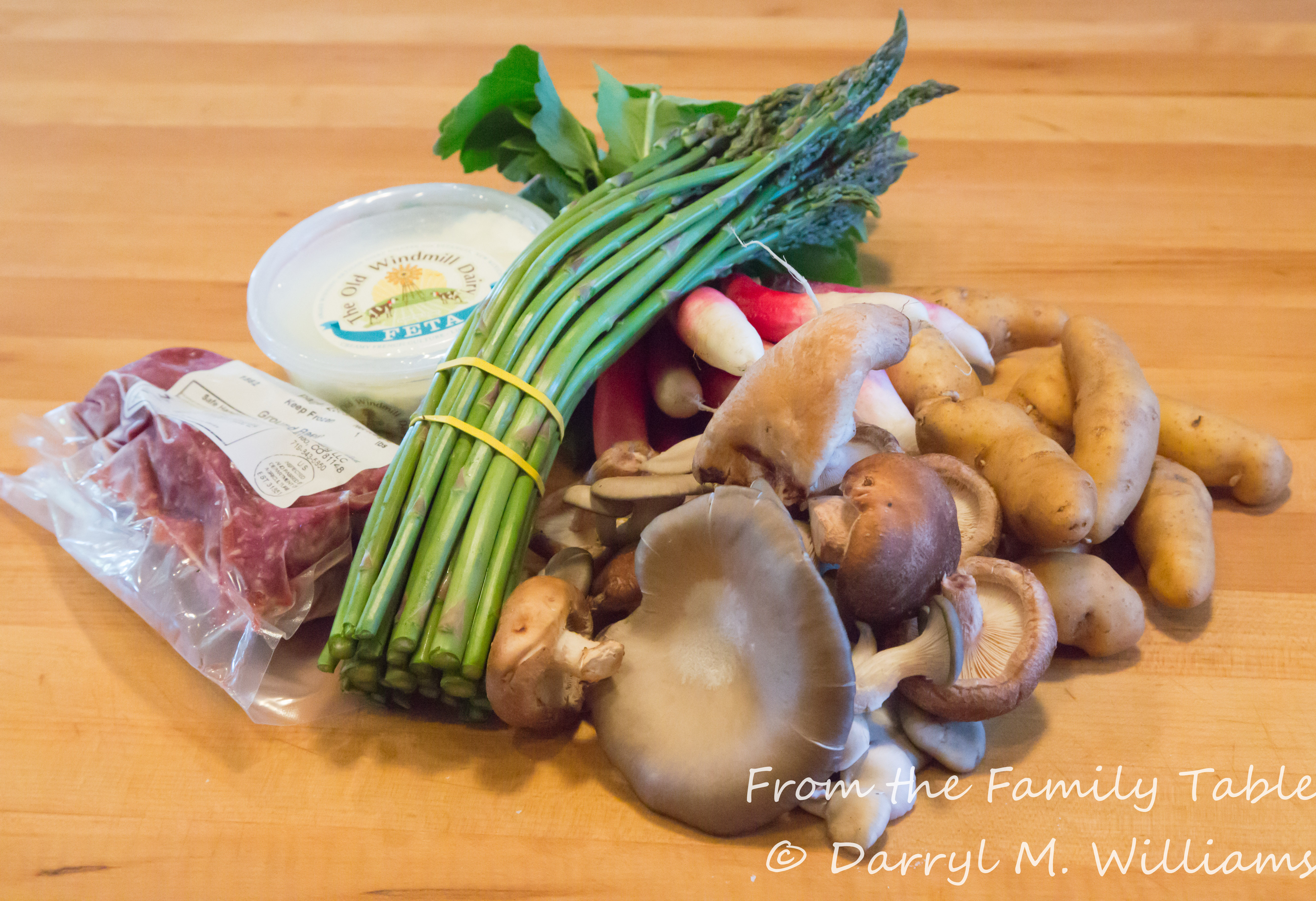
There was feta cheese from the Old Mill Dairy, along with shiitake and oyster mushrooms from the mushroom lady. I also found some long, slender, tender spears of green asparagus, fingerling potatoes, and organic ground beef.  The mushrooms seem to beg for a creamy risotto.

My purchases

My purchases

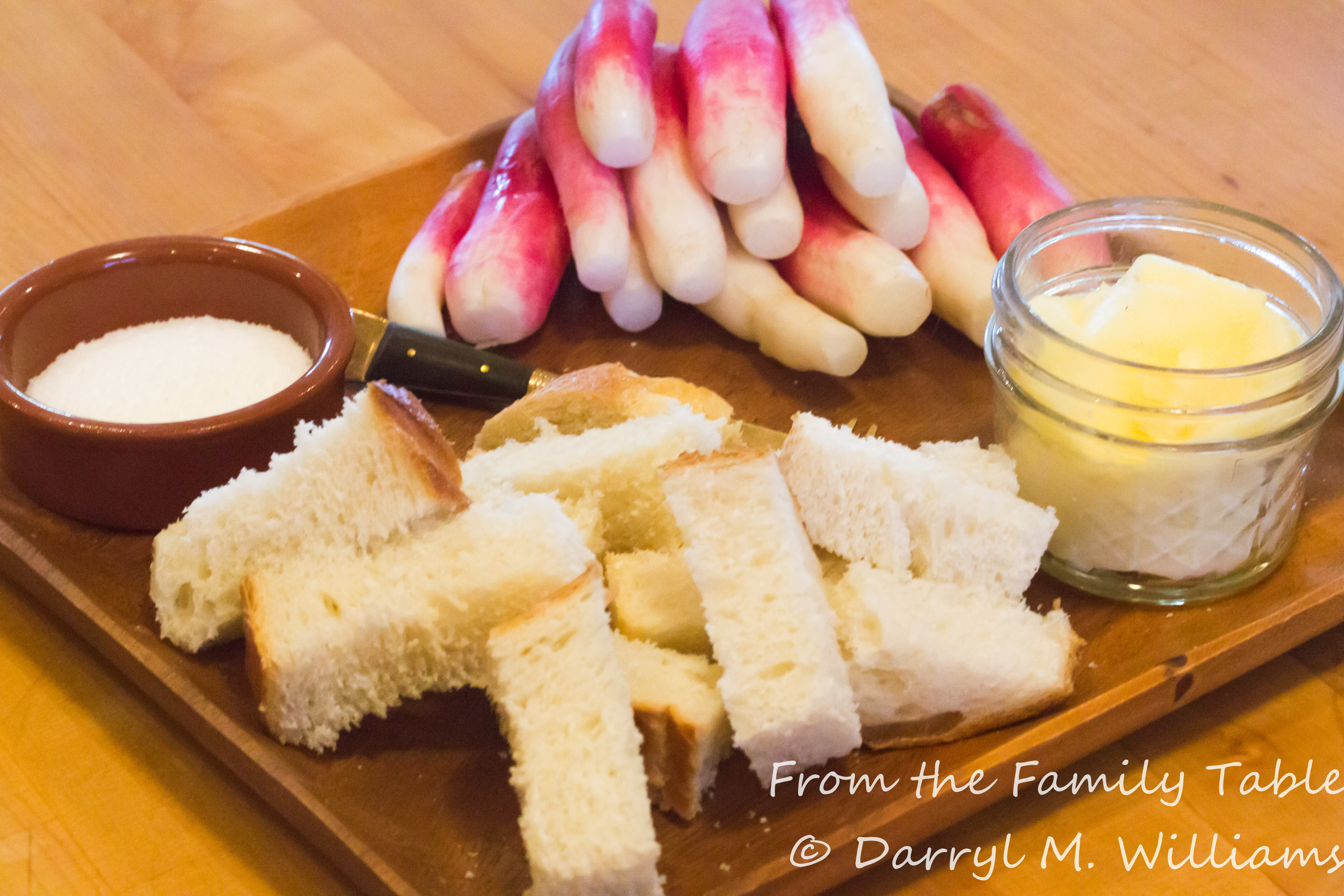
Of course, there was an abundance of radishes and other root vegetables. I wound up buying some French breakfast radishes. I plan to have those this evening with salt and thick chunks of bread spread with cultured butter from Sarah.

French breakfast radishes, cultured butter, salt, and crusty bread

French breakfast radishes, cultured butter, salt, and crusty bread

As for the other stuff, I’ll just have to think of what to do with it. After all, I have another week before I head back to the market.

6 Comments

Filed under Food, Photography

SOPAIPILLAS AND HONEY

A swarm of bees has invaded one of our canales, the little troughs that drain rain water from the flat roofs of New Mexico. We don’t know the first thing about bees, so that prompted a call to the local bee expert who advised that we call Nicolas, an expert bee keeper who specializes in extracting bee hives. Part of his fee is that he keeps the queen bee for a new pollinator hive. He has many hives that he moves around the orchards and farms of Northern New Mexico. Nicolas grew up in Provence, helping his uncle move hives in the fields of lavender that are so well known in that part of France.

“Nico” assessed our situation and then returned with his bee-keeping gear including his netted hat, heavy boots, and full-length coveralls with thick gloves that extended to his elbows.


Nico in full bee-protective gear

Nico in full bee-protective gear

Unfortunately, the bees proved more aggressive than usual, although Nico did not believe they had been Africanized. Still, he did not want to use the queen with her “bad genes”  in his pollinator hives. He did plan to capture the bees without exterminating them. That required a new strategy, and we are still waiting for Nico to come back with additional equipment.

As spring has arrived, the bees have become more active. In fact, they dive bomb us during the afternoon if we walk below their nest. They are more peaceful when they are busy among the flowers.


As a gift, Nico brought us a small jar of honey collected from his bees.  He has a business where he sells his honey, Fool’s Gold Honey. That made me think about ways to use honey beside just smearing it on a hot biscuit. What could be a better alternative than a Northern New Mexico sopaipilla? Sopaipillas are deep-fried flaky puffs  very similar to the beignets of New Orleans. They are also related to Navajo (or Pueblo) fry bread and buñuelos that are such important parts of Southwestern cuisine.

As to sopaipillas, there is no doubt that they originated in Northern New Mexico. My first memory of them was in 1948 when I visited my aunt and uncle, then living in Los Alamos. The recipe that follows is theirs.  The popularity of sopaipillas has spread throughout the Southwest, and they now are on the menus of practically every Tex-Mex restaurant, including those in New York City. They are usually served at the end of a meal with honey and maybe butter to pour inside, but they can be dusted with powdered sugar, coated with honey, served with jam, or even stuffed with chili con carne or carne asada as a main dish. Any way you eat them, they are delicious.  My most memorable sopaipillas – actually non-sopaipillas – were served years ago in the Cactus Taqueria in Dumas, Texas. The restaurant is no longer open. While traveling, our family stopped for lunch. We ordered the usual tacos and enchiladas. Sopaipillas were promised as dessert. Next to us, three cowboys were just finishing their meal, so the waitress delivered three big sopaipillas. At first, each of the cowboys poured honey into his dessert from a plastic dispenser sitting on the table. Shortly, one of the cowboys, unsatisfied with the flow of honey from the dispenser, stuck the end in his mouth and sucked away. We paid our bill as quickly as we could, and left with the waitress chasing after us shouting, “You still have your sopaipillas coming!”

Sopaipillas are very simple, and very easy to make, but there are a few tricks. First, the dough needs to be rolled to the right thickness. Too thick or too thin, and they will not puff up. Second, the oil for frying must be the right temperature – close to 400ºF. Otherwise they will not puff and/or become greasy. Finally, they need to be held under the surface of the oil for awhile when you first put them in the hot oil.  Otherwise they will not puff up. If they don’t puff up immediately or completely, they will not.

RECIPE

Sopaipillas

Ingredients

  • 1 cup unbleached all-purpose flour
  • 1 teaspoon baking powder
  • ¼ teaspoon salt
  • 2 tablespoons lard or vegetable shortening
  • ¼ cup water

Method

  1. In a large bowl, combine the flour, baking powder, and salt. Cut in the lard or shortening with a pastry blender until the mixture resembles cornmeal.
  2. Add the water and knead gently until the dough comes together. If it is too sticky, add another teaspoon or so of flour. If it is too dry, add more water, a few drops at a time until the dough holds together and forms a smooth ball.
  3. Turn the dough onto a heavily floured surface. Knead gently by flattening it out, folding it in half, flattening out again, and folding in half again. Repeat the process 10 or so times. Then form into a ball, cover with plastic wrap, and let rest for 15 minutes
  4. Place the rested dough on a floured surface and roll it out into a rectangle about ¼ inch thick. Cut into rectangles, squares, or triangles about 6 inches on a side.
  5. Cover the individual pieces with a cloth while you prepare to fry them.
  6. Heat at least 3 inches of oil in a heavy skillet or deep-frying pot to 400°F. When the ol is hot, gently drop one or two pieces of dough in the oil. With a spatula or pancake turner, hold the pieces under the surface of the oil until they start to puff. When the sopaipillas are brown underneath, turn them over and brown on the other side. Remove from the oil, and drain on several thicknesses of paper towel. If you wish, at this point drench the hot sopaipillas in powdered sugar or a mixture of sugar and cinnamon. Keep the finished sopaipillas in a warm oven (170 – 200°F) while you finish cooking the remaining pieces of dough. Serve with honey and butter while still warm.
  7. This should make 10 to 15 6-inch sopaipillas.

After I had written this post, I realized that I had already written about sopaipillas nearly a year and a half ago (October 9, 2013).  Worse, I had told the same stories about my aunt and uncle and about eating sopaipillas in the Cactus Taqueria. I guess that’s because good stories are worth hanging on to, or more ominously I should chalk it up to old age. I need to ask my kids if I have started to repeat myself. I don’t think I want to know the answer.

I have included some of the images from the earlier post, but as a  request for forgiveness, I have added some images of the wildflowers and garden flowers that have attracted bees from our hive.

1 Comment

Filed under Food, Photography, Recipes

POPOVER – POPUNDER

Popovers – when they work – are one of the easiest and most impressive quick breads. When they don’t work  they often wind up as a doughy lump that no one wants to eat.

There has been a lot written about what it takes to make a successful popover.

Some insist that the oven needs to be hot. Others say it works just as well to start the popovers in a cold oven. Still others say that the batter needs to be poured into a hot pan before it is put in the oven. I have not done an exhaustive study of the issue, but for me pouring room-temperature batter into a pan that has been heated in the oven as the oven gets to baking temperature has always worked.

Some say that you should only use a special popover pan, usually with six cups. Others say a 12-place muffin pan works better and you wind up with twice as many popovers. Again, I haven’t done a scientific study, but either seems to work just fine.

Some say that the pans must be heavily buttered with at least a tablespoon of butter in each cup. Others say that a little salad oil in each cup works just fine. I have tried both, and while I don’t know the real food chemistry, I believe that a good coat of a solid fat like butter is important to let the batter creep up the sides of the cup. I have had successes and failures with oil, but a good coating of butter (although not the mega dose that some recipes call for) always seems to work.

Some say that a lower constant baking temperature works just as well as a beginning hot temperature reduced to a lower temperature. I favor the latter. I’ve watched through an oven window with the light on many times, and the popping seems to be over at the end of 15-20 minutes of high temperature baking. The lower temperature crisps the popovers without burning them.

Some say you should pierce the popover half way through the baking to make sure the inside loses its “eggy” consistency and flavor. I think that can be dealt with by just baking the popovers a little longer.

You can use different flours or add a teaspoon of grated cheese or other flavoring, but the popovers will probably not rise as impressively.

Finally, I also believe that a well-mixed smooth batter at room temperature is key to success.

Here are some popovers Carol and I made during our recent visit in her home.

Hot from the oven

Hot from the oven

RECIPE

Popovers

Ingredients

  • unsalted butter to coat the baking cups generously (6-space popover pan or 12-space muffin pan)
  • 1 cup all-purpose flour
  • ½ teaspoon salt
  • 2 eggs, beaten
  • 1 cup milk (whole, 2%, 1%, or skim will all work)
  • 1 tablespoon melted unsalted butter

Method

  1. Generously coat the cups of the preferred baking tin with butter. Place in the middle of the oven and turn the oven on to 450°F to heat the pan and the oven.
  2. In the meantime, Combine the four and salt in a 4-cup measuring cup or a large mixing bowl with a pouring spout.
  3. Beat the eggs until light and well-mixed. Stir in the milk and butter. Add the liquid mixture to the dry ingredients.
  4. With  a whisk or mixer beat the batter for a minute or two until well-blended and smooth.
  5. When the oven has reached temperature, remove the heated baking pan to a trivet or heat-proof surface.
  6. Fill each baking cup 1/3 to 1/2 full, distributing the batter evenly to all cups. If you misjudge and run out of batter, you can use a large spoon, moving quickly to redistribute the batter more evenly.  Return the filled baking pan to the middle of the oven
  7. Bake undisturbed for 20 minutes. Then reduce the oven temperature to 350°F and bake for an additional 20 minutes.
  8. Remove from the oven. Loosen each popover by running a thin knife around the edge, and transfer to a serving basket. Serve immediately while still warm, with lots of butter and/or jam.
  9. Yields 6 popovers baked in a popover pan or 12 popovers baked in a muffin pan.

4 Comments

Filed under Food, Photography, Recipes

OYSTER AND ARTICHOKE SOUP

While working on my recent post about baked oysters New Orleans style, I got to thinking about all of the food I have enjoyed focused on oysters: oysters on the half-shell, oysters Rockefeller, oyster po’boys, etc., etc. I also got to thinking about all of the good meals I have enjoyed in New Orleans.

One outstanding oyster dish from New Orleans immediately came to mind: Potage Le Ruth, invented by Chef Warren Leruth and served at his fabled Le Ruth’s Restaurant on the West Bank in Gretna. Before he opened his restaurant, Leruth had gained recognition  as a baker, chef and food innovator. He had been personal chef to General Clark when he was in the army in Korea, and he helped to develop the famous Duncan Hines cake mixes at Proctor & Gamble. So it was not surprising when he decided to open his own place in his home town.

New Orleans is one of those cities where everyone wants the latest gossip about new restaurants and hot places to go. When Le Ruth’s opened in 1966, it caught everyone’s attention with its creative cuisine. Food critics at the time said that Leruth rescued New Orleans dining from itself because all of the old-line restaurants had started to rest on their reputations and the food had become more or less the same. Le Ruth’s changed all of that and soon gained the reputation as being undoubtedly the best restaurant in the city. That was evidenced by the difficulty in snagging a reservation.

It was not the easiest place to get to. You could use the bridge over the Mississippi River, but it was far easier to ride the Gretna ferry from the foot of Canal Street and then catch a cab to the restaurant.

I remember clearly the first time I ever ate at Le Ruth’s. A group of colleagues and I were attending a business meeting in downtown New Orleans. We had made our reservations well in advance, and everyone was looking forward to the experience. We found our way to the restaurant, took our seats at the table and, ordered wine. One of the group stuck two of the corks from the wine bottles in his nostrils  when they were offered to him. He announced that the wine was perfect. We all laughed, but two distinguished ladies at the next table raised their eyebrows. I don’t exactly recall, but I believe that at least the wine taster had spent a sizeable part of the afternoon on Bourbon Street.

It is a good thing we didn’t get tossed out. Le Ruth had the reputation for responding to critical letters with scathing rebukes from an “anonymous” diner. For folks who gave real offense, he would assign four waiters to the corners of the tablecloth of the miscreant. At a signal, they would lift the cloth to form a sack of food, dinnerware, and wine while Leruth would announce that he “had picked up the check” and summarily declare, “Get out of my restaurant!” I am certain that Warren Leruth would know how to handle the current generation of whiners on Yelp.

Le Ruth’s served many delicious and unique dishes, but perhaps the most famous was Potage Le Ruth. Unfortunately, to my knowledge there is no extant authentic recipe. Leruth said that he had  the original locked up in a vault. Nevertheless, imitations – none as good – soon showed up on the menus of most of the other high-end restaurants in New Orleans. Then recipes for oyster and artichoke soup began to appear in local newspapers. Many of the knock-offs used cream, but Leruth bragged that his recipe contained no cream.  The soup is a sort of rich velouté based on a blond roux, so you really shouldn’t need cream.

Surprisingly, some food writers say that Leruth used canned artichokes. My version does, too, although respected New Orleans chefs insist that only fresh artichokes, properly cooked and prepared, will do. If you want to use fresh artichokes, probably four medium are about right. My version is adapted from a recipe that appeared in one of the Shreveport newspapers of the time. Be advised that it is not the real thing. I have taken the additional liberty of adding some whole oysters in the style of an oyster stew. Even though it lacks authenticity, I think you will find it a most delicious soup.

RECIPE

Oyster and Artichoke Soup

Ingredients

  • 4 tablespoons unsalted butter
  • ½ medium onion, chopped finely
  • 1 rib celery, chopped finely
  • 1 small carrot, peeled and chopped finely
  • 14 ounce can artichoke hearts, quartered
  • 3 cups hot fish stock
  • ¼ teaspoon ground thyme
  • 1/8 teaspoon ground bay
  • 1/8 teaspoon cayenne
  • 1 teaspoon salt
  • 1 teaspoon Worcestershire sauce
  • 1 pint oysters
  • 1 teaspoon white vinegar or lemon juice (about)
  • 1 pinch sugar (about)
  • ¼ cup madeira

Method

  1. Melt butter in the bottom of a heavy soup pot over medium heat. Add the onion, celery, and carrots and sauté until the onions are translucent and the other vegetables have wilted. Do not brown.
  2. Add the flour and continue cook over medium heat and stirring frequently until the flour is completely incorporated and the raw taste has disappeared, about 2 minutes.
  3. Drain the artichokes and add to the sautéed mixture.
  4. Stir in the hot stock, thyme, bay, cayenne, salt and Worcestershire sauce. Simmer partly covered for 45 minutes.
  5. Strain the oysters in a fine-mesh strainer to remove any bits of shell and sand, saving the liquid. Set aside about half the oysters to be stewed later, and chop the remainder. Add the chopped oysters to the oyster liquor and then stir into the simmering soup, cooking for another 10 minutes below the boil
  6. With an immersion blender, blend the soup until smooth. Correct seasoning with vinegar and sugar. Add the madeira. If you wish, at this point you may strain the soup through a chinois for an especially smooth soup, or you can omit that step.
  7. Return the soup to medium-low heat and stir in the remaining oysters, cooking until they are firm and the edges are curled.
  8. Serve immediately or cool to serve later. Then, reheat to the boiling point and serve immediately. Grilled farm-style bread makes a good accompaniment.

2 Comments

Filed under Food, Photography, Recipes, Restaurants

THREE CITIES OF SPAIN CHEESECAKE

Mothers’ Day and Susan’s birthday coincided this year, so during our visit to Los Angeles, Carol needed a dessert for our celebration. One of Susan’s favorites is cheesecake, and this is one of Carol’s favorite recipes.

She originally found it in Gourmet magazine, and it has been published widely since then in other magazines and on the internet.

But everyone (or nearly everyone) gives credit to the Three Cities of Spain coffee house in Santa Fe for the original. Many years ago, the popular artists’ street, Canyon Road, was a narrow dirt road heading up the canyon from Paseo de Peralta. The Santa Fe artists’ colony was experiencing a boomlet in the 1950s-1970s, and this was one of the places on Canyon Road where the struggling artists hung out, drinking coffee, smoking, and eating cheesecake. There were nearby bars for more serious drinking at night.

For reasons unknown to me, Three Cities of Spain closed in the 1970s, Canyon Road was paved, and the old adobe home which housed the coffee house was transformed into Geronimo, one of the best and most famous restaurants in Santa Fe. The restaurant was named after the man who built the house in 1756.

I think you’ll like the cheesecake.

hree Cities of Spain cheesecake after the first baking

Three Cities of Spain cheesecake after the first baking

Spreading on the topping.

Spreading on the topping.

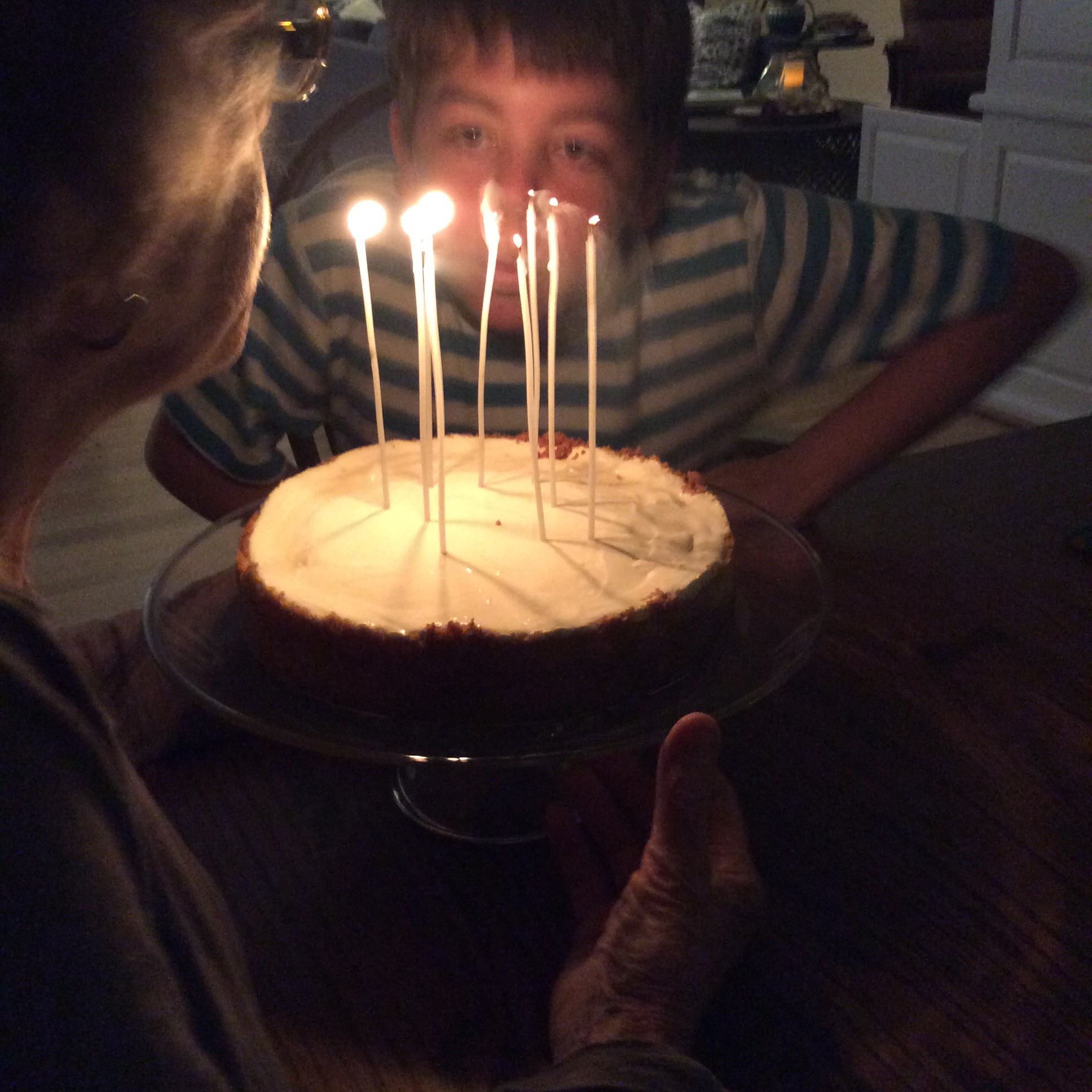
Birthday candles for more mature adults

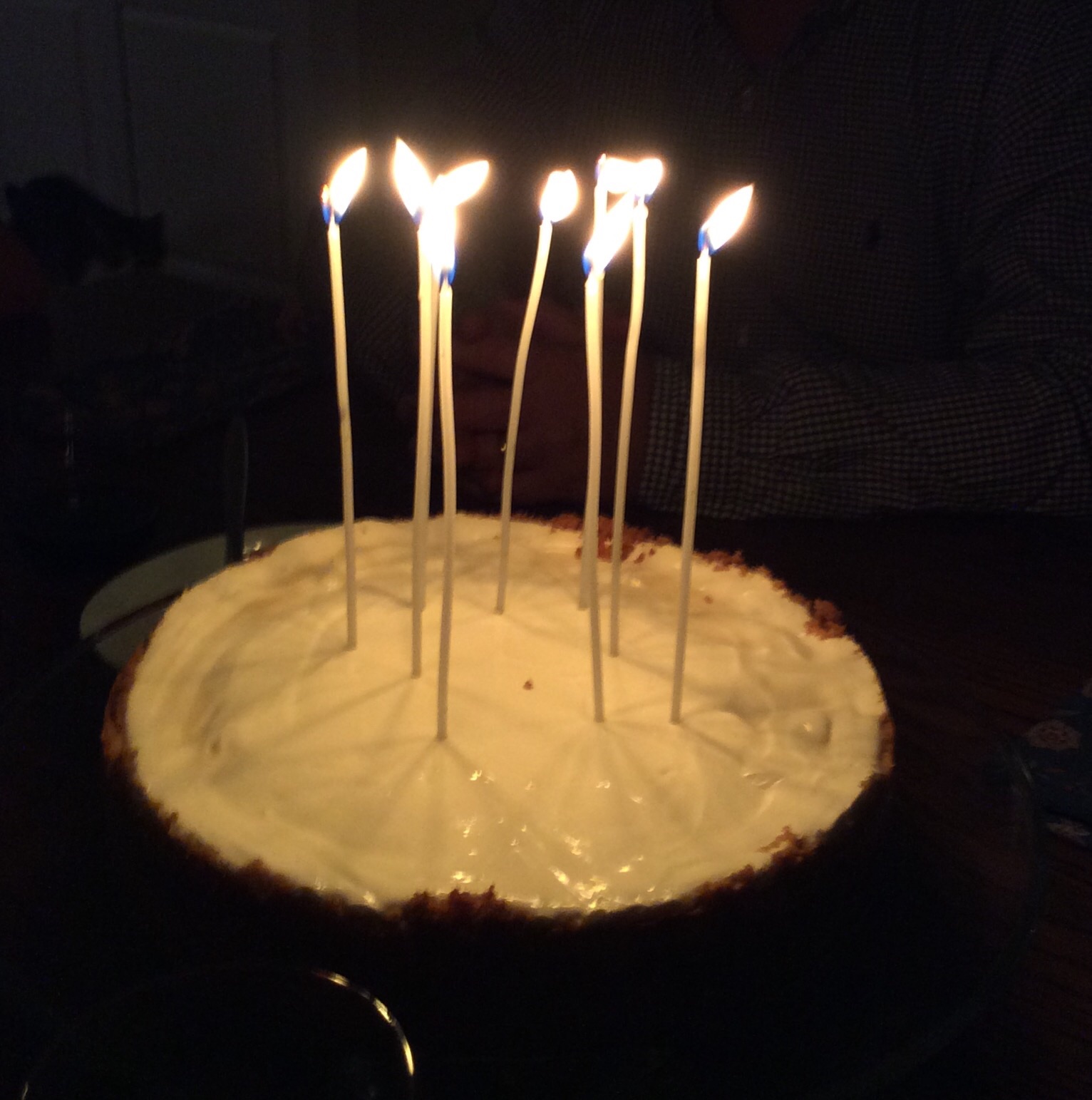
Birthday candles counted out for more mature adults

Blowing out the candles

Blowing out the candles

Cheesecake with berries

Cheesecake with berries

RECIPE

Three Cities of Spain Cheesecake

Ingredients

CRUST

  • 11 graham crackers, ground fine (1½ cups)
  • 1/3 cup unsalted butter, softened
  • 1/3 cup sugar
  • 1/8 teaspoon salt

FILLING

  • 24 ounces (3 packages) cream cheese, softened
  • 4 large eggs
  • 1 teaspoon vanilla
  • 1 cup sugar

TOPPING

  • 16 ounces sour cream
  • 1 tablespoon sugar
  • 1 tablespoon vanilla
  • berries (optional)

Method

  1. Stir together crust ingredients. Sprinkle half of mixture onto the bottom of a buttered 9½ inch springform pan. Then press the mixture up the side of the pan about 1¼ inches. Sprinkle and press the remaining half of the mixture into the bottom of the pan.
  2. With an electric mixer, beat the cream cheese until light and fluffy. Then beat in the eggs, one at a time. Beat in the vanilla and sugar until just combined.
  3. Pour the cream cheese and egg filling into the crust. Bake for 45 minutes at 350ºF or until the center of the cake is set.  Cool on a rack for 5 minutes.
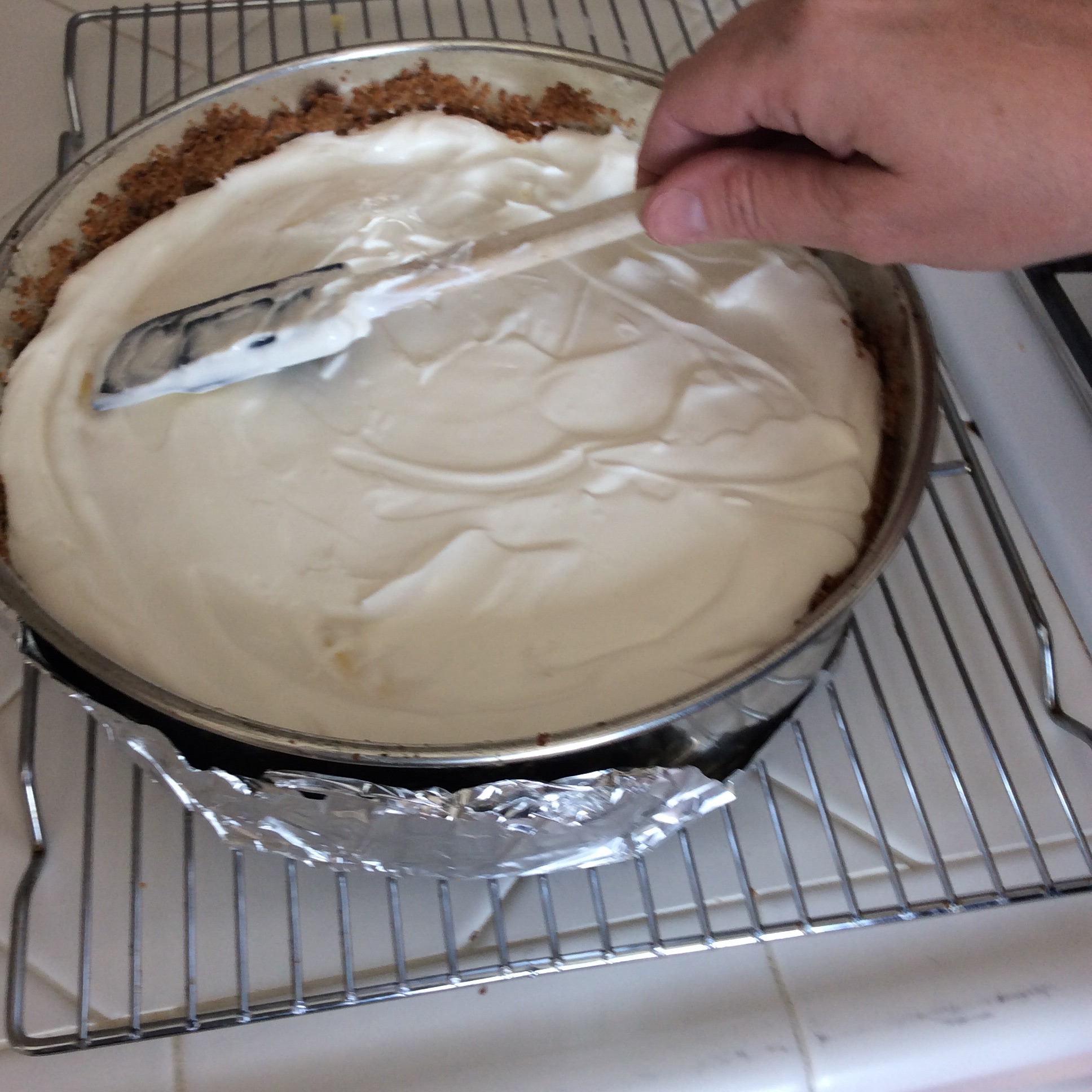
  4. Stir together the topping ingredients.  Drop by spoonfuls around the edge of the cake and spread gently into the center.
  5. Return to the 350ºF oven for another 10 minutes.
  6. Remove from the oven and cool completely on a baking rack before chilling overnight in the refrigerator.
  7. Serve at room temperature with or without optional berries.

4 Comments

Filed under Food, Photography, Recipes, Restaurants, Travel

BAKED OYSTERS NEW ORLEANS STYLE

At the end of our train trip from Seattle to Los Angeles, we spent a few days with our daughter, Carol, and her family. She is an excellent cook, and she always tries to make some interesting food during our visits. She also knows that Susan loves oysters, and since she grew up in Louisiana, New Orleans style baked oysters seemed perfect – even though it is May. The recipe in her recipe box is called Oysters Mosska, undoubtedly so as not to get in trouble with Mosca’s restaurant in the New Orleans suburb of Westwego and home to the eponymous Oysters Mosca.

Mosca’s is one of the old-line favorite restaurants of local residents, having opened in 1946 and operated by the same family ever since. Part of its charm is that it is not easy to find. It is on Highway 90 a ways after you cross the Huey P. Long Bridge, but it sits back from the road, is a low-slung white-painted clapboard building that looks more like a house, and has only a small, dimly lit sign. When we were living in Louisiana, I drove right by it more than once. An interesting story is that the place was where everyone went after a night spent in the gambling houses that populated this now-lonely stretch of road. As well, rumor has linked the restaurant to the local Mafia, but the Moscas have neither confirmed nor denied that rumor.

Once inside, you are struck by the liveliness of the place. It is brightly lit and filled with families enjoying themselves. Even with a reservation you may have to wait on the straight-backed chairs lined up against the walls.

Th menu is fairly limited but filled with Italian standbys that all have a full quota of garlic. Virtually every table has at least one order of Oysters Mosca. In the old days, the dish would be served in a metal cake pan, and each diner would fish out his or her helping of succulent oysters.

To my knowledge the family has never provided an authorized version of the recipe for Oysters Mosca. We have a made-up version in our family cookbook that is a close approximation. As I mentioned above, this version comes from Carol’s recipe collection and is labelled “Oysters Mosska”, I suspect to protect against any accusations of copyright infringement.

If you do decide to visit the restaurant, be advised that they do not accept checks or credit cards – cash only. But they do have a convenient ATM inside the dining area.

Oysters cooking in liquor/beef stock sauce

Oysters cooking in liquor/beef stock sauce

Ready for the oven

Ready for the oven

Ready to serve

Ready to serve

Baked oysters New Orleans style

Baked oysters New Orleans style

RECIPE

Baked Oysters New Orleans Style

Ingredients

  • 1 tablespoon vegetable oil
  • ¼ cup yellow onion, diced
  • 1½ tablespoons garlic, chopped
  • 1 pint shucked oysters with liquor
  • 1 cup beef stock
  • 1 tablespoon parsley, finely chopped
  • Creole spice
  • salt and pepper
  • 1 cup bread crumbs
  • 2 tablespoons Parmesan cheese, freshly grated
  • 1 tablespoon basil chopped
  • 1 tablespoon olive oil

Method

  1. n a saute pan over mediu heat, cook onions untile translucent. Then add garlic and stir for about 1 minute.
  2. Add the oyster liquor and the beef stock. Bring to the boil and simmer until the liquids are reduced to about one-half.
  3. Add the oysters and parsley. Return to the boil and then remove from heat. Adjust seasoning with Creole spice, salt, and pepper.
  4. Transfer to a metal cake pan or a shallow baking dish.
  5. Combine bread crumbs, Parmesan, chopped basil, 1 teaspoon of Creole spice, and olive oil. Sprinkle over the top of the oysters.
  6. Place under a pre-heated broiler for 8 to 10 minutes or until the top is brown and bubbling.
  7. Serve immediately. 2 or 3 servings

2 Comments

Filed under Food, Photography, Recipes, Restaurants, Travel