Tag Archives: San Francisco

CHAD ROBERTSON’S TARTINE BREAD FOR HOME BAKERS

San Francisco is one of those lucky cities that has lots of really great bakeries turning out really great bread. If you are a bread lover, as I am, that’s important. Of course, it is arguable as to which is the best bakery or best loaf, but Tartine Bakery and their basic country bread have to be on just about everyone’s lists.

Chad Robertson, the co-owner of Tartine Bakery, has  roots in West Texas, but he has travelled to France and probably other places to perfect his craft. He still bakes 250 loaves of bread a day when he is in town. He is driven in his quest to make the best loaf of bread he can, along with pastries and other baked goods. But he is generous in sharing his knowledge. Other chefs in San Francisco have been mentored by him, and now their bread is well-known. An example of that is Outerlands in the Outer Sunset district of San Francisco. Their grilled cheese sandwich on thick slices of house-baked bread is justifiably famous.

Robertson is now getting ready to install a custom-made behemoth of an oven in a new space in San Francisco so that he can increase his baking production. He is planning to open bakeries in Tokyo and maybe London and New York.

He has also written or taken photographs for several cookbooks, including a beautiful book, Tartine Bread (Chronicle Books, San Francisco, 2010). That classic (already) gives detailed instructions and beautiful photos for the home baker. The book also describes Robertson’s method to replicate the characteristics of a baker’s oven in the home. The problem is that the chapter on the basic loaf is 38 pages long, and the recipe itself is 26 pages long. That might be enough to put you off from trying your hand. That would be too bad, because by using those instructions, even a novice (me) can produce the best loaf of homemade bread that he or she has ever made.

You will need to be ready with your own sourdough starter that you have developed, stored, and if necessary rejuvenated by daily feedings of flour and water.  I have previously posted several methods to begin your own sourdough starter. You should also have the equipment for the process. These items can be purchased from King Arthur Flour, Breadtopia, and of course, Amazon if you can’t find them locally.

The recipe is based upon weight rather than volume (the standard for professional bakers), so you will need a reliable kitchen scale capable of registering metric weights.

One essential piece of equipment is the Lodge cast-iron combo-cooker. It has shallow and deep halves. The shallow half serves as the baking surface while the deep half covers the loaf and provides the necessary heat above the loaf for the steam needed for good lift and crisp crust. You can use a regular Dutch oven with the deep half on the bottom, but that makes it awkward to handle the loaf at 500°F and with oven mitts. Undoubtedly I would burn myself seriously with such an arrangement.

For the fermentation process, you can use any large, clear plastic or glass container, but the container from King Arthur Flour or Breadtopia is especially convenient.

Two bowls lined with clean dish towels will work to hold the loaves during their final rise before baking, but woven bannetons with their special liners are very handy. They are available from Breadtopia.

To make it easier for me to follow Robertson’s instructions without ruining my pristine copy of his book with flour-covered hands, I have condensed the instructions to numbered steps on a sheet of paper that can be stuck on the refrigerator door. Here are those instructions.

RECIPE

Tartine Bakery Basic Bread

Equipment

  • kitchen balance reading in grams
  • large metal mixing bowl
  • rubber spatula
  • 8 quart plastic or glass fermenting container
  • bench knife
  • 2 bannetons with cloth liners
  • kitchen towels
  • Lodge cast iron combo cooker
  • oven mitts
  • lame (you can use a new single-edged razor blade or sharp knife)

Ingredients

Leaven

  • sourdough starter
  • 200 grams warm (78°F) water
  • 200 grams 50/50 flour blend (white bread flour/whole wheat flour)

Bread

  • 700+50 grams water (80°F)
  • 200 grams leaven
  • 900 grams white bread flour
  • 100 grams whole wheat flour
  • 20 grams salt
  • 50/50 rice/wheat flour mixture
  • rice flour

Method

The night before: Developing the leaven

  1. Discard all but I tablespoon of starter.
  2. Add 200 grams of warm water.
  3. Add 200 grams of 50/50 flour blend.
  4. Stir until well mixed.
  5. Cover loosely with a towel and let stand in a warm place over night.

Baking Day

  1. Test the leaven by dropping a spoonful in a cup of water. If it floats, it is ready to be used. Otherwise let it work until it floats.
  2. Pour 700 grams of water into a large metal mixing bowl.
  3. Add 200 grams of the leaven and stir to mix.
  4. Add the bread flour and whole wheat flour. Mix thoroughly by hand until there is no loose flour.
  5. Allow the dough to rest for 30 to 40 minutes.
  6. Add salt and the remaining 50 grams of water to the rested dough. Squeeze the dough between your fingers to incorporate the salt and water.
  7. Fold the dough onto itself and transfer to the fermenting container. The dough will not rise much at this stage.
  8. Allow the dough to rise for 3 to 4 hours at 78 – 82°F, giving the dough one turn every half hour for the first 2 hours. Turn by dipping one hand in water, grab the underside of the dough with the wet hand, stretch it up, and fold it back over the remaining dough, repeating three times. After the second hour, turn the dough more gently so as not to deflate.
  9. Continue to let rise, with the turning process, until the dough releases from the sides of the container, ridges left by the turn hold their shape for a few minutes, and the dough increases by one-quarter to one-third in volume.
  10. Pull the dough out of the container onto an un-floured work surface with the spatula. Lightly flour the surface of the dough, and then cut it into two equal pieces with the bench knife. Flip the two pieces of dough so that the floured surfaces are on the work surface, and seal the raw dough with the floured surface.
  11. Work the dough into loaf shapes using your hands and the bench knife. Then let them rest for 20 to 30 minutes. Lightly flour and cover with a towel to prevent drafts.
  12. Form the final loaves by lightly flouring the top surface and then flipping the dough rounds so that the floured surface rests on the work surface.
  13. Working with one round at a time, fold a third of the dough closest to you over the middle third. Stretch the dough to the right and fold this over the center. Then stretch to the left and fold over the previous fold, anchoring with your fingers. Then grab the dough closest to you, and wrap it over the loaf while rolling so that the smooth underside is now the top, and the seams are on the bottom.
  14. Put the ball of dough between your hands and pull it toward you, rounding it at the same time to stretch the surface and close the seam. Let the shaped loaf rest for a few minutes while you repeat with the second loaf.
  15. Dust the lined bannetons with the rice/wheat flour mixture. Transfer the shaped loaves to the baskets with the bench knife so that the smooth sides are down.
  16. Let rise, covered with a towel, at 75-80°F for 3 to 4 hours.
  17. About 20 minutes before you are ready to bake, place the combo cooker with its lid in the middle of an oven preheated to 500°F.
  18. Dust one of the loaves with rice flour. Then remove the shallow lid of the combo cooker from the oven, and place it on the stove, using oven mitts, and leaving the deep half in the oven. Turn the dough into the hot pan. Score the top of the loaf with the sharp lame or razor blade. Then return the filled shallow pan to the oven, and cover with the deep half. Immediately reduce the temperature to 450°F.
  19. Bake for 20 minutes. Then using the oven mitts, remove the top and continue to bake for 20 to 25 minutes
  20. Again wearing oven mitts, remove the pan from the oven and transfer the loaf to a cooling rack to cool completely
  21. For the second loaf, wipe out the cooker, reheat for 10 minutes in a 500°F and repeat the process used for the first loaf.
  22. Cool completely before slicing.
2 Comments

Filed under Food, Photography, Recipes, Restaurants

DEVILED CRAB AND MUSHROOM GRATIN

For those of you who live near an ocean, crab is probably not so special, even more so now during crab season. Evan fishes for crabs at the beach near home in San Francisco. Carol goes to a great seafood shop right on the pier in Los Angeles. We land-locked folks are not so lucky. We can buy small plastic containers filled with pasteurized crab from Indonesia, and that’s about it. The pull date on the package is nearly 6 months away, so it is hard to think of the product as “fresh”, although it certainly beats canned crab filled with paper wrapping hard to distinguish from what is called the crab.

In spite of these shortcomings, I recently bought some of the pasteurized crab because I thought it would be easy for Susan to eat. As directed, I looked for bits of shell, and sure enough I found some. I admit that I did use a crutch. Some time ago, we bought a little ultraviolet (“black light”) flashlight from American Science & Surplus to search for scorpions in the desert with the grandchildren. It really works for that, and so I thought it might work with crab. Many restaurants use black light to screen their crab before they use it, so it was not an original idea. Nevertheless, our cheap little black light worked, and I found several pieces of shell and cartilage. One of my images shows my discovery of a bit of cartilage, although holding the camera and flashlight in a dark room while struggling with proper focus and exposure was a set of coordinated activities beyond my skill set.

After that little adventure, I set about using the crab in something that would be soft enough and not too spicy for Susan. Crab and mushrooms seemed like a perfect option.

RECIPE

Deviled Crab and Mushroom Gratin

Ingredients

  • 2 tablespoons unsalted butter
  • 2 tablespoons all-purpose flour
  • ¾ cup milk
  • salt and pepper
  • 1 clove garlic, minced
  • 1 tablespoon prepared whole-grain mustard
  • 2 tablespoons minced parsley
  • 1 teaspoon Pernod
  • 6 crimini mushrooms sliced
  • 2 tablespoons olive oil
  • 1 cup crabmeat
  • 1 cup panko, divided
  • ½ cup freshly grated Parmesan cheese
  • 2 tablespoons melted butter

Method

  1. In a small saucepan over medium heat, melt the butter and stir in the flour. Cook for a few minutes to remove the raw taste of the flour and to make a blond roux. Do not allow to brown.
  2. Stir in the milk and, stirring constantly, bring to a boil until thickened. Adjust seasoning with salt and pepper, and then stir in the garlic, mustard, parsley, and Pernod.
  3. In another saucepan, sauté the sliced mushrooms in the olive oil. Stir into the sauce along with the crab and ½ cup of the panko.
  4. Arrange in one or two buttered ramekins. Top with the remaining panko and grated Parmesan. Brush on melted butter.
  5. Bake in the middle of an oven preheated to 375°F for 15 minutes or until bubbling. Place under the broiler for a few minutes until the top is browned.
  6. Serve immediately. Serves two.


8 Comments

Filed under Food, Photography, Recipes

BOOK REVIEWS: COI, BAR TARTINE, AND FLOUR+WATER

For Christmas, Sarah and Evan gave us autographed copies of cookbooks written by some of their San Francisco colleagues and friends. They are all beautiful books, and certainly worth a place of honor on my cookbook shelves. Good and successful restaurants seem to go through the same sort of trajectory. First, there is the nervous anxiety after the opening and before reviews appear. Then, there are professional reviews, almost always glowing. Next come the Yelpers (I call them Whiners) with their smarmy comments: “Why do they charge so much; who do they think they are?” ” I could do better at home on my hot plate.”  “They seated someone else at my table even though I was only an hour late for my reservation.” ” When I told them I didn’t like the filet mignon after I had eaten it all, they refused to comp me.” After the whiners, the real customers take over, and the restaurant is wildly popular. Then there are demonstration tours, and finally a thick, beautifully illustrated cookbook appears so that the diner can try making the dish at home – ha.

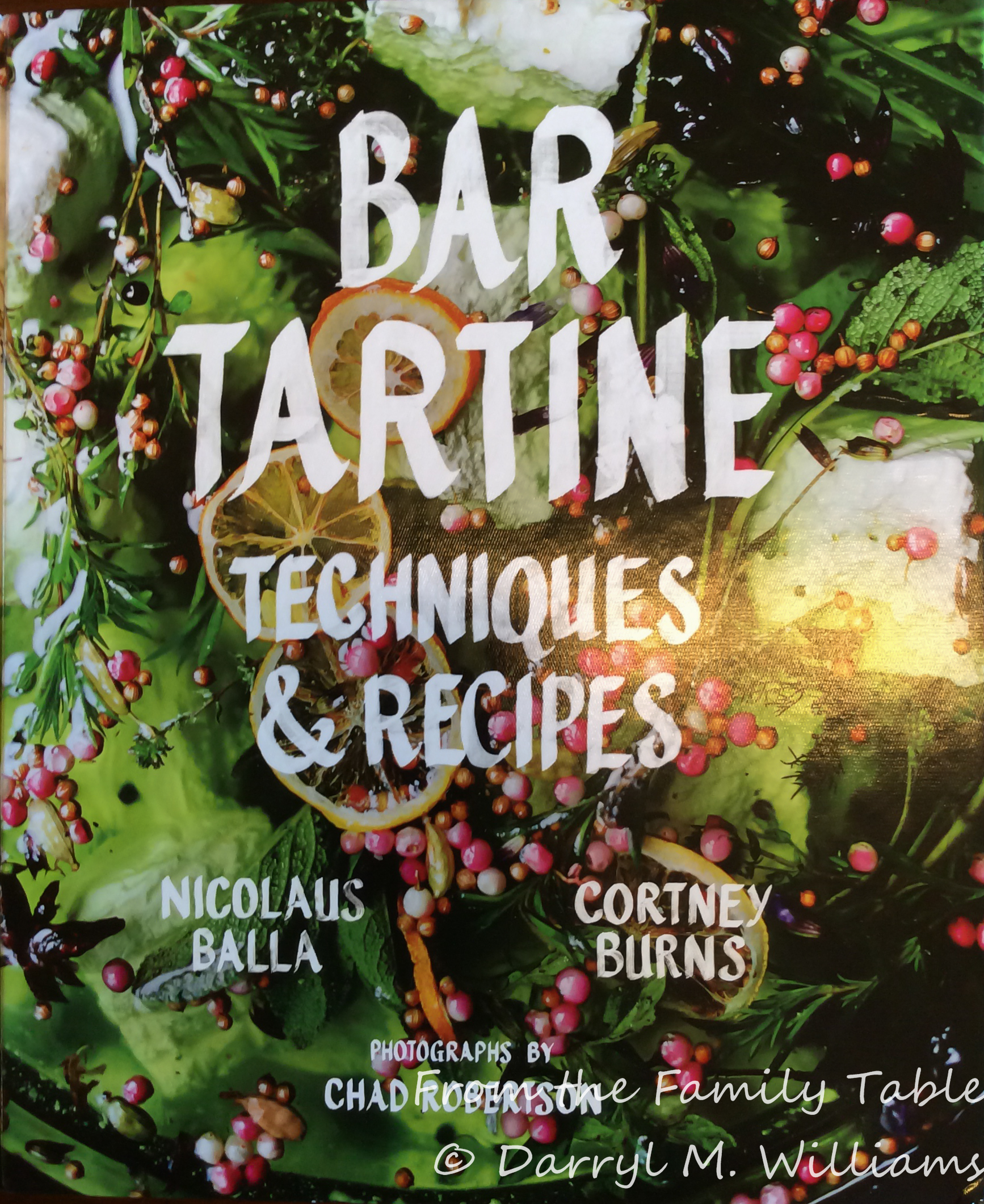
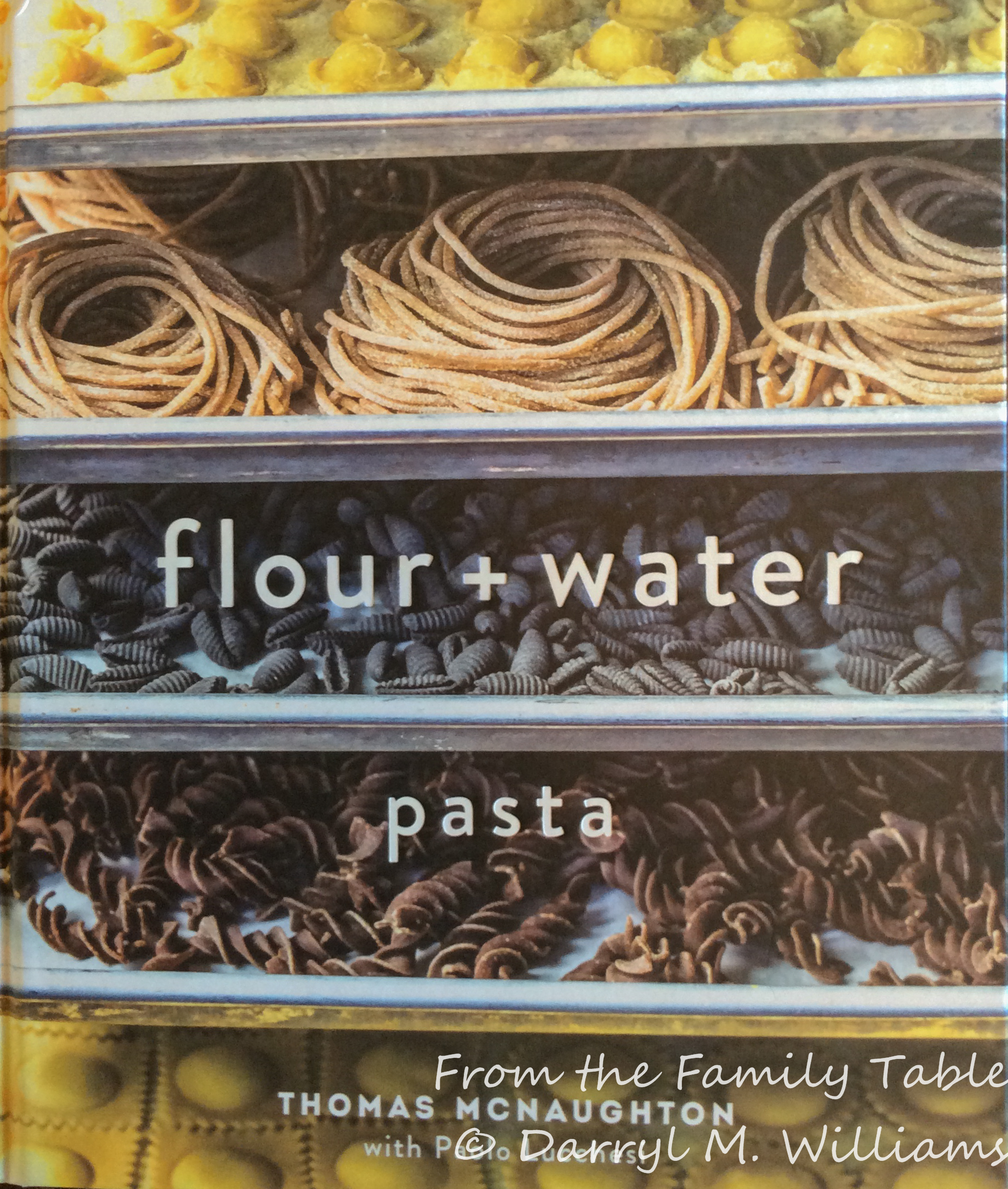
Coi, Bar Tartine, and Flour+Water are three of the best, most popular, and most successful restaurants in San Francisco, so it is not surprising that they all have beautiful cookbooks. Here are some of my random thoughts on all of them. Cookbooks-3 Coi: Stories and Recipes by Daniel Patterson (Phaidon Press, London and New York) is really more of a memoir than a cookbook, and it is illustrated with lush images of the California countryside along with relatively few food shots. Daniel Patterson is an accomplished writer as well as a Michelin-starred chef. His writing has appeared in the New York Times, Lucky Peach, Food and Wine, and the Financial Times among other publications. The photographer, Maren Caruso, clearly knows how to operate a camera. Besides all that, Patterson is gracious in recognizing many of the cooks who have helped to make Coi a success. To be sure, there are “recipes” although they do not appear in the typical format of lists of ingredients and the steps in putting them all together. In my view, you can reproduce some of the dishes only if you study the instructions very carefully and already possess a high level of cooking skill. The most engaging parts of the book are the personal stories and philosophical statements – meditations, really – that accompany each of the recipes. The feeling that the reader comes away with is that of understanding the author as a thoughtful person as well as an accomplished cook. Cookbooks-2 Bar Tartine: Techniques & Recipes by Nicolaus Balla and Cortney Burns with photographs by Chad Robertson (Chronicle Books, San Francisco, 2014) is reminiscent of Chad Robertson’s already classic Tartine Bread except that there is a lot more color. If you have been lucky enough to eat at Bar Tartine, you know that Nicolaus and Cortney have fun with their cooking. It has the same precision that you expect in high-end food, but at the same time it is playful. The chefs delight in using ingredients you may never have heard of, or in ways that you have never thought of. And that’s sort of how Balla and Burns approach their cookbook. There are delicious recipes and gorgeous images aplenty, but the emphasis is on ingredients  The first sixteen chapters are devoted to topics like “Drying”, “Assorted Powders”,  “Spice Mixes”, “Sprouting and Soaking”, “Oils & Animal Fats”, “Vinegars”, “Pickles & Preserves” along with suggestions about how to use ingredients like dried strawberries (The two love their dehydrator), kefir butter, schmaltz, and even burnt toast. The recipes look accessible but you will definitely need to expand your pantry. For me, the book is more like a beautifully illustrated instruction book than a conventional cookbook, and there are detailed instructions about how to make all of the powders and dried foods that serve as the basis of or as seasoning for the fabulous foods of Bar Tartine. The images by Chad Robertson add greatly to the final product, and in the credits, Balla, Burns, and Robertson also do all of the food and prop styling. The book is beautifully done and truly a labor of love, just like a meal at Bar Tartine. Cookbooks-1 Flour+Water: Pasta by Thomas McNaughton with Paolo Lucchesi and photography by Eric Wolfinger (Ten Speed Press, Berkeley, CA) is a detailed treatise on pasta, but it is fascinating reading and studying. There is a two-page spread immediately after the frontispiece showing the author intent on rolling out a length of pasta dough. From that single image you get the feeling that McNaughton wakes up and goes to sleep thinking of pasta. His descriptions about seemingly arcane topics such as the differences between Italian 00 flour and semolina flour turn out to be fascinating reading. And coupled with detailed, well-organized images, the narrative provides step-by-step instructions that even a tyro is willing to try. There is also an abundance of recipes for what to do with the pasta once you have made it. “Mouth-watering” does not adequately describe the images of some of the spectacular dishes: spaghetti with black trumpet, poached egg, and cured yolk; burrata triangoli with preserved lemon, summer squash, and mint. A bonus is the back story of McNaughton’s pilgrimage to Italy and his long, humbling hours of learning how to make pasta  under the tough guidance of a room full of Italian grandmothers. With that, the reader realizes that anything done well requires commitment along with hours, days, and years of practice.

2 Comments

Filed under Food, Photography, Restaurants

AZIZA AND THE OUTER RICHMOND

A while back I wrote about the great restaurant, Outerlands, located in the Outer Sunset District of San Francisco. Outer Richmond is a bit different. First, it is not to be confused with the City of Richmond located north of Berkeley and Oakland and home to the (in)famous Chevron refinery. Outer Richmond lies just north of Golden Gate Park and south of the Presidio and the very toney Pacific Heights, Presidio Heights, and Seacliff (home to the Barber family of the popular radio show of the Second World War, One Man’s Family – if you are old enough to remember.)

Outer Richmond does not lack for restaurants. It is home to many immigrant groups including Russians, Vietnamese, Koreans, Greeks, and Chinese. In fact, some people say that San Francisco’s REAL Chinatown is in the Richmond rather than the touristy version near Union Square. There are whole blocks with nothing but ethnic restaurants, many of them quite good, but none exactly a tourist destination.

Aziza is the exception. A number of years ago, it started out as a Moroccan restaurant serving the traditional cuisine. With time, it has morphed into an upscale California-American restaurant but with Moroccan overtones. And the food is delicious. Aziza has a Michelin star to prove that.

Main dining room

Main dining room

We spent a great evening there in the recent past. One of the secrets of our success was booking an early reservation. The place got very crowded as the evening wore on. On top of that, Aziza  sits on the corner of Geary and 22nd, so parking is impossible. You should definitely begin your hunt for a parking space well in advance of your scheduled reservation.

The menu changes fairly often, so you may not have the choices we had, but you can buy the cook book if you want to sample what’s available: Mourad: New Moroccan by Mourad Lahlou, Artisan, 2011, $40.00.

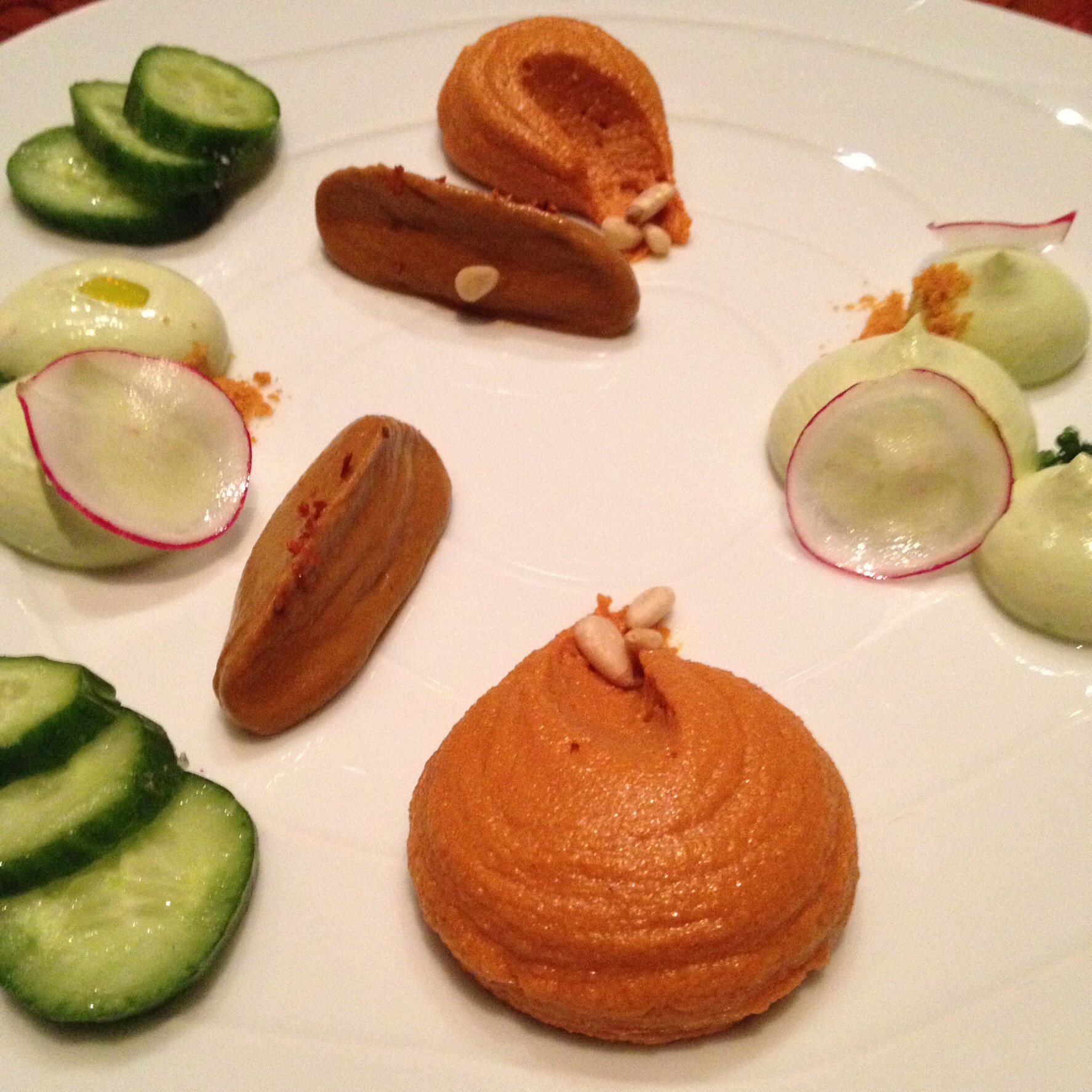
Spreads: eggplant, yogurt-dill, and piquillo-almond-tahini served with flatbread

Not your usual Middle Eastern dips and spreads, although they are clearly based on the traditionals. They are creamy-smooth with distinct but subtle flavorings.

Spreads

Spreads

Beets  with cabbage, persimmon, cheese, peanuts, and rye tuiles

These days, nearly every restaurant serves a beet salad, but not like this. The beets are roasted and come with the root completely intact, nestled on a soft cheese with purees of seasonal fruits and vegetables. The delicate rye tuiles make a perfect foil.

Beet salad

Beet salad

Couscous

The couscous is hand-made in house. Ours came with thin curls of fresh pumpkin, delicately cooked pieces of winter squash, and cranberries. Two dollops of harissa were served alongside so you could season to your liking.

couscous with pumpkin, winter squash, cranberries and harissa

couscous with pumpkin, winter squash, cranberries and harissa

Market fish

The night we were there, the market fish was black bass. It was served with Dungeness crab, which is in season, along with shaved, roasted brussels sprouts and oyster.

Market fish

Market fish

Lamb shank

Cooked exactly as it should be, it was falling off the bone and wonderfully seasoned. It came topped with shaved tart apple along with fennel, barley, and nettle.

Lamb shank

Lamb shank

Desserts

Don’t pass up desserts, because the pastry chef is a James Beard-recognized chef in her own right. We got a medley of bites, all of them delicious. Her version of Turkish delight (lokum) was the best I have ever tasted.

Dessert

Dessert

Aziza is definitely worth your making the trip to Outer Richmond. Besides, San Francisco is only nine square miles in size. How long a trip can it be?

2 Comments

Filed under Food, Photography, Restaurants, Travel

CIOPPINO AND THE OLD CLAM HOUSE, SAN FRANCISCO’S OLDEST RESTAURANT

The other evening, Peter and Rene treated us to a night out as an early Christmas present. Cirque du Soleil had a touring show in town, so we went to see it. For old fuddy duddies who have never gone to  one of these productions, it was quite a treat. It is still hard to believe that humans can do all of the things that they do in such a spectacular event.

Before the show, we went to dinner at the Old Clam House, reportedly the oldest still-operational restaurant in San Francisco. That is not hard to believe. It sits on a grimy thoroughfare in the middle of an industrial area that was once on the wharves of San Francisco. The restaurant had its start in 1861, as the first wave of the Gold Rush was winding down.

The place is an old clapboard building with a peaked roof. It is now painted, but it apparently spent many of its days as a raw wood establishment similar to those you see in old western movies. Inside, the original embossed tin ceiling is preserved, and the bar is a huge mirrored, ornately carved wooden structure that is at least twenty feet high.

Before and after

Before and after

I was prepared for the food  to be ordinary and tourist-driven, much like that at Fisherman’s Wharf, but I was wrong. Tourists probably don’t get there much, and the customers all looked like they were regulars, especially those sitting at the bar.

As soon as we sat down at the table covered with a blue-checked tablecloth, the waitress brought us a round of warm clam broth served in little glass cups along with a big loaf of Acme bread. That gave us a chance to study the menu.

The menu is fairly long and largely restricted to seafood, especially shell-fish. There is a nod to some California specialties like sand dabs, and because the season for Dungeness crabs has just opened there are several crab dishes. Susan ordered clam chowder – she always does, even at the Grand Central Oyster Bar in New York. Rene ordered crab cakes, and Peter ordered a whole crab, thus requiring the obligate bib.

I ordered the cioppino because, after all, this is San Francisco and it occupied a prominent place on the menu. With a wink, the waitress assured me that this was the original version of the dish. I’m certain that is not true, but I am equally certain that this version is delicious and enough for a longshoreman, if there is such a person around the place anymore. The bowl was a cast iron pot, piping hot and filled with a tomatoey broth rich with crab, clams, shrimp, mussels, and calamari along with new potatoes and chunks of corn on the cob. One local food critic claims the soup is diluted bottled marinara and the clam broth is mostly chicken stock.  I don’t believe either of those assertions, but I don’t have the cultivated palate of a food critic.

Here is a recipe for cioppino that has been in our family for nearly 40 years. It was given to us by our friend, Nancy Swanson, who prepared it for a group of couples with the ski patrol in Park City. Of course, there are many versions of cioppino. I am certain the food critic would declare this one not to be authentic, but if it tastes good, why worry about authenticity?

RECIPE

Cioppino

Ingredients

  • 1/2 cup olive oil
  • 3 cloves garlic, minced
  • 1 1/2 cups onion, chopped
  • 3/4 cup green pepper, chopped
  • 11 1/2 ounce can, clams
  • 2 pound can, tomatoes
  • 6 ounce can, tomato paste
  • 1 3/4 cups red wine
  • 2 teaspoons oregano
  • 1/2 teaspoon basil
  • 2 teaspoons salt
  • 1/4 teaspoon black pepper
  • 3/4 cup fish stock
  • 1 1/2 pounds cod or halibut
  • 1/2 pound raw shrimp, peeled

Method

  1. In a large, heavy-bottomed stockpot, saute the garlic, onion, and green peppers in the oil
  2. Drain the clams, reserving 1/4 cup clam juice. Add the remaining clam juice to the sautéed mixture.
  3. Add the tomatoes, tomato paste, wine, herbs, salt, pepper, and fish stock. Bring to the boil and simmer 10 minutes.
  4. Cut the fish into bite-sized pieces. Add the clams, fish and shrimp to the soup and simmer, covered, for 35 minutes.
  5. Remove cover and simmer for 15 more minutes. Serve with good San Francisco style bread.
  6. (Add fresh calamari, clams, crab, mussels, or other shell-fish as you wish)

6 Comments

Filed under Food, Photography, Recipes, Restaurants, Travel

OUTERLANDS: EXCELLENT SAN FRANCISCO RESTAURANTS

Many visitors to San Francisco only know about the famous restaurants in the heart if the city or in Berkeley or Napa/Sonoma. They think of the outer districts as somewhat alien neighborhoods with undistinguished cafes. Nothing could be further from the truth, and many a resident delights in discovering a new gem to try to keep to themselves.

Outerlands is well past the “secret gem” stage, and it is a favorite among chefs and other culinary professionals. The restaurant is in the Outer Sunset District, and sits on a corner of Jonah Street just a few blocks from the Great Highway and the beach on one side and Golden Gate Park on another.  It has an unassuming facade that, along with the interior, was built by the owner, Dave, much of it from driftwood and surplus lumber.

The restaurant fits into the neighborhood that serves as a turn-around point for the Muni and is filled with the kinds of rag-tag shops that give much of the city its charm. Outerlands is almost always busy, but the staff tries hard to minimize your wait. You can sit inside, outside, or at the bar, but usually you’re happy with whatever is available.

Inside, the place is a beehive: friendly staff to take your order and keep your water glass full, cooks in front of the stove in the open kitchen, and pastry cooks making bread and delicious desserts in a back little cubby hole.

The menu is filled with interesting choices,but the restaurant is perhaps most famous for its bread. Much of that is because Dave learned to bake bread from Chad Robertson, the famous baker and owner of Tartine Bakery in the Mission District. In fact, you can read about Dave’s learning experience with bread on pages 84-87 of Chad Robertson’s classic cookbook, Tartine Bread, (Chronicle Books, San Francisco, 2010).

Bread forms a base for many of the restaurant’s best known dishes. You really should not miss their grilled cheese sandwich. This is no ordinary grilled cheese. It is made from thick slices of freshly-baked bread filled with delicious cheeses and toasted to perfection so that the cheese just oozes out, begging to be eaten. If you want, the sandwich comes with a well-made, well-seasoned soup of the day.

The pastrami sandwich is another good choice. The thinly-sliced pastrami comes dressed with a lightly brinded cabbage that has the sourness of sauerkraut but remains crisp and fresh.

If you feel like a salad, they have those, too. The charred chicory salad comes topped with a perfectly poached egg that has been lightly dusted with freshly grated Parmesan. The bitter greens balance off the vinaigrette and the creamy egg yolk.

On weekends, check out brunch. The grilled cheese has disappeared from the menu, but other bread-based treats replace it. On a recent day, I had “eggs in jail”, which is a riff on the old standby of my childhood, toad-in-the-hole. But this version comes with a thick slice of bread toasted on the grill, egg nestled in the middle and topped with tasty wilted greens and a thick slice of perfectly fried bacon.

Excellent mixed drinks any time of the day, and a small but good selection of wines.

The wait staff reflect the neighborhood and many of the clientele – young, well-inked, wearing knitted caps, outgoing, and enthusiastic.

Outerlands is well worth the trip to the outerlands of San Francisco.

Leave a comment

Filed under Food, Photography, Restaurants, Travel

THANKSGIVING LEFTOVERS

Well, Thanksgiving is over, and it often has the same feeling: too much food and too much stress. Rich Table was closed, so our family, Sarah, Evan and their boys and Peter, Rene and their girls, took over the place. Sarah had planned to do the cooking, but because of the baby’s three-day illness and her being up for three straight nights, Evan took over. That was a busman’s holiday for sure.

I had baked rolls for the occasion in Sarah’s kitchen, including Sibella’s recipe from her blog. They turned out ok though not as beautiful as hers, but they were done in when Sarah forgot them in the oven while reheating them. They were sort-of edible cinders. Rene brought kale chips and stuffed mushrooms, and Evan made tacos from the turkey legs along with the usuals, including three kinds of cranberry sauce, as if one is not enough.  A pastry-chef friend, Bill Corbett, sent a spectacular pecan tart.

There was a play about pilgrims performed by the little ones, and then everyone pitched in to leave the restaurant as clean as we found it.

Apologies for the images. They are shakier than usual, but I had to give you an idea of the cinders and the spread.

Leave a comment

Filed under Food, Restaurants

A TALE OF TWO PEACH ICEBOX PIES: STRAWN’S EAT SHOP REVISITED

During our recent visit to Shreveport, we stopped at our old neighborhood haunt several times. The chicken-fried steaks, hamburgers, and fries were all tasty and much as we remembered them. But the main purpose of our frequent visits was to get a slice of one of their famous icebox pies. Strawberry is probably the most popular, but the fresh peach and coconut cream are not far behind. Although the names identify the fillings, the rest of the contents are very similar: a good down-home crust, a layer of custard, the fruit, and real whipped cream on top that hides the contents. To assist the serving staff, every pie has a slice of fruit plunked down in the middle of the whipped cream. You can buy a whole pie and take it home. Many folks do that, and we did, too, but an honest-to-goodness North Louisiana lunch consists of the plate special of the day, along with sweetened iced tea (Is there any other kind in Louisiana?) and a big slice of pie.

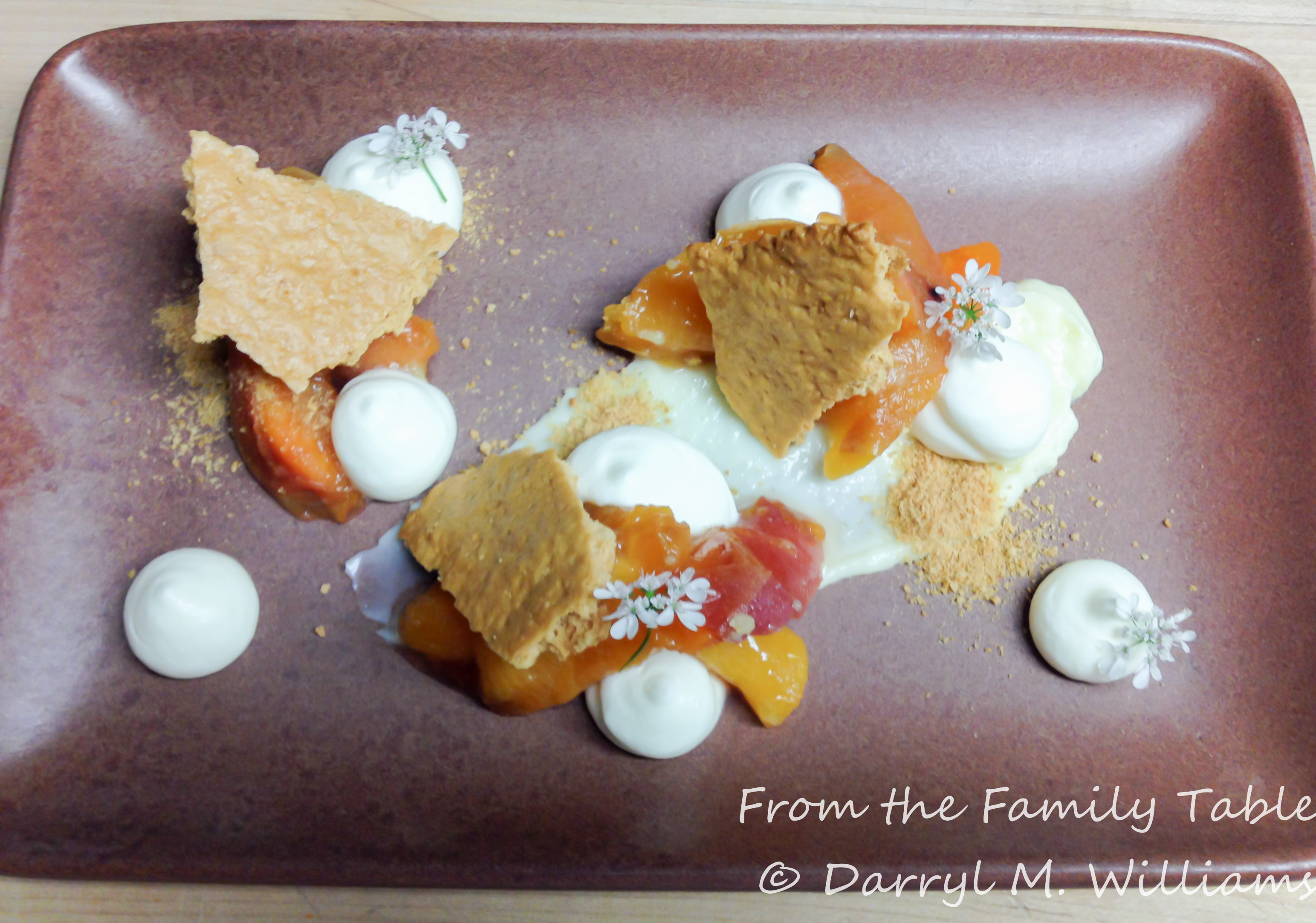
Sarah decided to create a new dessert for Rich Table based upon Strawn’s peach pie. Hers became a deconstructed version with dollops of custard and whipped cream topped with fresh peaches. Along side were pie-crust sables. It turned out to be a very sophisticated dessert that became a big hit the first night it appeared on the menu.

The deconstructed version of peach icebox pie served at Rich Table, San Francisco

The deconstructed version of peach icebox pie served at Rich Table, San Francisco

My version is a little more straightforward: cream pie topped with fresh peaches and whipped cream. Since peaches are in season right now, it is a perfect dessert for a patio meal at sunset.

RECIPES

Almond Pie Crust

Ingredients

  • 1 cup all-purpose flour
  • ¼ cup almond meal
  • ¼ teaspoons salt
  • 1 stick (8 tablespoons) unsalted butter, cut into pieces
  • ¼ teaspoon almond extract
  • 2 teaspoons ice water

Method

  1. Place all of the ingredients in the beaker of a food processor fitted with the metal blade
  2. Pulse several times and then process until the dough forms a ball.
  3. Remove the ball of dough from the processor and wrap with plastic film. It may be a little sticky from the heat of the blade. That’s ok. It will firm up in the refrigerator.  Refrigerate 30 minutes or until firm.
  4. When you are ready to bake the crust, press the dough into the bottom and along the sides of a 9 inch metal pie pan, forming an edge of dough on the rim of the pie pan.
  5. Pierce the bottom and sides of the crust all over with a fork. Bake in the middle of an oven pre-heated to 425° F for 12 to 14 minutes or until the crust is a golden brown. Remove to a cooling rack and cool completely in preparation for filling.

Cream Filling

Ingredients

  • 1 cup whole milk
  • ¼ cup sugar
  • 3 tablespoons all-purpose flour
  • ¼ teaspoon salt
  • 4 egg yolks, beaten until smooth and slightly foamy
  • 2 teaspoons vanilla extract
  • ¼ teaspoon almond extract
  • 2 tablespoons unsalted butter

Method

  1. In a heavy saucepan, bring the milk to a boil and turn off the heat
  2. Combine the sugar, four, and salt in a medium bowl. Very slowly pour the hot milk into the dry mixture, whisking continuously to prevent lumps of flour from forming. As you add the milk, you can increase the rate of pouring until it has been completely added to the mixture.
  3. Return the mixture to the saucepan and adjust the heat to medium. Stirring continuously, heat the mixture slowly until it boils and thickens.
  4. Remove from the heat and cool for a minute. Beat in the egg yolks. Then return to the heat, and return to the boil for one minute. Remove from the heat, and beat continuously for another minute, allowing it to cool slightly.
  5. Stir in the vanilla and almond extracts and butter until they are completely incorporated. Transfer to a bowl. Cover directly with plastic film and refrigerate for at least one hour until you are ready to assemble the pie.

Peaches and Whipped Cream Topping

Ingredients

  • 5 medium ripe peaches
  • 1 tablespoon sugar
  • 1 cup heavy whipping cream
  • 1 tablespoon confectioner’s sugar (or to taste)

Method

  1. Blanch the peaches in boiling water for 10 seconds and then cool
  2. Peel the blanched peaches and cut them into slices. Sprinkle with sugar and refrigerate, covered, until ready to use.
  3. When you are ready to assemble the pie, whip the cream with confectioner’s sugar until it forms  stiff peaks.

Assembly

  1. Spread the pastry cream evenly on the bottom of the pie shell.
  2. Drain the peach slices if necessary, and arrange over the top of the pastry cream
  3. Cover the peaches completely with the whipped cream. Refrigerate for one hour before serving.


8 Comments

Filed under Food, Photography, Recipes, Restaurants, Travel

SMOKED NEW POTATOES AND CARAMELIZED GARLIC AIOLI

Here’s another idea I lifted from Bar Tartine. Their smoked potatoes with black garlic are unique and delicious. I couldn’t possibly replicate them at home. First, because I don’t have black garlic, and second, I don’t have a clue as to how they smoke their potatoes. As to the black garlic, you can order it from Blackgarlic.com in Hollister, CA, near the garlic capital of the world – Gilroy.

Still, an effort was worth a try, especially if I dragged out my Camerons Stovetop Smoker. The smoker is one of the niftiest things in my batterie de cuisine even though I don’t use it that much. With it, I can hot smoke fish, poultry, meat, and anything else you can fit into it without filling the house with smoke. The smoker is available from the manufacturer, Amazon, kitchen stores, and several big-box retailers for under $60.

Camerons also sells wood chips specially sized for the smoker. The wood chips that you find in the barbecuing section of the grocery store are too big. But Camerons gives you a choice of apple, alder, cherry, hickory, maple, mesquite, oak, pecan, and even corn cob. I used alder, and I think it was a good choice.

As a substitute for the black garlic, I smoked fresh garlic with the potatoes in the hope that it would caramelize and then used for an aïoli. That turned out to be reasonably successful.

RECIPES

Smoked New Potatoes

Ingredients

  • 1/3 cup special smoker wood chips
  • 6-8 small new red potatoes for each diner, well-scrubbed
  • 3 tablespoons butter, melted
  • coarse Kosher salt

Method

  1. Prepare the smoker by placing the wood chips in the center of the bottom of the smoker. Line the tray with aluminum foil, and arrange it and the rack in the smoker.
  2. Arrange the potatoes on the rack with the garlic in a small aluminum foil nest in the center (see below)
  3. With a brush, lightly baste each of the potatoes on all sides and sprinkle generously with the salt.
  4. Slide the cover onto the smoker, leaving a 3 inch opening. Place over medium heat on the stove top. When smoke begins to come out of the opening, close to form a tight seal. You will be able to smell the smoke, and you may see a faint wisp, but there should be no smoke coming out of the sealed smoker.
  5. Roast for 45 minutes. Remove the smoker from the heat, and open the top.
  6. Transfer the potatoes to a serving bowl

Caramelized Garlic Aïoli

Ingredients

  • 6 cloves of garlic, peeled and stems removed
  • 1 cup mayonnaise
  • juice of ½ lemon
  • salt and pepper to taste

Method

  1. Crumple a sheet of aluminum foil into a small “nest” large enough to hold the garlic. Set the nest in the center of the potatoes on the smoker rack.
  2. Smoke according to directions above.
  3. When the potatoes are smoked, transfer the garlic to a small bowl and mash with a fork or pass through a garlic press.
  4. Stir in the mayonnaise and lemon juice. Adjust the seasoning with salt and pepper
  5. Serve as a dip with the potatoes.

7 Comments

Filed under Food, Photography, Recipes, Restaurants

LIPTAUER CHEESE

In a recent post, I described an amazing feast we enjoyed at Bar Tartine in San Francisco. One of the co-chefs, Cortney Burns, is featured in an article titled, “Dairy Queen” in the Spring, 2014 issue of Culture: the Word on Cheese, a beautiful quarterly magazine all about cheese. Before our recent visit to the restaurant, Sarah and Evan said we should be sure to get the Liptauer cheese spread. Unfortunately, it was not on the menu that night, so we didn’t get to give it a try. I’m not sure, but I suspect that Cortney is behind the spread being on the menu because of her obvious interest and expertise in cheese. Liptauer cheese, like the pimento cheese I wrote about a while back, is a classic from earlier days, commonly seen at cocktail parties. I guess with the renaissance of cocktails, there is a renewed interest in cheese spreads as well. Liptauer cheese is the name for both the soft, fresh, sheep’s milk cheese originating in Liptauer, Hungary, and the seasoned spread made and enjoyed in Austria, Germany, and other European countries.  You probably won’t be able to find the original Liptauer cheese at your local cheese monger, but fortunately you can make a reasonable facsimile using cottage cheese or cream cheese. If you want to turn your spread into a dip, just add enough sour cream to suit your taste. Also, for some tastes, this version may be a little bland. You can spice it up with cayenne or your favorite hot pepper sauce to taste.

RECIPE

Liptauer Cheese

Ingredients

  • 8 ounces cream cheese, softened
  • 1 stick butter, softened
  • 1 tablespoon Dijon mustard
  • ½ teaspoon salt
  • ¼ teaspoon ground black pepper
  • anchovy filet, mashed (or about 1 inch of anchovy paste)
  • 1 tablespoon paprika
  • 1 tablespoon caraway seeds
  • 1 tablespoon capers, chopped
  • 1 tablespoon chives, minced
  • 1 tablespoon green onion tops, chopped
  • 2 tablespoons finely chopped cornichons
  • 2 tablespoons finely chopped flat-leaf parsley
  • cayenne or pepper sauce (optional, to taste)
  • finely chopped chives or green scallions or paprika for covering the cheese ball.

Method

  1. In a food processor, pulse the cream cheese and butter until smooth.
  2. Transfer to a bowl and stir in the remaining ingredients until evenly combined.
  3. Refrigerate until firm, at least two hours or overnight. When firm, shape into a ball and cover in plastic wrap. Chill again.
  4. Roll the chilled cheese ball in chopped chives or green scallion tops (I used a mixture of garlic chives and scallions. Alternatively you can roll it in paprika.)
  5. Serve at room temperature with fresh, crusty bread – preferably dark rye – or crudités.

8 Comments

Filed under Food, Photography, Recipes, Restaurants