A SHORT HISTORY OF CORN

A couple of years ago, my two daughters and I started a book about corn (maize) to include recipes for a wide range of corn-based breads from around the world. The project bogged down when I started writing a blog, but we plan to revive our effort. Here is a short excerpt from the introduction. It may be more than you want to know about corn (maize), but I hope that you will find it interesting.

Nearly every American  school child knows that when the Europeans first came to the New World, they found a virtual cornucopia of foods which they had never seen or tasted before.  The explorers took back to their homeland many foods that soon became imbedded in cuisines in Europe, Asia, and Africa. Of these edibles, eight of the current 26 top crops by tonnage have become essential to many diets, and include maize (called corn in the United States and other English-speaking countries), potatoes, tomatoes, chiles, peanuts, manioc, chocolate and vanilla, and sweet potatoes. Other important New World contributions to the global diet included beans, squash, turkeys, pineapple, and avocado, along with numerous herbs, fruits, and nuts.  Of these foods, undoubtedly corn has become the most important for providing nutrition and calories throughout the world and in all socio-economic situations.  To support this contention, consider that corn (or maize) is grown on all of the inhabited continents, China grows more corn than any other country, and corn-based dishes are served in China, India, Africa, England, France, Italy, and all of the countries of Central and South America. Refined corn is used for cooking oil, sugar substitute, and food additives. Corn serves as a major food source for animals raised a sources of meat. It is an integral and essential part of nearly every human’s diet.

History of cultivation

Maize (corn) was domesticated nearly 9,000 years ago by people living in the region of what is now the Mexican states of Michoacán, Guerrero, and Mexico. Like all modern food grains, it arose from a wild grass – in this case a large grass, Balsas teosinte, that even to this day grows in the Central Balsas River Valley. 

Balsas teosinteAlthough no one knows exactly how or how long the process of domestication developed, clever modern breeding studies have produced hybrids of teosinte and maize that give us an idea of what some of the grains may have looked like along the way.

teosinte and maize cobsIt is clear that both the Aztecs and Mayas consumed domesticated maize, and archeological records document that domestic corn spread to Panama by 7,600 years ago and to Uruguay by 4,600 years ago. Later, domesticated corn spread throughout both North and South America so that it was an important part of the diet of the native peoples throughout the New World when the Europeans arrived. The European explorers took back seed grain, and the cultivation of corn spread quickly throughout Europe and then into Africa and Asia. This rapid acceptance occurred  largely because of ease of cultivation, wide range of favorable growing conditions, and usefulness as a basic foodstuff. Now virtually every culture in the world depends upon corn and has unique and traditional dishes based upon the grain.

3 Comments

Filed under Food, Photography, Travel

GOULASH – BUT NOT HUNGARIAN

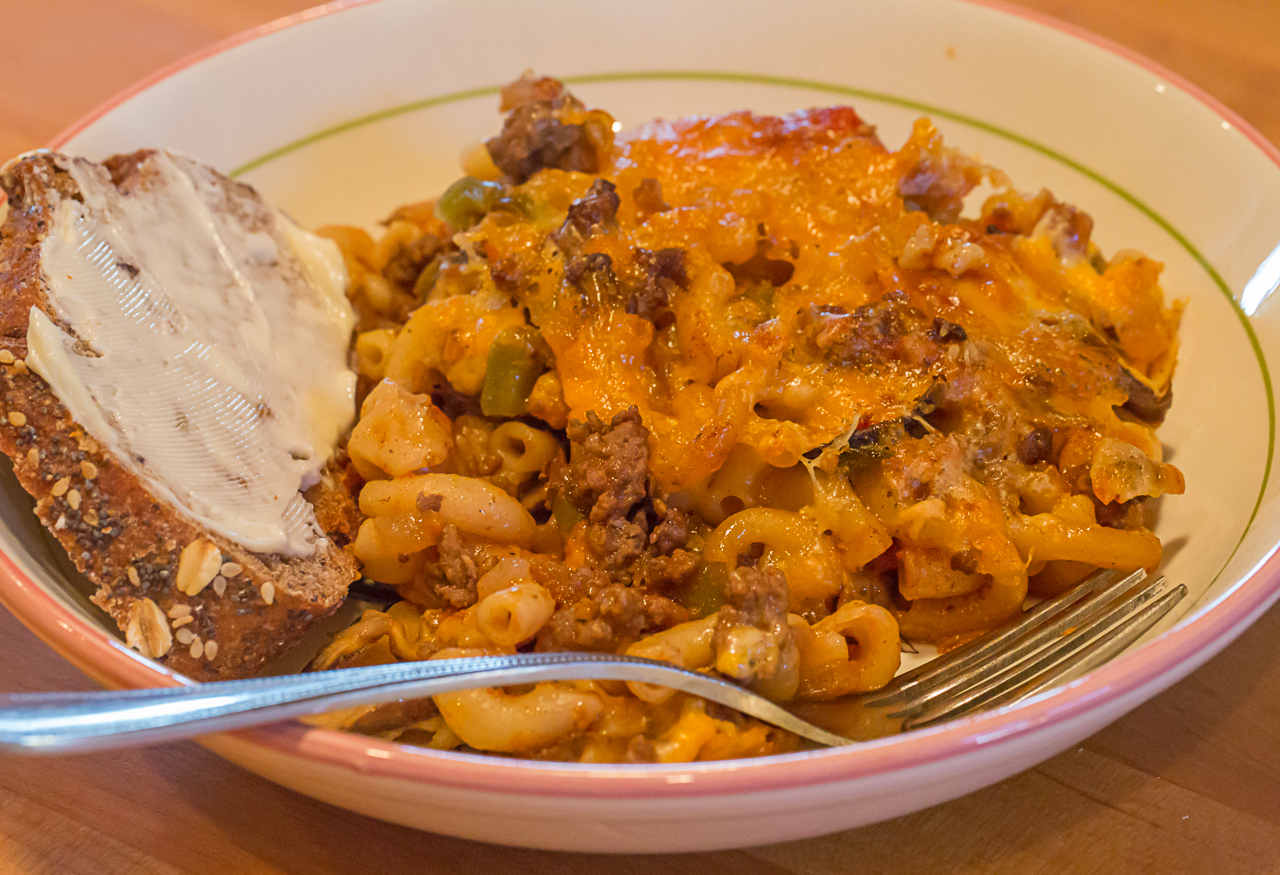
A few of my recent posts have dealt with pasta and casseroles, especially those I remember from my childhood. Here is yet another: my mother’s famous (or infamous as you will see) goulash, which was decidedly not the Hungarian variety. It was one of her most prized recipes, and a dish that family visitors often requested. She would bring it to the table with great pride, always in an oven casserole. When we had visitors, it would disappear before the meal was over, no matter how much she made.

Sometime around my parents’ 25th wedding anniversary, the topic of Mom’s famous goulash came up at the dinner table, and my father – for whatever reason  – made the offhanded comment that, actually, he never much cared for my mother’s goulash. A pall fell over the gathering, everyone ate quickly, and plates were rushed to the sink without much more comment. My mother never made her goulash again. Too bad, because it is really a quick, easy, and tasty one-dish meal for a family dinner.

When I was compiling a family cookbook years ago, I asked my mother for the recipe.  She didn’t send it even with a lot of cajoling. She even claimed that she had lost it. Finally, I received a copy just before she died. Actually, you don’t need a recipe, just a little imagination.

RECIPE

Goulash

Ingredients

  • 2 cups uncooked dry macaroni
  • 3 tablespoons olive oil
  • 1 medium onion, chopped coarsely
  • 3 ribs celery, chopped
  • 1 green bell pepper, seeded, deveined, and chopped
  • 2 cloves garlic, peeled and mashed or minced
  • 1 pound ground beef
  • ½ pound mushrooms, washed and sliced
  • 1 teaspoon paprika
  • ¼ teaspoon ground bay leaf
  • ¼ teaspoon ground thyme (more if you like)
  • salt and pepper to taste
  • 1 14.5 ounce can of diced tomatoes
  • 4 ounces sharp Cheddar cheese, grated
  • 2 tablespoons butter to dot the top of the casserole

Method

  • Cook the macaroni in a large pot of salted, boiling water until just al dente (about 12 minutes at sea level, longer at higher altitudes). Drain and set aside.
  • In a large oven-proof container (a large, heavy cast iron skillet works best), heat the oil on the stove over medium heat.
  • Add the onions and sweat them until they are translucent and soft. Then add the celery, bell pepper, and garlic. Continue to cook, stirring frequently, until the vegetables are soft and well cooked.
  • Add the ground beef. Stir frequently to break apart any lumps of uncooked meat. Continue to cook until the  meat is well-browned. Then stir in the paprika, bay leaf, and thyme. Correct the seasoning with salt and pepper.
  • Add the sliced mushrooms and stir until they are lightly cooked.
  • Stir in the cooked macaroni.
  • Stir in the canned tomatoes until well combined. Then stir in half the grated cheese
  • Sprinkle the top of the casserole with the remaining cheese, dot with butter, and bake in the middle of an oven pre-heated to 350°F for about 40 minutes or until the cheese topping is melted and bubbling a bit.
  • Serve immediately at the table with a salad and crispy bread.

2 Comments

Filed under Food, Photography, Recipes

BARCELONA: PATATAS BRAVAS AND CREMA CATALANA

I have been away from my computer for several weeks doing a lot of traveling. Part of that was spent in a cruise around the Mediterranean beginning in Barcelona, Spain.  This post describes our visit along with a couple of recipes for food we enjoyed while we were in this beautiful and exciting city.

Beautiful architecture along Las Ramblas

We arrived on a flight from Philadelphia and were taken to our hotel on La Rambla Catalanya. First on the agenda was a brief nap, and then we explored Las Ramblas and parts of the old city. The street was perfect for walking, with a wide pedestrian walkway shaded by beautiful old plane trees. All along the way, there were open-air cafés offering a wide variety of food and drink. We selected a brightly lit cafe with linen tablecloths not too far from our hotel. The waiters were extremely friendly, and the menu offered a wide choice of tapas, along with paella, sangria, and excellent Spanish and Portuguese wines.

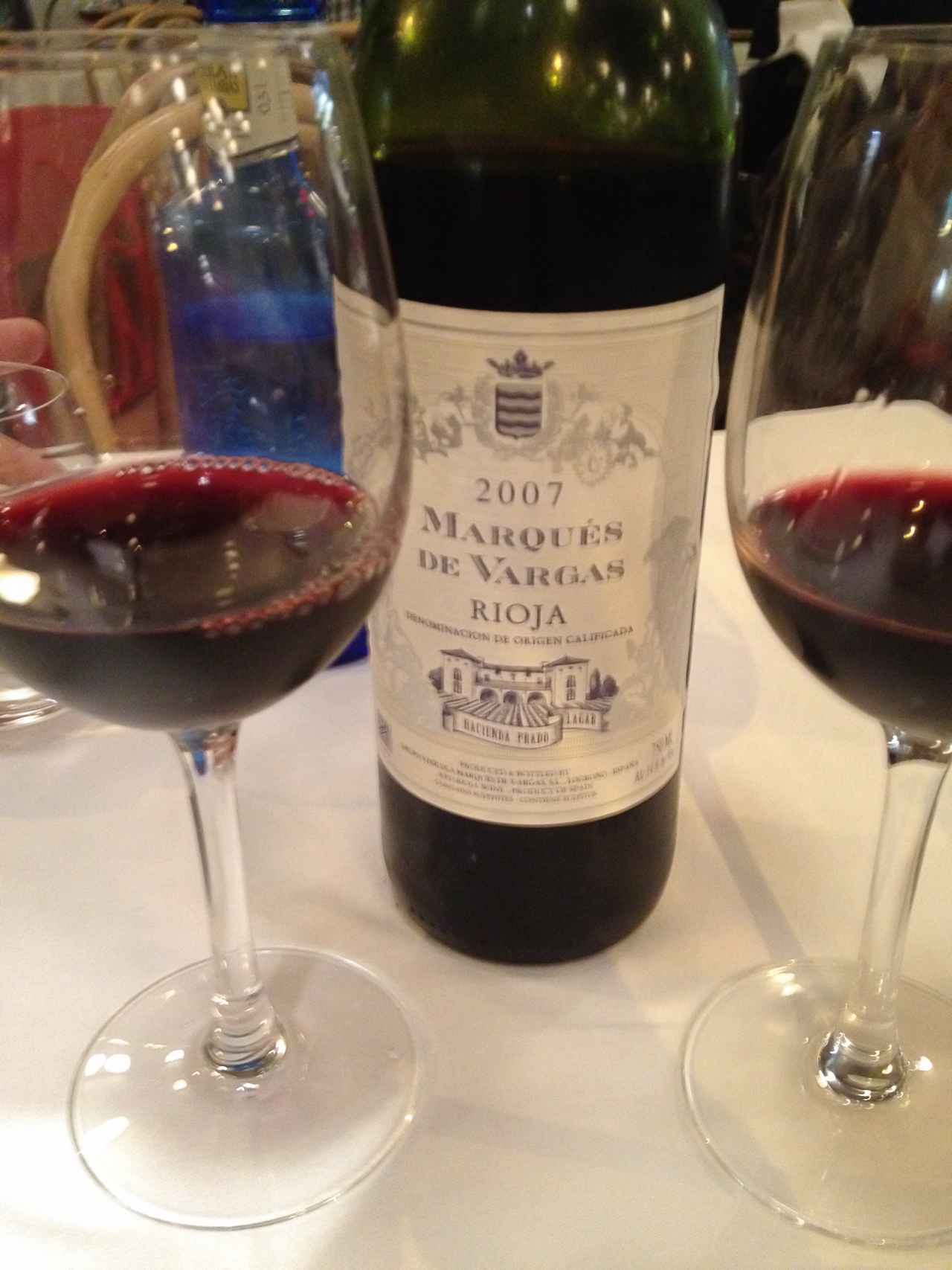
Spanish red wine to enjoy with tapas

We settled on a short list of hot and cold tapas which included octopus, cod-fish croquettes, tomato bread, and other tasty items. One of our favorites was patatas bravas, highly recommended by our daughter, Sarah, who had spent a couple of summers in Spain. It turned out to be a great choice.

Patatas bravas

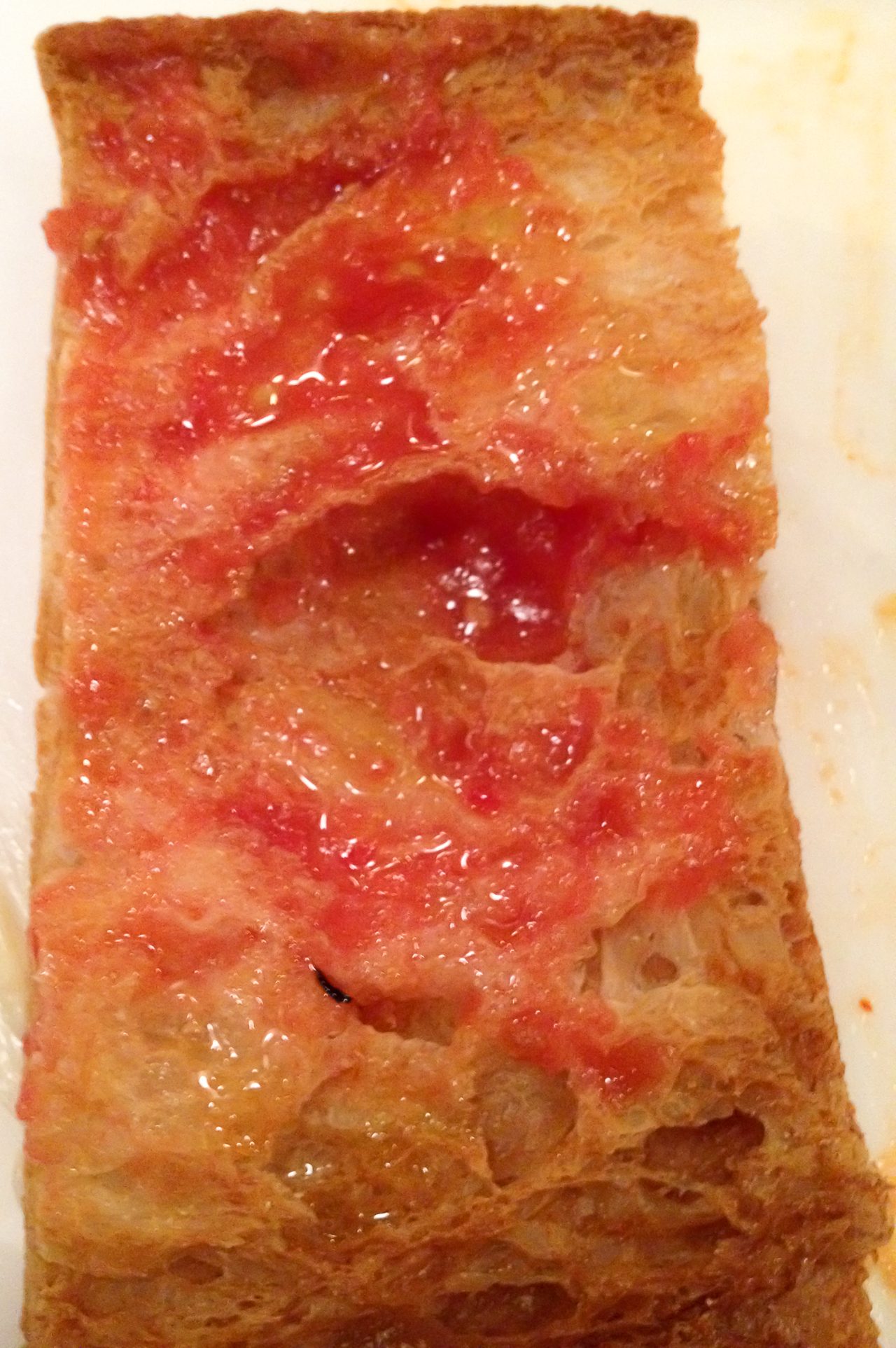
Another popular and simple tapa- toasted bread with garlic and tomatoes

We finished up with crema catalana for dessert, and as our waiter said, “How can you not have crema catalana? You’re in Barcelona.”

Crema catalana

The next day we toured the city including, of course, La Familia Sagrada. Even for those who have visited many times, no trip to Barcelona is complete without a visit to this spectacular church, under construction for 130 years with more construction projected to at least  2026.

The Basilica of La Familia Sagrada

To me, it is hard to call the basilica beautiful – it flies too far outside my concepts of graceful architecture. At the same time, it is impossible not to think of it as an architectural marvel.  The architect, Antonio  Gaudi,  began what would be his life’s ultimate work in 1883. Gaudi was obviously a genius who developed radical theories of construction based upon his observations of suspended strings and other seemingly simple yet profound understandings of geometry. The basilica is under very active construction with several huge cranes arranged around the perimeter, building more towers to bring the final total to thirteen or possibly eighteen, depending upon whether the full plan will be fulfilled.

RECIPES

Patatas bravas with tomato sauce and aioli

This is one of the most famous and popular of all tapas. As a result, there are many recipes for preparing the potatoes. You can choose to roast them, bake them, boil and fry them, deep fry them at two different temperatures, etc., etc. Probably the simples – and perhaps even the most authentic – is to roast them in the oven. There is also variation in what to serve with the potatoes. A tomato sauce is common, but aioli is also common. You may even want to offer both, or your own choice of sauce.

Tomato sauce

ingredients

  • 2 tablespoons olive oil
  • 2 tablespoons onion, minced
  • 1 clove garlic, minced
  • 3 medium tomatoes, peeled, seeded, and chopped
  • 1 tablespoon tomato paste
  • ¼ cup white wine
  • 1 tablespoon parsley, minced
  • 1/8 teaspoon ground red (Cayenne) pepper
  • 1 bay leaf
  • 1/8 teaspoon sugar
  • salt and pepper to taste

Method

  • Heat the olive oil in a small saucepan over medium heat.
  • Add the onion, sweat and then saute lightly.
  • Add the remaining ingredients, cover and cook over low heat for 30 minutes. Cool, strain, and dilute with water if needed to make a moderately thick sauce.

Alioli

Ingredients

  • 4 cloves garlic, peeled and mashed
  • 1 teaspoon salt
  • 2 egg yolks
  • 1 cup extra virgin olive oil
  • ¼ teaspoon dry mustard
  • 2 tablespoons freshly squeezed lemon juice

Method

  • In a mortar or small dish, mash the garlic and salt together to form a paste. Set aside
  • Using a whisk and a medium bowl, beat the egg yolks until smooth, thickened, and slightly foamy.
  • By drops at first, whisk in the olive oil, until it is fully incorporated into the yolks before adding more. As the process continues, you can speed up the addition of oil. Do not rush the process or the sauce will separate.
  • When the oil has been fully incorporated, whisk in the mustard and garlic-salt mixture. Then stir in the lemon juice to make a smooth sauce.

Patatas

Ingredients

  • 2 large Yukon gold potatoes, peeled and cut into ¾-inch chunks
  • ½ cup olive oil
  • salt and pepper
  • ½ teaspoon red pepper flakes
  • 2 teaspoons parsley, minced

Method

  • Arrange the potato chunks on a small baking sheet which has been lightly coated with some of the olive oil. Drizzle the remaining oil over the potatoes and ststir just enough to coat the potatoes, keeping them in one layer.
  • Roast in the middle of an oven preheated to 375° F for about 45 minutes. Stir several times during the roasting. Remove from the oven when the potatoes are well-browned and crisped.
  • Sprinkle with the salt, pepper,  red pepper flakes, and parsley.
  • Serve immediately while still warm, along with the tomato sauce and/or alioli for dipping or spooning over the top.

Crema catalana

This is only one in a family of creamy desserts, including baked custard, flan, crème brûlée, and créme anglaise. They all have eggs, sugar, and milk or cream. Sometimes they have corn starch or gelatin as a thickening agent. Some are baked in a water vath while some are cooked on the stove top. The more you read recipes to discern the differences, the more confusing  the relationships. Whatever, crema catalana is traditionally cooked on the stove, allowed to set up in the refrigerator,and  served in a shallow terra-cotta dish, topped with sugar  caramelized with a salamander, under a broiler, or with a blow torch.

Ingredients

  • 4 egg yolks
  • ¾ cup sugar
  • 1 cinnamon stick
  • zest of 1 lemon (use orange if you prefer)
  • 1 tablespoon cornstarch
  • 2 cups whole milk
  • additional sugar (about 1 tablespoon for each) for topping individual servings

Method

  • With a hand-held electric mixer, beat the eggs and sugar in a medium saucepan until they form a thick, smooth mixture
  • Add the cinnamon stick and lemon zest to the mixture
  • In a small bowl, dissolve the corn starch in the milk. Then add to the egg mixture and place over low heat
  • Stir constantly until the mixture thickens. Work slowly or you will scramble the eggs. When the mixture has thickened enough to lightly coat your stirring spoon, remove immediately from the heat.
  • Remove the cinnamon stick You can strain the custard at this point if you wish. Then ladle into 4 to 6 small ramekins or casuelas.
  • Refrigerate at least 3 hours, and preferably overnight.
  • When you are ready to serve, remove from the refrigerator, sprinkle about a tablespoon of sugar over the top of each of the individual servings.
  • Caramelize the sugar topping by (1) using a small metal salamander heated on a stove burner, (2) running under your oven broiler for 5 to 10 minutes, or (3) using a small culinary blow torch.
  • Serve immediately.

1 Comment

Filed under Food, Photography, Recipes, Restaurants, Travel

CLAM, MUSHROOM AND SPINACH STUFFED CONCHIGLIONI

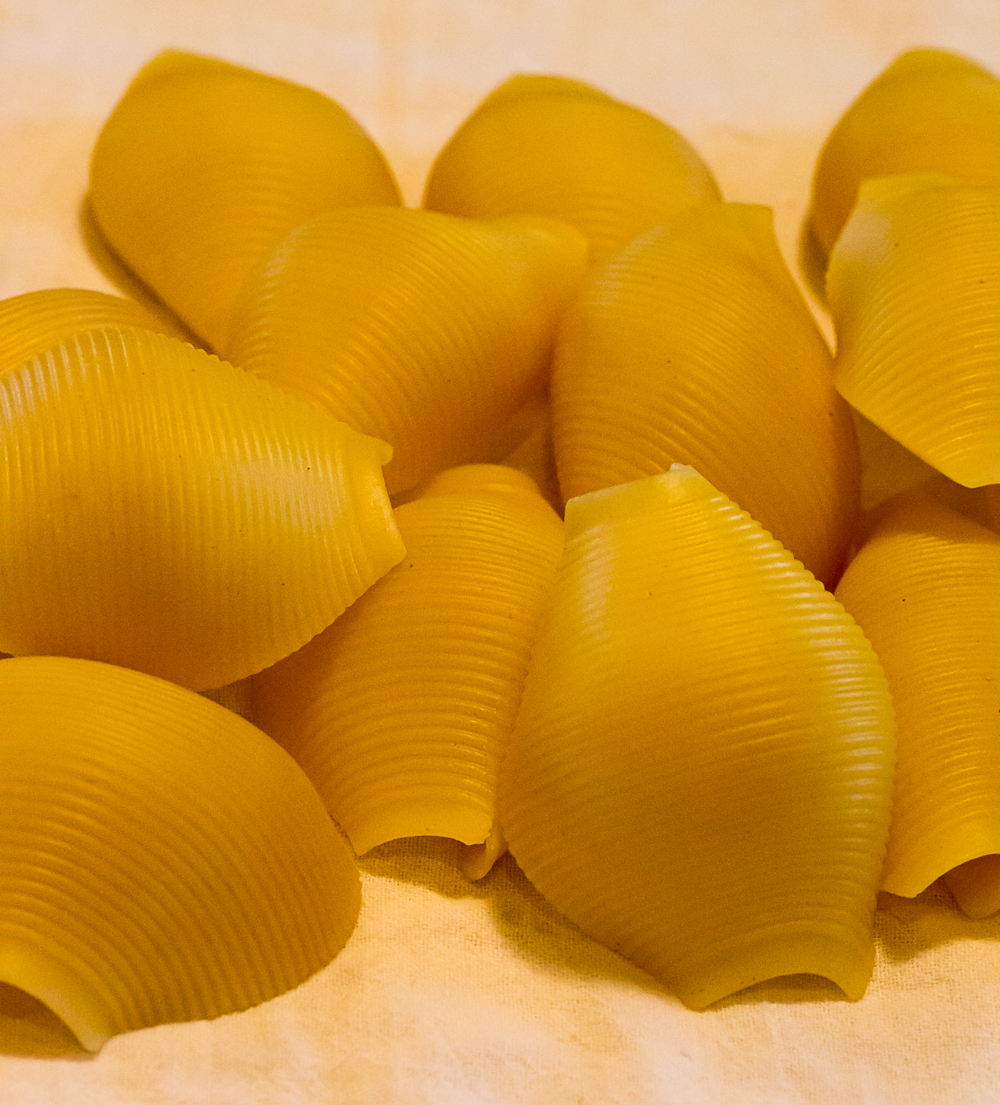
Pasta shaped like great big shells (conchiglioni) has always intrigued me, because those shells are just begging to be stuffed with something. The little ones are good, too, because they hold sauce in a hot dish or dressing in a pasta salad. But the big ones can hold any kind of stuffing you can think of.

Conchiglioni

A box of conchiglioni caught my eye in the grocery aisle the other day, so I bought one without having a clear idea of what I wanted to make from them. Over several days I flipped through a mental catalog: shrimp, cheese, ham, chicken, ground beef. Nothing seemed exactly right, and then I remembered a can of minced clams that had been sitting in the pantry just waiting for me to make one of my favorites, pasta with clams and white sauce.

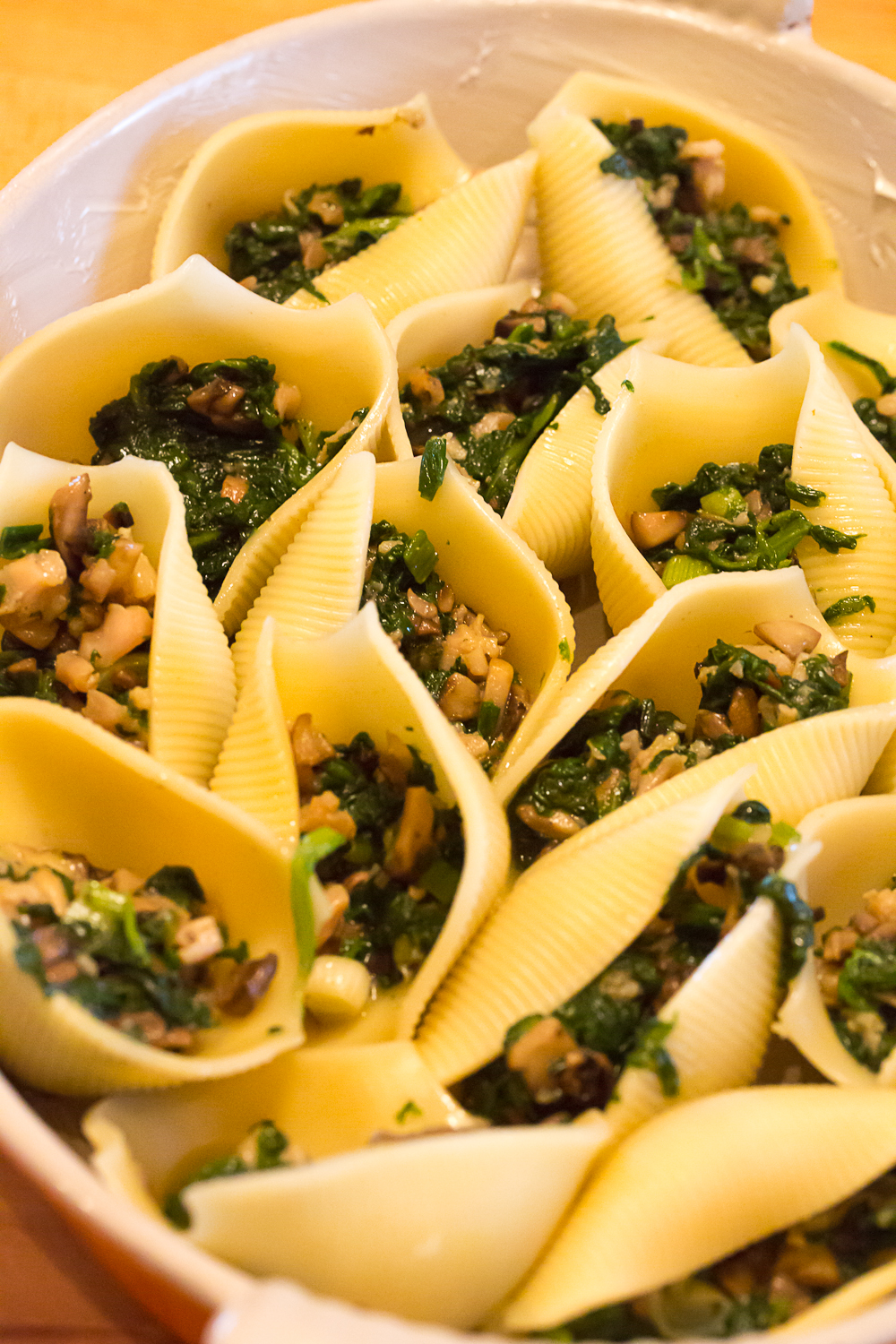
Stuffed shells ready for sauce

That seemed like a good beginning, but I was trying to think of something a little different. At last I came up with a plan and decided to make a stuffing of clams, mushrooms, and spinach.

Ready for the oven

Ingredients

  • 12 giant conchiglioni
  • 3 quarts salted water
  • 3 tablespoons olive oil
  • 1 bunch fresh spinach, washed, trimmed of stems, and chopped coarsely
  • 1 pound crimini mushrooms, washed and sliced
  • 6.5 ounces canned minced clams, drained (Reserve clam juice)
  • ½ teaspoon Pernod
  • salt and pepper to taste
  • 2 tablespoons butter
  • 2 tablespoons flour
  • ½ cup whipping cream
  • ¾ cup grated Swiss cheese
  • ½ cupgrated Parmesan cheese
  • butter for dotting the top of the casserole

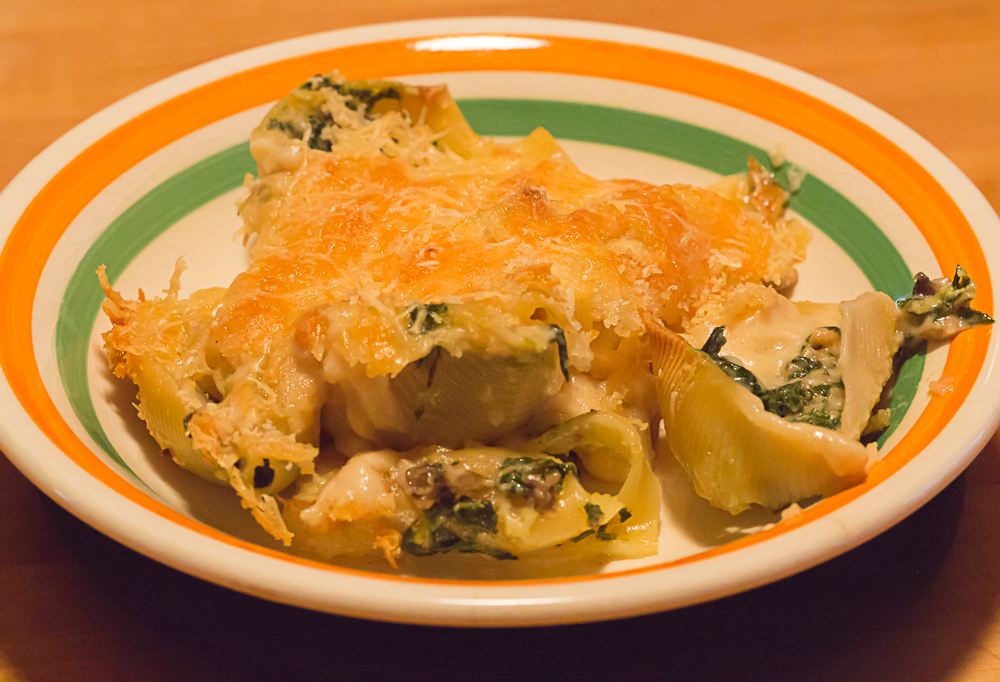
Baked

Method

  • Boil the pasta shells in the boiling salted water until al dente, about 12 to 15 minutes. Drain and set aside for stuffing.
  • In a large skillet over medium-high heat,  heat the olive oil until shimmering. Then add the chopped spinach and heat, covered, until wilted.
  • Add the mushrooms and continue to sauté until the mushrooms are cooked through.
  • Then add the clams, Pernod, salt and pepper. Be careful with the Pernod, as too much can be overwhelming.  Reduce the heat to low until ready for stuffing.
  • In a saucepan over medium heat, melt the butter and then add the flour. Stir until thoroughly mixed and cook for 5 minutes to remove the raw taste of the flour. Stir in the clam juice and enough cream to make a thick sauce. Adjust the seasonings with salt and pepper. Add water if the sauce is too thick.
  • Arrange the cooked pasta shells in a well-buttered baking dish.
  • Divide the stuffing evenly among the pasta shells. Then top with the sauce, sprinkle with Swiss  and Parmesan cheeses. Dot with butter, and place in the middle of an oven pre-heated to 350°F. Bake for 50 minutes or until the top of the casserole is well-browned.  Remove from the oven, let rest for 5 minutes, then serve.

Ready to serve

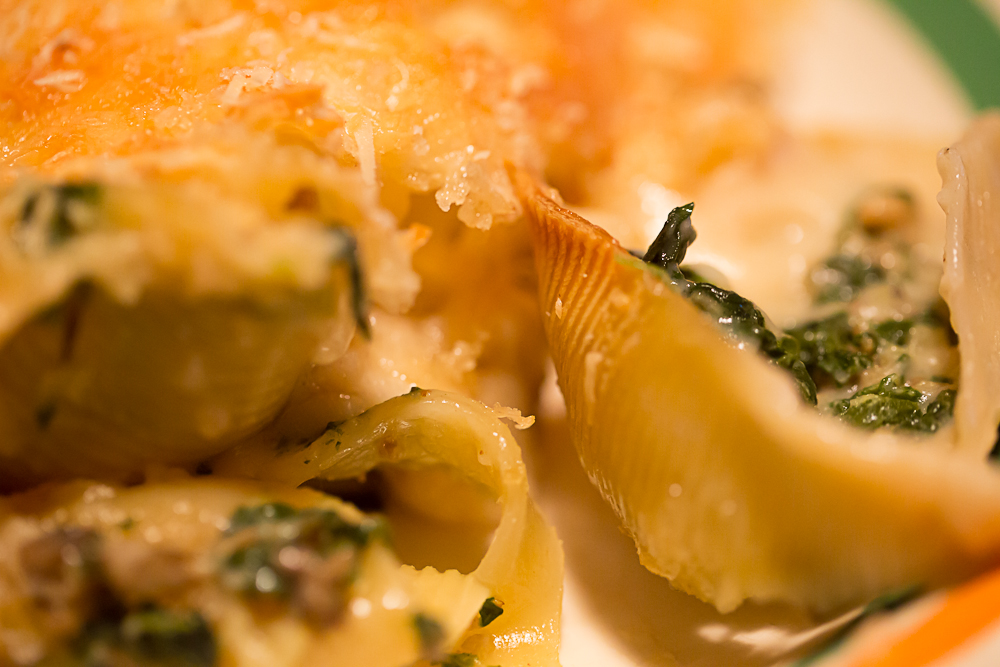
Closeup view of the finished dish

1 Comment

Filed under Food, Photography, Recipes

RICH TABLE – VERDICT IN; THE CRITICS APPROVE

Rich Table in the Hayes Valley section of San Francisco has only been open for a little over 2 months, but already the food and service have impressed the local critics. Michael Bauer in the San Francisco Chronicle has said, “It was ironic and symbolic that my first visit to Rich Table was the night of the blue moon, because only once in a blue moon does a restaurant like this come along.” ( 3½ stars, September 30, 2012) In San Francisco magazine, Josh Sens says, “Elements of surprise…Rich Table might sound like every other joint in town, but it’s not.” (3 stars, October, 2012)   7×7 San Francisco has selected Sarah and Evan as the chef representatives in their annual “The Hot 30”. (October, 2012)

With all that publicity, it may not be a surprise that the reservation book is filled for the next three months, but even if you can’t get a reservation, don’t despair. There are a few seats at the communal table deliberately left open for walk-ins. The bar is always humming, so you may need to sit on an outside bench to wait your turn.

How did a new restaurant get up and running so smoothly in such a short time? Only part of the answer is the talent of the chef-owners, Sarah and Evan Rich. The other part is the professional staff who work together comfortably, more like a family than a restaurant crew.

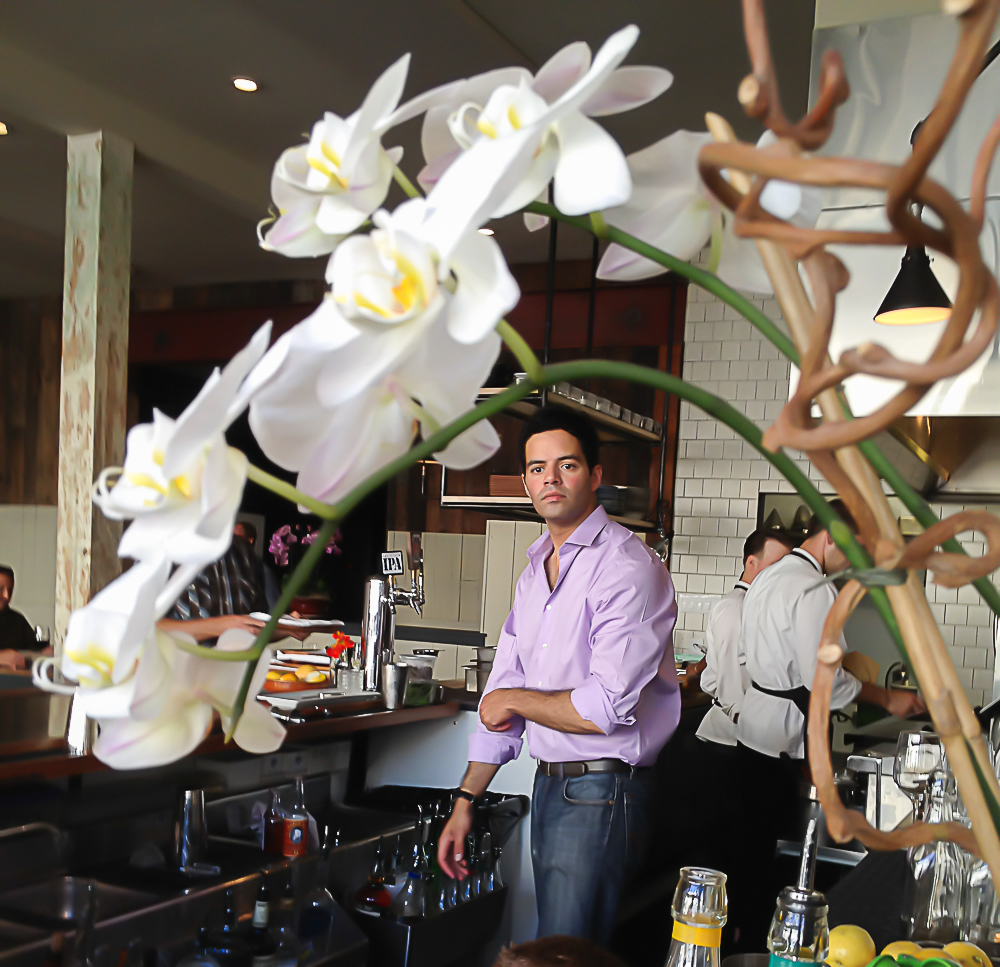
Maz has taken on responsibility for running the front of the house after working in the wait staff and as beverage manager for years at Coi. He has put together a menu of creative cocktails and an excellent choice of wines and beers that complement the food.

James and Nick have worked as cooks with Sarah and Evan for years, and so watching them in action is like watching a well-practiced athletic team. They have been joined by Bayoni, Miles, and Andrew. How all these folks fit in the tiny open kitchen is a mystery, but without a misstep they work with one another to turn out the orders beautifully composed and on cue.
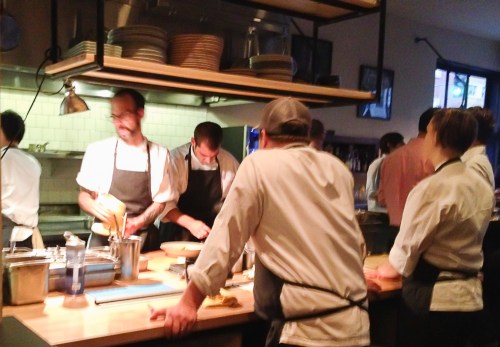
Michael and Charles left good, long-time positions in high-end restaurants to join the team. Rachel and Jamie, the runner, have also become team members. This makes a first-class, friendly, helpful, and knowledgeable front-of-the-house crew.

We visited San Francisco a few days ago with plans to eat at Rich Table. As parents of one of the chefs, Sarah, we thought that would not be a problem, but in a text message, Sarah gently reminded my wife that we need to let her know our plans , otherwise she could not guarantee a space.

We wound up sitting at the communal table with a party of five from France. They were making the “Great Circle Tour” of the American West. Even with limited English on their part and non-existent French on ours, we enjoyed a chat and wound up sharing some food.  They cleaned their plates and enjoyed the restaurant. I heard  one  say, “Magnifique.”

We spent three hours eating everything that Sarah sent out to us. Here’s what we ate:

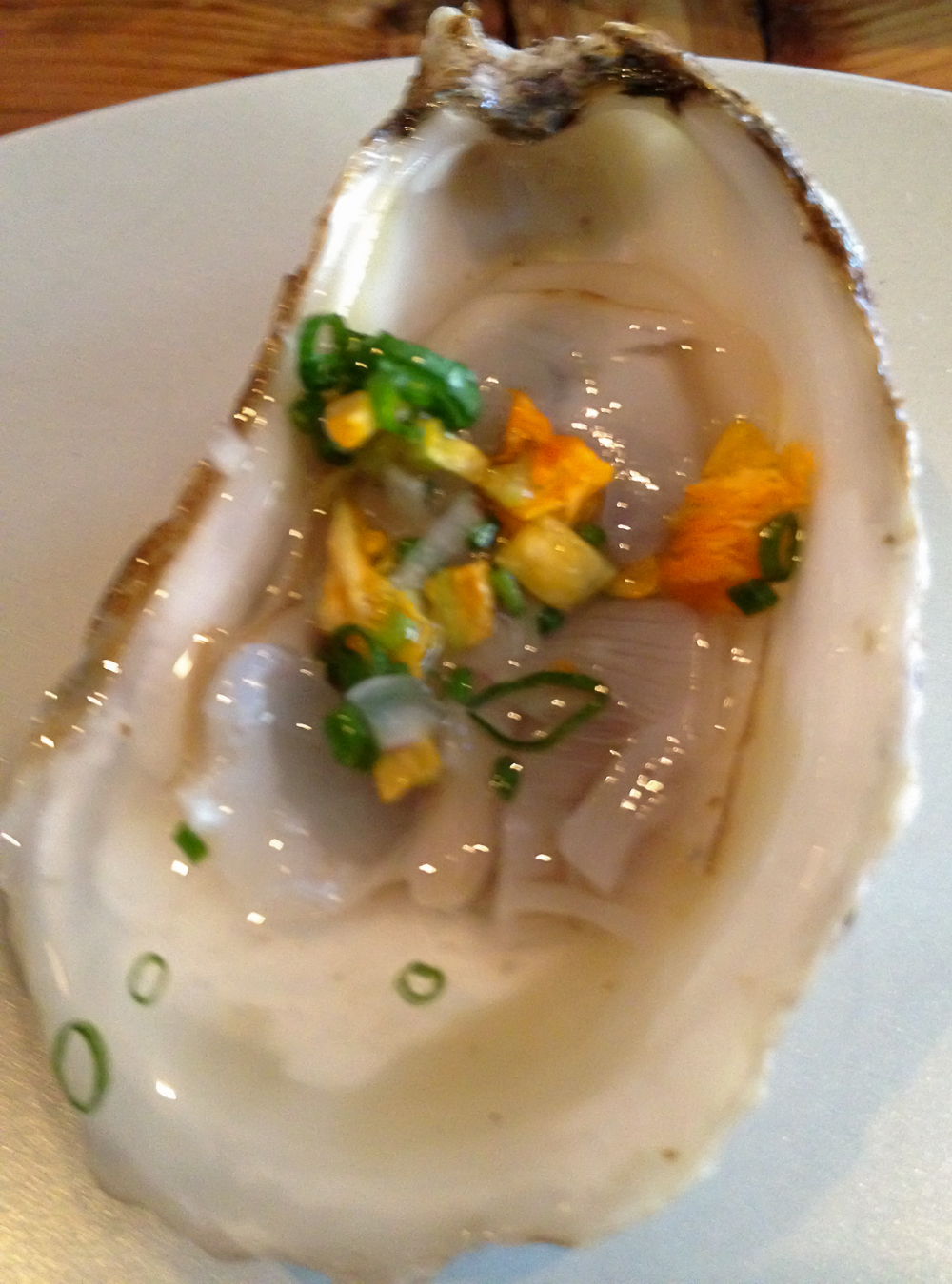
SPANISH CAVA WITH BEAU SOLEIL OYSTERS FROM NEW BRUNSWICK, CANADA
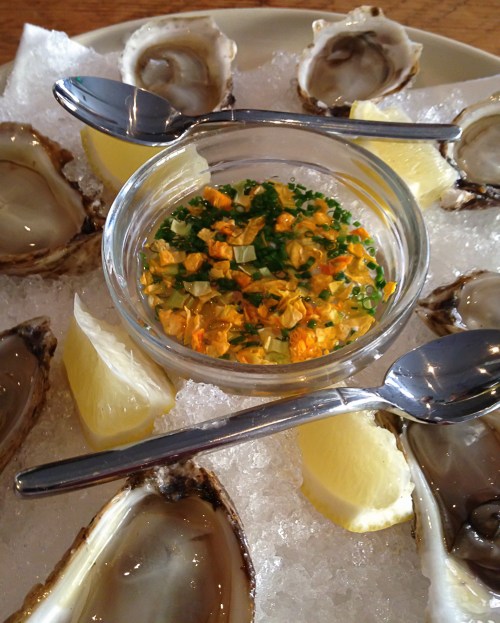
Canadian oysters in California! Delicious and ocean salty. Still, the highlight is the crushed squash blossom mignonette. The sauce is beautiful with green and yellow-orange confetti. It is also tasty with an acidic base that complements the salty oysters.

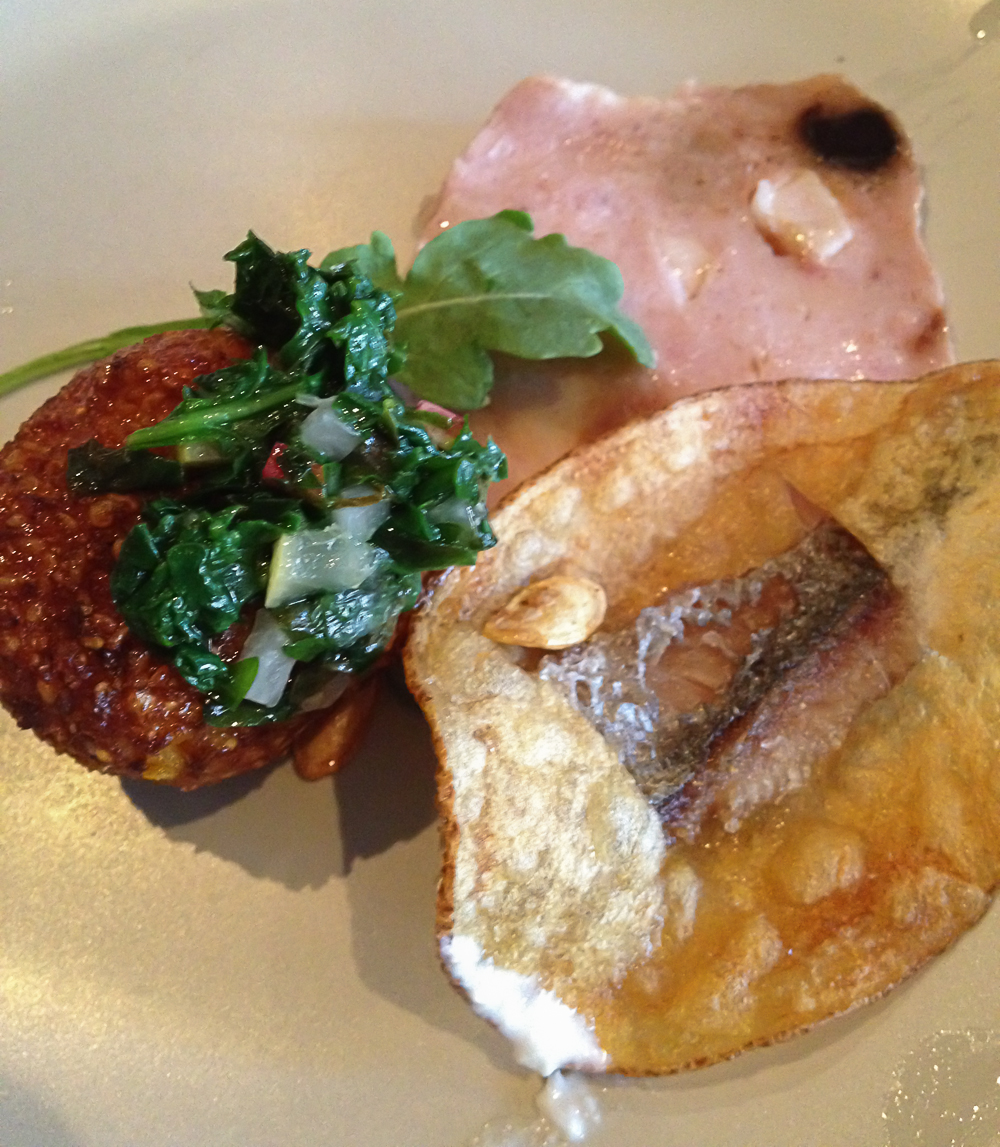
SARDINE CHIPS WITH HORSERADISH ANCHO CRESS

This is rapidly becoming a signature dish of Rich Table. Big, crisp potato chips have a slender sardine fillet woven in the middle raising the question, “How do they do that?” The horseradish sauce is a perfect foil.   CAUTION: you can’t eat just one!

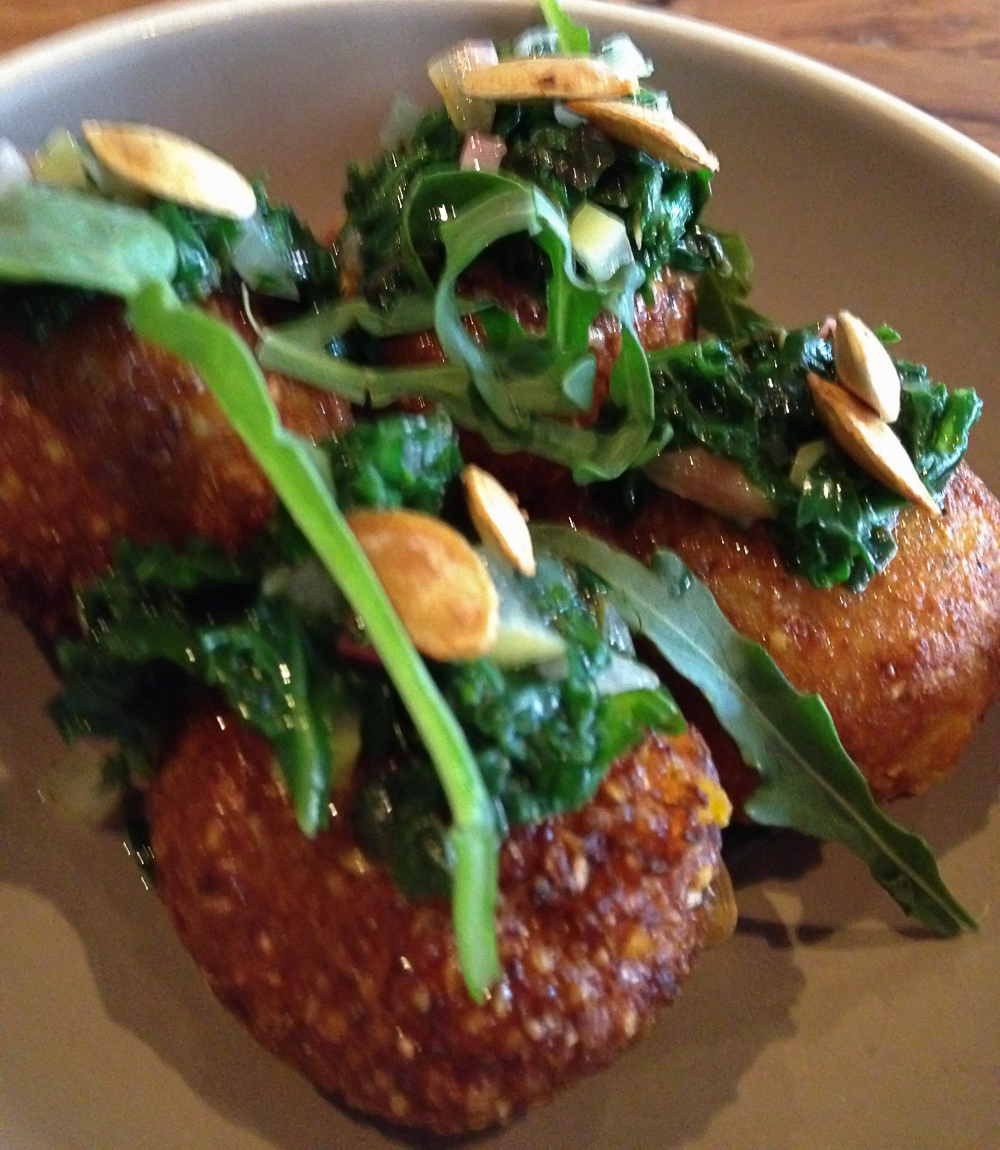
WINTER SQUASH FRITTER WITH PRESERVED LEMON AND ARUGULA SALSA VERDE
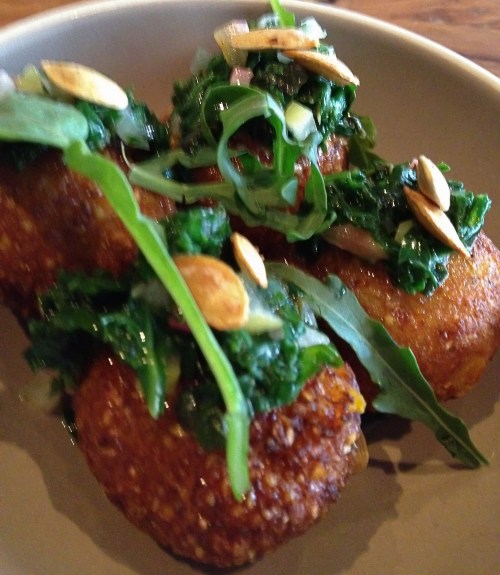
Another signature dish, corn fritters, has been transformed for the fall season into winter squash fritters with the sweet, creamy filling, crispy crust, and salty toasted squash seeds as a garnish.

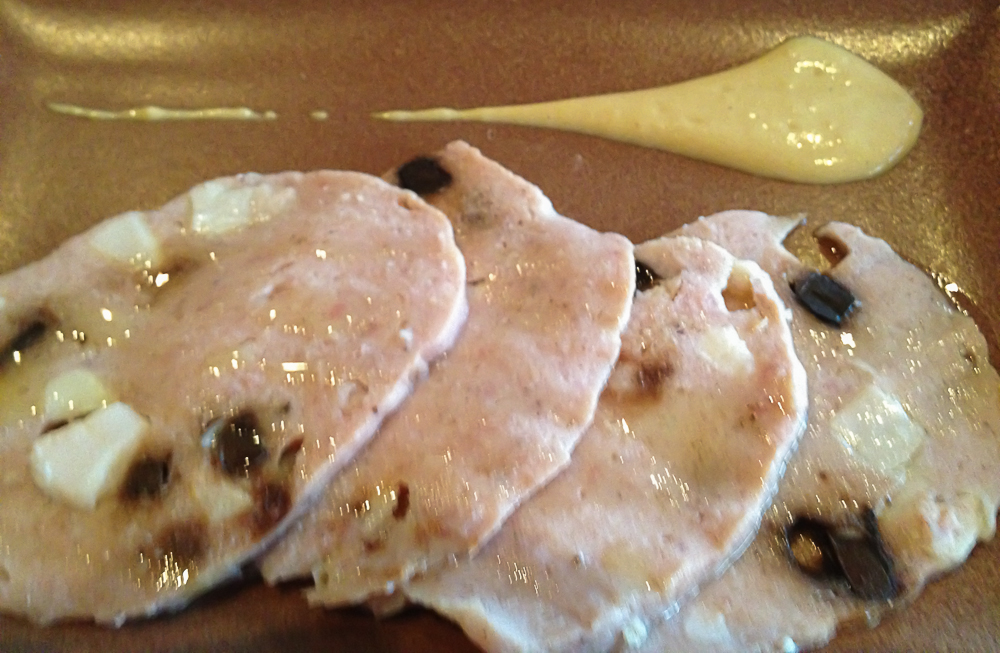
HOUSE-MADE BLACK GARLIC MORTADELLA WITH HOT MUSTARD

This in no way resembles the usual bologna-like mortadella. The sausage is a silky mousse of pork laced with lardons of pork fat and bits of black garlic, a smoked and aged garlic that has a nutty, woodsy flavor.
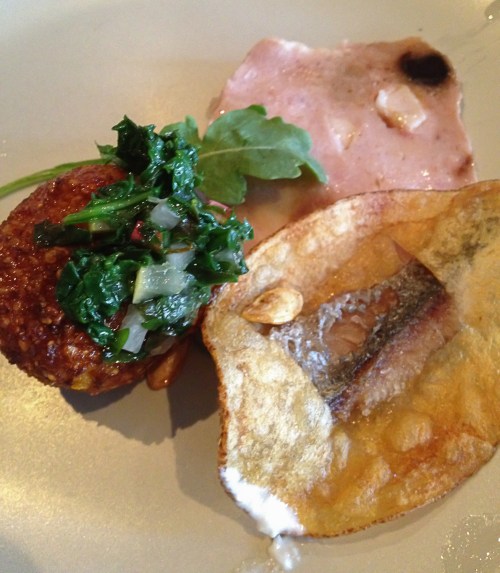
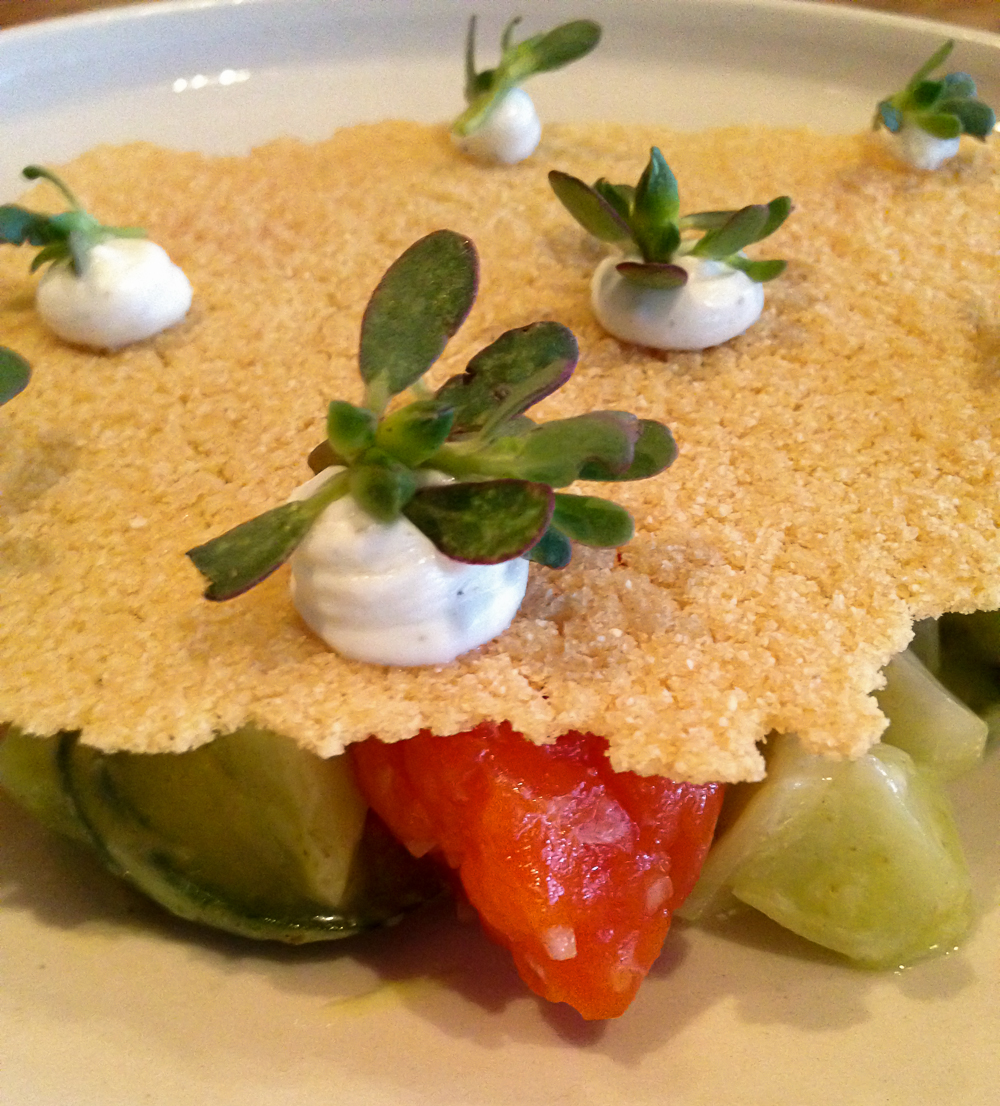
RAW KING SALMON WITH CUCUMBER AND DOUGLAS FIR TOPPED WITH SALTINE TUILE DOTTED WITH YOGURT AND FORAGED PURSLANE

Almost too beautiful to eat – well, almost! The salmon hides below a paper-thin tuile of saltine decorated with polka dots of yogurt and “bows” of foraged purslane. The decorations are delicious. The salmon and cucumber are superb.

HEIRLOOM TOMATO SALAD WITH BURRATA AND TOASTED SEAWEED

Sort of a sophisticated caprese. The tomatoes multi-hued, each with its own synthesis of sweet and tart. The burrata is creamy and a notch above the usual mozzarella, even the house-made, fresh variety. Seaweed  for basil? So Japanese and so different.

PLANCHA BREAD, RABBIT SAUSAGE, CORN, AND RED FRILL MUSTARD

Toppings for the plancha bread, done on one of the flat-top stoves, change frequently For our visit, rabbit sausage and corn were a perfect balance. Mustard served as both greens and sauce.

GARGANELLI WITH LAMB SAUSAGE AND ARUGULA
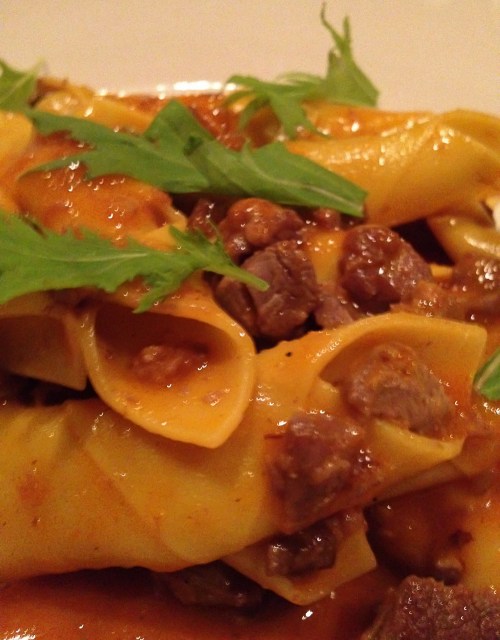
This unusual and beautiful pasta originated in Romagna and was rolled on a weaving comb to produce indentations before it was formed into cylinders resembling the breathing tubes of chickens (hence the name). Here it is topped with a light brown sauce faintly seasoned with tomato and the juices from lamb sausage. The sauce is perfect for dipping with bread.

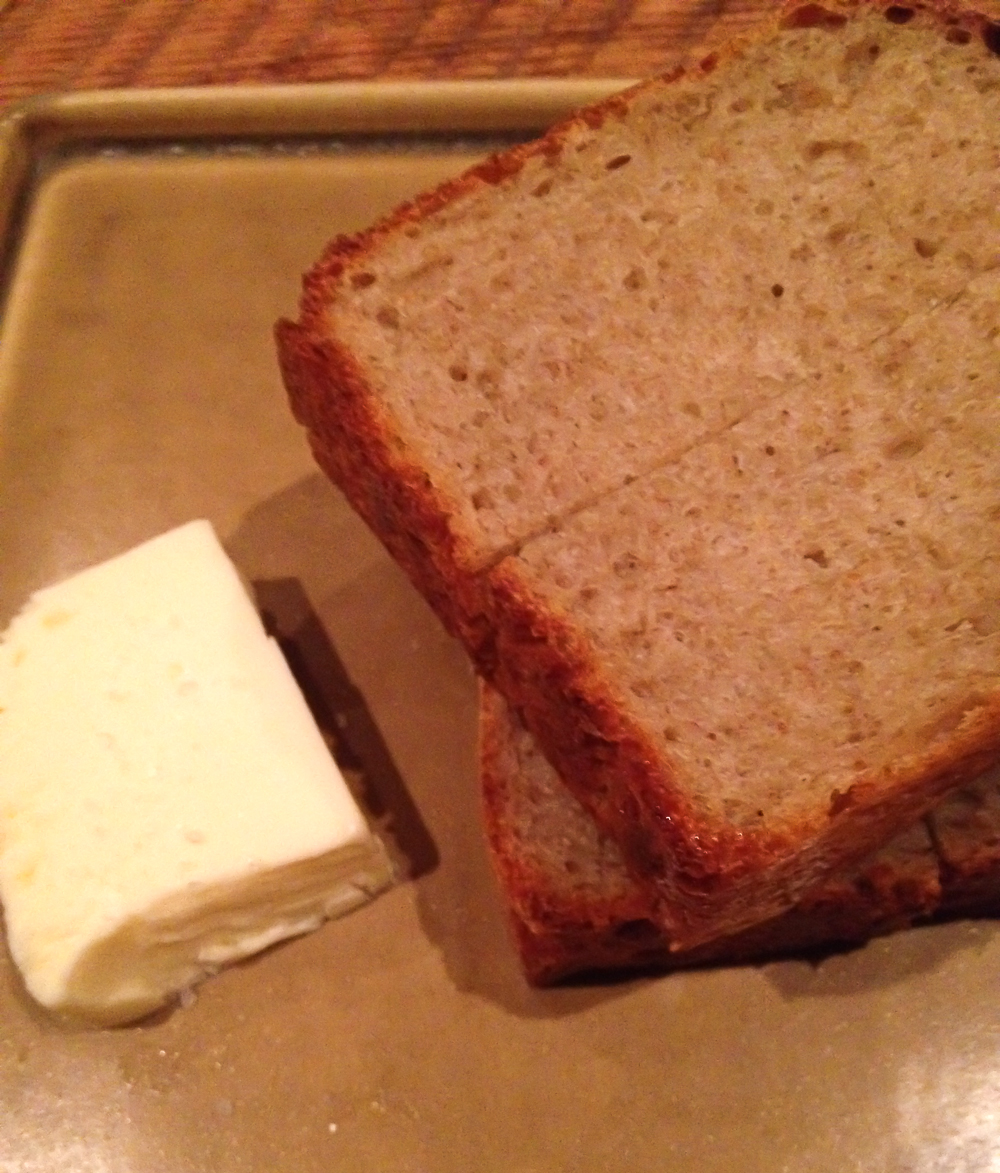
WILD FENNEL LEVAIN AND HOUSE-CULTURED BUTTER

The perfect bread for dipping – but also for eating by itself or with the house-made cultured butter. There are lots of excellent, famous bakeries in San Francisco – Acme, Grace, and Tartine to name a few – but this house-made bread has become another signature dish. The bread is made with a sourdough starter that has been maintained for years. The scent and subtle taste of foraged wild fennel pollen makes it unique. The butter is made from milk and culture that have been aged together for two days. Then the mix is churned. The butter is pressed and aged for another several days while the pungent buttermilk is saved for other uses. (You’ll see more about that later.)

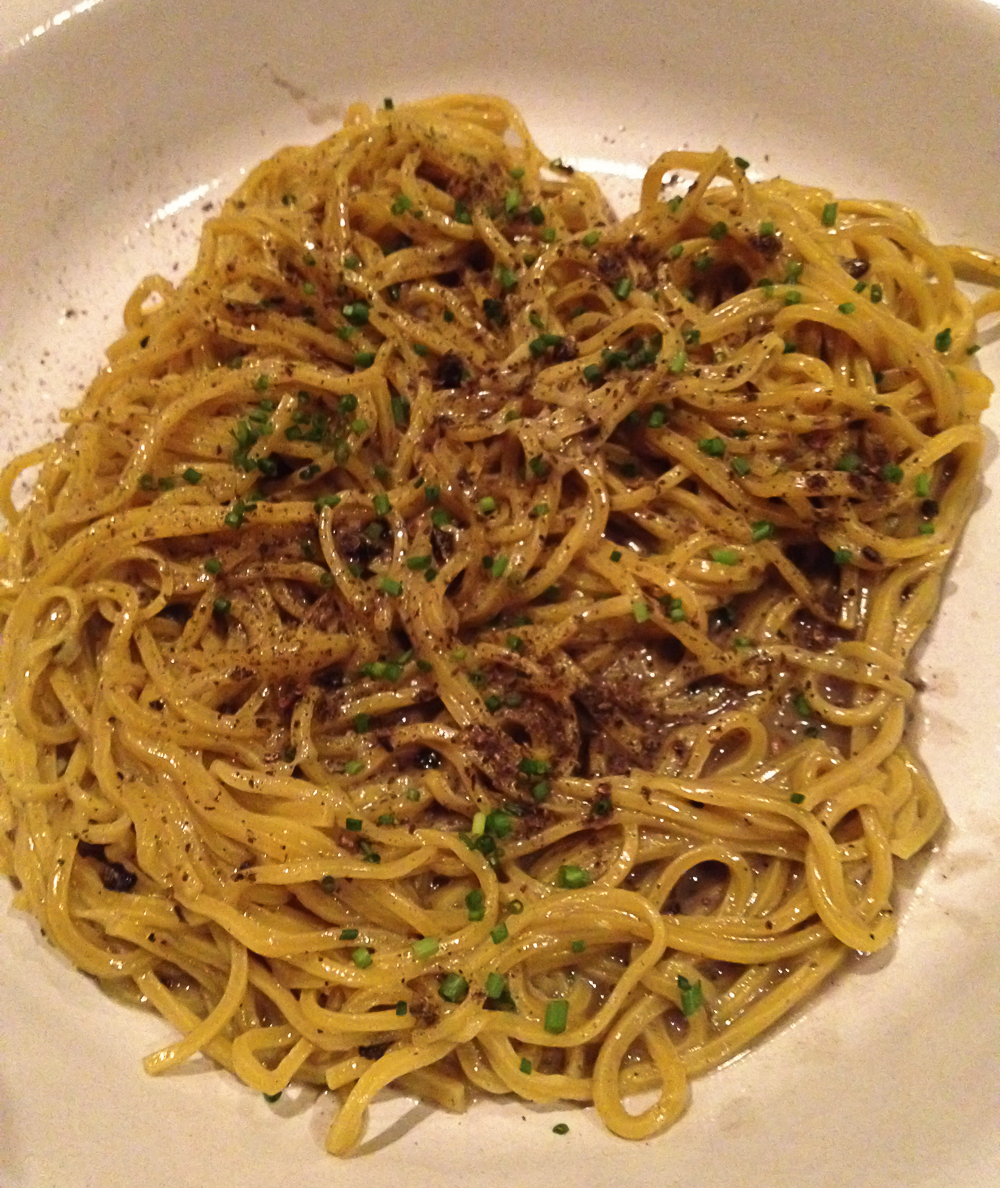
TAJARIN WITH CUITLACOCHE

The pasta originated in the Italian Piedmont. It is thicker than capellini but thinner than spaghetti. In Alba, a traditional dish is tajarin served with a sauce of black truffles. Thus, it is appropriate with cuitlacoche (corn smut, maize mushroom), a fungus that sometimes develops on ripening ears of corn. In Mexico it is a great delicacy and has been called “Mexican truffle”. Small wonder because it brings a chestnut color to the sauce along with a complex earthy aroma and taste which are clearly reminiscent of fresh truffles at the peak of the season.

RABBIT CANNELLONI, NASTURTIUM, SUNGOLD TOMATOES

An elegant pasta roll filled with tender rabbit and bathed with an herbal, slightly sweet sauce that makes you want more. The nasturtiums with their delicate blossoms and showy tiger stripes look too beautiful to eat, but they’re not. An elegant dish.

KING SALMON, BOK CHOY, TOASTED BUCKWHEAT, YOUNG GINGER
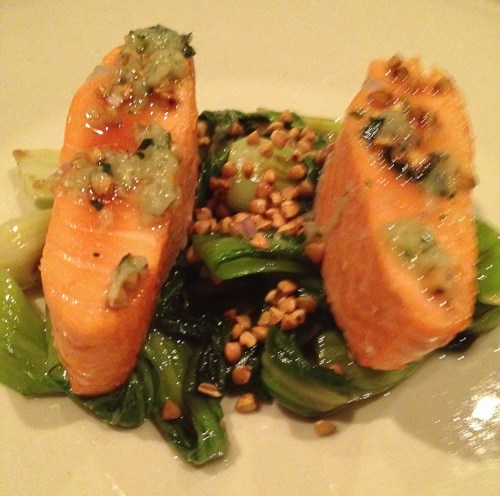
The bok choy and subtle ginger set an Asian note while the crunchy toasted buckwheat kernels offer an interesting contrast to the tender salmon fillets.

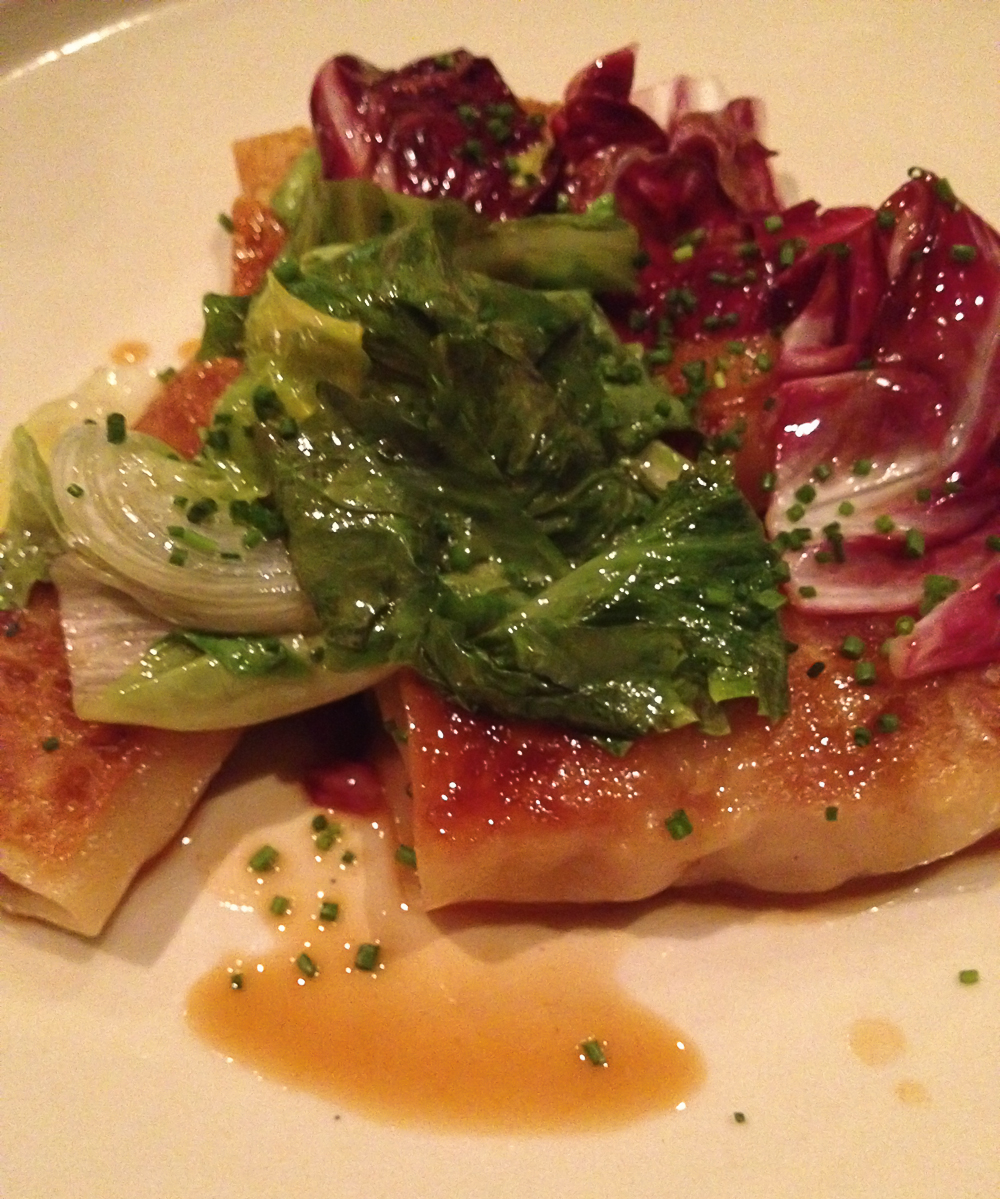
SWEET GLAZED PORK DUMPLINGS, BRAISED ESCAROLE, RADICCHIO

Delicate  rolls if pasta stuffed with a fluffy farce of pork augmented with airy egg whites and unctuous pork fat. The sweet glaze is caramelized so that the dish becomes a sophisticated pot sticker.

That’s it – only thirteen savouries, and we finished all of them. Then came dessert.

MUSKMELON GRANITÉ

The dish came to the table resembling a drift of melon-colored snowflakes, and the first spoonfuls added to the image. Then the surprise: buried in the bottom were perfect cubes of ripe melon and a ball of melon-flavored cream made with a siphon.

PANNA COTTA WITH PLUMS AND ALMOND CRUMBLE

So good that Susan started eating before I could take a picture, so here is an image of the fresh peach version from earlier in the season. This has become another signature offering.

PLUM CAKE WITH BUTTERMILK ICE CREAM
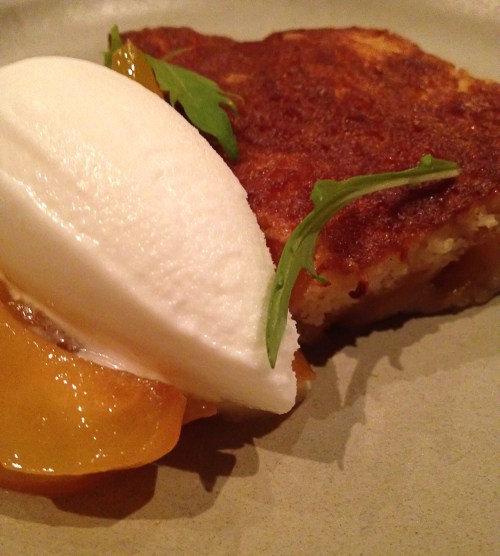
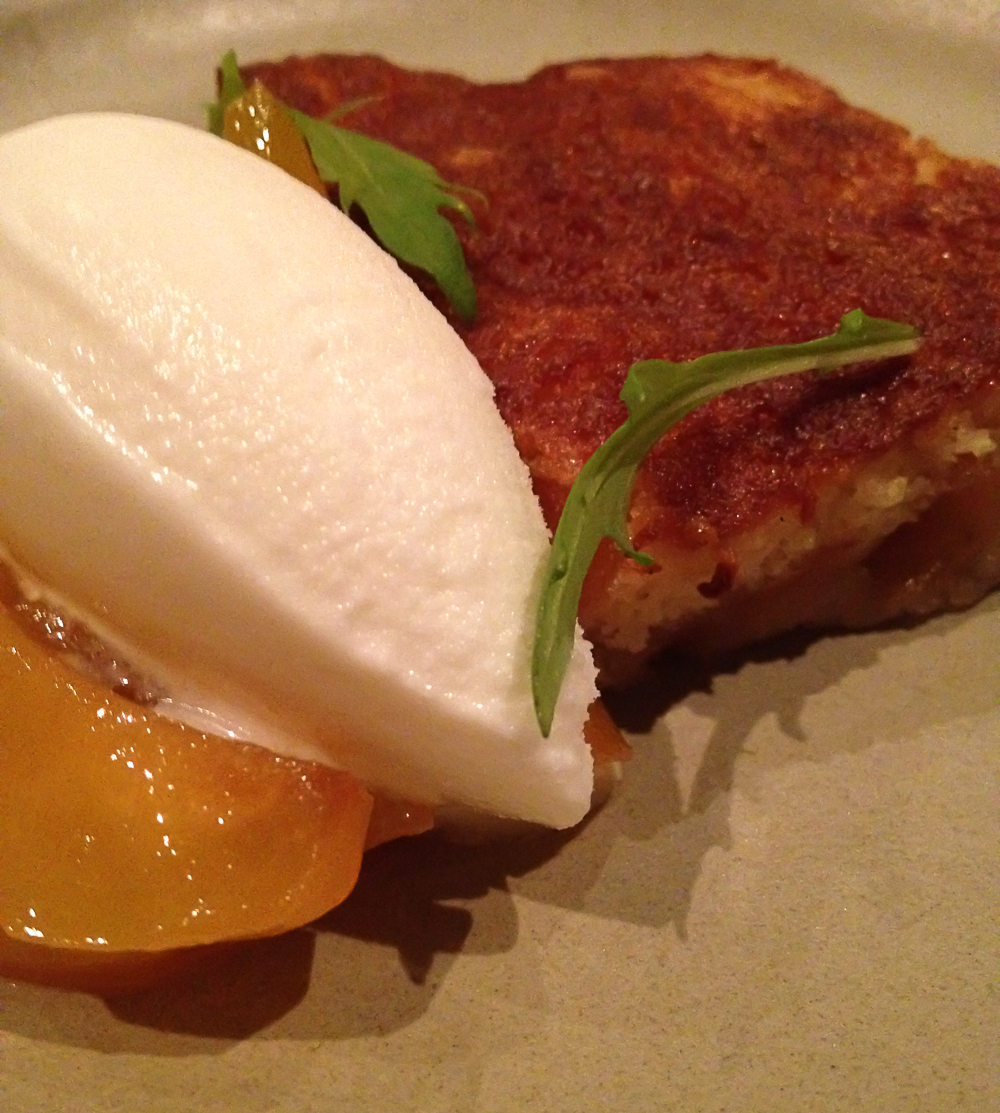
The cake oozes moisture and flavor. Not too sweet, but sweet enough with the subtle flavor of seasonal plums and a poached plum on the side along with a quenelle of buttermilk ice cream, tangy and smooth as silk. The buttermilk comes as a by-product of the house-churned butter. Some by-product!

That was it! No more, though no more was needed. Clearly a tour de force of creative American cooking with overtones of French, Italian, and Japanese. Can’t wait to visit again.

7 Comments

Filed under Food, Photography, Restaurants, Travel

CRABMEAT TECHE

Bayou Teche is one of the most important waterways in Louisiana. It is an ancient riverbed of the Mississippi River before it changed its flow several thousand years ago. Bayou Teche runs over a hundred miles before it empties into the Atchafalaya River, another former route of the Mississippi. The bayou served as the watery route of entry for the Acadians from Canada during their forced migration into Louisiana. The bayou flows through the heart of Cajun country, including some of its most famous towns and cities. Breaux Bridge is well-known for its zydeco, dance halls, and crawfish. St. Martinville is quaint and home to great Cajun food. New Iberia is close by Avery Island, the home of the famous Tabasco Sauce.  So, with a name like “Crabmeat Teche,” this dish must be pure Cajun.

The original recipe comes from the classic, “River Road Recipes” first published by the Baton Rouge, Louisiana, Junior League in 1959 and self-described as “The Textbook of Louisiana Cuisine”. Many of the recipes reflect the times, calling for canned mushroom soup, flavored gelatin, and lots of convenience foods. At the same time the book is a trove of honest-to-goodness Louisiana recipes, and for that reason you can usually find a copy of the cookbook in most Louisiana homes you visit.

The recipe for Crabmeat Teche was contributed  by Mrs. Roy Dabadie. I guess she lived in Baton Rouge at the time, but with a name like that, I shouldn’t be surprised if she originally hailed from someplace along the Bayou Teche. The  recipe used some of the convenience foods of the time, so I have made some small revisions. Nonetheless crabmeat Teche is still a 1950s casserole, but it tastes a lot better than tuna noodle bake.

Baked crabmeat Teche casserole

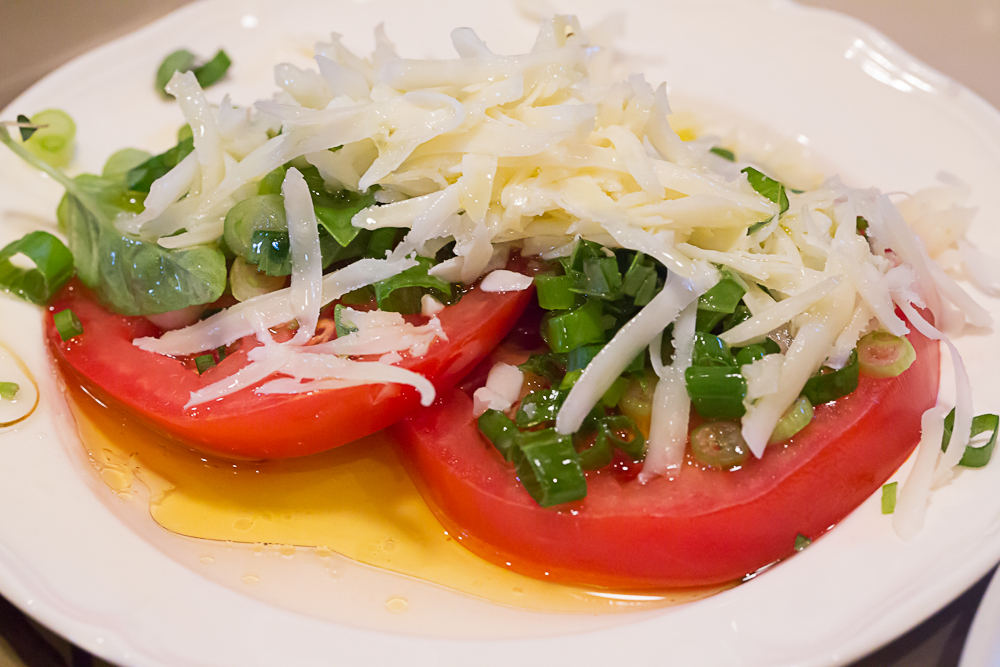
You’ll need a fresh vegetable to complement the casserole. I made a simple salad to go with it: sliced seasonal tomatoes, sprinkled with chopped fresh basil, coarsely-grated mozzarella cheese and your favorite vinaigrette.  It seemed to be an ideal foil for the rich casserole.

Caprese salad

RECIPE

Crabmeat Teche

Ingredients

  • 1 large bell pepper, chopped
  • 1 large onion, chopped
  • 3 ribs celery, chopped
  • 8 ounces crimini mushrooms, cleaned and sliced
  • 3 cloves garlic, minced
  • 4 tablespoons bacon drippings
  • 4 slices very dry toast (dry enough to crumble easily)
  • 3 cups fish stock or chicken stock, divided
  • 1 tablespoon Worcestershire sauce
  • 1 teaspoon salt
  • ½ teaspoon ground black pepper
  • ½ teaspoon celery salt
  • 1 teaspoon dried oregano, pulverized between your hands
  • Louisiana hot sauce, to taste
  • ¾ cup chopped fresh parsley
  • 1 pound can crabmeat, picked over for shells
  • ¾ cup cracker crumbs
  • 3 tablespoons butter
  • paprika

Crabmeat Teche

Method

  • In a medium skillet over medium-high heat, sauté pepper, onions, celery, mushrooms, and garlic in bacon drippings until tender, about 10 minutes.
  • In a small bowl, crumble the dry toast in 1½ cups of fish stock. When the stock is completely absorbed and the toast crumbs have softened, add them to the skillet along with Worcestershire sauce, salt, pepper, celery salt, and oregano. Continue to simmer, stirring frequently until well combined. Adjust flavoring with hot sauce to taste.
  • Add the parsley and remaining 1½ cups of fish stock, stirring until well combined.
  • Add crabmeat, and mix thoroughly. Then pour the mixture into a well-buttered casserole.
  • Sprinkle the  top with cracker crumbs, dot with butter, and sprinkle with paprika.
  • Bake  for 20-30 minutes at 350° in the middle of a pre-heated oven. IF casserole is made ahead and refrigerated, increase baking time to 45-60 minutes.

Serving of crabmeate Teche with caprese salad

Serves 4 to 8, depending upon serving size

2 Comments

Filed under Food, Photography, Recipes

POTATO CHIPS

I grew up in a semi-rural community near a much larger city. The schools – elementary school, junior high, and high schools were clustered together on the same campus. It was shortly after WWII, and our cafeteria was an old converted army building. We ate from army surplus steel trays, and the food was almost all surplus commodities including cheddar cheese, ground beef, eggs, and lots of ground beef. In those days there were honest-to-goodness “lunch ladies” who actually cooked from scratch instead of opening a package and slipping it into a microwave. Most of the women were mothers of friends and classmates (In fact, my mother was a lunch lady at a nearby school). They knew how to cook homestyle food, and they clearly loved their work.

The kids all loved their work, too – spaghetti and meat sauce, macaroni and cheese, grilled cheese sandwiches ( a lot of surplus cheese in those days), freshly baked hot rolls or cornbread every day plus milk and a sweet dessert like apple pie. The price was right, too: 25 cents.

About once a month the lunch ladies prepared a special treat, hamburgers with all the trimming along with homemade potato chips (potato crisps for my UK friends) still hot from the deep fryer. On those days the crowds of hungry kids were enormous.

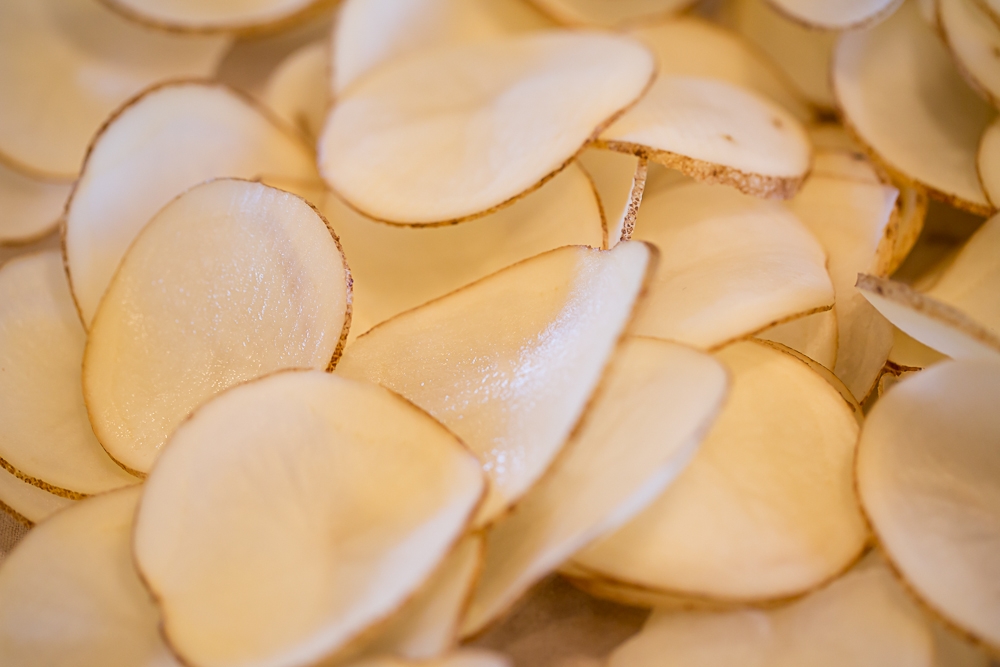
I thought about that memory the other day when I wondered to myself, “How hard can it be to make homemade potato chips?” The answer is, “Not hard at all.” The hard part comes in cleaning up the kitchen, especially if you are a messy cook like me. The hot oil splatters all over the place, paper towels used for draining get soggy and greasy, and accidental spills seem unavoidable.

Potato slices ready for frying

Still, homemade potato chips taste so much better than the commercial kind that there is no comparison.

Finished potato chips

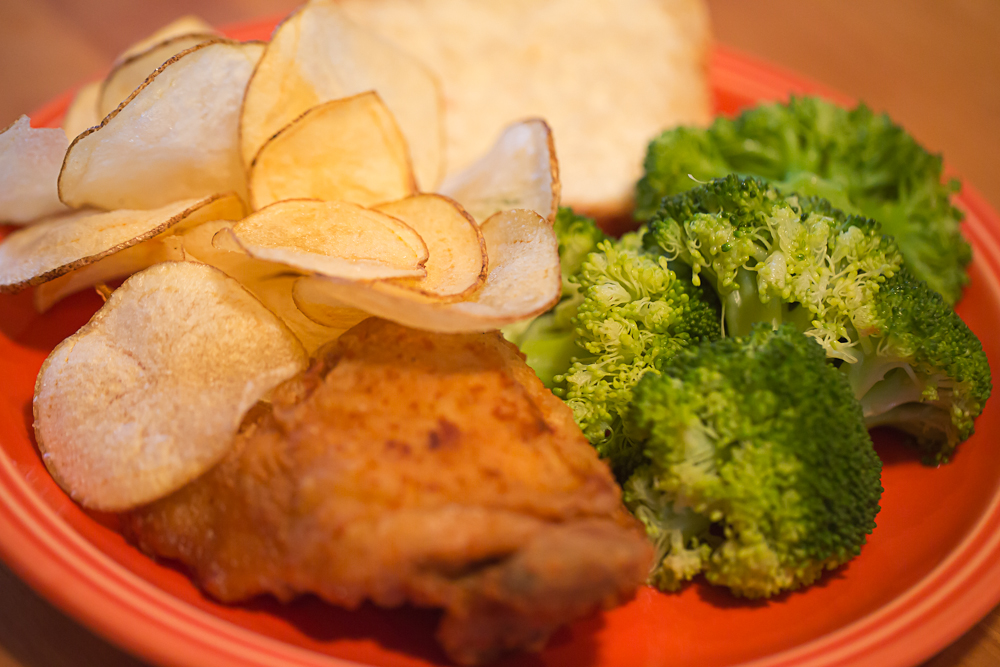
You can’t just sit down and eat nothing but a batch of fresh potato chips.  (Actually that’s not true; I know I can.) So you need to have a menu. I served the chips with fried chicken and broccoli. That only reinforced my memories of school days.

Potato chips, fried chicken, and broccoli

RECIPE

Potato Chips

Ingredients

  • medium-large russet baking potato (allow ½ potato for each person)
  • peanut oil (or other oil with high smoke point)
  • salt

Method

  • Scrub and dry the potato(es). Then slice crosswise with a mandoline. The modern, cheap plastic ones are better. Otherwise you will spend a lot of time cleaning up your expensive French one
  • Cover the potato slices with water and soak until you are ready to cook.
  • In a heavy frying pan  with tall sides (cast iron works great), pour in oil to a depth of 1 to 2 inches. Heat to 375°F. If you don’t have a deep fry thermometer, heat until the surface shimmers.
  • While the oil is heating, drain and dry the potato slices as well as you can. Residual water will make the hot oil flare up when the potato slices are added. Serious burns can result.
  • You can test the heat of the oil, either with a cube of bread or one of the potato slices. Bubbles should rise immediately, and the sample should brown in a minute or so.
  • Add the potato slices, a few at a time, to the heated oil, being careful not to burn yourself. Watch to make sure the oil does not boil over. Stir the slices gently while frying so that they don’t stick together.
  • When the bubbling has subsided and the underside of the slices are the desired color, turn them over, finish frying them, and then remove them to multiple thicknesses of paper towelling to drain.
  • While the fried chips are draining, lightly salt them.
  • As you continue with more batches, transfer the finished chips to an oven-proof bowl in the middle of an oven preheated to 200°F. Serve when all the chips are fried.

4 Comments

Filed under Food, Photography, Recipes

CHILES RELLENOS

Visitors to Santa Fe usually think of it as a visual place: the clouds and mesas that so enchanted Georgia O’Keeffe, the ancient adobe buildings around the Plaza, and the color of a fiesta. There are also sounds: the quiet of a December snow, crashing thunderstorms in the middle of summer, and the calls of geese and cranes flying overhead in the spring and fall. But Santa Fe is every bit a place of wonderful smells: lilacs pushing over an adobe wall in the springtime, the smell of a winter’s piñon fire burning in a fireplace near the Plaza. This time of year, the smell is of green chiles roasting. It is a fragrance like no other, and once you experience it, you never forget it.

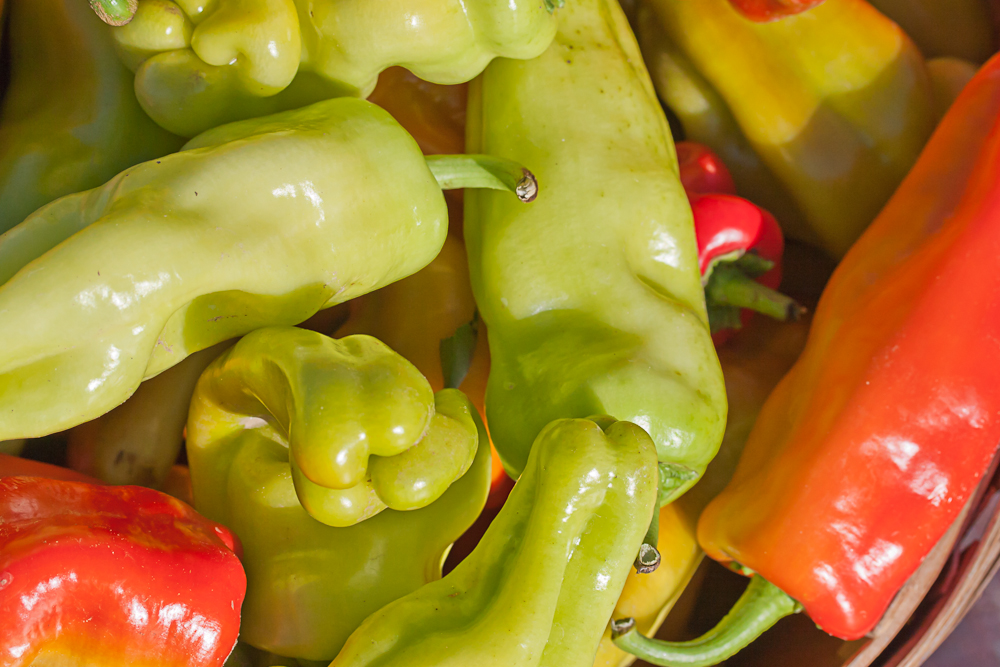
Chiles have been growing during the hot summer throughout the state. Perhaps the most famous chile crop comes from Hatch,, but there are also bountiful sources in Chimayó and Socorro along with many a back yard.

All sorts of chiles at the farmers market

Chiles

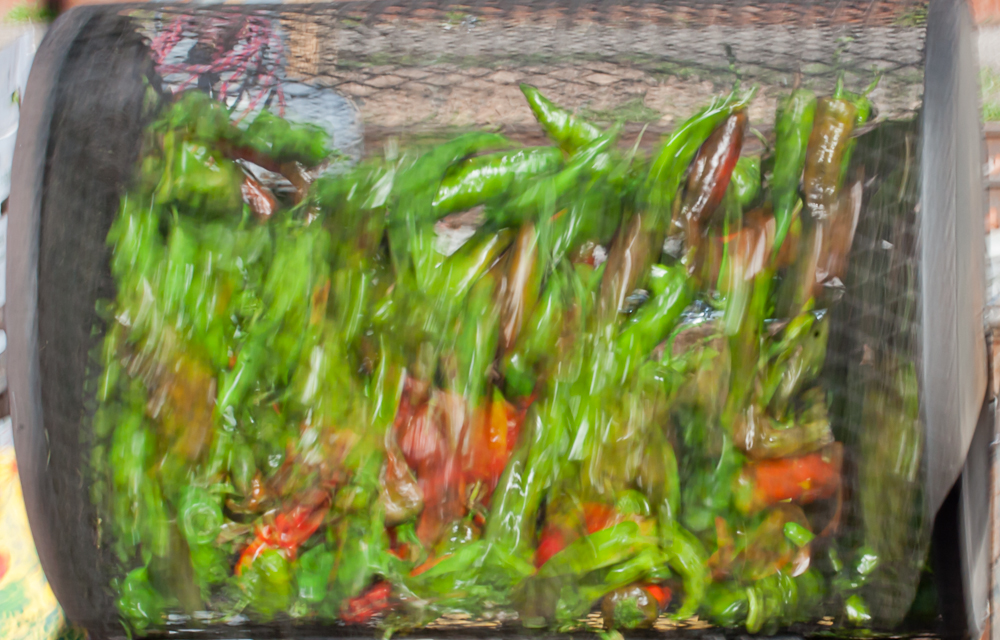
When the chiles are ready for harvest, they are loaded into big gunny sacks and taken by truck all over the state. In Santa Fe, growers set up stalls throughout the city where they roast the green chiles on the spot in a revolving metal mesh drum over a blazing butane flame. The tough outer coat of the chiles is charred in the process so that it can be peeled off in preparation for cooking. The roasting creates a pungent, unmistakable smell that fills the air.

The farmers market also boasts chile roasters who make the festive environment even more vibrant.

Chile roasting at the farmers market

The spin of the chile roaster

The buyer can get a whole gunny sack full of roasted chiles or even a small plastic bag. Then the task is to take them home, peel off the charred skin, and either cook or freeze them for the winter ahead.

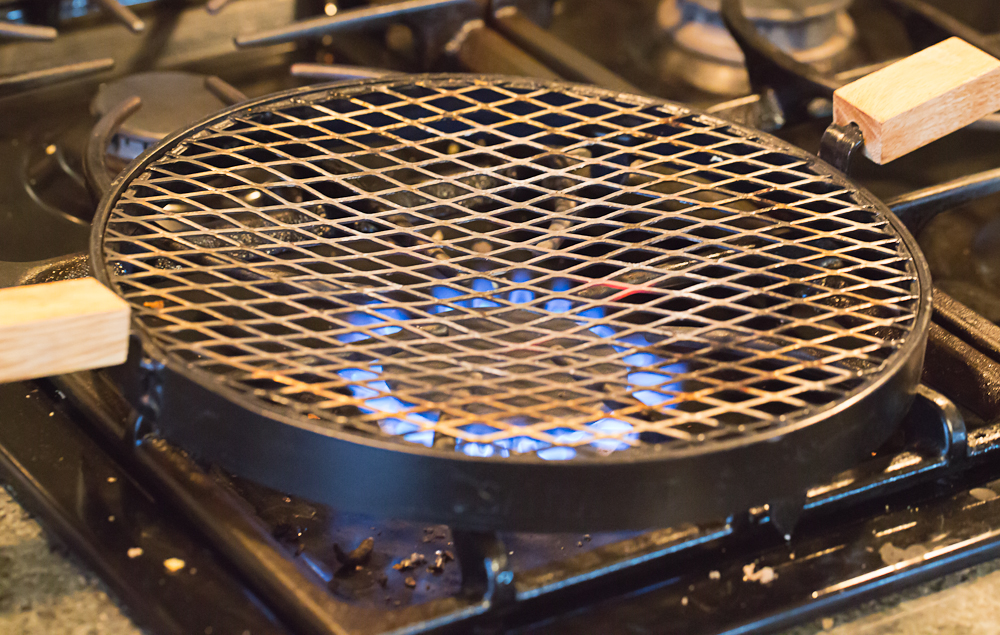
If you don’t need a green chile supply for the whole winter, you can even do them yourself on the barbecue or, better yet, on a special device made of metal screen and designed to sit over a gas flame. The device is indispensable for the Santa Fe cook. One can be ordered from the Santa Fe Cooking School.

Chile roasting pan

Roasting chiles

Roasted chiles resting in plastic bag before peeling

Green chiles wind up in just about every Santa Fe dish you can think of, including ice cream, but probably the most popular dishes are green chile stew, green chile cheeseburger, and my favorite, chiles rellenos.

Making a chile relleno is an act of love  because the preparation takes a lot of steps, and the chiles have to be eaten immediately. A leftover chile relleno is a soggy shadow of its former self. Still, they are worth the effort, especially when they are covered with a fresh salsa roja.  Here’s how you do it.

Roasted chiles peeled and ready for batter

Cheese pieces and chiles ready for stuffing

RECIPES

Chiles Rellenos

Ingredients

  • 6 to 12 Anaheim or New Mexico chiles
  • Monterey jack cheese, one ½x½x4 inch piece of cheese for each chile
  • 2 eggs, separated
  • 2/3 cup milk
  • 2/3 cup flour
  • ½ teaspoon salt
  • 1 tablespoon vegetable oil
  • all-purpose flour for dredging chiles
  • peanut oil for deep-frying

Two parts of batter before combining

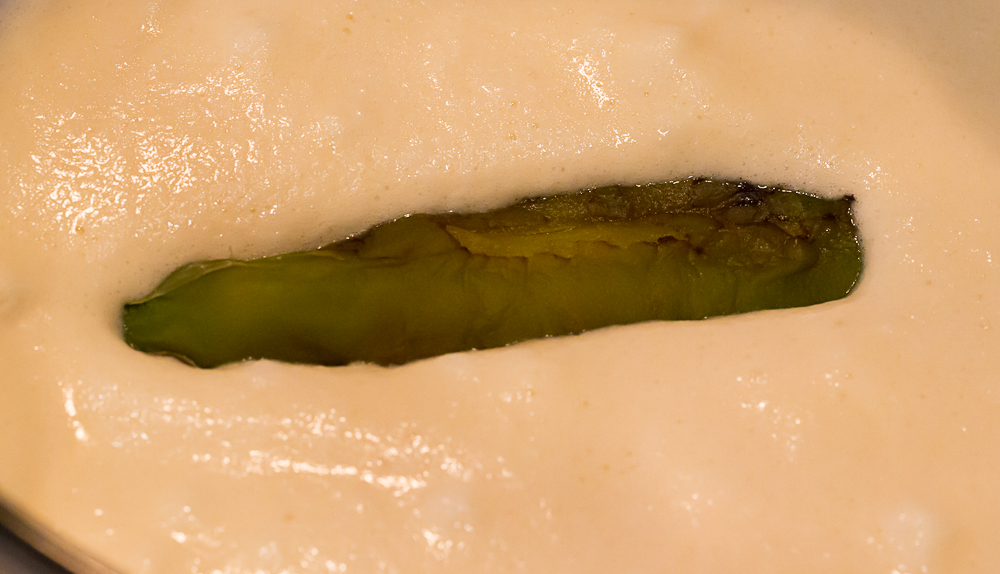
Coating the chiles with batter

Method

  • Purchase roasted chiles or roast your own on a chile roasting pan over a high flame, a very hot barbecue grill, or in the oven under the drill. Turn frequently until all sides of all chiles are heavily charred.
  • Immediately place the chiles in a plastic bag and allow to cool. Then remove the chiles from the bag, and under running water peel the charred skin carefully so as not to tear the flesh of the chiles.
  • Cut off the stems of the chiles, pull out the seeds and inner membranes using your fingers. Rinse out the chiles to remove any loose seeds.
  • Gently stuff each chile with one of the pieces of cheese and set aside on paper towels.
  • In the meantime, prepare the batter by combining egg yolks, milk, flour, salt and vegetable oil using a rotary egg beater. Let the mixture blend for  30 minutes while you whip the egg whites until they form stiff peaks.
  • Gently fold the yolk and milk mixture into the whipped egg whites until well combined.
  • Dredge each prepared chile into flour. Then dip the chiles individually into the combined batter.
  • While preparing the chiles, pour enough peanut oil into a deep-sided heavy pot (A cast iron skillet works well) and heat to 375°F.
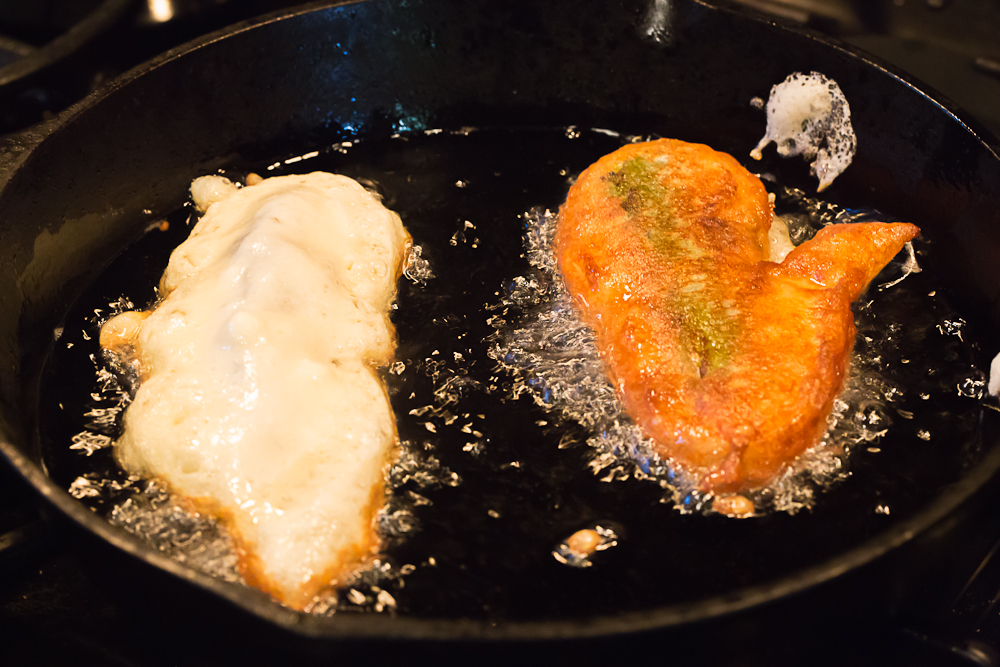
  • One at a time, place the batter-coated chiles into the hot oil. Cook no more than two at a time. Otherwise the chiles may stick together.
  • Turn the chiles when well browned on the bottom and finish frying the other side. Remove from the hot oil and drain on layers of paper towels.
  • Keep the finished chiles on a plate in an oven heated to 200°F until all of the chiles are fried. Serve immediately. Otherwise they may get soggy.

Testing oil temperature with a cube of bread

Chiles rellenos frying

Quick Salsa Roja

Ingredients

  • 1 14.5ounce can, diced tomatoes
  • ¼ teaspoon garlic powder
  • ¼ teaspoon onion powder
  • 1 tablespoon dry Mexican oregano, crumbled
  • ½ teaspoon ground cumin
  • 1½ teaspoons ground red chiles (amount and heat according to your taste)
  • salt and pepper to taste

Method

  • In a blender, purée the canned tomatoes, including their juice
  • Transfer the puréed tomato to a small saucepan over low heat. Bring to the simmer
  • Stir in the remaining ingredients until completely combined. Simmer for an additional 10 minutes

Finished chiles rellenos ready to serve

Assembly

  • Place two or three warm chiles rellenos on each plate
  • Top with a generous serving of the salsa
  • Add rice and/or beans (refried or other) if you desire.

Chiles rellenos with rice and fresh pear with green chile raspberry preserves and almonds

I finished the meal with rice and a fresh pear-half filled with green chile flavored raspberry preserves (no kidding) and blanched almonds.

7 Comments

Filed under Food, Photography, Recipes

POTATO-SESAME BREAD

A few weeks ago, I bought a loaf of potato-sesame bread from a baker at the local farmers market. It had a nutty flavor, and the crunch of the sesame seeds gave it a unique bite.  While waiting in line to pay, I heard the baker tell another customer that the bread was the first he learned to bake when he was in a monastery many years ago.

Later I bought another loaf of the same bread. It had lumps of whole potato – not nearly as good as the first loaf. That made me think that I wanted to bake my own version. I looked in vain for a recipe. There were lots of breads made with potato water, some made with potato sourdough starter, some with instant potatoes, and several with potato flour. There were none with mashed potatoes, which sounded to me like a good beginning.
Then I thought, “monastery – bread”. The only connection I could make was the classic baking book by Edward Espe Brown called The Tassajara Bread Book, Shambhala Publications, 1970. I checked my copy, and sure enough there were recipes for sesame bread and potato bread using mashed potatoes. There was no recipe for potato-sesame bread, though that was alright because I had already begun to work out my own version. The recipe follows. It is an easy bread to make, with a fine crumb and a chewy crust from the enrobement of sesame seeds. Since potatoes contain no gluten, I have added gluten powder to promote rising and good texture.

The finished loaves

RECIPE

Ingredients

  • 1 medium-large russet potato, peeled and cubed
  •  water
  • 1 tablespoon sugar
  • 1 package (7 grams, ¼ ounce) active dry yeast
  • 1 tablespoon salt
  • 4 tablespoons butter, melted
  • 1 tablespoon gluten powder
  • 4½ cups bread flour, divided
  • 1 to 2 cups raw sesame seeds 

Method

  • In a medium saucepan over high heat, put the cubed potatoes in plenty of water to cover and bring to a boil. Continue to boil the potatoes until they are done and a sharp fork pierces them easily, about 30 minutes. Do not add salt to the boiling water.
  • When the potatoes are done, drain them, reserving 2 cups of the potato water.  Pass the drained potatoes through a potato ricer or food mill and set aside. There should be about 2 cups of mashed potatoes. Let the potato water cool enough that it is warm but not hot.
  • In a large ceramic bowl, combine 2 cups of potato water with sugar. Stir until the sugar is dissolved. Then sprinkle the dry yeast on the surface of the mixture and let stand for 5 minutes. Then stir so that the yeast is dissolved.
  • Stir in the salt, melted butter, and gluten until well combined.
  • One cup at a time, stir in 3½ cups of flour, combining thoroughly after each addition.
  • Knead the dough in the bowl for about one minute. Then turn out onto a flat surface covered with the remaining one cup of flour. Knead for about 10 minutes until the extra flour is incorporated and you have a smooth dough. The dough should be sticky. This will make it difficult to work with, but too much flour will make the finished bread too firm and tough.
  • Form the dough into a ball, lightly oil the surface, and place it in a covered clean bowl or bread-proofing box.
  • Let rise in a warm place until the dough is doubled, about 2 hours. Punch down the risen dough and let rise a second time until doubled, about 1 hour.
  • Divide the dough into two equal portions. Shape each into a ball and place in a shallow pan or dish of sesame seeds. Sprinkle additional sesame seeds on the top of each round until completely covered with the seeds, and shape into a rough loaf.
  • Place each shaped, sesame-coated loaf in a well-greased 8½ x 4½ inch bread pan. Cover with a clean cloth and let rise for about 30 minutes.
  • In the meantime, preheat the oven to 375° F.
  • Bake the loaves in the middle of the preheated oven for 45 minutes. Test for doneness by thumping the bottom for a clear sound.
  • Turn the finished loaves onto a cooling rack and cool.

2 Comments

Filed under Food, Photography, Recipes

FAMILY CELEBRATION: CAROL’S SHRIMP AND MUSHROOMS WITH COUSCOUS

Our family birthday celebration was a multi-day affair with the culmination being dinner for all of the adults at Rich Table. In the meantime we had other meals together, and our other daughter, Carol, had volunteered to cook for children and adults on the night before the party.

Talk about bravery! Have you ever tried to cook for seven adults and five kids, all of whom have their own food hang-ups – “The sausage touched my scrambled egg, and I can taste the sausage!” “I don’t like pasta.” “The only thing I like is pasta.”

In spite of similar premonitions, Carol took on the challenge and prepared a wonderful meal that everyone enjoyed. There was nothing left.

Shortly before dinner time, Carol went shopping at the local farmers market and a grocery store. She brought home some beautiful heirloom tomatoes, fresh basil, home-made mozzarella in little balls, raw shrimp, and fresh mushrooms.

The first course was a sort of caprese salad made from the variously sized tomatoes, mozzarella balls, fresh basil, balsamic vinegar and olive oil.

For the main meal, Carol cleaned and shelled the shrimp with a little help, cleaned and sliced the mushrooms, and began to cook. I forgot to mention she melted a half pound of butter. Then she guessed at the amount of couscous, erring on the high side since both pasta-lovers and pasta-haters averred to liking couscous. She served this with a side dish of broccoli roasted in butter, lemon, and garlic.

Things were cooked up in a flash, and before anyone could even think of complaining about being hungry, the meal was on the table.

There was enough food for seconds, and soon dinner was over, plates were clear, and the serving bowls were empty.

That’s what I call success.

RECIPES

Heirloom tomato caprese salad

Ingredients

  • 2 pounds ripe heirloom tomatoes, various sizes
  • 2 packages (12 ounces each) marinate small mozzarella balls
  • 1 bunch fresh basil
  • 1 tablespoon balsamic vinegar
  • 3 tablespoons extra virgin olive oil
  • salt and pepper to taste

Method

  • Wash and cut the tomatoes into large chunks. Leave cherry tomatoes whole.
  • Combine the prepared tomatoes and mozzarella balls
  • Chop the basil leaves coarsely and add to the mixture
  • Dress with balsamic vinegar and olive oil, adjust seasoning with salt and pepper, and serve

Shrimp and mushrooms with couscous

Ingredients

  • 2 pounds crimini or white button mushrooms
  • 3 pounds unshelled raw shrimp
  • ½ pound butter
  • 3 cloves garlic, peeled and minced
  • 4 branches fresh rosemary
  • 2 lemons, juiced
  • salt and pepper
  • 2 packages couscous

Method

  • Clean and slice the mushrooms. Set aside.
  • Peel and clean the shrimp. Set aside.
  • In an oven pre-heated to 400°, melt the butter in a large casserole.
  • Add the minced garlic and  rosemary.
  • Add the mushrooms to the melted butter. Bake, stirring occasionally, until the mushrooms are cooked through, about 10 minutes.
  • Add the shrimp to the mushrooms and bake, continuing to stir occasionally until the shrimp are pink and have lost their translucency, about 5 minutes.
  • Remove the rosemary, stir in the fresh lemon juice, and correct seasoning with salt and pepper.
  • In the meantime, prepare the couscous according to directions on the box.
  • Serve as a generous helping of couscous topped with the shrimp and mushroom mixture.
  • Serves 12

3 Comments

Filed under Food, Photography, Recipes