Category Archives: Travel

THE COAST STARLIGHT REBOARDED

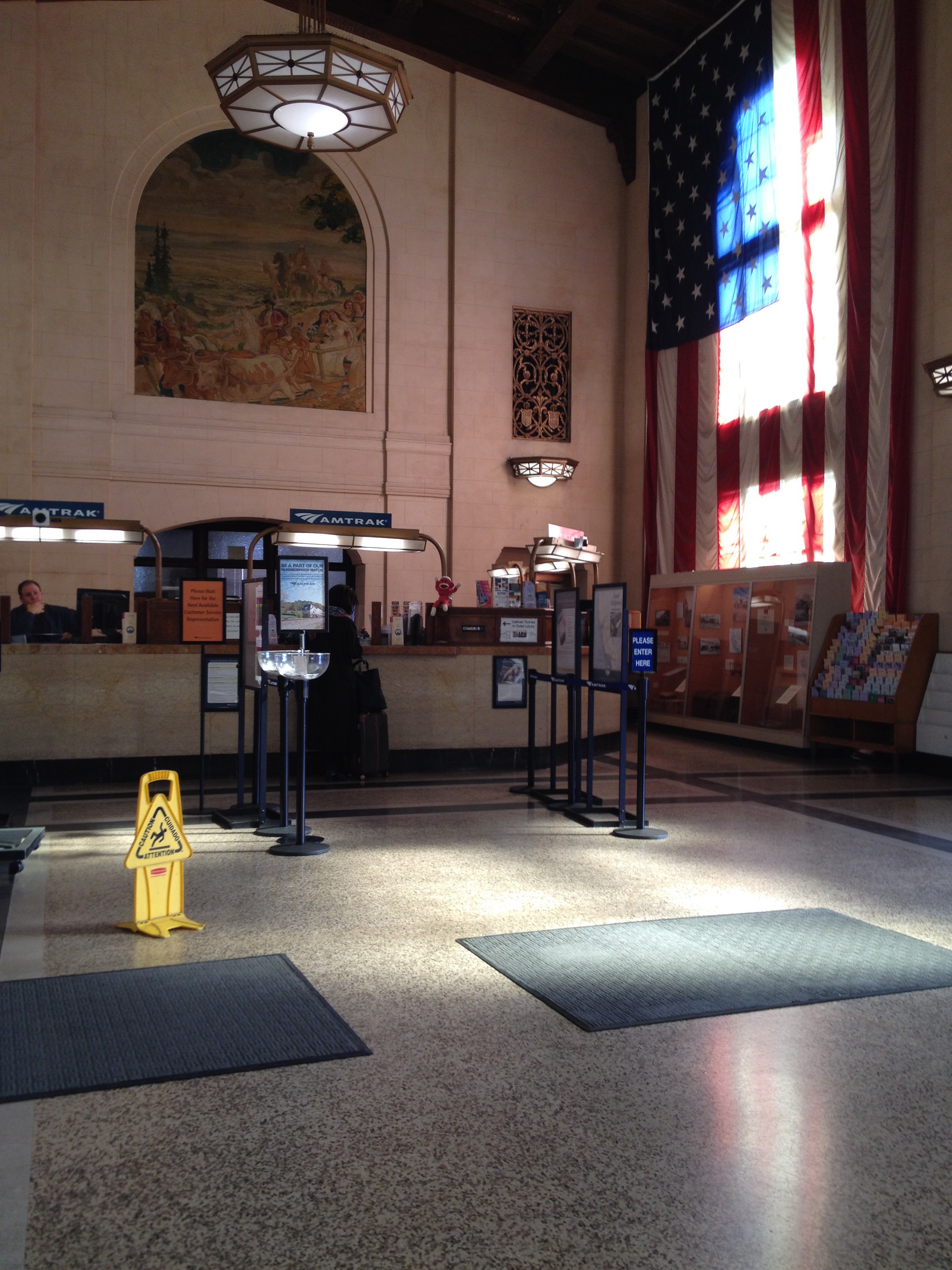
After several days of visiting with our children and their families in San Francisco, Susan and I finished our trip on the Coast Starlight to Los Angeles. Our son, Peter, drove us to San Jose through rush hour traffic. (Isn’t every hour rush hour on the 101?) We waited in the restored art deco station until the train pulled in – already about 15 minutes late.
image

For this leg of the trip, we booked a small roomette. We wouldn’t be using the sleeping bunks, but the extra space gave us some leg room, and the fare entitled us to lunch and dinner in the dining car as well as access to the comfortable chairs in the observation area of the parlor car.

image

As the train pulled out around 10 in the morning, two things became apparent. First, and I have observed this before, trains take you along the underbelly of American cities. We passed many hobo camps. Some of them were collections of cardboard boxes, old tires, a few blankets, and a fire ring. Others were more elaborate, with tents, tattered sofas, and grocery shopping carts filled with clothes and whatever. None of the sites was occupied, which made me wonder, “Where do these folks go during the day?”

The camps disappeared once we got out of the city, but it was then that I made my second observation: We think of California’s Central Valley as the garden of America. If you have travelled on Interstate Highway 5, you know that the Valley is rich with agriculture. But it is mostly fields of fruit and nut trees, dairies, and alfalfa fields. The real gardens line the 101 in the Santa Clara and Salinas Valleys between San Jose and Paso Robles. There are huge fields of strawberries with workers in long rows, bent over to harvest the fruits. There are artichokes, lettuce, onions, cabbages, broccoli, garlic, and many plants that cannot be identified from a moving train. Gilroy has been called “Garlic Capital of the World” (although that title probably now belongs to some place in China) and you can smell the garlic when you go through town.

Of course, there are grapes – in recent years all of California seems to have become one big vineyard – but there are also huge fields of ornamental houseplants. And most of the farms are filled with armies of harvesters with their beat-up old cars parked along the edge of the fields next to portable toilets mounted on little trailers.

We went to the dining car for lunch as the train headed into the mountains. W enjoyed the views, but the lunch choices were the same as they had been for our first day on the train. We passed on the sautéed panko-crusted chicken with mashed potatoes and instead opted for the “Chicken Caesar Salad” which was actually the regular salad mix with chicken, the same little hard croutons, and Newman’s Own salad dressing. I didn’t see any Parmesan. And there were certainly no anchovies. All told, though, it was pretty good and better than the panko chicken.

image

The highlight of the trip was just ahead. Shortly after a stop in San Luis Obispo (“SLO Town” to Californians) we headed onto the coast. The train hugged the cliffs as it made its way around Vandenberg Air Force Base where we could see several towers that are used to launch the military’s experimental rockets. Then it was beautiful beaches, surf, rocks, lighthouses, and steep cliffs.

We enjoyed the wine tasting again, and then it was time for dinner. We ate in the parlor car, and even though they were running out of things, we enjoyed the vegetarian lasagna rolls for Susan and the three-pepper braised short ribs for me. The sun playing on the waves turned out to be a magical background for a very nice meal.

Soon enough we got to Santa Barbara and then it became continuous freeways and people until we pulled in to the Los Angeles Union Station right on time. There was one last treat for a memorable trip, it was raining while we waited for our daughter, not enough to break the terrible West Coast drought, but enough to give some hope.

2 Comments

Filed under Food, Photography, Travel

OCTAVIA

When we’re in San Francisco, Sarah always suggests restaurants for us to try. There are so many places that one never runs out of first-time experiences, but it is always especially interesting to try out a new spot.

Sarah and Evan’s friend, Melissa Perello, has operated Frances for a number of years. When the restaurant first opened it was a sensation on the local food scene and was a nominee for James Beard Best New Restaurant. It remains a very popular place.

Now Melissa and her fiance, Robert, have embarked on a new venture, taking over the space that was once occupied by Quince when Evan worked there as chef de cuisine.

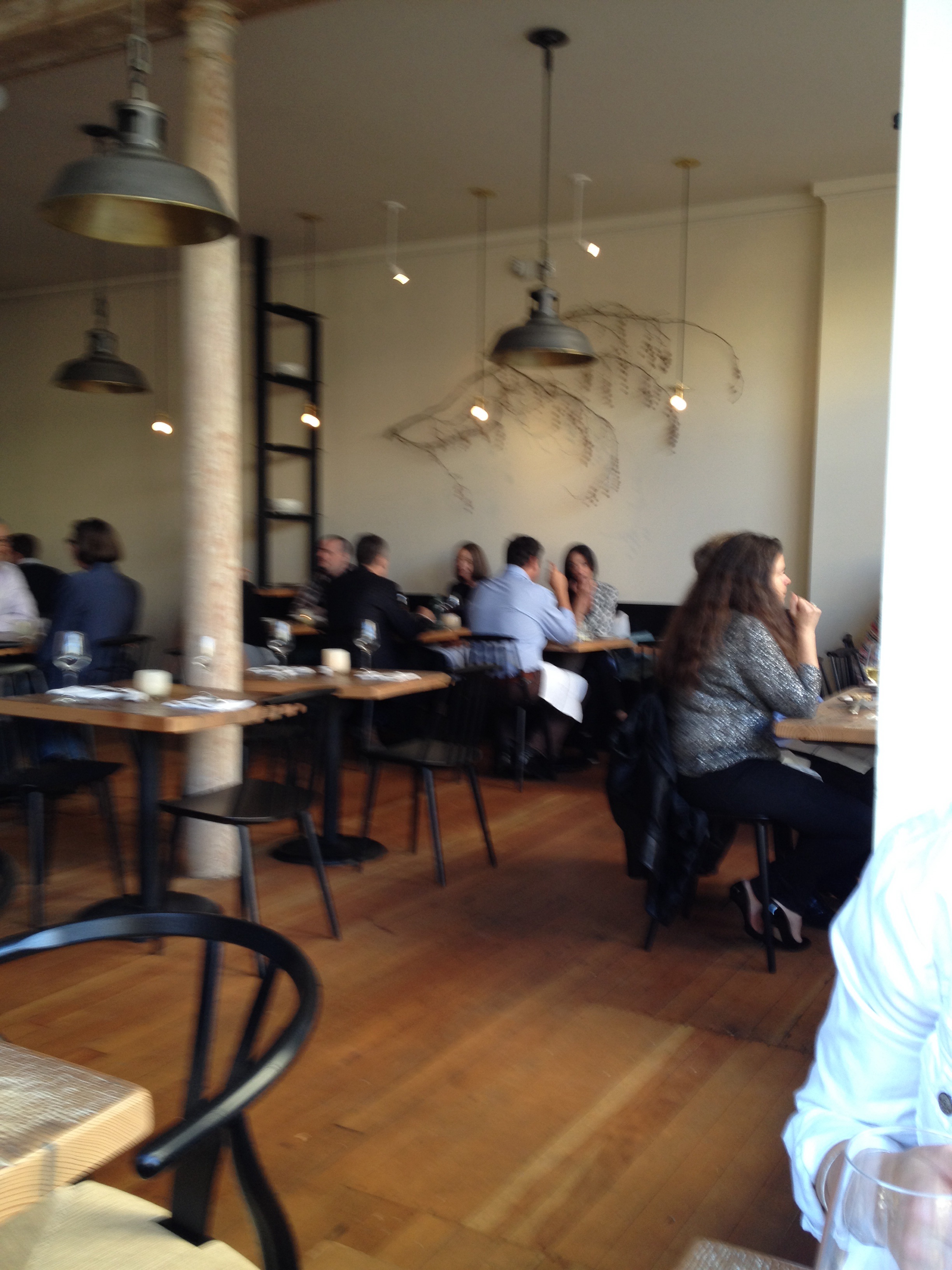
Melissa and Robert have transformed the place. It is filled with light from the floor-to-ceiling windows, and the casual tables and warm but muted colors have made the restaurant inviting and comfortable.

image

Sarah wanted to take me to dinner while Susan got to babysit. That turned out to be what I consider a perfect division of labor. I got to eat – which I love to do – and Susan got to mind the grandchildren – which is one of her very favorite activities.

The service was warm and welcoming. Kim, our excellent server, had made a conscious decision to move from another San Francisco standby where she had worked for nine years. She was happy with her decision. All of the other servers seemed as happy, friendly and efficient.

Of course, surroundings and service are both essential to a good experience, but in the end it is all about the food. Octavia did not disappoint.

As with so many contemporary restaurants, the Octavia menu is designed to encourage sharing of several small plates before the main course. With Sarah’s professional guidance, we chose a half dozen or so small plates to share.

First was the “Deviled Egg” with Fresno chile relish, marash pepper and spice. The quotation marks indicated it was not a real deviled egg, and that was so. It was a perfectly peeled mollet egg (That is so hard to do – have you ever tried it?) topped with a spicy red chile sauce. The yolk ran out a golden yellow with my fork attack, mixing with the chiles to form a creamy sauce.

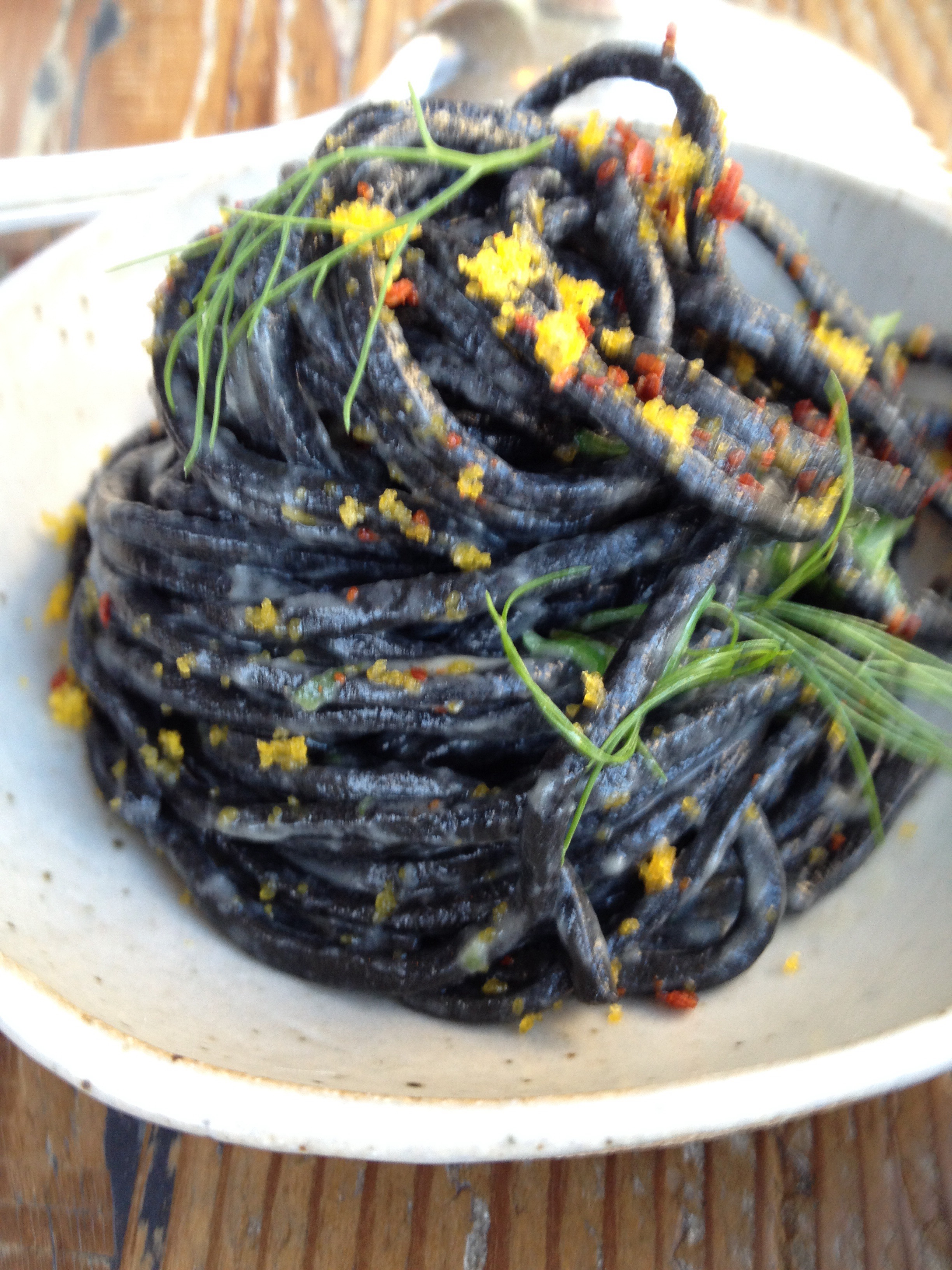
Chilled squid ink noodles with Cortez bottarga (salted fish roe), lemon oil, and green garlic came as a beautiful mound of black noodles dusted with gold. The chill took the edge off of the flavor that can sometimes doom a dish made with squid ink. The flavors of the ingredients came together. All I could think of was that I wanted more.

image

Mushrooms “A La Grecque” were a mix of hens of the woods, trumpets, and shiitakes in a light pickle and served with thick slabs of toasted house-made levain.

image

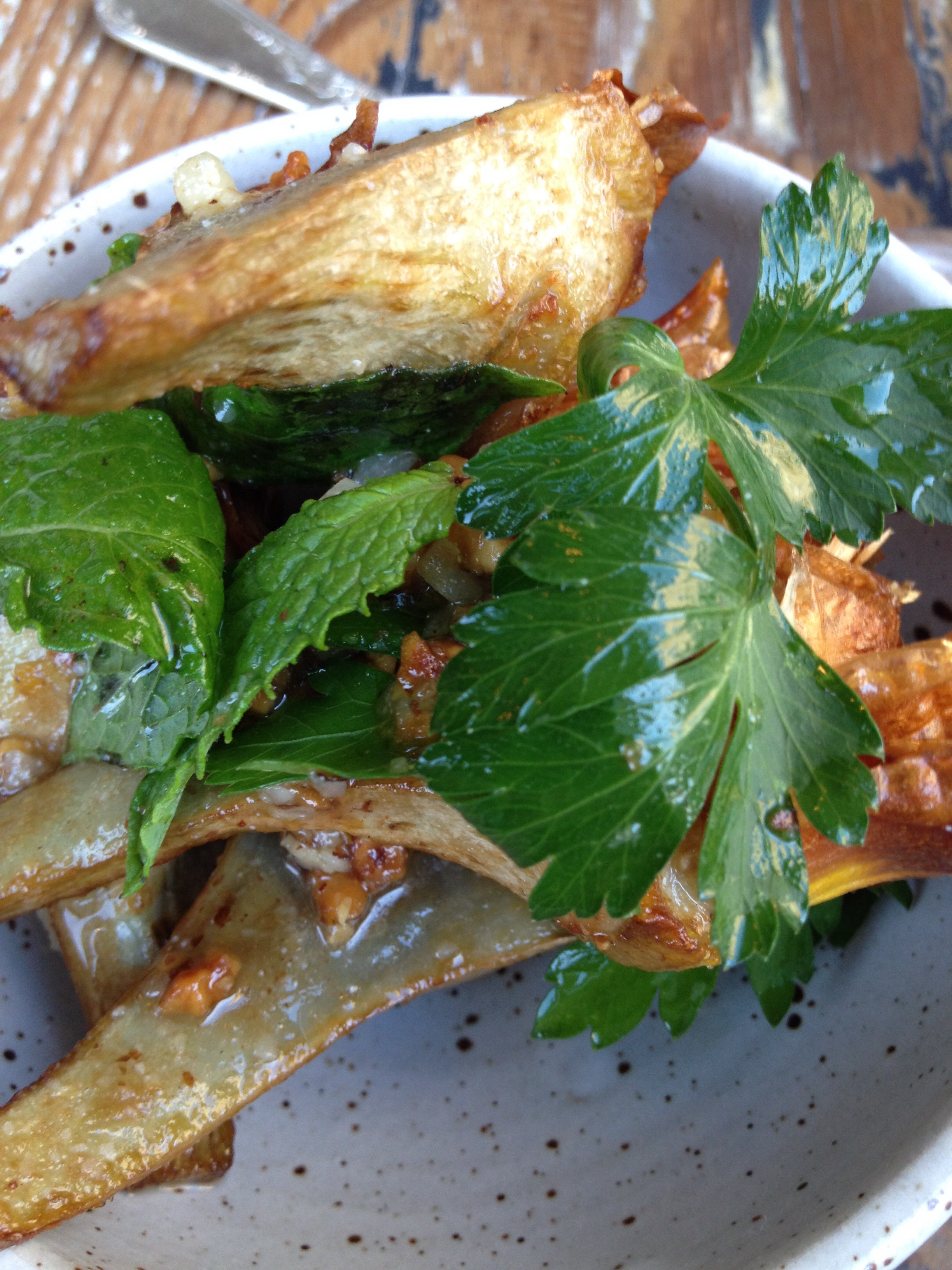
Fried artichokes were crispy on the outside and tender inside with thin shavings of Pecorino Siciliano, walnuts, and mint. If you like artichokes, you would love these.

image

Beef tongue with charred broccoli, toasted garlic, and marrow broth was flavorful. The tongue was so tender and well-cooked that it literally fell apart in my mouth. Some folks are squeamish about tongue, but when it is well prepared it is a great delicacy in the same way that sweetbreads are a special treat. With both, though, you should not plan on having your cholesterol measured the next day.

image

The salad was based on a local favorite lettuce, Little Gems, and tossed with Point Reyes blue cheese, grilled red onions, ramps (at the height of their too-short season right now) and buttermilk.

image

Sarah ordered the quail with morel mushrooms, spinach, and English peas. The quail was perfectly cooked, one of the best signs of an accomplished chef.

image

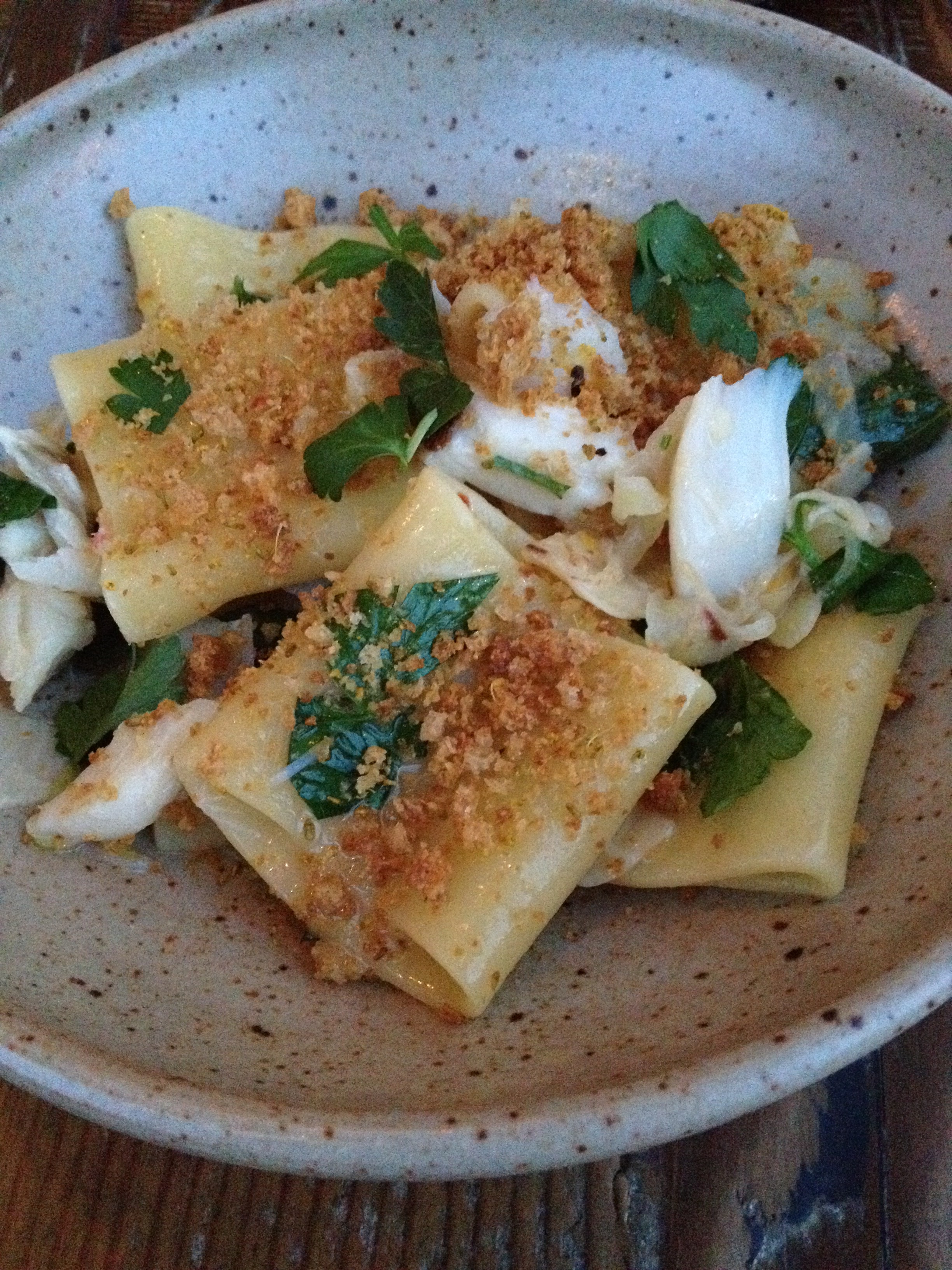
I ordered the paccheri pasta – great big rings – with olive-oil-poached bacalao (salt cod) and fennel pollen.

image

We ordered three different desserts. They were all delicious, but we saved them to take back to Susan, the Dessert Queen, as our thanks for being the resident baby sitter.

After dinner, Sarah had a nice visit with a well-known local restaurant reviewer and food critic and her son, a well-known Master Sommelier, who had been sitting at the next table. Chef Melissa also came out and visited with Sarah. It was a very special evening in a new San Francisco restaurant that promises to be a big success.

4 Comments

Filed under Food, Photography, Restaurants, Travel

ON BOARD THE COAST STARLIGHT

It seemed like the natural thing to do. We still hadn’t seen enough scenery, and a leisurely ride in a sleeper between Seattle and Los Angeles with a break in the Bay Area sounded like a lot of fun and a good way to relax. (Do you need to relax when you’re retired?)

We left our hotel before rush hour for a short taxi ride to the carefully restored Amtrak station. Our train from Vancouver, BC, pulled up to the gates, a good-sized crowd loaded up, and at exactly the designated hour we departed downtown Seattle.

There is always the mystique that trains take you to scenic places – and often that is true – but in big cities, you frequently see things that have been carefully hidden: truck terminals, rows of box cars and tank cars, and hobo camps filled with crumpled sleeping bags, cardboard boxes, and plastic crates.

At the same time, it is interesting to look out at the panoramas of the city and scenes that you would miss from the freeway. Soon enough, the messiness of the city gives way to the countryside, with lush trees, hillsides of yellow-flowered shrubs, and fields in every imaginable shade of green.

We missed breakfast at the hotel, so we were looking forward to lunch in the dining car. The steward came by and gave us a slip of paper with our time to show up in the dining car.  Then, at the appointed time, we heard an announcement that we should make our way to the dining car.

If you have never eaten in a dining car, there is a very fixed ritual, which the server will describe with a certain fatigue and indignation that must come from having done the same thing with thousands of past passengers. You sign your name and fill in the blanks for your car number and room. The server fills in everything else after you have chosen your meal.

Unlike Agatha Christie’s Orient Express, you should not anticipate fine dining. After all, the main reasons you take a train are the scenery and the leisurely pace. In fairness, though, the experience beats the current state of airline food (Is there such a thing any more?)

As is customary, we were seated with two strangers: one was a very pleasant middle-aged man who was on his way to help his niece celebrate her college graduation; the other was a college-aged young man who had absolutely no interest in engaging in conversation with old galoots. He wolfed down his sandwich as soon as it was delivered, mumbled something about how nice it was to meet us, and hastily beat an exit out the door.

We selected the sautéed chicken special. It came with a salad composed of the white ends of iceberg lettuce leaves (How did they manage to buy nothing but white ends?) and two cherry tomatoes that rolled around on the thin plastic plate with every lurch of the car, defying my best efforts to spear them with the little salad fork. The main dish was a breaded chicken breast that looked suspiciously like a chicken tender and had a similar taste. It was accompanied by a mound of mashed potatoes decorated with yet another cherry tomato. Dessert was a choice of cheesecake, cheesecake with strawberries, chocolate mousse, or ice cream. They all came in little plastic cups.

The food highlight of the day was a wine tasting in the parlour car mid-afternoon. It was very pleasant and cost only $7.50 per person. The steward gave everyone good pours of actually not-too-bad wine. Our experience was so good that we decided to change our dinner reservations from the dining car to the parlour car. That was a good choice because we got a table by ourselves, and the pepper steak was not too bad. Dessert choices were the same, but this time they were removed from the plastic cups and served on little plastic plates with the Amtrak logo.

image

Never mind. The scenery, especially in the Cascade Mountains was spectacular, and we stayed up, looking out the window until dark.

Then the car attendant made up our beds, and we settled in for the night. Sleeping was not too bad. We woke up with the train in the station at Sacramento. We dressed, went to breakfast in the parlour car, and sat in the comfortable chairs next to the tables, watching the scenery until it was time to get off th train in Emeryville.

The best food of the trip was a hamburger that our daughter prepared for lunch when we got to her apartment  – mushrooms, Swiss cheese, bacon, arugula, shallots, and dill pickles. Good food at the end of an interesting trip.

image

6 Comments

Filed under Food, Photography, Restaurants, Travel

SEATTLE AND THE OLYMPIC PENINSULA

We have been spending the last several days in downtown Seattle and in Olympic National Park on the Peninsula.

Of course, we enjoyed Seattle. It is one of the most beautiful and vibrant of American cities. The water, huge trees, mountains in every direction, and rhododendrons in bloom are gorgeous. But the people and the activity make it very exciting. When one realizes that Boeing, Microsoft, Amazon, REI outdoor supplier, Costco, and – yes – Starbucks all call this home or have a major presence, it becomes clear that this is one of the major engines of our current American economy.

Not surprisingly, all of that wealth and activity also mean that Seattle is a place for food. The first night, we ate at the restaurant in our hotel. The name is Tulio, and it definitely does not disappoint. We had drinks at the bar. We ordered the Bees Knees because they donated some of the proceeds to the Save the Bees Foundation fund-raiser. (is that Seattle or what?) The bar tender was very pleasant and clearly an expert mixologist. He said that his particular area of interest and focus was on Old Fashioneds, Manhattans, and their variants. So, of course, we had to try one of each. They were delicious.

Then it was on to the dining room where there were many choices. I selected the gnocchi. I always choose gnocchi when they are on the menu. Sometimes I am pleased. Sometimes I am disappointed. This time I was not disappointed. The little morsels were made of sweet potato, browned to be crispy, and bathed in brown butter. Smoked salmon ravioli were very Northwest, a little too heavy on the smoke, but delicious.

The next day we had a late lunch after strolling around the Pike Place Market, a must-do touristy thing if you are in downtown Seattle. The Sazerac, as you might guess, features food from New Orleans, but we had hamburgers because of the lateness of the lunch.

We saved our big meal for RockCreek in the Fremont neighborhood. Even though you think of Seattle as the epicenter of salmon and halibut, RockCreek makes a point of bringing in fish from all over the country/world. The menu changes daily, so you just have to wait and see what the offerings might be. The chef has been nominated for a James Beard award.

Oysters are local, but there is a good selection by micro-region. Three of us each got two from three different places, and they were outstanding served with a refreshing shallot mignonette.

Rhode Island Dory came with local morels. The Florida Amberjack came with a coulis made of fresh local green peas. Local Neah Bay Black Cod was done in the Provencal style. All were excellent.

The desserts were original and delicious – re-imagined Key lime pie and de-constructed s’mores. They were too sweet for my humble sweet tooth, but not for the dessert junky.

Then it was on to the real purpose of our trip: the Olympic Peninsula. The ferry ride was spectacular with the snow-covered Olympic Mountains looming over the waterway.

Our first stop was Port Townsend. This fascinating little town is filled with four- and five-story granite buildings, a giant courthouse, and many Victorian mansions built when the town was thought to be the impending “New York of the West Coast.” That was not to be; Seattle had other plans.

We made a real find. The Alchemy Bistro and Wine Bar on a side street away from the touristy main street was serving their Sunday brunch. “Bottomless mimosas” attracted a good crowd, but the fairly extensive wine list held our interest. The menu included one whole page of egg dishes and another page of soups, salads, and sandwiches.

Susan got a big bowl of oyster stew along with a plate of freshly baked scones and fresh fruit. I ordered the wild crab hash with poached eggs and Hollandaise. Neither of us went away disappointed or hungry. My hash was filled with huge chunks of fresh crab, so unlike crab dishes in lots of restaurants.

Finally we made it to the lodge where we have stayed for several days, the Lake Quinault Lodge (not to be confused with the Lake Quinault Resort on the other side of the lake where we first went.

The lodge is a classic National Park lodge, built in 1926. It has been modernized but still retains much of the rusticity of ninety years ago.

The big surprise was the Roosevelt Dining Room, named after Franklin D. Roosevelt who visited in 1937 and is credited by many for his support of the conversion of what was then a National Monument into a National Park.

Food in the dining room, whether it is breakfast, lunch, or dinner, is remarkably sophisticated, well-prepared, and beautifully presented. The wait staff is a bit uneven. Some are real professionals; some are high school students who are struggling – or maybe not – to learn the skills of good wait staff.

When we have not been eating, we have been sight-seeing. The rock formations in the surf of the Pacific Ocean are breathtaking. With modest hikes you can see the world’s largest Douglas Fir, Sitka Spruce, Western Hemlock, etc. Though I confess that once I saw one of the world’s largest [fill in the blank] I had had enough. The temperate rain forests were far more interesting. It is amazing to hear rain but for it not to make it to your level yet still have damp ground all around you. The ferns, mosses, and other plants fill the entire landscape. It is totally different from our dry Santa Fe.

This has been a wonderful escape. Now back to Seattle by way of the Bainbridge Island ferry, a good night’s sleep, seafood at the Athenian, made famous in “Sleepless in Seattle”, and then on to the next part of this adventure. The Athenian is a must although the seafood turned out to be a disappointment. Still, the perfect end to the day was a trip back to the wine tasting at our hotel.

4 Comments

Filed under Food, Photography, Restaurants, Travel

ALCATRAZ AND AI WEI WEI

I had meant to post something on Saint Patrick’s Day – for certain NOT corned beef and cabbage, but maybe something about Irish soda bread. But we were traveling back from San Francisco, and then my friend and fellow blogger, Jim Hastings, the Gringo Gourmet, wrote about his mother’s recipe for soda bread.  I still haven’t given up on a southwestern version of soda bread, but I’ve been so busy since we got home that I haven’t had time to cook, and anyway I am once again on a diet. Susan assures me that the reason I can’t lose any weight is that I wind up eating whatever it is that I’ve cooked for my blog postings.

So, needing something to write about, I thought of our trip the other day to Alcatraz. I couldn’t think of any prison food to go with the text, especially anything that would interest folks who like to read about food. That’s the reason that this is just a travelogue.

If you have never been to Alcatraz during a visit to San Francisco, it is something that you should do. Be advised that same-day tickets are usually impossible to get, so you should make reservations ahead. The ferry leaves Pier 33 about every half hour during the day, and  takes about 15 minutes. You should plan at least 2 hours on “the Rock” before you catch the return boat. You may also be able to plan your trip around a meal at the nearby Fog City Diner.

A special feature right now  through part of April is an exhibit of the work of Ai Wei Wei, the dissident Chinese artist who has spent much of his life in a Chinese prisons. It seems appropriate that Alcatraz is the site of the exhibit.

A centerpiece of the exhibition is a massive Chinese dragon that stretches surely over a hundred feet in one of the main exhibit halls – part of the old Laundry Building. Another of the key displays includes portraits of political prisoners from throughout the world. The portraits are arranged across the floor reminiscent of the AIDS quilt. The most amazing thing about the portraits is that they are all made of Legos carefully pieced together but with remarkable detail.

Alcatraz is pretty much a ruin. It was a military prison for many decades before it became the federal high-security prison. Then it was abandoned on  March 21, 1963. 1963. It was briefly occupied in 1964 by a small group of Sioux Indians. Then, from 1969 to 1971 it was occupied by a group known as Indians of All Tribes. Subsequently it has just sat, crumbling into ruins. Now the place is part of the Golden Gate National Recreation Area, and many of the buildings are being restored. Still, the ruins are very interesting and also very photogenic. One could easily spend many hours with a camera.

At the very top of the hill sits the main cell block. The cells remain intact, and there are a few furnished to show the not-so-luxurious accommodations.  One stop on the tour is the dining hall along with the accompanying kitchen. The breakfast menu for the closing day is still posted on the wall. It includes choice of cereal, juice, coffee, fruit, eggs, and breakfast meat. Sounds ok, but my guess is that it was slung out of the kitchen where outlines of the terrifying knives used by the cooks still cover the walls.

It is not for nothing that Alcatraz is nicknamed “the Rock”. That’s all that it was until soil was brought in to  make it a more pleasant place to live for the families of the guards and other prison employees. Now there are lots of flowers around the grounds, but they are all invasive species, and there are no native plants.

5 Comments

Filed under Photography, Travel

BENNE WAFERS

“Open sesame,” was the phrase that the miscreants used to open their cave filled with treasure in the story, “Ali Baba and the Forty Thieves”. Popeye said, “Open sez me,” in a cartoon version of the story. It is not entirely clear whether the phrase relates to the spice, sesame, or whether it is a mistranslation of an Arabic phrase. What is certain is that sesame has been used in cuisines throughout the world and throughout history. Some say it is the first spice discovered, and it has been identified in ancient Egyptian tombs.

Say “benne wafers” and you immediately think of Charleston, South Carolina, where they have been part of the local cuisine for hundreds of years. The first time I ever ate one was many years ago in a charming restaurant on Church Street in the middle of that city.  In fact, I think that may have been the very best benne wafer I have ever had. It was a crispy little cracker, not unlike lavash, filled with toasted black and brown sesame seeds. The traditional story of how these tasty bites got their name is that the word “benne” is West African for sesame seeds that the black soon-to-be-slaves brought with them, perhaps even sewn into their clothes and subsequently used in their cooking. The sesame-rich foods found their way to the plantation house and soon became embedded in South Carolina cuisine. There are two versions of benne wafers: one that is sweet and one that is savory. I prefer the savory version. Whatever the real story of benne wafers, there is no doubt that the modern versions are delicious.

During a recent visit to Los Angeles, Susan and I paid a visit with Carol to the Surfas kitchen store in Culver City. There I found a bag of black sesame seeds which reminded me of those long-ago benne wafers in Charleston. Brown sesame seeds are, of course, ubiquitous, but black seeds are not as common, so my find seemed like the perfect chance to try my hand. The recipe is actually a version of a pie crust dough, so it is important to keep your ingredients chilled and not over mix the dough to make sure it is crisp and flaky when baked.

RECIPE

Benne Wafers

Ingredients

  • ¼ cup mixed brown and black sesame seeds
  • 1 cup flour
  • ¼ teaspoon salt
  • cayenne pepper, to taste
  • 3 tablespoons chilled, unsalted butter
  • 1 egg yolk
  • 4 tablespoons ice water

Method

  1. In a dry skillet over low heat, toast the sesame seeds for 15 minutes, stirring frequently, until lightly toasted and fragrant. Be very careful not to burn the seeds.  Cool and set aside.
  2. In a medium bowl, mix the flour, salt, and cayenne. Work in the butter with your fingers or a pastry blender until the mixture resembles corn meal.
  3. Add the cooled sesame seeds, egg yolk and ice water to make a dough. It should be soft, but not sticky.
  4. Form the dough into a ball, wrap with plastic wrap, and chill in the refrigerator for 30 minutes.
  5. On a floured work surface, roll out the dough into a 12-inch circle. With a biscuit cutter, cut into 2-inch rounds.
  6. Place the rounds on an ungreased cookie sheet and bake in a preheated oven at 350°F for 15 minutes or until lightly browned. Cool on a rack. Makes about 2 dozen wafers.

9 Comments

Filed under Food, Photography, Recipes, Travel

COOKING FOR THREE-YEAR-OLDS: GNOCCHI, CHICKEN, MUSHROOMS, PEPPERS, BEURRE NOISETTE

Susan and I just returned from another trip to San Francisco. We babysat our 10 months-  and 3 years-old grandsons while Sarah and Evan travelled to Dallas. They were invited to cook with the staff at a hot, new Dallas restaurant, FT33. Sarah and Evan and the local chef alternated dishes for an 8-course tasting menu with wine pairings. The place was sold out, and Sarah got to see Corey and Megan, school friends of our other daughter, along with a fellow member of her crew team at the University of Texas.

My cooking task was more challenging: I was charged with feeding the two little ones. Actually, the 10-month-old was not difficult. He is still drinking a lot of liquids, and he will eat anything else you put in front of him.

The three-year-old was another story. The first morning, he wouldn’t eat his cheerios until I added some milk, so the next morning I anticipated him and poured in the milk. That morning he decided he didn’t want milk, so I had to scrap the first bowl. The next morning I made French toast with maple syrup. He didn’t like it, but the 10-month-old polished it off.

My greatest failure turned out to be lunch. I put together some things for his lunch box for nursery school. My first thought was a peanut butter and jelly sandwich. What child doesn’t like PB&J? Besides, PB&J is not forbidden at his nursery school as it is in many places. As I was planning my menu, Sarah sent a text message that the toddler doesn’t like peanut butter. I made a quick change of plans and substituted some chèvre that I found in the fridge. Then, I reached for a jar of fig jam when he announced that he didn’t like jelly. For that, I substituted some hummus. I thought a goat cheese and hummus sandwich on whole wheat bread looked pretty tasty, so I packed it with freeze-dried strawberry slices, crispy apple chips, and a stick of string cheese. Imagine my disappointment when the lunch box came home at the end of the day with only the string cheese gone.

We took advantage of the kids being at nursery school by taking a little trip to the Embarcadero and enjoying a good lunch at the well-known Fog City Diner.

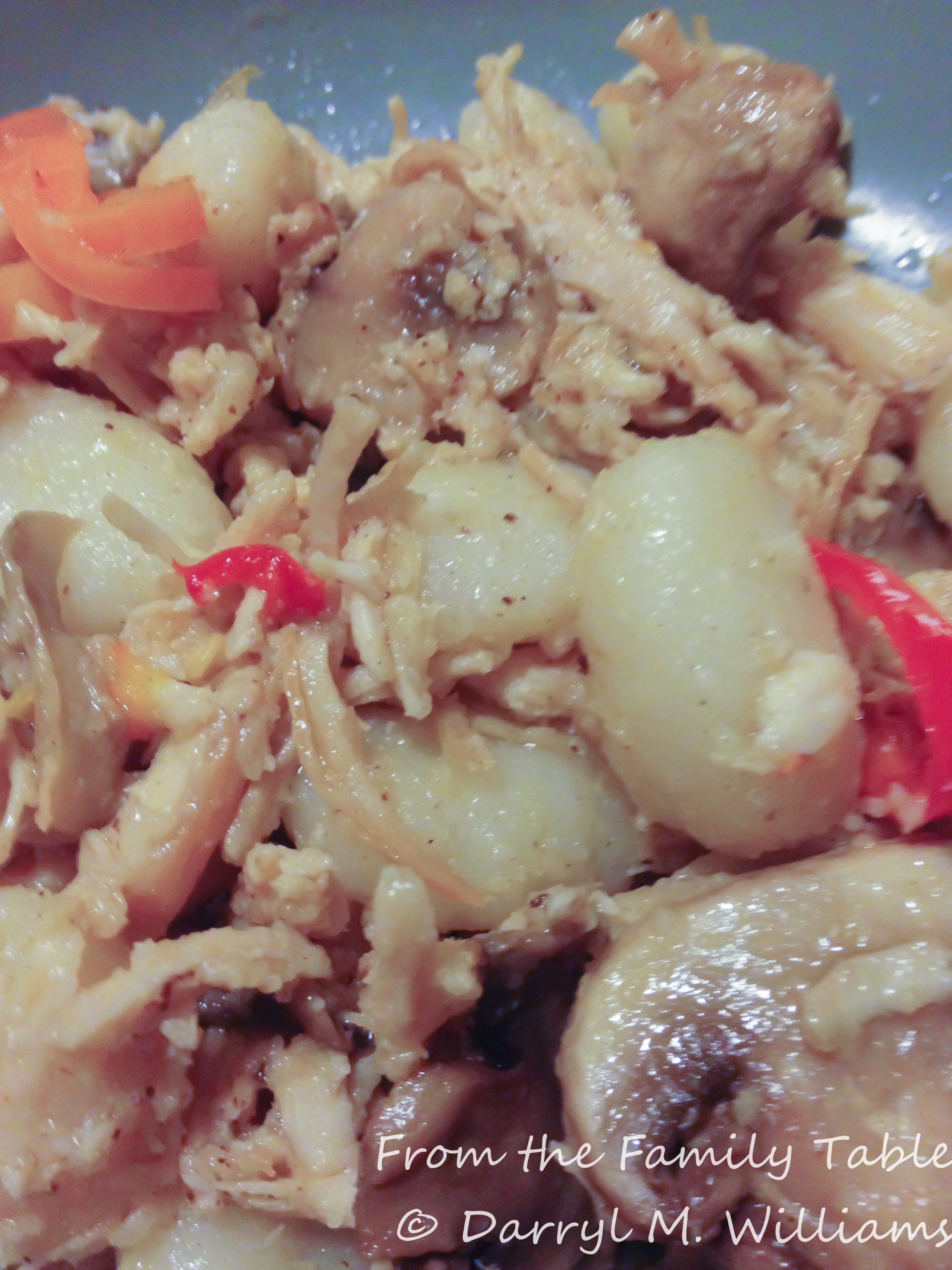
I was more successful with dinner one night. I found some packaged gnocchi and a cooked chicken breast in the refrigerator along with some mushrooms and colorful “snacking peppers”. I put it all together with some brown butter sauce, and it turned out to be a huge favorite with both kids.

RECIPE

Gnocchi, Chicken, Mushrooms, Peppers, and Beurre Noisette

Three-Year-Olds-1

Ingredients

  • ½ cup unsalted butter
  • juice of  ½ lime
  • ½ cooked chicken breast
  • 6 white button mushrooms, sliced
  • 1 each, red, orange, and yellow snacking peppers, sliced crosswise
  • 1 package prepared gnocchi
  • ½ cup grated Parmesan cheese
  • ½ cup grated Romano cheese
  • salt and pepper

Method

  1. In a small saucepan over low het, melt the butter. Heat gently until the milk solids float to the top and begin to brown. Skim off the solids with a tablespoon. Pour the melted butter into a small bowl, leaving any remaining solids on the bottom of the saucepan behind. Wipe the pan clean, return the clarified butter, and continue to heat over a low flame until it turns a nut-brown color. (hazelnut to be specific) Stir in the lime juice and set aside.
  2. Shred the cooked chicken with two table forks. Set aside.
  3. Sauté the sliced mushrooms in 2 tablespoons of the butter sauce over medium heat. Add the remaining butter sauce. Stir in the shredded chicken and pepper slices until heated through.
  4. In the meantime, boil the gnocchi in a pot of boiling salted water according to package instructions. Drain. Return to the pot, and stir in the butter sauce, mushrooms, chicken, peppers, and grated cheeses. Adjust seasoning with salt and pepper.
  5. Serve.

5 Comments

Filed under Food, Photography, Recipes, Restaurants, Travel

BOSQUE DEL APACHE AND GREEN (RED) CHILE CHEESEBURGERS

Last week we drove south to the Bosque del Apache National Wildlife Refuge in central New Mexico. The refuge sits on the bank of the Rio Grande and is one of the largest winter stopovers on the Central Flyway. There are thousands of water birds during the months of November through March. The largest colonies include snow geese, Canada geese, and Sandhill cranes; there are ducks of all sorts as well.

The main shows are always the flight at sunset when the geese and cranes settle in to ponds for safety during the night and then again at sunrise when the birds fly off in clouds to head to feeding grounds throughout the region. We were a little disappointed this year, because the evening spectacle was not as impressive as in the past. In part that is because some of the birds have already begun to head north in the spring migration.

Still, we enjoyed the birds of winter. We saw pintails, shovelers, mallards, many other ducks, and grebes. There were Gamble quails, red-winged blackbirds, herons, roadrunners, dozens of red-tailed hawks, and a merlin. Reportedly there was a trumpeter swan and a bald eagle around, though we didn’t see either one – we have seen them in the past.  We also saw a peccary and a skunk. It was a treat for anyone who enjoys wildlife.

After the evening flight, we stopped for a relaxed meal at the Buckhorn Bar in the nearby hamlet of San Antonio. This one-street town is probably the epicenter for the New Mexico green chile cheeseburger passion. Cafés and greasy spoons all across the state offer their version of this delicacy, but the Buckhorn and its big competitor, the Owl Bar and Café, sit just across the highway from one another, and both have at one time or another vied for the title of best green chile cheeseburger in the world if not the universe. Just down the interstate the McDonald’s and Burger King in Socorro, the largest nearby town, offer their versions of the sandwich, and a local gasoline station also serves a very tasty rendition, so there is no lack of opportunities to enjoy a GCCB, as the locals call it.

The standard question that is asked by the server in any New Mexico roadhouse is, “Red or green?” That means you are supposed to tell him or her whether you want red or green chile on top of whatever you order. If you can’t make up your mind, the standard reply is, “Christmas!” so that you get both red and green chile.

It has always been a puzzle to me as to why there is never a red chile cheeseburger choice, or maybe even better, a Christmas option. This is my effort to correct that culinary deficiency. For the green chile part, I roasted some Anaheim chiles – pretty conventional for a GCCB. For the red chile part, I decided to use chile colorado in two forms: the straight stuff and in mayonnaise. Forty years ago I learned to make chile colorado from our laboratory dishwasher who was from Mexico. This version is a little embellished from that recipe, but it is not very different from practically every recipe out there. The most important thing is to use ground chiles rather than commercial chili powder, which contains a mix of chiles along with garlic and onion powders, cumin and oregano, and probably a bit of MSG. The following recipe makes a lot more sauce than you will need for the cheeseburgers, so think about using the leftovers with fresh corn tortillas for enchiladas or chilaquiles.

RECIPES

Chile Colorado

Ingredients

  • ½ cup ground red chiles (your choice on the heat level)
  • 2½ cups water
  • 2 tablespoons vegetable oil
  • ½ small onion, chopped
  • 3 cloves garlic, peeled and minced
  • 2 tablespoons AP flour
  • 1 teaspoon ground cumin, toasted in a small  dry skillet
  • 1 teaspoon Mexican oregano, crumbled between your hands
  • 1 teaspoon kosher salt (or to taste)

Method

  1. In a dry skillet over medium heat, toast the chile powder until it darkens lightly and becomes fragrant. Stir frequently and do not allow to scorch. Stir the toasted chile into the water and set aside.
  2. Wipe out the skillet, and return it to medium heat. Heat the oil and add the onions and garlic, stirring until the onion is translucent. Stir in the flour and cook for 2 minutes, stirring frequently.
  3. Stir in the chile and water, cumin, and oregano, and bring to the boil. Then reduce to the simmer for 40 minutes until the raw taste of the flour has cooked out and the chiles have mellowed. Adjust the seasoning with salt.
  4. Cool and store in a non-reactive container. (Red chiles can present a challenge for stains)
  5. Makes about 1 pint

Red Chile Mayonnaise

Ingredients

  • ½ cup mayonnaise (homemade or commercial)
  • ¼ cup chile colorado

Method

  1. Combine the mayonnaise and chile colorado
  2. Set aside until ready to use.

Green/Red Chile (Christmas) Cheeseburger

Ingredients

  • 4 good-quality hamburger buns
  • 8 tablespoons red chile mayonnaise
  • 4 Anaheim chiles, roasted, peeled, seeded, and opened
  • 1 pound ground beef
  • salt and pepper to taste
  • 4 tablespoons chile colorado
  • 4 tablespoons chopped onion
  • 8 deli slices, cheddar cheese
  • condiments (lettuce, sliced tomatoes, dill pickle chips, ketchup, mustard as desired)

Method

  1. Slice the hamburger buns in half, and spread the cut-side of each half with red chile mayonnaise. Toast on a hot griddle until lightly browned. Set aside.
  2. Make 4 hamburger patties from the ground beef. Season with salt and pepper.
  3. Sauté  one side of the 4 hamburger patties on the griddle over medium-high heat for about 5 minutes. Turn the hamburgers only once. When you turn the hamburgers, coat them with the chile colorado using a pastry brush. Then top, in order, with chopped onion, cheddar cheese, and roasted green chiles. Saute for another 5 minutes or until the hamburgers are done to your liking.
  4. Place the cooked hamburger patties in the prepared buns and serve immediately with condiments as desired.

6 Comments

Filed under Food, Photography, Recipes, Travel

QUESO FUNDIDO (MELTED CHEESE)/QUESO FLAMEADO (FLAMED CHEESE)


This is one of the easiest recipes around, but it is also easy to mess up. When it is done properly it cam be ethereal. The first time I ever had it was some thirty years ago in Tlaquepaque, Mexico, a small town filled with artisans on the outskirts of Guadalajara. We had taken our children and one of their friends on a family vacation to the Mexican west coast, and this was to be our day of tourist shopping. The array of handmade goods was overwhelming. There were weavings, pottery, jewelry, worked silver, paper flowers, hand-made furniture, and the requisite “onyx” chess sets.

After a full morning of going from one vendor’s stall to another, everyone was ready for lunch. We chose a huge open air restaurant, partly because there were enough vacant seats for all of us.

The first thing we ordered was queso fundido and freshly made corn tortillas to snack on with drinks until our main dishes came. Dipping browned and molten cheese out of a dish and heaping it on a warm tortilla was a treat for all of us. There was crumbled crisp chorizo on top, but no chiles and no spice. It was just plain good eating.  We ate quickly, and that was a good thing. When queso fundido cools off, it can set up into a solid chunk of cheese.

Since then, I have enjoyed queso fundido, aka queso flameado in many places along the US-Mexico Border. Most of those versions have been good, but none as good as that in Tlaquepaque. The dish is not to be confused with another stalwart, chile con queso. In its traditional form, that dish includes melted cheese and roasted green chiles. Neither queso fundido nor chile con queso is to be confused with versions you are likely to see in fast-food Mexican restaurants: Ro-Tel mixed with melted Velveeta, or worse, Cheez Whiz mixed with bottled taco sauce.

When you make your own queso fundido, use authentic asadero cheese if you can find it, Mexican chorizo of the best quality, and corn tortillas that you make yourself.None of that is really very hard. If you can’t find asadero cheese, any yellow melting cheese like Monterey jack, American Muenster, or mozzarella will do.

Serve with your favorite salsa or even guacamole or both.

RECIPE

Queso Fundido

Ingredients

  • 12 ounces asadero cheese, coarsely grated
  • ¼ pound Mexican (not Spanish) chorizo, crumbled and lightly browned

Method

  1. Heat a shallow baking dish, about 9 inches across, in the middle of an oven preheated to 375°F for about 5 minutes or until hot.
  2. Remove the heated dish from the oven. Sprinkle the grated cheese evenly in the dish. Top with chorizo, and return to the oven for 10-15 minutes or until the cheese is completely melted and lightly browned.
  3. Remove from the oven. Set on a heat-resistant surface. Serve immediately with warm fresh corn tortillas and spoons for dipping the melted cheese.


4 Comments

Filed under Food, Photography, Recipes, Travel

THIRTY YEARS OF CHEFS’ HOLIDAYS

There’s no recipe in this post or much discussion of food. Honestly, I just wanted a chance to show some of my images from our recent visit to the Ahwahnee Hotel in Yosemite National Park.

Yosemite National Park is one of the true gems of the national park system in the United States. It was viewed as a treasure by the Native Americans who lived in it, and by early settlers and prospectors. Even shortly after gold rush days, there were efforts to protect Yosemite Valley. In fact, it celebrates its 125th anniversary as a national park this year. If you have visited the park, you know what a special and magical place it is (sans other tourists, if you could wish it). If you have never visited, it is a must on your list of places to visit.

The Ahwahnee Hotel, by itself, is a place that deserves its own spot on your list. The hotel was opened in 1927 at a cost approaching $2 million – a huge sum in those days. The story is that earlier lodging in the park could best be described as “rustic”. Many wealthy tourists including Lady Astor refused to visit because of the primitive conditions. For that reason the hotel was envisioned for that clientele. It was built in a grand style but in a fashion that blended into the beautiful mountain surroundings. Fearful of fires that had already destroyed more than one national park lodge, the builders used reinforced concrete stained to resemble California redwood. Even today, the eye of the visitor will be fooled by the exterior of the building.

Of course, the hotel has been modernized to remain attractive to demanding guests, but many of the original details including giant fireplaces, intricate woodwork, artwork, detailed floors, and even wooden ice chests on each guest wing have been preserved. The main dining hall is in the impressive style of many of the classic national park lodges. The food is definitely a cut above the fare in other national park lodges.

Most agree that the best time for a visit to Yosemite and the Ahwahnee is in the spring when the many waterfalls are at full flow. Next-best may be the autumn with colorful foliage and Indian Summer weather. Summer is beautiful with the only downside being the wall-to-wall humans.

Winter is clearly the low season. Snows can be fierce, and more than one visitor has gotten lost and frozen during an ill-conceived hike. The plus side is that there are many fewer visitors. That has posed a problem for the famous Ahwahnee Hotel. Unlike many of the grand old hotels of the national parks, the Ahwahnee stays open all winter, so it needs to attract as many guests as possible. They do that with various special activities.

The Bracebridge Dinner is a tradition that goes back to the first year that the hotel was opened. The dinner is a festive occasion with English period costumes, entertainments, and foods. It is extremely popular and becomes oversubscribed very early.

The Vintners’ Holiday is a gathering of thirty or more California vintners and guests who talk about things wine-related and wind up with a festive dinner complete with carefully paired wines.

For the past 30 years, the hotel has been sponsoring its Chefs’ Holiday. There are back-to-back sessions that run through January and early February. This year, there will be a delay of a few hours on Super Bowl Sunday so that football fans/food enthusiasts will not need to miss either event.

The Chefs’ Holiday attracts many well-known chefs and food writers, predominantly from California, but actually from all around. This is the second year for Sarah and Evan, but other chefs and writers include Kent Rathbun from Abacus in Dallas, Nancy Silverton and Mary Sue Milliken from Los Angeles, as well as Duskie Estes, Elizabeth Faulkner, and Zoi Antonitsas of television competitive cooking fame.

Guest chefs provide a short demonstration of one of their signature dishes and then host a tasting. Each session ends with an elaborate dinner prepared by the chefs, complete with carefully paired California wines.

It is fair to say that the Ahwahnee staff  is doing their part to assure a successful winter season in Yosemite.

2 Comments

Filed under Photography, Restaurants, Travel