Category Archives: Restaurants

POACHED MIGAS

Sarah always has a lot of new cookbooks. She and Evan buy a lot, and on top of that they receive others from publishers. During our last visit, we spent a lot of time looking at recent selections. One, in particular, caught the attention of both Susan and me. I wound up buying a copy because I think that anyone who likes cookbooks would want this one on his or her bookshelf.

The name of the book is Genius Recipes: 100 Recipes That Will Change the Way You Cook. The book is written by Kristen Miglore, Executive Editor of the food website, Food52.com. It is filled with beautiful images by the author and published by Ten Speed Press, Berkeley.

Genius Recipes

Genius Recipes

Some critics complain that the recipes are not really “genius” and that some of them don’t work. They are partially correct. Some of the recipes, at least in my hands, don’t work and some of them I will not make again.

The real genius behind all of the recipes is that they contain tricks that you never knew or methods that make you think, “Now, why didn’t I think of that.” As well, there are recipes that have become classics. An example of that is Shirley Corriher’s Touch-of-Grace Biscuits that was daughter Carol’s first contribution to our family cookbook. Who would think that a wet blob of dough could turn into light Southern biscuits?

Another recipe that intrigued me was Daniel Patterson’s Poached Scrambled Eggs. Daniel is chef/owner of Michelin-two-star Coi where Evan and Sarah worked before they opened Rich Table. The story behind the recipe is that Daniel’s wife made him toss out his beloved Teflon-lined sauté pan, so he had to come up with a new way of scrambling eggs for his breakfast. The genius of the recipe – why didn’t I think of that – is based upon a common folly of cooks who have tried to poach the perfect egg only to have it break in the cooking water. Patterson simply mixed the eggs before he put them in the poaching liquid, and mirabile dictu, he had a scrambled egg.

This recipe takes that technique one step further. Migas are a great Tex-Mex dish which requires two basic elements – eggs and stale corn tortilla pieces – and whatever else suits your fancy. I first ate them at a cafe in Austin near the University of Texas campus. Since then they have become a family favorite that is always on the menu at family gatherings. One of the keys to this recipe is to have all of the add-ins prepped and ready to go before you cook the eggs.

RECIPE

Poached Migas

Ingredients

  • 3 corn tortillas
  • 4 crimini mushrooms, sliced
  • vegetable oil
  • 3 scallions, cut in ¼ inch slices, including green tops
  • 2¼ ounces sliced black olives
  • 3 strips bacon, cooked until crisp and then crumbled
  • ½ green or red bell pepper, seeded and chopped
  • 3 snacking peppers, chopped
  • 4 ounces Hatch green chiles, diced (optional)
  • 1 medium tomato,  seeded and chopped
  • ½ cup Cheddar or Monterey jack cheese (use a combination of the two if you wish)
  • ½ cup coarsely chopped cilantro leaves
  • 4 eggs, beaten
  • 4 tablespoons butter, melted
  • salt and pepper
  • salsa
  • sour cream for topping

Method

  1. Lightly coat the tortillas with vegetable oil. Cut into ¼ inch strips and spread out on a baking sheet. Bake at 200° F for about 20 minutes or until the strips are crisp. Cool and set aside.
  2. Sauté the mushrooms in about 2 tablespoons of oil. Set aside
  3. Gather the add-in ingredients on your work surface.
  4. In a medium saucepan, bring salted water to the boil. Turn off the heat, stir the water vigorously to create a vortex, and pour the beaten eggs into the vortex. Cover the saucepan tightly for a full minute. Remove the lid and drain the cooked eggs in a fine-meshed sieve, shaking to remove any excess water.
  5. Return the drained eggs to the saucepan along with the melted butter. Stir to loosen the eggs and incorporate the butter.
  6. Stir in the tortilla strips, mushrooms, scallions, olives, bacon, peppers, optional green chiles, tomato, cheese, and cilantro.
  7. Adjust seasoning with salt and pepper. Top with salsa. Serve immediately while still hot. Pass sour cream for topping if desired.
 

10 Comments

Filed under Food, Photography, Recipes, Restaurants

THANKS ARE ALWAYS WELCOME

We’re back home at last from our 5-weeks child-ending adventure. We have rested a few days, done the household chores that needed to be done after a long absence, paid bills, and caught up on 700+ e-mails.

I have to admit that another reason for my absence from posting lately is a certain loss of enthusiasm. I have 300 posts over four and a half years, and some readers may think that I have run out of things to say along with needing some new recipes. But the main reason I have been a little quiet is receiving a couple of snarky comments that made me wonder, at my age, if I really need that. The way I look at it, if you don’t like my blog, just don’t read it. After some soul-searching, I have decided to write at least a few more posts. To do otherwise would let the boo-birds win, and I have never been inclined to do that.

So…

This post is to thank all of our children for their gracious ways of thanking my wife and me for our efforts.

The Los Angeles family made a point to go to a nice restaurant. Unfortunately, I missed the event so there are no images of food, but they took my wife to Bashi, the Asian-inspired restaurant at Terranea Resort. It has a wonderful ocean view, great service, a lovely dining space and delicious food. The only thing I can report is that they had a great time.

The San Francisco family made sure we had an evening at Rich Table. Evan was cooking that evening, so he pulled out all the stops. The list of things he sent out included:

Sarah’s popular fennel pollen levain served with house-cultured butter. The warm slabs of bread smeared with a delicious butter could be a meal by themselves.

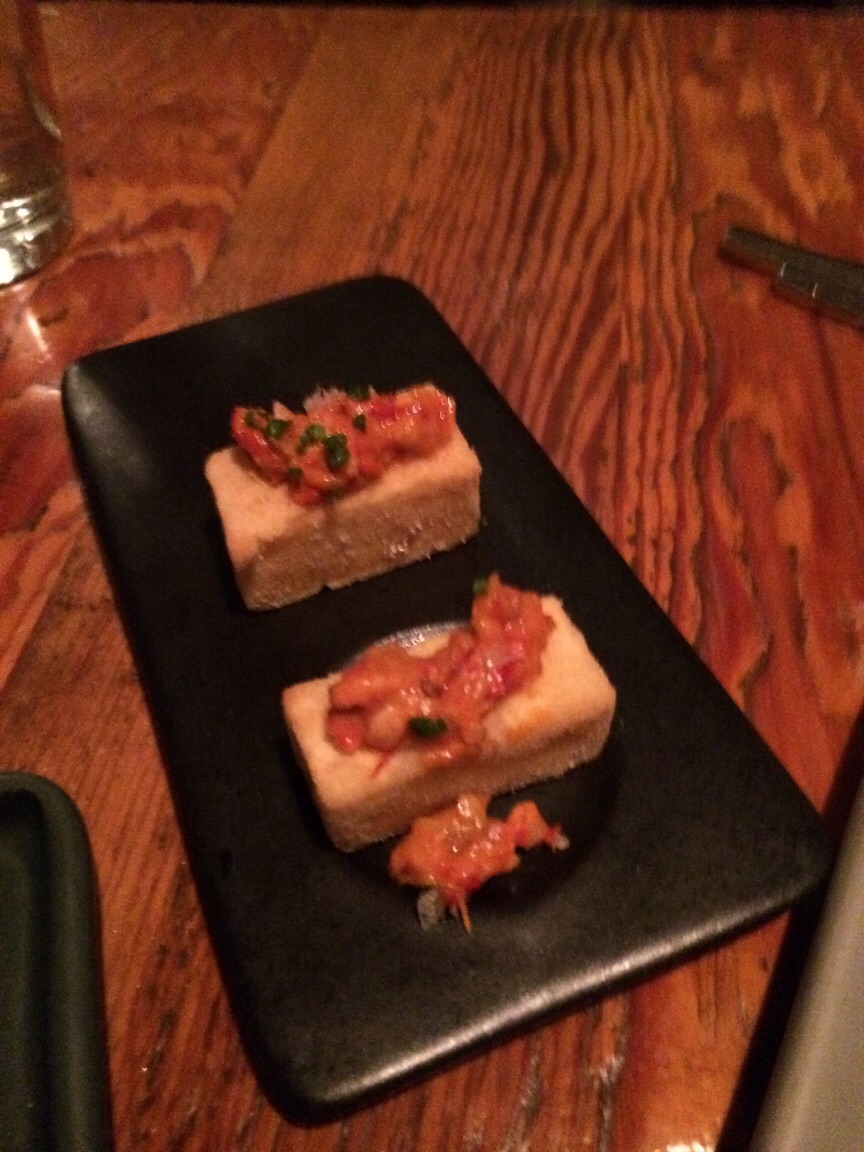
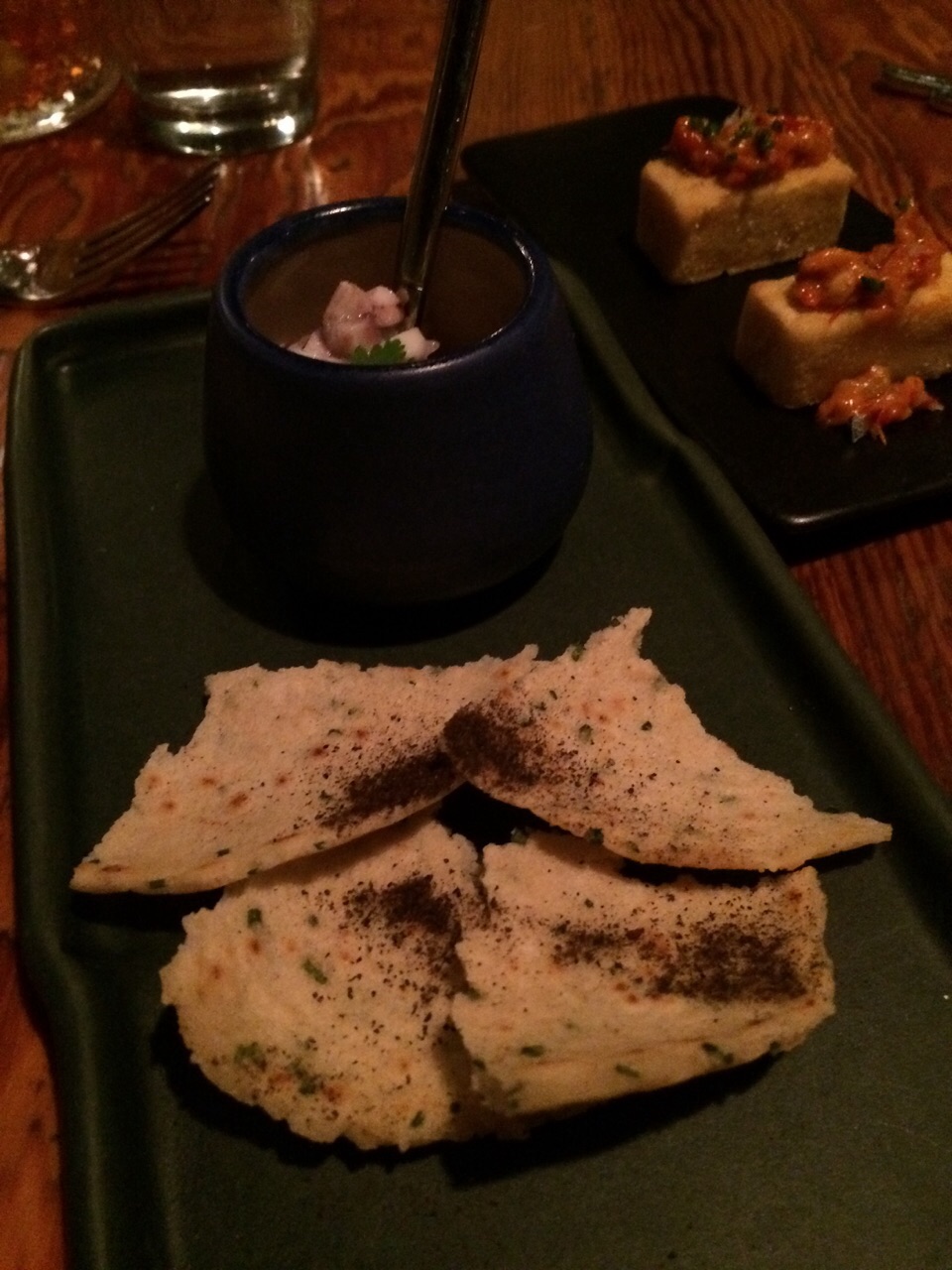
An amuse that was just a bite, but a delicious bite.

image

Octopus with grapefruit, hearts of palm, and sansho pepper.

image

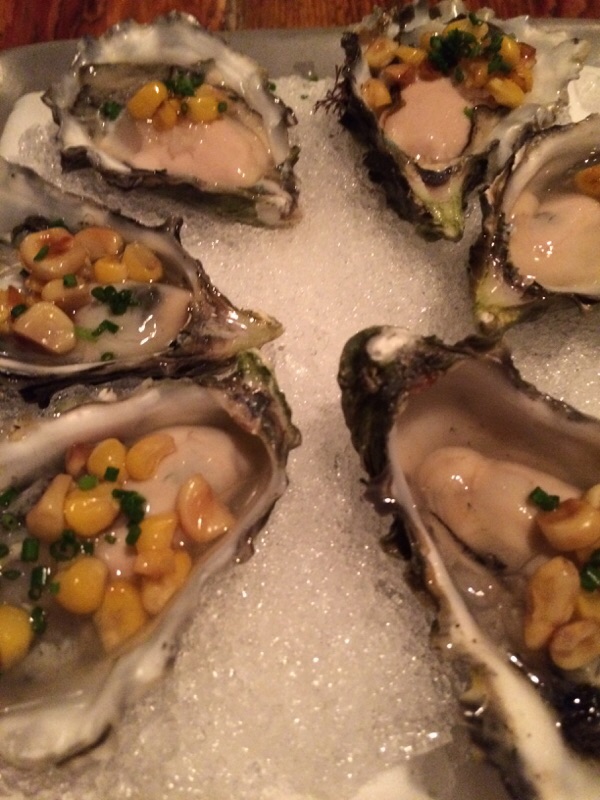
Oysters on the half shell with charred corn mignonette. Rich Table oysters always come well-scrubbed so there are no fragments of shells that you often encounter at some of the best seafood restaurants.

image

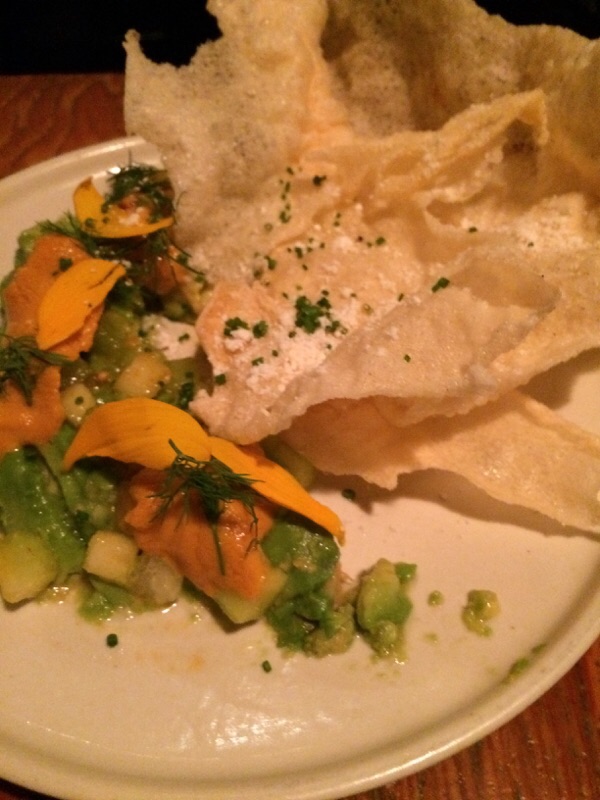
Avocado, sea urchin, fermented jalapeño, prawn crackers. I couldn’t even think of such a combination of flavors, but it definitely worked.

image


“Green juice” granite, avocado mousse, Stobe fruit, and brown butter ice cream.

image

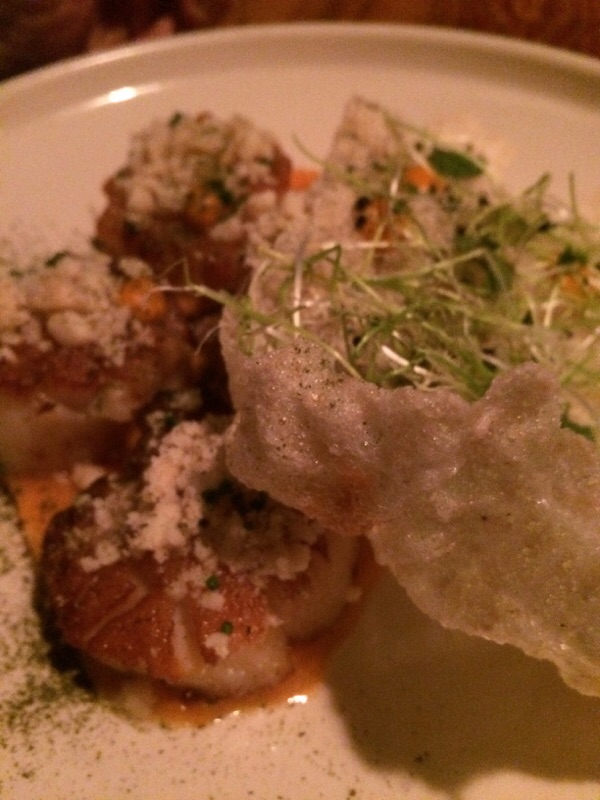
Scallops, sweet potato, red curry, macadamia nut, brown rice. Again, a combination that defied our imagination. The predominant flavor, of course, was the sweet scallops.

image

Grilled rib-eye with roasted cauliflower, almond, and sake lees. The steak is heavily marbled with a lot of fat. Whatever you do, don’t cut off the fat, but pop it in your mouth. The fat has absorbed all of the other flavors and just melts away as a delicious extra treat.

image

A dessert of sweet corn pot de creme with creme fraiche, strawberries, and lemon crumble. A little vegetal, but surprisingly sweet and refreshing.

image

The Silicon Valley family sent us some beautiful artisanal chocolates and a beer mug from Prague where our daughter-in-law had gone to a business meeting.

image

All of that was so unnecessary because taking care of the kids was gift enough, but it made us feel truly thanked and truly blessed.

19 Comments

Filed under Food, Restaurants

FRIED SMOKED SALMON DEVILED EGGS

This last week our traveling child care project moved to Los Angeles. We had assumed that watching teenagers would be easier than toddlers. In some ways we were right. The teenagers clearly have required less direct supervision, and there is not diaper changing. Scheduling is the main problem. Both require transportation to and from school as well as extra-curricular activities. The high school student has a variable schedule: sometimes she needs to be at school at 7:30 and sometimes she doesn’t go until 8:30. There seems to be no fixed schedule. In the evening she has practice for the swimming team. That cuts into the dinner hour. Then she disappears into her room for a prodigious amount of homework.

The middle school student has a different schedule,. He has his own homework, and grandparents are supposed to help in the absence of parents. What?  I can barely remember my own name. Even though the two schools are only a few blocks apart, dropping off and picking up require at least five and sometimes seven separate trips a day. It is a mystery to us how our daughter and son-in-law can get all of this accomplished and still both hold down full-time jobs with commutes of at least one hour each way.

Susan and I had planned to use our spare time doing some of the things in LA that we have wanted to do. We didn’t get that accomplished; mostly we just wanted to take a quick nap. The one outing we were able to accomplish was a visit to Terranea Resort with a nice lunch at one of their restaurants.

Southern Californians are almost as crazy about golf as they are the beach. In the community where our family lives, there are five golf courses, the oldest dating back to over ninety years ago. The most recent additions are the Trump National Golf Course Los Angeles, and its arch competitor, Terranea Resort. Both are built on the cliffs overlooking the Pacific Ocean and offer stunning views, especially at sunset. Both offer luxurious resort facilities, and both have excellent restaurants. Locals seem to prefer Terranea, but that suggestion runs the risk of being a political commentary in this day and time.

We chose to go to the Catalina Kitchen at Terranea. The restaurant is beautifully appointed with a comfortable indoor dining room and an outdoor terrace that looks out on the ocean. The wait staff is very professional but friendly; they know the menu inside and out. The menu is filled with old standards, but the big surprise is that the chef has added new and creative twists to items that have gotten a bit ho-hum. Susan ordered crab Louie, which came piled high with fresh Dungeness crab. I ordered the Caesar salad with salmon. It came with beautiful croutons on the side (They were not out of a package). The dressing had just a hint of anchovy, and on top were beautiful filets of white anchovy. The salmon was perfectly cooked with just a light glaze, and it was a generous portion.

With all of that, the highlight of the meal was fried deviled eggs. They were singularly delicious. They were served in a little pool of bright green basil-infused olive oil, crusted with a lightly browned panko, and topped with a bacon chiffonade and a tiny slice of  radish so thin that you could see through it.

image

I have tried to put my spin on that dish. My version is nowhere as elegant as the model, and it took more effort than the usual deviled egg, but it wound up being fairly tasty. I added smoked salmon to my version, which I thought gave it a nice taste. This recipe makes six deviled eggs, but you can expand the recipe as needed.

RECIPE

Fried Smoked Salmon Deviled Eggs

Ingredients

  • 3 eggs
  • ¼ cup sour cream or mayonnaise
  • 1 tablespoon Dijon mustard
  • snipped dill for filling and as garnish
  • 2 ounces smoked salmon (You could use lox)
  • salt and pepper
  • Tabasco sauce (optional)
  • all-purpose flour
  • 1 egg white
  • 1 tablespoon water
  • panko
  • oil for frying
  • capers
  • snipped chives

Method

  1. Hard boil the eggs according to your usual method. Chill in ice water. Peel. Cut in half lengthwise. Remove the yolk and set aside until ready to fry and stuff.
  2. Press the yolks through a strainer or sieve into a small bowl. Stir in the mustard and dill.
  3. In a small food processor, pulse the smoked salmon until smooth. Stir into the egg mixture. Adjust seasoning with salt and pepper. Add optional Tabasco to taste.
  4. Prepare the breading by placing the flour, egg white mixed with water, and panko in individual small bowls large enough to accommodate the egg white cases but small enough so that they can be completely immersed.
  5. Dry the reserved egg white cases.  Dip the cases into the flour, dusting off any extra. Dip in the egg-water wash, coating completely but draining any extra liquid from the hollow. Coat with panko.
  6. Using a spider or slotted spoon, transfer the coated egg whites one by one into frying oil, about 2 inches of vegetable oil heated to 350°F,, turning until browned on all sides. Transfer the fried egg white cases to several thicknesses of paper towel, using the same spider or slotted spoon to keep the coating intact. Cool.
  7. With a pastry sleeve fitted with a large star shape, pipe the filling into the egg white casings. Garnish with a few capers, some of the snipped dill and snipped chives. Serve.


18 Comments

Filed under Food, Photography, Recipes, Restaurants, Travel

HUEVOS ROTOS (BROKEN EGGS)

Last week while we were in San Francisco, our son and his family came up from Silicon Valley to spend Sunday with us. Susan rested to catch up with a week of intense child watching while René generously took the four kids to one of the playgrounds on the Presidio.

That gave me an opportunity to take Peter to brunch. We haven’t had a time alone for a long time, so both of us seemed to relish the opportunity. We went to the Presidio Social Club, which has become one of our favorite restaurants on the Presidio. It is housed in a very old barracks building that has been restored and filled with pictures and memorabilia from the days when the building served as a canteen during the Second World War. We enjoy everything about the place: the atmosphere is inviting, the service is good, and the food is very good without being too expensive. Besides all that, it is a short drive through the woods of the Presidio so you don’t have to get out on the busy streets of the city and spend a long time looking for a rare parking space.

The brunch menu is filled with the usual sorts of things that people order on a lazy late Sunday morning. Peter ordered a PSC Spritzer and I got a PSC Bloody Mary. Then we checked out the menu. Both of us focused on the chilaquiles as they are a favorite of everyone in our family. Peter and I have this funny custom that if one orders a dish, the other does not. We agreed that he should order the chilaquiles. Then I saw the huevos rotos. The dish was described as eggs, potatoes, and chorizo. It sounded sort of like my usual, huevos rancheros, and had the additional intrigue that I had never heard of it before. So I ordered it. In El Paso, I had eaten huevos divorciados – two eggs separated by chilaquiles or refried beans and topped one with green sauce and one with red. I had eaten huevos revueltos – scrambled eggs – and migas – eggs with chorizo and crisp tortilla strips. There’s machaca with eggs – shredded beef and eggs. And of course, the ubiquitous breakfast burrito. I had never eaten or heard of huevos rotos. In part that’s probably because it is originally a Spanish dish.

The version of huevos rotos served by the Social Club was so good, that I decided to try to replicate it at home. Here’s my version for 2 persons, but you should be as creative as you want with additional ingredients. I think you will find the dish so good, and so easy, that you will make it often for breakfast, lunch, or a snack.

RECIPE

Huevos Rotos (Broken Eggs)

Ingredients

  • 5 small Yukon Gold potatoes
  • vegetable oil for frying
  • ½ medium white onion, peeled and chopped very coarsely
  • 1 link Spanish chorizo (Do not use Mexican chorizo for this dish), casing removed, crumbled and chopped coarsely
  • hot Spanish paprika
  • salt and pepper to taste
  • Sriracha (optional, to taste)
  • 4 eggs

Method

  1. In a saucepan, boil the potatoes, unpeeled in salted water for about 10 minutes or until slightly soft but not cooked through. Remove from the heat, drain, and cut the potatoes into ½ inch chunks.
  2. In a skillet over medium heat, sauté the potatoes in enough oil to coat them. Toss frequently until lightly browned.
  3. Stir in the chopped onions and crumbled chorizo. Continue to sauté. Sprinkle with hot paprika, and adjust the seasoning with salt and pepper.
  4. Drain off any extra fat, transfer to a plate, and keep warm, covered loosely with foil, in a 170°F oven until ready to assemble the dish.
  5. Divide the potato-chorizo mixture equally between two warm serving plates. Top with Sriracha if desired.
  6. In a small non-stick frying pan, fry the eggs in oil over medium-low heat, turning once so that they are over-easy and the yolks remain runny.
  7. Top each plate with two over-easy fried eggs. Pierce the eggs with a knife so that the yolks run over the top of the dish.  Serve immediately.


4 Comments

Filed under Food, Photography, Recipes, Restaurants

HOG ISLAND OYSTER COMPANY

Hog Island Oyster Company is on Tomales Bay, just a short, beautiful drive north of San Francisco. Once there, you can buy unshucked oysters and other shellfish to take back home with you, or you can have all varieties of raw and cooked oysters, clams, and mussels in a spacious restaurant with great views of the bay.

Don’t worry if you can’t make the time to take the drive. You can still get fresh oysters at the Hog Island Oyster Company at the Ferry Building in San Francisco. The Ferry Building is one of the great destinations for visitors to the city. It has been lovingly renovated and occupies a dominant place on the Embarcadero. On Saturdays it serves as home for a huge farmers market where all of the city’s chefs shop. You are likely to catch a glimpse of someone you have seen on television or in whose restaurant you have eaten.

The Ferry Building is lined with shops filled with hard-to-find food, well-known products like Cowgirl Creamery cheeses, pottery, jewelry, and expensive one-of-a-kind kitchen gadgets.

The building sits right on the water because in times past it served as the terminal for the many ferries that crossed San Francisco Bay. Now the Oakland Ferry has a berth just a few steps away from the restaurant of the Hog Island Oyster Company. The beautiful new Bay Bridge makes a perfect backdrop, so that Hog Island is a popular stop for locals and tourists alike.

The Oakland Ferry and the Bay Bridge in the background

The Oakland Ferry and the Bay Bridge in the background

Expect a crowd on the weekend or when the weather is beautiful. That means you will have to wait, but the line moves quickly. It moves even more quickly if you get a bloody mary from the bar to pass the time.

Waiting in line

Waiting in line

Of course, outdoor seats are at a premium, so you may have to wait a little longer for them. But seats at the counter are often available, and to me they are preferable. You can watch the woman who runs the garde manger station as she whips up salads with blinding speed. Her knife skills are amazing as she cuts fresh basil into a fine chiffonade while she surveys the dining room. You can also watch the three oyster shuckers working non-stop to fill all the orders for oysters on the half shell.

Non-stop oyster shucking

Non-stop oyster shucking

Whenever we visit San Francisco, we almost always make at least one pilgrimage to Hog Island, and we almost always order their biggest tray of raw oysters – 2 dozen, mixed.

This time there were seven different kinds of oysters, so they sent out four each of six kinds. We asked for Kumomotos, our favorite, but they did not include Hog Island’s own Kumomotos. They are beautifully fluted and much smaller than other varieties, but they have a sweetness, brininess, and flavor that are unique. When we complained to the waiter, he promised to bring out some more, and he did. Then we recognized him as a server who had worked at Rich Table when it first opened.

Acme bread

Acme bread

Raw oysters

Raw oysters

You need a glass of wine to wash down the oysters

You need a glass of wine to wash down the oysters

We had a nice visit with Charles and then got down to business: eating all of those oysters with a tasty mignonette along with glasses of refreshing wine. Next came a plate of yellow fin crudo prepared by the garde manger lady and topped with her incredibly fine basil chiffonade.

Yellow fin crudo

Yellow fin crudo

Susan had an oyster roast instead of her usual clam chowder. I finished up with rustic seafood stew. I asked why, if this is San Francisco, it’s not called ciappino. The reply was that it didn’t have the crab required to call it that. It had everything else. Tentacles of the calamari, heads on the shrimp, clams, mussels, chunks of white fish, savory broth, and toasted Acme bread to soak up any leftover broth.  If there would have been.

Rustic seafood stew

Rustic seafood stew

Then home to catch a quick nap before it was time to pick up they boys.

4 Comments

Filed under Food, Photography, Restaurants, Travel

LEEK AND MUSHROOM SALAD IN THE STYLE OF THE CAMBRIDGE CLUB

Many years ago I did a lot of executive recruiting for my organization in Shreveport, Louisiana. Whenever someone –  especially a recruit– comes to Louisiana, he or she expects to eat well. Shreveport, like most cities in Louisiana, has a number of excellent restaurants specializing in a variety of cuisines, many with a Southern or Creole emphasis.

In my recruiting days, the Cambridge Club was the best of the best. It was actually a private dinner club run by two cousins from Italy, Vincent Campanella  ran the front of the house, and Giuseppe Brucia commanded (my choice of words) the kitchen. They were both trained at a famous Swiss hotel and restaurant school in Lucerne. How they got to Shreveport was anyone’s guess, but nobody cared because the setting, service, and food were so good.

On special occasions like birthdays, anniversaries, and celebrations I would take the family to dinner. They loved to go, first stopping at the front door of a beautiful house that evoked the Cotswolds to be greeted by a doorman who came out of a bright red English telephone booth and then escorted into a candlelit room with attentive waiters and delicious food.

Unfortunately, the Cambridge Club is long gone. Vincent retired years ago and Giuseppe opened his own place with a gigantic kitchen and dining rooms filled with patrons wolfing down huge plates of spaghetti and meatballs. Vincent and Giuseppe sold the Cambridge Club, and after only a few years it folded. That seems to be the story of so many legendary restaurants.

One of our family favorites on the Cambridge Club menu was a mushroom salad topped with a dab of red caviar. We talked Chef Brucia into giving us the recipe, and it was copied into our family recipe file in the teenage hand of our older daughter. Susan’s favorite salad was a leek and mushroom salad, but since our daughter runs from anything that remotely smells or tastes like an Allium, she did not copy that recipe.

What follows is a synthesis of the two recipes, minus the red caviar. But you should feel free to add that if you wish. The only other guidance is that the mushrooms absolutely must be peeled, not washed. That is much easier than it sounds. Just place the sharp point of a paring knife under the edge of the mushroom cap next to the gills, lift up and the thin covering strips away. Continue around the edge of the mushroom until it is completely peeled. That should take much less than a minute.  It is amazing how much more delicate peeled mushrooms become, how thin you can slice them, and how much more receptive they are to fresh lemon juice and the best EVOO (That’s what Sarah, Evan, and their cooks call extra virgin olive oil.)

RECIPE

Leek and Mushroom Salad in the Style of the Cambridge Club

Ingredients

  • white part of 1-2 large leeks
  • 2-3 large white mushrooms per serving
  • mesclun
  • juice of ½ lemon for each serving
  • 3 tablespoons of the best extra virgin olive oil for each serving
  • Parmigiano-Reggiano or Asiago of good quality
  • red caviar (optional)

Method

  1. With a very sharp knife, slice the leeks crosswise as thinly as possible. Rinse in a colander to remove any bits of sand and dirt. Refrigerate in ice water until ready to use.
  2. With a paring knife, peel the mushrooms. Slice crosswise as thinly as possible. Save the peelings for vegetable stock if you wish.
  3. Assemble the salad by placing a nest of mesclun on individual serving plates.  Drain the leeks. Divide the sliced leeks and mushrooms among the plates.
  4. Dress each plate with lemon juice and olive oil. Use salt and pepper if needed
  5. Top with slivers of Parmigiano-Reggiano or Asiago shaved as thinly as possible with a vegetable peeler.
  6. If you are feeling flush, add a dab of red caviar to the top of each serving. Remember, this is purely optional.


4 Comments

Filed under Food, Photography, Recipes, Restaurants

BOUILLI (BOILED BEEF)

When I wrote recently about Julia Child’s recipe for ratatouille, I reported that she suggested serving it with pot au feu. I was looking for something simple, but the recipe in Mastering the Art of French Cooking served twelve to sixteen people and called for 4 pounds of beef, 4 pounds of pork, 4 pounds of chicken, 2 pounds of sausage, and vegetables. That was more than I wanted to tackle.

I had more in mind boiled beef, which sounded fairly simple and something that would not overpower the ratatouille. There is a traditional Creole dish, known as bouilli. It has been served for decades in most of the old-line restaurants of New Orleans. Perhaps the best known version is served at Tujague’s, which was established in 1856 and claims to be the second oldest restaurant in New Orleans. (The famous Antoine’s Restaurant dates to 1840.) Tujague’s sits on Decatur at the corner of Madison, a block from Jackson Square. Like the rest of the French Quarter, the restaurant survived Hurricane Katrina. It is still serving bouilli. I first enjoyed it in 1962. At the time, I thought it was pretty ordinary – stringy beef served in a watery broth. Since then, I guess my taste buds have matured, or at least changed.  Bouilli was exactly what I was looking for to serve with ratatouille.

This is not Tujague’s authentic version of boiled beef. For one thing, theirs is made with brisket. I am also certain that they use some secret herbs and spices that I don’t know about. Still, I think that my version makes a good, if a bit bland, foil for the Mediterranean flavors of ratatouille.

Beef and vegetables in broth starting the slow boil

Beef and vegetables in broth starting the slow boil

Bouilli with vegetables and ratatouille

Bouilli with vegetables and ratatouille

RECIPE

Bouilli (Boiled Beef)

Ingredients

  • 2 pounds beef pot roast (chuck or round)
  • 1 quart beef stock
  • water as needed
  • 1 large carrot, peeled and cut in half crosswise
  • 2 ribs celery cut in thirds
  • 1 medium onion, peeled and quartered
  • 2 medium turnips, peeled and quartered
  • bouquet garni of whole cloves, parsley, bay leaf, fresh thyme, garlic
  • 12 whole black peppercorns
  • salt to taste

Method

  1. Place beef in a soup pot and add broth and enough water to cover the meat.
  2. Add the remaining ingredients and bring to the boil. Cover and reduce to the simmer for 3 to 4 hours or until the beef is tender.
  3. Remove the beef rom the broth, slice, and serve with some of the broth and the vegetables, if desired. Serve horseradish on the side.
  4. Strain and reserve, chilled, remaining broth for other uses.

Leave a comment

Filed under Food, Photography, Recipes, Restaurants

SHAVED FENNEL AND HARICOT VERT VINAIGRETTE

Fennel is beginning to appear at the farmers market. It is unlike  that in the supermarkets. The bulbs are big, and the tops are left on so that you may have four feet of vegetable, including the fronds.

I think fennel is beautiful. The fronds are lacy and brilliant green. The bulbs have the interlocked leaf bases that remind me of a nautilus shell. The perfume is that exotic, unforgettable odor, not quite of licorice or anise, but wonderful. And it’s all edible.

When I bought my farmers market fennel, the woman behind me wondered aloud what you can do with it. The vendor said that she puts it in salads. I said, “Braise it’,” thinking of quartered bulb braised with a juicy pork chop. But you can turn both bulb and fronds into soup, a boiled vegetable, and even a desert.

The large-bulbed (not actually a bulb but the thickened ends of the stems of the fronds) variety is sometimes called Florence fennel or finocchio to distinguish it from common fennel that has no bulb and grows wild in abundance in Northern California. In the past, I’ve written about using the “pollen” from wild fennel to flavor bread, as they do at Rich Table, or to add to soups and custards.

I also bought some haricots verts from one of my favorite vendors at the market. I like his products because he has fingerling potatoes in several colors, squash blossoms, petit pan squash, and heirloom tomatoes that are not as popular with other vendors. That made me think that a fresh salad of fennel and haricot vert would be a perfect summer accompaniment to seared ahi tuna.

RECIPE

Shaved Fennel and Haricot Vert Vinaigrette

Ingredients

  • 2 tablespoons fresh lemon juice
  • 1 tablespoon Dijon mustard
  • 6 tablespoons extra virgin olive oil (Use your best stuff)
  • ½ teaspoon Pernod
  • salt and pepper
  • good pinch of sugar
  • 1 good-sized fennel bulb, trimmed and washed
  • haricots verts (about two good handfuls), trimmed and cut into 2 inch pieces
  • lettuce leaves

Method

  1. Using a dinner fork or small whisk, combine the lemon juice and mustard in a two-cup glass measuring cup
  2. Beating vigorously, gradually add the olive oil, one tablespoonful at a time, making sure it is completely incorporated.
  3. Beat in the Pernod, salt and pepper to taste, and sugar. Set aside.
  4. Using a mandolin, slice the fennel bulb into paper-thin slices.
  5. Bring a medium pot of well-salted water to the boil. Stir in the trimmed green beans and return to the boil. Boil for 3 minutes after the pot has returned to the boil. Drain and plunge the cooked beans into a bowl of ice and water that you have prepared ahead.
  6. When the beans have cooled, drain and combine with the shaved fennel. Dress with the vinaigrette, toss, and cover with plastic wrap. Reserve any remaining vinaigrette for another use.  Refrigerate for 2 hours until ready to serve on lettuce leaves.


Leave a comment

Filed under Food, Photography, Recipes, Restaurants

NATIVE PLANTS. DURANGO, CO

For the past few days we have been in Durango, Colorado for the annual meeting of the New Mexico Native Plant Society. That sounds strange, doesn’t it? The story goes that nearby Farmington, New Mexico sits in the desert and oil patch of northwest New Mexico with limited native plants. Durango feels isolated from the rest of the Colorado Native Plant Society but has an abundance of native plants. The two cities decided to merge their membership in New Mexico. On top of that, Durango lies at the base of the San Juan Mountains, arguably the most beautiful range of the Colorado Rockies. The mountains are filled with old-growth forests, spectacular wild flowers, and stunning trails. Besides, Durango is a quaint gold and silver mining town from the 1880s with a lot of beautiful Victorian buildings. It is the center for river trips down the Animas River, hub for mountain bikers, and the terminus of the famous Durango and Silverton Rail Road, a vintage narrow-gauge train that takes passengers on a scenic trip through the San Juans to another old mining town, Silverton. With all of that going on, it was not surprising that the meeting sold out well in advance.

At these annual gatherings, Susan always goes to the meetings and field trips. I never do either one. I usually strike out on my own for a private photo shoot. This year was no different except that I didn’t wander that far afield. Because of a crash of my Adobe Lightroom software, I wound up having to post some images from my iPad and iPhone. Apologies for the quality.

The first night we ate at the Mahogany Grille of the Strater Hotel. This landmark was built in 1887 and has been lovingly and beautifully preserved. We were looking forward to our experience, because the restaurant promised fine dining in an antique setting. We were not disappointed with the room, but the dining did not really fulfill the concept of fine dining. For starters, the place was jammed with tourists in short shorts, cut-offs, and flip-flops. Durango is a classic summer tourist town overwhelmed by huge extended families of  all ages, sizes, dress, and demeanor.

The host sat us at a very private booth in the back of the room, so that took care of the crowds problem. The menu sounded very interesting with bruschetta and various toppings, elk chops, lots of grilled meats, corn chowder and what sounded like tasty salads. The kitchen gave it a good effort, but my glazed salmon came out dry and a little burned on the bottom, and Susan’s Colorado trout (That should be local and straightforward) came out so dry that Susan had to ask for some melted butter as a sort of sauce. All in all, a bit of a disappointment, but still a pleasant experience in a great old hotel.

The next night was another story. We were staying in the student apartments at Fort Lewis College, located on a mesa top with the San Juans as a backdrop. A lovely, if Spartan, setting. Because of the long day of walking behind us, we decided to try the college’s “All You Can Eat Buffet” at the student center. The choices included the mashed potato bar with cheese, sour cream and bacon bits, the salad bar, pizza, and the night’s special: tamale pie with grilled chicken. I had forgotten what dorm food can taste like. This brought back memories of my youth. We did not go back for seconds. In fact, we didn’t finish firsts. But the high school and college students who were participating in summer programs seemed to love it. Of course, their favorite was the pizza.

Here are a few of my food images from our two dining-out experiences as well as some shots from my trip along the route of the D&SRR and the San Juan Mountains.

6 Comments

Filed under Food, Photography, Restaurants, Travel

HYDE PARK CAFÉ PEACH PUDDING

When two of our kids were in school at the University of Texas at Austin, we would often visit. At least part of each visit inevitably was spent at a restaurant, Mom and Dad paying of course. A favorite place was the Hyde Park Café. It was fairly close to the campus, and the food was very good. It was a little pricey for college budgets so we often went there when we were in town. The rest of the time, Peter and Sarah would usually eat ramen in their house lovingly called Casa Hillmont, or they would choose takeout offered up at the “roach coach” on the street corner just outside the physics building.

The Hyde Park is still very much a part of the Austin food scene, although it has changed its name to the little more upscale Hyde Park Bar and Grill, and they have opened another location in another part of town.

Whenever we ate there,  Susan always got the peach pudding for dessert: a square of warm cake topped with peaches and swimming in a pool of thick cream. It is still on the menu at Hyde Park.

Somewhere along the way, we managed to get a copy of the recipe and it wound up in the family cookbook. It’s still as good as ever, and it makes a great dessert for company or for pot-luck dinners. You can dress it up with whipped cream or crème fraîche or ice cream, but I think it is best warm with thick cream.

RECIPE

Hyde Park Café Peach Pudding

Ingredients

  • 2 pounds canned or frozen peaches (slices or halves, your choice) or fresh if you prefer
  • sugar (If you use fresh peaches*)
  • Fruit Fresh® or citric acid (If you use fresh peaches*)
  • 2½ sticks unsalted butter, room temperature
  • 2¾ cups sugar
  • 3 eggs, room temperature
  • 1½ teaspoons vanilla extract
  • 3¼ cups flour
  • 1¼ teaspoons baking powder
  • ½ teaspoon baking soda
  • 1¼ cups buttermilk, room temperature

Method

  1. Thaw and drain the peaches. If you prefer, you can use fully ripe fresh peaches. It will take about four large peaches. Blanch and peel them, cut them into slices and toss with sugar and Fruit Fresh or citric acid the night before. Refrigerate until you are ready to use them.
  2. Using a stand mixer, beat the butter until smooth. Then cream together with the sugar, beating until light and fluffy. Add the eggs one at a time, beating after each addition until the eggs are fully incorporated. Add the vanilla and beat until fully combined.
  3. Sift together the flour, baking powder, and baking soda.
  4. Add the dry ingredients to the batter, one-fourth at a time and alternating with the buttermilk. Beat well after each addition. Continue beating until smooth.
  5. Pour the batter into a greased 9 x 12 inch metal baking pan. and arrange the peaches evenly on top. Note: The batter will rise and overflow a smaller pan, and baking will be greatly prolonged in a glass pan.
  6. Bake in the middle of a preheated oven at 350°F for 25 minutes. Turn the pan around and bake for an additional 25 minutes. Check frequently during the last 15 minutes of burning as the topping burns easily. If it becomes too brown, cover loosely with aluminum foil. When done and the center has set, remove from the oven and let cool for 10 minutes. Cut into serving-sized squares and serve while still warm with heavy cream, whipped cream, crème fraîche, or ice cream.

2 Comments

Filed under Food, Photography, Recipes, Restaurants