Category Archives: Recipes

ESQUITES (CORN SALAD), BRUSSELS SPROUT SLAW, AND PORK

The fresh produce season is beginning to wind down. You can feel it in the cooler mornings around here. That means the chile roasters shift into high gear, and corn season reaches its peak. There are lots of local farmers who grow excellent sweet corn, but arguably the best comes from a little town on Colorado’s Western Slope, Olathe. The town even have a noted Sweet Corn Festival in August.

My wife was gone for a few days to tend to some family matters in Texas. To celebrate her return, I thought a good meal would be pleasant in the now-beautiful evening. Even without prompting she declared in one of our phone calls that she did not want to go out to a restaurant. She can read my mind.

The pressure was on to come up with something tasty. Steak is always the obvious choice, but I’ve fixed that so many times when she returns from a trip that I knew she would be expecting it.  A pork chop makes a good substitute. That made me think of the abundance of fresh corn available right now. Then I got a cue from the New York Times. Melissa Clark had an article about elote: roasted ears of corn dusted with ground chiles along with lime juice and crema. Around here and along the border, elotes are popular street foods sold out of food carts and even little hand-pulled wagons. Delicious, but not very elegant. Esquites are nearly the same thing except the kernels of corn have been cut off the cob. That sounded great with grilled pork.

For a green vegetable, slaw made with raw Brussels sprouts instead of cabbage completed the menu.


RECIPES

Esquites (Corn Salad)

Ingredients

  • 2 ears fresh sweet corn, shucked and silk removed
  • 2 tablespoons butter
  • 2 tablespoons Mexican crema or sour cream
  • 2 cloves garlic, minced with microplane
  • 5 scallions, chopped
  • 1 bell pepper or several snacking peppers, seeded and diced
  • ½ cup chopped cilantro leaves
  • 4 ounces Mexican cojita cheese, crumbled (If you can’t find cojita, you can substitute feta)
  • salt and pepper
  • ground chiles, your choice of heat
  • 1 lime, cut in 8 wedges

Method

  1. Roast the whole ears of corn until individual kernels are browned. I used my chile roaster, but you can use a dry frying pan over high heat, turning the corn frequently. You can also use your barbecue grill if you have it fired up. Remove the roasted corn from the heat, cool, and cut the kernels off the cobs using a sharp knife. Set aside the corn kernels if you plan to make the esquites later.
  2. Melt the butter over medium heat in a medium frying pan. Stir in the corn kernels and cook for a few minutes, stirring frequently.  Stir in the sour cream, scallions, pepper, and cilantro. Cook for about 5 minutes until the peppers are softened.
  3. Stir in the crumbled cojita and stir gently until the cheese is well combined. Correct seasoning with salt and pepper. Sprinkle with ground chile. Serve immediately with lime wedges.

Brussels Sprout Slaw

Ingredients

  • 8-10 Brussels sprouts
  • 1 rib celery, diced
  • 4 scallions including greens, thinly sliced
  • 1 Granny Smith apple, diced
  • 1 carrot, peeled and grated with a coarse grater
  • 2 tablespoons mayonnaise (about)
  • juice of ½ lime
  • 1 teaspoon celery seed
  • 1 teaspoon minced dill fronds or dried dill weed
  • salt and pepper to taste

Method

  1. Using a mandoline, shred the Brussels sprouts. If there are unshredded leaves remaining, chop with a large chef’s knife until the shreds are fine enough to please you..
  2. Stir in the celery, apple, and carrot. Add mayonnaise to taste along with the lime juice.
  3. Stir in the celery seed and minced dill fronds. Adjust seasoning with salt and pepper. Chill in the refrigerator for 1 hour before serving.
12 Comments

Filed under Food, Photography, Recipes

CAPRESE SALAD

You are probably wondering, “Who needs a recipe for caprese salad?” After all, it’s fresh tomatoes, fresh mozzarella, and fresh basil with a splash of extra virgin olive oil, and a little salt. But if you check out the internet, you’ll see that nearly every celebrity chef, along with all of the food websites have posted a recipe. Some call for roasted tomatoes, some call for lots of additional ingredients, some leave out one or another of the key ingredients, some with bizarre (IMHO) substitutions. Then there are the purists who insist that anything other than chunked tomatoes (I think slices are easier), “torn” pieces of homemade mozzarella (slices match the tomatoes), and torn –  not cut –  basil results in an inferior dish. (I readily admit that my taste buds have never been discriminating enough to taste the difference between torn or chopped greens of any sort. Also, there’s something to be said for whole leaves of fresh basil).

There are some requirements that I do agree with: The tomatoes should be as fresh as possible; just picked from the garden may be the best and those from the farmers’ market are certainly acceptable. Supermarket tomatoes are a distant third. The mozzarella should be as fresh as possible. If it is refrigerated, it will shrink and firm up a bit, but is certainly ok, especially if it comes in liquid. Mozzarella that comes in plastic-wrapped slabs from the grocery store is in the same category as supermarket tomatoes. As to the basil, the fresher the better, and for this dish I prefer ordinary sweet basil to any of the other varieties. The olive oil should be the very best you have. As to the salt, you can use it straight out of the shaker, but kosher salt or a good finishing salt make it better. Freshly ground black pepper is ok, too.

That’s it. An unspoken truth is that NOW is probably the only season to make caprese salad, while the tomatoes and basil are fresh from the garden. As to the mozzarella, I got a nice round lump at the Cheesemongers of Santa Fe. The label said that it was from Rhode Island, but it was fresh enough to satisfy my unsophisticated  palate. With all of that, I feel obliged to offer a recipe for a wonderful dish that needs no recipe.

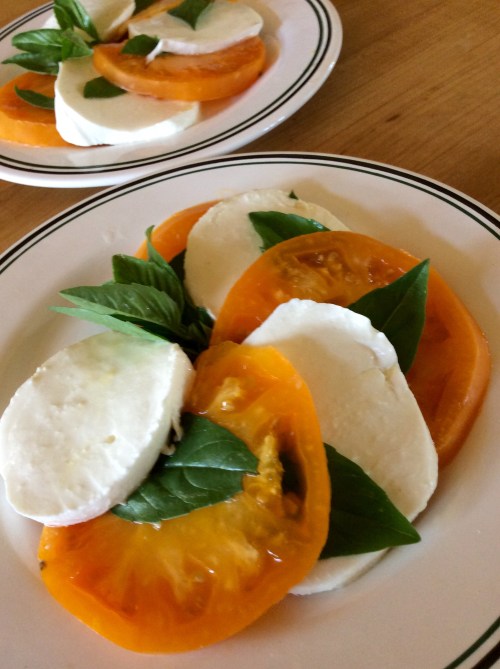
Caprese salad

Caprese salad

RECIPE

Caprese Salad

Ingredients

  • 1 or 2 large, ripe tomatoes
  • ½ to 1 pound fresh mozzarella
  • fresh basil leaves
  • extra virgin olive oil (the best you have)
  • salt
  • freshly ground black pepper (optional)

Method

  1. Slice the tomatoes and the mozzarella.
  2. Arrange the tomato slices, mozzarella slices and basil leaves in layers on salad plates. Sprinkle generously with olive oil and sprinkle with salt and optional ground pepper. Serve immediately.

9 Comments

Filed under Food, Photography, Recipes

RUSTIC GAZPACHO

The bounty of summer is beginning to pour in. Our neighbor has more peaches than he knows what to do with. Now we have more peaches than we know what to do with. And he has invited us back for more. Unfortunately his apricot and cherry trees had no fruit this year, probably because of  late frost.

Good friends gave us some delicious plums from their back yard. We will probably get some more when we visit them today. So far, no one has given us any zucchini, but they will come. The tomatoes are in abundance.

This week we went to the market at the Community Farm instead of our usual visit to the farmers’ market at the Rail Yard. The Community Farm is a group of fields and orchards owned by a 90+ year-old man who has contributed their use to the city. Volunteers do all of the work, and so the vegetables are not the perfect specimens that you find at the farmers’ market much less the supermarket. But the produce is put to good use. Most of it goes to the local food bank and a program of meals for house-bound clients. The farm has a public market every Sunday afternoon. We pulled into the driveway and were greeted by a group of volunteers clearly proud of their efforts: piles of fresh vegetables. We bought baskets of  fragrant and colorful vegetables, and now we have to make some good stuff from the bounty.

There were lots of tomatoes, peppers, cucumbers, and a red onion in our basket. What could be better to make than a summer soup of gazpacho? Actually, I am not a big fan of most gazpacho. It is often puréed into oblivion and resembles baby food. I much prefer to have identifiable vegetables and crusty garlic croutons. That’s what this recipe is.

RECIPE

Rustic Gazpacho

Ingredients

  • 6 ripe tomatoes, blanched, peeled, seeded, and coarsely chopped
  • 1 medium cucumber, peeled and coarsely chopped
  • 1 bell pepper, seeds removed and coarsely chopped
  • 1 small red onion, peeled and coarsely chopped
  • ½ cup minced parsley
  • 2 cloves garlic, finely minced
  • juice of 1 lemon
  • juice of ½ lime
  • ½ teaspoon sugar
  • ½ cup extra virgin olive oil
  • 4 cups chicken stock
  • salt and pepper
  • garlic croutons
  • snipped chives (optional)
  • sour cream (optional)

Method

  1. In a large bowl, combine the tomatoes, cucumber, pepper, onion, parsley, and garlic.
  2. In a small bowl, whisk together the lemon juice, lime juice, sugar, and olive oil until well combined. Stir the mixture into the vegetables.
  3. Stir in the chicken stock. Chill, covered, in the refrigerator for at least 2 hours. Adjust seasoning with more lemon juice if desired, salt and pepper. Serve, topped with croutons. Garnish with snipped chives and sour cream if desired.

14 Comments

Filed under Food, Photography, Recipes

RASPBERRY SNOW

It’s raspberry season, at least in the Rocky Mountain West. A friend just brought us a jar of raspberry preserves from Garden City, Utah. That’s home to a number of raspberry farms and the Bear Lake Raspberry Days. Closer to our current home is the Salman Raspberry Farm. You can pick your own, buy their preserves, or buy them in our local farmers market.

Bear Lake is a spectacular blue lake that sits astride the border between Utah and Idaho. It was home to back-to-back Mountain Men Rendezvous in the 1820s. Since then it has been a site of retreat for people from all over the world but especially from Salt Lake City. We made at least one annual trip every year we lived in Salt Lake City. The blue color of the water is so intense that it looks other-worldly. It is said that the color is due in large part to tiny grains of limestone, so-called glacial flour. Lakes in the Canadian Rockies, like Jasper Lake, are also an intense blue said to be due to glacial flour. Lake Tahoe on the California-Nevada border is also an intense blue, but local authorities have different explanations for the cause.

Salman’s Ranch can’t boast an other-worldly blue-colored lake, but it has its own long history. And it has raspberries.

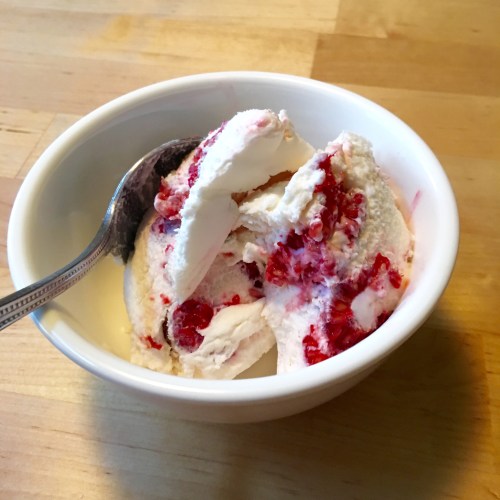
The gift of raspberry preserves was delicious, but the preserves gave me a hankering to do something with fresh berries. Raspberries and cream, though delicious, seemed a bit prosaic. Panna cotta with fresh berries was a little more complicated. Then I thought of a raspberry Bavarian. That would definitely not be a prosaic dessert. On the other hand, making a crème anglaise and finding a suitable mold seemed like a lot of trouble. I settled on something in between, raspberries in whipped cream stabilized with gelatin. The final result was ok – good but not great. There are some modifications that I would make to the recipe if I would do it again.  For one, you could use about half as much gelatin. Still, we cleaned the bowl in just a day, so I guess it wasn’t too bad.

Fresh raspberries

Fresh raspberries

Raspberry snow

Raspberry snow

RECIPE

Raspberry Snow

Ingredients

  • 1 pint fresh raspberries
  • 1 cup heavy whipping cream
  • 1 teaspoon vanilla extract
  • 1 packet (¼ ounce) unflavored gelatin
  • ¼ cup cold water
  • ¼ cup boiling water

Method

  1. Wash and drain the raspberries
  2. In a medium bowl, whip the cream to stiff peaks. Stir in the raspberries and vanilla extract. You may crush some of the raspberries as you stir them into the cream. That is fine because the juice will add to the color and flavor of the whipped cream.
  3. In a small bowl, sprinkle the gelatin granules over the cold water and let sit for at least a full minute until the gelatin is fully bloomed. Add the boiling water and stir for at least 2-3 minutes until the gelatin is fully dissolved.
  4. Stir the gelatin mixture into the whipped cream mixture. Be sure that it is evenly and completely incorporated. Cover the bowl with plastic wrap and refrigerate for at least 3 hours or until the mixture is set. If you prefer,, you can transfer the mixture to a decorative bowl or mold before chilling it.

5 Comments

Filed under Food, Photography, Recipes

SWISS STEAK AND FINGERLING POTATOES

I ate a lot of Swiss steak while growing up. I suspect a lot of kids of the 1950s and 1960s ate a lot of Swiss steak. It was fairly easy and fairly cheap. Moms could whip it together when they got home from work.  It probably got even more popular when crock pots came along. Honestly, I didn’t much like it – too many vegetables. I’m over that dietary hang-up now.

I haven’t had Swiss steak for years, and I think it has fallen out of favor across the USA. I’m not sure why that might be. Perhaps it reflects the move away from red meat. Perhaps folks have come to prefer vegetables that haven’t been cooked to death. Whatever the reason, I am of the mind that it needs to be reinstated as a delicious family meal. If you  add some potatoes – in this case, fingerlings from the farmers’ market – you wind up with a complete one-dish evening meal.

Fingerling potatoes

Fingerling potatoes

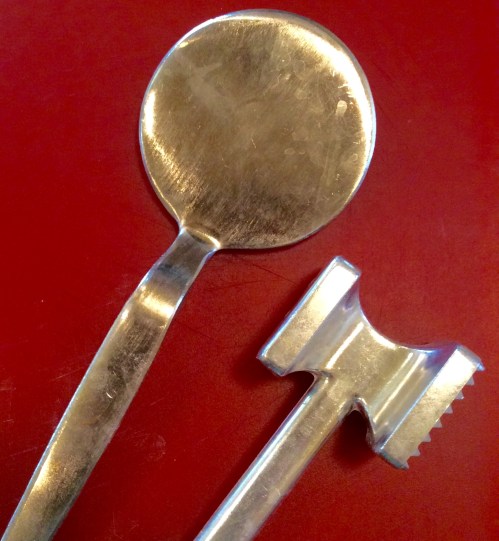
An interesting factoid that I learned in reading about Swiss steak: I had always assumed that Heidi’s mother made the dish while Heidi was out with the cows in a beautiful Alpine valley. Not so. “Swiss” refers to the process of pounding floured meat to tenderize it rather than to the country of origin. As to the pounding, the purpose is to break down muscle fibers in tougher cuts of meat. The simplest way to manage this step is to have your butcher run the meat through a “tenderizer” or “cuber”.  In my opinion, while the process does indeed tenderize the meat, it brings it just one small step away from ground beef. A meat pounder, with or without teeth, is a useful home kitchen tool. The edge of a saucer or small plate works just as well.

A pounder is a useful kitchen tool

A pounder is a useful kitchen tool

The geometry of pounded steak

The geometry of pounded steak

RECIPE

Swiss Steak and Fingerling Potatoes

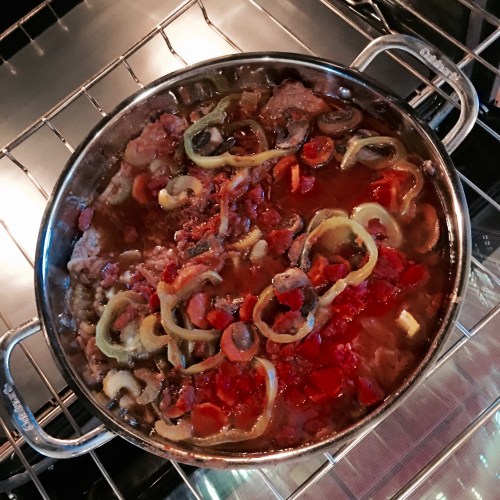
Halfway through the braising

Halfway through the braising

Ingredients

  • 1 cup all-purpose flour
  • 2 tablespoons kosher salt
  • 1 tablespoon ground black pepper
  • 1 pound round steak, cut about 1 inch thick
  • 3 tablespoons vegetable oil
  • 1 large onion, sliced thinly
  • 2 cloves garlic, minced
  • 1 large carrot, peeled and sliced into ¼ inch discs
  • 1 stalk celery, sliced thinly
  • 1 large green bell pepper, seeded and sliced in rounds
  • 8 medium crimini mushrooms, sliced
  • 14.5 ounce can diced tomatoes
  • ½ cup red wine
  • ½ cup beef stock
  • 2 teaspoons paprika
  • 1 tablespoon tomato paste
  • good pinch of sugar
  • 2 bay leaves
  • 8 – 12 fingerling potatoes
  • salt and pepper to taste

Method

  1. In a pie plate or deep dish, combine the flour, salt, and pepper. Cut the round steak into serving-sized pieces and blot dry. Dredge the pieces of steak in the flour mixture, shake off any excess, and place one-by-one on a flat surface. Pound on each side, dredge again in flour, and pound on each side again.
  2. Over medium-high flame, heat the vegetable oil until it is shimmering. Add pieces of floured steak and brown on both sides, turning several times as the meat browns. Transfer the browned steaks to a plate.
  3. Add the onions to the oil remaining in the pan and stir until the onions are caramelized, about 5 minutes.
  4. Stir in the garlic, carrot, celery, bell pepper, and mushrooms. Sauté for about 5 minutes until the vegetables are lightly cooked and the celery is translucent.
  5. Stir in the canned tomatoes, wine, beef stock, paprika, tomato paste, and sugar. Add the bay leaves. Bring to the boil, cover, and transfer to the middle of an oven preheated to 225°F.
  6. Cook for at least 3 hours, stirring from time to time and adding more water if needed.
  7. About an hour and a half before you are ready to serve, add the fingerling potatoes, making sure they are well covered in the cooking liquid. Adjust the seasoning with salt and pepper. Remove the bay leaves.
  8. Serve the steak and potatoes in soup bowls, topped with the vegetables and sauce. Serves 3 – 4 persons.

    Ready to eat

    Ready to eat

7 Comments

Filed under Food, Photography, Recipes

ELITCH GARDENS LIMEADE: THE PATHS OF ROBERT REDFORD AND ME

Denver’s original Elitch Gardens was one of those classic Victorian amusement parks, built on an old farm in the outskirts of the city. The parks were often built at the end of a trolley line and served as a wonderful Sunday getaway for city dwellers. During my high school years, I worked there in the summers.

Elitch started out as a botanical garden and zoo with picnic pavilions, but before long the zoo disappeared and the park added a miniature train, a carousel, restaurants, a wooden roller coaster and a baseball field where semi-pro teams played. There were two special attractions. The theater was claimed by Elitch to be the oldest and longest continuously operating summer stock theater in America. The Trocadero Ballroom was a huge art deco venue with open arcades to catch the breezes, a large bandstand, and tables all around for refreshments.

The theater was a relic of the Victorian Age, made with clapboard painted pea green, edged with white boards and topped with a cupola. There was a passageway to the entrance that was lined with photos of all of the luminaries who had played there, including Sarah Bernhardt, John Barrymore, Gloria Swanson, Myrna Loy, and many others, famous and not so. All of the pictures were inscribed to the owner of Elitch along with the kind of sappy notes that are always attached to that kind of image lined up  on the walls of restaurants and commercial establishments..

The Trocadero seemed elegant with recessed lights and hanging baskets of flowers in the arcades. I am sure that it was a potential fire trap like so many of the other ballrooms across the country. In the 1930s, 1940s, and 1950s it was the place to go for young people looking for a relaxed evening. All of the famous bands came through for a one- or two-week stand. There was Benny Goodman, Les Brown and the Band of Renown, and the Dorsey Brothers, Tommy and Jimmy. But by far, the most popular band was Lawrence Welk. He could really pack in the crowds.

For a time I worked at the Hamburger Stand, exactly what it sounds like, in the middle of the park and next to the carousel. The management was very proud of the fact that the soda fountain was the original from 1890, and so was the cooktop. The workers were not as happy with the ancient cooking gear as the owners. I was a busboy who then got promoted to working the order window and finally put behind the grill as the short-order cook. It was an interesting job and gave me an interesting perspective on customers and serving the public.

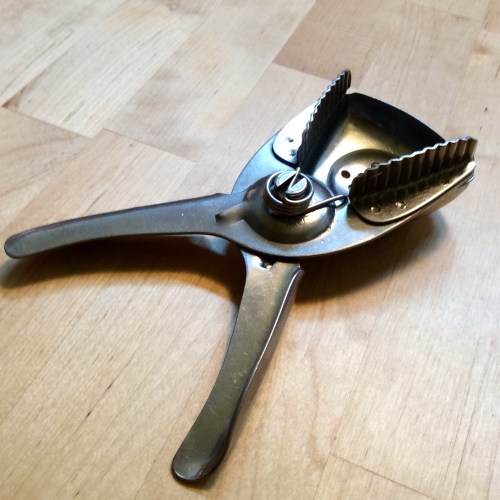
At the Trocadero, I worked as a busboy except when I ran the Lemonade Stand at the theater.  The Lemonade Stand was a little Victorian pagoda where we sold orange juice and lemonade made from very large cans of frozen concentrate that we thawed and diluted. Limeade was freshly made, and it was very popular.  Each day in preparation for the theater crowd, I would line up squadrons of paper cups in hotel pans, cut limes in half  and squeeze one lime into each paper cup. I wore out at least one metal squeezer, but my wrists got very strong. Each cup got a maraschino cherry and two squirts of simple syrup from the antique soda fountain. Then the prepared cups were put in the walk-in cooler until I hauled them to the lemonade stand to await the theater crowds and for final assembly.

Metal lime squeezer

Metal lime squeezer

When theater intermission came, the audience would rush out, and I would make them limeades as quickly as I could by adding ice and seltzer to the prepared paper cups. My efforts were never fast enough for the impatient crowds who worried that they might miss the curtain. There was a Wednesday matinée, and the crowd changed. The audience was almost all women who had enjoyed a fancy luncheon before the show. They were anxious to get their limeades at intermission. The ladies all wore gloves and hats.  I often wondered how you can see the play when you are sitting behind a lady with a hat?  One of the great unsolved mysteries of my lifetime.

When I was reading about the history of Elitch, and especially the theater, I learned that Robert Redford was listed as a cast member in 1955. That was the heyday of my lemonade stand days. I imagine that Robert Redford was busy inside learning and practicing how to be rich and famous. I was outside, making fresh limeade for ladies with gloves. Redford and I never met.

RECIPES

Simple Syrup

Ingredients

  • 1 cup sugar
  • 1 cup water

Method

  • Combine the sugar and water in a small saucepan. Do not worry if there is undissolved sugar.
  • Over high heat, bring the mixture to a boil and boil for 5 minutes, stirring occasionally. .
  • Remove from the heat. Cool. Transfer to a clean glass jar with a tight lid. Refrigerate any unused syrup.

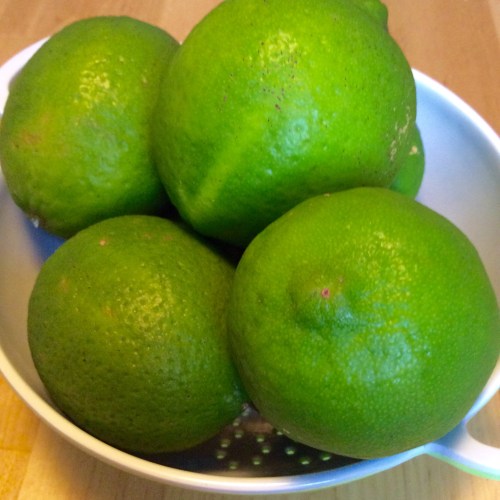
    Persian limes - or just "limes"

    Persian limes – or just “limes”

Elitch Gardens Limeade

Ingredients

  • 1 large Persian lime (Key limes won’t work)
  • 1 maraschino cherry
  • 1 ounce (equivalent to 2 squirts from the soda fountain dispenser) simple syrup
  • ice
  • club soda

Method

  • Soften the lime by rolling it with the palm of your hand on a hard surface. Cut it in half. With a lime squeezer, squeeze the juice into a 12-ounce glass, and add the rinds to the juice.
  • Add the maraschino cherry and the simple syrup.
  • Pack the glass with crushed ice or ice cubes
  • Fill the glass with club soda. Stir to mix, and serve. Makes one drink.

    My version of Elitch Garden limeade

    My version of Elitch Garden limeade


2 Comments

Filed under Food, Photography, Recipes

CHOPPED CHICKEN LIVER

We found a container of frozen chicken livers in our chest freezer. Susan thought that was an invitation to make chopped chicken liver to spread on toast for a light dinner during our current heat wave. That sounded like a good idea. We have several recipes, but I wanted to try something that was possibly more “authentic.”

I turned to Amanda Hesser’s The Essential New York Times Cookbook, which is an up-to-date, authoritative cookbook that has become a consistent go-to. She had a recipe for chopped chicken livers from Russ and Daughters on East Houston Street on the Lower Eastside. What could be more authentic than that?

Between them, our two girls lived in New York City for a number of years. Actually, for much of the time  they lived close to Manhattan. Carol lived in Hoboken while it was “cheap”. Now the hipsters have moved in, and it is no longer cheap. Every day she rode the bus through the Lincoln Tunnel to the Port Authority close to her job at the McGraw-Hill building.

Sarah lived in Hoboken for a time, too. She took the PATH to the World Trade Center. Then she moved to a couple of places in Queens, including a walk-up in Long Island City. The apartment was directly over an auto body shop, but it had a definite advantage. If you crawled out of the kitchen window you could enjoy a “terrace” that was actually the roof of the auto shop. There were no guard rails, so there was danger of falling into the salvage yard behind the garage, protected by two snarling, leaping, unchained German shepherds (They’re called “junk yard dogs”). When you were out on the terrace, but only if you balanced on a chair, you could see the tallest spires of a bit of the Manhattan skyline. I think New York realtors call that a peek-a-boo view. I don’t think the neighborhood is in danger of gentrification.

Years later, I saw the movie, Julie and Julia. I am convinced that they used Sarah’s apartment for one of the sets for that movie.

Eventually, Sarah and Evan moved to the Red Square Apartments on East Houston on the Lower Eastside. To this day you can recognize the building by the clock with random numbers and the 18 foot statue of Lenin with his arms outstretched in the direction of Wall Street. This neighborhood has undergone gentrification. Sarah and Evan probably couldn’t afford to live there anymore. There are multiple high-rise condominium buildings along with a fancy new grocery store AND a giant Whole Foods.

This is a long-winded introduction to tell you about the culinary delights of East Houston. There is more than one Punjabi takeout for the taxi drivers. There are several tiny but well known restaurants with long lines for Sunday brunch. But the jewels of eating are on the south side of Houston. The most famous is undoubtedly Katz’s Delicatessen, saved from threatened destruction during the gentrification process. The place is not to be missed. Just remember to follow precisely the instructions for diners before you start the process, especially in keeping track of your bill. You will be rewarded by one of the largest, most delicious pastrami (or whatever meat you choose) sandwiches you have ever had.

Then there’s Yonah Schimmel for knishes. The place goes back more than a hundred years, and I think it has not been renovated in a hundred years. Honestly, I am not a big fan of knishes, but this is the real thing, and just like an IHOP pancake it will stick to your ribs all day long.

My favorite food stop, though, is Russ and Daughters, specializing in smoked fish, caviar, herring, and related delicacies. It, too, dates back to more than a hundred years ago. It looks like it was updated in the 1930s, with art deco signs and lettering, straight out of a black and white movie with Nick and Nora Charles. The phalanx of servers is intimidating and definitely no-nonsense, but they turn out to be friendly (as much as you can expect), fast, and efficient. Besides their lox, they are famous for their chopped chicken livers. Here’s an interpretation of their recipe:

Chopped Chicken Liver

I thawed one container of frozen chicken livers, about one pound. I rinsed them and blotted them dry. Then I fried them in 2 tablespoons of vegetable oil, about 3 minutes on each side, and set them aside on a plate. Using a sharp chef’s knife, I chopped them coarsely. (You can use a food processor, but then the delicate livers will turn to mush.)

I hard-boiled three eggs, chilled them, and peeled them. Using a fork, I mashed them coarsely.

I diced two large yellow onions. Then I caramelized them in a sauté pan in 2 tablespoons of vegetable shortening, about 40 minutes.

Finally, I combined the sautéed chicken livers, mashed eggs, and caramelized onions. I adjusted seasoning with salt and pepper, and chilled in the refrigerator for an hour before serving with rye flat breads.

I’m not sure my recipe is authentic, but it turned out to be very tasty.


9 Comments

Filed under Food, Photography, Recipes

CFS: CHICKEN-FRIED STEAK WITH MASHED POTATOES AND CREAM GRAVY

Who doesn’t like CFS (chicken-fried steak)? Our older daughter, Carol, for one.  That is a surprise since she has roots in East Texas and Shreveport (There are credible claims that Shreveport is actually just an extension of East Texas)

She loves steak, but she believes that all that bread stuff just spoils a good piece of meat. I certainly agree with her point of view when some fancy pants restaurant does a chicken-fried rib eye or tenderloin. In that setting, I just want the real thing.

Chicken-fried steak, on the other hand, is a food of the people: a piece of round steak usually tough as a boot unless it is cooked for hours can be turned into a fork-tender delicacy through systematic pounding, breading, and frying. It becomes a distant relative of the more elegant Wiener schnitzel and veal alla Milanese.

Then there are the required accompanying mashed potatoes. They serve as the base for pouring on the cream gravy. In many a roadside diner they come from a box or are  lumpy, having sat for hours in a steam table. Really good mashed potatoes raise the  stakes (No pun intended) to something bordering on ethereal.

Finally, there is the cream gravy. No self-respecting CFS appears on the table without a good lacing of cream gravy. Unfortunately, many versions of cream gravy resemble, in both taste and consistency, library paste. In fact, you could probably use it as such when  it gels on the plate in a white, immobile blob. But again, there are few things as tasty as a well-made gravy studded with bits of crispy crust and a rich flavor from the fond of the cast iron frying pan.

My mother – who had never been to Texas until I was an adult – made a great CFS. She had her own little secrets. She pounded the floured raw meat with a saucer. She used crushed saltine crackers for the breading. And after browning the meat in a hot skillet with plenty of oil, she simmered the steaks for a half-hour or longer until the meat was tender. Then she raised the heat to get a crisp, brown exterior. I’ve never mastered those final steps, so this version relies on thin steak to be tender.

For mashed potatoes, I have used Sarah’s recipe as printed in the San Francisco Chronicle. For the gravy, I have used the decades-old recipe from our family cookbook.

Steamed broccoli with btter makes a good vegetable accompaniment.

RECIPES

Chicken Fried Steak

Ingredients

  • 1 pound round steak, thinly sliced (cubed beef should NOT be considered an acceptable substitute)
  • salt and pepper
  • all-purpose flour
  • 1 cup buttermilk
  • 1 large egg (I wound up using a double yolked jumbo)
  • 1 sleeve saltine crackers
  • peanut oil for frying

Method

  1. Trim any fat and silver skin from the steak and, if necessary, cut into serving-sized pieces. Season with salt and pepper.
  2. Dredge the pieces of steak on both sides with flour. Using the edge of a small plate or saucer, pound each steak in one direction and then at 90°. Turn over, and repeat the pounding process.
  3. Combine the buttermilk and egg in a pie plate, mixing vigorously to make sure the egg is completely incorporated. Individually, dip each floured steak in the mixture and then transfer to a second pie plate filled with crushed cracker crumbs.
  4. Coat both sides of each steak generously with the cracker crumbs, making sure that the meat is completely covered. Transfer to a drying rack.
  5. When you are ready to cook the steaks, heat the largest cast iron skillet that you have over a medium-high flame. Add about 1 inche of peanut oil (canola is also good) and heat until the oil is shimmering but not smoking. If you have a thermometer, heat to 350°F.
  6. Add enough steaks to fill the pan. Fry for a few minutes on one side until browned, about 5-10 minutes. Then turn and fry on the other side. If you are cooking in batches, transfer to a warming plate in a 170°F oven until all of the meat is cooked. You will also need to keep warm while you make gravy.
  7. Make gravy according to the following directions. Then serve immediately while still warm with mashed potatoes and cream gravy.

Mashed Potatoes

Ingredients

  • 2 pounds Yukon gold potatoes (about 5-6 medium potatoes), peeled and quartered
  • salt
  • 1 cup milk
  • ½ cup heavy cream
  • 2 sticks (½ pound) unsalted butter, softened
  • salt and pepper to taste

Method

  1. Place the potatoes in a large pot and cover with heavily salted water. Bring to the boil. Then reduce to a brisk simmer for 15-20 minutes or until the potatoes are pierced easily with a kitchen fork. Overcooked is better than undercooked. Drain.
  2. Transfer to a potato ricer in batches. Rice the potatoes into a medium saucepan. Over low heat, stir the potatoes with a wooden spoon until excess water is boiled out, about 2-3 minutes.
  3. Combine the milk and cream in a small pan and heat until they are just at a simmer.
  4. Add the butter to the potatoes and stir until completely incorporated. Stir in the milk/cream mixture slowly while stirring until the desired consistency is reached. Adjust seasoning with salt and pepper if needed. Serve immediately. If you are serving with chicken-fried steak, you will want to make a well in the middle of each serving to hold some of the gravy.

    Yukon gold potatoes

    Yukon gold potatoes

Cream Gravy

Ingredients

  • ¾ cup milk
  • ¼ cup cream
  • 1 cup chicken stock
  • 2 tablespoons flour
  • pan drippings from fried steak
  • ¼ cup dry white wine or dry white vermouth
  • salt and pepper

Method

  1. In a jar with tight lid (a pint Mason jar works well) combine the milk, cream, chicken stock, and flour. Cover and shake until the ingredients are well mixed. Set aside.
  2. Drain all but 2 tablespoons of the cooking oil from the pan used to fry the steak. Deglaze the pan with the wine, scraping loose any brown bits.
  3. Over medium heat, stir in the milk mixture, shaking it first to make sure it is well mixed.
  4. Stirring constantly, incorporate any loosened brown bits and bring the mixture to a low boil, continuing to cook until the gravy is thickened. If too thick, dilute with a little bit of milk. If too thin, stir in a bit of Wondra flour, stirring vigorously to prevent lumps. Adjust seasoning with salt and pepper. Serve immediately. Be sure to make a well in the middle of the heap of mashed potatoes on each plate to get some extra gravy; Put some gravy on top of the steak, too, if you want to feel real down-home.

    A traditional down home plate

    A traditional down home plate


14 Comments

Filed under Food, Photography, Recipes

SANTA FE STYLE CHICKEN AND WAFFLES

Chicken and waffles has become a trendy dish often featured in trendy restaurants. Supposedly it had its origins in soul food. There are definitely clues that reinforce that attribution: fried chicken and waffles is apparently a stand-by in Baltimore, there is a temple of the dish in South Los Angeles, and at least two places in Harlem have built their reputation on fried chicken and waffles. Honestly, I have never understood the enthusiasm. I love fried chicken as much as the next person, and waffles can be a terrific breakfast or dinner. But crisp fried chicken and sweet-sticky maple syrup together just doesn’t sound like a combination I want to give a try.

Turns out there is another version of chicken and waffles. It traces its origins to the Pennsylvania Dutch area around Lancaster, Pennsylvania. The dish is essentially the filling for chicken pot pie served on top of a waffle. To me, that is an interesting concept, and one that sounds like it might be delicious. My mother’s family traces its origins from Pennsylvania Dutch country through Wisconsin, Iowa, and eventually South Dakota. My wife’s family hails from Wilmington, Delaware, just a short drive to Lancaster. I don’t remember chicken and waffles ever showing up on either family table.

That made me think that maybe a Southwestern version of chicken and waffles incorporating some regional ingredients would make a good alternative to either of the better known traditions. Blue cornmeal waffles seemed like a good starting place. Green chiles and piñon nuts would serve as tasty additions. To brighten up an otherwise monochromatic dish, I topped it all with pico de gallo. For that, you probably have your own recipe. If you don’t, I’ve added one without the kick (There is a serious medical reaction to capsaicin in our household) but you are encouraged to zip it up to your own tastes.  So here it is: Santa Fe Style Chicken and Waffles with blue cornmeal waffles and green chile chicken sauce. If you can’t find blue cornmeal at your local store, you can order some from Talon de Gato farms. Otherwise, substituting yellow or white cornmeal is perfectly acceptable.

RECIPES

Blue Cornmeal Waffles with Pine Nuts

Ingredients

  • 1 cup all-purpose flour
  • 1 cup blue cornmeal
  • 2 teaspoons baking powder
  • ½ teaspoon baking soda
  • ¾ teaspoon salt
  • 2 cups buttermilk
  • ¼ cup maple syrup
  • 5 tablespoons unsalted butter, melted
  • 2 large eggs, separated
  • ½ cup pine nuts

Method

  1. In a large bowl, combine the dry ingredients: flour, cornmeal, baking powder, baking soda, and salt.
  2. In a separate medium bowl, combine the buttermilk, maple syrup, and melted butter. Whisk in the separated egg yolks until completely incorporated
  3. In a small bowl, beat the separated egg whites to stiff peaks. Fold into the batter in thirds.
  4. Stir in the pine nuts.
  5. Spoon into a heated waffle iron using slightly more than the amount recommended by the manufacturer. Bake until golden brown. Bake the remaining batter.

Green Chile Chicken Sauce

Ingredients

  • 2 tablespoons vegetable oil (chicken fat if you have it)
  • 1 large onion, diced
  • 4 ounces canned chopped green chiles (choose your heat)
  • 3 tablespoons all-purpose flour
  • 2 cups chicken stock + more as needed
  • 1 tablespoon dried Mexican oregano
  • ½ teaspoon ground cumin
  • salt and pepper
  • 1 whole chicken breast, cooked and shredded

Method

  1. In medium saucepan, heat the oil over medium-low heat. Add the onions, cover and sweat the onions for 5 minutes, stirring occasionally so as not to brown.
  2. When the onions are translucent, stir in the green chiles and cook, uncovered for an additional 5 minutes.
  3. Stir in the flour and cook for 5 additional minutes to remove the raw flavor of the flour. Add the chicken stock, stirring to remove any lumps. The sauce should be about as thick as a medium white sauce.
  4. Add the oregano by crumbling it between your hands over the pan. Add cumin and adjust seasoning with salt and pepper.
  5. Stir in the shredded chicken and simmer for 15 minutes more, or until the mixture is heated through.

Pico de Gallo

Ingredients

  • 1 large ripe tomato, seeded and coarsely chopped
  • 3 scallions including green tops, chopped
  • ½ onion, coarsely chopped
  • ¼ cup chopped green bell pepper (substitute jalapeño for more heat)
  • ¼ cup coarsely chopped cilantro leaves
  • juice of 1 large lime
  • salt and pepper

Method

  1. Combine all of the ingredients in a small bowl. Adjust seasoning with salt and pepper
  2. Cover tightly and refrigerate for at least 30 minutes. Serve.

Assembly

Place two waffles on each plate. Top with about 1½ cups of the green chile chicken sauce. Garnish with pico de gallo. Serve immediately with more optional Cholula sauce, if desired.

9 Comments

Filed under Food, Photography, Recipes

ROTISSERIE-ROASTED CHCKEN

When you are down-sizing and decluttering as we are right now, you open a lot of boxes that haven’t been opened since the day they were packed. You also dust off a lot of things that have been lurking on a high shelf in the garage. The most common response to a new discovery is probably to ask why in the world did you save [fill in the blank] in the first place. There are some items that you are pleased to see, and that bring back fond memories. The initial response is usually to keep such treasures even though the more reasoned reaction should be to toss them out or at least give them away.

There is another category of stuff: things that you want to try out or take on another spin before you make a decision. We found one of those in the garage. We had already brought it with great care from the family farm several years ago, and we had even used it several times before banishing it to the garage.

It was my mother-in-law’s Sunbeam Carousel Rotisserie Broiler, complete with a pamphlet of recipes and illustrations of happy chickens, pigs, and cows. I’m not sure how old the broiler is, but I would guess that it came from the 1960s. You can buy one on eBay or from Amazon, complete with original box, for $90-125. Mom-Mom’s is in remarkably good shape. The electrical cord, although old and without any of the modern safety features, is not frayed. The broiler turns and heats up when you plug it in.

The process for broiling chicken with this device is amazingly simple: Truss the chicken as you might for roasting it in the oven. If you’ve never trussed a chicken, Julia Child describes a method in volume I of Mastering the Art of French Cooking and Jacques Pepin describes three methods in his classic, La Technique. Two of those methods require a trussing needle, but the task can be done simply with kitchen twine.  Put your favorite flavorings in the body cavity before you truss it. I used butter, lemons and freeze-dried lemon powder. Slather the bird with melted butter. Put it on the rotisserie, legs down. Put on the lid, and plug it in. The suggested cooking times are even printed on the metal and glass-domed lid, so you don’t have to do much thinking. You can use a roasting thermometer if you prefer. For that, you will need to unplug the rotisserie, take off the lid, and preferably use an instant-read probe thermometer.

We had a five-pound chicken in the freezer. That’s about as big a bird as you can cook with the rotisserie. The chicken cooked to a beautiful golden brown and was juicy and delicious.

One thing is certain: if we spend as much time with every re-discovered treasure in our garage as we have with the rotisserie broiler we will never get down-sized or decluttered.

RECIPES

Trussing Poultry


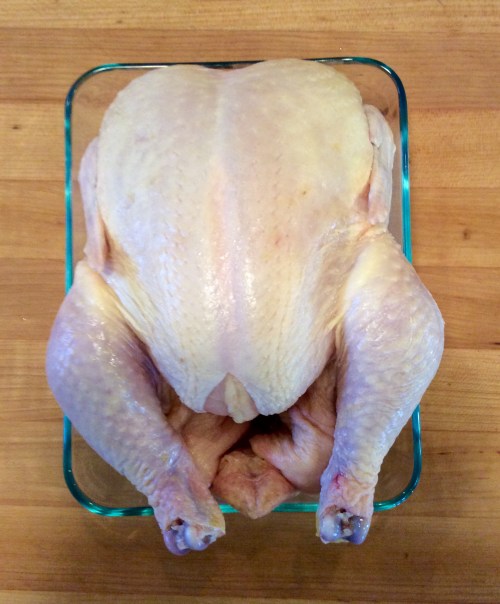
  1. Rinse and pat dry with paper towels a good-sized chicken, making sure that the bird has been completely defrosted and the gizzard, liver, heart, and neck have been removed from the body cavity.

    Good-sized roasting chicken

    Good-sized roasting chicken

  2. Remove the first joint of the wings with poultry shears.

    Cut off the first joint of the wings

    Cut off the first joint of the wings

  3. Salt and pepper the body cavity generously, and, if you like, stuff it loosely with sliced lemons.
  4. Holding a piece of kitchen twine in your fingers, stretch out both arms. Cut the string to that length.
  5. Find the middle of the string and catch it under the tail. Cross the string to both drumsticks. Wrap the string around both drumsticks and pull tight so that the drumsticks come together and the body cavity closes.
  6. Pass the two ends of the sting up the sides of the bird. Then turn the bird over and fasten the wings against the body with loops of the string in the bend of the wing. Make sure the wing is held tightly against the body. Tie the two ends of the string together and trim off long ends. The bird should be a compact packet that will fit on the rotisserie spit safely.

Carousel Rotisserie Broiled Chicken

Ingredients

  • 5 pound chicken
  • salt and pepper
  • lemons
  • melted butter

Method

  1. Rinse the chicken and pat dry. Season the cavity with salt, pepper, sliced lemons and melted butter
  2. Remove the tips of the wings of the chicken at the first joint. Truss the chicken with kitchen twine according to instructions above. Make sure that the chicken is a compact bundle so that it can turn freely in the rotisserie without brushing against the heating element. Brush the whole surface generously with melted buter. Add ½ cup water or chicken stock to the drip pan that holds the spit and basket. Put the chicken, legs down, on the spit. You may need to use the basket accessory to stabilize the bird. Cover with the domed lid. Turn on the broiler by plugging it in. Make sure the chicken turns freely and clears the burner element.
  3. Broil for 15-17 minutes per pound, checking through the dome frequently
  4. When the chicken is done, unplug the rotisserie; remove the chicken from the spit being careful not to burn yourself; remove the string and lemons if you are using them; let rest for 5 minutes; carve and serve. .

10 Comments

Filed under Food, Photography, Recipes