Category Archives: Recipes

SEA-SALT-SPRINKLED CHOCOLATE SABLÉS

Rich Table changes its dessert menu almost on a weekly basis, so chocolate sablés are on and off the list. But they are never off for long because they are so popular, and the restaurant regulars insist on them. These tasty little sandy cookies (Sablé is the French word for “sandy”.) are a great way to end a meal, especially when combined with ice cream, a light mousse, crème brûlée, or panna cotta.

The texture of the cookies is sandy because the ingredients are mixed together very lightly so that the crystals of sugar do not completely dissolve, so be careful not to over-work the dough.

This particular version adds a light dusting of smoked sea salt. I used smoked Halen Môn, a Welsh sea salt harvested on the Isle of Anglesey from whence my great-grandfather and great-grandmother migrated many decades ago.

It is interesting how well chocolate and salt seem to go together. You certainly see the effective combination in these cookies, but also increasingly in ice cream and chocolate bars.

Unfortunately, this is not Sarah’s authentic recipe, but it is pretty close to the real thing. The cookies are fairly easy to make, although there are several steps, and there are a couple of tricks along the way. These were a big hit at our recent potluck birthday party.

RECIPE

Sea-Salt-Sprinkled Chocolate Sablés

Ingredients

  • 3 ounces bittersweet chocolate
  • 1¼ cups flour
  • 1/3 cup cocoa
  • ¼ teaspoon baking soda
  • ¼ teaspoon sea salt
  • 11 tablespoons unsalted butter, softened
  • 1 cup sugar
  • 1 large egg yolk
  • water
  • smoked sea salt (Halen Môn or your favorite brand)

Method

  1. Place chocolate in freezer compartment of refrigerator for 10 minutes. Then grate onto a sheet of waxed paper using the fine side of a box grater. You will generate static electricity with the grating, so “ground” the gratings by touching them before you pour them into a bowl. Set aside.
  2. Whisk together the flour, cocoa, baking soda and sea salt.
  3. In a medium bowl, mix the butter and sugar together with an electric mixer until just combined. Do not over-beat. Then mix in the egg yolk.
  4. Add the dry ingredients and mix together briefly until just combined. Do not over-beat.
  5. Fold in the grated chocolate with a spoon or spatula.
  6. Squeeze the dough into a ball with your hands. The warmth of your hands should melt the butter slightly so that the dough comes together.
  7. Place the dough in the middle of a 16 inch long piece of waxed paper. Shape the dough into a log about 14 inches long,  3 inches wide, and 1 inch high, along the length of the paper.  Fold the waxed paper over the log, pressing the paper firmly against the dough. With the palm of your hand, flatten the log slightly so that it forms an oblong in profile.
  8. Refrigerate for 1 hour or more.
  9. While the dough is chilling, heat the oven to 350°F,  and line two cookie sheets with parchment paper.
  10. Remove the chilled dough from the refrigerator and cut into 1/3  inch thick slices with a very sharp knife. The dough will be very firm, so you will have to use some pressure on the knife to cut the slices.
  11. Arrange the cookie slices on the two cookie pans with at least 1 inch between them.  With a pastry brush, and in batches, moisten the tops of the cookies with a few drops of water. Sprinkle each moistened cookie with a few grains of sea salt. Chill again in the refrigerator for 15 minutes.
  12. Bake in the middle of the pre-heated oven for 10 to 12 minutes. Remove from the oven, cool on the pans for 5 minutes, and then transfer to baking racks until completely cooled.
  13. Serve. Makes about 24 oblong cookies.

6 Comments

Filed under Food, Photography, Recipes, Restaurants

CAJETA

It’s May! And I think that Spring may be here. Lots of flowers are in bloom, but we have experienced freezing weather for the last week. As well, it is a month of birthdays: three of our circle of friends are having birthdays within a week of one another, so we are planning a mass celebration. I am making the dessert. My plan is to make takeoffs from Sarah’s Rich Table desserts – salted chocolate sablés and buttermilk panna cotta. Neither of these is an authentic recipe from Sarah (Do you think Dad could talk her out of trade secrets?) but they should be close. I also plan to gild the lily – it is Spring, remember? – with Mexican cajeta to pour over the panna cotta.

The recipe for cajeta comes from the superb cook book, Authentic Mexican, by Rick Bayless and Deann Groen Bayless (William Morrow and Co., New York, 1987, p 293). Even though the recipe calls for regular white sugar, in the past I have used piloncillo, the small cones of unrefined sugar that you can find in Mexican and Central American markets. This time, though, I decided to go with turbinado. The other decision was whether to use goat’s milk or cow’s milk. The authentic version calls for goat’s milk, and it is easy to buy from the stalls selling goat cheese at the farmers market or in cartons at health food groceries, so I went with that.

The only tricky things about the recipe are: (1) don’t let the mixture boil over when you add the baking soda, (2) stir occasionally so that it doesn’t burn on the bottom, and (3) watch for the change in the size of the bubbles as it boils, because that is the sign to let you know it’s almost done.

Cajeta is akin to caramel or butterscotch sauces, and it can be used in exactly the same way. It is delicious over ice cream, fruit, cake, etc. I guess you could just eat it straight out of the bowl, and some folks probably do.

RECIPE

Cajeta

Ingredients

  • 1 quart goat’s milk
  • 1 cup turbinado sugar
  • 1 tablespoon light corn syrup
  • 1½ inch stick of cinnamon
  • ¼ teaspoon baking soda dissolved in 1 tablespoon water
  • 1 tablespoon light rum

Method

  1. In a large, heavy saucepan, combine the goat’s milk, sugar, and corn syrup, stirring until completely dissolved. Add the cinnamon
  2. Over medium heat, bring the mixture to the boil and then  remove from the heat and stir in the dissolved baking soda. It will foam up, so stir it vigorously to prevent boiling over.
  3. Return to the heat and adjust the temperature so that it simmers gently with a low boil. Stir frequently from the bottom of the pan to prevent scorching.
  4. Check frequently and stir. After about 30 – 45 minutes, the mixture will have reduced to about half or less, and the bubbles on the surface will change in size and become more glistening.
  5. Turn down the heat to medium-low, allowing the mixture to reduce still further, but stirring very frequently to prevent burning.
  6. When it has thickened sufficiently  – it should coat the spoon but still be fluid – remove from the heat. Cool for a few minutes, and then stir in the rum.
  7. Allow to cool completely and then transfer to a serving dish or to a wide-mouthed jar. It can be refrigerated for later use, but reheat gently before serving.

7 Comments

Filed under Food, Photography, Recipes

LIPTAUER CHEESE

In a recent post, I described an amazing feast we enjoyed at Bar Tartine in San Francisco. One of the co-chefs, Cortney Burns, is featured in an article titled, “Dairy Queen” in the Spring, 2014 issue of Culture: the Word on Cheese, a beautiful quarterly magazine all about cheese. Before our recent visit to the restaurant, Sarah and Evan said we should be sure to get the Liptauer cheese spread. Unfortunately, it was not on the menu that night, so we didn’t get to give it a try. I’m not sure, but I suspect that Cortney is behind the spread being on the menu because of her obvious interest and expertise in cheese. Liptauer cheese, like the pimento cheese I wrote about a while back, is a classic from earlier days, commonly seen at cocktail parties. I guess with the renaissance of cocktails, there is a renewed interest in cheese spreads as well. Liptauer cheese is the name for both the soft, fresh, sheep’s milk cheese originating in Liptauer, Hungary, and the seasoned spread made and enjoyed in Austria, Germany, and other European countries.  You probably won’t be able to find the original Liptauer cheese at your local cheese monger, but fortunately you can make a reasonable facsimile using cottage cheese or cream cheese. If you want to turn your spread into a dip, just add enough sour cream to suit your taste. Also, for some tastes, this version may be a little bland. You can spice it up with cayenne or your favorite hot pepper sauce to taste.

RECIPE

Liptauer Cheese

Ingredients

  • 8 ounces cream cheese, softened
  • 1 stick butter, softened
  • 1 tablespoon Dijon mustard
  • ½ teaspoon salt
  • ¼ teaspoon ground black pepper
  • anchovy filet, mashed (or about 1 inch of anchovy paste)
  • 1 tablespoon paprika
  • 1 tablespoon caraway seeds
  • 1 tablespoon capers, chopped
  • 1 tablespoon chives, minced
  • 1 tablespoon green onion tops, chopped
  • 2 tablespoons finely chopped cornichons
  • 2 tablespoons finely chopped flat-leaf parsley
  • cayenne or pepper sauce (optional, to taste)
  • finely chopped chives or green scallions or paprika for covering the cheese ball.

Method

  1. In a food processor, pulse the cream cheese and butter until smooth.
  2. Transfer to a bowl and stir in the remaining ingredients until evenly combined.
  3. Refrigerate until firm, at least two hours or overnight. When firm, shape into a ball and cover in plastic wrap. Chill again.
  4. Roll the chilled cheese ball in chopped chives or green scallion tops (I used a mixture of garlic chives and scallions. Alternatively you can roll it in paprika.)
  5. Serve at room temperature with fresh, crusty bread – preferably dark rye – or crudités.

8 Comments

Filed under Food, Photography, Recipes, Restaurants

THE MUFFULETTA AND THE CENTRAL GROCERY IN NEW ORLEANS

A while back I posted a recipe for olive salad that approximates the one that is used at the Central Grocery in New Orleans. Then I started reading Yelp reviews (which I try to avoid at all costs) and recipes on the Internet. All of that inspired me to write about what is said to be the “Original Muffuletta” and the Central Grocery.

First, there are Yelp complaints that the Central Grocery is dirty. C’m’on folks, the store is on Decatur Street in the Vieux Carre (the French Quarter). It is as old and as down at the heels as all of the other buildings in the neighborhood. At least one history says that the store was founded in 1906. It has probably operated non-stop ever since, except during severe hurricanes. Besides, a visit gives you the opportunity to wander the aisles and see some amazing food choices, like Bombay duck – not a duck at all, but rather a long dried fish with fearsome eyes and teeth – sticking out of a barrel,  and Italian delicacies hard to find elsewhere.

Then, some yelpers complain about rudeness of the men who make the sandwiches. I guess those reviewers have never been to Katz’s or Russ and Daughters on East Houston in Lower Manhattan. It is true that you need to be ready to order when you get to the front of the line, but the men are as friendly as I would be if I made sandwiches all day long.

Some recipes on the Internet call for lettuce or tomato. That doesn’t work, because then the sandwich becomes a sub or a hero. Some say that there are better versions elsewhere. I don’t know about that, but remember that the original is the original. The only place I know of that has a comparable sandwich is Fertitta’s in a seedy part of Shreveport, LA. Fertitta’s calls its sandwich “the Muffy”, and they make claims to being the original.

Whichever, the tale about the Central Grocery is that around 1906, Italian workers started coming to the grocery with lunches of cheese and meat. The owner of the Central grocery suggested putting the lunches in loaves of muffuletta, a Sicilian bread, and the muffulletta sandwich was born. Probably apocryphal, but it makes a good story.

These days the sandwich is sold as a whole or a half, and the whole is cut into fourths before being wrapped in butcher paper.  That’s really enough for four people, but many customers eat the whole thing. The paper gets olive oil stains all over, and that’s when you know the sandwich is ready to eat. Boxes and barrels are used as seats and  scattered around the crowded store, but you probably want to take a brief walk to Jackson Square and enjoy your lunch al fresco on a sunny day.

Bread. To me, the bread is an essential part of the successful muffuletta. The loaves at the Central Grocery are delicious, and in my experience only available in Louisiana, especially New Orleans. Schlotzky’s makes a reasonable substitute. Recently I discovered that the 9 inch focacchia loaf from Panera Bread makes another suitable choice.

Meat. You can choose whatever you like. Mortadella – a good mortadella and not plain “baloney” – is almost a requirement as is salami (I used Genoa). Ham is also important. A good Italian coppacola is my favorite, but any thinly sliced delicatessen-style ham can be used.

Cheese. Provolone and/or mozzarella are classic choices.

RECIPE

Central Grocery Style Muffuletta

Ingredients

  • 1 loaf, Panera Bread loaf, split in half
  • 1 batch Louisiana olive mix
  • ½ pound each, mortadella, salami, and ham
  • ¼ pound Provolone or mozzarella

Method

  1. Spread the cut halves of the bread generously with olive salad mix
  2. Add generous layers of meat and cheese and top with the top half of the bread loaf.
  3. Cut in four quarters. One quarter should serve most adults.

16 Comments

Filed under Food, Photography, Recipes, Restaurants

PIMENTO CHEESE

For some strange reason, I developed a craving from my childhood – a pimento (an alteration of the Spanish word for pepper, pimiento) cheese sandwich. Interestingly enough, since then I have become aware that pimento cheese is popping up on more and more restaurant menus. The delicacy is borne of the Great Depression. It made a good substitute for PB&J and was cheap. Besides that, it came in little glasses stenciled with colorful embossed designs so that over time you could accumulate a whole set of juice glasses. In the South, pimento cheese sandwiches were the stuff of ladies luncheons. I have also heard that they are a tradition at the Masters Golf Tournament in Augusta, Georgia, but obviously less iconic than the green jacket.

For my lunch bag, the cheese was spread between two slices of white sandwich bread. For the fancy version, the crusts are removed and then the sandwiches are cut into fancy shapes and often garnished with watercress. Except in the South, all of that is of the 40s and 50s. The little glasses are still available, but they have lost their colorful embossing. In my local grocery store, one 5 ounce glass was priced at nearly five dollars. In the South, and probably other places, you can still buy pint containers from the chilled  dairy section at the super market.

All of that is mostly of historical interest. It is easy to make your own, and it is guaranteed to be tastier. On top of that, you can doctor it up any way you please.  The basic recipe calls for three ingredients: Cheddar cheese, bottled pimentos, and mayonnaise.  I’ve added chopped “snacker” peppers for crunch. These cute little peppers have only recently been showing up in my local market. I’ve also added sour cream and Spanish hot paprika.

Once you have your pimento cheese spread, you can keep it in the refrigerator for a while.  As well, if you get tired of sandwiches, you can use  the spread for stuffed celery – another 1950s classic – or whatever you can dream up including twice baked pimento cheese potatoes. You’ll have to find your juice glasses elsewhere.

RECIPES

Pimento Cheese Spread

Ingredients

  • 1 pound sharp Cheddar cheese, grated
  • ½ pound Monterey jack cheese, grated
  • 3 miniature eating peppers, seeded and diced finely
  • 4 ounces (1 jar)  diced pimento, drained
  • 1/3 teaspoon garlic powder
  • 1/3 teaspoon onion powder
  • ½ teaspoon salt
  • ½ teaspoon ground black pepper
  • ½ teaspoon hot paprika
  • 2/3 cup sour cream
  • 1/3 cup mayonnaise

Method

  1. In a large bowl, combine all the ingredients
  2. Mix thoroughly so that the cheese is evenly distributed
  3. Cover and chill in the refrigerator for 30 minutes or more

Twice Baked Pimento Cheese Potatoes

Ingredients

  • 1 large russet potato
  • 1 tablespoon butter
  • pimento cheese spread
  • 2 green scallions, slices, including green tops
  • 2 slices bacon, fried until crisp, crumbled

Method

  1. Pierce the potato in several places with a sharp fork. Coat with the butter, and bake in the middle of an oven preheated to 350° F for 75 minutes.
  2. When the potato is baked, remove from the oven and cool on a baking rack.
  3. Cut the potato in half lengthwise and scoop out the potato flesh, leaving a ¼ inch shell and being careful not to break the skin of the potato.
  4. In a small bowl, mash the potato flesh until smooth. Add an equal amount of pimento cheese spread and mix to combine.
  5. Stir in the scallions and bacon.
  6. Divide the mixture in half and pack into the potato shells.
  7. Return the stuffed potatoes to the middle of the oven at 400°F for 15 minutes. Then turn on the broiler and continue to broil the potatoes until the tops are well browned – about another 2 minutes or so.
  8. Serve immediately while still warm. Serves two.

4 Comments

Filed under Food, Photography, Recipes

EATING MY WAY THROUGH SAN FRANCISCO – b. PATISSERIE

It is hard to say enough good things about the b. Patisserie. This French-style bakery has been open only a short time , but it has already collected a lot of awards and a big following. It is located in Pacific Heights/Laurel Heights at 2821 California Street. The chef/owner, Belinda Leong, a friend of Sarah and Evan, is an experienced pastry chef with many awards. She is formerly the pastry chef at the Michelin-starred Manresa in Los Gatos, CA and has also spent time in the fabled Parisian patisserie, Pierre Hermé.

The main attraction of b.’s is, of course, sweet pastry in the French style, but there is also a wide selection of granolas, mousses, quiches, and tartines so you can enjoy a nice lunch or snack with dessert. There ae pln†y of tables inside as well as some comfortable chairs outside. If you prefer, you can have it all packed in a box to take home, but then you have to forego the very interesting people watching.

There is a wide selection of croissants from plain (Is there such a thing as a “plain” croissant?) to a completely decadent chocolate, banana-almond version that is filled with a velvety banana cream.

The kouign amann is a wonder. Made of a light dough (I think it is puff pastry) and shaped like an opening flower bud, the outside is a caramelized brown, crisp and glistening with sugar crystals, reminiscent of a palmier. Break open the petals and the inside is filled with a nectar from the transformed sugar inside. You will need extra napkins even if you eat it with a fork.

The passion fruit-flavored bostock is redolent of almonds and the wonderful scent of passion fruit. The creamy little cake is so elegant and so flavorful.

When we visited, it was lunch time, so I ordered a muffuletta tartine. If you have been to New Orleans, you probably have had a muffuletta from the Central Grocery in the French Quarter where it is said the sandwich was invented more than a hundred years ago. The original is served on a giant Italian bread roll with provolone, salami and cappicola. The thing that really makes it a muffuletta and different from other subs, heroes, and po’boys, though, is the unique “olive salad” rich with garlic, olive oil, chopped olives, and pickled vegetables.

Belinda’s muffuletta nails the flavors of the original, including the olive salad. But it is so much more: served on a thin slice of flavorful toasted French bread slathered with olive salad, covered with Black Forest ham, Genovese salami, and mortadella topped with provolone melted under the salamander. Only one word: delicious.

To help you make your own muffuletta, either like the original or as a tartine, I am providing you with one of our family secrets, a recipe for olive salad that we collected when we lived in Louisiana and have subsequently included in our family cookbook.

RECIPE

Louisiana Olive Salad

Ingredients

  • 2/3 cup chopped green olives
  • 2/3 cup chopped black olives
  • 2/3 cup chopped celery
  • 1/4 cup chopped pimiento
  • 3 cloves garlic, minced
  • 1 anchovy filet, mashed
  • 1 tablespoon capers
  • 1/2 cup parsley, chopped
  • 3 tablespoons grated Parmesan cheese
  • 1 teaspoon dried oregano
  • ¼ teaspoon black pepper
  • 1/2 cup olive oil
  • ¼ cup fresh lemon juice

Method

  1. In a large bowl, combine all ingredients
  2. Let stand over night at room temperature.
  3. Use a generous serving when making a muffuletta.
Louisiana olive salad

Louisiana olive salad


6 Comments

Filed under Food, Photography, Recipes, Restaurants, Travel

SCRAPPLE

Scrapple is a great family favorite that comes from my wife’s heritage. Although she grew up in Texas, she was born in Wilmington, Delaware where many of her family still reside. Wilmington is on the edge of the scrapple epicenter which lies in the Pennsylvania Dutch communities of southeastern Pennsylvania and extend into nearby New Jersey and Delaware.

One of our favorite family breakfasts remains scrapple fried in butter (nothing else will do), sunny-side-up eggs so that the scrapple can be sauced with runny egg yolk, and ketchup. (You may want to take an extra dose of your cholesterol medication that morning – just kidding, of course.)

The Oxford Companion to American Food and Drink (Oxford University Press, 2007, page 529) has a comprehensive treatise on scrapple. The dish is the descendant of European pork puddings. What makes it American is the use of cornmeal, but grits and buckwheat may also be used.  The Pennsylvania Dutch  called it pawnhas before it was called scrapple, and the origin of the word “scrapple” remains cloaked in mystery and controversy. For a long time it was a regional specialty, but more recently it has been distributed throughout the country.

There is also some discussion about ingredients. Traditional recipes call for pork neck bones cooked until the meat is ready to fall off, or pig knuckles, and other pig parts. I discourage you from reading the ingredient list on packages of commercial scrapple; it is reminiscent of the ingredient list for Mexican chorizo. If you can’t find commercial scrapple, it is easy to make a close semblance of the real thing in your own kitchen.  If you have a favorite sausage recipe, you can make the scrapple even better by using your home-made sausage. After you have eaten your fill of freshly made scrapple, you can freeze any extra and use it whenever you have a craving for fried eggs and scrapple with ketchup.

A technical note: I used two large (9×5 inch) bread pans but medium (8½x4½ inch) would also work.

Ingredients

  • 2½ quarts water
  • 1 pound sausage, homemade or commercial
  • 2 cups cornmeal
  • 1 tablespoon salt
  • 1 teaspoon ground sage
  • red pepper flakes (optional)
  • additional salt and pepper to taste
  • butter for greasing bread pans

Method

  1. In a large pot, bring the water to a boil. Break up the sausage into chunks and drop into the boiling water. Return to the boil, and with a wooden spoon break up the sausage into fine lumps as it cooks. Fat will float to the top, but don’t worry. It will get incorporated into the mixture and help it to hold together when it cools and when it is fried.
  2. When the sausage is cooked and well-dispersed, whisk in the cornmeal very slowly . With a wire whisk, whisk vigorously to prevent lumps from forming. Reduce heat to the simmer and cook, stirring occasionally, for 30 minutes or until the mixture has thickened and the cornmeal is well cooked.
  3. Add salt, sage and optional red pepper flakes. Adjust seasoning and remove from the heat.
  4. Pour the slightly cooled mixture into two buttered bread pans ( large or medium will do)
  5. Completely cool the scrapple-filled bread pans. Cover with plastic wrap, and chill overnight in the refrigerator.
  6. The next day, run a knife around the edge of the chilled loaves of scrapple to remove from the pan. Cut into blocks to be wrapped in plastic film and aluminum foil for freezing.
  7. Use fresh, or thaw the appropriate amount when you are ready to use. Cut into ½ inch slices. Fry in melted butter until browned on both sides.
  8. Serve while still hot with fried eggs and ketchup.

5 Comments

Filed under Food, Photography, Recipes

SHAMELESS

We are back in San Francisco awaiting the birth of our new grandchild. It will be Sarah’s second child, and she is more than ready for her pregnancy to be over. While we wait, we are trying to give her a hand as well as helping our son and his family in Silicon Valley. This seems like an opportune time to visit Rich Table. Sarah is not going in, and Evan is working full throttle. The three-year-old will soon learn he is not the center of the universe.

Last night we had a wonderful feast with delicious offerings from the menu.

Rich Table is well known for its inventive, modern cocktails, but we settled on traditional standbys – an Old Fashioned and a Manhattan. Both were very well made, and they were even better with a few  sardine chips (potato chips with sardines woven into slits and served with horseradish creme fraiche) and radishes with toasted fresh yeast. The radishes seem appropriate as the Rich Table menu is festooned with a red radish drawn by Evan’s father.

For starters. we both chose the chilled spring onion soup sever over bay shrimp and green strawberries that had been lightly pickled. Who could believe that a green strawberry could taste so good.

Chilled spring onion soup, bay shrimp, green strawberries

Chilled spring onion soup, bay shrimp, green strawberries

For my pasta course I chose cappellacci (full name: cappellacci dei briganti – literally, brigands’ hats – shaped like little caps) with beef tongue, escarole, and sun dried tomatoes. Rich with butter, the dish was delicious and everything worked together so well. The tongue was tender and flavorful.

Cappellacci, beef tongue, escarole, sun-dried tomato

Cappellacci, beef tongue, escarole, sun-dried tomato

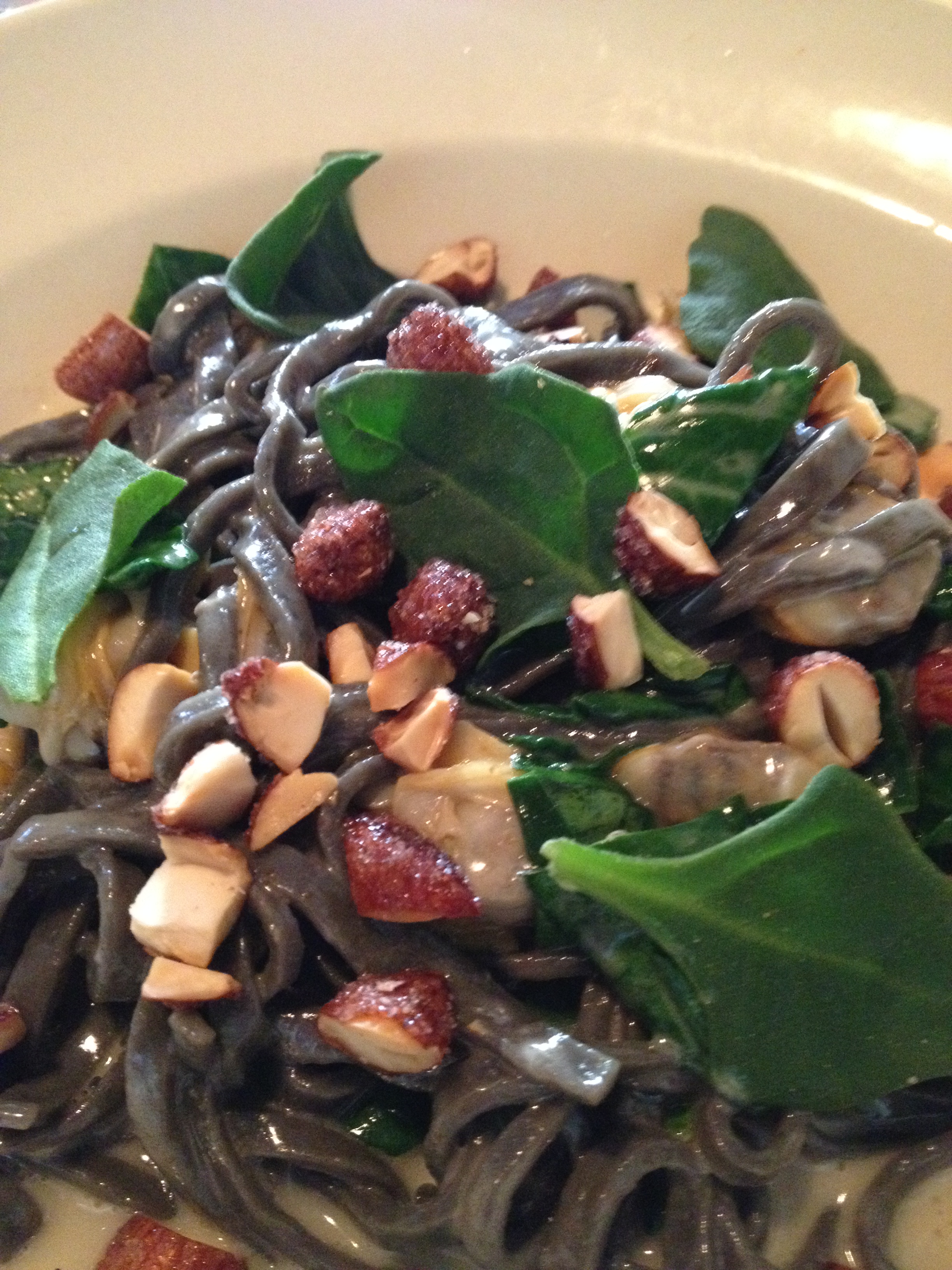
Susan chose black onion chitarra, a sort of pasta made with a form of tight, parallel wires nicknamed a chitarra or “guitar”. The pasta was dark with the black onion and served with manila clams, almond, and spinach. Another delicious dish.

Black onion chitarra, manila clams, almond, spinach

Black onion chitarra, manila clams, almond, spinach

For my main course, I ordered glazed pork cotechino (a traditional Italian sausage) served with asparagus diamonds, sour orange, and a sunchoke coulis. Susan had the swordfish with artichoke and seaweed barigoule, and fava greens.

We could not pass up dessert; we didn’t really try. My choice was panna cotta with a burnt sugar sauce. Susan chose white chocolate cheesecake with fennel and pomegranate  seeds. We both got California creamsicles as an amuse bouche, and Susan finished off with Rich Coffee containing house made Irish Cream!

No shame with any of that. Here that comes. Sarah and Evan are in the running for Food and Wine’s Best New Chef contest. They are in the list of California contestants. You can vote early and often by logging in to the website and casting your vote. Here’s the link:

http://www.foodandwine.com/blogs/2014/03/24/the-peoples-best-new-chef-california-chefs 

8 Comments

Filed under Food, Photography, Recipes, Restaurants, Travel

HORSERADISH MAYONNAISE AND PUFF PASTRY EMPANADAS

The other evening we were invited to a dinner party. It was a little bit of a pot luck, and we were asked to bring a light appetizer. I decided to use some puff pastry from the freezer to make empanadas, but that seemed a little bland, so I also made some mayonnaise as a dipping sauce.

Mayonnaise is so easy to make, and it tastes so much better than the bottled kind, that it seems crazy not to make your own. Especially when you have a fool-proof recipe (so far at least) from one of the world’s greatest chefs. Michel Roux of the Michelin-starred, much-honored Waterside Inn in England, has written a beautiful little book simply called “eggs” (John Wiley and Sons, 2005) filled with amazingly creative, not-so-classic and classic egg recipes including, of course, mayonnaise.

I doctored up the basic recipe using some tricks from Sarah and Evan. The additions of freshly grated horseradish and finely chopped chives or green scallion tops make a great dip that perks up the empanadas.

I filled the empanadas with hearts of palm, parsley, and grated Parmesan, but you can let your imagination run wild: tiny button mushrooms, little shrimp (is that redundant?), water chestnuts, olives (seed removed, of course), cubes of cheese, dolma filling, etc., etc., would all be good. I don’t know, but maybe a little oyster would work.

This recipe makes 20-24 appetizers depending upon how big you make the empanadas

RECIPES

Horseradish Mayonnaise

Ingredients

  • 2 egg yolks, room temperature
  • 1 tablespoon Dijon mustard
  • salt and pepper
  • 1 cup peanut oil, room temperature
  • juice of ½ lemon, more if needed
  • ¼ cup freshly grated horseradish
  • ¼ cup chopped chives or green tops of scallions

Method

  1. Put the egg yolks, mustard, salt and pepper in a small mixing bowl with handles and/or on a towel or other non-slip surface. Combine with a balloon whisk until smooth.
  2. Whisking continuously, add a few drops of oil. When the oil is completely incorporated, add more oil, repeating the process  until the mayonnaise thickens. You may then add the oil in a more continuous stream, but pause occasionally to make sure the oil is fully incorporated before adding more.
  3. When all of the oil has been incorporated, whisk for another minute or so until the mayonnaise is smooth. Then add the lemon juice. The mayonnaise will become visibly less yellow. Adjust with more lemon juice, salt, and pepper to suit your taste.
  4. Stir in the horseradish and chives or scallions. Add more of either to suit your taste.
  5. Refrigerate, covered with plastic wrap, until ready to use. This should hold for several hours.

Puff Pastry Empanadas

Ingredients

  • ¼ cup parsley, finely chopped
  • ¼ cup Parmesan cheese, freshly and finely grated
  • 1 sheet commercial frozen puff pastry, thawed according to directions
  • 1 14½ ounce can hearts of palm, drained and cut into ½ inch coins
  • 1 egg, beaten well with 2 tablespoons water

Method

  1. In a small bowl, combine the parsley and Parmesan cheese. Set aside
  2. On a lightly floured work surface, open the thawed sheet of puff pastry. With a lightly floured rolling pin, flatten the pastry to about 1/16 inch thick
  3. Using a 3 inch circular cookie cutter (a 2½ inch biscuit cutter will do) cut circles in the flattened pastry dough. Working quickly, place a palm coin and about ¼ teaspoon of the parsley/Parmesan mixture in the center of each circle.  Paint the edges of the circles with the egg mixture, using a small pastry brush.
  4. One by one and using your hands, stretch the dough gently to cover the palm disk. Pinch the edges of the half-moon empanada closed with your finger and then seal with the tines of a dinner fork
  5. Arrange the empanadas on a baking sheet lined with parchment paper
  6. Paint the tops of the empanadas with the egg mixture, trying not to let it drip onto the parchment.
  7. Bake in the middle of an oven preheated to 400°F for 15 minutes or until puffed and lightly browned.
  8. Remove from the oven and transfer to a cooling rack to cool.
  9. Serve with the dipping mayonnaise either at room temperature or gently rewarmed.

11 Comments

Filed under Food, Photography, Recipes

LYTRO CAMERA, PART TWO – ASPARAGUS AND PESTO BUNDLES

I’m still learning to use my new Lytro light field camera. It has several features that make it absolutely unique. Most importantly you can focus any part of the image while it is still in the viewfinder, and unbelievably you can focus again once you upload the image to your computer (As long as you have the provided software installed). You can make images of something very close to the lens and something in the background. Then you decide which you want to emphasize or bring everything into focus. The camera is especially useful for ultra-close-ups.

I decided to play around with the camera for images of a dish to go with the shrimp, mushroom and artichoke mac and cheese from my most recent post. Actually, I had some fresh asparagus in the fridge and some puff pastry I needed to use up. I added a little pesto from the freezer, and I wound up with something easy and  a little different. The way I did things, I was only able to make three servings, but very easily – and undoubtedly better – you can make six servings by just cutting more of the stem off of the asparagus spears. The crowns are the better parts anyway.

When basil is in season and plentiful. you can make fresh pesto, but we often make extra and store it in the freezer for later use. It is also readily available in jars or frozen so that you don’t need to take the somewhat laborious extra step of making fresh pesto.

RECIPE

Asparagus and Pesto Bundles in Puff Pastry

Ingredients

  • 1 sheet frozen puff pastry, thawed according to directions
  • 9-12 fresh asparagus spears, trimmed of the woody ends
  • 1 cup fresh, frozen, or bottled pesto
  • ¼ cup pine nuts, lightly browned in a dry skillet
  • 1 whole egg beaten with 2 tablespoons water

Method

  1. On a lightly floured surface, carefully unfold the thawed puff pastry and roll with a lightly floured rolling pin until it is about 1/16 inch thick
  2. Divide the rolled dough into three strips along the fold lines.
  3. Place 3 or 4 asparagus spears in the center of each strip ( If you wish, you can divide the dough into 6 strips and use only enough of the asparagus crowns to fit the strip.)
  4. Spread a generous tablespoon of pesto over each of the asparagus bundles.
  5. Sprinkle the toasted pine nuts on top of the pesto.
  6. Paint the edges of the dough strips with some of the egg and water mixture. Fold the dough over the asparagus and pesto. With your fingers, seal the edges of the envelope. Then finish sealing, using the tines of a dinner fork and gentle pressure.
  7. Arrange the bundles on a baking sheet lined with parchment. Paint the tops of the bundles with egg and water mixture, trying not to let the mixture run down onto the parchment where it is likely to burn and may stick the baked bundles to the parchment
  8. Bake in the middle of an oven preheated to 400°F for 15 minutes or until the bundles are golden brown.
  9. Serve while still warm. A little Hollandaise couldn’t hurt if you like.

Leave a comment

Filed under Food, Photography, Recipes