Category Archives: Photography

FRENCH VANILLA ICE CREAM

It is definitely the time of year to make ice cream at home. It always tastes so much better than what you buy at the store, and these days it is easy to make.

When I was a child, in the hot summer we often sat out on the back porch with the ice cream churn,  a burlap sack of ice, and a big box of rock salt. My mother would set a tinned canister filled with a sweet cream mixture in the middle of the wooden churn bucket, and my father would pack it with ice and rock salt in layers so that the melting ice would stay as cold as possible. Then the kids took turns turning the crank so that the dasher inside the canister would scrape the cream as it froze against the side. The process seemed to take a long time, and no single kid could finish the whole effort. At the end, some grown-up – usually my father – would turn the crank until it wouldn’t turn any more. The dasher came out. The kids took turns licking it, and the ice cream was put back into the ice to firm up a bit before everyone got their own bowlful of the ambrosia.

Next in the evolution of the home ice cream maker was one with an electric motor. Ours never survived very long, because the motor would burn out when everyone forgot to watch it carefully.

Now, there are all sorts of choices and all sorts of prices. We have had our machine for many years, and it continues to work just fine. One advantage is that we can make ice cream whenever we want it. We don’t have to wait for summer. We stick the canister in the bottom of our freezer and forget about it until it is time to make a batch. Then we fill it up, put the dasher in, fasten down the cover, and turn on the motor. In about half an hour, we have ice cream that tastes better than anything one can buy. Our machine cost about $50 when we bought it.  It’s probably a little more expensive these days, but not much. You can buy versions with built-in freezers and elaborate adjustments. Those can easily run to well over $300. In my view, you have to eat a lot of ice cream to justify the expense, but someone must be buying those machines.

This recipe comes from our family cookbook. It is called French vanilla ice cream. I always thought “French” referred to some kind of fancy vanilla, but it turns out that “French” implies that the ice cream is made from custard. That makes me think that the proper name for the dish should be vanilla French ice cream. I don’t look for that change to occur.

Crème anglaise is probably the most common custard base used for ice cream. This recipe is actually based on a modified crème anglaise that uses whole eggs instead of egg yolks. But the same warning applies: don’t let the custard get too hot or the eggs will scramble. Even if you don’t do that, you should always strain the custard before you chill it overnight as invariably there will  be tiny little clumps of egg, and you want the finished ice cream to be as smooth as possible.

RECIPE

French Vanilla Ice Cream

Ingredients

  • 3 eggs
  • 1 cup sugar
  • 2 cups whole milk
  • 2 cups cream
  • 2 teaspoons vanilla extract

Method

  1. In a bowl, using an electric beater, cream the eggs and sugar together until pale yellow and smooth
  2. Add milk and beat until completely combined
  3. Place the mixture in a heavy-bottomed saucepan over medium low heat. Stir constantly until the mixture has thickened and coats the spoon. It should reach about 160°F. Do not boil or the eggs will scramble and you will have to start over. Remove from the heat and cool for about 5 minutes.
  4. Stir in the cream and vanilla. Strain through a fine-meshed sieve into a storage container and refrigerate, covered, over night.
  5. Place the mixture in an ice cream maker and spin according to directions.
  6. Transfer the finished ice cream to a container and place in the freezer for an hour to temper. Serve.

5 Comments

Filed under Food, Photography, Recipes

HYDE PARK CAFÉ PEACH PUDDING

When two of our kids were in school at the University of Texas at Austin, we would often visit. At least part of each visit inevitably was spent at a restaurant, Mom and Dad paying of course. A favorite place was the Hyde Park Café. It was fairly close to the campus, and the food was very good. It was a little pricey for college budgets so we often went there when we were in town. The rest of the time, Peter and Sarah would usually eat ramen in their house lovingly called Casa Hillmont, or they would choose takeout offered up at the “roach coach” on the street corner just outside the physics building.

The Hyde Park is still very much a part of the Austin food scene, although it has changed its name to the little more upscale Hyde Park Bar and Grill, and they have opened another location in another part of town.

Whenever we ate there,  Susan always got the peach pudding for dessert: a square of warm cake topped with peaches and swimming in a pool of thick cream. It is still on the menu at Hyde Park.

Somewhere along the way, we managed to get a copy of the recipe and it wound up in the family cookbook. It’s still as good as ever, and it makes a great dessert for company or for pot-luck dinners. You can dress it up with whipped cream or crème fraîche or ice cream, but I think it is best warm with thick cream.

RECIPE

Hyde Park Café Peach Pudding

Ingredients

  • 2 pounds canned or frozen peaches (slices or halves, your choice) or fresh if you prefer
  • sugar (If you use fresh peaches*)
  • Fruit Fresh® or citric acid (If you use fresh peaches*)
  • 2½ sticks unsalted butter, room temperature
  • 2¾ cups sugar
  • 3 eggs, room temperature
  • 1½ teaspoons vanilla extract
  • 3¼ cups flour
  • 1¼ teaspoons baking powder
  • ½ teaspoon baking soda
  • 1¼ cups buttermilk, room temperature

Method

  1. Thaw and drain the peaches. If you prefer, you can use fully ripe fresh peaches. It will take about four large peaches. Blanch and peel them, cut them into slices and toss with sugar and Fruit Fresh or citric acid the night before. Refrigerate until you are ready to use them.
  2. Using a stand mixer, beat the butter until smooth. Then cream together with the sugar, beating until light and fluffy. Add the eggs one at a time, beating after each addition until the eggs are fully incorporated. Add the vanilla and beat until fully combined.
  3. Sift together the flour, baking powder, and baking soda.
  4. Add the dry ingredients to the batter, one-fourth at a time and alternating with the buttermilk. Beat well after each addition. Continue beating until smooth.
  5. Pour the batter into a greased 9 x 12 inch metal baking pan. and arrange the peaches evenly on top. Note: The batter will rise and overflow a smaller pan, and baking will be greatly prolonged in a glass pan.
  6. Bake in the middle of a preheated oven at 350°F for 25 minutes. Turn the pan around and bake for an additional 25 minutes. Check frequently during the last 15 minutes of burning as the topping burns easily. If it becomes too brown, cover loosely with aluminum foil. When done and the center has set, remove from the oven and let cool for 10 minutes. Cut into serving-sized squares and serve while still warm with heavy cream, whipped cream, crème fraîche, or ice cream.

2 Comments

Filed under Food, Photography, Recipes, Restaurants

RADISH AND RYE

Last night for our belated anniversary celebration we went down to the Plaza for drinks and dinner. We are always game for places we have never been. Last night was a bonanza.

Our first stop was the Inn on the Alameda. As its name suggests, this smallish collection of casitas is on the Alameda, but it is far enough away from the busy Plaza that it is relatively quiet. They have just recently started serving meals, and their bar is reputed to be outstanding. We lucked into arriving just as their wine and cheese happy hour began. We both got a glass of wine and a plate of cheese and crackers. Then we headed out to the beautiful courtyard, and sat under a huge crabapple tree. The adobe  walls, vines, flowers, and coolness made it a place hard to leave. Besides that, others were enjoying drinks and quiet conversations, unlike the boisterousness that is so common on the Plaza.

Soon enough, it was time for our dinner reservation at Radish and Rye, a restaurant that has only been open for five weeks. It turned out to be a find. In fact, in my humble opinion, I think that it is serving up the best restaurant food currently available in Santa Fe.

The restaurant is in space that formerly housed La Ristra, one of the standbys of the local dining scene but closed because of the death of its owner. The space has been totally redone: light, bright, and airy with bold artwork and interesting lamps and accessories on the walls and side tables. The cocktail and wine menus are presented in wooden books with the restaurant name and logo burned into them with a laser – very stylish. The napkins are bar towels, reminiscent of Rich Table.

The wait staff is very friendly and helpful without being overwhelming, and they are all quite knowledgeable about the menu. The kitchen crew is hard working, and you can watch them from the front dining room.

IMG_4964

The “Rye” in the name of the place recognizes their emphasis on high-quality bourbon. You can order some rare brands neat, but for the rest of us, it is easier to choose a blood orange old fashioned or, as I did, an “Abuelito” (little old grandpa) Manhattan. The Manhattan is served in a beaker fuming with what I guess is a last-minute blast of liquid nitrogen. The wine list is relatively small, but it is well-chosen, even if a bit pricey.

Of course, the main attraction is the food. It is billed as Contemporary American, but it is far more eclectic than that: fried green tomatoes and fall-off-the-bone pork ribs from the South, ceviche from the Southwest, beet salad and grilled cauliflower steaks – perhaps representing California?, gorgeous salmon filets from the Northwest, and a nod to France with the eponymous radishes served with fresh butter and sea salt. .

Notable in their absence were the green chiles that make nearly every other menu in town as well as the enormous elk chops meant to appeal to the many Texan tourists of summer. That in itself is refreshing, as the most famous local restaurants have maintained old menu favorites at the expense of losing their creativity and currency.

Unfortunately, the Yelpers are already complaining about portion size. They don’t seem to get the concept of small plates (as opposed to steaks that will feed a family) that has become so popular in San Francisco, Los Angeles, and New York.

You can choose from “large plates”, regular entrée-sized servings or “small plates” meant to be shared. I guess, if you had a  Yelper/Texan appetite, you could order from both parts of the menu, but we chose a number of small plates. Here’s what we ate:

Sea scallop ceviche: Sea scallops arrive in a little ramekin, bathed in the citrus juice they have been “cooked” in and with golden droplets of a finishing oil flavored with jalapeño. Micro-greens complete the dish. It is delicious.

IMG_4961

Fried green tomato: This Southern classic is prepared in a way not usually seen with fried green tomatoes. The tomatoes are lightly fried in a tempura batter, and between the slices is a tasty dollop of another Southern classic: pimento cheese. I have previously written about pimento cheese, April 17, 2014. This preparation raises a standard ladies luncheon staple to a new level.

IMG_4963

Ham hock croquette: Ordinarily one doesn’t think of ham hocks as delicate, but these come as light croquette, breaded and fried to just the right color and temperature. A whole grain mustard for dipping and pickled shallot complete the dish.

Unfortunately I forgot to get an image. I was too busy admiring the plate

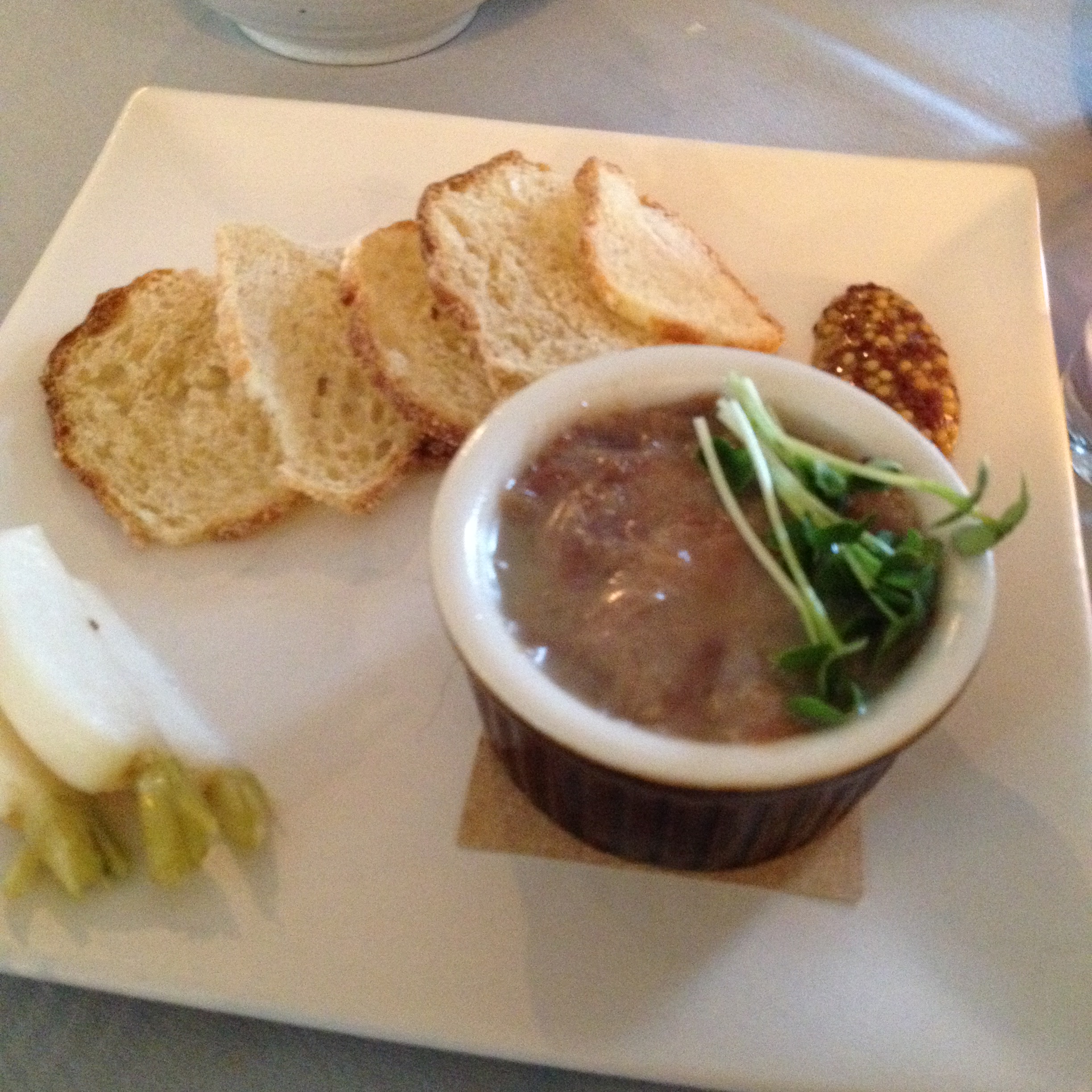
Duck rillette: What could be richer than duck confit poached in duck fat, then chopped finely and mixed with still more duck fat? The dish comes in a little ramekin to be spread on the accompanying razor-thin crostini. The pickled baby turnip makes a perfect foil for all of that richness.

IMG_4959

Grilled cauliflower: Florets of the vegetable are lightly charred and then combined with pecans and capers, then topped with lemon butter and sage.

IMG_4960

Back ribs: The meat literally falls off the bone it is so tender, and it has the smoky taste you expect from the Carolina-style glaze.

Roasted beet: Beet salad is perilously close to becoming cliché in contemporary American cuisine, but this version pulls it out. The beets pair nicely with the sour sweet of balsamic vinegar, and the walnuts, lovage, and blue cheese complement the other ingredients.

IMG_4962

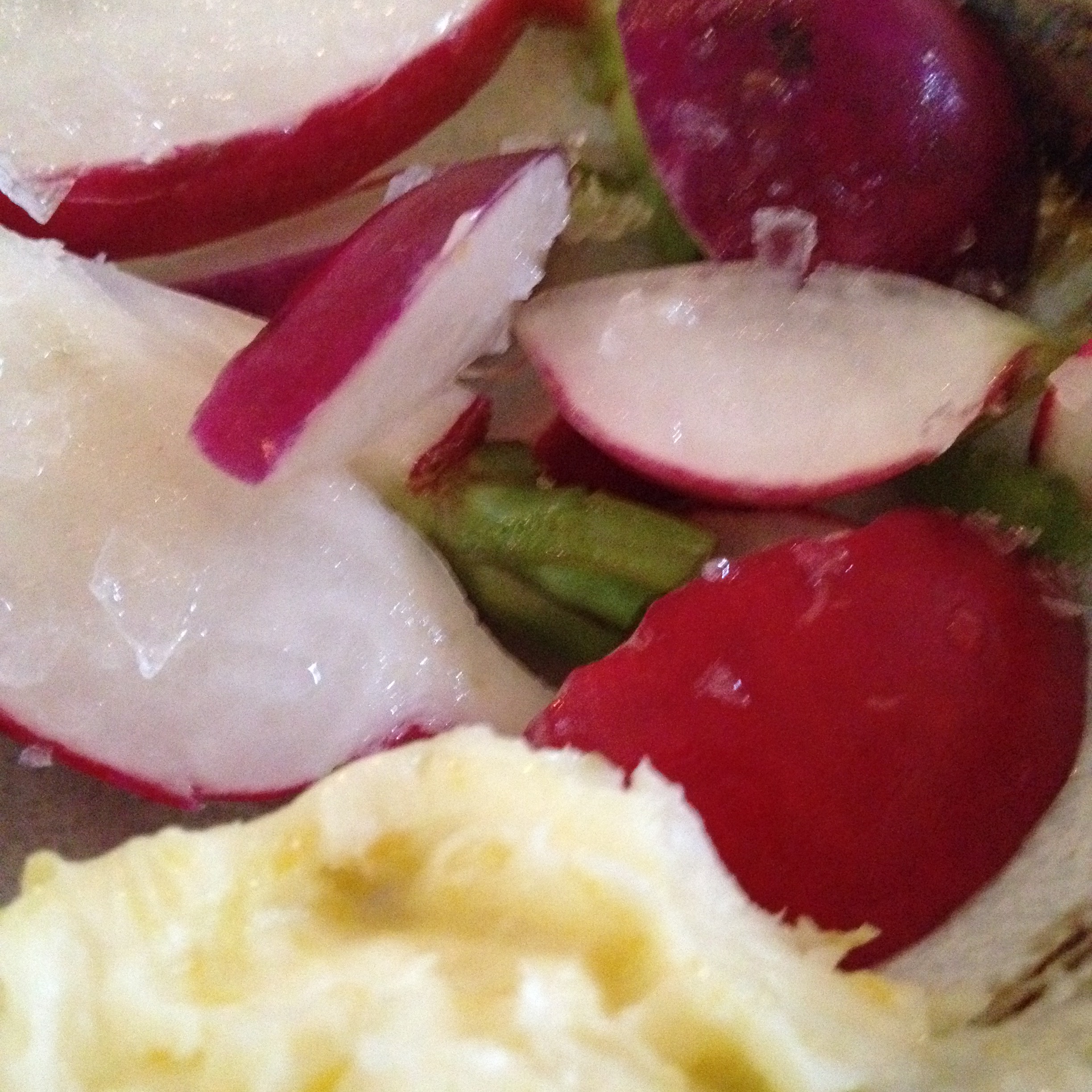
Radish and lemon butter: With a name like Radish and Rye, the restaurant had to offer a radish dish, and this French-style plate of quartered perfect radishes served with sea salt and lemon butter did the trick.

IMG_4958

For dessert, we had a panna cotta with stone fruit topping and a pecan pielet topped with a candle to honor our anniversary. Truly an evening to remember.

4 Comments

Filed under Food, Photography, Recipes, Restaurants

PAELLA AND SOFT-BOILED EGGS. MISSION IMPOSSIBLE: COOKING FOR A FOUR-YEAR-OLD

It is a challenge to cook for Sarah and Evan. They are always gracious and polite, but you worry that whatever you cook might not be up to their standards. During their recent visit, they stayed in a resort hotel near the Plaza for a couple of nights. Their reports on meals were, “Oh, they were OK.” Hardly a resounding testimonial.

In the meantime, Susan and I took care of the 2-year old and the 4-year old. We had a lot of Cheerios, hamburgers, Kraft macaroni and cheese dinner, and hot dogs. That seemed to work as long as Susan could buy them off with ice cream on a stick from the Village Market.

Still, I accepted the challenge to cook outdoors on Independence Day. I decided to have “Spanish Night” actually Spanish/Mexican Night. We started with Sarah’s well-known watermelon margaritas along with olives, manchego, membrillo, and crackers. We were also going to have marcona almonds fried in olive oil and Spanish paprika, but I forgot them. Then gazpacho – not the mushed up kind, which I don’t like, but instead coarsely chopped vegetables in a double consommé. Evan told the four-year-old that it was a kind of special tomato soup, and he got very excited. He said he loves tomato soup. He was disappointed when it came out and refused to eat. Fortunately, we had a can of Campbell’s tomato soup, the kind that his best friend’s mother serves. We heated that up, and a dietary crisis was averted.

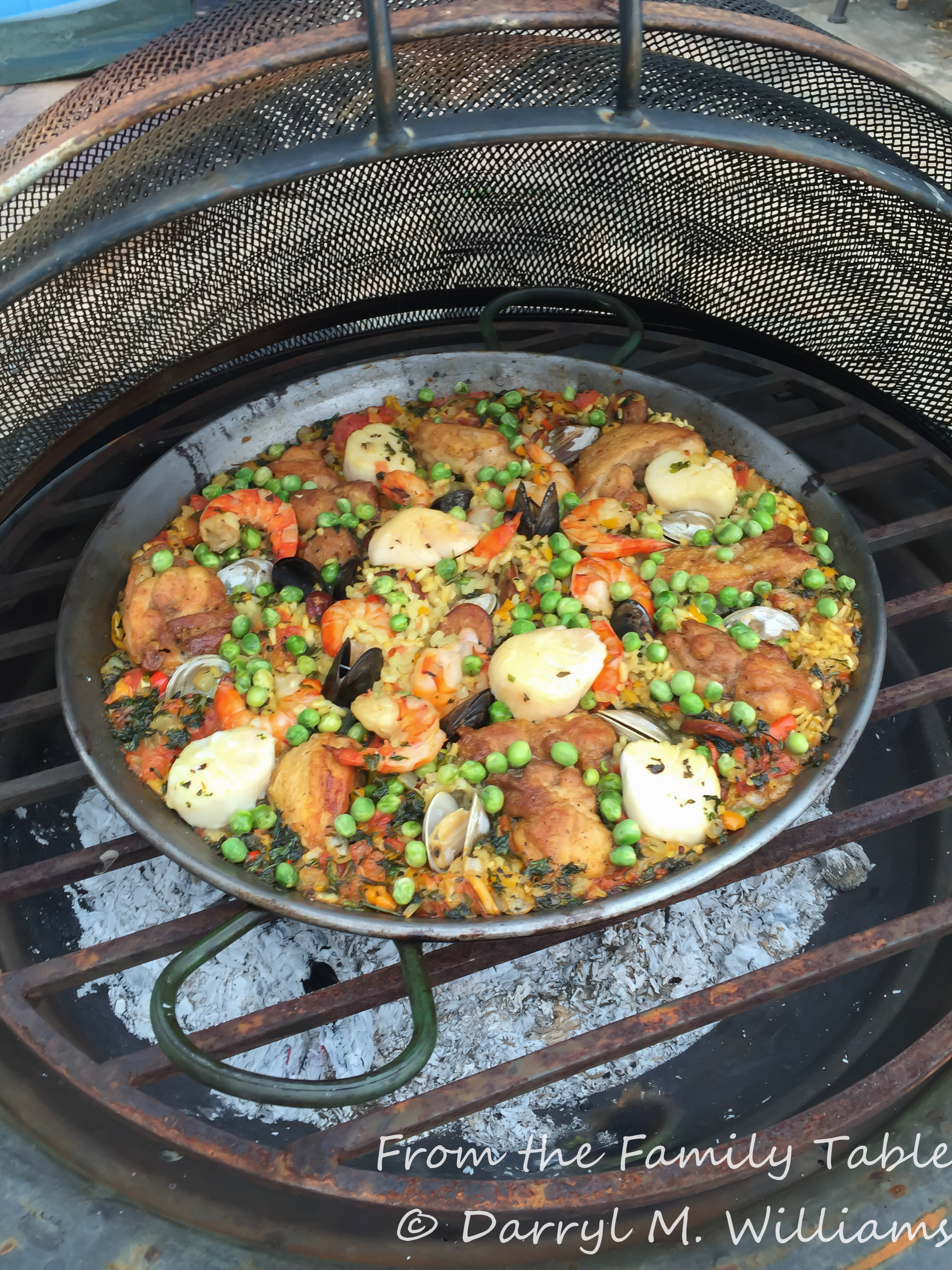
Then came the main course. I cooked  paella over an open fire in our outdoor fire pit. The dish had chicken, shrimp, scallops, clams, mussels, and chorizo. Again, I forgot something – this time it was the calamari. Nonetheless, the paella cooked well over the open fire and wound up with a good crust. Not surprisingly, the four-year-old would have none of it.

Photo courtesy of Sarah Rich

Photo courtesy of Sarah Rich

He did eat the home-made churros and cajeta.

Then we watched the fireworks displays from several locations all around us. Of course, the conversation turned to family times in the past, and favorite foods while growing up. Sarah said that one of her favorites was Susan’s soft-boiled eggs for breakfast, served in egg cups. The four-year-old was very excited.

That inspired Susan to get up early, select egg cups from her big collection of family treasures and antiques. Then she made soft-boiled eggs, served them in special egg cups, and topped them with hand-knitted egg cozies. The four-year-old would have none of it. Fortunately, we had some Campbell’s tomato soup left over from the night before.

All of this proves that it’s harder to cook for a four-year-old than a professional chef. It is also hard to get decent photos with a four-year-old. Ah well, we all still had a good time.

7 Comments

Filed under Food, Photography, Recipes

CHICKEN PANZANELLA – CLEARING OUT THE FRIDGE

Sarah said that she wanted to cook dinner at least once while she was visiting. I agreed. Who wouldn’t want an award-winning chef cooking in the kitchen. The limit  set for the adventure was that it had to follow her High protein/low carb regimen. The other thing was that I didn’t want to go to the store again, so she decided to use what was in the pantry and the refrigerator.

She chose to make chicken panzanella. I reminded her that the dish referred to a traditional Italian bread salad. She said, “Just don’t eat the bread.” Point made.

I have not been too specific about quantities except for the chicken breasts – we only had two – and the bread – we had already started eating a pound-and-a-half loaf. Adjust the quantities of the various other ingredients to your particular likes and to the size of the group you plan to serve.

Some of the keys to success include making certain that the bread cubes are completely dried out and firm. Otherwise, they will absorb too much of the juice from the vegetables and wind up being soggy. The seedless grapes are a surprise: they make a sweet foil for the other acidic and bitter components of the salad. The avocado is also not a usual ingredient in a traditional Panzanella, but it makes a tasty addition. You can add more lettuce, but it might overwhelm the other flavors of the salad. You can use your favorite vinaigrette, but simple oil and vinegar allow you to adjust the acidity just as you prefer.


RECIPE

Chicken Panzanella

Ingredients

  • 2 boneless, skinless chicken breasts
  • buttermilk
  • Greek yogurt
  • scallions, chopped coarsely
  • 1 pound (2/3 loaf) farm-style bread, (Sage Bakehouse), cut into ¾-inch cubes, crust on
  • extra virgin olive oil
  • salt
  • snacking peppers, seeded, coarsely chopped, and lightly sautéed so that they are still crunchy
  • butter lettuce (about 1/3 head)
  • cherry tomatoes, halved
  • snacking cucumbers, peeled and cut into ½ inch circles
  • red seedless grapes, halved
  • avocado, diced
  • fresh garden herbs (parsley, mint, oregano, tarragon)
  • white wine vinegar
  • extra virgin olive oil
  • salt and pepper

Method

  1. Marinate the chicken breasts for 2 hours in a mixture of equal parts of  buttermilk and Greek yogurt with sliced scallions. Turn frequently.
  2. While the chicken breasts are marinating, toss the bread cubes with olive oil and salt, and dry in a 250°F oven until they are completely dry. Set aside.
  3. Lightly sauté the peppers in a hot skillet until they are slightly wilted, but still crisp.
  4. Wash, dry, and cut the lettuce into bite-sized pieces. Prepare the tomatoes, cucumbers, grapes and avocado. Wash the herbs, remove the leaves from the stems, and chop finely. Set everything aside.
  5. Drain extra marinade from the chicken breasts and grill over a hot flame until the chicken is cooked through and the marinade has turned into a golden glaze. Let the grilled chicken rest for 5 minutes, and then cut into ½ inch cubes.
  6. In a large serving bowl, combine the chicken, bread cubes, peppers, lettuce, tomatoes, cucumbers, grapes, avocado, and herbs. Dress with white wine vinegar and extra virgin olive oil to taste. Adjust seasoning with salt and pepper. Let sit for 30 minutes to allow the bread to absorb some of the juices from the vegetables. Serve.

2 Comments

Filed under Food, Photography, Recipes

SALADE NIÇOISE: HIGH PROTEIN/LOW CARB DIETS

This is a great time of the year. Our grandchildren are out of school, and their parents are looking for a little relaxing time. That means we get to have them in Santa Fe for a few days. Our youngest, Sarah, is here now with her two toddlers. That is exciting for Grandma and Grandpa, but it also is a reminder why young people are parents and old people are grandparents.

Sarah and her husband, Evan, are chefs. They have fallen into the occupational hazard of those who cook for a living: they taste – and taste – and taste. Over the years they have added a few pounds along with – for Sarah – the weight gain of motherhood. As a result, they have gone on a very strict diet and exercise regimen prescribed by a no-nonsense personal trainer.

Before her arrival, Sarah announce that there would not be the usual eating out that seems to be part of the visiting tradition. I was disappointed about that, because there are several new restaurants in town worthy of a visit. The other restriction was that home meals should be high protein/low carbohydrate. How to deal with that? No pasta; no red and green chile enchiladas; no pies or cakes. I decided that a simple resolution, at least for the meal the evening of their arrival, was salade Niçoise. I know – what about the potato salad? No problem. That becomes a personal option.

Sarah signed off on the suggestion, and so that’s what we had. I bought some beautiful raw ahi tuna at the store which I seared to keep the lovely pink inside. There were haricots verts at the farmers market and Kalamata olives from the Cheesemongers of Santa Fe. Everything else I found in the pantry or refrigerator, so it was just a matter of cooking and blanching the beans, hard boiling the eggs, and assembling everything right before we ate. Salade Niçoise [2]-1 That gave us time to enjoy the beautiful sunset. A good ending to a tiring day for Sarah shepherding two toddlers on a flight that wound up sitting on the tarmac for thirty minutes after arrival, waiting for a gate to open. Salade Niçoise [2]-2

RECIPE

Salade Niçoise

Ingredients

  • butter lettuce, washed and spun dry
  • potato salad – your favorite recipe
  • ahi tuna, sautéed and sliced thinly across the grain
  • anchovies packed in oil, drained
  • haricots verts, boiled and blanched
  • hard-boiled eggs, peeled and quartered
  • tomatoes, quartered
  • kalamata olives
  • vinaigrette

Method

  1. Arrange the lettuce leaves around the edge of a large serving bowl
  2. Heap the potato salad in the middle
  3. Arrange the other ingredients on top of the potato salad
  4. Dress with vinaigrette and serve.

2 Comments

Filed under Food, Photography, Recipes

ARANCINI

The name of this dish translates from Italian as “little oranges” because the puffs are golden yellow and round, resembling little oranges. You can make them as large as you wish, but the more they resemble oranges the more leaden they become. I prefer little balls that you bite into so that the hidden mozzarella oozes out onto your tongue.  You can sauce them with your favorite tomato sauce – like marinara – but I think that hides the delicate flavor of the arancini. The morsels are a favorite at one of our local bar/restaurants, Dr. Field Goods,  that serves them as bar food or as an appetizer.

For a long time, Rich Table made a dish that they called “fritters”.  The fritters were a big hit when Sarah and Evan were doing pop-ups, and they stayed on the menu for a long time after Rich Table opened.  The fritters were made with a corn batter instead of the rice of a classic arancino, but they had a similar flavor and the same surprise when you bit into the creamy middle.

For this version I have used cooked sushi rice so that it will stick together,.

RECIPE

Arancini

Ingredients

  • 4 cups chicken stock
  • 1 envelope unflavored gelatin
  • 2 tablespoons unsalted butter
  • 3 scallions, minced finely
  • 1 cup sushi rice
  • salt and pepper
  • 2 eggs
  • mozzarella cheese, cut into ½ inch cubes
  • fine, dry bread crumbs
  • peanut oil for frying

Method

  1. Place the chicken stock in a large microwave-proof measuring cup. Sprinkle the surface of the stock with the unflavored gelatin, and let it bloom for 5 minutes. Stir the gelatin into the stock so that it is completely dissolved. Heat the stock to boiling in a microwave.
  2. In a medium pot, melt the butter over medium heat. Stir in the chopped scallions and cook until translucent, but not burned. Add the sushi rice and continue to stir until the rice grains are translucent with a pale white center, about 5 minutes. Pour in about 1 cup of the heated chicken stock. Be very careful, because the mixture will boil up and may overflow the pot if you are not careful. Continue at the boil, but stir continuously. When the liquid has nearly boiled away, add more liquid, continuing to stir the pot. Gradually add the chicken stock in batches until it has all been added. The rice should be creamy, and individual grains should be well cooked. Remove from the heat and let cook for a few minutes in the pot.
  3. Transfer the rice to a baking pan lined with parchment and allow to cool completely. Then transfer to a bowl and stir in the eggs until they are thoroughly combined. Chill in the refrigerator overnight.
  4. Remove the chilled rice mixture from the refrigerator. Shape about 2 tablespoons of the mixture into a round ball, using your hands. Push a cube of mozzarella into the center of each ball, roll with your hands again until smooth, and place on a parchment-lined baking pan. Chill the formed rice balls for an additional hour.
  5. One by one, roll the rice balls in fine, dry bread crumbs. Using a slotted spoon, transfer the rice balls to a deep pan filled to about 1½ inches deep with peanut oil heated to 350°F  As they are frying, turn the rice balls until they are golden brown on all sides.
  6. Drain on several thicknesses of paper towelling, and the transfer to a baking rack.
  7. Serve while still warm.

10 Comments

Filed under Food, Photography, Recipes

TATER-TOT-STUFFED FRIED BALONEY CUPS

Many years ago, I worked at a hospital named (I’m not making this up) Confederate Memorial Hospital. It was a teaching hospital, so there were many young nursing students and resident physicians. Nearly all of the patients were poor and uninsured. With all those mouths to feed, it is not surprising that the food was particularly uninspired. As you might suspect, the menu included a lot of fried okra, corn bread, greens cooked into oblivion, and grits. Even at that, everyone dreaded the weekend beginning on Friday night and extending into Monday morning. The kitchen staff was all off, except for a skeleton crew. Disposable cardboard trays were used, and the plates and utensils all were changed to plastic so that staff on the wards could clean up by dumping everything in huge trash barrels.

The entrée at Friday dinner, even for patients on special diets, was almost always fried baloney cups.  Now, fried baloney cups are a common Southern delicacy, but they usually are filled with creamed chicken or vegetables. That was not the case at the hospital. The baloney cup came on the middle of a plastic plate with nothing else. It rolled around on the plate, so that for a sick, bed-ridden patient it was difficult to spear with a flimsy knife and fork that often broke in two.

Bologna lunch meat can be transformed by frying, especially when it is cooked with the cellophane rind still intact. The slice of meat puffs up in the middle on the hot skillet and the rind shrinks a bit so that you wind up with a cup-shaped vessel just begging for filling. Of course, any cook worried about finesse will remove the cellophane rind before serving. The interesting thing is that frying enhances the flavor of the bologna.

Well-made bologna is much maligned because of confusion with the super market version that I will call baloney.  Along with its close relative, mortadella,  the real thing can be quite delicate and delicious. The stuff called baloney is what you want to use for this dish. These days, you will have to look around a bit to find baloney with the cellophane rind intact, but even without that, a thick slice of the sausage will puff up in the middle so that you can stuff it.

This version incorporates some other standbys of Southern cooking: tater tot potatoes, American cheese, fried eggs, and mustard greens. It is clear that the dish will not help your cholesterol level, but hopefully it will bring back memories for those of us who spent some of our lives in the South.

RECIPE

Tater-Tot-Stuffed Fried Baloney Cups

Ingredients

  • vegetable oil for frying
  • 2 bunches mustard greens
  • 2 tablespoons vinegar
  • 1 tablespoon Louisiana hot sauce (or to taste)
  • 8 thick slices bologna (baloney) with cellophane rind
  • ½ yellow onion, chopped
  • 12 tater tots
  • 2 teaspoons Louisiana hot sauce (or to taste)
  • 2 tablespoons all-purpose flour
  • ½ cup milk
  • salt and pepper
  • 4 slices American cheese
  • 4 eggs

Method

  1. Wash the mustard greens, remove large ribs, and chop coarsely. Place the chopped greens in a medium non-reactive covered pot over low temperature with a tablespoon or so of cooking oil and the vinegar. Cook until wilted. Adjust the seasoning with Louisiana hot sauce, salt and pepper. Drain, and arrange  as “nests” in the middle of 4 serving plates.
  2. In a medium frying pan over medium high heat, fry 4 of the slices of baloney, rind on, until lightly browned. Transfer from the frying pan, remove the rind, and arrange on top of the mustard greens.
  3. In the same frying pan, heat another tablespoon of oil. Add the chopped onions and stir until lightly browned.
  4. Remove the rind from the remaining 4 slices of bologna, chop coarsely, and add to the frying pan. Stir until lightly browned. Then stir in the tater tots, breaking them apart with a  fork or wooden spoon. Stir in the  hot sauce and flour. Cook for a few minutes until the flour is incorporated to remove any raw taste. Add the milk, bring to the simmer, and stir until the mixture is thickened. It should not be soupy, but just moist enough to hold its shape.
  5. Fill the baloney cups with the mixture. Top each with a slice of American cheese. Run under a hot broiler until the cheese melts.
  6. In the meantime, fry the 4 eggs. Top the melted cheese with the fried eggs. Serve.

2 Comments

Filed under Food, Photography, Recipes

GARLIC SCAPE FRITTATA

The season has come – and probably gone – for garlic scapes at the farmers market. This is the time of year when the garlic growers trim the tops of their green garlic plants to force growth into the maturing bulbs. The tops have a wonderful curl as well as a pale head that will mature into tiny little garlics if you don’t cut it off. The head and the pointed stem above it are often woody, but the curly shoots below are tender with  a mild flavor of garlic. I usually chop them up and make them into a green garlic soup that seems perfect for a springtime lunch on the patio.

This year, I decided to try something different. I made a frittata of un-chopped scapes along with other ingredients from the farmers market including feta cheese from The Old Windmill Dairy. Along the way, I added some leftover spaghetti.

RECIPE

Garlic Scape Frittata

Ingredients

  • butter
  • about 1 pound garlic scapes (2 generous handfuls)
  • 4 large mushrooms, sliced
  • 4 snacking-sized sweet peppers, seeded and sliced
  • 3 cups cooked spaghetti
  • 8 ounces feta cheese, crumbled
  • 4 large eggs
  • 2 cups cream or 1 cup cream and 1 cup whole milk
  • nutmeg
  • salt and pepper

Method

  1. Generously butter a 9-inch pie plate and set aside
  2. Wash the scapes; remove the heads and tops. Cut the remaining stalks into pieces that will fit easily into the pie plate
  3. Arrange half of the scapes, sliced mushrooms, and sliced peppers in the bottom of the buttered pie plate.
  4. Arrange half of the spaghetti on the vegetable bed and top with half of the crumbled feta.
  5. Top with the remaining spaghetti, and then the remaining scapes, mushrooms, peppers and feta cheese
  6. In a medium bowl, beat the eggs until well mixed. Combine with the cream or cream and milk seasoned with grated nutmeg, salt, and pepper.
  7. Pour the egg mixture over the assembled pie.
  8. Bake in the middle of an oven preheated to 350°F for 45 minutes or until the mixture is set and the top is lightly browned
  9. Cut into wedges and serve while still warm.

5 Comments

Filed under Food, Photography, Recipes

CRAB-STUFFED ARTICHOKES

A while back I wrote about a classic oyster and artichoke soup from New Orleans. Artichokes are among the  favorite ingredients for Louisiana cooks, both professionals and amateurs. It goes without saying that crab, along with shrimp and crawfish, is another favorite Louisiana ingredient. Combining the two is the basis for another popular Louisiana dish. I first enjoyed it many years ago when Susan and I were dinner guests of a great home cook in Ruston, Louisiana. Globe artichokes stuffed with a savory dressing is a welcome alternative to the usual artichoke bracts (leaves) dipped in aioli or Hollandaise.

Some Louisiana food authorities assert that stuffed artichokes – plain only or with shellfish – had their origin in Italian restaurants throughout the state and then became widely popular. That seems likely, because cultivated artichokes apparently had their origins in Sicily, and Italian cookbooks usually have many recipes using artichokes.  At the same time, I have only been able to find one recipe for stuffed artichokes – that by Giuliano Bugialli in the classic The Fine Art of Italian Cooking, first published in 1977. He stuffed his artichokes with pancetta or prosciutto.

In the USA, Castroville, California, seems to be the epicenter of the artichoke crop. The town dubs itself “Artichoke Capital of the World”, and you can see miles and miles of artichoke fields along the highway or through the windows of the train. Roadside stands abound.

The Louisiana crop is more modest, but it seems to meet the local need. We are nearing the end of the usual season, but with our present world-wide commerce, artichokes are available year around.

Whatever the origin of the recipe or the source of the vegetable, it is easy to see why stuffed artichokes are so popular. This recipe combines crab and Romano cheese, not considered by some to be a good combination. For me, it works.


RECIPE

Crab-Stuffed Artichokes

Ingredients

  • 2 large artichokes
  • 1 lemon, halved
  • 8 ounces crab meat, picked over for shells and cartilage
  • ½ cup dry bread crumbs + more for topping
  • ½ cup fresh Romano cheese, grated + more for topping
  • 1 large egg, lightly beaten
  • ½ teaspoon Creole seasoning or Old Bay
  • salt and pepper
  • 4 tablespoons unsalted butter, melted

Method

  1. In a stock pot boil enough water to submerge the artichokes. Squeeze the juice of the lemon into the boiling water and add the rinds. Add the artichokes, cover and boil slowly for 30 – 40 minutes or until an outer leaf is soft and can be removed easily. Drain and cool the artichokes.
  2. Prepare the artichokes for stuffing by cutting off the stem so that the artichoke can sit squarely on the work surface. Using scissors and starting up about 1/3 from the base, cut off the pointed ends of the outer leaves, working around the choke, trimming all the leaves until you come to the pink-hued inner leaves. Remove those leaves to expose the choke (also called the chaff). With a teaspoon, remove the fibrous chaff until the base of the artichoke is exposed and smooth. Set aside.
  3. Prepare the stuffing by combining the crab, bread crumbs, Romano, beaten egg, and seasonings in a small bowl.
  4. Working from the outer leaves inward and using a spoon, place a good teaspoon of the filling in the hollow of each leaf, reserving enough of the stuffing to fill the central hollow.
  5. Sprinkle the tops of the stuffed artichokes with additional bread crumbs and grated cheese. Drizzle the tops with melted butter and place the stuffed artichokes in the middle of an oven preheated to 400°F for 40 minutes. Serve while still warm. Eat by pulling off the bracts, one by one. Take a bite of stuffing and scrape the soft artichoke flesh off the bract between your teeth. Keep on working toward the center. Cut the center into bite-sized pieces.

18 Comments

Filed under Food, Photography, Recipes