Yearly Archives: 2017

OSSO BUCO IN A SLOW COOKER

We bought our own slow cooker so that we could return the one we had borrowed from Carol. Susan found a large one because she wanted to try it with brisket. Dutifully, I went to the butcher shop and bought a beautiful 3 pound brisket that was just the right size for the cooker. (I’ll post the family recipe for that at a later date. ) While I was waiting for the butcher to cut the brisket to order, my eye caught some meaty veal shanks lined up in pairs in one corner of the display case. To my way of thinking, shanks of any sort – lamb, veal, beef – are delicious and perfect for braising. They turn out fork-tender and suffused with the herbs and liquids that you use to braise them. Another perfect meal for the slow cooker. I had two wrapped up with plans for dinner for the evening. Those plans would include topping the braised veal with the traditional gremolata, a distant cousin of chimichurri and Italian salsa verde, and scooping out the braised marrow to spread on toast soldiers. I wound up serving the mirepoix – onion, celery, and carrot – but you can strain it out. I think that would be too bad because the braised vegetables are so flavorful. You can also add tomatoes, anchovies, and different herbs – or not. There are many recipes and variations for osso buco, so unless you’re a purist you can take some liberties with the preparation to make it your own.

RECIPES

OSSO BUCO

Ingredients

  • 2 tablespoons olive oil
  • 2 cross-cut veal shanks
  • ½ cup carrots, coarsely chopped
  • ½ cup celery, coarsely chopped
  • ½ cup white onion, coarsely chopped
  • 4 cloves garlic, smashed
  • bouquet garni ( 3 sprigs parsley, bay leaf, 3 sage leaves, 3 branches thyme in cheesecloth packet)
  • ½ cup chicken stock
  • ½ cup dry white wine
  • salt and pepper

Method

  1. Heat the olive oil in the slow cooker set at LOW. Add the veal shanks, turning them until they are lightly browned on both sides, about 5 minutes. Don’t worry if they don’t brown fully on the low temperature of the cooker.
  2. Add the carrots, celery, onion, smashed garlic, bouquet garni, chicken stock, and white wine. Cook, covered, for 3 hours with the cooker set on SIMMER if you have that setting, otherwise, set on LOW. Check periodically and add more chicken stock if needed.
  3. Remove the bouquet garni and correct seasoning with salt and pepper. Serve the lamb shanks on a bed of the vegetables on individual plates with the braising liquid ladled over them. You can make a thicker sauce if you wish to use another pan. Transfer the braising liquid to a small saucepan over a medium flame to reduce the liquid by half. Top with the gremolata.

GREMOLATA

Ingredients

  • 12 sprigs of parsley, stems removed and leaves chopped very finely
  • 1 large clove garlic, base and green sprout – if any – removed
  • 1 lemon, zest + 1 tablespoon juice
  • salt and pepper

Method

  1. On a cutting board, chop the parsley finely and push it into a compact pile.
  2. Using a micro plane, grate the garlic onto the pile of parsley.
  3. Again using the micro plane, zest the lemon onto the parsley.
  4. Add 1 tablespoon lemon juice.
  5. With your fingers, combine the ingredients. Adjust seasoning with salt and pepper. Transfer to small bowl.
  6. Serve on top of the braised veal shank, and pass any extra at the table.

4 Comments

Filed under Food, Photography, Recipes

MILE-HIGH STRAWBERRY PIE

One thing I have learned during the stove outage is that it is very difficult to make dessert without a stove and oven. Not impossible, of course, but difficult. You need to bake cakes and most pie crusts. Fillings sometimes need to be cooked on the stove. Even the custard for ice cream needs to be cooked. Since the breakdown, I have made a cheese plate with grapes and sliced pears. The grandchildren thought that was too fancy and not sweet.  I have served ice cream from the store, but that doesn’t count. This week was my turn for dessert for Sunday family dinner. I looked through several recipe books but had difficulty in finding a cooking-free recipe that sounded delicious. This comes from Marion Cunningham’s The Fannie Farmer Baking Book (Alfred A. Knopf, New York, 1984). I have freed the original recipe from the oven by using a packaged graham cracker crust from the grocery shelf. I have also added gelatin so that the filling holds its shape. Key tips that don’t appear in the recipe and that you should follow include making certain that you beat the egg whites so they form stiff peaks. Any less and the filling will collapse. If you need it, a pinch of cream of tartar might help. The cream should also be beaten so that it holds peaks. Chilling overnight is highly recommended.

RECIPE

Mile-High Strawberry Pie

Ingredients

  • 5 egg whites
  • 1/8 teaspoon cream of tartar (optional)
  • ¾ cup sugar
  • 10 ounce package frozen strawberries, thawed
  • 1 envelope unflavored gelatin
  • 2/3 cup heavy cream
  • 1 9-inch prepared graham cracker crust
  • 1 quart fresh strawberries, washed, hulled, and sliced in half

Method

  1. In a large bowl, beat the egg whites with an electric mixer until they form soft peaks. Add the cream of tartar if you are using it. Gradually add the sugar and continue to beat until they hold stiff peaks.
  2. Set aside ½ cup of juice from the frozen strawberries before beating the berries and remaining juice into the egg whites. Continue beating until the mixture becomes fluffy and stands in soft peaks.
  3. Place ¼ cup of the reserved juice in a small bowl, sprinkle with the gelatin and let stand for 5 minutes until the gelatin has bloomed. Meanwhile, heat the remaining ¼ cup juice in the microwave, about 15 seconds on high. Stir the hot juice into the gelatin mixture, stirring until the gelatin is completely dissolved. Beat into the egg white mixture.
  4. Whip the cream until it forms stiff peaks. Fold into the egg white mixture.
  5. Pile the mixture into the prepared crust. Chill overnight in the refrigerator. Arrange fresh strawberries over the top and serve.

7 Comments

Filed under Food, Photography, Recipes

SLOW COOKER CHICKEN SPAGHETTI

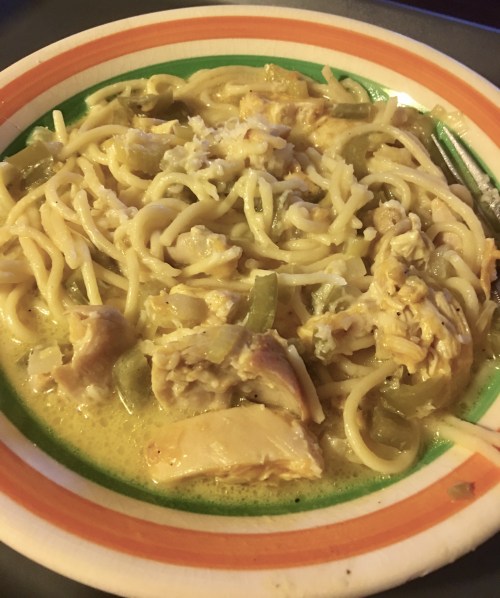
Our stove is still unrepaired so I continue using my daughter’s slow cooker. I hope that she doesn’t ask for it back any time soon as we’re still uncertain about how much longer the stove will be out of commission.  The rotisserie chicken for Sunday dinner turned out well. I had done two chickens so there were lots of leftovers for us and for Carol. I tried to think of how I could use the chicken in some slow cooker recipe. Soup immediately came to mind, but it seemed too hot outside for soup. I couldn’t figure out how to make chicken pot pie or chicken and dumplings without a stove. Old-fashioned chicken spaghetti sounded like a good option. We ate chicken spaghetti at the East Texas farm for as far back as I can remember. The recipe was a treasure of Susan’s mother and included a generous amount of Velveeta. I suspect the original recipe came from a Velveeta box and that it has been copied onto 3 x 5 cards in many families. This is not the authentic recipe. I used sharp Cheddar instead of Velveeta. I also wound up cleaning out the vegetable drawer in the refrigerator along with using up all of the leftover chicken.  Since the leftover chicken had been topped with garlic butter, I did not add garlic, but you could if you like. The slow cooker was the perfect utensil for the project.

RECIPE

Slow Cooker Chicken Spaghetti

Ingredients

  • 2 tablespoons olive oil
  • ½ medium onion, chopped
  • 1 green bell pepper, seeded and chopped
  • 2 ribs celery, chopped
  • 2 cloves garlic, minced (optional)
  • 4 cups chicken stock
  • 8 ounces spaghetti
  • 4 ounces Cheddar cheese, shredded
  • leftover roasted chicken, bones and skin removed, cut into bite-sized pieces (about 4 cups)
  • salt and pepper

Method

  1. Sweat onions in olive oil for about 5 minutes with slow cooker set on High. Add pepper, celery, and optional garlic. Cook for another 10 minutes. Then add chicken stock and cook for 1 hour or until the vegetables are tender.
  2. Break the spaghetti into pieces that will fit into the slow cooker and stir into the pot. Cook for 20 minutes on High or until the spaghetti is just al dente.
  3. Reduce the heat to Low. Stir in the grated cheese until it is melted. Add the chicken and cook just long enough to warm it thoroughly. Adjust seasoning with salt and pepper. Serve immediately.

12 Comments

Filed under Food, Photography, Recipes

BUTTERMILK-BRAISED ROAST CHICKEN

It’s been six weeks since our stove and oven quit working. The saga of the long delay will have to wait for another blog – when and if the stove gets repaired. This time I will deal with how someone who likes to cook copes without a stove.

Six weeks is a long time to go without cooking for some households, at least ours.  During this time, we have eaten some delicious meals at Carol’s house, and for that we thank her. We have eaten at some little neighborhood restaurants across the street. But we have also depended upon our supply of plug-in appliances, along with a slow cooker that we borrowed from Carol. Waffles with the waffle iron, panini from the George Forman grill, and rice from the rice cooker have all been on the menu. The main thing I have done, though, is to use the slow cooker. It works beautifully and confirms all of the enthusiasm for its utility for busy people. You toss some things in the pot, turn it on, leave it unattended for a few hours, and return to a delicious dish just waiting to be served. The only problem, in my hands at least, is that everything comes out looking and tasting like stew. I know that there are myriad cookbooks filled with interesting recipes. I know that there are even some enthusiasts who claim you can bake a cake! I have not succumbed.

The one appliance I haven’t used since the demise of household fire is our Sunbeam rotisserie. I have written about it in the past; it really does do a good job of roasting things as if they were on a spit. It’s my turn for Sunday family dinner, so I thought it would be a good time to get out the rotisserie. It also seemed like the opportune time to try out Sarah and Evan’s recipe for roasted chicken that appeared in this month’s issue of Food and Wine. (Check out “Winner, Winner” on page 46 of the October, 2017 issue.) Since Douglas fir trees don’t grow at this altitude in Southern California, I substituted rosemary. Also, since the original recipe was for oven roasting, I have made a few changes to accommodate the absence of the stove and the demands of the rotisserie. Otherwise, everything is the same. The chicken is brined over night in a bath of buttermilk, salt, sugar, garlic and rosemary with the secret ingredient of porcini mushroom powder. The mushroom powder adds distinct umami to the mixture. The final touch of roasted garlic oil is also an important taste profile. Without a stove, I had to use the microwave to heat the garlic slices in olive oil.  Surprisingly, the garlic browned, although I am sure it could easily burn and become bitter. In any event, the process worked well, and the family had a pleasant Sunday dinner.

I will be glad when we get our stove back.

RECIPE

Buttermilk-Brined Roast Chicken

Ingredients

  • Kosher salt
  • 11 garlic cloves, 9 smashed and 2 thinly sliced
  • 2 tablespoons sugar
  • 2 tablespoons rosemary leaves
  • 1 bay leaf
  • ½ cup dried porcini mushrooms
  • 1 quart buttermilk
  • 1 chicken, 3 to 5 pounds
  • 2 teaspoons unsalted butter, softened
  • 2 tablespoons extra virgin olive oil

Method

  1. Combine ¼ cup Kosher salt, smashed garlic, sugar, rosemary and bay leaves in a large microwave-proof bowl. Stir in 2 cups of water. Heat in the microwave on high for 6 minutes. Remove from the microwave, stir to dissolve any undissolved sugar and salt. Add 2 cups of water and cool.
  2. Transfer the mixture to a large container big enough to hold the brine and the chicken. (I used an 8 quart plastic bread-proofing container.)
  3. Grind the porcini mushrooms to a powder using an electric spice grinder.
  4. Whisk the ground mushrooms and buttermilk into the salt and sugar mixture. Place the chicken in the mixture, cover, and refrigerate overnight. Be sure to remove any giblets that have been packaged inside the chicken.
  5. When you are ready to roast the chicken, remove it from the buttermilk brine, drain it well, and pat it dry with paper towels. With kitchen string, truss the bird: tie the legs together; tuck the wings behind the back and tie them firmly. You should wind up with a compact package that will fit easily on the rotisserie spit. Season all over with salt.
  6. Arrange the chicken on the spit so that it is firmly seated and will not come in contact with the heating element. Cover the rotisserie with the protective lid and turn on the spit.
  7. After 15 minutes, stop the rotisserie, brush the chicken all over with the softened butter.  Restart the rotisserie, and roast for an additional 50 minutes or until the temperature of the thickest part of the breast reaches 165°F as measured with an instant-read probe thermometer.
  8. Transfer the roasted chicken to a cutting board. Cover loosely with aluminum foil and let rest for 15 minutes.
  9. Meanwhile, combine the sliced garlic and olive oil in a small microwave-proof cup or bowl. Heat the bowl in the microwave on high for 2 minutes. The garlic should brown. Check to make sure it does not burn. Remove from the microwave.
  10. Remove the trussing from the bird. Cut into serving pieces. Brush lightly with the garlic oil. Serve immediately, passing the remaining oil at the table.

1 Comment

Filed under Food, Photography, Recipes

RAISED WAFFLES

Things just came together. Our range and oven have been out of service for over two weeks while we await a back-ordered replacement computer board. We have been relying on ancillary kitchen appliances: the microwave, an induction plate that I bought, a George Forman grill, etc. We had not yet used our waffle iron, so it was time. Peter and René had brought us a bottle of Canadian maple syrup from a recent visit to Montreal. Finally, the cupboard was nearly bare as I had been putting off going to the grocery store. A waffle supper with fried eggs done on the induction plate, bacon cooked in the microwave, and waffles in the iron seemed obvious.

This is an old family recipe. Carol made these many years ago for a family gathering in Santa Fe. The waffles were so good that I asked her to contribute the recipe to the family cook book. She called them the best ever, so I titled the recipe, “Carol’s Best-Ever Raised Waffles”.

Actually, the recipe is not original. It came from Marion Cunningham’s masterful revision of The Fanny Farmer Cookbook. Since then the recipe has been reprinted countless times, often verbatim, and including the internet sites, Epicurious and Food52. Most of the internet reviews are glowing, with some notable exceptions. One writer said that the waffles were so limp and tasteless that she threw the remaining batter down the disposal.  While it is true that the waffles will not be as crisp as what you might be used to, my hunch is that she used bad yeast or forgot to add the eggs in the morning or something. Other writers substituted oil for melted butter, vanilla-flavored almond milk for milk. or gluten-free flour for all-purpose flour. Some complained that the batter was too thin and added ¾ cup of flour. You could do any or all of those things, but then you would have a different recipe and a different waffle.

If you follow the recipe as written, you will wind up with a waffle that has the yeasty aroma of a French boulangerie, the taste of a fresh sweet roll straight from the oven, and a lightness that absorbs the unctuous flavors  of added melted butter and maple syrup. My latest effort resulted in waffles just as I remembered them from Carol’s introduction years ago. Keep in mind that if you plan on breakfast waffles, you need to start the night before; if you plan on a waffle supper, start in the morning.

RECIPE

Raised Waffles

Ingredients

  • ½ cup warm water
  • 1 package dry yeast
  • 2 cups warm milk
  • ½ cup (1 stick) melted butter
  • 1 teaspoon salt
  • 1 teaspoon sugar
  • 2 cups all-purpose flour
  • 2 eggs
  • ¼ teaspoon baking soda

Method

  1. Pour the warm water into a large bowl. Sprinkle the yeast over the water and let stand for 5 minutes to dissolve.
  2. Add the milk, butter, salt, sugar, and flour. Beat with a hand-held electric mixer until smooth and blended.
  3. Cover the bowl with plastic wrap and let stand at room temperature over night or all day. The batter should rise to about double its volume.
  4. Just before cooking the waffles, beat in the eggs and baking soda, stirring until well mixed. The batter will be very thin.
  5. Pour ½ to ¾ cups of batter into each mold of a very hot waffle iron. Bake the waffles until they are golden and crisp. Serve immediately or cool on a baking rack to prevent then from getting soggy.

6 Comments

Filed under Food, Photography, Recipes

HATCH CHILES SO-CAL STYLE: CHILES RELLENOS

What a surprise to find authentic Hatch chiles in busy Los Angeles. My daughter, Carol, told me that a local grocery store brings in a big shipment every summer. On a certain Saturday they have a chile roaster operating in the parking lot – just like Santa Fe! Unfortunately we missed the roaster, but we bought a supply of green chiles. I roasted them in two batches: first with my trusty fail-safe portable device. (I have written about it several times in the past. It is available at the Santa Fe School of Cooking, and they ship.) I wound up going to Carol’s house because she has a gas stove – and our stove at the apartment is out of commission with a sick electronic board. (My grandmother’s wood-burning stove always worked if you could chop the wood. To my knowledge, it never required a board replacement. End of rant.) I roasted the second batch on the gas grill in our apartment common area.

When I first learned of the availability of Hatch chiles in Los Angeles, I made the rash commitment to make chiles rellenos. That effort is widely recognized as an affirmation of a grandparent’s love for his or her family. That is because making chiles rellenos is a multi-step process – nothing really difficult, but definitely labor intensive. Still, it is always worth the work. The enthusiasm of the diners is much appreciated by the tired cook. Make plenty. Two to three per person is a good target, but serve them quickly after you fry them. A fresh, fluffy, crispy chile relleno is a thing to savor; an old soggy version is forgettable in an unforgettable way.  We ate ours for Sunday family dinner along with Margaritas, Mexican rice, refried black beans, and de-constructed Caesar salad. Everyone seemed to enjoy the meal. And then Carol served an ice cream tart with a delicious nectarine sauce. The perfect ending.

STEPS IN THE MANUFACTURE OF CHILES RELLENOS

Roasting the chiles

  • Turn on your heat source and top with any special roasting device you might have. A gas flame works better than an electric range. You could use a wood fire. A broiler in your oven will also work. In any event, it is important that the source be very hot.
  • Arrange chiles on the roasting surface. If you are using the broiler in your oven, use a heavy pan that will not warp with the high heat.
  • With long tongs, turn the chiles frequently as they roast. The chiles will become blistered, charred, and black. Don’t be alarmed. That is what you want. Adjust the chiles over the flame so that all sides and all parts become charred.
  • As the chiles become charred to your wishes, move them to a plastic bag that can be folded over to contain the heat. REMEMBER: the chiles are hot at this point, so be careful not to burn yourself.
  • Add more chiles until you have roasted your supply, and they have all been transferred to a plastic bag.
  • Allow the chiles to cool completely in the bag. This may take thirty minutes or longer.
  • Remove the chiles from the bag. Under a thin stream of cold water, use your fingers to pull the charred skin off of each chile. The char should pull off easily, and you will have a smooth, olive-colored chile for the next step in the process. Repeat the process until all of the chiles have been peeled.

Preparing the chiles for stuffing

  • With a sharp, pointed paring knife make a slit along one of the edges of the chile. Start at the stem and extend the slit about 3 inches.
  • Under a stream of cold water, gently open the slit, and with your finger pull out the seed bundle located directly under the stem. The paring knife may help in the process. Rinse free any loose seeds. Pat dry with paper towels or a dish towel.
  • Cut “fingers” of good melting cheese – Monterey jack, cheddar, mozzarella, Chihuahua, asadero – about ¼ inch x ¼ inch x 4 inches. I like to use fingers of two different cheeses for each stuffed chile. Slide the cheese fingers gently into the chile through the slit. Don’t pack the cheese too tightly or the chile will burst. Not enough cheese and the chile will be undistinguished.
  • Fold the loose sides of the slit over the cheese so that it is completely covered.
  • Refrigerate until you are ready to fry the chiles.

Coating and frying the chiles

Ingredients (enough batter for about 12 chiles)

  • 3 eggs, room temperature, separated
  • 1 cup whole milk
  • 1 cup flour
  • ¾ teaspoon salt
  • 1½ tablespoons vegetable oil
  • flour for dusting chiles
  • vegetable oil for frying

Method

  1. In a large, wide bowl, whisk the egg yolks. Then stir in the milk, flour, salt and vegetable oil. Whisk together until most of the lumps are gone. Let rest for 30 minutes and whisk again. You should have a smooth mixture.
  2. Meanwhile, whip the egg whites with a rotary beater or hand mixer until they form peaks. Fold the stiffened egg whites into the batter mixture. Let rest for 30 minutes and then stir gently to incorporate any fluffs of egg white that may remain.
  3. When you are ready to fry the chiles, heat about 2 inches of vegetable oil to 375°F in a sturdy, deep pot. Dust the stuffed chiles with flour. Then, working one by one, use the stem as a handle to dip a chile into the batter, making sure the cheese is completely enclosed and the chile is covered with batter.
  4. Carefully lower the chile into the hot oil. Be very careful not to burn yourself. If there is room in the pot, add more chiles, but do not crowd them.
  5. When the chile is well-browned on one side, turn with long tongs, and brown the other side. Remove browned chiles to a plate lined with paper towels to keep warm in the oven until all of the chiles have been fried. Replenish the oil as needed.
  6. Serve immediately with your favorite salsa.

2 Comments

Filed under Food, Photography, Recipes

FARRO-STUFFED FLANK STEAK

Stuffed flank steak has been one of my favorite foods for over 50 years. It is one of my family’s favorites, too. But honestly, our version has gotten a little boring. The tradition is to stuff the flank steak with a conventional bread dressing and – don’t get me wrong – it is delicious. But my thought is that surely you can do something different after 50 years. Once again, it was my turn for the main dish at our Sunday family dinner. A wonderful new market had opened in the little shopping center across the street, and they had some beautiful flank steaks in their butcher shop. Like a conjunction of the planets, flank steak stuffed with something different seemed like an inspiration. Evan and Brandin Rice at Rich Table have been experimenting with farro lately, and I was interested in how I might make it work in my more plebian dishes. Inspiration! – farro-stuffed flank steak. Of course, there needed to be something to perk up meat and grain, so the addition of a green sauce – chimichurri is a natural – came to mind. Mushrooms and pine nuts added to the flavors. It all came together.

I made a serious miscalculation by buying two flank steaks for 6 people.  That is way more than you need, The recipe that follows is for one flank steak. On the other hand, leftovers of this dish are a bonus, so you may want to make two stuffed steaks. Regardless of your decision, I am sure you will enjoy the result.

RECIPE

Farro-Stuffed Flank Steak

Ingredients

  • 1 flank steaks, about 1½ pounds
  • ½ cup cooked farro
  • 1 recipe chimichurri, divided (see previous post for recipe)
  • 4 cremini mushrooms, chopped finely
  • ¼ cup pine nuts
  • ¼ cup panko
  • 1 egg
  • all-purpose flour
  • 3 tablespoons vegetable oil
  • 2 cups beef stock
  • 1 tablespoon tomato paste
  • salt and pepper

Method

  1. With a sharp knife, butterfly the steak so that it opens like a book. Flatten the meat with a heavy pounder. Chill until ready to fill.
  2. In a. Medium bowl, combine the cooked farro, half of the chimichurri, mushrooms, pine nuts, panko, and egg.
  3. To fill the flank steak, open it on a flat surface, cut side up. Spread with the farro/chimichurri mixture leaving a half-inch border around the edge. Begin to roll the steak beginning from the narrow end until the roll is sealed. Tie the rolled steak with kitchen twine at two-inch intervals, making sure the ends are tied closed.
  4. Heat the oil in a heavy lidded oven-proof casserole over a medium flame. When the oil is hot, brown the stuffed flank steak, turning frequently until browned on all sides. When the steak is browned, add the beef stock and tomato paste. Bring to the boil and then transfer the covered casserole to the middle of an oven preheated to 275°F. Cook, covered, for 2 hours.
  5. Remove the steak from the oven and transfer to a plate, cover with foil, and let rest for 5 minutes. Remove the twine, slice into ¾ inch slices and serve with the remaining chimichurri to be spooned over the top if desired.

3 Comments

Filed under Food, Photography, Recipes

FRIED CHICKEN AND CREAM GRAVY

Fried chicken has always been popular in our family. Probably it is in most families. And there have been lots of family cooks who have staked their reputation on their version of the delicacy.

My mother was celebrated among her family contemporaries as the champion, and her special family dinner was always fried chicken, mashed potatoes and cream gravy. A picnic in the mountains was an anticipated treat of childhood. My mother would fry up two chickens, pack them into a big glass jar that she reserved for the occasion, and arrange the jar in the back window of our Willys Overland Americar to keep the chicken warm until we reached our destination. (Why none of us ever came down with a fatal food-borne illness I will never know.) At the picnic table we would reach into the jar and pull out a favorite piece – or the back if we were too late. There was never any chicken left.

My mother-in-law often served fried chicken when family had gathered around her table at the farm. The crispy skin and juicy meat  stimulated sibling rivalry at the table, sometimes triggereing mild rebuke from PopPop, the patriarch, who had high expectations for table manners.

Sarah, also known as Sally Hurricane, has for years made fried chicken for family meals at the restaurants where she has worked. Now she serves an off-menu treat at RT Rotisserie that is known as Sally Hurricane’s Southern Fried Chicken. I have written about it in this journal, and there is a story about it in the San Francisco Chronicle.

Susan and Carol also make some mean versions of fried chicken, but Susan has largely turned from cooking to gardening, and Carol doesn’t like to fry things. So, for a recent Sunday family dinner I decided to make fried chicken (one of Carol’s all-time favorite foods) with salt-crusted fingerling potatoes instead of the usual mashers but keeping the traditional cream gravy.

Inspired by a recent visit to RT Rotisserie, I have been thinking about fried chicken a lot lately. RT ages its chickens before roasting them on the rotisserie. The cooks arrange trussed chickens on big racks in a large cold room in order to dry them a bit and make the skin crispier. That’s similar to what is done to make the skin on Peking duck so crispy.

Also, I have become interested in slower cooking: a potato baked longer at a lower temperature seems fluffier, and a braise at a lower temperature seems more flavorful. (Think crock pot?) Usually I start frying chicken at a high temperature until it is brown and then reduce the temperature to complete the cooking. I thought that I would give “slow from the start” a chance. All in all, my experiments turned out ok. I thought the chicken was crispy and tasty. What more can one ask? One important thing I did learn was that when you fry chicken at a lower temperature be sure to get the skin as dark as you want it before you turn it. Turn each chicken piece only once; otherwise it will stick to the pan and you’ll lose the crispy skin that you have been trying so hard to achieve.

RECIPE

Fried Chicken and Cream Gravy

Ingredients

  • 1 whole chicken
  • ¾ cup flour
  • 2 tablespoons salt
  • 2 tablespoons pepper
  • 2 teaspoons paprika
  • 2 teaspoons poultry seasoning
  • 3 tablespoons canola or peanut oil for frying
  • 1 cup milk
  • 1 cup chicken stock

Method

  1. Using a very sharp large chef’s knife, cut the chicken into serving pieces. You should wind up with 2 wings, 2 thighs, 2 drumsticks, 2 or 3 pieces of breast meat depending on how you cut it up, and the back, which you can fry after cutting into 2 pieces or for some other purpose such as making chicken stock. If you prefer, you can buy ready-prepared chicken parts.
  2. Place the cut-up chicken in a large pie plate and set in the refrigerator, uncovered, overnight. Turn occasionally while it rests.
  3. When you are ready to fry the chicken, combine the flour, salt, pepper, paprika, and poultry seasoning in a sealable quart plastic bag. Mix well, then reserve 2 tablespoons in a separate bowl to be used later for making cream gravy.
  4. Heat the oil in a large heavy-bottomed frying pan over medium-low heat. Make sure it is up to heat before you add the chicken. (I used a ceramic cooktop set at 2.4 with a full range of 10)
  5. When the frying pan is heated, add one piece of chicken to the plastic bag, seal and shake. Remove the chicken from the bag, shake loose any excess flour mixture and place in the hot oil, skin side down.
  6. Repeat the process until all of the pieces of chicken have been floured and added to the frying pan. If you have one, cover with a spatter shield. Do not cover with a lid.
  7. Fry the chicken without turning for 15 minutes or until the skin has browned to your liking. Turn the chicken pieces and continue to fry, again not turning, for another 15 minutes or until the chicken is well browned and cooked through. An instant-read thermometer may be useful at this point. The internal temperature of the chicken should read 170°F.
  8. Transfer the fried chicken to a large plate and place in a warm oven until the gravy is made.
  9. Pour off all but 2 tablespoons of the frying oil and return the pan to the heat. In a Mason jar, combine the reserved flour mixture, milk and chicken stock, seal with a screw lid and shake until completely mixed. Add  the mixture to the heated frying oil.
  10. Stirring constantly, bring the mixture to a low boil and cook until it thickens, about 3 minutes. Correct the seasoning with salt and pepper. Serve while still warm along with the fried chicken.

3 Comments

Filed under Food, Photography, Recipes

FOUR-CHEESE-STUFFED PHYLLO TORTE

Our six-months probationary period is up, and I think we now qualify as Angelinos. We drive, relatively terror-free, on the 405 and think nothing of an hour+ cross-town odyssey for a 15 minute appointment. The very best part of our transplant has been getting more involved with our children and their families. As part of that, the Sunday dinner has become a firmly entrenched tradition that we all anticipate each week.

I have written a number of times about our family dinner. The guidelines are fairly straightforward: the venue alternates between our home and Carol’s family home; whoever hosts is responsible for the main dish and sides; the other is responsible for appetizer and dessert; both bring a bottle of wine that is interesting; cleanup is sort of a joint effort except that the home team winds up finishing the dishes. These guidelines have remained intact except that the appetizer has been dropped from the menu. That is because even without it, there is a lot of food. Everyone is on a diet, and I have gained 10 pounds since moving to Los Angeles. Of course, this dish is not responsible for all of my weight gain, but it certainly helped push us to dropping the appetizer rule.

The recipe is an adaptation of one from Melissa Clark of New York Times fame by way of Lynne Rossetto Kasper and Sally Swift in their cookbook, The Splendid Table’s How to Eat Weekends. If you choose to make it, I guarantee that there will be gasps of amazement when you bring the finished torte to the table. Then there will be complete quiet as folks sit around wolfing down the whole thing. At the same time, it is easier to make than you might think. I know that Carol saves it for special occasions. You might want to do that, too.


RECIPE

Four-Cheese-Stuffed Phyllo Torte

Ingredients

  • 2 cups feta cheese, drained, dried, and crumbled
  • 1½ cups cottage cheese, drained
  • 1½ cups Asiago cheese
  • 1½ cups grated Parmesan cheese
  • ½ medium onion, diced
  • 2/3 cup chopped fresh dill fronds
  • ½ teaspoon ground nutmeg
  • 1 teaspoon ground cinnamon
  • juice of ½ lemon
  • zest from ½ lemon
  • ½ teaspoon ground black pepper
  • salt to taste
  • 3 large eggs, lightly beaten
  • 1 package frozen phyllo dough, thawed according to instructions on the carton
  • 3 sticks unsalted butter, melted
  • honey

Method

  1. In a large bowl, prepare the filling by combining the four cheeses, onion, dill, nutmeg, cinnamon, pepper, and salt. Stir in the eggs, and set aside.
  2. Unfold the stack of phyllo leaves on a work surface covered with plastic wrap. Cover the stack with another layer of plastic wrap and a damp kitchen towel. Keep unused sheets of dough from drying out while you work with individual sheets.
  3. Brush the inside of a 12-inch Bundt pan with some of the melted butter. Lay a sheet of phyllo across the pan, pushing it down against the sides of the pan and breaking a hole around the center tube of the pan. Repeat in a crisscross fashion with additional sheets of phyllo until the inside of the pan is completely covered with many layers of the dough.
  4. Fill the lined Bundt pan with the cheese filling, folding the free ends of the phyllo sheets over the filling and pressing it together gently. With a sharp knife, pierce the assembled torte all the way through to the bottom of the pan in many places – 2 or 3 dozen. Pour the remaining melted butter over the torte.
  5. Place on a baking sheet and bake in the middle of an oven preheated to 375°F for 75 minutes or until the torte is browned and puffy.
  6. Cool in the pan for 1 to 2 hours.
  7. When ready to serve, unmold the tart by flipping it onto an inverted plate. Remove the baking pan, garnish the torte as you please, and serve. Pass honey to be drizzled over individual slices as desired.

2 Comments

Filed under Food, Photography, Recipes

POACHED PEACHES AND RASPBERRY SAUCE: PÊCHES CARDINAL

It was Carol’s turn to create the main menu for our weekly family dinner. (Soon I hope to share some of her recipes.) She always comes up with an array of interesting dishes that go well together. Did I mention she is a good cook IMHO? This past Sunday she made some delicious toasted walnuts with rosemary, sea salt, and brown sugar for the happy hour. The walnuts were impossible to resist. Then she served a salad of tomatoes, shaved fennel and green beans, all from the farmers market. The main dish was grilled shrimp wrapped in prosciutto. Corn on the cob and muffins made with zucchini from the farmers market rounded out the menu. As usual, my assignment was dessert.

This time of year it is so easy to build a meal with offerings from the farmers market, and  I followed the theme. Peaches and other stone fruit are at the height of their season along with berries of all sorts. This past Saturday we went to the Torrance Market, one of the largest in the Los Angeles area, instead of our smaller local event. The choices available were astounding. One of the biggest stalls specializes in stone fruit, so I could choose yellow peaches, white peaches, yellow nectarines, white nectarines, pluots, plums, all with several varieties of each. Remembering a classic recipe from the first volume of Mastering the Art of French Cooking, I went with white peaches that, from the samples available, were much sweeter than the yellow varieties. I had to go to the berry booth to find plump and fresh raspberries.

The recipe for pêches cardinal is deceptively simple: poach the peaches in a heavy syrup; make a sauce with the raspberries; cover the peaches with the sauce; serve. Of course, you can embellish the dish with ice cream, whipped cream, toasted nuts and/or whatever appeals to you. However, the devil is in the details, as they say. The peaches should be poached in a single layer with their skins intact. The raspberries should be forced through a sieve to form a puree without the seeds. If you don’t take that somewhat tedious step, the seeds will haunt you in the finished dish, even if you use a Vitamix to make the final sauce. And all of that is worth the effort, because the sauce becomes velvety. Warn your guests that the peaches still have their pits. Even though the preparation is easy, the result is both elegant and delicious.

RECIPE

Poached Peaches and Raspberry Sauce: Pêches Cardinal

Ingredients

  • 6 cups water
  • 2¼ cups sugar
  • 2 tablespoons vanilla extract
  • 6 fresh, ripe, unblemished peaches
  • 2 pints raspberries, 18 raspberries set aside for garnish
  • ¾ cups sugar
  • 6 mint sprigs for garnish
  • sweetened whipped cream for garnish
  • chopped toasted walnuts for garnish
  • vanilla ice cream (optional)

Method

  1. In a large saucepan that will hold the peaches in a single layer, combine the water, sugar and vanilla extract. Bring to a simmer, stirring to make sure the sugar is completely dissolved. Add the peaches, and return to the simmer. Turning the peaches occasionally, simmer them for 8 minutes. Remove from the heat and cool for 20 minutes. Drain the peaches on a rack, and peel while still warm. Arrange the peaches in a deep serving dish, and chill in the refrigerator.
  2. Force the raspberries through a sieve to remove the seeds. You should wind up with about 1 cup of raspberry puree. Combine the puree with sugar. Blend in a Vitamix or conventional blender on a high setting for 3 minutes. The mixture should thicken and turn a beautiful pink color. Chill.
  3. When both the peaches and raspberry sauce are well chilled, spoon the sauce over the peaches, and chill in the refrigerator until ready to serve.
  4. When you are ready to serve, remove from the refrigerator and garnish with the reserved raspberries, mint sprigs, whipped cream, and walnuts. Serve in bowls along with a scoop of ice cream, if desired.

2 Comments

Filed under Food, Photography, Recipes