Tag Archives: farmers market

GREEN CHILE CHEESEBURGER – MY TAKE

The journey begins at home, they say, so after writing about my search for the perfect green chile cheeseburger, it only seemed fair that I write about my version. It is based on my observations over the years. It is what I like, so I make no claims for its being in the “best” category, and I certainly would not think of entering it in any contest. I will leave that to the pros.

The first essential is roasted green chiles. You can buy them canned or frozen, but in New Mexico this is green chile season, so there are roasters at the farmers market, and farmers from Hatch and Chimayo (Hatch’s chief competitor) bring gunny sacks filled with green chiles along with roasting cages and butane burners to parking lots all over the city. They will roast as many as you want, and then it is up to you to peel them, cook with them, and put them up for the winter ahead.

Alternatively, you can roast the few that you need for a recipe at home. There are lots of ways to do that: you can roast them under the broiler in your oven; you can use your outdoor grill. The problem with that is that the wonderful roasting smell will draw neighbors and even strangers to your back yard; you can roast chiles over a gas flame; but my favorite way is to use a chile roasting grill that I purchased years ago at the Santa Fe School of Cooking. I like it so much that I have given many of them to friends on my gift list.

The second essential is to have a tasty melting cheese. Asadero is my favorite, but mozzarella, Monterey jack, cheddar, Emmental, or even Gruyère will also work. The important thing is to make sure that whatever cheese you use, the finished product is as gooey as you can make it.

The third essential is the bun, You should use the very best quality bun you can find. Kaiser rolls are good. Hamburger buns in the cello wraps are not good, but if that is all you can find, it will have to do.

Finally, of course, the most essential ingredient is the meat. I use ground beef with 93% lean, but whatever your favorite might be – from 85% to ground sirloin –  will work. You should plan on anywhere from 4 to 8 ounces of meat per burger. I do a couple of things that are considered heretical. First, I incorporate seasoning – salt, pepper, red pepper if you wish – into the meat. With burgers that big, I don’t think salt or pepper can find their way into the middle and the finished burger tastes bland. Second, that means you will have to mix the meat lightly before you shape the burgers. Just try hard not to compress the meat too much. Third, frying the burger in a cast-iron pan or on a flat grill yields a texture that is tastier to me than from a grill

One tool that helps a lot, especially if you make half-pound burgers, is an instant-read probe thermometer. It will take 7-10 minutes or longer on each side to get the right doneness, and the old thumb-pressure trick may not work as well as you are used to with steaks and smaller burgers. Here are some temperature suggestions: Rare – 130°F (54 °C); Medium-Rare – 135°F (57 °C); Medium – 145°F (63°C); Well Done – 150°f ( 66°C).  IMPORTANT: If you are worried about possible risks with undercooked ground beef, cook longer and adjust your temperature accordingly.

Sauce and extras like thick slices of onion and tomatoes, pickles, and lettuce are your option.

Ingredients

  • 2 – 4 fresh Hatch green chiles
  • 2 teaspoons mayonnaise
  • 2 teaspoons Dijon mustard
  • 2 teaspoons ketchup
  • 2 -4 good-quality hamburger buns
  • butter
  • 1 pound 93% fresh ground beef
  • 1 teaspoon salt
  • ½ teaspoon ground black pepper
  • ¼teaspoon cayenne pepper (optional)
  • 2 – 4 slices asadero cheese

Method

  1. Heat the roasting grill until the screen turns bright red. Place the fresh chiles on the grill, turning them frequently until all sides are evenly charred. Remove from the heat and place in a zippered plastic bag. Allow them to cool. Then, under running water, peel away the charred skin. If you have roasted the chiles evenly, the skin should pull away easily. Remove the stems, slit one side, and remove seeds and ribs. Set aside.
  2. In a small bowl, mix the mayonnaise, mustard, and ketchup together.
  3. Butter both halves of the hamburger buns and toast on a dry, hot skillet.  Spread both tops and bottoms with the mayonnaise, mustard, ketchup mixture. Set aside.
  4. Combine the meat with salt, pepper and optional cayenne. Gently divide into 2 or 4 equal portions. Press into patties about the same size as the buns.
  5. Heat a cast-iron skilled over high heat. When it smokes slightly, add the hamburger patties. Sauté on one side for 7 to 10 minutes. Turn and sauté the other side. Check the temperature with your instant-read probe thermometer.
  6. About 2 minutes before you are ready to finish the hamburgers, top each with 1-2 roasted green chiles, a generous slice of asadero cheese, and the top half of a hamburger bun. Check the temperature again.
  7. Transfer the burgers and toppings to the bottoms of the buns and serve immediately.
  8. Have available sliced onions, tomatoes, pickles,  other condiments, and sides of your choice – potato chips, French fires, potato salad, etc., etc.

4 Comments

Filed under Food, Photography, Recipes

STUFFED SQUASH BLOSSOMS REDUX

It’s the time of year again when squash blossoms make their appearance at the local farmers market. When that happens, I always buy a dozen for stuffing. Of course, if you have your own zucchini patch, you can harvest your own squash blossoms. Choose the male flowers without the swelling at the bottom that will ultimately become the mature squash.

It is surprising how many things you can do with these delicate flowers. There is a lovely soup, sopa de flor de calabazas, and you can use them in quesadillas, pancakes, etc., etc., but I always wind up stuffing them.  Whatever you do with them, use them the day you buy or pick them because they fade very quickly. If the blossoms have stems, you can keep them fresh in ice water in the refrigerator with a plastic bag over them, just as you keep parsley and other herbs. Even then, you should try to use them the same day you buy or pick them.

Exactly three years ago, I posted a recipe for stuffed squash blossoms which I liked a lot (still do), but the batter was a little heavy. The mushrooms I used to stuff them were tasty, but there are so many other options, that I thought you might like this version which has a lighter tempura batter and a stuffing of local ingredients. You can even fry squash blossoms with no stuffing and no batter at all. In truth, whatever you do with the flowers, they almost always turn out delicious.

One step that is often overlooked is the removal of the stamen. You can stuff the blossoms with the stamen still in, but it may make things a little bitter, and besides you want there to be as much room for the stuffing as possible. To perform that little surgical task, you can use a pair of long tweezers. I use a surgical hemostat. Scissors might work, and if your fingers are not too fat, they might work, as well. An important caution with this step is not to tear the sides of the blossom cup or the leaves. If you do that you run the risk of having all the filling run out while frying, even with a patch job. Some images on the internet show part of the flower cut away. If you are just going to stuff the flowers, that will work, but if you plan to fry them, the stuffing needs to be hidden away.

Stuffed squash blossoms sound a bit complicated. They aren’t really, and they are certainly worth the effort.

RECIPE

Fried Squash Blossoms Stuffed with Goat Cheese and Pine Nuts

Ingredients

  • 8 ounces chèvre-style goat cheese softened at room temperature
  • 1 tablespoon fresh lemon juice
  • 2 tablespoons shallot very finely chopped
  • ¼ cup parsley, finely chopped
  • ½ cup pine nuts
  • salt and pepper
  • 12 fresh, large squash blossoms
  • 2 cups all-purpose flour, divided
  • 1 large egg yolk
  • 1½ cups ice water
  • peanut oil for frying

Method

  1. In a small bowl, combine the softened goat cheese and lemon juice to form a smooth paste. Stir in the shallot and parsley.
  2. In a small dry skillet over medium heat, roast the pine nuts for a few minutes, stirring them frequently, so that they brown slightly and release their oils. Be very careful not to burn. Remove from the heat. Cool. Chop coarsely if you like, and stir them into the cheese mixture. Adjust the seasoning with salt and pepper. Set aside.
  3. Prepare the blossoms by removing the stamens, being careful not to tear the petals of the flowers. If the flowers are dusty, you may rinse them, although they do best with as little handling as possible.
  4. With a spoon, pastry sleeve, or your fingers, fill each blossom with stuffing. I have found the greatest success using my fingers. Fill only to the base of the petals so that you can fold them over one another and seal them with a dab of the cheese mixture. Arrange on a plate and chill for the few minutes needed to prepare the batter and heat the cooking oil.
  5. Place one cup of flour in a pie plate.
  6. In a small bowl that is big enough to dip the blossoms individually, beat the egg yolk and ice water together and then stir in the remaining cup of flour. The batter should be smooth, but it is not essential to get out all of the lumps as long as they are not too big.
  7. Fill a deep heavy-bottomed pot with 2 inches of cooking oil and heat to 375°. It’s a good idea to use a thermometer if you have one. Temperature will plunge when you start to fry, so you will need to regulate the flame.
  8. Remove the filled squash blossoms from the refrigerator, and one at a time, dip them into the flour, shaking off any extra. Then dip them into the batter, drain for a minute, and transfer to the hot cooking oil. Working in batches of no more than three or four, fry the blossoms, turning them frequently until they are lightly browned and crisp on all sides.
  9. Drain on multiple layers of paper towel and transfer to a plate in the oven at 200° until they are all fried. Serve immediately.
  10. Three to six individual blossoms make a good appetizer-sized serving for one person. You can gild the lily, so to speak, with a dipping sauce or salsa, but the stuffed flowers can easily stand on their own.


6 Comments

Filed under Food, Photography, Recipes

BLACK HARICOTS VERTS TURNED GREEN

Just as with everything else, there are trends and fashions at the farmers market. Year before last it was cardoons. Last year it was kohlrabis. Now those are old hat. This year one of the new items is black haricots verts. Actually they’re not black but a very deep shade of purple that looks black. The beans are very distinctive, heaped up in baskets next to the regular green pole beans. It’s very hard to resist buying some if you are looking for something a little different to try out.

Many of you experienced cooks probably already know this, but I was surprised and more than a little disappointed when I dropped the beans into boiling water to blanch them, and the purple/black color disappeared. Suddenly my haricots verts were, indeed, green.

Curious to know why that happened, I turned to the most reliable expert on kitchen science that I know, Harold McGee, author of a regular column in the New York Times and numerous books including On Food and Cooking: The Science and Lore of the Kitchen (Second edition, Scribner, New York, 2004). Sure enough, there he had a short scholarly discussion of anthocyanins (pp. 267-268, 281-281) It turns out that the red and purple colors of most flowers and vegetables are due to a group of about 300 related chemicals known as anthocyanins. They are very sensitive to alkalinity and acidity as well as some metals, which help to determine the color that the chemical gives to a flower or vegetable. They are also highly water-soluble, so when the spaces where they are stored break open during the cooking process, the coloration is rapidly diluted and dissipates. Hence, the beautiful black beans turn a beautiful chlorophyll-green. And that’s ok, too, because the blanched haricots verts can be used for whatever might be one of your favorite dishes.

I decided to use them in a chilled salad with scallions and dill, topped with a balsamic vinaigrette. The bright green chlorophyll color was terrific.

RECIPE

Haricots Verts Vinaigrette with Scallions and Dill

Ingredients

  • 1 pound fresh haricots verts, washed and trimmed
  • 4 scallions cut in ½ inch slices, whites and greens included
  • ¼ cup fresh dill fronds, coarsely chopped
  • 1 tablespoon white wine vinegar
  • 1 tablespoon balsamic vinegar (not the expensive stuff)
  • 1 clove garlic, peeled and minced
  • 2 teaspoons Dijon mustard
  • salt and pepper
  • pinch of sugar
  • 6 tablespoons extra virgin olive oil (the good stuff)

Method

  1. In a large pot, bring 2 quarts of salted water to a rolling boil
  2. Add the green beans in a single batch and return the water to the boil
  3. Boil the beans for no more than 4 minutes so that they remain crisp. Drain and immediately plunge into a prepared large bowl of ice and chilled water.
  4. When the beans have cooled, drain and transfer them to the refrigerator until they are ready to use. (Remove any remaining pieces of ice)
  5. Prepare the scallions and dill. Set aside.
  6. Using a whisk and a small bowl, combine the vinegar, minced garlic, mustard, salt, pepper, and sugar.
  7. Whisking continuously, slowly stir in the olive oil to make a vinaigrette. Correct the seasoning.
  8. In a large bowl, combine the haricots verts, scallions, and dill. Dress with the vinaigrette to suit your taste.  Adjust the seasoning. Chill, tightly covered, in the refrigerator for an hour to let the flavors blend.
  9. Serve alone or on lettuce leaves.


5 Comments

Filed under Food, Photography, Recipes

CREAMED PEAS, NEW POTATOES, AND PEARL ONIONS – BOUNTY FROM THE FARMERS MARKET

I went to the farmers market this weekend and was surprised to find that the fruits and vegetables usually available this time of year were missing. We live at 7,000 feet, so the growing season is usually later than in other parts of the country. We also had a late spring,  and things are just behind schedule. On top of that, I’ve recently visited farmers markets in Southern California, Texas, and Louisiana where the season is much further along.

The market did have a lot of greens and root vegetables, but not many stone fruits or tomatoes. I found a few heirloom tomatoes that had been grown under protective tents. I’m going to use those to make panzanella. I also found the first peaches of the season, and I plan to use those for my version of Strawn’s Café Famous Peach Ice Box Pie.

The big finds, though, were green shell peas and tiny new potatoes. When I was growing up, we always planted green peas by Saint Patrick’s Day to assure a good crop. Then, when they came in, my grandfather, father, and I would sit on the back step, eating them raw, fresh out of the pod. In the American South, green peas are called English peas to distinguish them from the black-eye, Crowder, purple hull, and cream peas that are so important there. I don’t know what the English call green peas. Maybe one of my blogger friends from the UK can help me out.

The freshly dug potatoes looked delicious, and at one stand they had been carefully sorted by size, so that one basket was filled with tiny potatoes no more than an inch and a half across and all practically the same size. Boiled new potatoes like those are among the luxuries of early summer.

All of that reminded me of one of my favorites of childhood: creamed peas, new potatoes, and pearl onions. So that’s what I made for supper. Even though that’s an old-timey dish, it was every bit as good as I remembered.

RECIPE

Creamed Peas, New Potatoes, and Pearl Onions

Ingredients

  • 1 pound small new potatoes, washed
  • 1 cup pearl onions, fresh or frozen
  • 1½ pounds unshelled green peas, shelled
  • 2 tablespoons butter
  • 2 tablespoons all-purpose flour
  • 1 cup whole milk
  • salt and pepper
  • ½ teaspoon sesame oil or to taste
  • 3 tablespoons fresh dill fronds, snipped

Method

  1. Bring a large pot of salted water to the boil. Add the potatoes, return to the boil and cook until the potatoes are pieced with a cooking fork, about 20 minutes. They should be not quite cooked through.
  2. Add the pearl onions and return to the boil for another 5 minutes. Then add the peas and boil for another 5 minutes or until the peas are done. Drain.
  3. In the meantime, in a small saucepan over medium heat, melt the butter and stir in the flour. The mixture should be foaming. Stir for a few minutes to cook the flour.
  4. Pour in the milk and stir continuously until the mixture thickens. It is alright if it begins to boil, but at that point remove from the heat.
  5. Adjust the seasoning with salt and pepper and add sesame oil to taste. Be gingerly, as sesame oil can be overpowering. Stir in the snipped dill
  6. Pour the sauce over the drained vegetables. Mix until well combined. Serve immediately.
  7. Serves two to four as a side dish.


4 Comments

Filed under Food, Photography, Recipes

LETTER FROM UNSCENE SHREVEPORT: BUTCHERING A PIG

Trigger warning: this post is not for vegetarians.

As part of their residency in Shreveport, Sarah and Evan were asked to demonstrate how to butcher a  whole hog. The program was designed for professionals so that they would consider buying whole animals or primal cuts instead of just ordering chops or steaks from the restaurant food supply company. In that way, they could use everything, both as a cost-saving measure and as a way to think of new uses for meat cuts that they had never tried before.

No, Sarah did not slaughter the pig, but it came close: the animal was bled, skinned, and cleaned of offal, but otherwise it came snout to tail with suggestions on how to use every part.

Sarah’s tools included knives that she spent all morning sharpening, a big cleaver, and a hack saw that she bought from the hardware store.

The audience included restaurant professionals, enthusiastic amateurs, old folks who recalled butchering a hog on their grandparents’ farm, farmers from the farmers market who were interested in sustainable farming, and students from the local culinary training program who mostly slept in the back of the hall.

Evan talked while Sarah talked and demonstrated how to separate the various cuts of meat.  She carved out the tenderloin, chops, roasts, hams, and pork belly. She showed how to trim excess fat, and how to remove silver skin for a more tender cut of meat.

In the end, she demonstrated how to get hog cheeks – a delicacy – and what to do with the whole head. Several older people were very interested in that because they remembered making souse and head cheese when they were younger.

In the end, it turned out not to be a beautiful or tasty demonstration, but one that everyone found interesting – except the culinary students.


3 Comments

Filed under Food, Photography, Travel

LETTER FROM UNSCENE SHREVEPORT: PURPLE HULL PEAS, TASSO AND COLLARDS

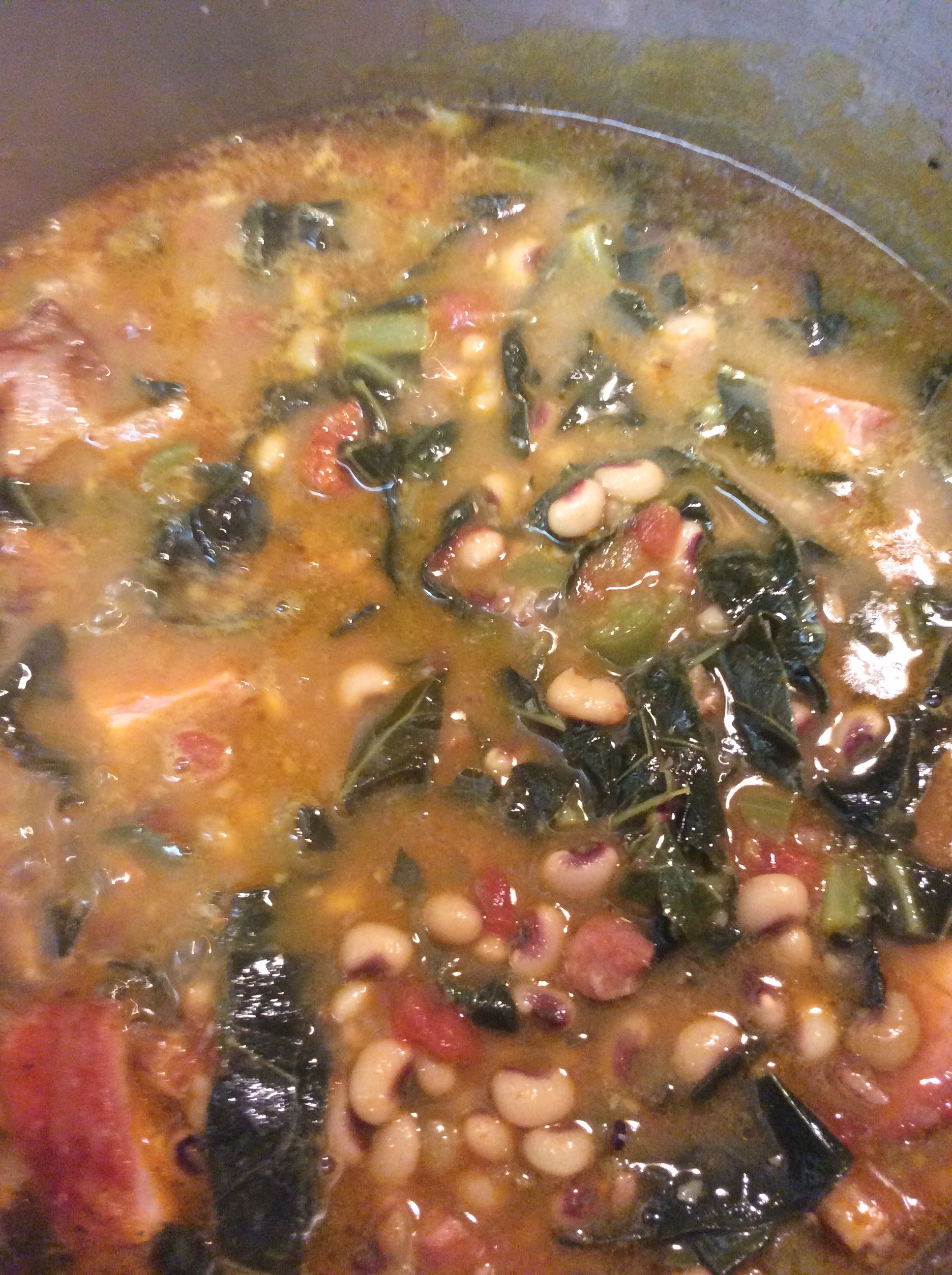
Last night we ate at our apartment after Sarah, Evan, and Van went fishing with Jason Brady and his family. It seemed like a perfect time to cook up some purple hull peas I had bought at the farmers market.  I went to the grocery store to get some salt pork and tasso, but I probably could have found those at the farmers market, too.

You can’t have peas, tasso, and collards without some cornbread to sop up all of the juices, but none of us was in the mood to bake cornbread in our understocked apartment kitchen. Fortunately we had  some leftover corn muffins that had been served with our chicken fried steak at Strawn’s for lunch. The muffins were sweet (Yankee cornbread in Louisiana!?) but they would have to do.

I cooked the meal while the fisher persons were out on the lake.

RECIPE

Cookin'

Cookin’

Purple Hull Peas, Tasso and Collards

Ingredients

  •  2 tablespoons vegetable oil
  • 1 large onion, chopped
  • 8 ounces salt pork, cut into a large dice
  • enough water to cover the salt pork in a small saucepan
  • 32 ounces chicken stock
  • 1 quart shelled purple hull peas, fresh or frozen
  • 1 large green bell pepper, seeded, deveined, and chopped
  • 14 1/2 ounces canned, diced tomatoes (fresh tomatoes would be great, but I forgot to buy them at the farmers market)
  • 3 cloves garlic, minced
  • 1/2 teaspoon sugar
  • 1 1/2 tablespoons vinegar or lemon juice
  • salt and pepper
  • 8 ounces Cajun-style tasso ham, cut into bite-sized chunks
  • 1 large bunch fresh collard greens, washed, trimmed, and cut into a coarse chiffonade
  • Louisiana Hot Sauce to taste (optional)

Method

  1. In a large, covered pot heat the oil over medium-low heat. Add the onions, cover, and sweat until the onions are soft and translucent. Transfer to a bowl.
  2. Bring water to a boil in a small saucepan and add the salt pork. Return to the boil and boil for 5 minutes to remove any excess salt.. Drain and transfer to the large pot over medium heat. Stir frequently to allow light browning.
  3. Return the onions to the pot. Add chicken stock and bring to the boil. Stir in the peas, bell pepper, and garlic. Adjust seasoning with salt and pepper. Return  to a boil and then adjust the heat to a simmer. Simmer, covered for 1 hour or until the peas are soft.
  4. Stir in the tasso and simmer for another 30 minutes.
  5. Add the collard greens and simmer for another 30 minutes or until the greens are thoroughly cooked but not limp. Adjust the seasoning. Be sure to use hot sauce if you like it.
  6. Serve in large soup bowls.

2 Comments

Filed under Food, Photography, Recipes, Travel

LETTER FROM UNSCENE SHREVEPORT: FARMERS MARKET

Today we went to the Farmers Market at the Festival Plaza in downtown Shreveport near the banks of the Red River. We arrived at 7 AM, but there was already a long line of customers waiting to buy fresh corn from the Bailey Farms trailer filled with sacks from the fields of the Mennonite colony in Arkansas. The crowds were otherwise fairly light, but within a short time, the plaza was filled with folks of all descriptions, and the vendors were busy selling their wares. Unscene Shreveport is an ongoing project of the Shreveport Regional Arts Council, who are trying to revitalize the riverfront while bringing new ideas about art and food to the community. The executive director, Pam Atchison, met with Sarah and Evan, along with local chef, Jason Brady, to plan events of the day and to talk about the cooking challenge.

Amateur cooks were encouraged to  participate in a free cook-off using a “secret” ingredient from the farmers market. The entrants drew their assignments from a big basket – either tomatoes or squash. It was interesting to see how many were puzzled about  what to do with tomatoes, which were in abundance –  ripe or green, big or small, heirloom or otherwise. There were lots of choices for squash as well.

On Monday evening, contestants were to return with eight helpings of their dish. Sarah, Evan, and Jason would be the judges and also cook a meal from market selections. Then there would be a sort of covered-dish supper with all the entrants invited to sample their competitors’ offerings.  Extra points for using more ingredients from the market. As we wandered around the plaza we saw the bounty of the Ark-La-Tex (the region where the three states come together with Shreveport as the unofficial capital) There were berries of all kinds, fresh watermelons, authentic Louisiana pralines by Dardie, fried pies, fresh and pickled quail eggs, hen’s eggs, meat of several varieties, cookies, cupcakes, bread, goat cheese, and on an on.

I’m looking forward to Monday.

Leave a comment

Filed under Food, Photography, Travel

UNSCENE SHREVEPORT : HERBED PORK CHOPS AND MEXICAN CORN

This is my first post from the Shreveport Unscene. The project is a year-long event designed to advance music, the arts, and food in the Shreveport area. Sarah and Evan are doing a two week residency with the goal of  promoting the use of fresh fruits and vegetables in restaurant menus and, along the way, in the family menus of the community. They will be cooking with products from the local farmers market and challenging local chefs to do the same.

Shreveport has a rich food tradition with many Southern and Louisiana specialties. But like much of the South, its food is heavy on deep frying – chicken fried steak, Southern fried chicken, fried catfish and hush puppies, not to mention Natchitoches meat pies, corn dogs, fried pickles, and even deep-fried ice cream. Bucking that tradition will be a challenge.

On our day of arrival, Sarah and Evan went to the farmers market, which is held twice a week. The market is much larger on the weekend, so during the week the choices were limited, but they found fresh pork chops, onions, garlic, new potatoes, sweet yellow peppers, corn from a Mennonite colony in nearby Arkansas, blueberries, raspberries, and fresh cream.

They augmented these products with prosciutto from the gift basket in their room and red onions, cilantro, vegetable oil, and balsamic vinegar from the nearby grocery store. Then they cooked our evening meal from all of this bounty, sort of as a trial run. Sometimes it’s ok to be a guinea pig.

RECIPES

Herbed Pork Chops

Ingredients

  • 2 tablespoons vegetable oil
  • 4 large pork chops
  • 5 cloves garlic, peeled but whole
  • 1/2 large onion, chopped coarsely
  • salt and pepper
  • 1 red onion, diced finely
  • 1 large bunch cilantro, chopped
  • balsamic  vinegar

Method

  1. In a large sauté pan, heat the oil over high heat, Add the pork chops, garlic, and onions. Brown the pork chops on both sides. Then transfer to an oven-proof dish and place in the oven preheated to 375.  Roast for 20 minutes or until done to your liking. Adjust the seasoning.
  2. In the meantime, combine the red onion, cilantro, and balsamic vinegar in a small bowl. Set aside.
  3. When ready to serve the pork chops, top each with a large tablespoonful of the herb mixture

New Potatoes, Onions, and Sweet Peppers with Pancetta

Ingredients

  • 1 1/2 pounds new potatoes, quartered
  • 1/2 large white onion, chopped coarsely
  • 4 sweet yellow peppers cut crosswise into 2-inch slices
  • 2 tablespoons vegetable oil
  • 1/2 of  reserved herb mix (see recipe ab0ve)
  • 3 ounces prosciutto, sliced into thin ribbons

Method

  1. Add the potatoes, onion, and peppers to a large saute pan over medium high heat with the oil.
  2. Stirring frequently, cook the vegetables until they are soft. Remove from the heat. Serve topped with half the herb mixture and the prosciutto.

Mexican-Style Corn with Yogurt and Queso Fresco

Ingredients

  • 6 ears fresh corn, shucked and silk removed
  • 1/2 cup Greek-style yogurt
  • 1 pound Mexican queso fresco, crumbled
  • Old Bay seasoning (note: one of us is very sensitive to spicy food, so that was the choice of seasoning. Ground chiles or chili powder would also be very good.)

Method

  1. Over high heat, dry roast the corn, two or three ears at a time, until they are lightly charred.
  2. Transfer to an oven-proof pan or dish. Spread the roasted corn with yogurt and then sprinkle with queso fresco and seasoning.
  3. Place in the oven preheated to 375 for a few minutes until the cheese is melted and slightly browned. Serve immediately.


2 Comments

Filed under Food, Photography, Recipes, Travel

OAK-SMOKED SHRIMP WITH TRUMPET MUSHROOM RISOTTO

Our local farmers market stays open all year, but only now have the growers occupied their open-air stalls. There is still wind and cold weather, so about the only things available are greens and a few root vegetables. One exception to that is the beautiful trumpet mushrooms available from the  “mushroom man”. If you are like me, you wind up buying way more from the vendors than you can possibly use. I try to plan daily menus in my mind as I walk down the aisles. Invariably, my eyes and appetite fail me so that when the end of the week and a new farmers market arrives, there are things still in the vegetable crisper. The trumpet mushrooms fell into that category this week, so when I looked in the pantry and saw a container of Arborio rice, I immediately thought of risotto. I also wanted to try a new brand of boxed fish stock as well as Better Than Bouillon fish stock base suggested by my friend, Jim Hastings. It seemed like a perfect excuse for shrimp risotto. On top of all that, the stove top smoker was still sitting on the kitchen counter after my effort at smoked new potatoes, so the stars just seemed to come together for smoked shrimp with mushroom risotto.

RECIPES

Oak-Smoked Shrimp

Ingredients

  • ¼ cup smoking chips
  • 6 large (10-15/pound) per person
  • Old Bay seasoning
  • salt and pepper

Method

  1. Prepare stove top smoker by heaping special wood chips in the middle of the smoking pan. Cover the tray with aluminum foil to make cleanup easier and insert, along with rack in the smoker.
  2. Skewer 6 shrimp. Sprinkle with Old Bay seasoning, salt, and pepper. Place on the smoker rack, and close the top, leaving an opening of about 3 inches.
  3. Place the smoker over two burners of the kitchen range, both set to medium flame.
  4. When smoke begins to come out of the lid opening, close tightly and smoke for 20 minutes.
  5. Remove the smoker from the stove, open the lid, and remove the shrimp.If they do not appear to be done, replace the smoker lid and place over the flame for another 5 minutes.

Trumpet Mushroom Risotto

Ingredients

  • 2 tablespoons olive oil
  • ¼ cup shallot finely chopped
  • 1 cup Arborio rice
  • 2 quarts seafood stock made by dissolving 2 teaspoons Better than Bouillon fish stock base in 2 quarts water (or use canned fish stock or your own home-made fish stock diluted 1:4 with water)
  • 1 pint container of trumpet mushrooms
  • 2 tablespoons unsalted butter
  • salt and pepper to taste

Method

  1. In a medium sauce pan with lid, heat the oil over a medium-low flame. Add the shallots and sweat, covered, for about 5 minutes.
  2. Add the rice, and raise the flame to medium, stirring constantly until the rice becomes opaque but does not brown.
  3. In the meantime, bring the fish stock to the simmer over another flame.
  4. Add one ladleful of stock to the shallot-rice mixture and raise the heat to bring to the boil.
  5. Stir frequently (constantly) until the liquid has almost completely evaporated. Then add another ladleful of the stock and again stir until nearly evaporated. Repeat the process until the fish stock is used up or the rice is creamy and tender, about 30 – 40 minutes  . If you need more liquid to finish cooking the rice, use water.
  6. In the meantime, melt the butter in a small skillet over medium heat. Add the mushrooms and sauté for 5 minutes. Set aside.
  7. When you are ready to serve, stir the mushrooms into the risotto. Adjust the seasoning with salt and pepper. Top with the smoked shrimp and serve. There should be enough risotto for 2 to 4 persons, depending upon hunger.

8 Comments

Filed under Food, Photography, Recipes

BRAISED SWISS CHARD WITH CILANTRO

As summer nears its end with Labor Day, there is a spectacular bounty at our local farmers’ market. Less so in our neighborhood. We have already run out of recipes for zucchini from our neighbors while our little vegetable garden is limited to herbs and chard. The chard, however, is luxuriant with succulent green leaves and bright red stalks.

A few days ago I harvested some of the chard, and then my wife made a recipe out of Deborah Madison’s excellent and encyclopedic Tenth Anniversary Edition of  Vegetarian Cooking for Everyone, Broadway Books, New York, 2007. The preparation is easy, and the cilantro provides a novel balance to the flavor of the chard. Of course, summer is the perfect time for fresh corn on the cob as well. That plus a slice of ham makes a real East Texas mid-day dinner. The only thing missing is the dinner bell.

My thought about chard is that like many greens, it can be bitter. You can overcome that shortcoming and brighten the flavor with the addition of fresh lemon juice and a little sugar. Whether or not you make these additions, long slow cooking is important, and you should plan to use both the leaves and the stems in any preparation.


RECIPE

Braised Chard with Cilantro

Ingredients

  • 2 pounds chard leaves
  • 1½ cups chard stems, diced
  • 1 onion, finely diced
  • ½ cup cilantro, chopped
  • 1/3 cup extra virgin olive oil
  • 1 teaspoon paprika
  • 1 clove garlic, made into paste with 1 teaspoon salt
  • juice of ½ lemon
  • 1 teaspoon sugar
  • ½ cup water
  • salt and pepper to taste

Method

  1. In a large heavy pot with tight lid, combine all ingredients.
  2. Bring to a boil, cover tightly, and cook over low heat for 45 minutes.
  3. Correct seasoning with salt and pepper. Serve immediately.

5 Comments

Filed under Food, Photography, Recipes