LETTER FROM UNSCENE SHREVEPORT: FARMERS MARKET

Today we went to the Farmers Market at the Festival Plaza in downtown Shreveport near the banks of the Red River. We arrived at 7 AM, but there was already a long line of customers waiting to buy fresh corn from the Bailey Farms trailer filled with sacks from the fields of the Mennonite colony in Arkansas. The crowds were otherwise fairly light, but within a short time, the plaza was filled with folks of all descriptions, and the vendors were busy selling their wares. Unscene Shreveport is an ongoing project of the Shreveport Regional Arts Council, who are trying to revitalize the riverfront while bringing new ideas about art and food to the community. The executive director, Pam Atchison, met with Sarah and Evan, along with local chef, Jason Brady, to plan events of the day and to talk about the cooking challenge.

Amateur cooks were encouraged to  participate in a free cook-off using a “secret” ingredient from the farmers market. The entrants drew their assignments from a big basket – either tomatoes or squash. It was interesting to see how many were puzzled about  what to do with tomatoes, which were in abundance –  ripe or green, big or small, heirloom or otherwise. There were lots of choices for squash as well.

On Monday evening, contestants were to return with eight helpings of their dish. Sarah, Evan, and Jason would be the judges and also cook a meal from market selections. Then there would be a sort of covered-dish supper with all the entrants invited to sample their competitors’ offerings.  Extra points for using more ingredients from the market. As we wandered around the plaza we saw the bounty of the Ark-La-Tex (the region where the three states come together with Shreveport as the unofficial capital) There were berries of all kinds, fresh watermelons, authentic Louisiana pralines by Dardie, fried pies, fresh and pickled quail eggs, hen’s eggs, meat of several varieties, cookies, cupcakes, bread, goat cheese, and on an on.

I’m looking forward to Monday.

Leave a comment

Filed under Food, Photography, Travel

UNSCENE SHREVEPORT : HERBED PORK CHOPS AND MEXICAN CORN

This is my first post from the Shreveport Unscene. The project is a year-long event designed to advance music, the arts, and food in the Shreveport area. Sarah and Evan are doing a two week residency with the goal of  promoting the use of fresh fruits and vegetables in restaurant menus and, along the way, in the family menus of the community. They will be cooking with products from the local farmers market and challenging local chefs to do the same.

Shreveport has a rich food tradition with many Southern and Louisiana specialties. But like much of the South, its food is heavy on deep frying – chicken fried steak, Southern fried chicken, fried catfish and hush puppies, not to mention Natchitoches meat pies, corn dogs, fried pickles, and even deep-fried ice cream. Bucking that tradition will be a challenge.

On our day of arrival, Sarah and Evan went to the farmers market, which is held twice a week. The market is much larger on the weekend, so during the week the choices were limited, but they found fresh pork chops, onions, garlic, new potatoes, sweet yellow peppers, corn from a Mennonite colony in nearby Arkansas, blueberries, raspberries, and fresh cream.

They augmented these products with prosciutto from the gift basket in their room and red onions, cilantro, vegetable oil, and balsamic vinegar from the nearby grocery store. Then they cooked our evening meal from all of this bounty, sort of as a trial run. Sometimes it’s ok to be a guinea pig.

RECIPES

Herbed Pork Chops

Ingredients

  • 2 tablespoons vegetable oil
  • 4 large pork chops
  • 5 cloves garlic, peeled but whole
  • 1/2 large onion, chopped coarsely
  • salt and pepper
  • 1 red onion, diced finely
  • 1 large bunch cilantro, chopped
  • balsamic  vinegar

Method

  1. In a large sauté pan, heat the oil over high heat, Add the pork chops, garlic, and onions. Brown the pork chops on both sides. Then transfer to an oven-proof dish and place in the oven preheated to 375.  Roast for 20 minutes or until done to your liking. Adjust the seasoning.
  2. In the meantime, combine the red onion, cilantro, and balsamic vinegar in a small bowl. Set aside.
  3. When ready to serve the pork chops, top each with a large tablespoonful of the herb mixture

New Potatoes, Onions, and Sweet Peppers with Pancetta

Ingredients

  • 1 1/2 pounds new potatoes, quartered
  • 1/2 large white onion, chopped coarsely
  • 4 sweet yellow peppers cut crosswise into 2-inch slices
  • 2 tablespoons vegetable oil
  • 1/2 of  reserved herb mix (see recipe ab0ve)
  • 3 ounces prosciutto, sliced into thin ribbons

Method

  1. Add the potatoes, onion, and peppers to a large saute pan over medium high heat with the oil.
  2. Stirring frequently, cook the vegetables until they are soft. Remove from the heat. Serve topped with half the herb mixture and the prosciutto.

Mexican-Style Corn with Yogurt and Queso Fresco

Ingredients

  • 6 ears fresh corn, shucked and silk removed
  • 1/2 cup Greek-style yogurt
  • 1 pound Mexican queso fresco, crumbled
  • Old Bay seasoning (note: one of us is very sensitive to spicy food, so that was the choice of seasoning. Ground chiles or chili powder would also be very good.)

Method

  1. Over high heat, dry roast the corn, two or three ears at a time, until they are lightly charred.
  2. Transfer to an oven-proof pan or dish. Spread the roasted corn with yogurt and then sprinkle with queso fresco and seasoning.
  3. Place in the oven preheated to 375 for a few minutes until the cheese is melted and slightly browned. Serve immediately.


2 Comments

Filed under Food, Photography, Recipes, Travel

BREAKFAST BURRITOS

When I was considering this post, I thought, “Who doesn’t know how to make a breakfast burrito? More than that, who doesn’t have his or her own favorite?”  While all of that is probably true, I decided to write this post anyway.

Part of the reason is that I just made some breakfast burritos for my wife, who started out before dawn to drive more than 14 hours and more than half way through Texas to visit her sister in the Dallas-Fort Worth Metroplex and then to pick up our grandson from the airport to take him to Shreveport, Louisiana, where his parents will be involved in a two-week-long food and cooking demonstration. I will join them and plan to send posts about the events, including my daughter’s demonstration on how to butcher a whole hog! You read that right, and I plan to document the event for posterity.

The second reason for the post is that whenever I visit San Francisco, I always make breakfast burritos for Evan and Sarah as they rush out the door to the restaurant. After the birth of their new son, they have both gone on diets, so I have been told that there will be no more breakfast burritos. So I thought I needed to share with somebody.

RECIPE

Breakfast Burrito

Ingredients

  • 3 tablespoons vegetable oil + more as needed
  • ¼ pound breakfast sausage
  • 2 cups frozen hash brown potatoes
  • 3 crimini mushrooms, coarsely chopped
  • ½ cup diced red onion
  • 6 cherry tomatoes, quartered
  • 2 large eggs
  • ½ cup sharp Cheddar cheese, grated
  • ¼ cup diced green chiles
  • ¼ cup salsa
  • Cholula hot sauce, to taste (optional)
  • salt and pepper
  • 2 extra-large flour tortillas (10½ inch wrap size) I used garden spinach herb flavor, but you can choose any flavor)

Method

  1. Heat the oil in a medium frying pan over medium heat. Add the sausage and sauté until the pink color is lost, breaking it up as it cooks.
  2. Stir in the frozen hash browns, adding more oil if needed. Stir frequently until the potatoes begin to crisp.
  3. Stir in the mushrooms and sauté until they give up their liquid and the mixture is nearly dry. Then add the red onion and tomatoes. Sauté until the onions and tomatoes are softened.
  4. Lower the heat to medium-low and stir in the eggs, mixing them in thoroughly. When the eggs have nearly set up, stir in the green chiles and salsa. If you want more spiciness, adjust the seasoning with hot sauce, salt and pepper. Reduce heat to low as you prepare the tortillas.
  5. Heat a large cast iron skillet or comal over a high flame. When the surface is hot, place one of the tortillas on the skillet and bake for 15 seconds or until it is lightly browned. Turn and bake the other side until lightly browned and the tortilla is softened. Do not cook too long, or the tortilla will become stiff. Set the first tortilla aside and then bake the second.
  6. Place half of  the sausage and egg mixture  in the middle of each tortilla. Fold over opposing edges, and then roll up from one end. Serve immediately or wrap in foil so it can be taken on the road. If you are going to eat them at home, you can cover them with red or green chile sauce.

5 Comments

Filed under Food, Photography, Recipes

PECOS PUEBLO AND BARBECUE

Instead of the traditional, requisite Memorial Day cookout, we decided to take a day trip. After putting the American flag at the mail box, we drove down the interstate to the Pecos Pueblo National Historical Monument. We had not been there for several years, and so we thought it would be a great visit. The weather was beautiful as was the drive up from Santa Fe to Glorieta Pass where the road to the monument takes off. Because the pass is one of the main breaks in the Rocky Mountains in New Mexico between the eastern plains and the Rio Grande basin, it is filled with history.

During the Civil War, the Confederates had organized the Confederate Arizona Territory which included southern parts of what are now Arizona and New Mexico (some things never change) with the ultimate goal of seizing the gold and silver mines of California and Colorado.  Santa Fe had fallen to the Confederates, and things were looking bad for Union forces until the two sides met in Glorieta Pass where the Colorado infantry and the New Mexico militia turned back the Confederates whose supply train was ultimately destroyed, forcing them to give up their effort.

Glorieta Pass is also where the Santa Fe Trail crossed from the prairies into the Santa Fe region. The trail followed earlier native American trails and was established in the late 1700s, but eventually became the main trade route from Missouri settlements in the United States with Mexico, of which Santa Fe was a part until the end of the Mexican War in 1848.

But preceding all of that, the region was the center of trade between the peoples of the plains and the pueblos. Pecos Pueblo sat at the juncture and became a thriving trade center. At its peak, there were over 2,000 individuals living in a five-story dwelling. The Spanish explorers first visited the pueblo in 1640 and immediately set about to convert the population to Christianity. A huge church was built to hold all 2,000 residents at one time. During the Pueblo Revolt of 1680, the church was set on fire and destroyed, but in the re-conquest, another, less grandiose church was built. Over time the pueblo fell on hard times and the population diminished until the few remaining individuals relocated to Jemez Pueblo. The structures fell into ruins – a sight-seeing side trip for folks traveling on the Santa Fe Trail. Now, only ruins remain, but the site is an impressive and interesting glimpse of the local history.

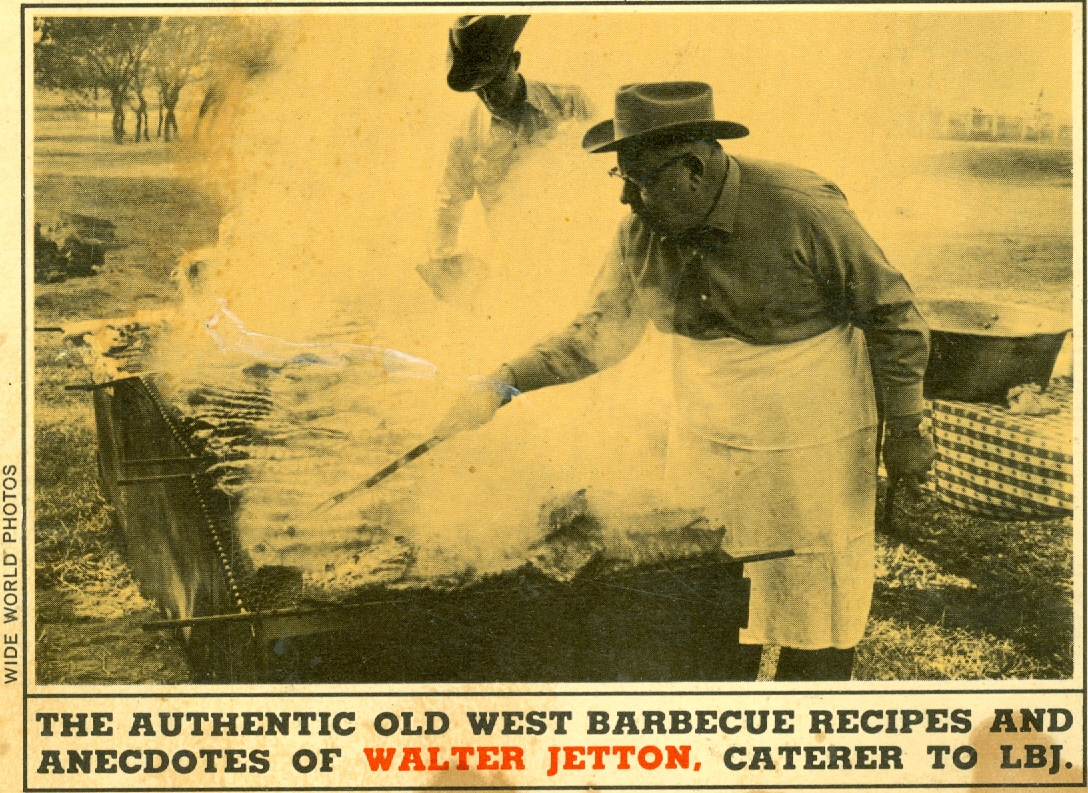
So much for my ramblings. Now it’s on to recipes. We decided to delay our traditional cookout and wound up having barbecued ribs, Susan’s famous brisket, Sarah’s herbed potato salad, coleslaw, and Southern buttermilk cornbread. For the barbecue, I used recipes from a cook book that has been in our family for 50 years: Walter Jetton’s LBJ Barbecue Cook Book (Pocket Books, Inc., New York, 1965, $1.00) Walter Jetton billed himself as caterer to the LBJ Ranch. He was from Fort Worth, but spent a lot of time in Washington, D.C. introducing Hubert Humphrey and other politicians to authentic Texas barbecue. Here are my modest revisions of his recipes for dry rib rub and barbecue mop, two essential condiments for barbecue.

Walter Jetton at the barbecue - from the cover of his 1965 cook book

Walter Jetton at the barbecue – from the cover of his 1965 cook book

RECIPES

Dry Rib Rub

Ingredients

  • 3 tablespoons salt
  • 3 tablespoons sugar
  • 1½ teaspoons lemon powder
  • 3 teaspoons Accent MSG
  • 1 tablespoon ground black pepper
  • 1½ teaspoons paprika

Method

  1. Combine all ingredients in a container with a lid
  2. Rub the mixture generously on all surfaces of the rack of ribs before you place it on the barbecue

Barbecue Mop

Ingredients

  • 1 tablespoon salt
  • 1 tablespoon dry mustard
  • 2 teaspoons garlic powder
  • 1 teaspoon ground bay leaf
  • 2 teaspoons chili powder
  • 1 tablespoon paprika
  • 1 tablespoon Accent MSG
  • 2 teaspoons Louisiana Hot Sauce
  • 1½ cups Worcester sauce
  • ¾ cups white vinegar
  • 1 carton (32 ounces) beef stock
  • ¾ cups vegetable oil

Method

  1. In a large bowl, combine first seven (dry) ingredients
  2. Stir in the liquid ingredients until completely mixed
  3. Cover and let stand overnight at room temperature
  4. With a small (new) dish mop, brush on barbecue meats frequently as you cook them.
  5. Refrigerate any that is left over when you have finished barbecuing. Store it in a tightly-lidded jar. It will last for a long time.

7 Comments

Filed under Food, Photography, Recipes, Restaurants, Travel

ASPARAGUS FRIES AND AIOLI

A few evenings ago, we went with our food-enthusiast friends to a relatively new Santa Fe restaurant, Arroyo Vino. We were excited about the visit, which was a ways out of town, because we had previously been big fans of the Executive Chef, Mark Connell, who had wowed us at a downtown place that is now history. The restaurant is only open for dinner Tuesday through Saturday so reservations can be dicey. But the added feature is that it is attached to a very complete wine shop that is open throughout the week, and with lots of good choices for fair prices. You can even buy a bottle for your dinner if nothing on the menu pleases your palate.

The menu changes frequently and tends to favor the current enthusiasm for the farm-to-market movement. Specials are posted on a blackboard, and they are worth considering in view of the restaurant philosophy.

Asparagus is in season, so you can get it prepared in one of several ways. I didn’t see asparagus ice cream, but the asparagus soup was a keeper, and to my taste the asparagus fries turned out to be a highlight of the evening

The dish was served in a beaker filled with plump asparagus spears lightly dusted with panko and fried just until the panko toasted but not enough to rob the asparagus of its green and crispness. It was lighter than tempura – if you want tempura you do batter – but it begged to be dipped in the accompanying Hollandaise.

When I got home I decided to emulate this very special dish. My effort didn’t come close to the real thing, but it was good enough that there was no asparagus left at the end of dinner. This recipe is also ingredient-efficient because I used egg whites to give the panko something to stick to and then the yolks to make a dipping aioli instead of Hollandaise. Making the aioli also gave me a chance to use one of my new gadgets.

Over the years, I have gone through countless garlic presses. Of course, the pros among you will say, “Don’t put it through a press, just mince it, or make a paste with the flat of a knife, or use a mortar and pestle.” All of those skills have escaped me, but garlic presses have also been a big disappointment. They break; the holes are hard to clean out; the press part doesn’t meet the plate of holes; the garlic doesn’t get extruded; etc. So my wife gave me a JosephJoseph garlic rocker, made by the British firm owned by the twin brothers Joseph and designed by Goodwin Hartshorn. It is a thing of beauty, made of lightly brushed metal with two wings and an indentation of a honeycomb of sharp-edged hexagonal holes. You place the rocker on some garlic, and rocking the wings back and forth, you force the garlic through the holes into the indentation. The garlic may not be as fine as you would like, so just press it through a second time. It works, it’s fun, and it’s easy to clean/dishwasher safe.

Our home meal was finished with corn-on-the-cob and twice-baked potato.

RECIPE

Asparagus Fries

Ingredients

  • 1 bunch fresh asparagus, preferably larger stalks
  • 2 egg whites
  • 2 tablespoons water
  • ½ cup panko
  • 2 tablespoons cornstarch
  • ½ teaspoon baking soda
  • 1 teaspoon salt
  • peanut oil for deep-frying

Method

  1. Wash the asparagus and trim the woody stems so that the stalks are about the same length
  2. Whip the egg whites so that they are frothy and evenly mixed. Whip in the water and transfer to a shallow plate or pan.
  3. In another plate or pan, combine the panko, cornstarch, baking soda, and salt.
  4. Working a few stalks at a time, coat them with egg white and then coat them with the panko mixture. Set on a baking rack for a few minutes to dry until all of the stalks are coated.
  5. Heat a heavy pot with about 3 inches of peanut oil to 350° F. Adjust the heat to maintain temperature because the asparagus will cool of the oil rapidly, and the asparagus will become greasy if the temperature is too low.
  6. Working in batches, transfer the asparagus stalks to the hot oil. Fry for no more than a minute until the panko is lightly browned. Transfer to folded paper towels to drain, and keep warm until all of the asparagus is fried.
  7. Serve immediately with freshly made aioli. You can use the 2 leftover egg yolks for that.

9 Comments

Filed under Food, Photography, Recipes, Restaurants

STOP COOKING AND SMELL THE FLOWERS

Spring has finally come. Or is it summer already? The last big snow storm on the Sangre de Cristos melted a few days ago, and now there is only a tiny sliver of white on the highest peak. Today, the temperature is in the 80s, and tomorrow it is supposed to be over 90.

The western bluebirds and Say’s phoebes have built their nests while the purple house finches are looking for their space. Piñon jays have appeared in great flocks, the first time that has happened in years, perhaps because of the years-long drought and the early spring rains we have had. The spotted towhees are back with their distinctive cheerful sound, and the ravens are brooding in a huge nest built of sticks (too big to be called twigs) in a juniper on the bank of the arroyo. Black-chinned hummingbirds have arrived at the feeders, but it is too early for the more aggressive broad-tails.  It has been a joy to watch the migrants traveling through our yard on their trip up north. Lizards are sunning themselves on the patio wall.

Apricots and peaches put on an early show and then promptly froze, so again there won’t be fruit from the trees in our yard. Lilacs and daffodils have finished their performance, and now the irises and columbines are at their peak with the peonies bowing down as their huge flowers overwhelm the slender stems. The native plants have also begun to color the landscape: evening primroses (both yellow and white varieties), yuccas and their accompanying hawk moths, paintbrush, buckwheat, and Artemisia. The color should start to come in waves now until the winter frost with chollas, fern bushes, desert willows, sacred daturas, desert four-o’clocks, sunflowers, cow pen daisies, and asters joining in at just the appropriate time.

With all of this gong on, it has become harder to cook and to make images in the kitchen, so I decided to take a break and wander around my wife’s beautiful garden. I hope you will forgive this lapse, and I also hope that you enjoy this little break from cooking.

Enjoy your summer ahead.

3 Comments

Filed under Photography

OAK-SMOKED SHRIMP WITH TRUMPET MUSHROOM RISOTTO

Our local farmers market stays open all year, but only now have the growers occupied their open-air stalls. There is still wind and cold weather, so about the only things available are greens and a few root vegetables. One exception to that is the beautiful trumpet mushrooms available from the  “mushroom man”. If you are like me, you wind up buying way more from the vendors than you can possibly use. I try to plan daily menus in my mind as I walk down the aisles. Invariably, my eyes and appetite fail me so that when the end of the week and a new farmers market arrives, there are things still in the vegetable crisper. The trumpet mushrooms fell into that category this week, so when I looked in the pantry and saw a container of Arborio rice, I immediately thought of risotto. I also wanted to try a new brand of boxed fish stock as well as Better Than Bouillon fish stock base suggested by my friend, Jim Hastings. It seemed like a perfect excuse for shrimp risotto. On top of all that, the stove top smoker was still sitting on the kitchen counter after my effort at smoked new potatoes, so the stars just seemed to come together for smoked shrimp with mushroom risotto.

RECIPES

Oak-Smoked Shrimp

Ingredients

  • ¼ cup smoking chips
  • 6 large (10-15/pound) per person
  • Old Bay seasoning
  • salt and pepper

Method

  1. Prepare stove top smoker by heaping special wood chips in the middle of the smoking pan. Cover the tray with aluminum foil to make cleanup easier and insert, along with rack in the smoker.
  2. Skewer 6 shrimp. Sprinkle with Old Bay seasoning, salt, and pepper. Place on the smoker rack, and close the top, leaving an opening of about 3 inches.
  3. Place the smoker over two burners of the kitchen range, both set to medium flame.
  4. When smoke begins to come out of the lid opening, close tightly and smoke for 20 minutes.
  5. Remove the smoker from the stove, open the lid, and remove the shrimp.If they do not appear to be done, replace the smoker lid and place over the flame for another 5 minutes.

Trumpet Mushroom Risotto

Ingredients

  • 2 tablespoons olive oil
  • ¼ cup shallot finely chopped
  • 1 cup Arborio rice
  • 2 quarts seafood stock made by dissolving 2 teaspoons Better than Bouillon fish stock base in 2 quarts water (or use canned fish stock or your own home-made fish stock diluted 1:4 with water)
  • 1 pint container of trumpet mushrooms
  • 2 tablespoons unsalted butter
  • salt and pepper to taste

Method

  1. In a medium sauce pan with lid, heat the oil over a medium-low flame. Add the shallots and sweat, covered, for about 5 minutes.
  2. Add the rice, and raise the flame to medium, stirring constantly until the rice becomes opaque but does not brown.
  3. In the meantime, bring the fish stock to the simmer over another flame.
  4. Add one ladleful of stock to the shallot-rice mixture and raise the heat to bring to the boil.
  5. Stir frequently (constantly) until the liquid has almost completely evaporated. Then add another ladleful of the stock and again stir until nearly evaporated. Repeat the process until the fish stock is used up or the rice is creamy and tender, about 30 – 40 minutes  . If you need more liquid to finish cooking the rice, use water.
  6. In the meantime, melt the butter in a small skillet over medium heat. Add the mushrooms and sauté for 5 minutes. Set aside.
  7. When you are ready to serve, stir the mushrooms into the risotto. Adjust the seasoning with salt and pepper. Top with the smoked shrimp and serve. There should be enough risotto for 2 to 4 persons, depending upon hunger.

8 Comments

Filed under Food, Photography, Recipes

SMOKED NEW POTATOES AND CARAMELIZED GARLIC AIOLI

Here’s another idea I lifted from Bar Tartine. Their smoked potatoes with black garlic are unique and delicious. I couldn’t possibly replicate them at home. First, because I don’t have black garlic, and second, I don’t have a clue as to how they smoke their potatoes. As to the black garlic, you can order it from Blackgarlic.com in Hollister, CA, near the garlic capital of the world – Gilroy.

Still, an effort was worth a try, especially if I dragged out my Camerons Stovetop Smoker. The smoker is one of the niftiest things in my batterie de cuisine even though I don’t use it that much. With it, I can hot smoke fish, poultry, meat, and anything else you can fit into it without filling the house with smoke. The smoker is available from the manufacturer, Amazon, kitchen stores, and several big-box retailers for under $60.

Camerons also sells wood chips specially sized for the smoker. The wood chips that you find in the barbecuing section of the grocery store are too big. But Camerons gives you a choice of apple, alder, cherry, hickory, maple, mesquite, oak, pecan, and even corn cob. I used alder, and I think it was a good choice.

As a substitute for the black garlic, I smoked fresh garlic with the potatoes in the hope that it would caramelize and then used for an aïoli. That turned out to be reasonably successful.

RECIPES

Smoked New Potatoes

Ingredients

  • 1/3 cup special smoker wood chips
  • 6-8 small new red potatoes for each diner, well-scrubbed
  • 3 tablespoons butter, melted
  • coarse Kosher salt

Method

  1. Prepare the smoker by placing the wood chips in the center of the bottom of the smoker. Line the tray with aluminum foil, and arrange it and the rack in the smoker.
  2. Arrange the potatoes on the rack with the garlic in a small aluminum foil nest in the center (see below)
  3. With a brush, lightly baste each of the potatoes on all sides and sprinkle generously with the salt.
  4. Slide the cover onto the smoker, leaving a 3 inch opening. Place over medium heat on the stove top. When smoke begins to come out of the opening, close to form a tight seal. You will be able to smell the smoke, and you may see a faint wisp, but there should be no smoke coming out of the sealed smoker.
  5. Roast for 45 minutes. Remove the smoker from the heat, and open the top.
  6. Transfer the potatoes to a serving bowl

Caramelized Garlic Aïoli

Ingredients

  • 6 cloves of garlic, peeled and stems removed
  • 1 cup mayonnaise
  • juice of ½ lemon
  • salt and pepper to taste

Method

  1. Crumple a sheet of aluminum foil into a small “nest” large enough to hold the garlic. Set the nest in the center of the potatoes on the smoker rack.
  2. Smoke according to directions above.
  3. When the potatoes are smoked, transfer the garlic to a small bowl and mash with a fork or pass through a garlic press.
  4. Stir in the mayonnaise and lemon juice. Adjust the seasoning with salt and pepper
  5. Serve as a dip with the potatoes.

7 Comments

Filed under Food, Photography, Recipes, Restaurants

BRINED ROOT VEGETABLES AND CAULIFLOWER

Here’s my take on the brinded vegetables served at Bar Tartine. Even though mine are not nearly as good as those at the restaurant, they have turned out ok.

This exercise began at the farmers market. One of the vendors we especially like had some freshly-dug parsnips. That got me to thinking about brining some root vegetables, and I found some turnips and carrots at the grocery store. I couldn’t find anything green – I guess broccoli would have worked – so I settled on a mix of the four.
Then, of course, I had to drag out my Harsch Steinzeug sauerkraut crock. The task also gave me the opportunity to try out my copy of “The Art of Fermentation” by Sandor Ellix Katz. My daughter, Carol, had given me the book as a gift, and I was so pleased because it has become a classic and the “standard” on the topic in just the short two years since it has been published. The only other things I needed were some Kosher salt and water.

My crock is 5 liters, which is just the right size for me, but it comes in larger and smaller sizes as well. If you haven’t seen a Harsch Steinzeur crock, it is a thing of beauty with a gleaming brown glaze, shaped handles, and a straight-sided lid with a stylish knob on top. It is also an example of German ingenuity and practical design. During my childhood, my grandmother made crocks and crocks of sauerkraut. The process was tedious and odoriferous. As well, skimming the scum off the top of the crocks took lots of attention for weeks.

My crock overcomes all of those problems. Inside are two half-moon weights that fit tightly together to keep whatever you are brining submerged. There are notches in the rim to provide escape for carbon dioxide, and there is a shallow trough around the lip that you fill with water to form an air-tight seal. That cuts down on the smell of fermenting vegetables. Once you have your system set up, and the vegetables start to ferment, you will hear an occasional “frog croak” as a burp of carbon dioxide escapes. That’s reassurance that things are going alright.

Some briners are careful to weigh out the salt and to balance it with enough water to make a brine of specific concentration, but you don’t need to do that so long as you make sure to add enough salt to make a good brine. Even though I peeled the vegetables, you don’t have to do that either, but I thought they would be more attractive with their peelings gone – especially the turnips and rutabegas.

I harvested my vegetables after about ten days of brining. They were still crisp with a briny, slightly pickled taste. If you want a stronger pickle, you can brine them longer, and you can check from time to time to see if the vegetables are to your liking. Just remember when you repack the crock to charge it with more salt and water and to seal the lid with water as you did at the beginning of the process.

So here’s what I did:

RECIPE

Brined Root Vegetables and Cauliflower

Ingredients

  • 3 parsnips, peeled and cut into chunks
  • 3 rutabagas, peeled and cut into eighths, lengthwise
  • 3 turnips, peeled and cut into discs
  • 4 large carrots, peeled and cut into chunks
  • 1 head cauliflower, cut into florets
  • Kosher salt
  • water

Method

  1. Prepare the vegetables
  2. Arrange a single layer of mixed vegetables on the bottom of the crock. Sprinkle generously with salt.
  3. Repeat the process, layer by layer, until you have used all of the vegetables
  4. Arrange the half-moon weights so that they fit together and the vegetables are covered.
  5. Add water to cover the weights with at least two inches
  6. Place the lid on top of the crock, and move to a cool place out of the way of your cooking.
  7. When the crock is in place pour water into the groove around the lid and go about your business
  8. Check the level of water around the lid on a daily basis. Fill with more water if needed
  9. After about 4 4 days listen for the “burp”
  10. You should probably plan on at least 10 days before you check the vegetables. That will be a good time to remove any scum that might have formed on the weights, although there will probably be none or very little because of the air-lock system. If you want to brine the vegetables longer, sprinkle the top of the vegetables with more salt, adjust the water level, and replace the weights. Refill the watereseal around the lid and let the process work for another week.
  11. Remove and serve the vegetables whenever they suit your taste.

Leave a comment

Filed under Food, Photography, Recipes, Restaurants

GINGER-SCENTED BUTTERMILK PANNA COTTA

In a previous post, September 10, 2013, I wrote about Sarah’s panna cotta recipe and added some images of her making it and a berry topping down in the basement prep area of Rich Table. That version uses fresh buttermilk from the restaurant that is a byproduct of their house-churned cultured butter.

This is a slightly different version of the panna cotta using commercial buttermilk and ginger as the principal flavoring. I used it as the centerpiece of the dessert for our recent pot luck birthday party: ginger-scented panna cotta with cajeta and sea-salt-sprinkled chocolate sables.

It is very easy to make. The only special step is to strain the panna cotta into the ramekins to remove any bits of ginger root and undissolved gelatin.

RECIPE

Ginger-Scented Buttermilk Panna Cotta

Ingredients

  • 1¼ cups heavy cream
  • ½ cup sugar
  • 1 6-inch piece of fresh ginger root, peeled and cut into 1 inch pieces
  • 1 packet unflavored gelatin
  • ¼ cup water
  • 1½ cups buttermilk

Method

  1. In a medium saucepan over medium heat, combine the cream and sugar. Bring to a boil, stirring until the sugar is dissolved. Add the ginger root pieces and simmer for 15 minutes
  2. Meanwhile, sprinkle the gelatin over the surface of the water in a small bowl. Let stand for 5 minutes to soften the gelatin.
  3. Stir the softened gelatin into the simmering cream mixture and stir vigorously until the gelatin is completely dissolved.
  4. Add the buttermilk and simmer gently for another 10 minutes, stirring frequently.
  5. Remove from the heat, cool for a minute or two, and then strain into six 6-ounce ramekins
  6. Cool to room temperature and then cover each ramekin with plastic wrap. Refrigerate overnight.


3 Comments

Filed under Food, Photography, Recipes