Category Archives: Travel

ANOTHER YEAR IN YOSEMITE – PLANCHA BREAD

It has been nearly a year since I last reported from Yosemite. Sarah and Evan have been invited again to demonstrate the preparation of one of their dishes and to prepare a dinner at the Ahwahnee Hotel.

During the past year, things have changed in our family and with the park. Last year, Sarah was trying to cook while 8+ months pregnant. This year we were charged with watching a nearly four year old and a 10 month old while Sarah cooks.

The park is still suffering from the results of last summer’s fires. There are great stands of blackened tree skeletons, and huge logging trucks are pulling enormous tree trunk s down the road.  The drought and warm weather have both had their impact: there is no snow, and Yosemite Falls, usually frozen by this time of year, are without ice. In the Central Valley below, the reservoirs are nearly empty. Everyone is hoping for the rains and snows that don’t appear to be coming.

Perhaps the biggest current news is the successful climb of  the Dawn Wall of El Capitan by Tommy Caldwell and Kevin Jorgeson. Sarah and Evan’s demonstration was interrupted by the announcement, and since then the hotel has been abuzz with the news. All of the television networks appeared with cameras and had the climbers get up at 4 AM (After being on a sheer rock face for 19 days.) to give interviews for Good Morning America, Today, etc.

Today, Susan and I took a drive while Sarah, Evan, and the boys were taking a walk – the first time they have had a chance to get out of the hotel and the kitchen.

Our drive took us past El Capitan. There were still three bivouac tents hanging from the Dawn Wall, and there was a huge traffic jam of television trucks in the meadow where Caldwell and Jorgeson were giving yet more interviews. Then we drove past Bridal Veil Falls to the Tunnel View Point to get an obligate image of the whole valley including El Capitan and Bridal Veil Falls with Half Dome in the background. It is a cliché image, but it is so breathtaking that you can’t avoid it. Neither could a big crowd of people even in the middle of winter.

Tonight, Sarah and Evan will serve a wonderful dinner to include aged duck lasagna and an almond-chocolate dessert.

here’s the menu:

  • Onion soup: radish and dried plum salsa verde, fried shallots
  • Aged duck lasagna: chickories
  • Bone marrow roasted cauliflower: kumquat
  • New York strip steak: lemon verbena curry, pommes fondant
  • Bittersweet chocolate ganache: marshmallow fluff, citrus

But I thought I would share recipes from their demonstration:


RECIPES

Rich Table Plancha Bread

Ingredients

  • 1 1/2 cups water
  • 2 1/4 teaspoons dry yeast
  • 1 teaspoon honey
  • 1 1/2 cups whole wheat flour
  • 1 cup bread flour
  • 1 3/4 teaspoons salt
  • 2 tablespoons Sevillano olive oil

Method

  1. Mix together the water, yeast, honey, and olive oil.
  2. Add flour and salt to the bowl of a stand mixer. Using the dough hook, add the wet to the dry ingredients and mix to form a ball.
  3. Keep the dough in the mixing bowl and wrap the whole thing with plastic wrap. Let dough proof in a warm area of the kitchen for one hour.
  4. Once the dough has proofed, divide it into 70 g balls. Roll each ball out into an oblong about 1/4 inch thick.
  5. On a griddle or large cast iron pan heated to medium-high and seasoned with oil, sear each flat bread, cooking and browning on both sides.

Roasted Baby Cauliflower Dip

Ingredients

  •  1 head baby cauliflower
  • 3 tablespoons butter, browned and reserved
  • juice of 1/2 lemon
  • salt to taste

Method

  1. Clean cauliflower to remove most of the greens leaves and stem. Cut in half.
  2. Blanch cauliflower in boiling salted water until jus tender
  3. Sear the blanched cauliflower on a griddle or heavy cast iron pan until golden. Then bake in a 350 degree F oven until tender.
  4. Season cauliflower with lemon juice, brown butter, and salt. Puree if desired or serve as is.

Shelling Bean Dip

Ingredients

  • 1 pound fresh cranberry beans
  • 2 bay leaves
  • 3-4 tablespoons pure olive oil
  • salt to taste
  • 1 teaspoon Douglas fir powder
  • 1 teaspoon fennel pollen

Method

  1. Cook cranberry beans in water with bay leaves until soft. Strain beans and reserve the cooking water
  2. In a mixing bowl, season the beans with pure olive oil (e.g. Mission Trail from Sciabica), some of the reserved cooking water, salt, Douglas fir powder, and fennel pollen.
  3. Using a fork, mash everything together until the desired texture is reached. The puree should be as smooth as hummus.

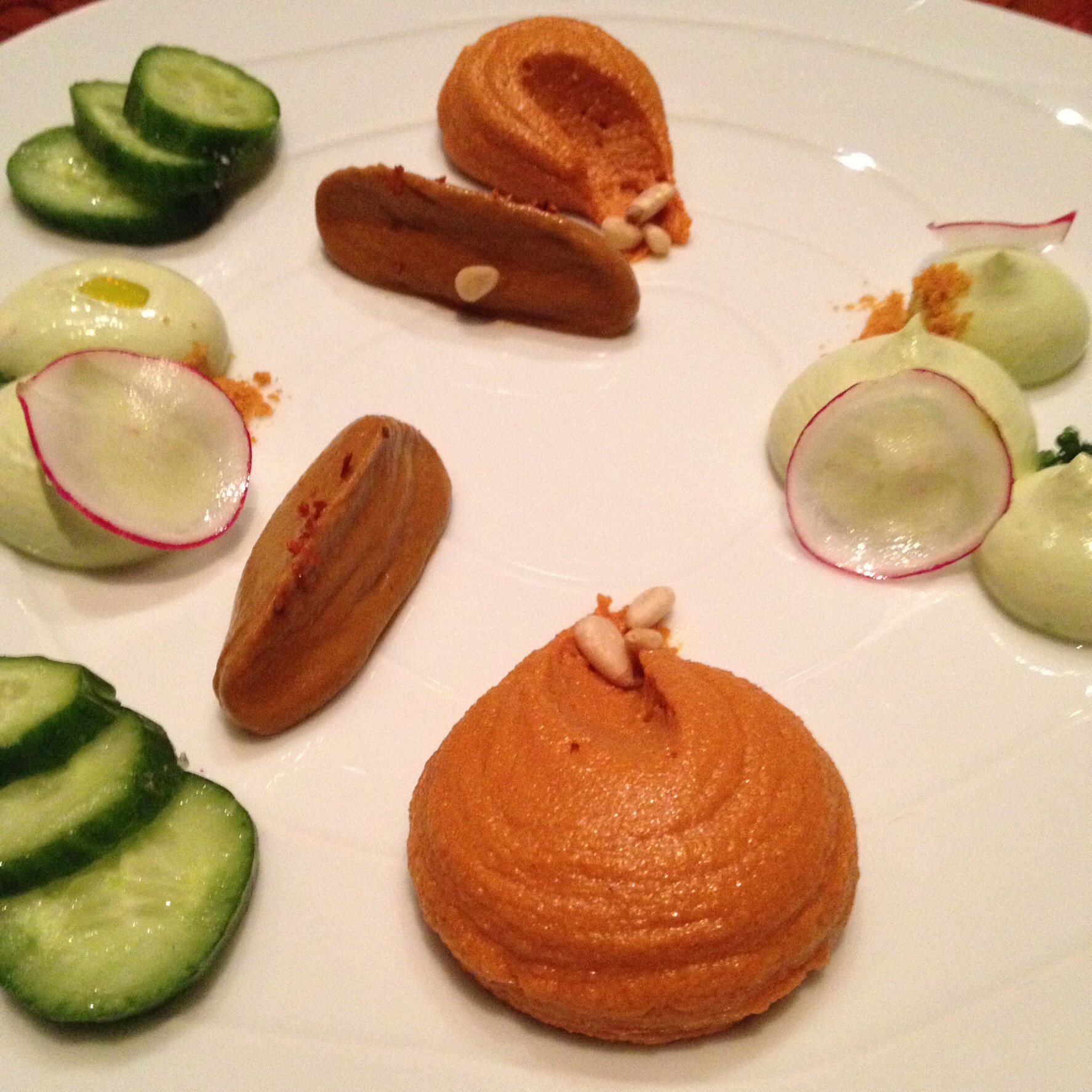
Note: With both dips, you can spread them on pieces of reheated plancha bread and garnish with tiny cauliflower florets or thinly sliced radishes and caramelized finely sliced shallot.

Leave a comment

Filed under Food, Photography, Recipes, Restaurants, Travel

L.A. FLOWER MARKET, GRAND CENTRAL MARKET AND BUCHE

For a family outing, we decided to visit downtown LA. “Why,” you might ask. “There’s nothing there.” But you would be wrong. The downtown is being revitalized, and it has long been home to the LA flower market, two huge warehouses filled with flower merchants offering all sorts of cut flowers, plants, and vases and pots to hold them. It’s not the Chelsea Flower Show, but it is a pretty interesting place. In addition, the Grand Central Market has recently been redone. It has been open since the early twentieth century, but it had fallen on hard times. Now it has become more upscale, but it still has the feel of a Mexican mercado. Peter, our son, joined us for a couple of days from Silicon Valley, so he was in our group.

To get to the flower market, you have to pass through the garment district where bolts of cloth are displayed at store fronts. I though I was back in El Paso. For the flower market, you park on the roof top of one of the warehouses, ride the elevator down to the showroom floor, and pay an entrance fee of $1. Then you wander the aisles between displays of hydrangeas in many colors (dyed of course), bromeliads, cacti, roses, daisies, and this time of year, poinsettias being pulled from the shelves. Prices are remarkably low, so it is easy to fill your arms with bunches of flowers wrapped in old Korean-language newspapers.

The street between the two warehouses is filled with food vendors, and you can get pastries, humus, french fries, elotes (corn on the cob), and any number of sandwiches. But we were saving our appetites for the Grand Central Market.

We drove a few blocks, parked in the garage, and rode the elevator down to the market. It was an overwhelming sight. There were crowds of people, neon signs advertising various vendors, and stalls filled with the special offerings of every vendor.

Among the items we wound up buying was a huge bacalao that I got to make for a New Year’s Day dinner (along with black-eyed peas and cabbage, of course). There was an abundance of fruits and vegetables, but no yuca which Peter was looking for to make his Colombian sancocho later in the day.

Surprisingly, there was an oyster bar with a good selection of raw oysters and wine, so some of us paused there. Others chose Thai, Chinese, or barbecue. We passed up the Eggslut (Don’t ask me how it got the name) because the line was way too long. The place is one of the best known vendors in the market and offers eggs done in a myriad of ways.

Peter opted for a Mexican stand that was selling tacos and tortas. You could choose any number of fillings – chicharon, tripitas, tripe. For most of them, there was an English translation for what it was. Some did not have a translation. One of those was buche. This is considered a great delicacy, but for all my years in El Paso, I could never get anyone to tell me what it was.

Years ago, I had a waitress in a Mexican restaurant tell me that if I had to ask what a dish was, I probably didn’t want o order it. Those are words to live by.

Anyway, Peter ordered the buche sandwich even though the server seemed amazed and double checked that that was what he wanted. Peter got the sandwich, took one bite, swallowed, and then googled to learn that buche is pig esophagus. He put down the sandwich and headed straight to the barbecue stand.

2 Comments

Filed under Food, Photography, Travel

AZIZA AND THE OUTER RICHMOND

A while back I wrote about the great restaurant, Outerlands, located in the Outer Sunset District of San Francisco. Outer Richmond is a bit different. First, it is not to be confused with the City of Richmond located north of Berkeley and Oakland and home to the (in)famous Chevron refinery. Outer Richmond lies just north of Golden Gate Park and south of the Presidio and the very toney Pacific Heights, Presidio Heights, and Seacliff (home to the Barber family of the popular radio show of the Second World War, One Man’s Family – if you are old enough to remember.)

Outer Richmond does not lack for restaurants. It is home to many immigrant groups including Russians, Vietnamese, Koreans, Greeks, and Chinese. In fact, some people say that San Francisco’s REAL Chinatown is in the Richmond rather than the touristy version near Union Square. There are whole blocks with nothing but ethnic restaurants, many of them quite good, but none exactly a tourist destination.

Aziza is the exception. A number of years ago, it started out as a Moroccan restaurant serving the traditional cuisine. With time, it has morphed into an upscale California-American restaurant but with Moroccan overtones. And the food is delicious. Aziza has a Michelin star to prove that.

Main dining room

Main dining room

We spent a great evening there in the recent past. One of the secrets of our success was booking an early reservation. The place got very crowded as the evening wore on. On top of that, Aziza  sits on the corner of Geary and 22nd, so parking is impossible. You should definitely begin your hunt for a parking space well in advance of your scheduled reservation.

The menu changes fairly often, so you may not have the choices we had, but you can buy the cook book if you want to sample what’s available: Mourad: New Moroccan by Mourad Lahlou, Artisan, 2011, $40.00.

Spreads: eggplant, yogurt-dill, and piquillo-almond-tahini served with flatbread

Not your usual Middle Eastern dips and spreads, although they are clearly based on the traditionals. They are creamy-smooth with distinct but subtle flavorings.

Spreads

Spreads

Beets  with cabbage, persimmon, cheese, peanuts, and rye tuiles

These days, nearly every restaurant serves a beet salad, but not like this. The beets are roasted and come with the root completely intact, nestled on a soft cheese with purees of seasonal fruits and vegetables. The delicate rye tuiles make a perfect foil.

Beet salad

Beet salad

Couscous

The couscous is hand-made in house. Ours came with thin curls of fresh pumpkin, delicately cooked pieces of winter squash, and cranberries. Two dollops of harissa were served alongside so you could season to your liking.

couscous with pumpkin, winter squash, cranberries and harissa

couscous with pumpkin, winter squash, cranberries and harissa

Market fish

The night we were there, the market fish was black bass. It was served with Dungeness crab, which is in season, along with shaved, roasted brussels sprouts and oyster.

Market fish

Market fish

Lamb shank

Cooked exactly as it should be, it was falling off the bone and wonderfully seasoned. It came topped with shaved tart apple along with fennel, barley, and nettle.

Lamb shank

Lamb shank

Desserts

Don’t pass up desserts, because the pastry chef is a James Beard-recognized chef in her own right. We got a medley of bites, all of them delicious. Her version of Turkish delight (lokum) was the best I have ever tasted.

Dessert

Dessert

Aziza is definitely worth your making the trip to Outer Richmond. Besides, San Francisco is only nine square miles in size. How long a trip can it be?

2 Comments

Filed under Food, Photography, Restaurants, Travel

CIOPPINO AND THE OLD CLAM HOUSE, SAN FRANCISCO’S OLDEST RESTAURANT

The other evening, Peter and Rene treated us to a night out as an early Christmas present. Cirque du Soleil had a touring show in town, so we went to see it. For old fuddy duddies who have never gone to  one of these productions, it was quite a treat. It is still hard to believe that humans can do all of the things that they do in such a spectacular event.

Before the show, we went to dinner at the Old Clam House, reportedly the oldest still-operational restaurant in San Francisco. That is not hard to believe. It sits on a grimy thoroughfare in the middle of an industrial area that was once on the wharves of San Francisco. The restaurant had its start in 1861, as the first wave of the Gold Rush was winding down.

The place is an old clapboard building with a peaked roof. It is now painted, but it apparently spent many of its days as a raw wood establishment similar to those you see in old western movies. Inside, the original embossed tin ceiling is preserved, and the bar is a huge mirrored, ornately carved wooden structure that is at least twenty feet high.

Before and after

Before and after

I was prepared for the food  to be ordinary and tourist-driven, much like that at Fisherman’s Wharf, but I was wrong. Tourists probably don’t get there much, and the customers all looked like they were regulars, especially those sitting at the bar.

As soon as we sat down at the table covered with a blue-checked tablecloth, the waitress brought us a round of warm clam broth served in little glass cups along with a big loaf of Acme bread. That gave us a chance to study the menu.

The menu is fairly long and largely restricted to seafood, especially shell-fish. There is a nod to some California specialties like sand dabs, and because the season for Dungeness crabs has just opened there are several crab dishes. Susan ordered clam chowder – she always does, even at the Grand Central Oyster Bar in New York. Rene ordered crab cakes, and Peter ordered a whole crab, thus requiring the obligate bib.

I ordered the cioppino because, after all, this is San Francisco and it occupied a prominent place on the menu. With a wink, the waitress assured me that this was the original version of the dish. I’m certain that is not true, but I am equally certain that this version is delicious and enough for a longshoreman, if there is such a person around the place anymore. The bowl was a cast iron pot, piping hot and filled with a tomatoey broth rich with crab, clams, shrimp, mussels, and calamari along with new potatoes and chunks of corn on the cob. One local food critic claims the soup is diluted bottled marinara and the clam broth is mostly chicken stock.  I don’t believe either of those assertions, but I don’t have the cultivated palate of a food critic.

Here is a recipe for cioppino that has been in our family for nearly 40 years. It was given to us by our friend, Nancy Swanson, who prepared it for a group of couples with the ski patrol in Park City. Of course, there are many versions of cioppino. I am certain the food critic would declare this one not to be authentic, but if it tastes good, why worry about authenticity?

RECIPE

Cioppino

Ingredients

  • 1/2 cup olive oil
  • 3 cloves garlic, minced
  • 1 1/2 cups onion, chopped
  • 3/4 cup green pepper, chopped
  • 11 1/2 ounce can, clams
  • 2 pound can, tomatoes
  • 6 ounce can, tomato paste
  • 1 3/4 cups red wine
  • 2 teaspoons oregano
  • 1/2 teaspoon basil
  • 2 teaspoons salt
  • 1/4 teaspoon black pepper
  • 3/4 cup fish stock
  • 1 1/2 pounds cod or halibut
  • 1/2 pound raw shrimp, peeled

Method

  1. In a large, heavy-bottomed stockpot, saute the garlic, onion, and green peppers in the oil
  2. Drain the clams, reserving 1/4 cup clam juice. Add the remaining clam juice to the sautéed mixture.
  3. Add the tomatoes, tomato paste, wine, herbs, salt, pepper, and fish stock. Bring to the boil and simmer 10 minutes.
  4. Cut the fish into bite-sized pieces. Add the clams, fish and shrimp to the soup and simmer, covered, for 35 minutes.
  5. Remove cover and simmer for 15 more minutes. Serve with good San Francisco style bread.
  6. (Add fresh calamari, clams, crab, mussels, or other shell-fish as you wish)

6 Comments

Filed under Food, Photography, Recipes, Restaurants, Travel

OUTERLANDS: EXCELLENT SAN FRANCISCO RESTAURANTS

Many visitors to San Francisco only know about the famous restaurants in the heart if the city or in Berkeley or Napa/Sonoma. They think of the outer districts as somewhat alien neighborhoods with undistinguished cafes. Nothing could be further from the truth, and many a resident delights in discovering a new gem to try to keep to themselves.

Outerlands is well past the “secret gem” stage, and it is a favorite among chefs and other culinary professionals. The restaurant is in the Outer Sunset District, and sits on a corner of Jonah Street just a few blocks from the Great Highway and the beach on one side and Golden Gate Park on another.  It has an unassuming facade that, along with the interior, was built by the owner, Dave, much of it from driftwood and surplus lumber.

The restaurant fits into the neighborhood that serves as a turn-around point for the Muni and is filled with the kinds of rag-tag shops that give much of the city its charm. Outerlands is almost always busy, but the staff tries hard to minimize your wait. You can sit inside, outside, or at the bar, but usually you’re happy with whatever is available.

Inside, the place is a beehive: friendly staff to take your order and keep your water glass full, cooks in front of the stove in the open kitchen, and pastry cooks making bread and delicious desserts in a back little cubby hole.

The menu is filled with interesting choices,but the restaurant is perhaps most famous for its bread. Much of that is because Dave learned to bake bread from Chad Robertson, the famous baker and owner of Tartine Bakery in the Mission District. In fact, you can read about Dave’s learning experience with bread on pages 84-87 of Chad Robertson’s classic cookbook, Tartine Bread, (Chronicle Books, San Francisco, 2010).

Bread forms a base for many of the restaurant’s best known dishes. You really should not miss their grilled cheese sandwich. This is no ordinary grilled cheese. It is made from thick slices of freshly-baked bread filled with delicious cheeses and toasted to perfection so that the cheese just oozes out, begging to be eaten. If you want, the sandwich comes with a well-made, well-seasoned soup of the day.

The pastrami sandwich is another good choice. The thinly-sliced pastrami comes dressed with a lightly brinded cabbage that has the sourness of sauerkraut but remains crisp and fresh.

If you feel like a salad, they have those, too. The charred chicory salad comes topped with a perfectly poached egg that has been lightly dusted with freshly grated Parmesan. The bitter greens balance off the vinaigrette and the creamy egg yolk.

On weekends, check out brunch. The grilled cheese has disappeared from the menu, but other bread-based treats replace it. On a recent day, I had “eggs in jail”, which is a riff on the old standby of my childhood, toad-in-the-hole. But this version comes with a thick slice of bread toasted on the grill, egg nestled in the middle and topped with tasty wilted greens and a thick slice of perfectly fried bacon.

Excellent mixed drinks any time of the day, and a small but good selection of wines.

The wait staff reflect the neighborhood and many of the clientele – young, well-inked, wearing knitted caps, outgoing, and enthusiastic.

Outerlands is well worth the trip to the outerlands of San Francisco.

Leave a comment

Filed under Food, Photography, Restaurants, Travel

CALIFORNIA CHILI COOK-OFF CHAMPIONSHIP, 2014

The 2014 California Chili Cook-off Championship has come and gone, and I didn’t win a thing. But I had a lot of fun and learned about chili cook-offs. (This was my second, the first one being in New Mexico over ten years ago.)

The event was held at the Woodbridge Winery near Lodi, California. I had never been to that part of California, and was pleasantly surprised by Lodi. It is not Napa or Sonoma and sits on the edge of the Central Valley. It reminded my wife of Lubbock, Texas “with hills”. That said, the downtown turned out to be charming with lots of wine-tasting rooms, restaurants, and shops. The fields surrounding the town are almost completely taken up by vineyards.

The Woodbridge Winery is the elephant in the room. It has 300 acres of vineyards, and a large bottling operation that bottles 27 different brands of wine. It ships millions of cases of wine each year (One source says over 6 million compared with 500 cases or fewer by local family operations.)

Woodbridge was established by Robert Mondavi, but is now owned by a huge conglomerate that bought out Robert Mondavi a number of years ago. Still, it feels committed to the local community and makes a point of sponsoring a number of community-oriented activities throughout the year at its park-like headquarters space.

For 12 years it has put on a combined chili cook-off and car show. The cook-off serves as the California state championship with the winner entitled to go to the CASI (Chili Appreciation Society International) World Championship  in Terlingua, Texas. That’s sort of the chili equivalent of the Burning Man in Nevada. This year the contest attracted entrants from all over California as well as from as far away as Illinois and Kansas. The reigning world champion along with two former world champions were cooking.

The car show was huge. There were hundreds of cars of all ages, makes, and models. They were all in mint condition.

There were other things to do as well, so that the crowd was in the thousands, most of whom were anxious to taste chili, guacamole, and salsa that were prepared for respective contests.

I tagged along with my friend,, Reggie Graves, who is himself a champion chili cook who has won many contests throughout Louisiana, Texas, and Arkansas. We decided to enter all three contests. Reggie was in the Top Ten chili cooks. I was not. And we also didn’t win in the guacamole or salsa contests. That’s just the way it goes.

Here’s an image of some of the winners:


some of the winners

some of the winners

3 Comments

Filed under Food, Travel

ON THE TRAIL OF THE GREEN CHILE CHEESEBURGER

The best green chile cheeseburger I have ever eaten was at Ski Apache near Ruidoso, New Mexico. I realize that there is a situational bias to that statement. Every day during ski season, weather permitting, cooks fired up an outdoor grill close to the lift line. The scents of fresh roasted green chiles and hamburger would drift up the lift line creating hunger pangs that made it hard to unload at the top. Then you had to deal with the wonderful fragrance as you made it down the trail as quickly as possible to get in line for your own burger.

Since then, I have been looking for the perfect green chile cheeseburger. I am not alone in that quest, nor am I the first. In fact, the State of New Mexico has its official Green Chile Cheeseburger Trail. New Mexico has an official state cookie – the biscochito – and two official state vegetables – the chile and the pinto bean – but it does not have an official state dish, probably because there are a lot of candidates – enchiladas, Frito pie, fry bread among them. Nor does the state have an official sandwich even though nearly every New Mexican would probably agree that the designation should go to the green chile cheeseburger.

Nobody knows exactly who invented the GCCB. Some say it was the original Blake’s Lotaburger store in Albuquerque. (Blake’s is our local junior McDonald’s or In-N-Out with stores all over the state.) Of course that claim is disputed, and there are several claimants to the honor. Whatever the origins, the GCCB can be found in virtually every city and hamlet across the state, most of them claiming that they have the world’s best GCCB.

The first GCCB to gain national recognition came from the Owl Café in San Antonio, NM, a tiny little town just off Interstate 25. It was made famous by the commentator, Charles Kuralt who discovered it in his journeys around the USA. For years I always stopped at the Owl on my many trips up and down the interstate. Then I discovered Manny’s Buckhorn Tavern, just a short distance  across the road in San Antonio. The rustic outsides, the numerous flashing beer signs and the armada of parked motorcycles suggested that it was not the place to be, but once inside, it felt comfortable and welcoming. Bobby Olguin, Manny’s son and heir was at the flat top behind a partition, frying up Buckhorn Burgers. The solitary middle-aged waitress was scurrying around taking orders, and the stuffed mountain lion and various birds of prey occupied the walls of the back room.

Bobby always stuck his head around the partition to give a welcome, and if things were slow, he would pay a little social visit at your booth. Then things changed. the Buckhorn was discovered by the Food Network and Bobby Flay, who lost a throw-down to Bobby Olguin. After that, there was a long waiting line at the front door and a sign that said, “Please wait to be seated” near the entrance. Bobby hired some cooks to work the flat top so that he could work the dining room, and sadly, the stuffed mountain lion disappeared because Bobby had watched Robert Irvine’s television series about restaurant re-dos. Bobby thought the place needed a face lift and the mountain lion had become too dusty and mangy. Nothing much else has changed, and the GCCBs are as good as they have ever been.

San Antonio, besides being the epicenter of the world of the GCCB is also the gateway to the Bosque del Apache National Bird and Wildlife Refuge. During the winter, birders from all over the world come to watch the hundreds of thousands of sand hill cranes, Canada geese, and snow geese along with bald eagles and numerous other birds. Of course, many of those tourists visit the Owl and the Buckhorn.

One of our previous governors, unwilling to get caught up in the controversy of who had the best GCCB in New Mexico, but wanting to promote the competition and with the encouragement of food writers, suggested the promotion of the GCCB. The Office of Tourism took up the effort in 2009. They created the Green Chile Cheeseburger Trail, identifying restaurants across the state with noteworthy GCCBs. The list was updated in 2011 with the help of noted Santa Fe cookbook author, Cheryl Alters Jamison, along with other food writers and cooking professionals. Their list included around 200 noteworthy GCCBs. Both the Owl and the Buckhorn recused themselves from any competitions to select the state’s best GCCB. Still, there were lots of potential candidates.

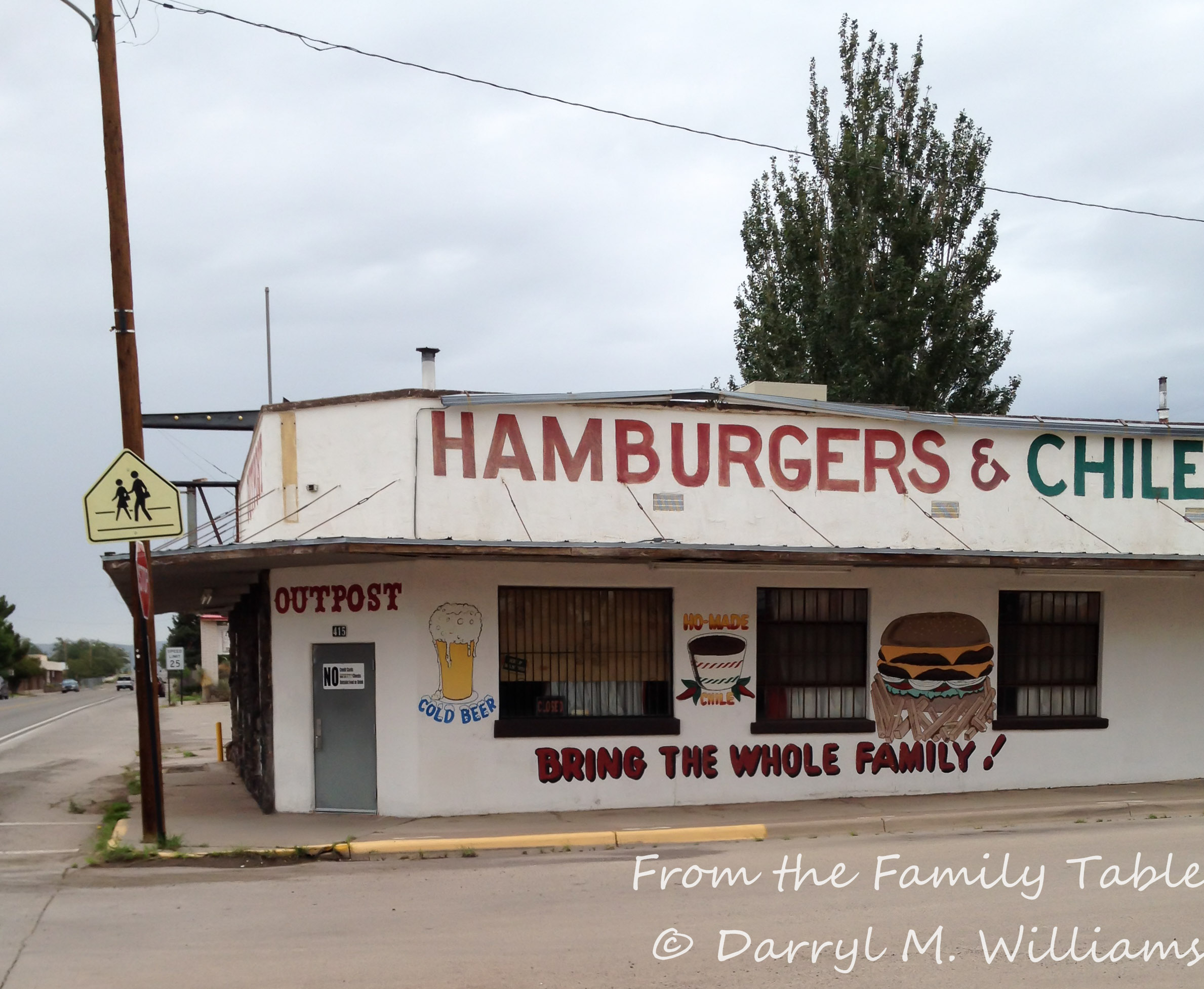
Sparky’s is a perennial favorite. In part that is because the place is in Hatch, home of the world-famous New Mexico green chile.  Bert’s Burger Bowl in Santa Fe is often mentioned as a contender because it has been featured on Guy Fieri’s  “Diners, Drive-Ins and Dives” on the Food Network. Unfortunately, some of the strongest contenders have shuttered their doors. One of my favorites was the Outpost in the town of Carrizozo, just down the road from San Antonio. It was a family biker bar with motorcycles lined up in front, 12-foot rattlesnake skins tacked up on the walls, a terrarium filled with lizards and other desert varmints, and a pool table toward the back of the dining room. They had a wonderful GCCB along with crisp but greasy French fries, but I guess the owner just got tired and decided to close.

The now-closed Outpost in Carrizozo, New Mexico

The now-closed Outpost in Carrizozo, New Mexico

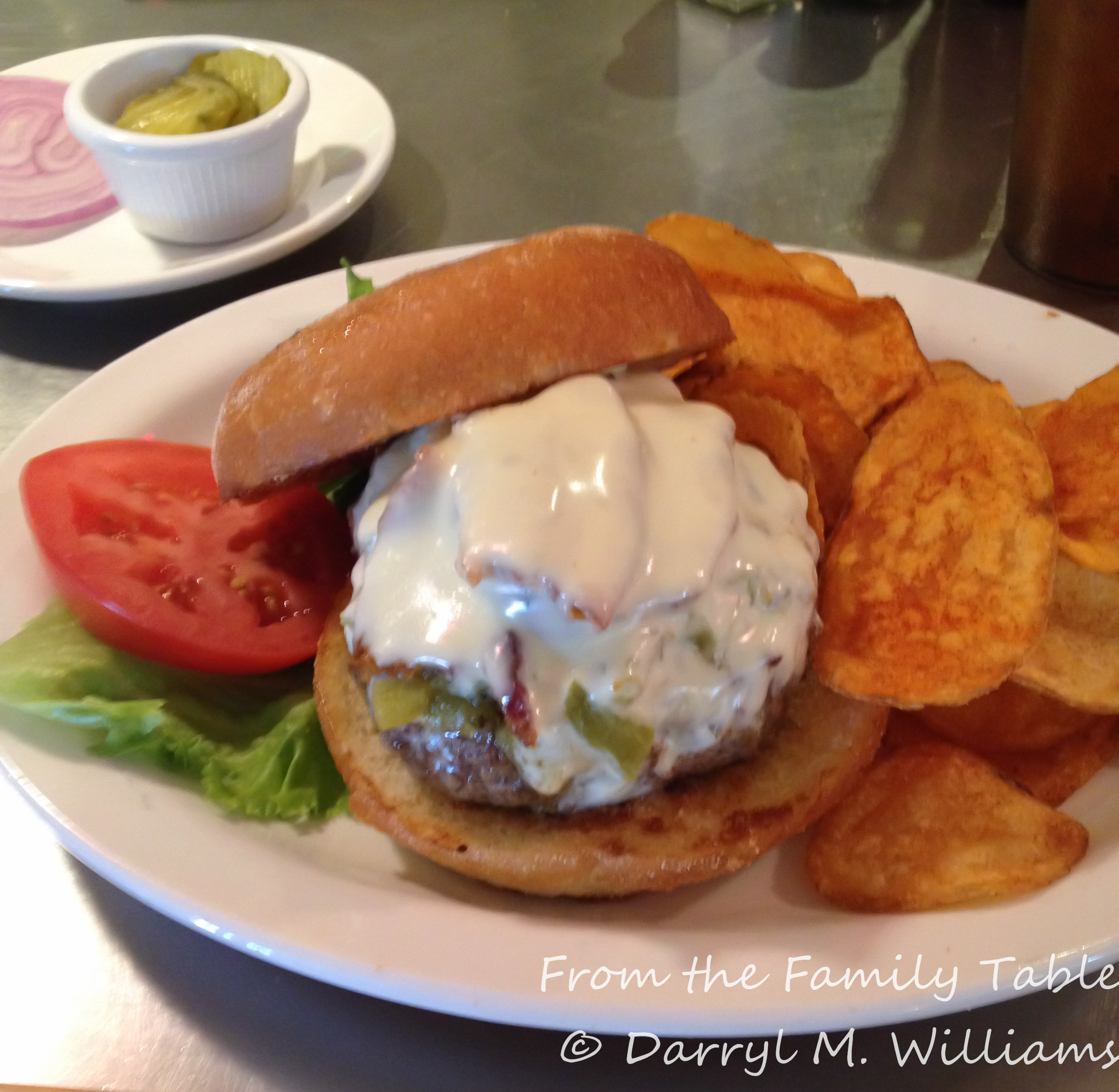
In my view, the Santa Fe Bite stands in a class of its own. It formerly operated as the Bobcat Bite in a tiny little adobe building just off the interstate several miles from Santa Fe. It had quirky hours, and there was always a line waiting for coveted few seats when it was open. After a lease fight with the adobe’s owner, the restaurant relocated to much better, bigger digs in downtown Santa Fe. They are still jammed at lunch time. Their burger is made of 10 ounces of freshly ground sirloin, prepared to your liking. Because it is so big, even for medium rare it takes a while to prepare. Just be patient. You can get it plain, with cheese, with green chile, with bacon, or with all of the above along with fresh house-made potato chips and a side of onion and pickle. Of course, there’s mustard, ketchup, and mayonnaise available, but to me that just covers up the great taste. The Santa Fe Bite GCCB is definitely not for the faint-hearted, and you should be prepared to ask for a doggy bag.

Green chile cheeseburger with bacon and house-made potato chips at the Santa Fe Fite

Green chile cheeseburger with bacon and house-made potato chips at the Santa Fe Fite

If you’re interested in following the GCCB Trail, check out the website. You won’t be disappointed wherever your travel takes you.

4 Comments

Filed under Food, Photography, Restaurants, Travel

ANASAZI BEANS AND RICE

The Anasazi were a native people who lived in the Four Corners area of the United States – New Mexico, Colorado, Utah, and Arizona. What they called themselves is unknown, but archaeologists working in the area called them “the Anasazi” from a Navajo word which means “the ancient ones” or “the ancient enemy”. The modern Pueblo Indians, who live in villages throughout the Rio Grande Basin are thought to be the descendents of the Anasazi who abandoned their native homeland during a prolonged drought in order to be closer to a more reliable water source near the largest river in the region. The Pueblo Indians don’t like the name, Anasazi, for obvious reasons, but it has stuck.

The Anasazi began their civilization at least hundreds if not thousands of years BCE, living in pit houses, but they advanced rapidly to live in sophisticated multi-story stone apartments situated in secure areas like mesa tops and huge hollows in stone cliffs There they could pull up ladders leading to the valley floor and ride out sieges from marauding enemies.  When they finally abandoned their homelands in the 1400s, they had built amazing structures like Cliff Palace in what is now Mesa Verde National Park in Colorado, the White House in present-day Cañon de Chelly National Park in Arizona, and what may be the most sophisticated population center of all, Chaco Canyon in New Mexico, with advanced astronomical observatories, and a web of roads and trails leading in all directions, suggesting that the place may have been the commercial or religious center for the entire region.

Today, there are only a few remaining structural links to the ancient people: Taos Pueblo in northern New Mexico, the ruined Pecos Pueblo that I wrote about a while back, other ruins scattered around the Four Corners, and much more modest communities in the existing pueblos.

All of that is a long-winded introduction to Anasazi beans and how they got their name.  The traditional story is that a sealed jar of beans was discovered by archaeologists digging in the ruins of the Cliff Palace. The beans were spotted red and white, unlike any other beans the scientists had seen. To their surprise the beans sprouted, and were subsequently propagated. This story has its detractors who say that beans lose their ability to sprout after 50 years or so. They think that while the beans may have been discovered in the clay pot they could have not germinated, but  they were identical to beans that had continued to be cultivated in the region. Of course, there have been multiple interpolations of the two stores, so we really don’t know the truth. Nevertheless the name, Anasazi beans, was given to the beans and it has stuck ever since.

For a time, the beans were raised commercially only in Colorado, but now they are raised in many places, probably because of their unusual coloration and because of their distinctive, some say sweet, taste.

We bought a big supply of Anasazi beans at a farm stand, so I decided to make a variation on the Louisiana classic, red beans and rice. I know that late summer is way too hot to be making beans and rice, but I had the beans, so why not.

RECIPE

Anasazi Beans and Rice

Ingredients

  • 2 cups Anasazi beans
  • water
  • 2 tablespoons olive oil
  • 1 large yellow onion, chopped
  • 2 closes garlic, minced
  • 4 cups chicken stock
  • 1 stalk celery, diced
  • 1 green bell pepper, diced
  • 6 ounces ham slices, cut into ½ inch squares
  • 8 ounces link sausage, Andouille, bratwurst, or your choice, cubed
  • 1 tablespoon dried Mexican oregano, crumbled between your hands
  • 1 teaspoon ground cumin
  • salt and pepper
  • 8 cups cooked rice
  • chopped scallions for garnish
  • Louisiana hot sauce (optional)

Method

  1. Pick over the beans carefully for small stones and shriveled beans. In a large pot, cover the beans with water to at least 2 inches depth. Soak overnight.
  2. In a large, heavy-bottomed pot, heat the oil over medium heat. Add the onions and cover to sweat for 5 minutes until they are translucent but not browned.
  3. Stir in the garlic, chicken stock, celery, bell pepper,  ham pieces, cubed sausage, oregano, and cumin. Bring to the boil, and then cover and reduce the heat to the simmer.
  4. Cook the beans until they are tender, 2 to 4 hours.
  5. Uncover and raise the temperature to a slow boil in order to reduce the liquid until it is thickened to your taste. Adjust seasoning with salt and pepper.
  6. Place a cup of cooked rice in each serving bowl. Ladle on the cooked beans. Serve with optional chopped scallions and hot sauce.

3 Comments

Filed under Food, Photography, Recipes, Travel

NATIVE PLANTS AND GORDITAS

This last week we drove down to El Paso, Texas, for the New Mexico Native Plant Society annual meeting. Yes, El Paso is in Texas, although there are many who wish it were in New Mexico: many of the residents of the city as well as many Texas politicians. El Paso is in the same time zone as New Mexico, an hour out of sync with almost all of Texas, and the population is decidedly different from those of Dallas and Houston. On top of that, it’s over five hundred miles from El Paso to Houston and San Antonio, and only thirty miles to the New Mexico border and a little over two hundred miles to Albuquerque. But the main reasons that El Paso is part of the New Mexico Native Plant Society is that the ecology (read desert) of El Paso is similar to much of New Mexico; both are on the edges of the Chihuahuan Desert and so the plants are very similar, unlike the live oaks and Spanish moss of East Texas.

We lived in El Paso for a number of years, so the meeting was an opportunity for us to renew old friendships, visit our old neighborhood, and enjoy some of the good regional food of the Border.

Susan went to meetings while I drove around old haunts and took naps, but both of us took time out to eat at two of our old-time favorites, the Little Diner in Canutillo, Texas, and the H & H Car Wash & Coffee Shop in downtown El Paso. We ate at a trendy new restaurant in the refurbished warehouse district. We didn’t much like it, so it will go nameless. But we also enjoyed drinks and snacks in the Liquids Bar in our hotel, a wonderfully revnovated derelict of a hotel that had sat vacant for many years after having a moment of glory in the distant past when Elvis Presley performed there.

Here are a few images of native plants from New Mexico that you might enjoy.

The Little Diner is a local institution. It is extremely hard to find in a residential area of the little town of Canutillo. It sits right next to a coin laundry, so you can do your washing while you are having lunch. Unfortunately, the original owner has died, and her daughter now runs the place. Some of our El Paso friends reported that it had gone down hill, but we had a great experience. The specialty of the house is gorditas, fat little masa pillows deep-fried, slit open, and stuffed with seasoned beef, cheese, tomatoes, and lettuce. You add the salsa to your liking. They are so unlike the pale copies sold at Taco Bell that you wonder how they share the name. They come three to a plate with beans and a salad, so even a big man should not go away hungry. To my knowledge, gorditas are fairly localized to this part of the border. I have never seen them on Tex-Mex menus in the rest of Texas, and they are not a part of the cuisine around Santa Fe.

Gorditas at the Little Diner

Gorditas at the Little Diner

H & H Car Wash is legendary. It was awarded the 2001 James Beard Award for American Classics. Not bad for a hole-in-the wall with a counter and about 10 stools along with two booths. Never mind that you can get your car washed and filled with gas and also get your shoes polished while you wait your turn for jumping on one of those stools. The day we visited, there were heavy rains, decidedly unusual for El Paso (It’s in the desert, remember?) So the car wash didn’t have much business, and as a result the coffee shop was also not crowded. Being able to speak Spanish helps when you order. Actually, many of the staff speak English, but here you are on their turf, and they don’t cut a lot of slack unless it is clear that you need HELP.

I ordered what I always order, huevos rancheros. Their version is unique, and I favor my own version, but it is still delicious and, anyway, that’s the reason I came to eat. Susan got the eggs and sausage. Since it was Saturday morning, we could have also gotten a bowl of menudo that was heating in a big pot on the back of the flat-top. We both passed, but that’s another story.

The night we ate at the bar, we ordered queso fundido (“melted cheese”). The first time we ever had that dish was nearly thirty years ago in Tlaquepaque, Mexico. It was so good with freshly made corn tortillas that it has been a favorite of ours ever since. The bar’s version came with crostini, cutting across cultures, but it was delicious. I will give you a recipe in a subsequent post.

Queso fundido at Liquids

Queso fundido at Liquids

All in all, we had a great visit, and enjoyed some food that we can’t get locally.


10 Comments

Filed under Food, Photography, Restaurants, Travel

A TALE OF TWO PEACH ICEBOX PIES: STRAWN’S EAT SHOP REVISITED

During our recent visit to Shreveport, we stopped at our old neighborhood haunt several times. The chicken-fried steaks, hamburgers, and fries were all tasty and much as we remembered them. But the main purpose of our frequent visits was to get a slice of one of their famous icebox pies. Strawberry is probably the most popular, but the fresh peach and coconut cream are not far behind. Although the names identify the fillings, the rest of the contents are very similar: a good down-home crust, a layer of custard, the fruit, and real whipped cream on top that hides the contents. To assist the serving staff, every pie has a slice of fruit plunked down in the middle of the whipped cream. You can buy a whole pie and take it home. Many folks do that, and we did, too, but an honest-to-goodness North Louisiana lunch consists of the plate special of the day, along with sweetened iced tea (Is there any other kind in Louisiana?) and a big slice of pie.

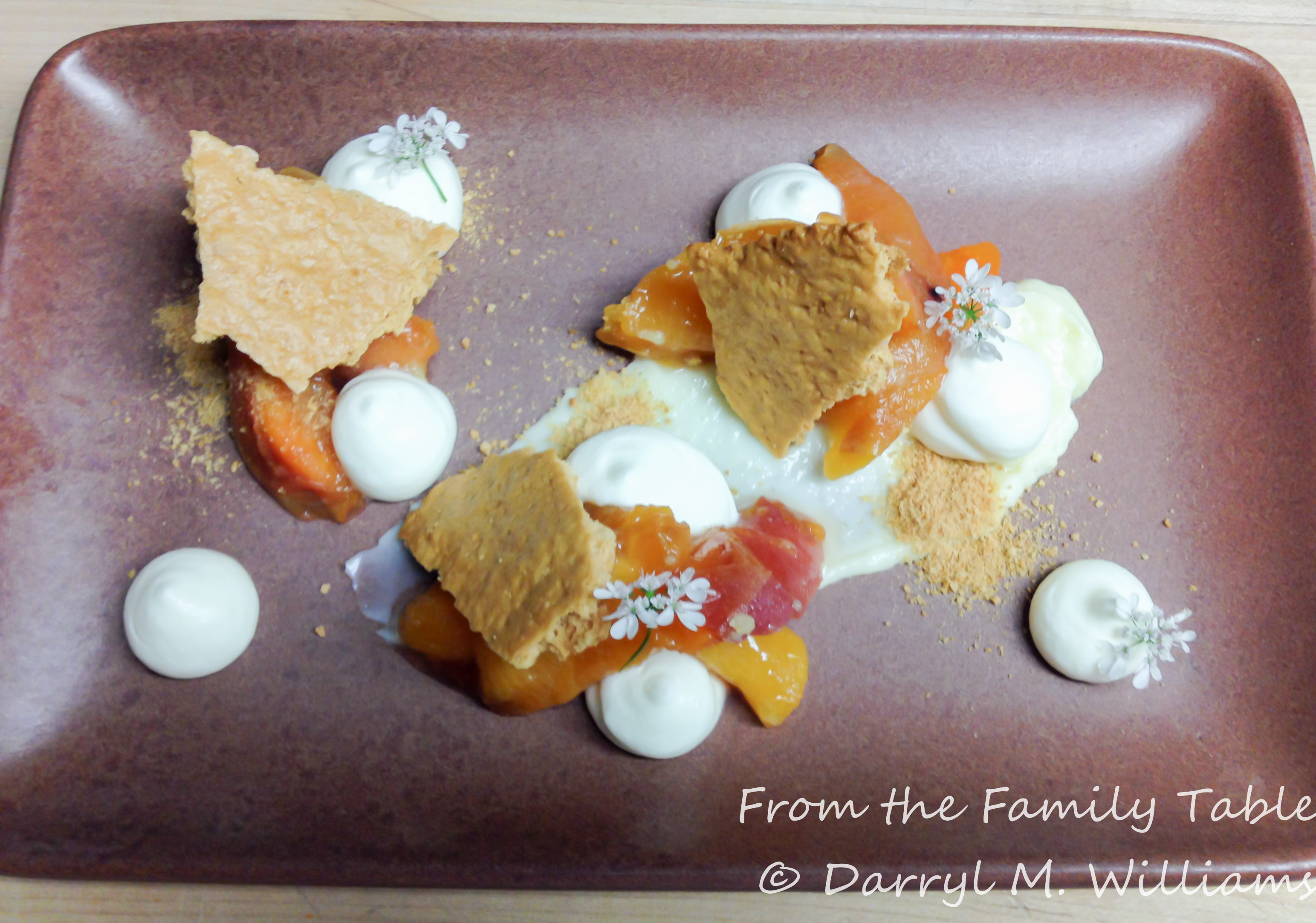
Sarah decided to create a new dessert for Rich Table based upon Strawn’s peach pie. Hers became a deconstructed version with dollops of custard and whipped cream topped with fresh peaches. Along side were pie-crust sables. It turned out to be a very sophisticated dessert that became a big hit the first night it appeared on the menu.

The deconstructed version of peach icebox pie served at Rich Table, San Francisco

The deconstructed version of peach icebox pie served at Rich Table, San Francisco

My version is a little more straightforward: cream pie topped with fresh peaches and whipped cream. Since peaches are in season right now, it is a perfect dessert for a patio meal at sunset.

RECIPES

Almond Pie Crust

Ingredients

  • 1 cup all-purpose flour
  • ¼ cup almond meal
  • ¼ teaspoons salt
  • 1 stick (8 tablespoons) unsalted butter, cut into pieces
  • ¼ teaspoon almond extract
  • 2 teaspoons ice water

Method

  1. Place all of the ingredients in the beaker of a food processor fitted with the metal blade
  2. Pulse several times and then process until the dough forms a ball.
  3. Remove the ball of dough from the processor and wrap with plastic film. It may be a little sticky from the heat of the blade. That’s ok. It will firm up in the refrigerator.  Refrigerate 30 minutes or until firm.
  4. When you are ready to bake the crust, press the dough into the bottom and along the sides of a 9 inch metal pie pan, forming an edge of dough on the rim of the pie pan.
  5. Pierce the bottom and sides of the crust all over with a fork. Bake in the middle of an oven pre-heated to 425° F for 12 to 14 minutes or until the crust is a golden brown. Remove to a cooling rack and cool completely in preparation for filling.

Cream Filling

Ingredients

  • 1 cup whole milk
  • ¼ cup sugar
  • 3 tablespoons all-purpose flour
  • ¼ teaspoon salt
  • 4 egg yolks, beaten until smooth and slightly foamy
  • 2 teaspoons vanilla extract
  • ¼ teaspoon almond extract
  • 2 tablespoons unsalted butter

Method

  1. In a heavy saucepan, bring the milk to a boil and turn off the heat
  2. Combine the sugar, four, and salt in a medium bowl. Very slowly pour the hot milk into the dry mixture, whisking continuously to prevent lumps of flour from forming. As you add the milk, you can increase the rate of pouring until it has been completely added to the mixture.
  3. Return the mixture to the saucepan and adjust the heat to medium. Stirring continuously, heat the mixture slowly until it boils and thickens.
  4. Remove from the heat and cool for a minute. Beat in the egg yolks. Then return to the heat, and return to the boil for one minute. Remove from the heat, and beat continuously for another minute, allowing it to cool slightly.
  5. Stir in the vanilla and almond extracts and butter until they are completely incorporated. Transfer to a bowl. Cover directly with plastic film and refrigerate for at least one hour until you are ready to assemble the pie.

Peaches and Whipped Cream Topping

Ingredients

  • 5 medium ripe peaches
  • 1 tablespoon sugar
  • 1 cup heavy whipping cream
  • 1 tablespoon confectioner’s sugar (or to taste)

Method

  1. Blanch the peaches in boiling water for 10 seconds and then cool
  2. Peel the blanched peaches and cut them into slices. Sprinkle with sugar and refrigerate, covered, until ready to use.
  3. When you are ready to assemble the pie, whip the cream with confectioner’s sugar until it forms  stiff peaks.

Assembly

  1. Spread the pastry cream evenly on the bottom of the pie shell.
  2. Drain the peach slices if necessary, and arrange over the top of the pastry cream
  3. Cover the peaches completely with the whipped cream. Refrigerate for one hour before serving.


8 Comments

Filed under Food, Photography, Recipes, Restaurants, Travel