Category Archives: Restaurants

50 YEARS: TIME FLIES WHEN YOU’RE HAVING A GOOD TIME

We just got back from Carmel, California where all of our family helped us celebrate our fiftieth wedding anniversary. Outside of driving through 115°F heat in the Mojave Desert, it was a wonderful experience. As proof of that, I gained 5 pounds in one week, because it seems like we ate a lot. I’m not counting stops on the Mother Road or travel snacks, although undoubtedly both contributed greatly to my calorie count.

Our first “real restaurant” break was at Rich Table in San Francisco. Sarah stayed home with the boys, and Evan was expediting. That meant that even though we ordered a light meal, Evan sent us out a lot of extras. Honestly, I’m glad that he did, because the dishes were all outstanding. Sarah is back doing all of the desserts on the menu, so Evan made certain that we got to taste every one of them – along with his savory creations.  We sat at the bar until our table was ready. The bartender is very creative, so he always has some new drinks to try. “Suns n’ Roses”  with bourbon, dried stone fruit, vanilla and lemon is a riff on an old fashioned. The “Puddle Jump” contains rum and a rhubarb syrup. Since it is in season, rhubarb enjoys several prominent places throughout the men.

When we got to our table, we started out with sardine chips. They’ve been on the menu since Rich Table opened. Customers keep asking for them. They really are delicious: a white sardine woven into a big potato chip and served with a delicious horseradish sauce. A little amuse bouche that Evan sneaked in was a tiny panna cotta topped with a jewel-like cucumber and parsley gelée and a savory crumble. Delicious!

Sardine chips, horseradish créme fraiche

Sardine chips, horseradish créme fraiche

Amuse bouche: panna cotta, cucumber gelee, and crumble,

Amuse bouche: panna cotta, cucumber gelee, and crumble,

Of course, we had an order of the famous and popular Douglas fir levain with house-cultured butter. The bread comes out in thick, warm slices, and the tang of the cultured butter complements the Douglas fir scent and subtle taste of the bread. The sourdough starter originally came from our house and it is many years old.

The foie gras torchon with blueberries, and puffed sorghum sounded like a wild combination, but it was delicious when paired with slices of perfectly toasted brioche. Smoked white fish was tasty. Big chunks of Maine lobster were served with a house-made chitarra pasta, corn bisque, and plum was delicious. And who would believe that a fresh peach would taste as complex as the one we were served.

I had a beautifully cooked pork chop with cucumber, avocado, and crisp rice noodles. Susan enjoyed a grilled ribeye topped with salsa roja, corn, aioli, and lobster butter. We did not count calories or measure cholesterol levels.

We finished up with Sarah’s desserts: cherry ice with sorrel and almond milk ice cream; and dark chocolate pudding with summer berries and yogurt ice cream. After that, there were still honeycomb bites, chocolate nibbles, and wrapped candies to take home with us. (Susan took the candies home for the boys.)

After that bacchanal, we headed down to Carmel where we met all of our family. Everyone – adults and children – went to a popular Italian/French restaurant. A good time was had by all except for one of the little girls who developed a belly ache from eating too many goldfish crackers on the trip from Silicon Valley. René missed the meal because she was dealing with the goldfish overdose. Carol, Peter, Kevin, Sarah and Evan all seemed to have a good time.

The next evening turned out to be an event to remember. The adults and teenagers walked down the street from our hotel to a very nice restaurant, Aubergine. The men all wore ties – unheard of in California – and the women dressed up. First, we gathered at the fire pit on the patio of the hotel for a toast. Sarah had tracked down a bottle of red burgundy with a vintage the same as the year of our wedding. Evan struggled with the fifty-year-old cork, and then the wine was poured looking like Coca Cola. We were all surprised when it turned red after a little aeration. The wine was surprisingly good for being 50 years old, and it was certainly good enough for a toast. Carol and Peter contributed long-forgotten anecdotes from their childhood.

After a brief walk, we convened in the wine cellar of the restaurant for what turned out to be a lavish chef’s tasting menu. Highlights included Kumamoto oysters wrapped like little packages with string. When we lifted off the top shell with the string we were surprised to find a plump oyster topped with a tasty mignonette and caviar.  Green strawberries with seaweed and strawberry snow was delicious, as was a grilled slice of avocado. Lobster with fish sauce and pink fish roe was stunning in presentation and taste. Locally harvested abalone in a tea sauce was fork-tender and delicious. Even roasted kohlrabi was a success. One of the highlights  was perfectly cooked Wagyu beef. Then there were dessert(s) including Cameron’s favorite chocolate ganache tart with honeycomb ice cream. There were macarons, sablés, and chocolate cookies to make sure we made it back to the hotel without starving.

We’re home, now, working on dealing with our weight gain. Currently we are subsisting on salad, but we have some wonderful memories to treasure.


13 Comments

Filed under Food, Photography, Restaurants

SALLY HURRICANE’S SOUTHERN FRIED CHICKEN

If you have read this blog for any length of time, you know that our daughter and son-in-law, Sarah and Evan Rich, run a popular restaurant in San Francisco named Rich Table. The food there has been described as “New American” and generally  is based on the current offerings available in the bounteous farmers’ markets of the Bay Area.

But Sarah has roots in the South as well as having two grandmothers who were excellent home cooks. Both grandmothers took pride in their fried chicken. Fried chicken, mashed potatoes and cream gravy along with home-baked biscuits were staples on the Sunday dining room table at our family farm in East Texas.

That’s also where Sarah got the nickname, Sally Hurricane. As a two-year-old she ran the show. One family photograph shows her wearing her great aunt’s wig borrowed from a wig stand in a back bedroom.

Hurricane Sally

Hurricane Sally

Sally Hurricane has been cooking fried chicken from the recipe in our family cookbook since before she went to culinary school. She has made her version (now revised and considerably improved) for family meals at upscale restaurants in New York City and San Francisco. Inevitably, regardless of the restaurant, when fried chicken and biscuits were the family meal menu, cheers went up from both the front of the house and kitchen staffs.

This week, Sally Hurricane is revealing some treasured family secrets in the food section of the San Francisco Chronicle.  She also gives the recipe for mashed potatoes that she learned when she worked for David Bouley. You might enjoy a preview.

http://www.sfchronicle.com/recipes/article/Sarah-Rich-taps-family-recipe-for-Southern-style-8313792.php?t=e37fe5da3d8cb1714c&cmpid=twitter-premium#photo-10076970


20 Comments

Filed under Food, Photography, Recipes, Restaurants

BRANDON RICE, RISING STAR CHEF SAN FRANCISCO, 2016

Congratulations to Brandon Rice for being recognized as a Rising Star Chef for San Francisco in 2016. Brandon is Chef de Cuisine at Rich Table. Since his taking that position, he has become a vital member of the Rich Table family.

A couple of years ago, Sarah was doing the dessert menu, managing paper work, taking care of a toddler, and expecting a new baby. Evan was working seven days a week, and had been doing that for many months. Needless to say, they were both feeling a lot of pressure. Then Brandon came on the scene, and things got a lot better. Importantly, Evan got a day off, and Brandon quickly assumed a leadership role in taking charge of the kitchen when Evan was not there. Brandon also demonstrated his skills and creativity as a cook, coming up with new dishes and new presentations. If you are on Instagram, you can find some of his work at brandonrice123.

It is clear that Brandon is a dedicated hard worker with a bright future in the culinary world. That’s why the Rising Star award is so important and so well deserved.

The actual recognition ceremony is a very big deal. This year there is a VIP reception, the awards ceremony, and a spectacular tasting at the Julia Morgan Ballroom. The annual event is always well attended by those in San Francisco who are interested in restaurants and food. Doesn’t that mean just about everyone in San Francisco?

As I mentioned to Sarah, the downside of this recognition is that Brandon will probably be leaving soon to start his own restaurant. Although there is no reason to think that Brandon will be moving on in the near future, Sarah allowed that Brandon’s ambition was to open his own restaurant.  But that sort of process is an important lesson for every mentor: special pride  comes from sharing the success of a colleague whom you have encouraged and nurtured; enjoy your own success as a mentor.

3 Comments

Filed under Food, Restaurants

SEARCHING FOR THE MOTHER LODE

Our month-long visit to Lodi, California, has provided us an excellent base to explore the foothills of the Sierra Nevada and the area that was the center of the feverish gold rush that began in 1849. We have visited Sacramento, now the capital of California, but at one time a center for transportation during the gold rush as well as serving as the western terminus (San Francisco notwithstanding) of the great race between the Central and Union Pacific Railroads to meet up to create the first transcontinental railroad. We have also visited some of the historic towns in the foot hills and taken back roads into the mountains and the areas of devastation from the “Butte Fire” of last summer. All of it has been a learning experience.

Sacramento is much like any big city. It has around a half million residents and traffic to match. The capital building is a replica (smaller of course) of the national Capitol in Washington DC and it has its own beautiful mall. The riverfront has been restored into “Old Sacramento” which, like most “Old [fill in the blank]” is filled with Victorian-era buildings, bars, restaurants, and gift shops.

But one place in Old Sacramento that shouldn’t be missed is the Railroad Museum. The place has accumulated engines and rail cars that capture the entire history of California railroading. The rolling stock has all been carefully restored. The museum goer can walk through many of the exhibits. Some of the restored cars even replicate the rocking motion of a speeding train. We spent several hours in the museum and then decided that we didn’t need to see any more of Sacramento.

We explored several mining towns and soon learned that you have to get off of the main highway. The main drags are universally lined with the usual  gas stations, McDonald’s, hardware stores and Dollar Generals. The old town Main Streets are the places to experience the real feel of the communities.

One of our first visits was to Murphy’s. The main landmark of the street is “Murphy’s Historic Hotel” which advertises itself as having served the town since 1850. That claim does not make it clear whether the current building is the original, but that doesn’t really matter. The building is old enough and run down enough that you can picture it as the background of a gun fight during gold rush days. There is a bar in the front of the building where locals hang out. In the back, the dining room has been fixed up to capture Victorian styles. It looks like a good place to enjoy a leisurely lunch or a fancier dinner. There are white linen tablecloths and comfortable chairs. Lots of good California wine choices. The food turned out to be “ok” with a badly over-cooked hamburger supposedly topped with blue cheese crumbles that turned out to be a grayish unpleasant-tasting blob that could only be salvaged by scraping it off. Perhaps the “chef” (who had just started work that day according to the slightly deaf server) put the blue cheese on the burger too early in the cooking process. The bacon-wrapped shrimp po’boy special turned out to be a better choice.

Another stop was Sonora. The guidebook informed us that the town had been named by homesick Mexicans for their home state in Mexico. They had apparently come to California during the gold rush to make their fortunes. Our food discovery in that quaint little town was Talulah’s Restaurant, named by the woman owner just because she thought the name sounded cute. The Victorian storefront was painted in bright chartreuse, and the inside also had touches of chartreuse. Not a big place, it had a surprisingly large menu with, of course, a good selection of California wines.  The mushroom soup was so flavorful and aromatic that I started to eat it before I remembered to make an image. The complementary garlic bread turned out to be picture perfect and delicious to boot. The marinara on the spaghetti was not my recipe, but it was flavorful and tasted of fennel and just a hint of cinnamon and cloves. (I know what you’re thinking – no, it was not Cincinnati five-way chili. It was really quite tasty.) The grand finish was a delicate lemon cake filled with a light-as-a-feather lemon mousse and topped with a warm lemon sauce.

We drove through Angel’s Camp, named after Mr. Angel, not the celestial variety. Angel’s Camp is home to Mark Twain’s “Jumping Frog of Calaveras County”, so everything was named, “Frog”, including the high school mascot.

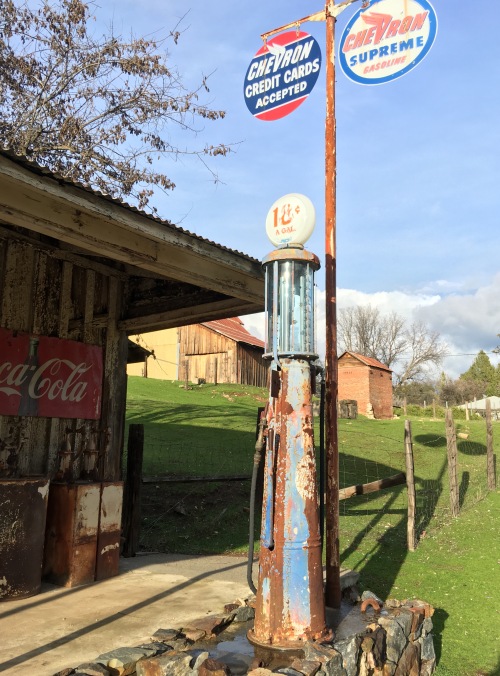
My favorite place was Sheep Ranch (the name of the town, population 32) located on Sheep Ranch Road and former headquarters for the Sheep Ranch Mine. There was a large, still well-preserved but unoccupied white hotel nestled in the pines at the end of the main street. There were no restaurants in town, but the abandoned general store still advertised gasoline at 18 cents a gallon. Unfortunately there was none for sale.

Sheep Ranch

Sheep Ranch

Up Swiss Ranch Road, after the pavement had turned to gravel, we discovered an ornate iron gate that looked as though it was the entrance to a great English country house. Its story remains a mystery to us, but I am certain it would be very interesting.

The saddest part of our trip was to see the devastation caused by the “Butte Fire” of October, 2015. Miles of forest were burned and over 500 homes were destroyed. Most of the ruined buildings had nothing above the foundation, and they were surrounded by the shells of burned-out cars and trucks. It will be years before the forests and hazardous materials are cleared, decades – if ever – before the forests come back, and probably never for families to put their lives back together.


9 Comments

Filed under Food, Photography, Restaurants, Travel

DEVILED EGGS

Deviled eggs seem to be enjoying a renaissance. They are on many menus these days. Sarah often makes them for catered dinners as well as for family occasions. Sometimes she stuffs them with smoked trout or other delicious fillings.

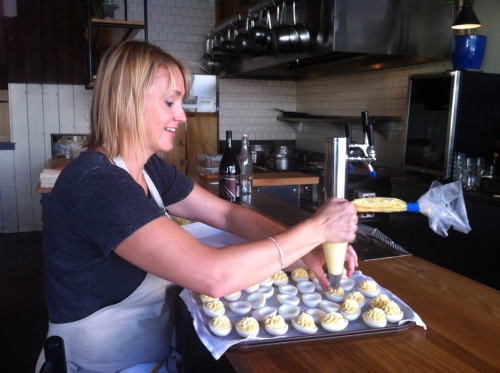
Sarah piping deviled eggs

Sarah piping deviled eggs

But in their simplest form, how difficult can deviled eggs be to make? Hard boiled eggs cut in half; yolk mashed with a little mayonnaise, mustard, lemon, salt and pepper; yolk mixture spooned or piped into the egg white halves; maybe a little garnish of paprika, snipped chives, or crumbled bacon. Simple is not always easy.

During this visit to California, deviled eggs have been on many menus. I have eaten many of them because I like them when they are good.

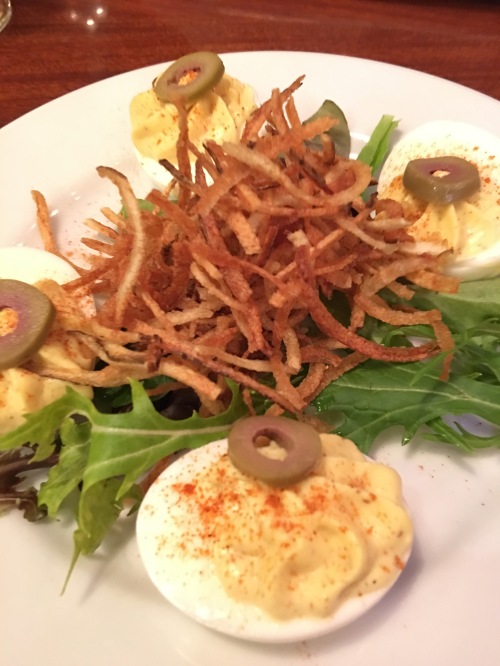
The best ones so far were served at the School Street Bistro in Lodi. My very minor quibbles were that the yolk filling was too runny (Too much mayonnaise?) and had too much mustard. Otherwise they were delicious, and their garnish of house-made French-fried potato straws was outstanding  I could have eaten a plate of the potato straws by themselves.

Sunday deviled eggs with potato straws at the School Street Bistro, Lodi, CA

Sunday deviled eggs with potato straws at the School Street Bistro, Lodi, CA

Some of the eggs have had a rubbery texture undoubtedly from the eggs being boiled too hard and/or too long.

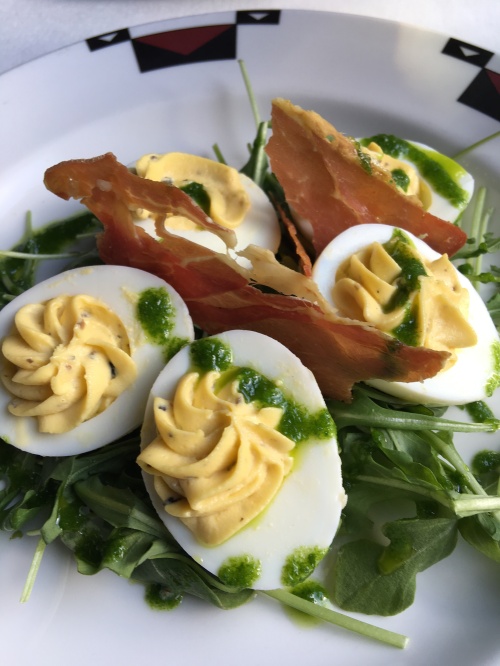
The ones I liked the least were the ones that were supposed to be the fanciest. The word, “truffles”, seems to make something more luxe. Visions of pigs rooting up fungi at the base of a French hazelnut tree come into play, or a liveried waiter shaving little shards with his special knife onto a perfect French omelet. That’s not the same as truffle oil. This condiment has been banned from many a high-end kitchen. The well-known San Francisco chef and writer, Daniel Patterson, has written a great piece in the New York Times about why truffle oil does not find favor with professional chefs.

The main reason is that almost no commercial truffle oil contains actual truffles. The fragrance and taste of real truffles come from a complex array of compounds. The most prominent appears to be a chemical, 2,4-dithiapentane, that can be synthesized in a laboratory or factory. And that is the chemical that is added to truffle oil to give it flavor. Small wonder that foods which incorporate commercial truffle oil take on a chemical flavor; some would even say petroleum-like.

Deviled eggs with truffle oil

Deviled eggs with truffle oil

Here is a basic recipe for deviled eggs, perhaps of the Southern variety. If you don’t like it, experiment by adjusting the amounts of the basic ingredients and add any extras that sound appealing to you. Just – please – don’t add truffle oil.

RECIPE

Basic Deviled Eggs

Ingredients

  • eggs, at room temperature
  • 1 teaspoon mayonnaise for each egg
  • 1/8 teaspoon dry mustard for each egg
  • few drops fresh lemon juice for each egg
  • salt and pepper to taste
  • paprika

Method

  1. Pierce the large end of each egg with an egg piercer and place in a single layer in a saucepan with enough water to cover the eggs by at least an inch. Bring to the boil over high heat, just until large bubbles begin to appear around the eggs. Cover, remove from the heat, and let stand, undisturbed, for 10 to 18 minutes, depending on the size of the eggs and the altitude.* You should work out the time beforehand. Transfer the eggs to a large bowl filled with ice and water. Chill for the same amount of time as you used for the cooking.
  2. Peel the eggs by cracking them all over and, starting at the big end, peeling them under a small stream of running water. The longer the eggs sit in the refrigerator before peeling them, the harder it will be to peel them and the more likely you are to get the dreaded green ring around the yolks, so it is best to prepare them immediately.
  3. Slice the cooled eggs in half lengthwise and gently remove the cooked yolk. Press the yolk through a fine-mesh sieve or strainer into a medium bowl. Stir in the mayonnaise, mustard, and lemon juice. If the mixture is too stiff, very slowly stir in more mayonnaise by half teaspoonfuls until the consistency suits you.  Adjust the mustard and lemon juice to please you. Correct the seasoning with salt and pepper.
  4. Spoon or pipe the yolk mixture into the empty halves of cooked egg white. Garnish with a sprinkle of paprika and serve.

* At 7000 feet, a jumbo egg takes 18 minutes to cook; a large egg takes 16 minutes. Probably at sea level you should deduct about 2 minutes for each cooking time, but it is best to work out specific times for your cooking conditions.

15 Comments

Filed under Food, Photography, Recipes, Restaurants, Travel

LODI

I have been a little quiet in the blogosphere for awhile. We are in Lodi, California, where we will be staying for the month of January. Some time ago I wrote about Lodi when we attended the California State Chili Cookoff Championship https://fromthefamilytable.com/2014/10/26/california-chili-cook-off-championship-2014/ . That’s not the reason we are here this time.

Why, you might legitimately wonder, does one choose to spend January in Lodi? For us, the answer is a bit complex. First, our children have been encouraging us to find a place that could be used as a family retreat. The Sierras are not far away, and that is where two of the families ski and escape the city. Second, we have always wanted to explore this part of California, as we don’t know much about it, and it has a rich history. Finally, we might be able to find a relocation home; we certainly can’t afford LA or the Bay Area.

Lodi is an interesting little town of about 70,000 a half hour away from Sacramento and two hours from San Francisco. It is really all about wine.

As you know, California is responsible for much of the USA’s wine production, and some of it will compete with the finest wines in the world. There are four large wine growing areas in the state: North Coast, Central Coast, South Coast, and Central Valley. These areas are divided into over 130 smaller regions, called AVAs (American Viticultural Areas) according to weather, temperatures, soil, and other growing characteristics. At the same time, some wine fanciers often count only eleven regions where they think high quality wines are produced. These include Los Carneros, Napa, Sonoma, Mendocino, and Livermore in the North Coast; the Sierra Foothills; Paso Robles and Monterey in the Central Coast; Santa Barbara and Santa Inez in the South Coast; and Lodi in the Central Valley. Lodi is the only Central Valley place to be included even though wine production in the Central Valley is enormous.

That’s where Gallo is located – headquartered in Modesto – along with Bronco Winery headquartered in Ceres. Gallo produces many labels including those old college favorites, Boone’s Farm and Carlos Rossi along with the label you can only read if you peel off the brown paper sack – Thunderbird. Bronco Winery is operated by a newer generation of the extended Gallo family. They, too, produce many brands, but probably their most famous is Charles Shaw, Trader Joe’s signature “Two Buck Chuck”. The grapes come from ever-expanding plantings throughout the Central Valley.

In all fairness, Lodi has a giant production facility, too.  Constellation Brands, headquartered in New York and the largest wine producer in the world, several years ago paid over $1 billion in cash to buy out Robert Mondavi. Their Robert Mondavi Woodbridge winery sits at the edge of town. (That’s where the chili cookoff is held each year.) But the essence of the local wine-making mystique is set in the 80 or so family-owned wineries that produce only a few hundred or thousand cases of wine each year.

It is impressive how many different varietals are grown in the nearby area, but the main grape is Zinfandel, and Lodi seems determined to make it a competitor with the varietals popular in Sonoma and Napa. This is not the cloying white Zinfandel of a couple of decades ago. I haven’t seen a bottle of that since we’ve been here. These are stylish, well-made wines that can sometimes run over $100 a bottle.

Here are a few you might look for in your local wine store: Klinker Brick, McCay Cellars, Harney Lane Wines, Michael David Winery.

Unfortunately, the food to go along with the wine is a little disappointing. Places we have enjoyed are the School Street Bistro, The Dancing Fox Winery and Bakery (The food not the wine.), and a small little bistro away from the downtown, Zin Bistro. The latter is a tiny store-front in a strip mall run by husband/wife chefs and owners; it is a great discovery. The night we were there, their rockfish was cooked perfectly – moist and flaky – and their braised lamb shank was delicious with a gremolata and mashed potatoes. So far we think they make the best food in town, although we have a couple of white-tablecloth places still to check out.

We’ve already visited Sacramento and been on one side trip to Yosemite to babysit while Sarah and Evan did a demonstration at the Ahwahnee Hotel’s annual Chefs’ Holiday. More travels and food to report later.

11 Comments

Filed under Photography, Restaurants, Travel

CORZETTI WITH SAUSAGE AND CLAMS

Our daughter, Carol, has been visiting us for a few days without her family. For her it has been a relaxing time with no chauffeuring duties to swimming, school meetings, the morning school rush, and cooking. She has been doing some work from her office, but she has also found time to sleep a little late, to shop, and to eat out.

Carol has her own big library of cookbooks, but it is different from my collection, so she has spent time leafing through some of my newer acquisitions. She also enjoys working in the kitchen with Susan and me, and we enjoy that, too.  We agreed to cook together on a recipe that appealed to her. She found a recipe in Flour + Water (Ten Speed Press, Berkeley, 2014), the eponymous cookbook from the San Francisco restaurant owned by Thomas McNaughton, a friend of Sarah and Evan.

The recipe she chose was entitled, “Corzetti with Sausage, Clams, and Fennel”, page 186. It involved making pasta – which sounded like fun. The challenge was to re-create the corzetti. Oretta Zanini de Vita (Encyclopedia of Pasta, translated by Maureen B. Fant, University of California Press, Berkeley, 2009) describes the pasta dating back to the thirteenth century and consisting of a bit of pasta dough with two thumb indentations to resemble an “8”. That shape was apparently for commoners because by the Renaissance the pasta was often pressed with special wooden stamps that included coats of arms and other designs. These days you can buy corzetti stamps on the Internet. They are designed to cut the pasta into circles with an imprint on both sides. The little devices are often made of exotic woods and quite beautiful. Trouble is, you have to make a lot of corzetti to justify the purchase as the stamps run $60 or more.

We made do with what I had: a 1½ inch ring from my nest of pastry cutters and a wooden mold that I use for butter and springerle cookies. Carol and I wound up imprinting only one side of the pasta, but that was effort enough for two cooks. The finished pasta, though, cooked beautifully, and the sauce was delicious. It all turned out to be a perfect meal with a nice Italian red, a tossed salad, and a fresh baguette. Pistachio gelatto finished it off. This recipe should serve four generously.

Note: Fennel “pollen” is a common ingredient on the West Coast as wild fennel grows prolifically along the roadsides from south of Big Sur to north of the Bay Area. The yellow “pollen” (I think it is actually the flowers and seeds) is often foraged by chefs from the Bay Area. Ground toasted fennel seeds will make an adequate substitute.

RECIPES

Pasta

Ingredients

  • 2 cups all-purpose flour
  • 1 teaspoon kosher salt
  • 2 large eggs
  • 3 egg yolks
  • 1½ teaspoons extra virgin olive oil
  • water

Method

  1. Heap the flour in the middle of a large, flat, clean surface. Form a well in the middle. Add the salt
  2. Add the eggs, egg yolks, and olive oil to the well, and with a fork, combine the eggs and oil, being careful not to incorporate any of the flour. When the eggs are combined, gradually pull bits of the flour into the mixture until it is completely incorporated. Sprinkle in a few drops of water if you cannot incorporate all of the flour.
  3. Draw the mixture into a ball. Knead for 10 minutes until the dough is smooth and slightly shiny. Add a few more drops of water if necessary. Wrap with plastic film and let rest at room temperature for at least 30 minutes.
  4. When you are ready to roll out the pasta, cut the dough in fourths, working with one piece at a time and rewrapping the remaining pieces.
  5. Pat the piece of dough into a flattened, elongated piece and run it through the pasta machine rollers at the widest setting. Fold in thirds and run through the rollers once more. Repeat the process one more time. Then run the dough through the rollers, decreasing the setting by steps until you have reached the thickness you desire.  (Different machines will have different settings.) You shouldn’t need to flour the dough, but if it is too sticky, lightly dust it while you roll it out.
  6. Place the rolled dough under a clean kitchen towel while you roll out the remaining pieces of dough.
  7. With a 1½ inch circular pastry cutter, cut the sheets of pasta. Then, using a stamp of the same diameter, press firmly on each dough circle to form an imprint. Separate the imprinted circles from the remaining dough (Save that for some other use.) and let rest until you are ready to boil it.

Sausage and Clam Sauce

Ingredients

  • 3 pounds Little Neck clams
  • 1 tablespoon olive oil + more for sautéing the sausage
  • 1 shallot, thinly sliced
  • 1 garlic clove, thinly sliced
  • 2 cups + ½ cup white wine
  • 8 ounces bulk pork sausage
  • 1 medium red onion, diced
  • ½ teaspoon fennel pollen (if you can’t harvest your own fennel pollen, dry-toast fennel seeds and grind finely in a spice grinder. Substitute ½ teaspoon of the ground fennel
  • 2 garlic cloves, minced
  • 1 cup chicken stock
  • juice of ½ lemon
  • salt and pepper to taste
  • extra virgin olive oil
  • 1 tablespoon chopped Italian parsley
  • 1 tablespoon snipped chives
  • grated Romano cheese (optional)

Method

  1. Scrub the clams and let them stand in cold water in a colander for a few minutes to give up their sand. Drain.
  2. In a large sauté pan, heat the olive oil over a high flame. Stir in the shallot and cook until translucent. Add the sliced garlic, 2 cups of white wine, and the washed clams. Cover and cook until the clams open, about 10 minutes. Remove the clams and continue to boil the liquid until it has reduced by half. Cool the liquid completely.
  3. Remove the clams from their shells and return to the cooled liquid. Refrigerate until ready to use.
  4. Wipe the sauté pan clean and return to high heat. Add a tablespoon or so of the olive oil. Then stir in the sausage and brown on all sides, breaking it up as you cook it. Stir in the red onion. Cook until the onion is translucent, about 2 minutes.
  5. Stir in the fennel and minced garlic. Continue to cook until the garlic is lightly browned (Do not burn!). Add ½ cup of white wine and boil until it has almost completely evaporated.
  6. Add the chicken stock, the clams, and their cooking liquid. Bring to the simmer.

Assembly

  1. Cook the pasta by adding it to a large pot of boiling, well-salted water. Return to the boil and cook for 3 – 5 minutes or until the pasta is al dente. Be careful not to overcook.
  2. Drain the pasta and add to the sausage and clam sauce. Simmer the mixture for 2 to 3 minutes until the sauce thickens a bit. Adjust the seasoning with lemon juice, salt, and pepper. Drizzle with extra virgin olive oil.
  3. Divide the pasta and sauce between four plates, top with parsley and chives, and serve immediately. Top with optional grated Romano cheese.

7 Comments

Filed under Food, Photography, Recipes, Restaurants

CHEF BRUCIA’S YAM PIE

You may be tired of pumpkin pie for Thanksgiving. That’s what Chef Giuseppe Brucia said many years ago. I have written about him before. He is an Italian trained in Switzerland, and was chef of Ristorante Firenze and the Cambridge Club in Shreveport, Louisiana. I attended one of his cooking classes nearly 40 years ago, and there he showed us how to make his substitute for pumpkin pie.

His English was not very good, and the recipe had been transcribed in a sort of shorthand by a volunteer who knew nothing about cooking. On top of that, measurements were either in restaurant terms or approximate, and some of the ingredients were restaurant grade not readily available to the home cook. Nonetheless, I tried to adapt the recipe so that it could be included in the family cookbook. Even with all of those disclaimers, I think you’ll enjoy making the pie – and eating it. Another warning, it is a bit complicated to make, especially the crust. You can save a lot of time and effort by simply using a ready-made pie crust. I’ve used a cake pan with removable bottom to give straight sides and to let the finished pie stand on its own, but without a fluted edge, the crust will shrink. A regular pie pan will work just fine.

RECIPES

Chef Brucia’s Sweet Pie Crust

Ingredients

  • 3 cups all-purpose flour
  • 11 ounces (22 tablespoons)  unsalted butter, room temperature
  • 1 teaspoon salt
  • 1 teaspoon sugar
  • 1 egg
  • 3 ounces heavy cream
  • 1 egg yolk
  • 1 teaspoon milk

Method

  1. Sift flour directly onto work surface. Make a hollow in the center
  2. Place the butter, salt, sugar, and egg in the hollow. Gently mix together with your fingers, being careful not to mix in the flour. Add 2 ounces of cream and incorporate into the mixture.
  3. With your fingers, gradually draw the flour into the mixture, continuing until all of the flour is incorporated and the dough holds its shape. Add additional cream as needed until the dough is smooth and soft.
  4. Wrap the dough in plastic and refrigerate for at least one hour or overnight. Roll the dough to fit a 9-inch tart or cake pan. Arrange the dough so that it fits snugly without stretching. Run a rolling pin across the edge of the pan to trip the dough. The dough may shrink if you have stretched it while lining the pan.
  5. Bake blind in a 350° F oven for 12 minutes, weighting down the shell with aluminum foil filled with beans or pie weights. Remove from the oven, and remove the pie weights. Paint with a glaze made by mixing the egg yolk and milk together. Return to the oven for 2-3 minutes to brown. Remove from the oven and cool.


Chef Brucia’s Yam Pie

Ingredients

  • 1 large yam
  • ½ cup water
  • 10 tablespoons sugar, divided
  • 2 fresh oranges (should yield about ½ cup of stained juice)
  • 5 ounces (10 tablespoons) unsalted butter
  • 1 package (0.25 ounces) unflavored gelatin
  • 1 egg
  • 1 egg yolk

Method

  1. Peel and dice the yam into 1 inch cubes. In a saucepan, combine the diced yam with the water and 5 tablespoons of sugar. Bring to the boil and then simmer, covered, until the yam is soft. Drain the yam, reserving the cooking liquid. Puree the yam in a potato ricer, food mill, or food processor.
  2. Using a microplane, zest the oranges, setting the zest aside. Juice the two oranges, strain the juice, and set aside.
  3. In a small saucepan, combine the cooking liquid, orange juice, and butter. Bring to the boil, and heat until the butter is melted.
  4. Sprinkle the unflavored gelatin over ¼ cup cold water and let bloom for 5 minutes. Heat gently for 15 seconds in a microwave until the gelatin is dissolved.
  5. In a separate bowl, whisk together the egg, egg yolk, and the remaining 5 tablespoons of sugar. Add the dissolved gelatin and whisk together.
  6. Combine the orange and egg mixtures and heat gently while stirring constantly until the mixture thickens. (About 155°F. Do not heat too fast or too high or you will wind up scrambling the eggs. If you wish, use a double boiler over not in boiling water.) Remove from the heat and stir in the yam puree and reserved orange zest until well incorporated.
  7. Pour the completed filling into the prepared pie shell. You may have some extra filling depending on how high the edge of the crust is. Don’t overfill. Refrigerate for at least one hour or until set.
  8. Cut into 6 to 8 wedges and serve by itself or with whipped cream or vanilla ice cream.

8 Comments

Filed under Food, Photography, Recipes, Restaurants

PECAN PIE

When Mom Mom and Pop Pop lived on their East Texas farm, Thanksgiving was a holiday that the whole family anticipated. Mom Mom would spend weeks planning the menu and then days setting a festive table. All of the children and their respective families would arrive as early in the week as they could to help with wood chopping, cooking, and schmoozing. The giant turkey was the centerpiece of the celebration, but what everyone was really looking forward to was dessert with pumpkin and pecan pie – enough that everyone could have a slice of both, along with whipped cream, of course.

The pecan pies were a joint effort. Pop Pop would sit on the front porch for days cracking pecans with his trusty impact nut cracker, and Mom Mom would use the freshly-shelled nuts for her famous pecan pie. Her version was well known among the ladies in town, and she did several versions from one-bite tassies to lindividual pies to the real thing. She had a secret that she never passed on to the town ladies, who always made their pies with Karo syrup. Mom Mom used only brown sugar and never passed on the secret to anyone except her daughters.

Of course, there must be hundreds of recipes for pecan pie, and there will be plenty more in newspapers and magazines as Thanksgiving gets closer. This recipe, though, is special. It comes from Jessica Maher and was published in the November, 2015 issue of Texas Monthly.

Jessica and Sarah have been close friends since college days. They rowed together in the women’s eights at the University of Texas at Austin. But unbeknownst to one another, their lives followed amazingly similar paths. After college, both were casting about for careers (Sarah decided it was hard to make a living with a major in Spanish and a minor in Italian.) They both wound up going to culinary school in New York, and then their paths crossed again. They both worked for a time at Bouley in Lower Manhattan. Subsequently they both moved on to other New York restaurants, but they kept in close touch. Then they both married chefs, moved away from New York, opened up restaurants while having two kids each, and wondering what to do with their spare time. To this day, though, they stay in touch, often calling one another at least every week.

Jessica and Todd have a very successful restaurant in Austin, Texas, named Lenoir. For a number of years they have been prominent in the Austin restaurant scene, and their place has gotten excellent reviews in Texas Monthly, a publication no good Texan does without. (They call themselves the “National Magazine of Texas.”) This recipe, complete with a gorgeous image, comes from the November issue.

RECIPE

Jessica Maher’s Perfect Pecan Pie

Ingredients

  • pie crust for 9 inch pie, unbaked
  • 2 cups pecans (45 halves reserved for top)
  • 1 cup dark-brown sugar
  • 2/3 cup Lyle’s golden syrup*
  • 1 tablespoon bourbon
  • 4 tablespoons unsalted butter
  • 3 eggs, lightly beaten
  • ¼ cup heavy cream
  • big pinch salt

*Note: Lyle’s golden syrup may be a bit hard to find in the US. It is one of the most popular brands of an English product made during the production of cane sugar. Dark treacle is a thick syrup that has some of the characteristics of molasses. When it is filtered and decolorized it becomes light treacle, also known as golden syrup. Unfortunately there are no good substitutes. Light Karo has added vanilla. Dark Karo may have too much flavor. Maple syrup is not as thick. Some suggest mixtures of honey and Karo or straight agave syrup. The short answer is there is no substitute. Supposedly Lyle’s is carried at Whole Foods and World Market, but if all else fails, you can order it online.

Method

  1. Use your favorite pie dough recipe or a prepared, unbaked crust
  2. Spread the pecans in a rimmed baking pan and toast in the middle of an oven preheated to 250° F for about 10 minutes, stirring frequently until the oils begin to release and the pecans become fragrant. Watch carefully to avoid scorching. Remove from the oven, cool, set aside 45 halves for the top and chop the remaining pecans coarsely.
  3. In a saucepan, combine the sugar, syrup, bourbon, and butter. Bring to the boil, stirring constantly. Remove from the heat and cool to room temperature.
  4. In a bowl, whisk the eggs, cream, and salt together. Then whisk into the sugar mixture.
  5. Spread the chopped pecans over the bottom of the pie crust fitted to a 9 inch pie pan. Then pour in the batter. Arrange the pecan halves on top of the pie in concentric circles, starting from the middle.
  6. Bake in the middle of an oven preheated to 350° F for 45 to 50 minutes or until the filling is just set and the crust is golden brown.
  7. Rest for at least one hour on a cooling rack or overnight. Serve with whipped cream or ice cream.

12 Comments

Filed under Food, Photography, Recipes, Restaurants

SALT-CRUSTED POTATOES

Here is another simple, delicious recipe from the cookbook, Genius Recipes (Ten Speed Press, Berkeley, Kristen Miglore, editor.)

The recipe comes from José Pizarro, a Spanish restaurateur who owns and cooks in two London restaurants: José, a tapas bar, and Pizarro, a full restaurant. The focus of the dish is fingerling potatoes boiled in heavily salted water until the water is boiled off, and the salt coats the potatoes. Pizarro accompanies the potatoes with cilantro mojo as a dipping sauce, but you can just as easily substitute horseradish aioli or your own favorite dipping sauce. Or, you can do as I did and just serve the potatoes as a side dish with grilled meat and a green vegetable. I chose boneless pork ribs and broccoli with pine nuts and brown butter.

At first, the salt-coated potatoes look a bit daunting, but don’t worry. There is just enough salt to flavor the potatoes, and the creamy insides are a perfect complement. In my version, the extra brown butter from the broccoli was perfect with the potatoes. But with a dipping sauce, tiny fingerlings could even serve as an hors d’oeuvre.

RECIPE

Salt-Crusted Potatoes

Ingredients

  • fingerling potatoes, enough to make a single layer in a shallow pan
  • 2 tablespoons sea salt
  • enough water to just cover the potatoes

Method

  1. Arrange the potatoes in a single layer in a wide, shallow pan. Add the sea salt, and just cover with water.
  2. Over high heat, bring the potatoes to the boil. Continue to boil, uncovered,  adjusting the heat as necessary, until the water has completely boiled off.
  3. Be careful not to burn the potatoes. Remove from the heat and serve while still warm, or cool and serve with your favorite dipping sauce.

5 Comments

Filed under Food, Photography, Recipes, Restaurants