Category Archives: Photography

SANTA FE RESTAURANTS 3: TERRA AT ENCANTADO RESORT

This has become one of our favorite restaurants in Santa Fe. We also like it for special occasions and celebrations. In an earlier post, I mentioned that our younger daughter was visiting with her 10-month-old from San Francisco. During her visit, she and her husband completed the negotiations on space for their new restaurant. That of course called for a celebration, so we made reservations at Terra.

Part of the charm of Terra is that it is several miles north of town, and the drive is beautiful. Another part of its charm is the beautiful view of the Jémez Mountains from the deck and huge picture windows of the bar and restaurant.

We chose the earliest seating so that we could arrive before the sunset to enjoy one of New Mexico’s incomparable evening displays.

We arrived at the front door of the resort and were immediately greeted by the friendly valet. The traditional Santa Fé scent of piñon smoke hung in the air as we passed the blazing fire in the huge fireplace on the deck.

As we entered the bar, we were greeted by the bartender and welcomed into a beautiful room flanked by another fireplace – this time modern and chrome – and huge windows looking over the distant mountains. We tried to sit outside in the cool early evening, but the heaters failed to work, even with the attention of the bartender and the manager, so we came back in. That was ok, because it was warm and we still got to enjoy the beautiful sunset along with flutes of New Mexico Gruet sparkling wine and some tasty truffle French fries.

Lights in the bar at Terra

Dinner kept up the excellent experience. The room was spacious, beautifully decorated, and blessedly quiet. Another breathtaking fireplace anchored the room with a glass-enclosed wine cellar on either side.  Our server was attentive and knowledgeable but not intrusive. The wine selection was enormous. Many of choices were well beyond our budget, but there were enough modestly priced bottles that we easily found an excellent option.

The menu presented a lot of hard choices, but eventually we made our decisions, and we were not disappointed.

Diver scallop and crispy pork belly with edamame purée was beautifully presented, the flavors blended.

Crispy sweetbread salad had its high and low points: the sweetbreads were crisp yet delicate, just as sweetbreads are supposed to be, and the “potato wheel” was amazing – a single spaghetti-sized strand of potato coiled into a perfect circle and fried to a delicate golden brown. The sauce was bland and needed salt (no chef ever wants to hear that).

Crispy sweetbread salad with potato wheel

The mains, though, were flawless. The venison two ways included a creative red chile venison tamal and a perfectly roasted venison lin with Cumberland sauce.
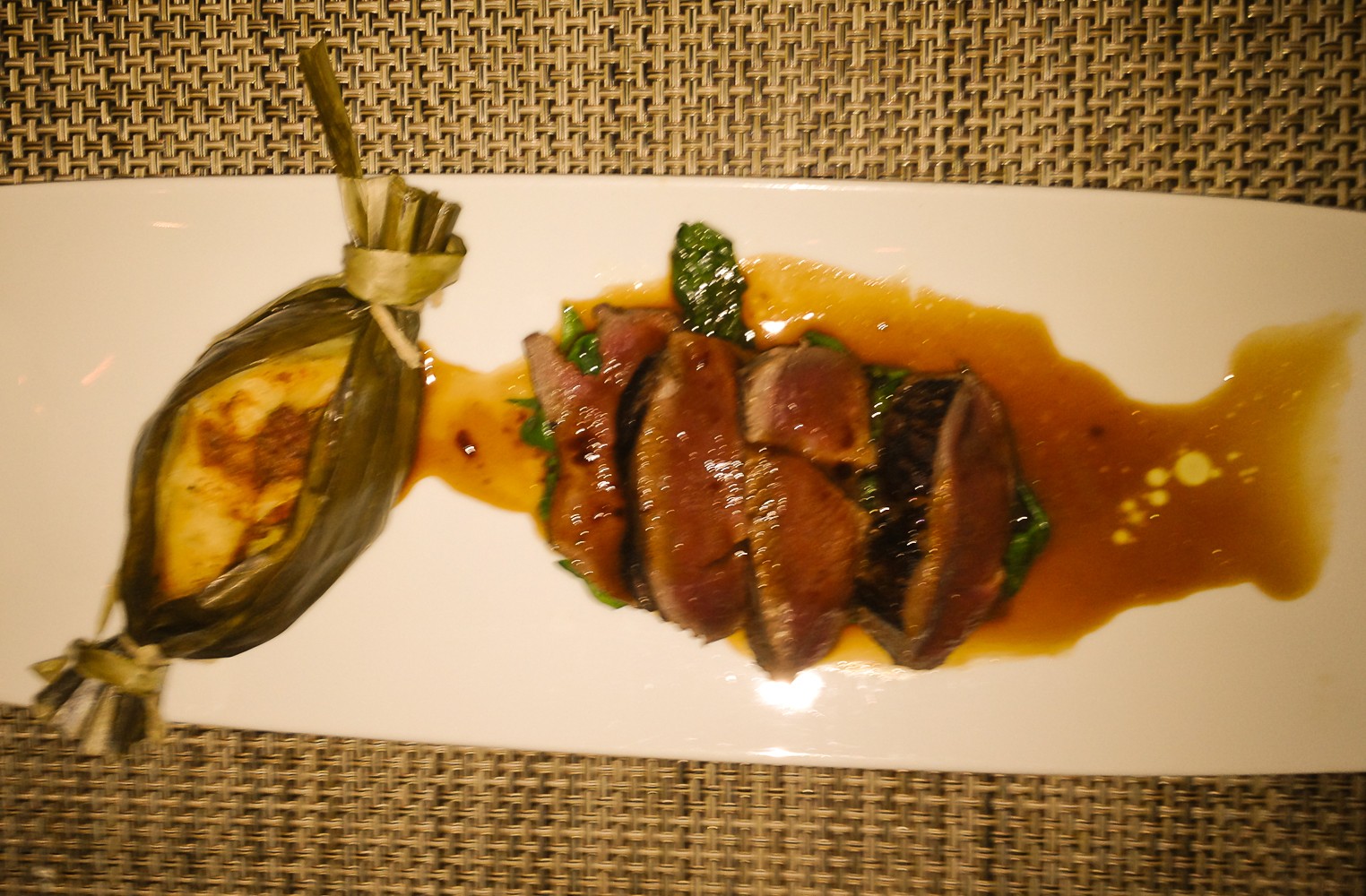
Venison two ways

The duck cassoulet was complete with a crispy duck leg and green chile sausage along with the traditional bread crumb crust. The big surprise was that New Mexico chicos substituted for the beans.
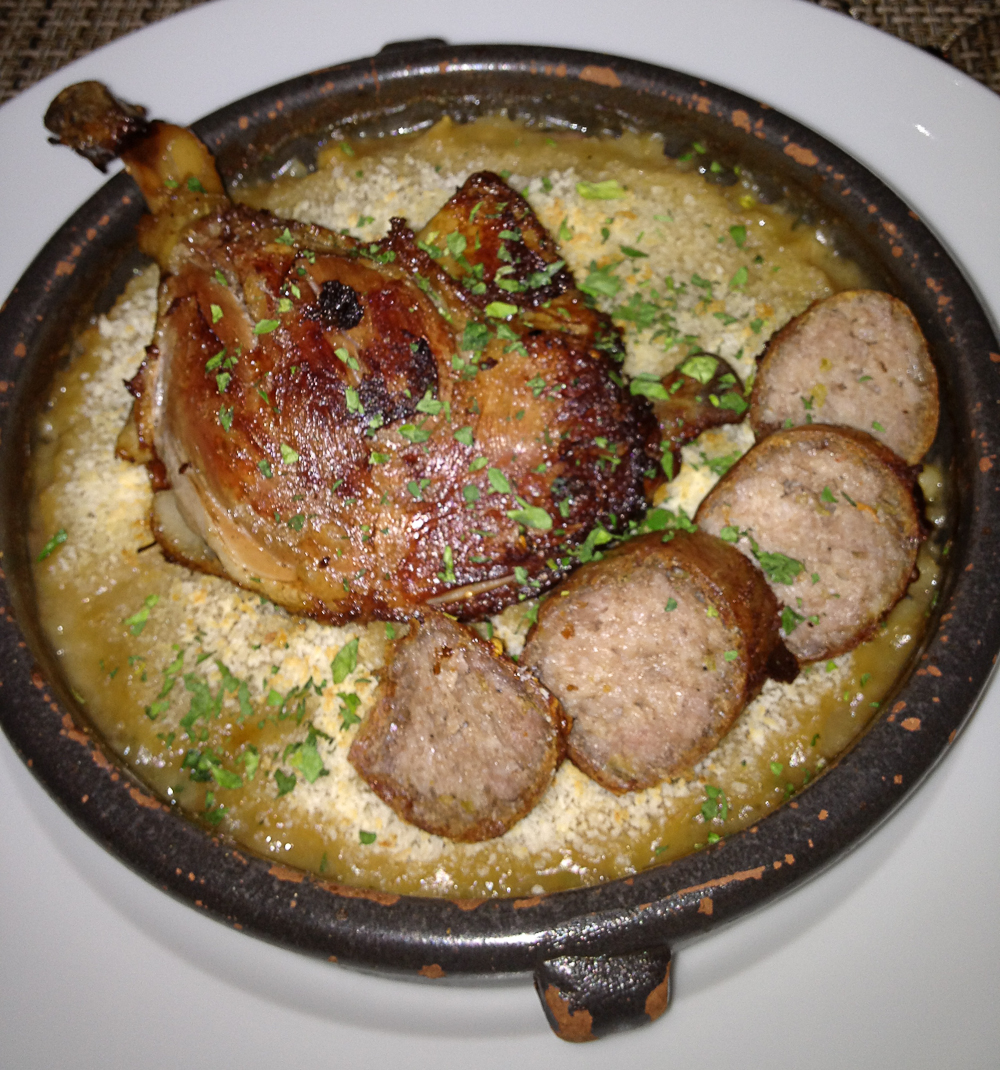
Duck cassoulet

The hot smoked salmon was topped with a crisp “chicharrón” of salmon skin and served with a delicate cauliflower mousse flavored with almond along with roasted kale.

Hot smoked salmon

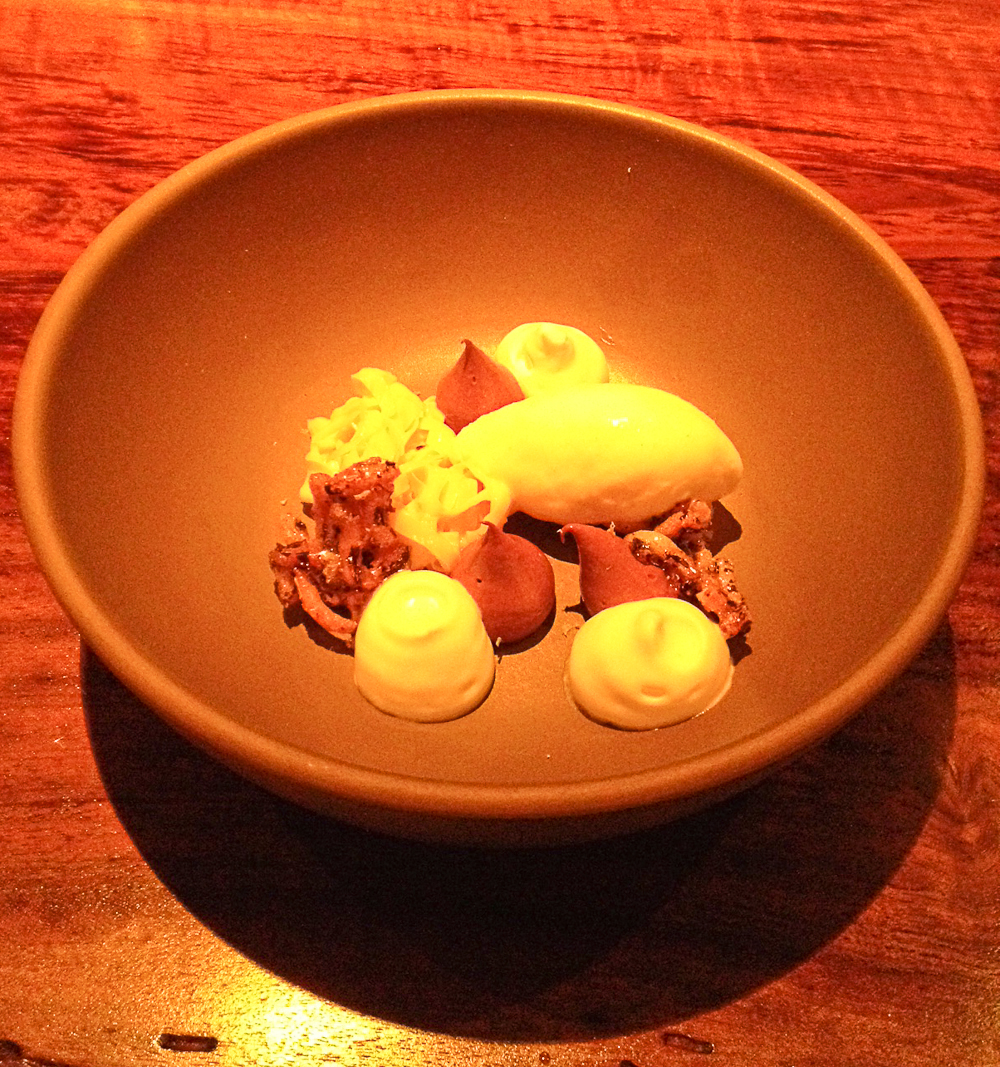
Dessert included the traditional street food, churros, but raised to a new level and accompanied by rich cajeta.

This last week, we went back with our older daughter, Carol, and her two children. The scene was just as magical, and we now had an opportunity to try more things on the imaginative menu. I had the “West of the Pecos Winter Posole”, which was unlike any posole I have ever had. A big bowl was brought to the table with a nest of shredded ham hocks, posole, and micro cilantro nestled in the middle. The server then poured a steaming pitcher of fragrant broth into the bowl. The seasoning is not for the faint-of-heart, but it was a beautiful and flavorful start.
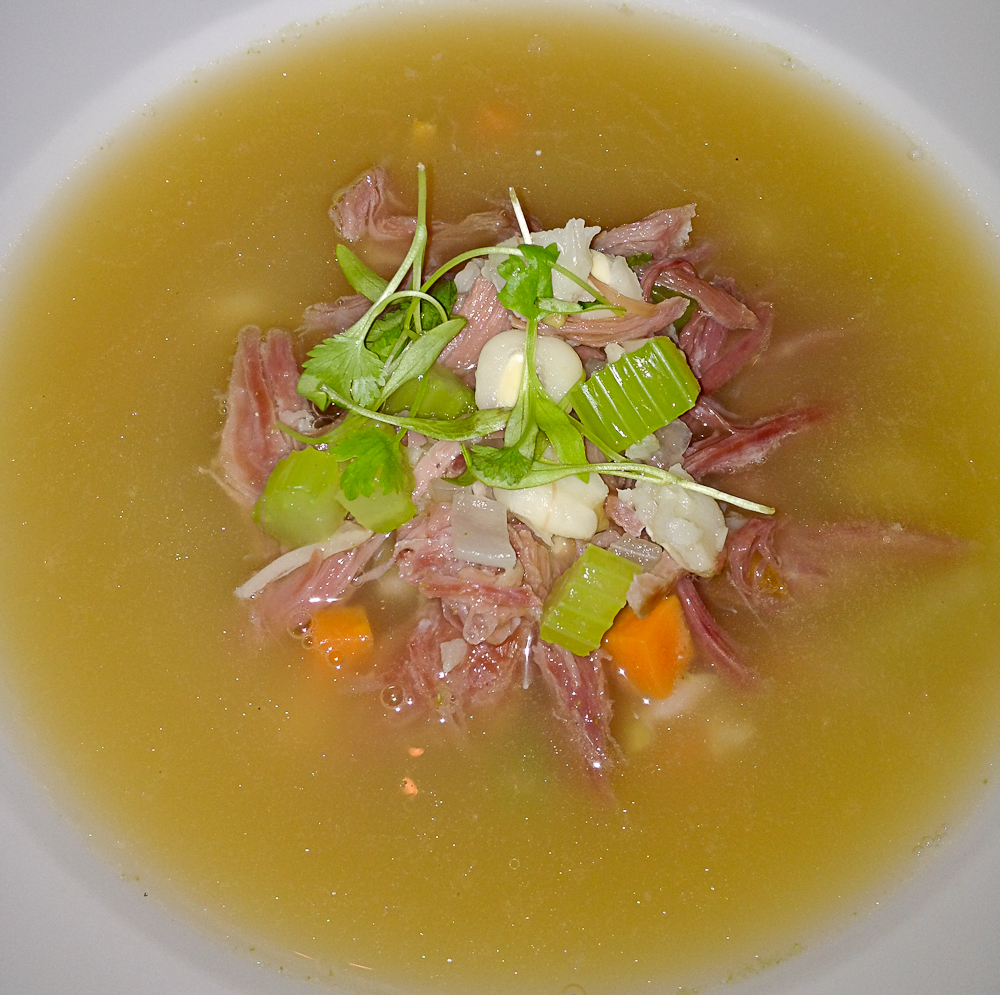
West of the Pecos winter posole

Carol had the warm chicory salad with crispy prosciutto and topped with a glistening, perfectly poached farm egg just begging to be opened so that the yolk could flavor the whole dish.

Warm chicory salad

She also chose the Guajillo prawns with – white chocolate molé! What’s not to like about that?!

The venison from the week before looked so good, that I chose that. As before, it was well-prepared with interesting seasonings. There was a delicate “cloud” of fois gras foam as an accompaniment.

Susan chose the wild mushroom ravioli with rabbit ragu. She pronounced it delicious.


Leave a comment

Filed under Food, Photography, Restaurants

SAND HILL CRANES AND MANNY’S BUCKHORN TAVERN

Bosque del Apache

Bosque del Apache sits nearly in the center of New Mexico and it is one of our favorite places to visit, especially this time of year. It is a major bird refuge for winter water fowl. Even if you are not a birder, it is worth a three-hour drive from just about any place in the state. For that matter, serious bird watchers come from all over the United States. Snow geese and Sand Hill cranes number in the thousands, and there are many Canada geese, ducks, grebes, coots, golden eagles, and bald eagles as well.

Sand Hill crane feeding

If you plan a visit, you should do it soon, as the birds will be leaving in the next few weeks to start their northern migration to the plains and tundra of Canada. You should also plan your visit so that you arrive just before sunset or before sunrise. During the day, the cranes and geese have been feeding in nearby grain fields. When evening comes, the birds fly into the many lakes and ponds to spend a cold night safe from predators. The evening arrivals are spectacular, as large flocks fly in, making loud noises and silhouetting themselves against the mountains and the sunset. The morning flights are also beautiful, but you need to be in place well before dawn to catch the show.

Sand Hill cranes against the sunset

To get there, travel on I-25 to the little town of San Antonio. Directions from there will be clear. When you arrive, your first stop should be at the visitors’ center where friendly volunteers will tell you the current viewing sites – they tend to change over time.

In flight and ready to land

Then plan a leisurely drive around the loop to see raptors, smaller birds, dabbling ducks, geese, and cranes feeding in the fields. There is a small fee for the trip because even though this is a federal reserve, it is not well-funded. The fee is worth it. Time your tour so that before the sun has begun to set you are in place for the main event. Have your camera and binoculars at the ready because gradually the cranes will begin to come in, first by ones and twos, and eventually in great noisy flocks that continue to land in the shallow lakes even as the light fades into night.

Getting ready for the night

In the morning, the flights may be even more amazing. Usually, as if by some signal, the birds will depart in one great cloud and with noisy chatter. But they are early risers, so you will miss the even if you are not in place well before dawn.

Night time and the show is almost over

If you want to catch both the evening and morning performances, there is a small RV park nearby. Otherwise you will need to plan on staying in Socorro, a half hour or so toward the north.

Manny's Buckhorn decor

San Antonio has another claim to fame: it is home to two of the great stops on the Quest for the Best Green Chile Cheeseburger. The Owl Café is an institution, and for many years we stopped there on our trips between Santa Fé and El Paso. We always drove by a little bar on the other side of the road. It looked like a honky-tonk, and its glowing beer signs  and its name, “Manny’s Buckhorn Tavern”, seemed only to confirm that.

Buckhorn Burger - green chile cheeseburger

One night, though, we ventured in. It was not very crowded, and the crowd was clearly made up of locals. Bob Olguin, the owner and son of the founder, was behind the grill, cooking and chatting with everyone – us included. We ordered the Buckhorn burger – green chile cheeseburger – and thought we had finished the Quest.

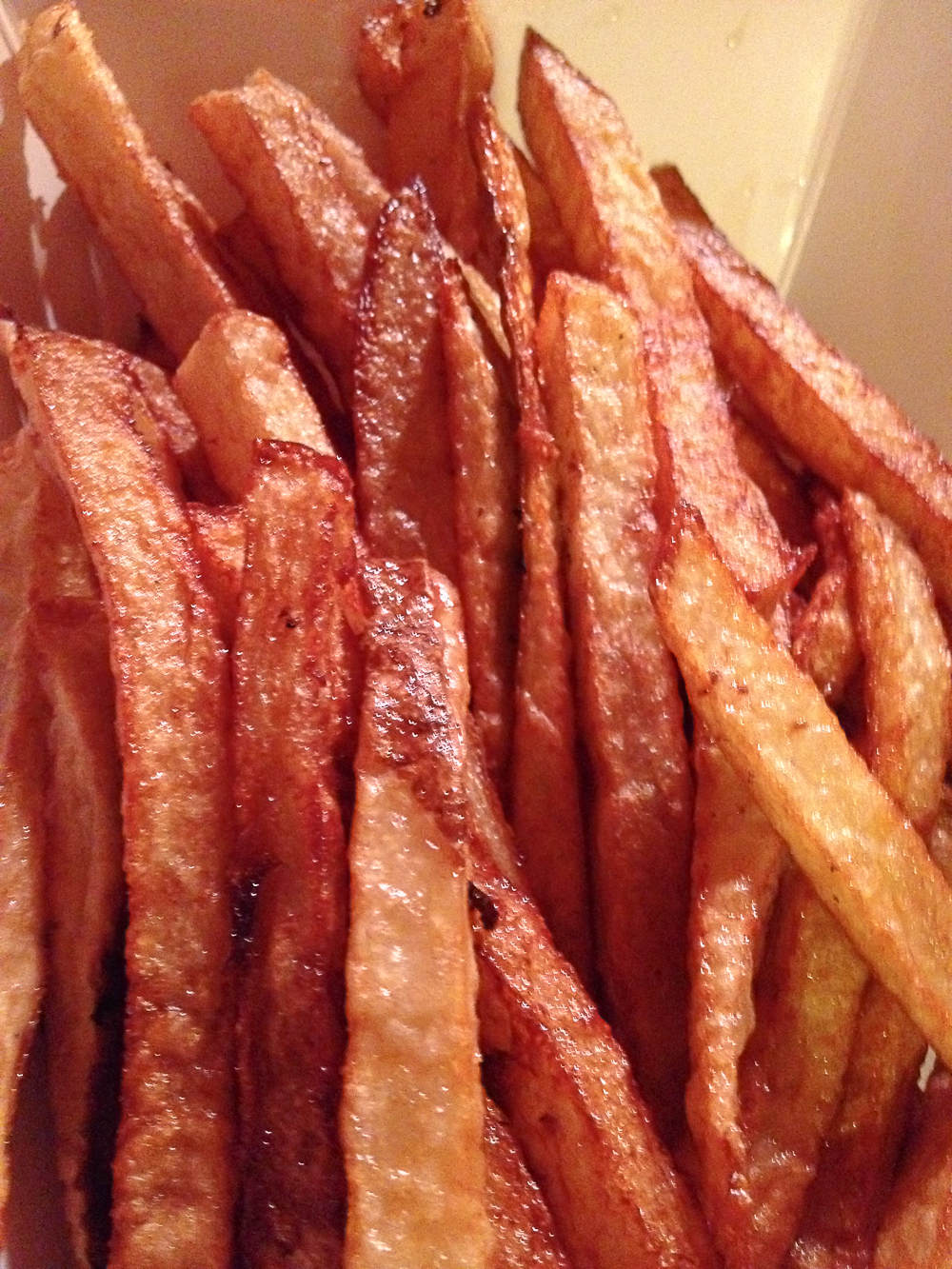
French fries

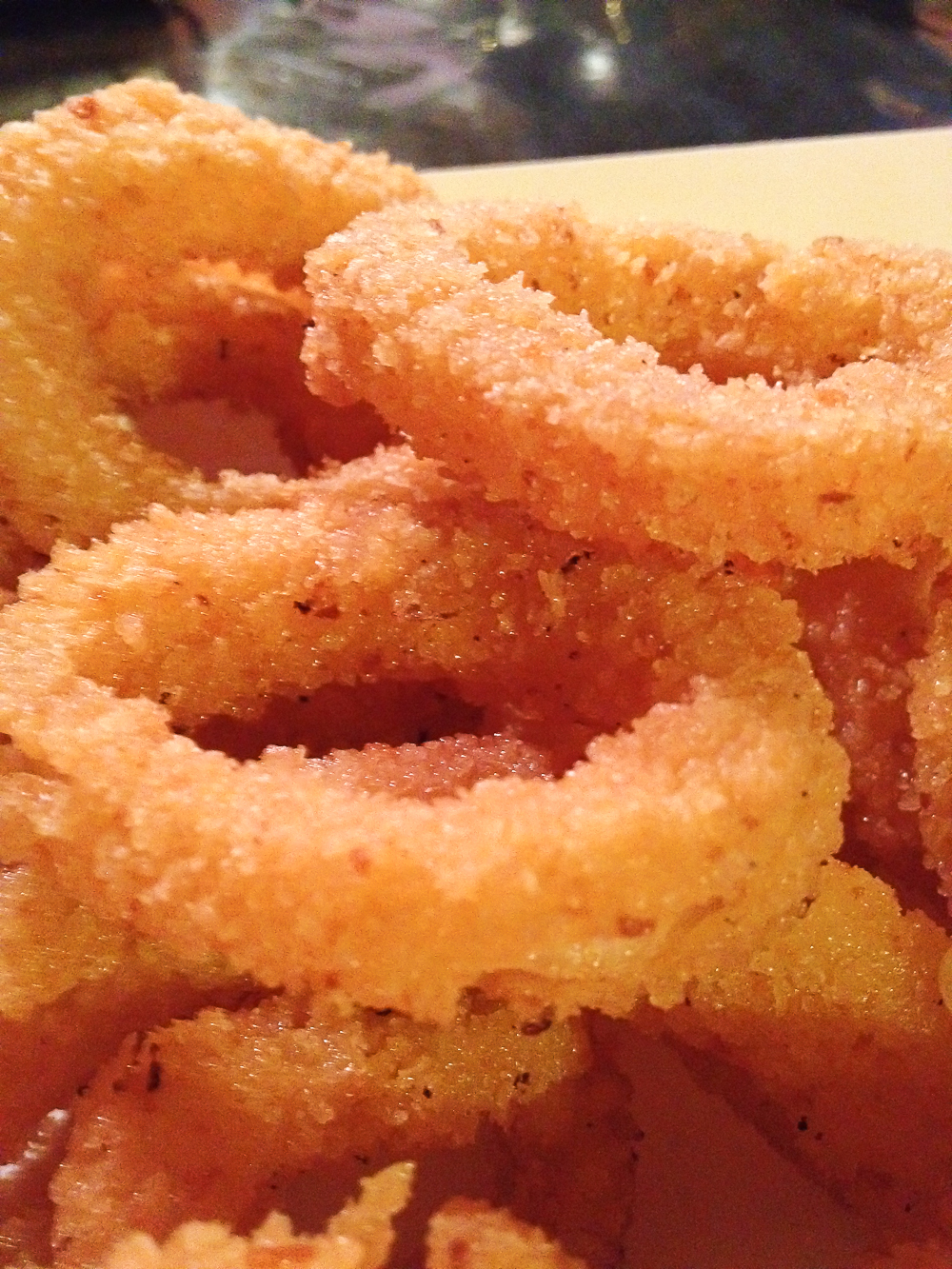
Fried onion rings

For years, we stopped at the Buckhorn; the crowds got bigger; but Bob kept his place at the grill. Then he wound up on national TV in a throw down with Bobby Flay. Since then, the crowds have become huge, especially during tourist season, and now there is a sign directing you to wait until seated. Bob no longer works the grill, but he visits each table as customers wait for their burgers. Still, the atmosphere has not changed, and the Buckhorn burgers are as good as ever. The experience is one you shouldn’t miss.  Just be sure to get fries or onion rings with your order.

2 Comments

Filed under Food, Photography, Restaurants

SARAH COOKS IN SANTA FE

This last week, our daughter Sarah and her 10 month old son, Van, visited us from San Francisco. Since she is a chef, we spent a lot of time eating at some of our favorite restaurants as well as doing a lot of home cooking. Without doubt, the food highlight of the week was the dinner which Sarah cooked for us. The menu was designed to feature the foods that Susan and I especially like, but they were all done with a restaurant-quality twist.

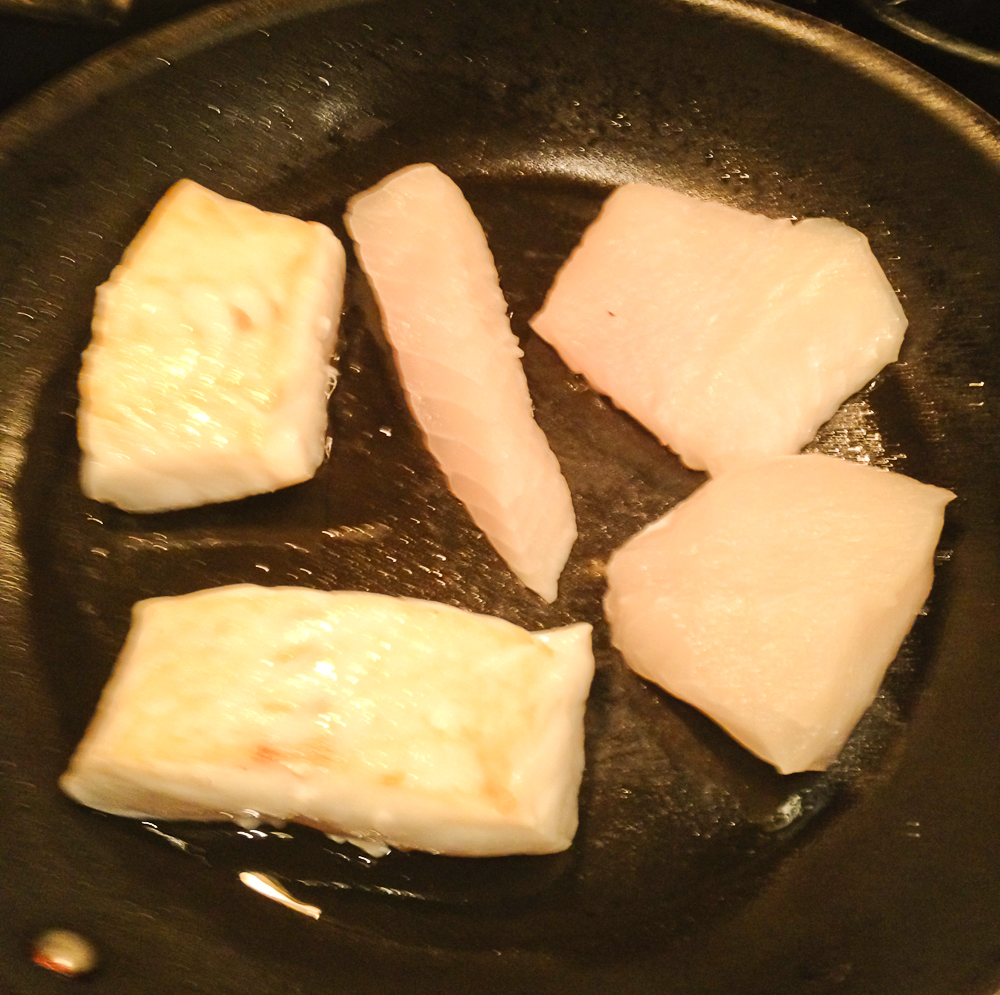
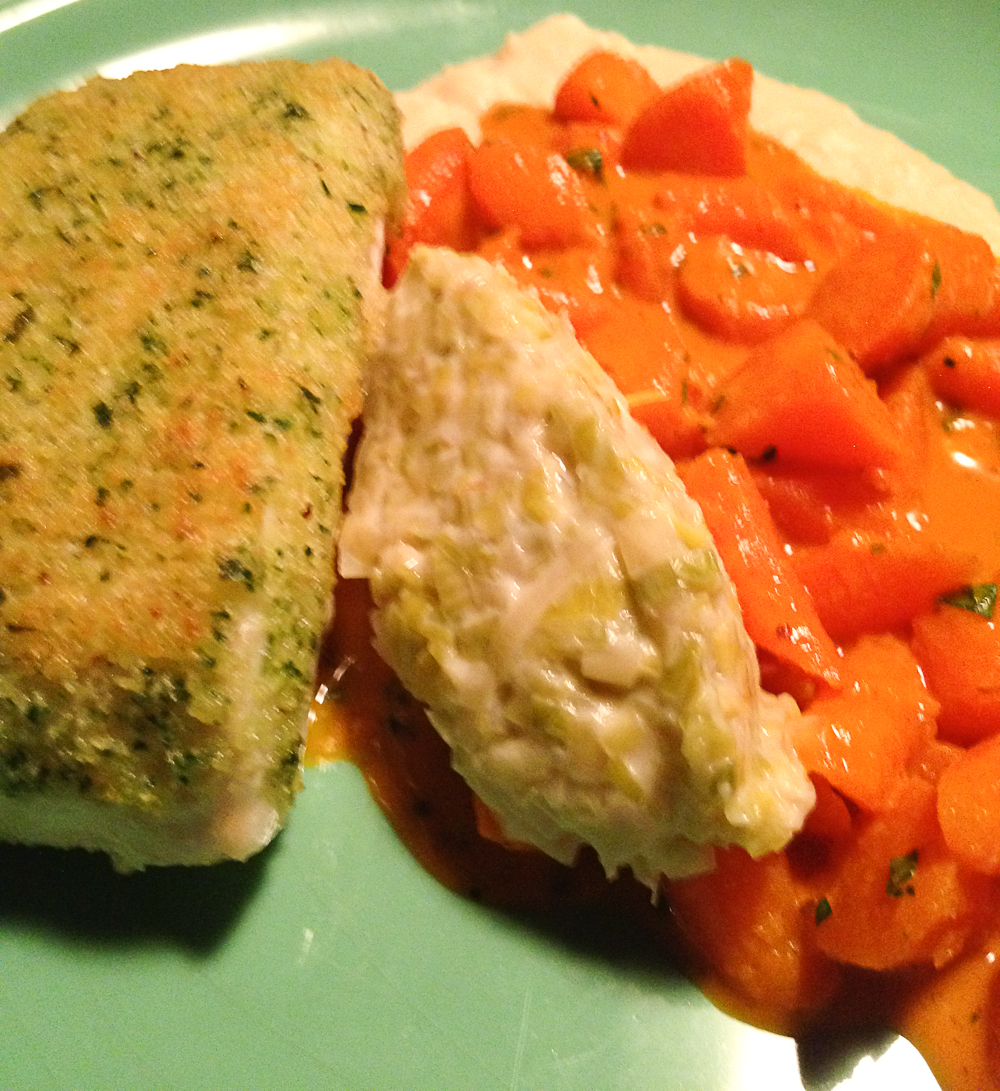
The feature of the main course was halibut. Sarah brined thick slices of the beautiful fish for just a few minutes to remove the extra moisture that you often see when a fish like halibut is cooked. Then she sautéed serving-sized fillets in butter to just underdone, finishing off by topping each piece with herb panade (more butter along with bread crumbs, garlic, salt, and herbs) and broiling for just a couple of minutes until the fish was perfectly cooked and the panade was golden brown.

Sautéing halibut filets

The starch was a delicate purée of smoked parsnips. First, Sarah smoked the parsnips along with cream in our handy Cameron stove-top smoker. She chose hickory chips to give the parsnips a definite but subtle smoky taste. Then she simmered the parsnips until they were fork tender, puréed them with a hand-held blender, and combined them with the cream and more butter until they were smooth and silky.

Cooking the smoked parsnip purée

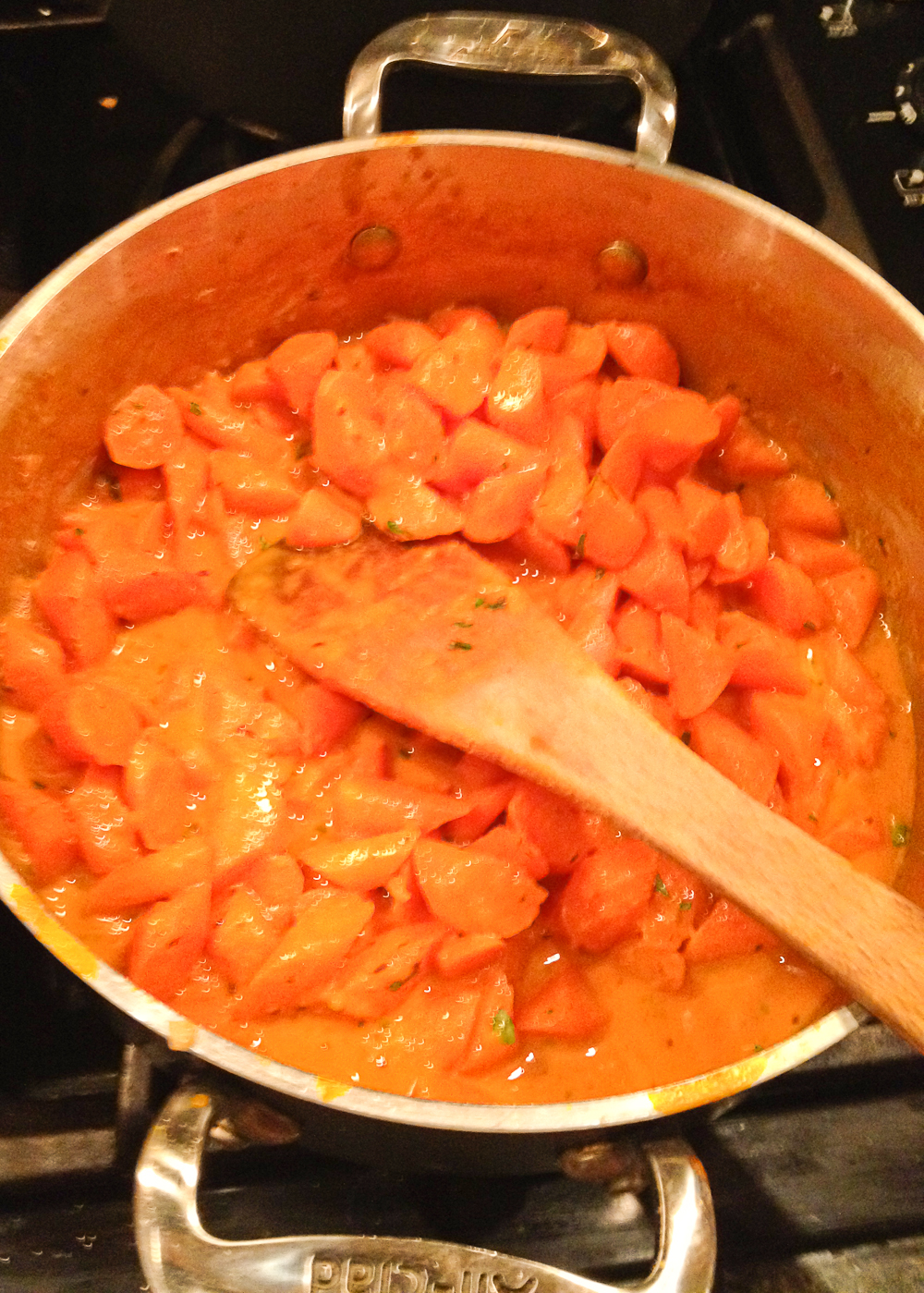
The vegetable was carrot stew: baby carrots simmered in fresh carrot juice that was then reduced to make a thick sauce. The sugar of the carrots and the carrot juice made the dish sweet – but not too sweet – without the addition of any sugar.

Carrot stew

As an added touch, “melted” leeks were chopped finely and cooked into a smooth, savory dish which could be shaped into quenelles to top the vegetables. Then everything came together into a beautiful presentation.

The final plate with halibut, parsnips, carrot stew and melted leeks

For Sarah, probably the best part of the week was the news she had been anxiously awaiting for months. She and her chef husband, Evan, had been working on securing space for their own restaurant in San Francisco. The contract finally was settled, so she spent time at the kitchen table reviewing and signing the documents before faxing them back to Evan. We had a celebratory dinner at Terra (I’ll say more about that in another post).

Sarah signing the lease

Later in the week, Sarah returned to San Francisco to help post the sign in the window of the new place.

Sarah and Evan getting ready to post the sign

If you want to read more about their new restaurant, check it out at the following link:

http://insidescoopsf.sfgate.com/blog/2012/02/05/sarah-and-evan-rich-ink-a-deal-for-a-hayes-valley-restaurant/

1 Comment

Filed under Food, Photography, Recipes

MAKING SAUERKRAUT

When I was a little boy, we lived next to my grandparents. It was the Second World War, so everyone had a Victory Garden. We were no exceptions, and we even had a chicken coop where I collected eggs each morning. My grandparents, though, were serious about feeding themselves. In addition to a big garden, they had a small barn and a pond complete with ducks and a hissing goose.  Both grandparents had grown up on farms in the Dakotas, so they were used to putting up quarts and quarts of tomatoes, pickles, string beans, peas, cherries, and peaches beginning in the early spring and continuing until the first frost in the autumn.  

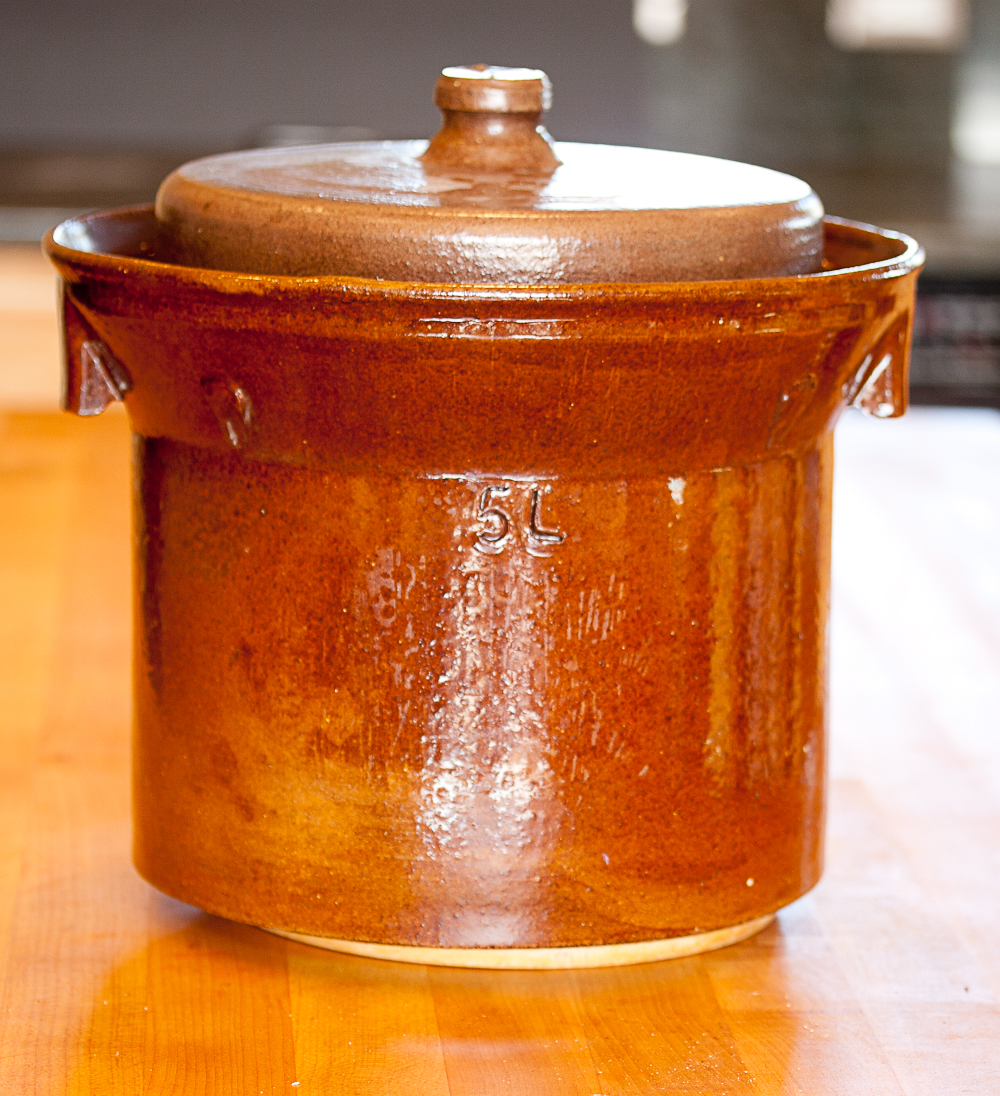
Harsch Steinzeug crock

My grandmother, though, had even more preserving to do when the rest of the harvest was over. She came from a large German family who had immigrated to North Dakota from Russia in the 1880s. German farmers had lived in Russia since the days of Catherine the Great, but when the Russians made it uncomfortable for them, the emigrated by the thousands to the Great Plains – especially to North Dakota. There they continued their German ways, including the production of huge quantities of sauerkraut to see them through the long winter.  

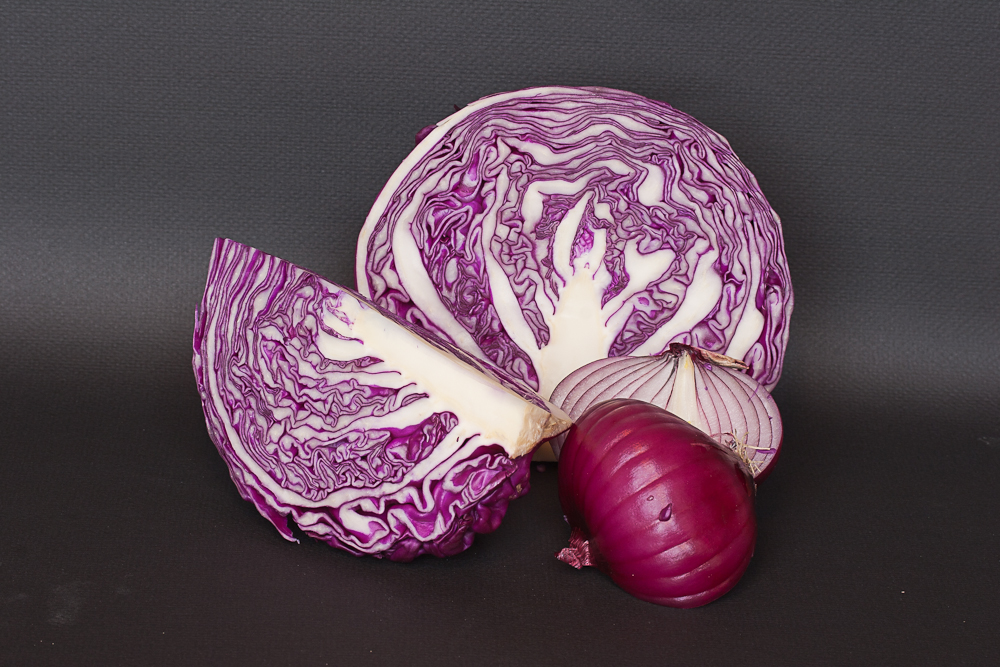
Red cabbage and red onions

Grandma continued that tradition in her back yard, so in the early fall bushels of giant cabbage heads would magically appear between her garden and the garage door. That would then become the place for an organized production line. A big wooden kraut slicer would be hauled down from storage in the garage. Big 25 gallon crocks would be brought up from the basement to be scrubbed clean. Boxes of salt would be brought from the kitchen. A kitchen chair was moved out to sit in front of a huge bowl where the cabbages would be shredded into heaping mounds. Then the packing began: shredded cabbage was layered into the crocks, salt was sprinkled on top, and the process was repeated until the crocks were completely full. Then the crocks would be lined up along a cool wall in the garage, covered with cheesecloth and big plates. Bricks would be placed on the plates for weights, and the real process began.  

Various utensils for slicing slaw

Fermenting the cabbage went on for weeks, and it was my job to check the crocks daily, skim off any scum, and add water if they looked too dry. During those days the garage was not a good place to spend much time because the dense smell of fermenting cabbage hung in the air. Finally, my grandmother pronounced the process done. At that point all of the women fired up their canning equipment and filled dozens of quart jars with the fragrant kraut until the crocks had been emptied.  

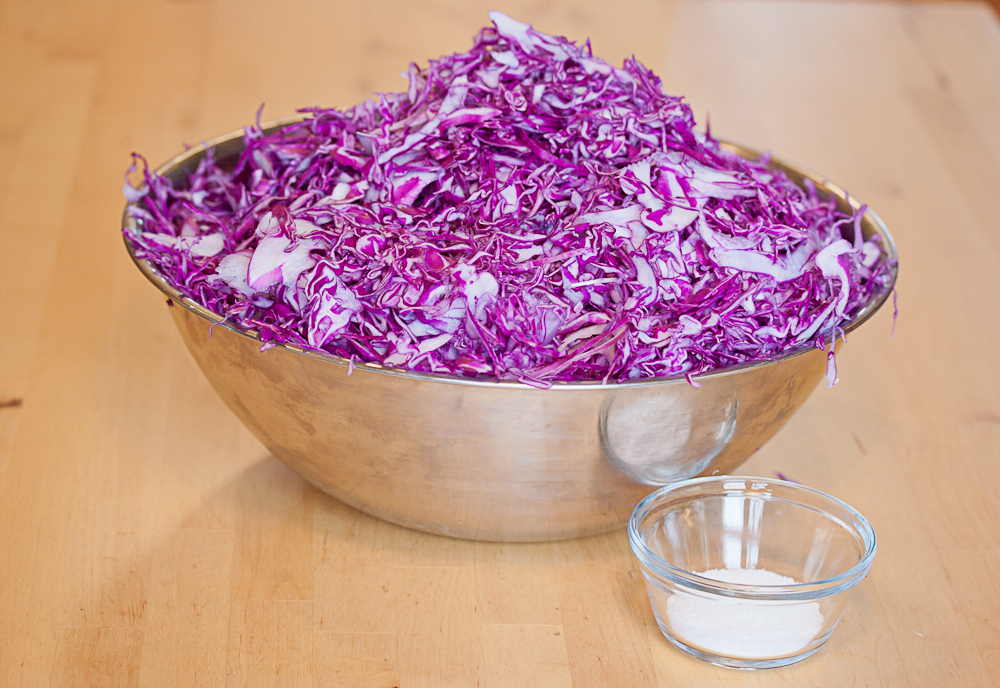
Slaw and salt ready to go in the crock

To my dismay, the supply of sauerkraut lasted all winter, and at least once a week we had the same meal for supper – sauerkraut, bland mashed potatoes, and a big sausage.  As much as I dreaded that menu, it left a lasting impression and surprisingly fond memories.  

The finished sauerkraut

For that reason, I decided to make some sauerkraut in the butler’s pantry in our home in Shreveport. All of the children were school age, and all of them regularly brought home their friends who wanted to know what was in the crock sitting on the counter.  When the children announced that it was sauerkraut their dad was making, there came a long pause and shoulder shrugs. The episode also became the basis for a favorite family story – one in which Dad gets a lot of laughs.

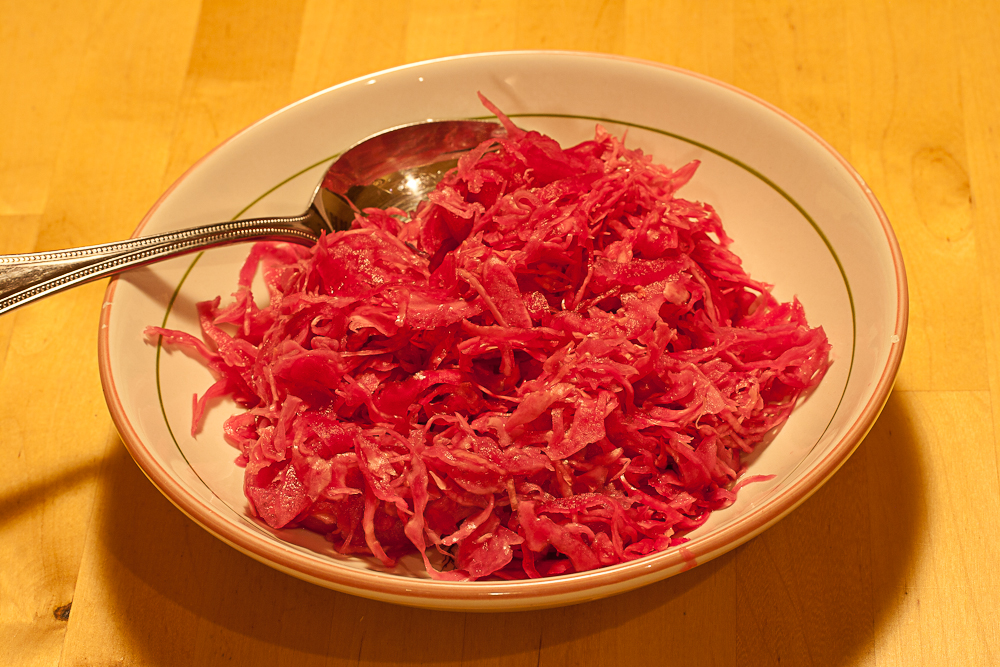
A bowl of sauerkraut ready to serve

I have never made sauerkraut again, so I was surprised when my Christmas gift from Susan was a beautiful had-crafted sauerkraut crock made by Harsch Steinzeug in Germany along with instructions for how to make sauerkraut. My crock is the five-liter size. You can get them up to 50 liter, but unless you have a big German family and eat sauerkraut every day, the 5-liter size seems perfect for home use.  

Once again, I am making sauerkraut. I have adapted the recipe that came with the crock into the one that follows. 

RECIPE

Ingredients

2 medium heads, red cabbage

2 medium red onions

10 grams coarse kosher salt for each kg of sliced cabbage + 15 grams for brine

water


  1.  Remove the outer leaves of the cabbages, quarter, and remove the core.
  2. Shred the quartered cabbage as thinly as possible. You may use an authentic wooden slaw cutter, a French-style mandoline, a plastic mandoline, or a very sharp chef’s knife. Each implement has distinct advantages and disadvantages. The wooden cutter is the most authentic, but the blade must be sharp, and it requires a lot of muscle. The French-style mandoline works very well and is adjustable, but with all of its parts it needs a lot of cleanup afterward. The plastic mandoline is inexpensive and usually not adjustable, but the slices are fine, and the blade is very sharp.  Cleanup is easy. The knife must be very sharp, and it is hard to get the cabbage shreds as thin as you would like. I prefer the plastic mandoline.
  3. Shred the red onion and combine with the cabbage.
  4. Weigh the shredded cabbage and onion. Weigh separately 10 grams of salt for each kg of cabbage and onion.
  5. Arrange a layer of shredded cabbage and onions in the bottom of the crock. Sprinkle with salt. Continue the process, alternating cabbage and onions with salt until you have filled the crock no more than four-fifths full. This is important. Otherwise you will not be able to fit the weight stones into the pot.
  6. Press down so that liquid is released and rises an inch or so above the weight stones. If it does not, pour in brine prepared by boiling then cooling 15 grams of salt in 1 liter of water.
  7. Cover the crock with the lid, Seal the lid by pouring water in the groove to that it is above the notches in the sides of the lid, and set in a cool place.
  8. In 2 or 3 days you should hear bubbling as the kraut begins to ferment. This will continue for a week or so. Do not open the crock, but continue to make sure to keep the water seal refreshed.
  9. After three weeks or so, open the crock, remove the weight stones, and dish out your first sauerkraut. Replace the weight stones and reseal to use again at another time. 

Red cabbage sauerkraut, bratwurst, German-fried potatoes, and fresh bread

Around my grandmother’s table, we had sauerkraut, sausage, and mashed potatoes at least once a week. With my first batch of kraut, I tried to reproduce that meal, substituting German-fried potatoes for the mashers. The crispy red sauerkraut was much better than that of my memories, the freshly made bratwurst from the butcher was flavorful, and the meal turned out to be a big success with everyone.


4 Comments

Filed under Food, Photography, Recipes

SANTA FE RESTAURANTS 2: THE RANCH HOUSE

Santa Fe is viewed by many as at the epicenter of red or green chile – chile stews of both colors and made with chicken, pork, beef, or whatever – along with posole, and carne adobado. There is also the ubiquitous green chile cheeseburger which causes big disagreements about who cooks the best.  At the same time good barbecue is hard to find. Texan tourists certainly agree with that! Josh’s Barbecue was one of the few oases in the desert even though it was tucked away in a hard-to-find strip mall.

The bad news is that Josh’s has closed. The good news is that the Ranch House has opened. This is Josh’s new venue located at 2571 Cristos Road in a beautiful new building complete with great views of the mountains and spacious courtyards for outside dining in warmer weather. The old-time favorites are still on the menu, but there are some new and interesting additions. There are several dining rooms inside, so don’t be put off by a full parking lot, because you will probably be seated quickly and served by one of the attentive staff.

Baby back ribs with greens and cornbread

The day we visited for lunch, the place was busy but not crowded. Susan chose the baby back rib plate, and I chose the green chile chopped brisket sandwich – a new experience for me.  The ribs came with real Southern greens and cornbread with just enough sugar to compromise between Yankees who like sugar and Southerners who don’t.  The sandwich was good, too, although I think I prefer either a classic chopped brisket sandwich or an authentic green chile cheeseburger. For me, the highlight of the meal was the little fry basket filled with crispy sweet potato fries.

Green chile chopped brisket sandwich with sweet potato fries

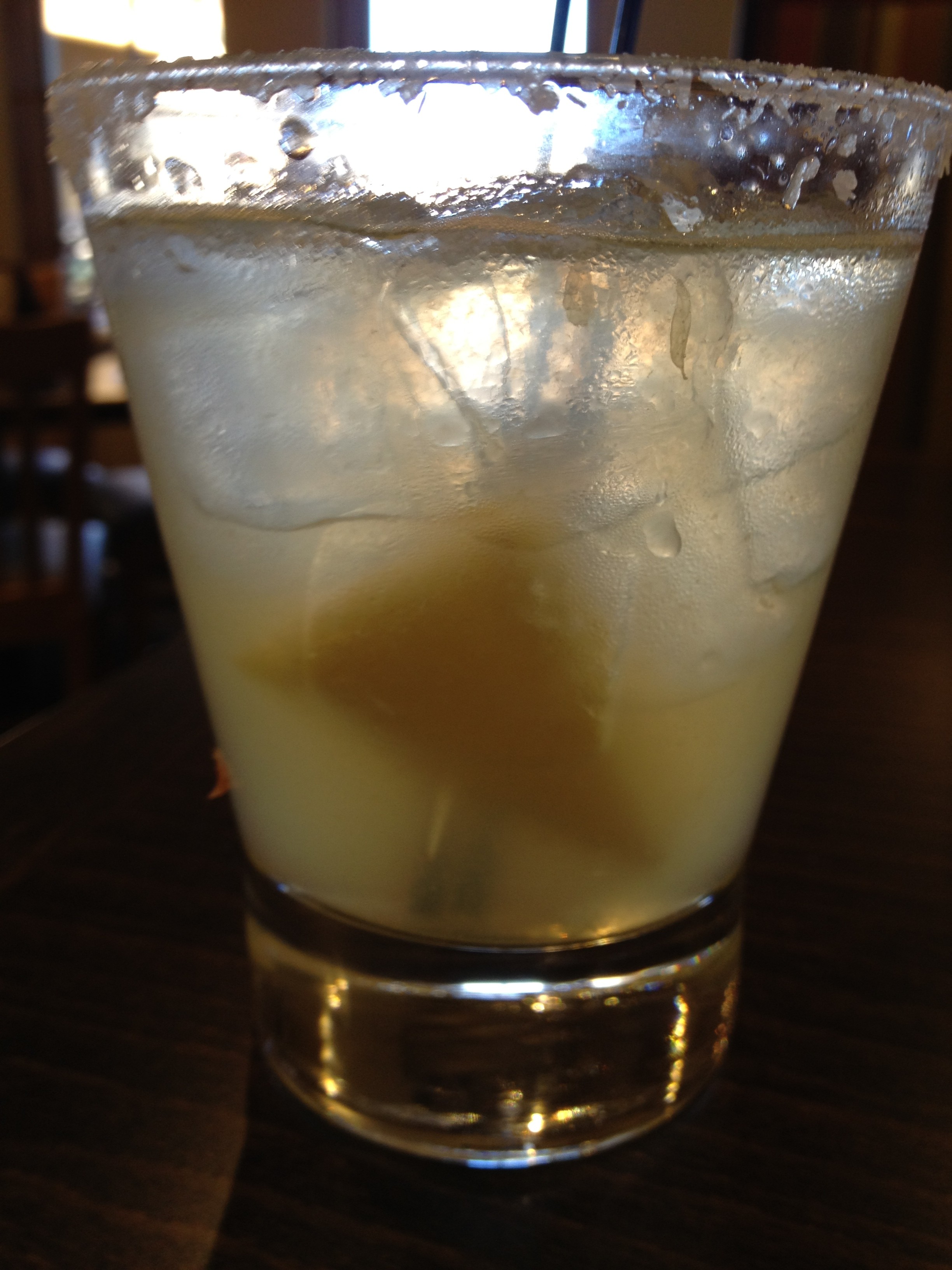
The drink selection was good though limited. Lots of beers of course, and wine (who drinks wine with barbecue?) The specialty drinks sounded good, and the pineapple margarita was a hit.

Pineapple margarita

The Ranch House is definitely worth checking out if you are a barbecue fan. And who isn’t?

1 Comment

Filed under Food, Photography, Restaurants

GREEN CHILE CHICKEN STEW

Our family has lived in the Southwest for so long that we have adopted many of its traditions. For years we have made tamales on Christmas Eve, and now that is also a tradition for our children and their families, regardless of where they live. Making tamales from scratch is fun, and the fresh, finished product always tastes better than even the best store-bought versions. Posole warms the body and the soul on a cold winter evening, and it is perfect for a family gathering on New Year’s Eve. Biscochos (in El Paso) or biscochitos (in Santa Fe) have to be homemade and – like the tamales – have to be made with lard to taste like the real thing. The crisp anise-flavored cookies compete with my grandmother’s anise-flavored German springerle when it comes to dipping into a cup of hot chocolate or a glass of milk.

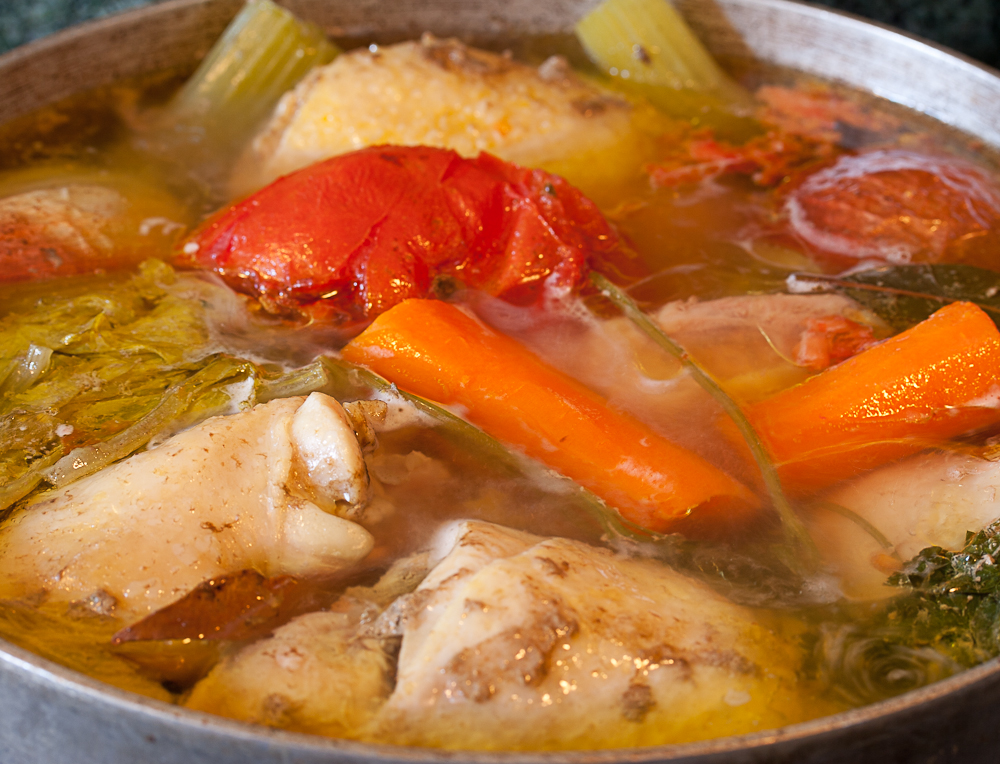
Chicken thighs cooking in stock with vegetables

Green chile chicken stew is in a class by itself. A hot bowl always reminds me of long-ago lunches in the lodges at the top of the runs at Taos Ski Valley or Ski Apache in Ruidoso. Our kids always ask for it when they visit us in Santa Fe, and so we try to have a pot on the stove for them when they arrive from a long cross-country drive. Our usual recipe calls for a whole chicken and makes enough for a large group. This version is quick, but by cooking the chicken in stock along with vegetables the broth becomes especially rich. If you are in a hurry, just skip adding the vegetables. The recipe makes enough for four adults. It is ideal for the late evening arrival of tired travelers.

Ready for your choice of garnishes

RECIPE

 Ingredients

4 Cups chicken stock

4 chicken thighs

1 medium onion, cut in quarters

1 medium carrot, cut in thirds

1 stalk celery cut in thirds

1 handful fresh celery leaves

3 stems fresh parsley

12 whole peppercorns

1 Roma tomato

2 Tablespoons cooking oil

1 medium yellow onion, diced

4 ounces chopped green chiles

2 cloves garlic, minced or pressed

3 Tablespoons all-purpose flour

2 russet potatoes, peeled and cut into ¾ inch cubes

¼ teaspoon ground cumin

2 Tablespoons dried Mexican oregano, crushed

1 teaspoon kosher salt

½ teaspoon ground black pepper

  1. In a large, heavy-bottomed pot, bring the chicken stock to the boil. Add the chicken thighs, onion, carrot, celery, celery leaves, parsley, and peppercorns. Continue to cook at a very low boil for about 45 minutes or until the chicken is cooked through.
  2.  About 10 minutes before the chicken is cooked, squeeze the Roma tomato into the stock and add the pulp.
  3.  Remove from the heat. Strain the stock into a container and allow to cool so that you can remove the fat that gathers on the top. Set aside.
  4.  Remove the skin and bones from the thigh meat, chop the meat into bite-sized pieces and set aside.
  5. Clean the pot and return it to the stove over a medium flame. Heat the oil, and then add the diced onions. Cover and sweat the onions for 5 minutes or until they are soft and translucent. Do not allow them to brown.
  6. Add the green chiles and minced garlic and continue to cook, uncovered. Stir frequently until the moisture has evaporated from the mixture. Add the flour and stir continuously for about 3 minutes so that the onions and chiles are completely coated and the flour has lost its raw taste.
  7. Add the strained, cooled chicken stock and cubed potatoes. Return to the boil, stirring frequently. Continue to cook at a low boil until the potatoes are soft and cooked through – about 20 to 30 minutes.
  8. Stir in the cumin, oregano, salt and pepper. Adjust the seasoning with more salt and pepper if needed and continue to simmer for 10 minutes.
  9. Add the chicken pieces, simmer for another 10 minutes, and then serve in large soup bowls along with your choice of garnishes.

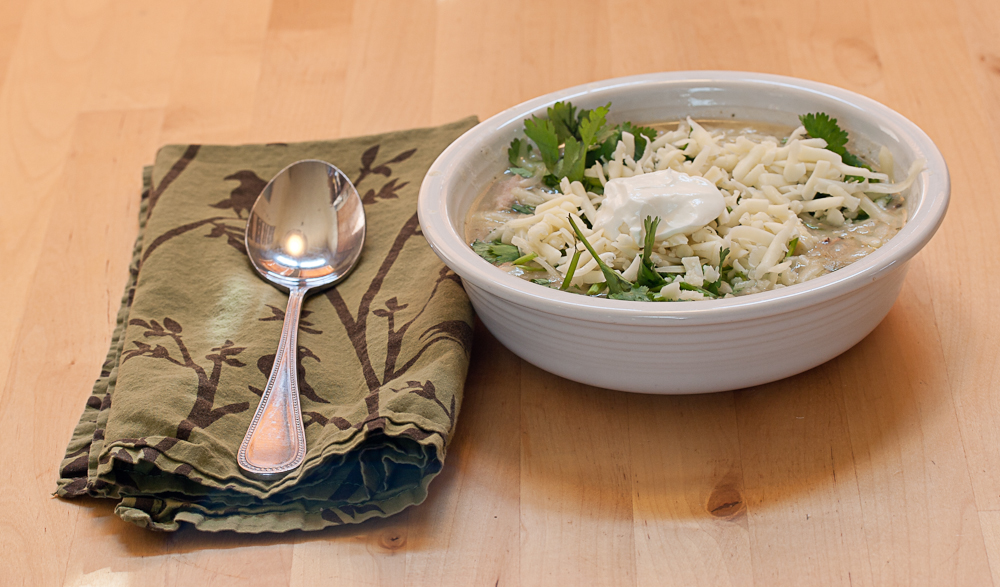
Green chle stew with the garnishes our family likes

Garnishes

There are lots of traditional choices for garnish. We always like to pass bowls of chopped fresh cilantro leaves, thin-sliced, baked corn tortilla strips, grated Monterrey jack cheese, and diced avocados along with hot sauce for those who like their soup spicier. We also like to serve hot tortillas (corn or wheat) or cornbread fresh out of the oven.

2 Comments

Filed under Food, Photography, Recipes

CHICKEN ENCHILADA CASSEROLE WITH MOLÉ ROJO

The other night we were aware that LSU was playing for the national championship in football. As former Louisianans with direct ties to LSU, we should have been planning a big TV watching party complete with gumbo or that Monday night standby in New Orleans, red beans and rice. Instead we watched an old movie and enjoyed the last of some molé rojo which one of our daughters had sent to us as a Christmas gift. To be honest, we enjoyed the old movie more than watching the drubbing administered by the Crimson Tide, and the molé made a quick meal outstanding.

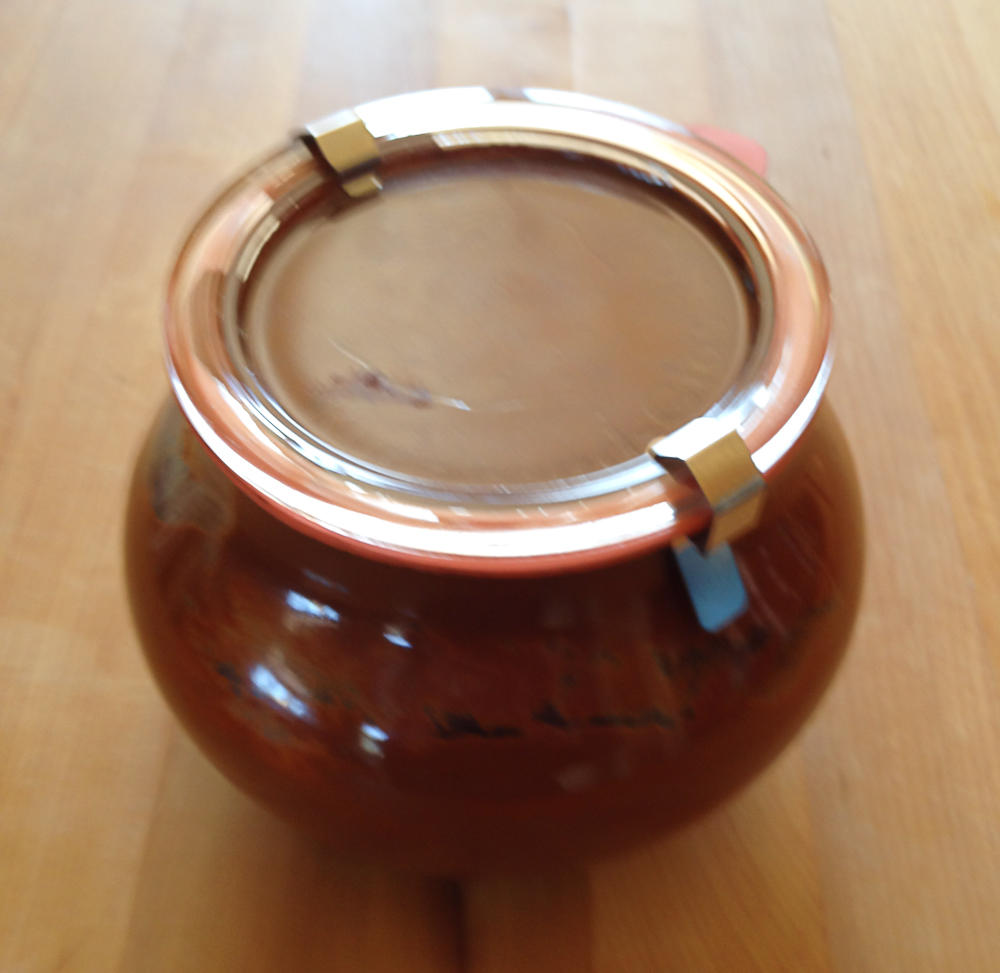
Pot of freshly made molé rojo

Classic molés have the reputation of requiring many ingredients and a long cooking process. Indeed, Rick Bayless presents his “streamlined” version in his excellent cookbook, “Authentic Mexican: Regional Cooking from the Heart of Mexico,” William Morrow and Company, New York, 1987, pp 201-203. For the recipe, go to the book, but I thought it would be interesting to provide the list of ingredients. The process involves many steps.

Ingredients

4 medium dried ancho chiles, stemmed seeded and deveined

2 medium dried mulatto chiles, stemmed seeded and deveined

1 medium dried pasilla chile, stemmed seeded and deveined

1½ Tablespoons sesame seeds

⅓ Cup lard

2 heaping Tablespoons unskinned peanuts

2 Tablespoons raisins

½ medium onion, thickly sliced

1 clove garlic, peeled

½ stale corn tortilla

1 slice dried, firm white bread

1 ripe medium tomato

3 medium tomatillos

¾ ounce Mexican chocolate, chopped

½ teaspoon dried oregano

¼ teaspoon dried thyme

1 bay leaf 8 peppercorns

3 cloves

1 inch cinnamon stick

5 Cups chicken broth

1 teaspoon salt

1 Tablespoon sugar

Clearly, the real thing is a labor of love and considerable skill. If you can’t or don’t want to go to all the trouble, bottled versions are at hand. But you will have to be satisfied with second best. Still a handy jar serves as the basis for a quick meal.

Here is my version of quick chicken enchilada casserole – certainly not authentic – but a good supper dinner for a chilly winter evening.

Chicken enchilada casserole ready for the oven

Ingredients

2 chicken thighs

4 Cups chicken stock

1 Tablespoon Mexican oregano leaves, crumbled

¼ teaspoon ground cumin

2 ounces cheddar cheese, coarsely grated + more for sprinkling on top of the casserole

2 ounces Monterey jack cheese, coarsely grated + more for sprinkling on top of the casserole

½ medium onion, chopped

salt and pepper to taste

8 fresh corn tortillas

2 Cups molé rojo Sour cream for topping

1. In a medium sauce pan, place chicken thighs in the stock, bring to a boil, reduce to a low boil, and cook for 30 to 40 minutes until the chicken is cooked. Strain the stock and reserve for another purpose. Cool the cooked chicken, remove the meat from the bones, and chop coarsely.

2. In a medium mixing bowl, combine the chicken, oregano, cumin, cheeses, and onion. Adjust the seasonings with salt and pepper.

3. Meanwhile wrap the tortillas in aluminum foil and heat for about 10 minutes at 180° in the oven until soft.

4. One at a time, fill the tortillas with the chicken mix, roll, and place seam-side down in a greased 8 x 8 inch baking dish.

5. When you have filled all of the tortillas, cover them with the molé rojo, sprinkle with the remaining grated cheese, cover the pan with aluminum foil and bake in the middle of a pre-heated oven at 300° until the enchiladas are completely heated and the cheese has melted.

6. Serve immediately with a generous tablespoonful of sour cream.

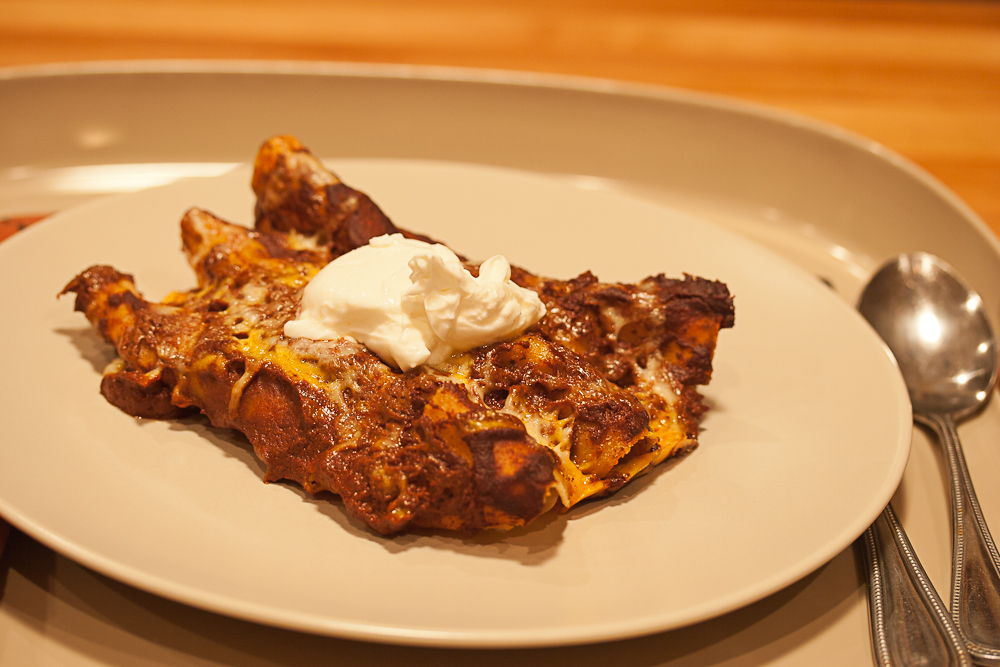
Chicken enchilada with molé rojo and sour cream ready to eat

Serves 2

2 Comments

Filed under Food, Photography, Recipes

SANTA FE RESTAURANTS I: MUSEUM HILL CAFÉ

Santa Fe is fortunate to have many excellent restaurants in all price ranges and with varied cuisines.  Santa Fe is also lucky to have a great number of outstanding museums. The museum within the Governor’s Palace, the Georgia O’Keeffe Museum, the Museum of New Mexico History, and the Museum of Art all cluster near the Plaza, and they are popular with both tourists and locals. Of course, you can make a day of it and take a lunch and/or dinner break in one of the many excellent restaurants nearby.

Less well-known is the collection of museums on Museum Hill surrounding a central plaza with a spectacular view. These include the Wheelwright Museum of the American Indian, the Museum of Indian Arts and Culture, the Museum of International Folk Art, and the Museum of Spanish Colonial Art.  They are all extremely well done with fascinating collections and frequent travelling exhibits. There is so much to see that you cannot possibly see everything in a single day.  If you can, though, you should plan at least a full day. If you do, you will also want a nearby place for either a quick or leisurely lunch. The Museum Hill Café is the perfect place, because it is right on the central plaza with the same spectacular view.

View from Café

On a recent visit, we arrived around one in the afternoon, a little after the lunch rush. That may have been a mistake because they were out of our top choices: grilled salmon with mango salsa and smoked duck flautas with mango purée. Still, there were a lot of other excellent choices including several specials, a variety of soups and salads, as well as hot and cold sandwiches.

Even before we ordered they knew that we wanted an order of sweet potato fries served with chipotle sauce. How they knew that, I’m not sure, but they were right – and the fries were exceptionally tasty. In general I am not a big fan of sweet potato fries because they usually come from the kitchen soggy and greasy. Not so with these; they were fresh, crisp, and without a hint of grease.

Sweet potato French fires

My substitute choice was their special Asian shrimp taco plate. It was served as a beautiful array of three small soft corn tortillas loaded with shrimp, small chunks of clementine, and a spicy Asian sauce. On the side was some finely shredded Napa cabbage to heap on the tacos along with a tasty pico de gallo. I must say I soon forgot the duck flautas though I plan to return  for another try at those.

Susan ordered the vegetarian plate, which our daughter-in-law had ordered on a visit the previous week. The plate consisted of a beautiful presentation of a savory lentil dal, orzo, edamame, and a lightly dressed green salad.

The wine selection, though small, is well-chosen and excellent for lunch. We both ordered a glass of New Zealand Sauvignon blanc – light and just right with our food – and also non-filling so that there was still room for dessert.

That meant sharing a big slice of eggnog pie – a sweet and mellow ending to a relaxing lunch.

Eggnog Pie

Did I mention the view? Did I mention that the café is also very kid-friendly? There were several families enjoying themselves in a modern but tastefully decorated room with well-chosen art and the bright sun pouring in through the glass walls.

Leave a comment

Filed under Food, Photography, Restaurants

RED OR GREEN? CHRISTMAS IN NEW MEXICO

The standard question in Santa Fe when you order chile is “Red or green?” If you have a hard time deciding, you can just say, “Christmas”, and they will bring out a dish slathered in both colors of chiles. This week’s  cookie recipe picks up on that theme. Linzer cookies are traditional for Christmas – a tender sandwich of almond or hazelnut cookie filled with raspberry jam pushing through a hole in the top. They remind some people of eyes, and  so the cookies are also called Linzer Augen (eyes). Authentic Linzer cookies are delicious, but for a Santa Fe Christmas, they almost beg for a little chile kick.

Rolling and cutting the cookies

As the name of the cookie suggests, it had its origins in Linz, Austria. Lenz is an ancient city founded by the Romans and home to luminaries like the mathematician Johannes Kepler, the composer Anton Bruckner, and unfortunately Adolf Hitler. But it may be more famous as the home of the Linzer Torte, a delicious pastry that can be traced back to the 1600’s and is now a feature of many of the great pastry shops of Vienna. It has become popular throughout Austria as well as the world, and especially at Christmas. The Linzer cookie uses all of the same ingredients.

Jars of chile-flavored jam

For the Santa Fe version, there are local products that let the baker add that chile kick without changing the basic recipe too much. Heidi’s Raspberry Farm makes a raspberry-red chile jam that fits the bill. In New Mexico, you can find it at farmers’ markets or in specialty grocery stores. You can also order it from Heidi’s Raspberry Farm, P.O. Box 1329, Corrales, NM 87048. Green chile jam is harder to find, but you can make your own from roasted sweet green chile sauce made by Desert Gardens, Comfort Foods, Inc., 9900 Montgomery Blvd, NE, Albuquerque, NM 87111, www.comfortfoods.com. I’ll tell you how to transform the sauce into jam as well as giving you the basic recipe for the cookies. You will see that there are a lot of steps in making the cookies, but it can all be done in a morning of busy baking.

RECIPES

Sweet Green Chile Jam

Ingredients

9 ounce jar sweet green chile (see sources)

1 Tablespoon sugar

1 teaspoon low- or no-sugar pectin

  1. Empty the jar of green chile in a small saucepan. Stir in the sugar, pectin, and water, and bring to a boil, stirring frequently.
  2. Boil for two minutes. Then remove from heat and allow to  cool partly
  3. Return the mixture to the jar. Cool completely, and then store in the refrigerator until ready to use.

Almond Flour

Ingredients

½ Cup almonds

4 Cups boiling water

  1. Place the raw almonds in a large heat-resistant bowl.
  2. Pour the hot water over the almonds and let steep for 5 minutes.
  3. In batches, remove the almonds from the hot water. Slip the skins off the almonds.
  4. Spread the peeled almonds on clean paper towels and allow to dry completely for about two hours.
  5. Ad the completely dried almonds to a spice grinder or small food processor. Grind the nuts using pulses of the low power. Watch carefully as too vigorous grinding can turn the almonds into almond butter. Remove and set aside when the almonds resemble coarse cornmeal.

Icing

Ingredients

1 Tablespoon unsalted butter,melted

1 Cup confectioners’ sugar

¼ teaspoon almond extract

2 Tablespoons cream

  1. In a small bowl, combine the butter, sugar, almond extract, and cream.
  2. Transfer to a plastic, zipper sealed sandwich bag and cut a 1/16 inch piece from one corner of the bag. When ready to ice the cookies, squeeze the icing through the hole to form patterns of your choice on the cookie top.

Linzer Cookies

Ingredients

½ Cup vegetable shortening

¼ Cup unsalted butter

¼ Cup sour cream

½ Cup sugar

½ Cup brown sugar, packed

½ teaspoon salt

1 teaspoon baking powder

1 teaspoon vanilla extract

1 large egg

2½ Cups all-purpose flour

½ Cup almond flour

½ Cup cornstarch

  1. In the bowl of a stand mixer, combine the shortening, butter, sour cream, sugar, brown sugar, salt, baking powder, and vanilla extract. Beat at slow to medium speed until the ingredients are well mixed.
  2. Add the egg, and continue to mix at medium speed until the batter is light and fluffy.
  3. In a separate bowl, combine the flour, almond flour, and cornstarch.
  4. Add the dry mix to the batter and continue to beat until the ingredients are well combined and you have a smooth dough.
  5. Divide the dough in two equal portions. Form the portions into balls, wrap them in plastic wrap, and chill them for at least one hour in the refrigerator. If the dough is too soft, it will stick to the rolling-pin when you try to roll out the cookies.
  6. Roll the chilled dough, one ball at a time,  on a lightly floured work surface to about 1/8 inch thick. Using a 2¼ inch round cutter, cut rounds in the dough. Then using a 1 inch cutter, cut holes in the center of half of the rounds.
  7. Gather up any scraps of dough and shape them into a ball. Chill, roll, and cut cookies until all of the dough is used.
  8. Bake the cookies  for about 10 minutes or until lightly browned around the edges, on parchment-lined baking sheets in an oven preheated to 350º. Cool on a mesh rack.
  9. Ice the tops of the cookies with the hole in the center. Alternatively, and more classically, sprinkle them with confectioners’ sugar. Turn the solid cookies over and place about ½ teaspoon of jam in the middle. Then top with the frosted cookies.

Baked, decorated cookies

Makes about 4 dozen cookies

1 Comment

Filed under Food, Photography, Recipes

CHEFS’ NIGHT OFF

I just got back from San Francisco where Susan and I took care of our grandson so that my daughter and son-in-law could prepare and serve their latest pop-up dinner. During the dinner Susan took care of the baby, so I got to enjoy the meal.

 This time the dinner was held at Coi, the Michelin two-star restaurant where Evan is the chef de cuisine and where Sarah worked for a short while early in her recent pregnancy. The dinner turned out to be a big success with a waiting list for reservations.  The kitchen crew was experienced, so the food came out on time and with a beautiful presentation. Most of the servers were recruited from the regular staff of Coi, so service was unobtrusively attentive. The wine and beer selections were small but very well-chosen to complement the meal.

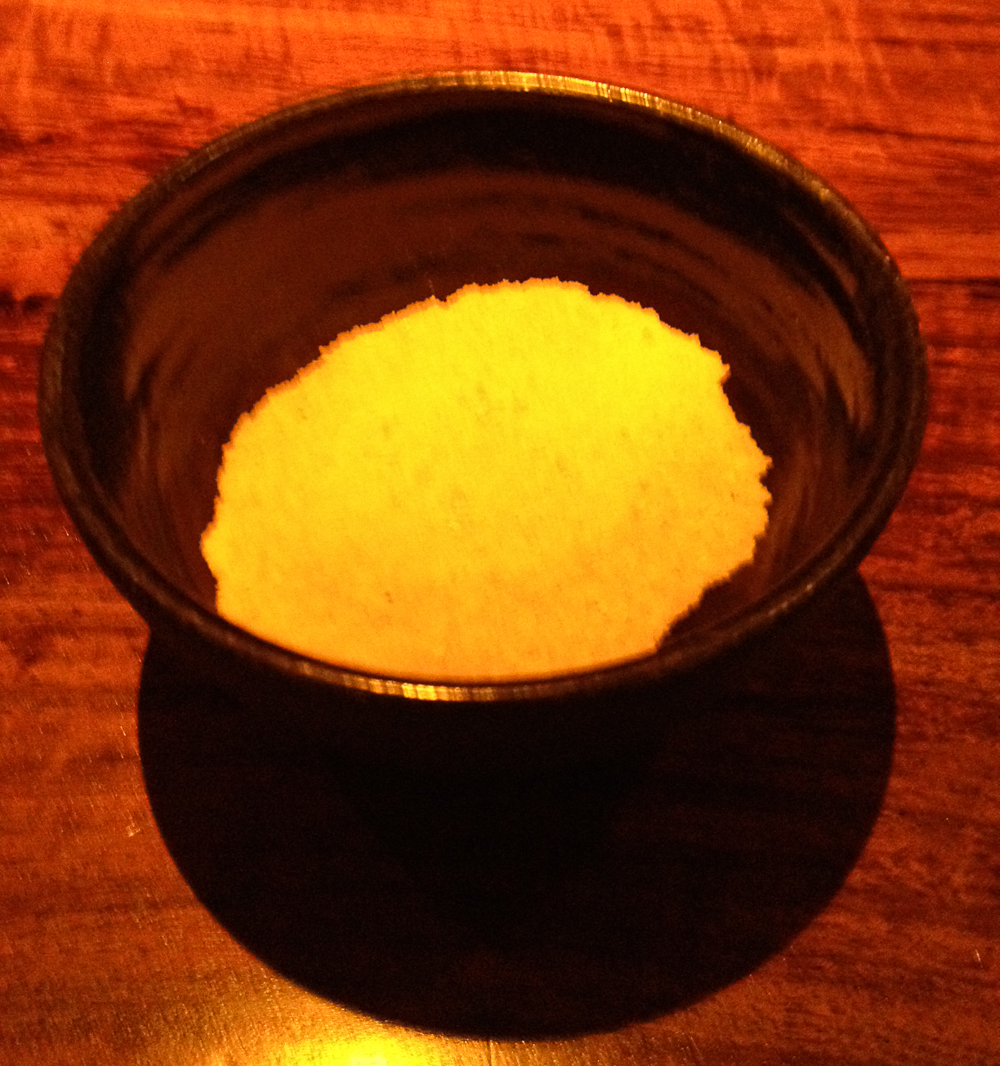
Wild-Fennel-Pollen-Dusted Kettle Corn

Popcorn is the classic American snack food for movies and with drinks. Kettle corn raises it to a new level with a light sugary accent to the salty tang. This version, dusted with wild fennel pollen raises the bar one notch. In Northern California, wild fennel grows everywhere, so it is easy for foragers to gather the pollen from the golden flowers when they are in full bloom. The aroma and taste are subtle reflections of the stronger accents of fennel seed or cooked fennel. This is rapidly becoming a standard dish for the Chefs’ Night Off pop-ups because it is so popular and so perfect with cocktails, beer, or wine before dinner. One group of guests worked their way through six bowls.

Sun-Dried Tomato Fritter with Shiso

Fritters may be one of the signature dishes for Chefs’ Night Off. This version showed off sun-dried tomatoes folded into a stiff béchamel, crusted with cornmeal, and fried. Shiso, also called perilla or Japanese basil, is an aromatic leafy green.

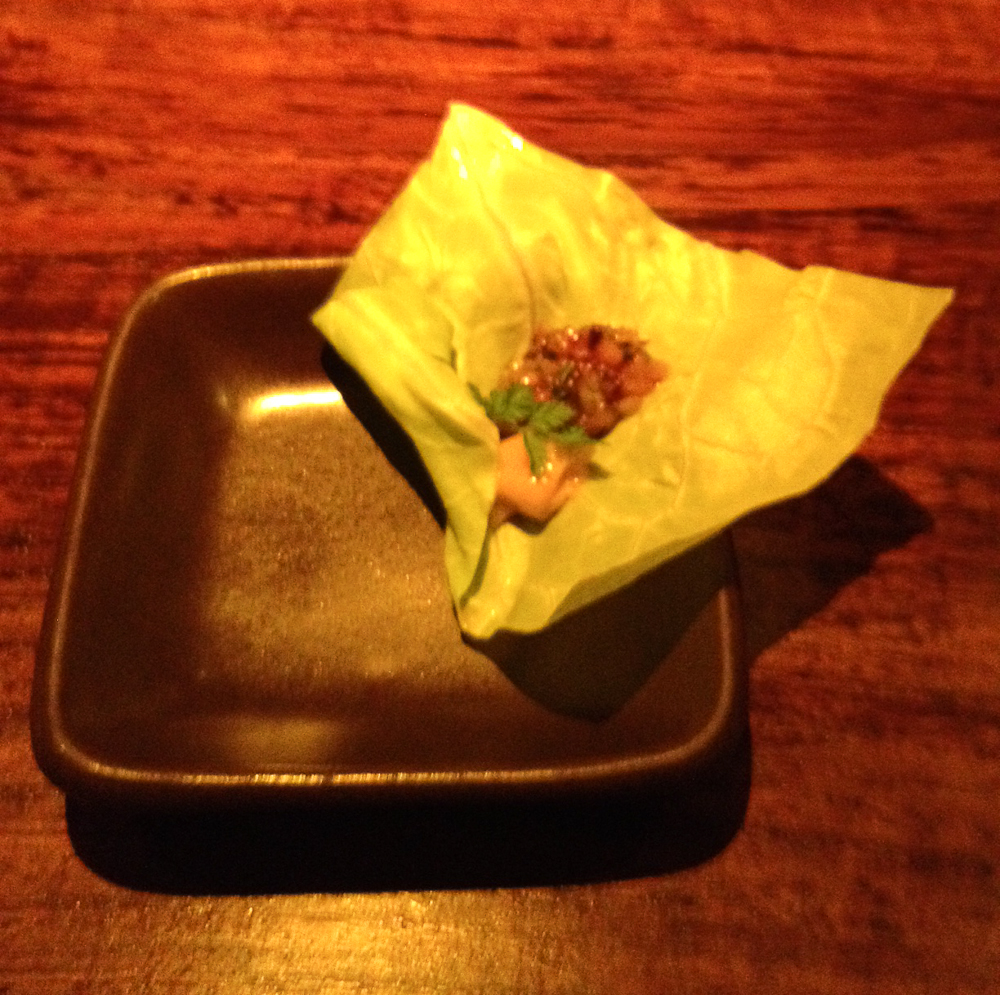
Dungeness Crab Louie with Little Gems and “Saltine Crackers”

This is the season for Dungeness crab in San Francisco, and it is found on many menus prepared in many different ways. This version called for the pink, sweet morsels of crab to be combined with apples, celery, and house-preserved pickles, seasoned with a light, siphoned sauce Louis, garnished with a chiffonade of little gem lettuce, and hidden beneath a tuile made of saltine crackers in the style of an Italian frico.

Avocado, Little Gems, and “Saltine Crackers”

For vegetarians, this dish imitated the Dungeness crab Louie, substituting avocado ribbons and avocado balls stuffed with avocado mousse.

Plancha Bread with Roasted Squash, Smoked Pancetta, and Burrata

This complex dish used rectangles of flat bread baked on a plancha (iron griddle) and topped with roasted squash purée, crisp smoked pancetta, a siphon of burrata ( the creamy, earthy cousin of mozzarella) and herbs. For the vegetarians, the pancetta was replaced by smoked onions.

Chicory Salad with Date Vinaigrette and Persimmons

A beautiful and interesting break from the main courses, a leaf of chicory was dressed with a date vinaigrette siphon, grilled chicory chiffonade, and diced persimmons.

Roasted Chicken with Chestnuts, Pomegranate,  and Pine

Chicken legs were deboned and prepared pressée, stuffed with truffle and seaweed mousse. Chicken breast was stuffed, under the skin, with truffles and seaweed. The dish was served with chestnut purée, seaweed salad, frisée, pomegranate seeds, and seaweed chips.

Gnocchi with Chestnuts, Pomegranate, and Pine

For vegetarians, gnocchi poached and seared in brown butter were substituted for the chicken with the addition of shaved white truffles.

Chocolate Cremeaux with Coconut Whipped Cream, Rice Ice Cream, Fried Puffed Rice, and Yuba Strips

Not quite mousse and not quite ganache, the chocolate cremeaux anchored dessert, but there were lots of flavor surprises. Who would have thought of fried puffed rice? But it definitely fit in. Yuba, the skin that forms when tofu is heated, finished the dish.

Black Pepper and Blood Orange Marshmallows

These were definitely not the marshmallows you put in s’mores. The spiciness of the black pepper played off the blood orange and made this a fine end to a special meal.

2 Comments

Filed under Food, Photography, Restaurants