Category Archives: Food

OLIVE OIL POACHED TUNA SALAD WITH FENNEL

Our local wine shop hosts weekly wine tastings as well as periodic wine classes that emphasize wine and food pairings. So, of course, with the wine classes there is food. One of the featured dishes at the most recent class was oil-poached tuna salad. It was delicious and refreshing. I thought I would try to copy it. I found that there were lots of recipes for oil-poached fish to be found on the internet. They all sounded good although there was a lot of variation in the instructions on how to cook the fish. There were also ingredients that didn’t appeal to me. The wine class version included cooked fennel. I thought I would opt for the refreshing crunch of raw fennel.  Otherwise, I decided to wing it with my own recipe. In any event, I was determined not to replicate the tuna salad of sandwich fame that is made with canned tuna. Probably everyone has had one of those in a brown bag lunch. There is no worry: olive oil poached tuna tastes nothing like the canned variety.

RECIPE

Olive Oil Poached Tuna Salad with Fennel

Ingredients

  • fennel bulb with stems and fronds still attached
  • 4 cloves garlic, peeled but left whole
  • about 3 cups olive oil (no need to use extra virgin)
  • 10 ounces ahi tuna
  • 4 tablespoons champagne vinegar, divided
  • 6 small cremini mushrooms, quartered
  • ½ teaspoon dry mustard
  • 2 ribs celery, sliced thinly
  • 5 scallions including green tops, sliced thinly on the bias
  • 1 tablespoon chopped pimento
  • ½ cup small pitted black olives drained and cut in half
  • 1 ripe avocado, ½ inch dice
  • salt and pepper
  • Romaine lettuce leaves

Method

  1. Trim the stems and fronds from the fennel bulb. Cut the stems into 1-3 inch pieces. Chop 3 tablespoons of the fronds and set aside to add to the finished salad. Slice the fennel bulb horizontally using a mandoline. Set aside the sliced fennel bulb.
  2. In a saucepan that is just large enough to hold the tuna in a single layer, combine the chopped fennel stems and fronds, garlic, and olive oil. Bring to the boil for about 5 minutes, reduce the heat to low, and add the tuna. The hot oil should cover the tuna. Turn off the heat and poach the tuna, uncovered, basting from time to time with the hot oil and turning once during the poaching. Poach for 20 minutes. Remove the tuna to a plate. Strain the oil into a small bowl.
  3. Place the quartered mushrooms in a small container that can be firmly sealed. Add 2 tablespoons of the vinegar and 6 tablespoons of the poaching oil. Cover tightly, and turn from time to time to make sure the mushrooms are well-marinated.
  4. Prepare a vinaigrette by combining the remaining vinegar and dry mustard in a small bowl or measuring cup. Slowly whisk in by drizzles 7 tablespoons of the poaching oil. Set aside for final assembly of the salad.
  5. With a sharp knife. cut the tuna into bite-sized pieces. Place in a large bowl. Add the marinated mushrooms, celery, scallions, pimento,  olives, avocado, and reserved chopped fennel fronds. Gently stir in the vinaigrette, making sure that the salad is well mixed.  Serve on Romaine lettuce leaves.

7 Comments

Filed under Food, Photography, Recipes

SECRETS OF THE AGES REVEALED: BLENDER HOLLANDAISE SAUCE

I have been making hollandaise sauce in a blender since reading about it in Mastering the Art of French Cooking over forty years ago. After all this time I learn that I have been doing it wrong. That’s probably because Julia Child wrote that any 8-year-old child could follow the recipe.  (How’s that for an ego-squelcher?) She also said that the sauce would not accept as much butter nor be as good as the sauce you made laboriously over a steaming water bath. My hollandaise always turned out a little runny, but I thought it was a butter thing and just the way it was. Nothing could be further from the truth. From watching too much TV on the Food Network, reading Michel Roux’s Eggs and Harold McGee’s Keys to Good Cooking, and playing with my new Vita-Mix, I have discovered several mistakes I have made over the years. By correcting them, I have been able to make the hollandaise of my dreams and fool-proof. It has become so easy to make and so delicious that I have become a serial saucier, putting hollandaise on asparagus, artichokes, and tonight I’m thinking of hamburgers.

HERE’S WHAT I’VE LEARNED:

1.) The eggs must be at room temperature. This is very important. If you are even thinking about making hollandaise in the afternoon or evening, take the eggs out of the refrigerator in the morning.

2.) Too much acid (lemon) and the sauce may not emulsify and will be runny. For three egg yolks use one tablespoon of fresh lemon juice. If you want a more lemony flavor, you can always add some more juice after the sauce has come together.

3.) A little mustard will help the emulsification just as it does with vinaigrette and hand-made mayonnaise.

4.) Clarified butter is the gold standard, but plain melted butter, preferably unsalted, will work. Just don’t pour the milk solids that settle on the bottom into the blender. You can melt the butter in a small saucepan over low heat or in a glass measuring cup in the microwave. The measuring cup may give you better control as you pour the butter into the blender. In either case, be careful not to brown or burn the butter. Let the melted butter sit for a minute or two so that the solids settle to the bottom, but the melted butter should be warm when you add it to the sauce mixture.

5.) Patience. If you just dump the melted butter into the blender, it may not come together. A slow drizzle over several minutes – just as you do with the oil in making a vinaigrette – is best. You can actually see and hear the changes when the sauce emulsifies.

So, there they are: secrets of the ages revealed. And here’s a basic recipe for hollandaise sauce made in a blender.

RECIPE

Blender Hollandaise Sauce

Ingredients

  • 3 large egg yolks, room temperature
  • 1 tablespoon fresh lemon juice
  • ½ teaspoon salt
  • 1/8 teaspoon dry mustard
  • pinch cayenne (to taste)
  • ½ cup (1 stick) unsalted butter, melted

Method

  1. Add the egg yolks, lemon juice, salt, mustard, and cayenne to the container of the blender. Cover with the center plug of the lid removed. Blend on one of the higher settings of your machine.
  2. When the mixture is completely blended, very slowly pour the melted butter into the mixture by drizzles. This should take at least a couple of minutes. Stop adding butter when the solids at the bottom reach the lip of the butter container.
  3. Serve immediately. Otherwise transfer the sauce to a bowl and keep it warm in a larger bowl of warm water for no more than 30 minutes.

15 Comments

Filed under Food, Photography, Recipes

FILET MARCHAND DE VIN

Our household is back to normal. My wife has returned, and that justifies celebration. More reasons to celebrate include her upcoming birthday and Mothers’ Day even though she told me many years ago in a somewhat icy tone, “I am not your mother.” Hence we both rely on telephone calls from our children to commemorate that event.

A quiet home-cooked dinner seemed like a good first event in the protracted celebration cycle. No casseroles. No health foods. Small filets with some fresh asparagus seemed like a good choice. Somehow, though, a grilled filet seemed a bit plain. That’s when I thought of the classic sauce for filet, marchand de vin – wine merchant sauce.  The first time I had marchand de vin was in Louisiana many years ago. A colleague and good friend hosted us. He was anxious to introduce us as newcomers to Louisiana cuisine. He had lived in New Orleans for many years and thought that the quintessential Louisiana company dish  was filet marchand de vin. It was certainly delicious.

From the name, you know the sauce has to contain wine. Beyond that, there are countless recipes with countless ingredients. Most French recipes call for the addition of demi-glace and/or other classic sauces. Their allium of choice is shallot, and for richness they often include marrow. New Orleans does everything with bold flavor, so the shallot became onion along with a lot of garlic. The recipe from Commander’s Palace substitutes ham for the marrow. This version represents a tweaking of the recipe found in Roy F. Guste, Jr.’s The 100 Greatest Dishes of Louisiana Cookery. Guste is a member of the family that owns the famous Antoine’s in the French Quarter. At one time he was the CEO of the restaurant, so he knows a thing or two about traditional New Orleans cooking. As you will see from the following recipe, there is a lot of garlic and wine, but the final brew definitely dresses up a plain old filet. I wound up using a shallot even though I knew it would be overpowered by the garlic. The reason for my transgression was that I had a shallot that needed to be used. You should use an onion if you like. We served the filets with fresh asparagus topped with hollandaise. Even though that’s a lot of sauces, it turned out to be a tasty combination. There were coconut cakes from a local artisanal bakery for dessert. A comfortable bottle of Badia a Coltibuono Chianti classico completed the feast.

RECIPE

Filet Marchand de Vin

Ingredients

  • 2 tablespoons butter
  • 2 tablespoons flour
  • 1 medium onion, chopped finely
  • 6 cremini mushrooms, sliced
  • 1 Roma tomato, peeled, seeded, and finely chopped
  • 5 cloves garlic, minced
  • ½ rib celery, chopped finely
  • 2 tablespoons parsley, finely chopped
  • 1 bay leaf
  • ¼ teaspoon ground thyme
  • 1 cup red wine
  • 1 cup beef stock
  • salt and pepper
  • 2 – 4 filets, one for each diner

Method

  1. In a small saucepan, combine the butter and flour over medium-low heat, stirring until smooth and lightly browned.
  2. Add the onion and mushrooms, stirring occasionally until the onions and mushrooms are lightly browned.
  3. Add the tomato, garlic, celery, parsley, bay leaf, thyme, wine, and stock. Simmer for an hour until the sauce is thickened enough to coat a wooden spoon.  If the sauce doesn’t thicken to your satisfaction, you can help it along by stirring in a few sprinkles of Wondra flour.  Adjust the seasoning with salt and pepper You may keep warm until ready to serve or, if you plan to use it later, chill in the refrigerator and reheat when ready to serve.
  4. Cook the filets by your favorite method and to your desired doneness. Rest for 5 minutes and then transfer to individual plates. Top with the warm sauce and serve.

6 Comments

Filed under Food, Photography, Recipes

FRIED EGG, CHEESE, AND ONION SANDWICH

My last night home alone, and the cupboard is fairly bare except for some eggs. In such a situation, I would usually make a scrambled egg or omelet. This time, though, I had a craving for a fried egg sandwich. I remember feasting on one at 2 AM while in college.

Cramming for exams (I know, you’re not supposed to do that. ) or finishing up a multi-page research paper always generated hunger. When we needed a study break, a group of us would load up in my Nash Rambler convertible. (You probably didn’t even know there was such a car. ) Then we would drive across town to an all-night diner, The White Palace, situated next to the train tracks. The place should definitely not be confused with the iconic White Castle of the East Coast. It was definitely a greasy spoon. The coffee, while terrible, was strong enough to keep a diligent student going until dawn. The specialty of the house was their fried egg sandwich, and it was delicious. The egg was fried over-easy to make sure that the yolk was still runny. You definitely needed a napkin to keep it from running down your arm. The sandwich was layered with a thick slice of Bermuda onion, mustard, and mayonnaise. For an extra charge you could get a slice of ham. I thought it was one of the most delicious things I had ever eaten.

After college, one of my most treasured memories was the fried egg sandwiches at the White Palace. I wanted to share my joy with others. My wife was not as taken as I was. Neither was our older daughter, who can’t stand onions. But my son became a devotee, and sometimes I would make the two of us a sandwich – usually as a midnight snack. Later, whenever my son came home for visits from college he would request a fried egg sandwich. Even now, when he visits with his family I will occasionally make him a fried egg sandwich to his great delight.

There are certain obligate elements of this decidedly unrefined dish: fried egg, of course; cheese; and onion. Mayonnaise and mustard are optional, but ketchup is considered heretical. Ham or – in a pinch – bologna can be added, but they are not considered to be totally authentic. The single absolute technique required is that the yolk must be runny. The runnier the better. For serving utensils, a plate is useful, although a napkin is a necessity as you may wind up eating the sandwich over the kitchen sink. I know you will enjoy this version of the fried egg sandwich. You may think up your own variations; just don’t stray too far from the real thing.

RECIPE

Fried Egg, Cheese, and Onion Sandwich

Ingredients

  • 2 slices good quality sourdough white bread
  • butter
  • 1 ounce cheddar cheese
  • Romaine lettuce
  • white onion, slices as thick and as many as you like
  • salt and pepper

Method

  1. Toast the bread to taste, butter one side, and place on counter for sandwich assembly.
  2. With a cheese plane, prepare enough slices of cheese to completely cover the slices of toasted bread to your preference.
  3. Arrange lettuce leaves on one slice of the toasted bread. Arrange sliced onions on the other slice of toasted bread.
  4. Melt some of the butter in a small sauté pan. Over low to medium-low heat, fry the egg gently on one side. Turn over once just long enough to set the egg white. Transfer to one of the waiting bread slices.Close up the sandwich and eat immediately. Under no circumstances should you cut the sandwich in pieces.

8 Comments

Filed under Food, Photography, Recipes

CHICKEN SPAGHETTI FOR ONE

When my wife is away for a while, I always bounce around the house at loose ends. One of my main challenges is to decide what to eat. Sometimes I will go to a restaurant, but feeling comfortable at a table for one is always a problem. Sometimes I buy a bunch of frozen dinners with the misguided, maybe even delusional, notion that I can lose some weight during Susan’s absence. The other alternative, cooking for one, is neither easy nor appealing. Still, this time I decided to cook something fairly simple that could be eaten as leftovers.

I had bought a chicken breast during my planning for meals for Susan’s trip, but I wound up not using it. So, needing to cook the chicken, I settled on a family favorite that could be scaled back from the usual crowd-pleaser.

When Susan’s mother and father were living on their East Texas farm, the many siblings and their children would often visit. The old-fashioned Southern comfort food, chicken spaghetti, was on the list of must-cook favorites. Mom Mom would often comply by cooking up a big batch. Her version included boiling a whole chicken to get a lot of chicken broth and shredded chicken. The recipe also called for Velveeta or American cheese. The finished dish fed a houseful of relatives.

For my home-alone effort, I wound up paring down the recipe and substituting ingredients including mild cheddar cheese for Velveeta.  I’m sure my friend, Jim, would want to add green chiles, and that would be good, too. It was fairly easy to make, and there was enough left over from the first dinner for the next night. It tasted good, but I am anxious for Susan’s return.

RECIPE

Mom Mom’s Chicken Spaghetti For One

Ingredients

  • boneless, skinless chicken breast
  • 4 cups chicken broth
  • 3 scallions including green tops, sliced
  • ½ green bell pepper, diced
  • 3 cremini mushrooms, chopped
  • 2 tablespoons butter
  • 2 tablespoons flour
  • 3 ounces mild cheddar cheese + more for topping
  • 1/3 pound dry spaghetti
  • salt and pepper

Method

  1. In a large pot, cover the chicken with chicken stock and bring to the boil. Lower heat to low boil and cook for 3o minutes until the chicken is cooked through. Remove the chicken to a cutting board and reserve the broth.
  2. With two forks, shred the chicken and set aside.
  3. Return the broth to the boil and stir in the scallions, peppers, and mushrooms. Simmer for 10 minutes until the vegetables are cooked but still crunchy.
  4. In the meantime, make a blonde roux by combining the butter and flour in a small saucepan over medium low heat. As the butter melts, stir until  they form a smooth paste. Cook for another 2-3 minutes to get rid of any raw flour taste. The roux should be smooth and not browned. Pour in a few tablespoons of the stock mixture, stirring at the same time. Then add the tempered roux back to the broth. (This should prevent lumps)
  5. Add the grated cheese and shredded chicken to the broth mixture and simmer for 10 minutes until everything is heated through.
  6. While the broth and chicken are simmering, cook the spaghetti in salted boiling water until tender, about 10-12 minutes. With tongs, transfer the cooked spaghetti to the hot broth mixture and stir gently until well combined. If needed, use some of the cooking liquid to thin the broth. Adjust seasoning with salt and pepper.
  7. Ladle the mixture into a serving bowl making sure to include chicken, spaghetti, vegetables, and broth. Sprinkle with additional grated cheese and serve immediately. Enough for one with leftovers for a second meal.

14 Comments

Filed under Food, Photography, Recipes

TAKE-AWAY CASSOULET

If you have ever made cassoulet from Julia Child’s recipe in Mastering the Art of French Cooking, you know how delicious it is. You also know how laborious it is. You need to cancel all of your calendar for a week and take a couple of days off from your job. On the other hand, Mark Bittman in How to Cook Everything says that cassoulet is not much more than pork and beans and that you should not be intimidated. I was looking for some middle ground for a dish that evoked the real thing without all of the effort.

The reason for my search was that my wife was going out of town to spend time with her sister who had been ill for a while. She (my wife) wanted to spend her time visiting and not cooking. She asked if I could make some dishes that she could take with her to warm up for evening meals. I agreed and then faced the challenge of making things that could be transported and that had enough variety so the two ladies would not turn to TV dinners. Of course, the proteins needed to be different, but it would be a good idea if the starches were different, too. Thus came the menu.

First dish was an old standby: ham, mushroom, and potato casserole. We had just had a new version a couple of weeks ago, and it was a big hit. My wife suggested that a redo of the recipe would be a good idea.

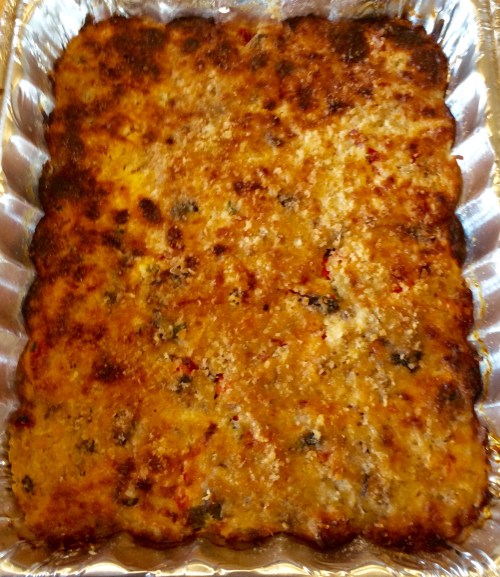
Ham, mushroom, potato casserole

Ham, mushroom, potato casserole

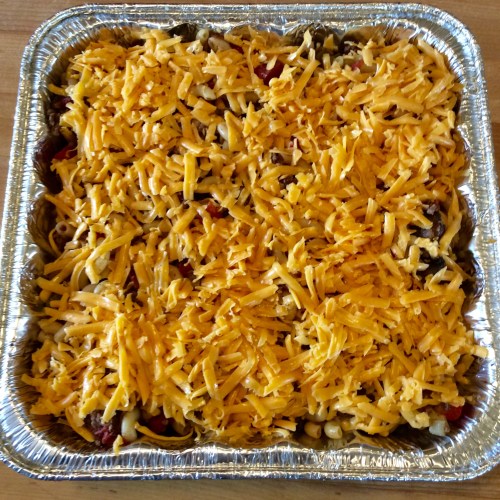
The second dish was something that I hadn’t made for a long time, my mother’s version of goulash. I’ve posted the recipe in the past. It is really not goulash, but that’s what my mother called it. It was one of her most successful dishes and was often requested by out-of-town family visitors. Ground beef and pasta seemed like a good idea.

Goulash. Just heat until warm and the cheese melts.

Goulash. Just heat until warm and the cheese melts.

Finally, beans are always a good choice for pot luck dinners, and  my cooking project was really a long distance potluck. A bowl of Texas red with beans sounded good, but that would be more ground beef and might be too much for sensitive digestive systems. My goal was to make a cassoulet that wouldn’t wear me about. The result turned out to be fairly easy and fast. Impartial diners will have to be the judges of taste.

Cassoulet ready for travel

Cassoulet ready for travel

RECIPE

Take-Away Cassoulet

Ingredients

  • 2 cups Great Northern beans
  • 3 slices pre-sliced salt pork
  • 1 medium onion, halved and sliced
  • bouquet garni (3 sprigs parsley, 3 sprigs thyme, 2 cloves garlic, 2 bay leaves, 2 cloves tied in cheesecloth)
  • 2 tablespoons vegetable  oil
  • 1 pound boneless pork ribs, cut in 2 inch cubes
  • 1 pound lamb shoulder, bones removed and cut in chunks
  • 1 large bratwurst, cut in 1½inch slices
  • 6 ¾ inch rounds of packaged bulk sausage (Jimmy Dean or similar brand)
  • 4 cups beef broth
  • 1 cup dry vermouth
  • 3 tablespoons tomato paste
  • 2 garlic cloves, minced
  • ¼ teaspoon ground thyme
  • 1/8 teaspoon ground bay (or 2 bay leaves)
  • salt and pepper to taste
  • ½ cup panko
  • ½ cup dried bread crumbs
  • ½ cup fresh parsley leaves, finely chopped
  • extra virgin olive oil

Method

  1. Pick over the beans for stones and shriveled beans. Place in a large, heavy-bottomed pot, cover with water to a level at least 1 inch above the beans, and soak over night.
  2. In the meantime, cover the salt pork with water in a small pan. Bring it to the boil for 2 minutes. Drain and cool. Cut the salt pork strips in half lengthwise and then cut the pork into triangles. Set aside.
  3. In the morning, make sure the beans are covered with water. Add the prepared salt pork, onions, and bouquet garni. Bring to the boil and then reduce to a very low boil. Cook uncovered until the beans are tender, about 2 hours. Add water as needed so that the beans remain well covered.
  4. When the beans are done, remove from the heat, and let stand in the cooking water until you are ready to combine with the cooked meats.
  5. While the beans are cooking prepare the meats. In a large skillet, heat the vegetable oil. Then, in batches brown the pork pieces on all sides. Transfer browned pieces to a deep plate. Repeat the process with the pieces of lamb shoulder, bratwurst, and bulk sausage. Cut the browned sausage rounds into quarters.
  6. When you are ready to assemble the cassoulet, drain the beans, reserving the liquid. Return the beans to the large cooking pot. Add the beef broth, vermouth,  and enough of the cooking liquid to cover the beans. Stir in the tomato paste, garlic, thyme, and bay. Bring to the boil and add the pork, lamb, bratwurst, and sausage. Reduce to the simmer, and cook for 30 minutes. Add more beef broth or cooking liquid to make certain that the beans are just barely covered. Adjust seasoning with salt and pepper.
  7. Remove from the heat and allow to cool for 10 minutes. Then transfer to an aluminum container suitable for travel. If you have used whole bay leaves, remove them.  The liquid should just barely cover the bean and meat mixture.
  8. Mix the panko, bread crumbs, and parsley together and then sprinkle over the top of the bean and meat mixture. Drizzle with olive oil. Cool completely and then cover for travel.
  9. When you are ready to serve, remove the cover used for travel and place in the upper third of an oven preheated to 375°F.After 15 minutes, a crust should form. Break the crust with the back of a large spoon and reduce the oven to 350°F Continue to bake for 30 more minutes, breaking the crust with a spoon from time to time.
  10. When the cassoulet is heated completely through and the crust is well formed and browned, remove from the oven and serve immediately. Should serve 4 to 6 persons, easily.

4 Comments

Filed under Food, Photography, Recipes

LEEK AND POTATO SOUP – VITA-MIX VERSION

My Vita-Mix is a new gadget that I have had a good time learning about. It is very efficient in chopping. Instructions call for using small volumes of food to chop. That is important because the chopped pieces are thrown against the sides of the container, and chopping stops before the food is turned into mush. That means that chopping large amounts of food requires several passes. That slows down the process, but still – 10 seconds to chop a cup of carrots is a remarkable efficiency. The big bonus is puréeing large volumes of soup into the smoothest dish one can imagine. You get to do both of those processes with the recipe for leek and potato soup. Actually, I think you could do the same thing with a food processor or an old-fashioned blender. For that matter, you could even use a knife and chop things by hand. But then it wouldn’t be as much fun.

RECIPE

Leek and Potato Soup

Ingredients

  • 3 large leeks, cut into 1 inch slices, white and pale green parts only
  • 1 large onion, peeled and cut into 1 inch pieces
  • 4 tablespoons unsalted butter
  • 2 medium russet potatoes, peeled and cut into 1 inch pieces
  • 5 cups chicken broth
  • 1 cup heavy cream
  • 3 sprigs parsley
  • 3 sprigs fresh thyme
  • bay leaf
  • 1 teaspoon kosher salt
  • ¼ teaspoon white pepper

Method

  1. Set Vita-Mix controls to Variable and speed 3. Fasten the lid with the center cap removed. Turn on the machine and by cupfuls, pour the cut-up leeks through the opening. Pulse 10 times. Turn off the motor. Transfer the chopped leeks to a bowl. Repeat the process until the leeks have all been chopped.
  2. Repeat the above steps to chop the onion.
  3. In a large pot, melt the butter over medium heat. Add the leeks and onion, stir and cover. Sweat the vegetables until they are translucent but not browned, about 5 minutes.
  4. Add the potatoes, chicken broth, cream, parsley, thyme, and bay leaf. Correct seasoning with salt and pepper. Use more if needed for taste. Bring the mixture to a boil and then reduce to a simmer for 4o minutes or until the potatoes are cooked through. Remove from the heat.
  5. Cool the soup mixture until it is easy to work with. Remove the parsley, thyme and bay leaf. Then, in three divided portions, add the mixture to the Vita-Mix container. Make sure the top and top are well seated on the container. With the settings on “Variable” and “8” speed, process the mixture for 30 seconds until it is smooth. Combine the three batches. Reheat, garnish with minced scallion greens or chives if desired, and serve immediately. You may also refrigerate and then serve chilled. Makes about 12 cups.

11 Comments

Filed under Food, Photography, Recipes

CHIMICHURRI AND VITAMIX

Recently I celebrated my birthday. I was surprised when a big box came from my family. It turned out to be a gleaming Vitamix food machine. I can hear some of you asking, “What will the old goat do with that?”  It seems akin to buying $2000 skis for a duffer who only skis greens or a Sunday driver receiving a Ferrari. Still others are thinking that, after all,  its only a blender.  A Vitamix is way more than a blender – it has a full 2 horsepower motor with speeds up to 37,000 rpm and variable speeds between 12,000 and 24,000 rpm. It will grind up just about anything without a single whine. It  sounds like those are specs straight out of a Ferrari ad. Now if I can only learn to drive it like a Ferrari.

I spent the first day reading all of the manuals and recipe books. I definitely did not want to destroy the machine during its first outing in the kitchen. Then, I had to think of something to make. Creamed soups prepared in a Vitamix are supposed to be so smooth that they don’t require  straining through a sieve or chinois. Soups are definitely on my list of things to make, but I wanted something to go with the meal I had already planned: pot roast and roasted potatoes. Some sort of sauce seemed like a good choice. Salsa verde and romesco came to mind. One of my food blogger friends , writing with the title of Back Road Journal, had provided a great recipe for the Dominican sauce, wasakaka (Isn’t that a great word to say?). That struck me as very similar to one of my favorites, the Argentinian chimichurri that goes so well with roasted beef.

The Vitamix cook book didn’t have the recipe, but I found one to modify in the Joy of Cooking. For a first pass, the chimichurri turned out to be easy and flavorful, but I will probably add some tweaks for my next effort. If you don’t have a Vitamix, you can use a food processor fitted with a metal blade. Pulse until you get the right consistency, and be careful not to blend for too long.  Of course, you can always chop things by hand. You’ll just have to do it more finely. Also, there is a severe sensitivity to chiles in our household, so I usually omit them, but you can definitely mince some jalapeño or add some cayenne.

Finally, a big THANKS to all my family for such a thoughtful gift.

RECIPE

Chimichurri

Ingredients

  • ¼ cup red wine vinegar (If you don’t have red wine vinegar, another vinegar will do.)
  • ½ cup extra virgin olive oil
  • ½ cup parsley leaves, washed and stems removed
  • 3 cloves garlic, chopped coarsely
  • 1 medium onion, chopped coarsely
  • 2 tablespoons fresh oregano leaves OR 1 tablespoon dry Mexican oregano.
  • salt and pepper to taste
  • 1/8 teaspoon cayenne pepper (optional or to taste)

Method

  1. Pour the vinegar and olive oil into the Vitamix container. Make sure the cover is in place. Set the speed indicator to High. Turn the machine on and process for about 15 seconds or until the vinegar-oil mixture is emulsified. Turn off the machine.
  2. Add the parsley, garlic, onion, oregano, salt, pepper, and optional cayenne pepper. Set the speed indicator to Variable and Variable knob to 3. Make sure the cover is in place, turn on the machine and as you process gradually turn up the rate to 6. Process for 20 seconds or until the mixture is the desired consistency. Be careful not to over-process. Turn off the machine. Transfer the chimichurri to a bowl, adjust the seasoning if needed, and let stand at room temperature for at least 30 minutes before serving.


14 Comments

Filed under Food, Photography, Recipes

SHAKSHOUKA

Disclaimer: This is not an authentic recipe for shakshouka. For one thing, it includes fried chicken. For another, it uses Swiss cheese. Also, I do not plan to take sides in the various controversies as to whether the dish should be viewed as Tunisian or Israeli or whether it should be viewed as a breakfast dish or served at an evening meal. I can only reaffirm that shakshouka is easy to make and delicious.

RECIPE

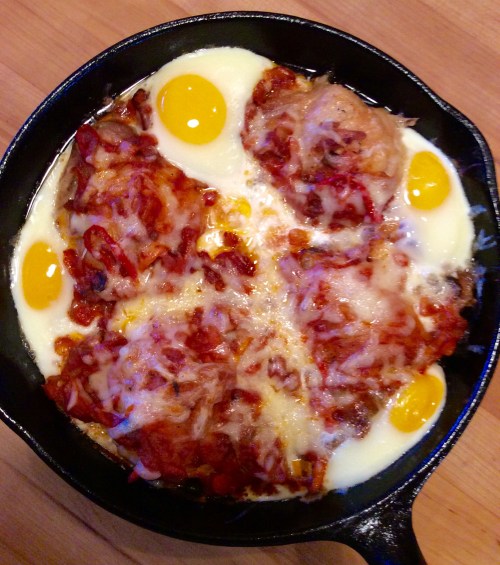
Shakshouka

Shakshouka

Shakshouka

Ingredients

  • 4 chicken thighs
  • olive oil
  • ½ yellow onion,, chopped
  • ¼ cup diced carrots
  • ¼ cup diced celery
  • 6-8 miniature sweet peppers, sliced into rings
  • 4 medium crimini mushrooms sliced
  • ½ cup dry vermouth
  • 8 ounces tomato sauce
  • 8 ounces chicken stock
  • ¼ teaspoon ground sage
  • ¼ teaspoon ground thyme
  • ¼ teaspoon ground cumin
  • ¼ teaspoon powdered lemon peel
  • salt and pepper to taste
  • 2 ounces Swiss cheese, coarsely grated
  • 4 eggs

Method

  1. In an oven-proof skillet (cast iron is perfect), brown the chicken thighs in a couple of tablespoons of olive oil over medium heat. Drain off the rendered fat and transfer the pan to the middle of an oven preheated to 250°F.
  2. In a separate skillet, sweat the onions in a couple of tablespoons of olive oil over medium-low heat. Stir in the carrots, celery, and sweet papers, and continue to sauté for 10 minutes until the vegetables are softened. Stir in the mushrooms and cook for another 5 minutes until the mushrooms are cooked through. Add the vermouth and continue to simmer until the vermouth has almost completely reduced.
  3. Stir in the tomato sauce, chicken stock, sage, thyme, cumin, and lemon peel. Adjust seasoning with salt and pepper. Simmer for another 5 minutes.
  4. Remove the chicken thighs from the oven. Cover with the sauce. Sprinkle with the grated Swiss cheese and return to the oven.
  5. When the cheese has melted, remove the pan from the oven. Increase the oven temperature to 350°F. Crack the eggs and place them in the spaces between the chicken thighs. Return to the oven and bake for another 5 to 10 minutes until the egg whites have set but the yolks are still runny. Watch carefully so that you don’t overcook the eggs.
  6. When the eggs are done to your liking, remove from the oven and serve immediately.

12 Comments

Filed under Food, Photography, Recipes

CALIFORNIA DREAMIN’ AND SOUR CREAM COFFEE CAKE

Our daughter in Los Angeles invited us to join her family for Easter. The visit would include holiday activities along with birthday celebrations, real estate adventures, and lots of cooking. On Saturday, the ritual dying of Easter eggs was completed. At dawn, the traditional Easter egg hunt was finished in record time.

Easter breakfast was an event that we could never have experienced in Santa Fe. The meal included something that could only be enjoyed in a few places across the country – most notably California and Florida. Our daughter’s husband and son went out into the backyard to harvest oranges for freshly squeezed juice. Meanwhile, she stirred up a delicious coffee cake and fried some link sausages.  She served it all with a fresh berry and kiwi fruit compote. Here’s the recipe for the coffee cake, copied from her hand-written recipe card.

RECIPE

Sour Cream Coffee Cake

Ingredients

  • ¾  cup flour
  • ¾ cup sugar
  • ½ cup brown sugar
  • 2 tablespoons cinnamon
  • 2 tablespoons cold unsalted butter
  •  1 cup pecans, chopped
  • 12 tablespoons unsalted butter + 2 tablespoons for greasing pan
  • 4 large eggs
  • 1½ cups sour cream
  • 1 tablespoon vanilla
  • 2¼ cups flour
  • 1¼ cups sugar
  • 1 tablespoon baking powder
  • ¾ teaspoon baking soda
  • ¾ teaspoons salt

Method

  1. In a food processor, combine flour, sugar, ¼ cup brown sugar, and cinnamon. Process for 15 seconds. Transfer 1¼ cups of the mixture to small bowl, and stir in the remaining brown sugar. Set aside for filling.
  2. Add butter and chopped pecans to the mixture remaining in the food processor. Pulse to a coarse pebbly consistency. Set aside for topping.
  3. Grease a 10 inch tube pan. Preheat oven to 350ºF.
  4. In a medium bowl, whisk together eggs, one cup of sour cream, and vanilla.
  5. In the bowl of a stand mixer, combine flour, sugar, baking powder, baking soda, and salt. Add butter and remaining ½  cup of sour cream. Beat on low until the mixture resembles wet sand, about 1½ minutes. Increase speed to medium and beat for 10 seconds. Scrape down.
  6. Lower the mixer speed to medium low and add the egg and sour cream mixture in three additions. Increase speed to medium high and beat for about 1 minute, until light and fluffy.
  7. Using a rubber spatula, spread 2 cups of batter on the bottom of the pan, smoothing the surface. Sprinkle evenly with ¾ cup filling. Repeat and then spread remaining batter over top. Sprinkle with topping.
  8. Bake for 50-60 minutes, until the cake is firm to touch and a skewer comes out clean. Cool in pan on cooling rack for 30 minutes. Then invert onto plate, removing the baking pan. Invert again onto the cooling rack, and cool to room temperature. Serves 12-16


9 Comments

Filed under Food, Photography, Recipes