Tag Archives: Santa Fe

THREE CITIES OF SPAIN CHEESECAKE

Mothers’ Day and Susan’s birthday coincided this year, so during our visit to Los Angeles, Carol needed a dessert for our celebration. One of Susan’s favorites is cheesecake, and this is one of Carol’s favorite recipes.

She originally found it in Gourmet magazine, and it has been published widely since then in other magazines and on the internet.

But everyone (or nearly everyone) gives credit to the Three Cities of Spain coffee house in Santa Fe for the original. Many years ago, the popular artists’ street, Canyon Road, was a narrow dirt road heading up the canyon from Paseo de Peralta. The Santa Fe artists’ colony was experiencing a boomlet in the 1950s-1970s, and this was one of the places on Canyon Road where the struggling artists hung out, drinking coffee, smoking, and eating cheesecake. There were nearby bars for more serious drinking at night.

For reasons unknown to me, Three Cities of Spain closed in the 1970s, Canyon Road was paved, and the old adobe home which housed the coffee house was transformed into Geronimo, one of the best and most famous restaurants in Santa Fe. The restaurant was named after the man who built the house in 1756.

I think you’ll like the cheesecake.

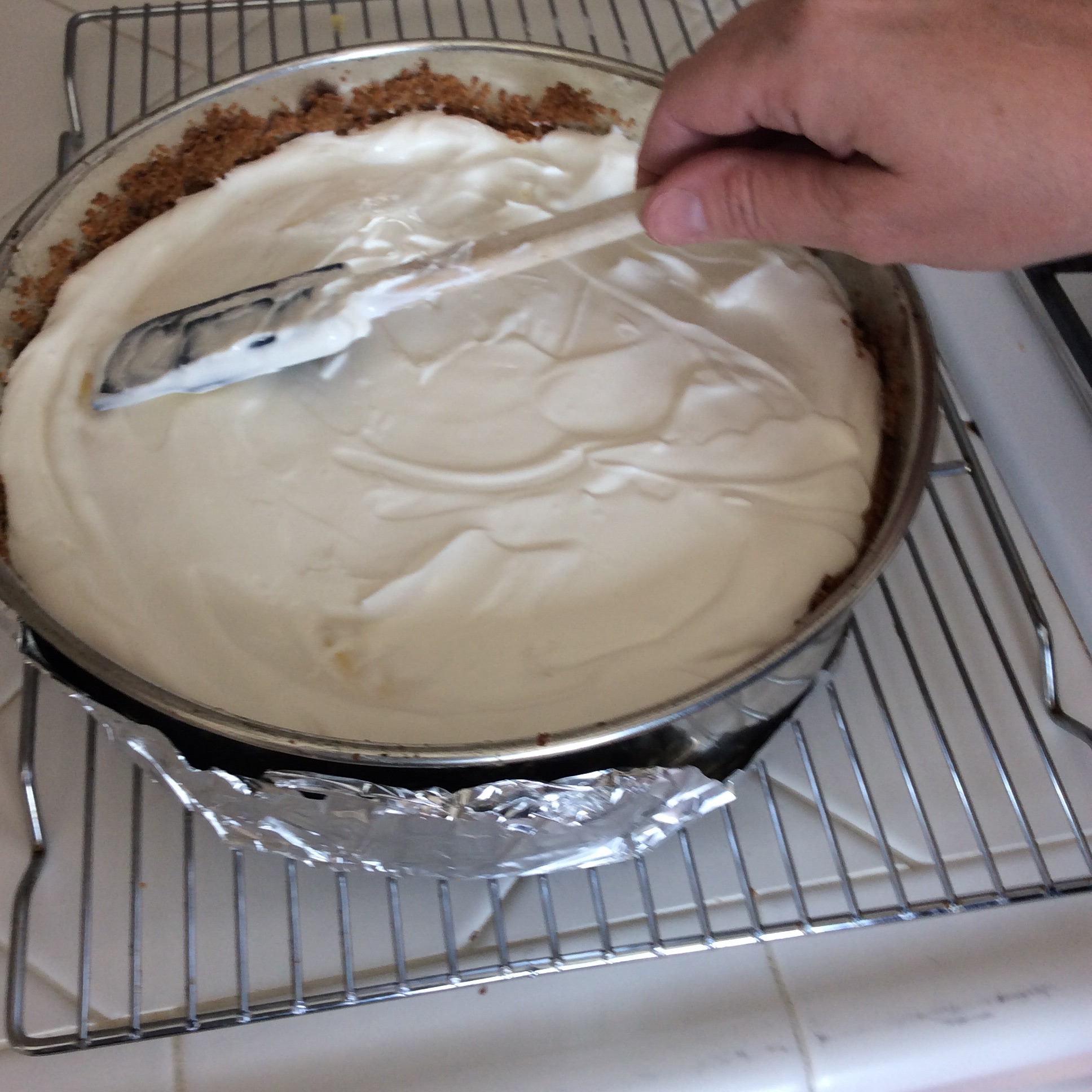
hree Cities of Spain cheesecake after the first baking

Three Cities of Spain cheesecake after the first baking

Spreading on the topping.

Spreading on the topping.

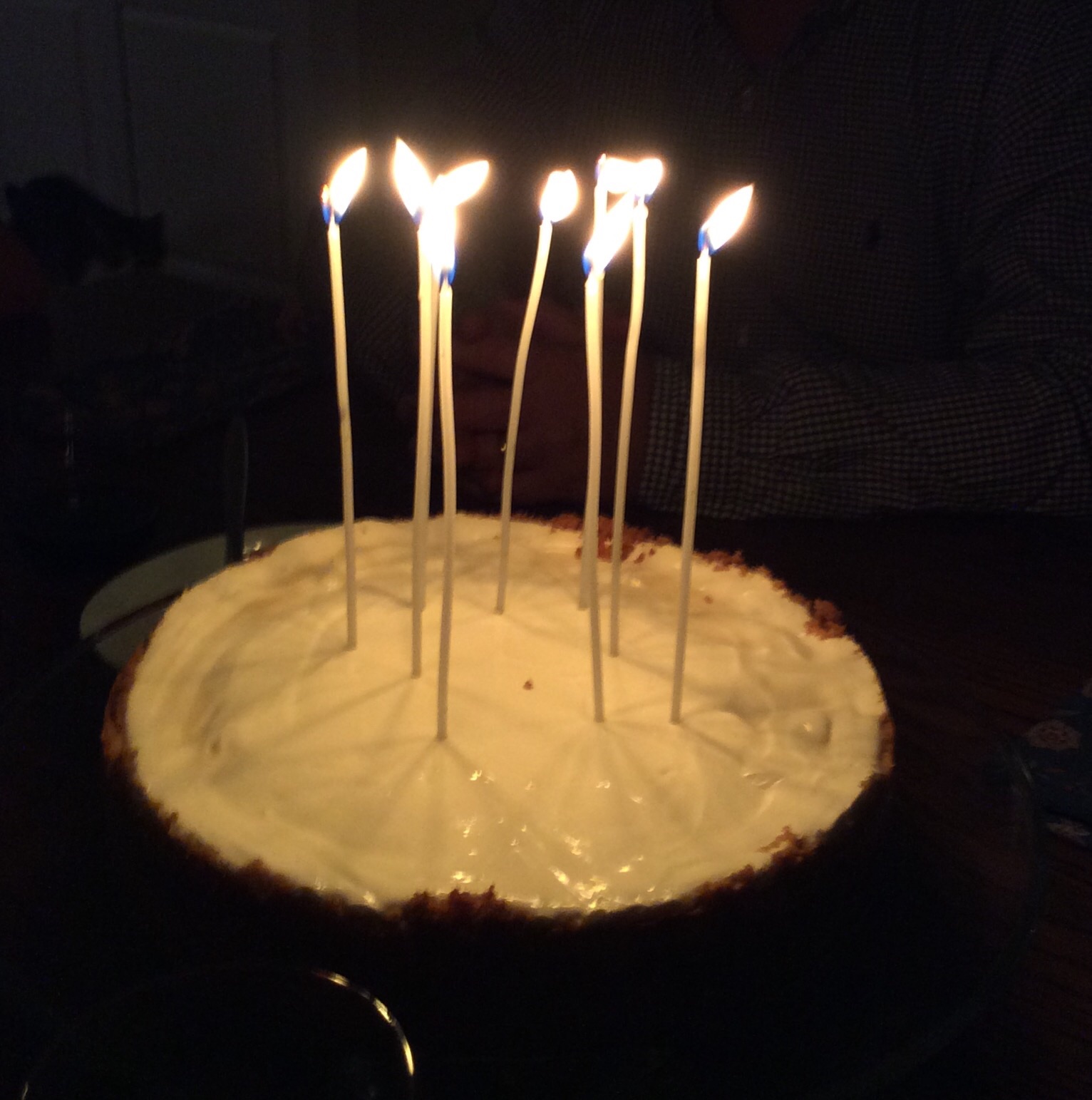
Birthday candles for more mature adults

Birthday candles counted out for more mature adults

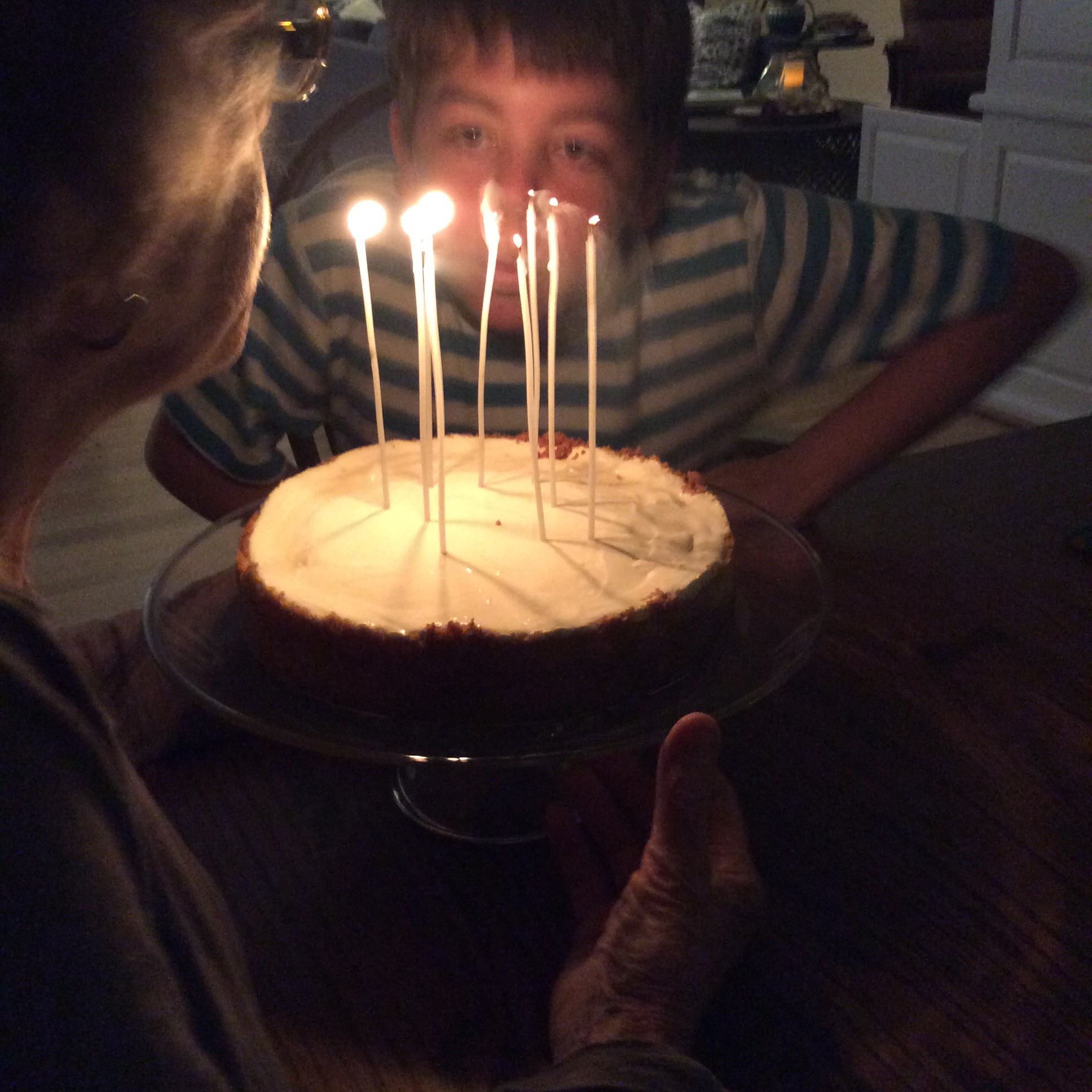
Blowing out the candles

Blowing out the candles

Cheesecake with berries

Cheesecake with berries

RECIPE

Three Cities of Spain Cheesecake

Ingredients

CRUST

  • 11 graham crackers, ground fine (1½ cups)
  • 1/3 cup unsalted butter, softened
  • 1/3 cup sugar
  • 1/8 teaspoon salt

FILLING

  • 24 ounces (3 packages) cream cheese, softened
  • 4 large eggs
  • 1 teaspoon vanilla
  • 1 cup sugar

TOPPING

  • 16 ounces sour cream
  • 1 tablespoon sugar
  • 1 tablespoon vanilla
  • berries (optional)

Method

  1. Stir together crust ingredients. Sprinkle half of mixture onto the bottom of a buttered 9½ inch springform pan. Then press the mixture up the side of the pan about 1¼ inches. Sprinkle and press the remaining half of the mixture into the bottom of the pan.
  2. With an electric mixer, beat the cream cheese until light and fluffy. Then beat in the eggs, one at a time. Beat in the vanilla and sugar until just combined.
  3. Pour the cream cheese and egg filling into the crust. Bake for 45 minutes at 350ºF or until the center of the cake is set.  Cool on a rack for 5 minutes.
  4. Stir together the topping ingredients.  Drop by spoonfuls around the edge of the cake and spread gently into the center.
  5. Return to the 350ºF oven for another 10 minutes.
  6. Remove from the oven and cool completely on a baking rack before chilling overnight in the refrigerator.
  7. Serve at room temperature with or without optional berries.

4 Comments

Filed under Food, Photography, Recipes, Restaurants, Travel

ELOISA – A NEW RESTAURANT STAR IN SANTA FE

For many years, our local hospital was housed in a 1920s-1930s style building just off the Plaza and directly behind the cathedral. It had fallen on hard times, and most Santa Feans preferred driving to Albuquerque for their hospital care. Some time ago, the hospital relocated to a beautiful facility near the outskirts of the city. The old building fell into continuing disrepair and decline. From time to time some venture – like an oxygen bar where you could get a quick puff of pure oxygen to pick you up – rented some of the space. Mostly, though, the very large building became increasingly derelict until Drury Hotels bought the property. They have spent years renovating the building so that now it is a handsome addition to the landscape and a very desirable place to stay.

Locals wondered and hoped that the hotel would have a restaurant, but until recently there was no certainty about that.

The wait and wonder are behind us now as Chef John Rivera Sedlar has opened the restaurant, Eloisa, named after his grandmother who gave him his first cooking lessons.  Since then, Rivera has received many recognitions for his cooking, and  he has cooked in Spain, France, the Bay Area, and most recently in Los Angeles. In LA, he opened several popular restaurants including his acclaimed Rivers, which he will close as he moves back to his home town of Santa Fe.

Eloisa is still in its shake-down cruise, having been open only a few days. But it seems to have arrived under full sail.. We went the other night and saw practically every noteworthy local chef at one or another table. As well, the place was packed. Reservations are definitely recommended.

The space is beautiful with huge windows and contemporary touches that are completely new to the local restaurant scene.  One wall is filled with video screens that exhibit a constantly changing series of lovely light pictures. It is hard to take your eyes away from the display.  There is a gorgeous bar and an attractive fireplace. In the warmer months, there is an inviting patio. The open kitchen is enormous with gleaming equipment of every description and an army of cooks and kitchen assistants.

But the food is the star. The menu is divided into small plates and large plates; both sections are reasonably priced.  The night we were there, the small plates included Tortillas Florales, tortillas made from nixtamalized corn and set with an array of edible flowers along with Indian butter, a creamy, beautifully seasoned avocado spread; Maize Budino was a smooth corn pudding set in a corn husk boat and topped with corn, black quinoa, and red amaranth. Next to it was a whimsical replica of an ancient pictograph done in paprika; Pastrami Taco, blue corn tortillas, pastrami, sauerkraut, pickled serranos, and ballpark mustard; Nopal Paillard,  grilled cactus pad with mushroom stuffing. You get the idea.

The large plates were every bit as creative. I ordered Duck Enfrijolada, duck confit snuggled with crema between blue corn tortillas and napped with a mole-like cabernet chile sauce. Susan ordered the Salmon Painted Desert. The salmon was perfectly prepared, but the highlight of the dish was a delicate tamal filled with a light-as-air salmon mousse.

It was hard to choose dessert, but we settled on white chocolate with piñon nuts and dark chocolate with mescal. I must admit that I am not a fan of the flavor of mescal, but it is a trendy beverage, and the dish was beautifully prepared.

My final report: The meal was very special, and this new kid on the block is definitely worth more visits.

7 Comments

Filed under Food, Photography, Restaurants

STRAWBERRY GALETTE

It’s beginning to be the season for fresh strawberries in California, but not here in New Mexico where we still anticipate at least one more hard freeze. Even though the grocery store versions of strawberries lack the sweetness and flavor of those at San Francisco’s Ferry Building, they have the advantage of being available year around. That is good, because this beautiful dessert is worth the effort any time of year. If you prefer, you can substitute your choice of other berries or any combination of berries.

Although I have tweaked it a bit, the original recipe comes from one of Deborah Madison’s excellent cookbooks: Seasonal Fruit Desserts From Orchard, Farm, and Market (Broadway Books, New York, 2010, p. 119). Deborah Madison now lives in Santa Fe and is viewed as the doyenne of the local food-writing community  even though she is not nearly old enough for such a title. She began her cooking career in the Bay Area, working at Alice Waters’s Chez Panisse and then eventually serving as the founding chef of what has been called the first high-end vegetarian restaurant, Greens. The restaurant is still popular and definitely worth a visit at its beautiful site on the edge of San Francisco Bay. Since then her cookbooks, including Vegetarian Cooking for Everyone, have won many awards including the James Beard Foundation Book Award.

This dessert fulfills that well-earned reputation.

Just a few minute last-minute pointers: Resist the temptation to overfill the galette with fresh fruit. Make certain that the edges of the dough are well-sealed. Otherwise, it may leak, and you could face a major oven cleanup.

RECIPES

Pastry for Galette

Ingredients

  • 1 cup all-purpose flour
  • 1 cup pastry flour
  • ½ teaspoon salt
  • 1 tablespoon sugar
  • ¾ cup (1½ sticks) chilled unsalted butter, cut in pieces
  • 1 egg yolk
  • 1 teaspoon fresh lemon juice
  • 5-6 tablespoons ice water

Method

  1. In a bowl large enough that you will be able to mix the dough with your hands, mix together the flours, salt and sugar.
  2. With a pastry blender, cut in the chilled butter until the mixture resembles coarse meal. The crust will be flakier if some larger pieces of fat are left unblended.
  3. In a small bowl, combine the egg yolk, lemon juice, and 4 tablespoons ice water. Pour over the dough mixture and work in with your hands.
  4. Add remaining ice water, 1 tablespoon at a time, until the dough comes together. It should not be sticky. Knead lightly; divide into two equal balls. Pat into discs about an inch thick, wrap with plastic wrap, and refrigerate for at least 30 minutes.

Strawberry Galette

Ingredients

  • 4 cups strawberries, washed, hulled, and halved
  • 1/3 cup maple syrup
  • ½ teaspoon lemon juice
  • 2 teaspoons cornstarch
  • 1 teaspoon vanilla extract
  • ½ pastry recipe (above)
  • 1 tablespoon unsalted butter, melted
  • 1 tablespoon cream
  • 1 tablespoon turbinado sugar

Method

  1. In a large bowl, combine the halved strawberries, maple syrup, lemon juice, cornstarch, and vanilla extract.
  2. On a well-floured work surface, roll out one of the chilled discs of dough into a circle at least 13 inches in diameter.
  3. Arrange the rolled-out crust on a rimmed 13 x 18 inch baking pan lined with parchment. Top the crust with the strawberry mixture, leaving a 2-inch margin around the filling.
  4. Fold the edge of the crust over the filling so that it drapes over the filling and any folds are sealed.
  5. Sprinkle the melted butter over the filling.
  6. Brush the crust with cream and sprinkle with turbinado sugar.
  7. Bake in the middle of an oven preheated to 425°F for 35 minutes or until the crust is golden.
  8. Serve warm or cold with heavy cream, whipped cream, or vanilla ice cream.

8 Comments

Filed under Food, Photography, Recipes

ASPEN COLOR AND THE IZANAMI JAPANESE INN

The aspen colors are at their height right now, so the other day we took a drive up Hyde Park Road to the Ski Basin.  Although my knees and back are not as limber as they once were, we walked up a couple of our favorite trails, and I took pictures, in spite of already having hundreds images of golden aspens. The colors are not as multi-hued as they are in New England, but an entire mountainside clothed in bright yellow still elicits a gasp from me, along with the need to take yet another image.


We avoid the weekends looking at the colors. It seems as though the entire city makes the pilgrimage on Sunday so that there are traffic jams on the winding mountain roads. During the week, the crowds are smaller, and there is an additional excuse to stop for a late lunch after our viewing and shooting.

Toward the bottom of the mountain is one of our favorite restaurants.  Izanami has been carefully and beautifully built to resemble a Japanese inn and to afford spectacular mountain views in all directions. . The food and service are also Japanese. The restaurant only opened months ago, and it was a semifinalist for the national James Beard New Restaurant of the Year Award. The food is delicious and so far as I know, authentic (I’ve never been to Japan). Some detractors complain that their peanut sauce is not truly authentic, even though I can find recipes for Japanese peanut sauce on the web.

Whatever, the restaurant is the latest addition to Ten Thousand Waves Spa. There are communal baths, massages, and therapies, and Japanese-style lodging. People come from all over the world to enjoy the luxury, and now they have delicious Japanese food to add to the experience.

The menu offers many choices, all with Japanese-sounding names. One of our favorites is kinpira gobo (slivered burdock root and carrot served with a sesame soy dressing). Other good choices include red pepper-tomato soup,  tofu dengaku (tofu cubes glazed with yuzu-miso), pork belly kakuni, and tonkatsu (panko-breaded pork loin cutlets with hot mustard and miso katsu sauce).

A short trip back home, and it was time for a nap.  All in all, a great day.

2 Comments

Filed under Food, Photography, Restaurants

PECOS PUEBLO AND BARBECUE

Instead of the traditional, requisite Memorial Day cookout, we decided to take a day trip. After putting the American flag at the mail box, we drove down the interstate to the Pecos Pueblo National Historical Monument. We had not been there for several years, and so we thought it would be a great visit. The weather was beautiful as was the drive up from Santa Fe to Glorieta Pass where the road to the monument takes off. Because the pass is one of the main breaks in the Rocky Mountains in New Mexico between the eastern plains and the Rio Grande basin, it is filled with history.

During the Civil War, the Confederates had organized the Confederate Arizona Territory which included southern parts of what are now Arizona and New Mexico (some things never change) with the ultimate goal of seizing the gold and silver mines of California and Colorado.  Santa Fe had fallen to the Confederates, and things were looking bad for Union forces until the two sides met in Glorieta Pass where the Colorado infantry and the New Mexico militia turned back the Confederates whose supply train was ultimately destroyed, forcing them to give up their effort.

Glorieta Pass is also where the Santa Fe Trail crossed from the prairies into the Santa Fe region. The trail followed earlier native American trails and was established in the late 1700s, but eventually became the main trade route from Missouri settlements in the United States with Mexico, of which Santa Fe was a part until the end of the Mexican War in 1848.

But preceding all of that, the region was the center of trade between the peoples of the plains and the pueblos. Pecos Pueblo sat at the juncture and became a thriving trade center. At its peak, there were over 2,000 individuals living in a five-story dwelling. The Spanish explorers first visited the pueblo in 1640 and immediately set about to convert the population to Christianity. A huge church was built to hold all 2,000 residents at one time. During the Pueblo Revolt of 1680, the church was set on fire and destroyed, but in the re-conquest, another, less grandiose church was built. Over time the pueblo fell on hard times and the population diminished until the few remaining individuals relocated to Jemez Pueblo. The structures fell into ruins – a sight-seeing side trip for folks traveling on the Santa Fe Trail. Now, only ruins remain, but the site is an impressive and interesting glimpse of the local history.

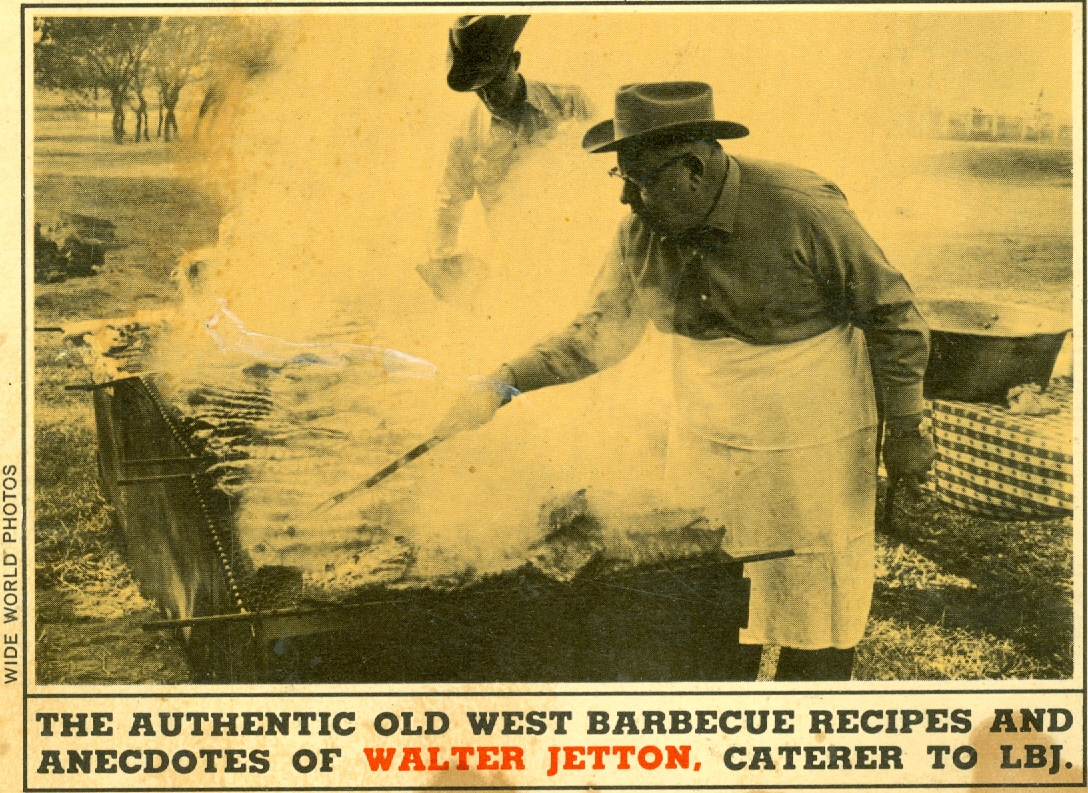
So much for my ramblings. Now it’s on to recipes. We decided to delay our traditional cookout and wound up having barbecued ribs, Susan’s famous brisket, Sarah’s herbed potato salad, coleslaw, and Southern buttermilk cornbread. For the barbecue, I used recipes from a cook book that has been in our family for 50 years: Walter Jetton’s LBJ Barbecue Cook Book (Pocket Books, Inc., New York, 1965, $1.00) Walter Jetton billed himself as caterer to the LBJ Ranch. He was from Fort Worth, but spent a lot of time in Washington, D.C. introducing Hubert Humphrey and other politicians to authentic Texas barbecue. Here are my modest revisions of his recipes for dry rib rub and barbecue mop, two essential condiments for barbecue.

Walter Jetton at the barbecue - from the cover of his 1965 cook book

Walter Jetton at the barbecue – from the cover of his 1965 cook book

RECIPES

Dry Rib Rub

Ingredients

  • 3 tablespoons salt
  • 3 tablespoons sugar
  • 1½ teaspoons lemon powder
  • 3 teaspoons Accent MSG
  • 1 tablespoon ground black pepper
  • 1½ teaspoons paprika

Method

  1. Combine all ingredients in a container with a lid
  2. Rub the mixture generously on all surfaces of the rack of ribs before you place it on the barbecue

Barbecue Mop

Ingredients

  • 1 tablespoon salt
  • 1 tablespoon dry mustard
  • 2 teaspoons garlic powder
  • 1 teaspoon ground bay leaf
  • 2 teaspoons chili powder
  • 1 tablespoon paprika
  • 1 tablespoon Accent MSG
  • 2 teaspoons Louisiana Hot Sauce
  • 1½ cups Worcester sauce
  • ¾ cups white vinegar
  • 1 carton (32 ounces) beef stock
  • ¾ cups vegetable oil

Method

  1. In a large bowl, combine first seven (dry) ingredients
  2. Stir in the liquid ingredients until completely mixed
  3. Cover and let stand overnight at room temperature
  4. With a small (new) dish mop, brush on barbecue meats frequently as you cook them.
  5. Refrigerate any that is left over when you have finished barbecuing. Store it in a tightly-lidded jar. It will last for a long time.

7 Comments

Filed under Food, Photography, Recipes, Restaurants, Travel

ASPARAGUS FRIES AND AIOLI

A few evenings ago, we went with our food-enthusiast friends to a relatively new Santa Fe restaurant, Arroyo Vino. We were excited about the visit, which was a ways out of town, because we had previously been big fans of the Executive Chef, Mark Connell, who had wowed us at a downtown place that is now history. The restaurant is only open for dinner Tuesday through Saturday so reservations can be dicey. But the added feature is that it is attached to a very complete wine shop that is open throughout the week, and with lots of good choices for fair prices. You can even buy a bottle for your dinner if nothing on the menu pleases your palate.

The menu changes frequently and tends to favor the current enthusiasm for the farm-to-market movement. Specials are posted on a blackboard, and they are worth considering in view of the restaurant philosophy.

Asparagus is in season, so you can get it prepared in one of several ways. I didn’t see asparagus ice cream, but the asparagus soup was a keeper, and to my taste the asparagus fries turned out to be a highlight of the evening

The dish was served in a beaker filled with plump asparagus spears lightly dusted with panko and fried just until the panko toasted but not enough to rob the asparagus of its green and crispness. It was lighter than tempura – if you want tempura you do batter – but it begged to be dipped in the accompanying Hollandaise.

When I got home I decided to emulate this very special dish. My effort didn’t come close to the real thing, but it was good enough that there was no asparagus left at the end of dinner. This recipe is also ingredient-efficient because I used egg whites to give the panko something to stick to and then the yolks to make a dipping aioli instead of Hollandaise. Making the aioli also gave me a chance to use one of my new gadgets.

Over the years, I have gone through countless garlic presses. Of course, the pros among you will say, “Don’t put it through a press, just mince it, or make a paste with the flat of a knife, or use a mortar and pestle.” All of those skills have escaped me, but garlic presses have also been a big disappointment. They break; the holes are hard to clean out; the press part doesn’t meet the plate of holes; the garlic doesn’t get extruded; etc. So my wife gave me a JosephJoseph garlic rocker, made by the British firm owned by the twin brothers Joseph and designed by Goodwin Hartshorn. It is a thing of beauty, made of lightly brushed metal with two wings and an indentation of a honeycomb of sharp-edged hexagonal holes. You place the rocker on some garlic, and rocking the wings back and forth, you force the garlic through the holes into the indentation. The garlic may not be as fine as you would like, so just press it through a second time. It works, it’s fun, and it’s easy to clean/dishwasher safe.

Our home meal was finished with corn-on-the-cob and twice-baked potato.

RECIPE

Asparagus Fries

Ingredients

  • 1 bunch fresh asparagus, preferably larger stalks
  • 2 egg whites
  • 2 tablespoons water
  • ½ cup panko
  • 2 tablespoons cornstarch
  • ½ teaspoon baking soda
  • 1 teaspoon salt
  • peanut oil for deep-frying

Method

  1. Wash the asparagus and trim the woody stems so that the stalks are about the same length
  2. Whip the egg whites so that they are frothy and evenly mixed. Whip in the water and transfer to a shallow plate or pan.
  3. In another plate or pan, combine the panko, cornstarch, baking soda, and salt.
  4. Working a few stalks at a time, coat them with egg white and then coat them with the panko mixture. Set on a baking rack for a few minutes to dry until all of the stalks are coated.
  5. Heat a heavy pot with about 3 inches of peanut oil to 350° F. Adjust the heat to maintain temperature because the asparagus will cool of the oil rapidly, and the asparagus will become greasy if the temperature is too low.
  6. Working in batches, transfer the asparagus stalks to the hot oil. Fry for no more than a minute until the panko is lightly browned. Transfer to folded paper towels to drain, and keep warm until all of the asparagus is fried.
  7. Serve immediately with freshly made aioli. You can use the 2 leftover egg yolks for that.

9 Comments

Filed under Food, Photography, Recipes, Restaurants

LIL’S ICE WATER CRACKERS – SANTA FÉ MONSOONS

At last the summer monsoons (Yes, that’s what they are called.) have come to Santa Fé. Clouds build over the mountains in the early afternoon and develop into towering thunderheads. By late afternoon the clouds darken and horsetails of rain begin to stream in patches over the valleys and mesas. Sometimes you get a shower. Sometimes you don’t. We have been suffering from a severe drought for the past three years, so the rains have been a welcome relief. Even though the drought has not been broken, the new moisture has helped the grasses to green and ripen, and the flowers have been encouraged to bloom. The white clouds and blue skies are an important part of the New Mexico landscape, They are among the things that have attracted so many artists over the years. Georgia O’Keeffe clearly loved the clouds, and that love is captured in her famous series of paintings, Sky Over Clouds. One of the series, Sky Over Clouds IV, has a prominent place in the Art Institute of Chicago, while others hang in museums all over the world.

Georgia O'Keefe's Sky Above Clouds, IV, Art Institute of Chicago

Georgia O’Keeffe’s Sky Above Clouds, IV, Art Institute of Chicago

The rains have brought water to the dry arroyo in our back yard, and the water, lightning, and thunder have encouraged the spade-foot toads from their long sleep in the mud at the bottom of the pond to serenade us all night long.

My digression on monsoons has led me far away from the food topic of this entry, but I wanted to share the good news of moisture at last. Now on to crackers.

One of the food blogs I like to follow is Dinner of Herbs. The author has been trying out a lot of different recipes for crackers lately, so I decided to look through my collection of cracker recipes. I came across an old favorite that I got from Bernard Clayton’s classic, New Complete Book of Breads, (Simon and Schuster, 1987) I’m not sure if the recipe is in the original edition, published in 1973. Marion Cunningham has also been credited with first publishing the recipe. That has some importance because there are a lot of entries on the Internet describing this or that as the “original” version. In any event, Clayton says that he got the recipe from Lillian Marshall, a noted cook and author from Kentucky, hence the name, “Lil’s Ice Water Crackers”. I have made some changes and suggestions about the recipe that you can read in the “Comments” section after the recipe.

Actually, the recipe is NOT for crackers, but instead how to turn plain saltines into something tastier and fit for company. When you read the recipe you will ask yourself how can this turn out to be anything but a pile of glop?

Trust me, you will love the results.

RECIPE

Lil’s Ice Water Crackers

Ingredients

  • 24 single saltine crackers (a sleeve of crackers contains about 36)
  • 1 quart ice water
  • 1 stick butter, melted

Method

  1. Arrange the crackers in a single layer in a 11 x 17 inch jelly roll pan with a turned up edge
  2. Pour the ice water over the crackers and let them stand for 3 minutes.
  3. Carefully remove the crackers with a spatula or slotted spoon and place them on a towel covered layers of paper towels. The crackers will be soggy and fragile so take extra care with this step.
  4. While the crackers are draining, wash and dry the jelly roll pan.
  5. Pour half of the melted butter into the pan and spread with a spatula or your fingers so that the bottom of the pan is completely coated.
  6. Arrange the crackers in the pan and drizzle the remaining butter over them.
  7. Bake in the middle of an oven preheated to 475°F for 15 to 20 minutes, checking frequently to make sure that they don’t burn
  8. Serve immediately while still hot.

Comments

  • A sleeve of saltines contains about 36 crackers, but some of them will probably be broken. Also, 36 crackers may be too many to work with at one time, especially if you are just trying out this recipe. Some of the crackers might begin to disintegrate before you can transfer them. As well, if they are too close to one another, they tend to stick together.
  • The original recipe called for 2 quarts of ice water, You don’t need that much to moisten the crackers, and the amount is a bit unwieldy.
  • Three minutes is tops for the crackers to soak. Some recipes say 10 minutes, but that is too long. The crackers need to swell up, but they will start to disintegrate with long soaking.
  • Wet crackers may stick to a wet paper towel, so be sure to have enough layers of towelling to absorb all of the excess moisture.
  • Allow plenty of space between the crackers so they don’t stick together.
  • If some of the crackers do stick together, don’t worry. They may take longer to crisp than the single crackers, but the way to deal with that is to remove crackers when they are golden and crisp and return the unfinished crackers to the oven until they are fully baked.

4 Comments

Filed under Food, Photography, Recipes

FAJITAS – HIGH SEASON IN SANTA FÉ

It is clearly high season in Santa Fé. Nearly everyone has visitors, and tourists jam the Plaza. Our own first visitors were two of our grandchildren, and so we tried to have kid-friendly meals that they could help make. When their parents came to visit and pick up their kids, we planned an easy meal for their arrival. We needed something that could wait in case their plane was late. Fajitas came to mind, so I started getting them ready the day before their arrival. The first thing to do was to trim and marinate the skirt steak. Skirt steak, called arracheras  by Mexican cooks, is actually the diaphragm muscle which separates the chest and abdominal cavities. It is well-flavored but tough, so it has to be prepared to make it tender. The first thing to do is to strip off the pleura and peritoneum (the linings of the chest and abdominal cavities respectively). That is an easy but necessary step, using a sharp, pointed knife to cut at  the demarcation line between the steak and the fibrous linings. An overnight soak in marinade, followed by grilling over hot coals are additional steps to create a tender meat for the fajitas. I got the recipe for the tequila marinade from The Sunset Southwest Cook Book (Lane Publishing Co., Menlo Park, CA, 1987, p. 45). If you don’t want to use tequila, just substitute more lime juice.

I had to deal with some of the food dislikes within the family. Some don’t like onions or even things that touch onions. Some can’t tolerate piquant chiles because of food sensitivities. Some don’t like avocados. Because of all these variables, I grilled the onions separately from the meat. Instead of classic pico de gallo (rooster’s beak), I made what I call pico de gallina (hen’s beak) without the jalapeños. I omitted the guacamole, but I would encourage you to include it in your choices of fillings.

In the end, everyone seemed to enjoy the modified fajitas.

The next day  we became inveterate tourists, trying to pack in as many events as possible.

There are lots of things to choose from: the Santa Fé Opera is high on the list, the Chamber Music Festival, dancing on the Plaza, riding the Rail Runner train, visiting the Bandelier ruins, hiking in the mountains, visiting the Shidoni Foundry, swimming at the community center, visiting the many museums, and eating, eating, eating.

The first day of the visit we went to one of our favorite restaurants, Babaluu’s Cocina Cubana, a quirky place away from town with great Cuban food. My daughter and I went to Whole Foods for the picnic for our tailgate dinner that evening at the opera. The opera tailgate is totally unlike the ones you may have attended at a football game. People show up in tuxedos and long gowns with candelabra, white tablecloths, fancy silver, and elaborate food on tables in the middle of the parking lot. Years ago we spent hours getting ready a fancy feast, but we now just go to the market for wine and food.

Following our festive meal, some of us went to the opening of La Traviata. It was our twelve-year-old granddaughter’s first opera and she was excited. She watched intently to the end and shed a few tears when Violetta died.

The next day my wife and I visited the Opera Ranch, the grounds of the Santa Fé Opera where singers, musicians, and technicians gather, practice, and enjoy the beauty of the area. Afterward we had lunch at the Tesuque (Te-su’-kay) Village Market, a combination country store, wine shop, gourmet bakery, and rustic café serving typical Northern New Mexico meals like huevos rancheros and green chile cheeseburgers.  It is very popular with locals.

The kids enjoyed the Shidoni Foundry where bronze sculptures are cast on commission from all over the world. The sculpture garden is filled with some amazing, interesting, and beautiful pieces. The foundry is near the end of Bishop’s Lodge Road, named after Archbishop Jean-Baptiste Lamy, a Frenchman who built a French-styled cathedral on the plaza of very Spanish/Mexican Santa Fé. He had a beautiful summer retreat along the road; the retreat has subsequently become a posh resort.  The archbishop was also the model for  the protagonist in Willa Cather’s famous novel, Death Comes for the Archbishop.

The kids and their parents rode the Rail Runner train. We shopped on the Plaza. We took a short hike in the mountains until we retreated in a thunderstorm. We had another great meal at another favorite restaurant,  Taberna La Boca. Finally my daughter made her famous “Law School Chicken” at the kids’ request. My granddaughter specifically forbade me from writing about “their secret family recipe.”

Then time ran out, and the visit was over.

RECIPES

Tequila Marinade

Ingredients

  • ½ cup fresh lime juice
  • 1/3 cup vegetable oil
  • 1/3 cup tequila (may substitute lime juice)
  • 4 cloves garlic, minced
  • 1½ teaspoons ground cumin
  • 1 teaspoon dry Mexican oregano leaves
  • ½ teaspoon ground black pepper

Method

  1. In a small bowl, combine all of the ingredients.
  2. Set aside until ready to marinate skirt steak

Pico de Gallina

Ingredients

  • 2 medium ripe tomatoes, chopped
  • 1 large white onion, chopped
  • 1 green bell pepper, seeded and chopped
  • ½ cup fresh cilantro leaves, chopped
  • juice of 1 lime
  • salt and pepper to taste
  • ½ teaspoon garlic powder (optional)
  • 1-2 fresh jalapeños, seeded and chopped (optional)

Method

  1. Combine all ingredients in a large bowl.
  2. Cover and refrigerate until ready to use

Fajitas

Ingredients

  • 2 pounds skirt steak, trimmed of membranes
  • 1 batch tequila marinade (recipe above)
  • 3 bell peppers (red, yellow, or green) seeded and sliced into strips
  • 2 large yellow onions, peeled and sliced into strips
  • 1 dozen large flour tortillas
  • 1 batch pico de gallina (recipe above)
  • sour cream

Method

  1. Combine the steak and marinade in a plastic zip bag. Refrigerate overnight, turning frequently to coat the steak on all sides.
  2. When you are ready to cook the fajitas, prepare a hot fire in either a charcoal or gas grill.
  3. Place the steak over the hot fire.  Grill for about 7 minutes. Then turn over and grill for an additional 7 minutes. Baste frequently with reserved marinade.
  4. Meanwhile, place the sliced peppers and onions in a fire-proof grilling basket and place on the grill. Stir or turn occasionally until caramelized on all sides.
  5. When the steak is done, transfer to a cutting board. Arrange the grilled vegetables in a serving bowl.
  6. Rest the steak, covered with aluminum foil for 5 minutes before slicing thinly on the bias.
  7. Meanwhile, warm the tortillas.
  8. Invite each diner to make his or her own fajita with sliced steak and grilled vegetables on a warmed tortilla. Add pico de gallina and/or sour cream as desired.
  9. In a group that is not avocado-averse, fresh guacamole is a welcome addition.
  10. Roll and eat.

6 Comments

Filed under Food, Photography, Recipes, Restaurants, Travel

TWO YEARS OF FUN AND FRIENDS

Just the other day I received a notice from WordPress that my blog had just passed its second anniversary. I was a little surprised with the event, but it caused me to reflect on my writing over the past two years. So far I have published 113 posts which works out to a few more than one a week. Honestly, that has kept me busy with cooking, recipe development, photography and editing. But once a week is not very prolific. There are lots of bloggers who make a point of posting at least once a day. I don’t know how they do it, though why they do it – at least one of the reasons – is to improve their ranking in internet searches.

That is really not one of my motivations, though I enjoy seeing my list of followers increase over time. The main reasons I started this blog were to try to polish my writing style, learn how to write a coherent recipe, improve my photography skills, especially with food, and to communicate with family and friends.  I think I have accomplished these goals although I need to let my readers be the judge of that.

One unexpected benefit of the blog has been the development of friendships with folks whom I have never met from all over the world . I look forward to reading and seeing their blogs; I look forward to their comments about my posts.  In many ways they have become friends. I even imagine that someday I might have the opportunity to meet these cyberspace friends in real life.

I guess I will keep on writing as long as I think I have something to say along with posting images that I think folks might find a little unique.

This time I’m not going to write anything about food, just thank all of you have participated in one way or another with this blog. I will share some images from my home town – Santa Fe, New Mexico. In particular, the images are of sculpture, architecture, and flowers along Canyon Road, Santa Fe’s famous art district.

3 Comments

Filed under Photography, Travel

SUPER MOON IN SANTA FE

Last evening we decided to walk across the arroyo in our back yard up to a hill where we could get a good view of “Super Moon” rising above the Sangre de Cristo Mountains.

Unfortunately, we got a great view of the plume of smoke from a forest fire that has been burning uncontrolled in the Pecos Wilderness for two weeks. No houses are threatened, but the Pecos is a beautiful and wild place that will undoubtedly be forever changed – at least for my lifetime – by this devastating fire. Our severe drought conditions make it likely that we will experience more forest fires this season.

The sunset over the Jemez Mountains was spectacular, so it was hard to figure how great the moon view would be. We took cameras, binoculars, ground cloth, tripod, and – thanks to my wife’s forethought – two glasses of port to toast the evening. We also had headlamps for the return walk across the arroyo.

9 Comments

Filed under Photography