Tag Archives: chicken

CHICKEN TAMALES, A CHRISTMAS TRADITION

Our family has lived in the Southwest USA long enough that we have adopted many of the local traditions, especially those that have to do with food and with Christmas. For many years we have gathered around the kitchen table on Christmas Eve to make and then eat tamales.

The event is festive, with everyone laughing and each person assigned a particular task. Susan usually prepares the masa – always with lard, and beaten until the dough floats on water to show that it has enough incorporated air. I prepare the corn husks in hot water so that they are pliable and can be used to wrap up the dough and filling. Others make the filling. Our favorite is chicken. The recipe came from the back of a bag of masa harina from many years ago.

Pork in red chile is more traditional, and we sometimes make those, too, but our family favorite is chicken with an unusual ingredient – olives.

After the filling and dough are prepared, the teamwork and fun begin.  Some spread the masa dough on the corn husks. Others put on the filling. Others wrap up the tamales. We try to make things come out even with just enough filling for the masa dough. Usually it doesn’t, and we have a little of one or the other left over. Even at that, we always wind up with enough tamales for everyone to get their fill.

Finally, the tamales  are stacked on a trivet in a big pot to be steamed. The steamer pot is put on the stove, and the tamales are cooked to perfection.

While we wait – it may take an hour or so – we sit around the Christmas tree and enjoy a mug of home-made eggnog. Then the feast begins before it is time for bed and dreams of Christmas Day.

This year, Sarah and her son will join us for a few days before Christmas while Carol and her family will arrive on Christmas Eve so we won’t be able to have our tamales party. Instead we will make them ahead, freeze them, and then thaw and steam them for each of our visiting families.


RECIPE

Ingredients

Filling

  • 1 medium onion, chopped
  • 1 tablespoon vegetable oil
  • ½ cup taco sauce, canned or homemade
  • 1/3 cup black olive slices
  • 1 teaspoon cumin
  • 1 teaspoon salt
  • 4 cups shredded cooked chicken

Masa

  • 1 cup lard (may substitute vegetable shortening)
  • 2½ cups masa harina
  • 2 teaspoons ground red chiles (do not use chili powder)
  • 1 teaspoon salt
  • 1¾ cups chicken stock

Corn husks for filling (about 2 dozen, soaked in hot water)

Method

  • Sauté onions in oil. Then add taco sauce, olives, cumin, salt, and chicken.  Combine well, cook over medium heat for about 5 minutes, then set aside.
  • In a stand mixer, cream the lard (or shortening) until fluffy. Then add masa harina, chiles, salt, and chicken stock. Continue to beat until the mixture is light and fluffy enough that a small piece of the dough floats in water.
  • Divide the masa into 24 balls. Spread each of the dough balls onto a soaked corn husk so that the dough comes to the edge of the husk. Place a good-sized tablespoon of the filling on the dough, fold over the two edges of the husk so that the dough completely covers the filling. Then fold over the two edges of the corn husk so that the dough completely covers the filling. Fold the tail of the folded husk over the tamal.
  • Stack the finished tamales on a trivet over water in a large kettle
  • Steam, covered, over gently boiling water for about one hour or until the masa does not stick to the corn husks. Serve warm with your favorite chile sauce or molé.
  • If you choose to freeze the tamales, thaw them completely before steaming.

Don’t try to make the dough without a mixer as the dough is heavy and it really does need to float in water before you quit beating. That’s hard on the modern wrist. You can use vegetable shortening if you wish, but the tamales are never as tasty as those made with lard. Choose your own degree of heat with the ground chiles. Personally, I prefer “hot”, but some in our family are incredibly sensitive so we choose “mild”. You can always douse your personal tamales with hot sauce.

IMPORTANT: Remember to remove the corn husk wrapper before you eat the tamal.

There should be about 2 dozen tamales.
4 Comments

Filed under Food, Photography, Recipes

PAELLA AND CHAMOMILE/LIME FLAN

The other evening we had some friends over for dinner. I had tasted a bottle of Spanish granacha, Cruz de Piedra, at our neighborhood wine tasting the week before, so of course I thought of making paella in our back yard over our open fire pit. It turned out to be Spanish night with manchego, membrillo, white anchovies, paella, and chamomile/lime flan with home-made cajeta. I was pretty proud of the result, and then I discovered that our friends’ daughter, who runs the first food truck in our town, serves paella on a regular basis. Not only that, she writes a food blog where she has done a very complete and scholarly description of the history and traditions of paella. You can read all about it on her blog, http://www.foodtruckclick.com/

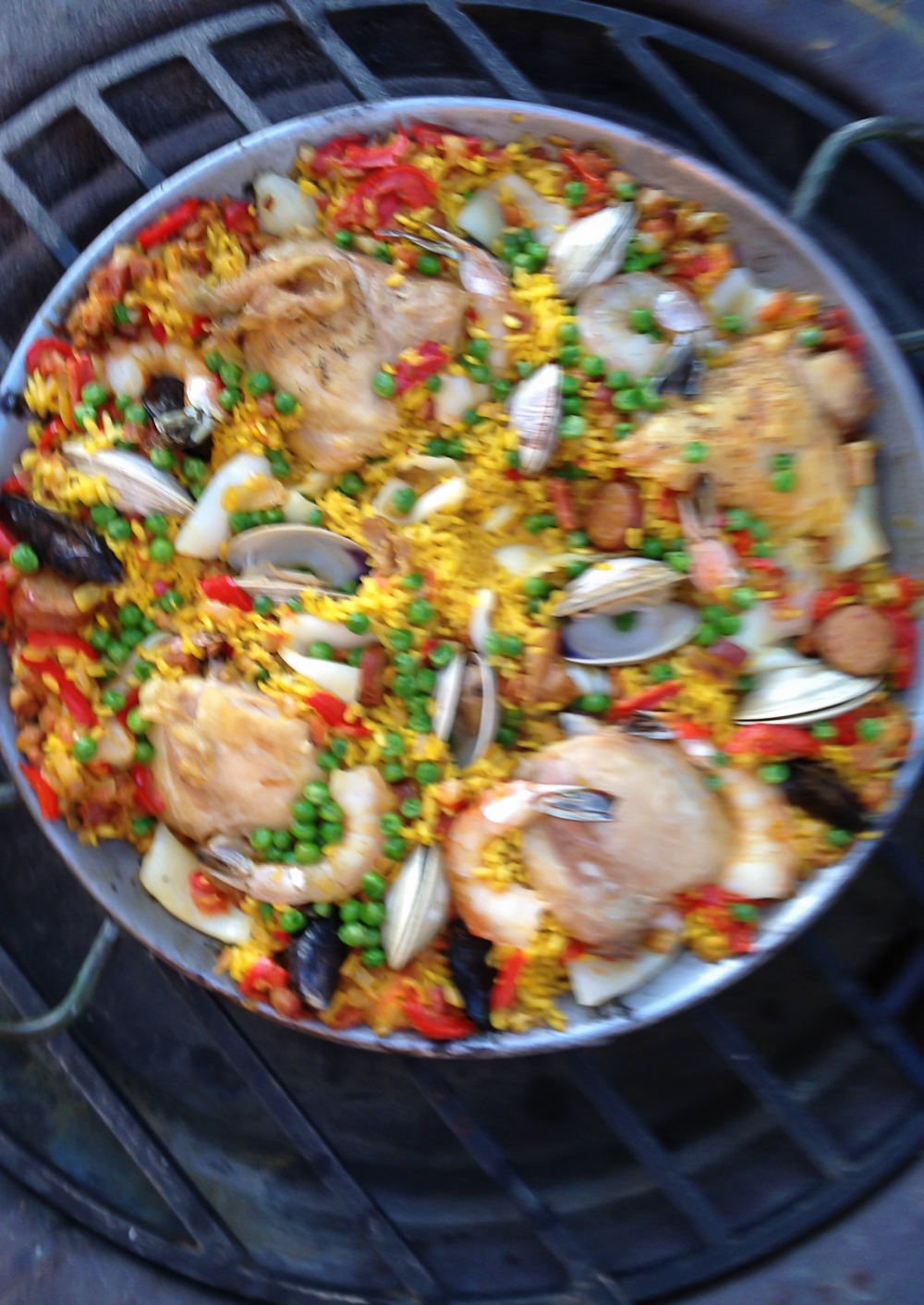
Paella on the fire pit

We still had a good time at our gathering, and cooking the paella over an open fire was the hit of the evening.

We enjoyed some of the Cruz de Piedra, along with some vinho verde in deference to the Portuguese and a warm evening. Our friends brought a tasty green salad dressed with a simple vinaigrette along with a crusty batard of farm bread.

Dessert was a classic flan except that it was flavored with chamomile and lime. I served it with the traditional caramel topping but along with cajeta made with fresh goat’s milk.

As evening came, we just relaxed on the patio and watched the sun go down.

Paella is one of those things where you can just do whatever you please except for the required rice and saffron. The recipe that follows is the version I chose for the evening.

Ready to eat

RECIPES

Paella

Ingredients

  • ½ cup olive oil, divided
  • 4 chicken thighs
  • 3 ounces pancetta, chopped
  • 2 chorizo sausages, one diced and one sliced crosswise
  • 1 medium yellow onion, diced
  • 1 large tomato, peeled, seeded, and chopped
  • 1 red bell pepper, seeded and cut into ¼ x 1½ inch strips
  • 3 cloves garlic, peeled and minced
  • 2½ cups Arborio rice
  • 2½ cups fish stock
  • 2½ cups chicken stock
  • 1 teaspoon kosher or sea salt
  • ½ teaspoon Spanish saffron (no other)
  • 8 clams
  • 8 mussels
  • 8 large shrimp, shelled except for the tail and deveined
  • ½ cup fresh or thoroughly thawed frozen green peas
  • 4 medium squid tubes, each cut into 4 pieces

Method

  • On the stove, heat half of the olive oil over a medium high flame. When it is just shimmering, add the chicken thighs, skin-side down. Brown the chicken until the skin is crisp and brown, turning frequently so the chicken cooks through completely. Drain the chicken on paper towels and set aside. You may want to refrigerate if dinner is a long way away.
  • Add the sliced chorizo to the hot oil and chicken fat. Turn frequently until lightly browned. Drain the cooked chorizo on paper towels and set aside.
  • Add the pancetta and diced chorizo to the still hot pan. Stir frequently until the pancetta is just slightly browned but not crispy. Then add the onion, tomato, pepper, and garlic. Cook until the vegetables are well wilted, liquid has boiled  off, and the mixture is a thick sauce. This is the sofrito. Transfer to a bowl and set aside.
  • About an hour before you plan to start the paella, build a fire in the fire pit. Although a wood fire is traditional, charcoal briquettes are perfect.
  • Back in the kitchen, pour out the oil and chicken fat from the pan. Add the remaining olive oil and heat until it shimmers. Then add the rice, stirring frequently until it is well coated.
  • In the meantime, combine the fish and chicken stock in a large pot and bring to the boil.
  • When the rice is evenly coated stir in the sofrito, salt, and saffron. Then pour in the boiling stock, and bring it back to the boil.
  • It is now time to take the pan out to the fire pit. Be careful not to spill.
  • When the pan is firmly set on the grate, make sure it is bubbling gently. From now on, don’t stir.
  • Now it is time to add the other ingredients. First arrange the chicken thighs around the outside of the pan. Then put in the sliced chorizo. After a few minutes, place the clams, hinge side down, deep into the rice. Next add the mussels, and then the shrimp.
  • Sprinkle the peas over the top. Then check to see how everything is going. Add more water if needed. Stir only if the bottom seems to be burning.
  • Cooking should take around 20-30  minutes, depending upon the heat of your fire.
  • Just 3 or 4 minutes before you think things are done, bury the pieces of squid in the rice. They will get tough if you cook them too long.
  • Serve immediately.

Chamomile/Lime Flan

Ingredients

  • 2/3 cup white sugar
  • ¼ cup water
  • 2 cups whipping cream
  • 2 bags pure chamomile tea (some have mint or other herbs)
  • rinds of 2 limes
  • ½ cup sugar
  • 2 whole eggs
  • 2 egg yolks
  • 2 quarts boiling water

Method

  • Preheat oven to 300° and set out 4  6-ounce ramekins
  • In a small sauce pan, combine the sugar and water. Bring to a boil over medium heat. Do not stir but continue to boil until the mixture is a light amber color.
  • Working quickly, pour some of the caramelized sugar into each of the ramekins, turning them so the caramel coats the bottoms and sides. Set aside.
  • In a heavy-bottomed saucepan,  heat the cream to a simmer along with the added tea bags and lime rinds. Heat for about 10 minutes. Then stir in the sugar, and remove from the heat.
  • Let steep off the heat for another 10 minutes. Then strain into a bowl.
  • In the meantime, combine the eggs and egg yolks in another bowl, using a whisk. Make sure that they are very well mixed.
  • Whipping constantly, Pour a small stream of the heated cream into the egg mixture/ Not too much so that the eggs don’t scramble. Add a little more of the heated cream to temper the eggs, and then pour that mixture into the cream, whipping to combine completely.
  • Pour the egg and cream mixture into the prepared ramekins.
  • Arrange the ramekins in an oven-proof pan which will hold them comfortably.
  • Pour the boiling water into the pan ust to the level of the tops of the flans, being careful not to get water in the ramekins.
  • Transfer to the middle of the preheated oven and bake for 30 minutes. Remove the pan from the oven. The centers of the custards will still be soft.
  • Place the pan on a cooling rack and allow the flans to cool completely in the water bath. They will finish their cooking as they cool.
  • Cover the cooled ramekins with plastic wrap and chill in the refrigerator for at least an hour and even over night.
  • To serve, run a thin spatula around the edge of each flan. Invert over the serving plate. The flan should slide out easily. If it does not, twist gently and it should come free.

2 Comments

Filed under Food, Photography, Recipes, Restaurants

GREEN CHILE CHICKEN STEW

Our family has lived in the Southwest for so long that we have adopted many of its traditions. For years we have made tamales on Christmas Eve, and now that is also a tradition for our children and their families, regardless of where they live. Making tamales from scratch is fun, and the fresh, finished product always tastes better than even the best store-bought versions. Posole warms the body and the soul on a cold winter evening, and it is perfect for a family gathering on New Year’s Eve. Biscochos (in El Paso) or biscochitos (in Santa Fe) have to be homemade and – like the tamales – have to be made with lard to taste like the real thing. The crisp anise-flavored cookies compete with my grandmother’s anise-flavored German springerle when it comes to dipping into a cup of hot chocolate or a glass of milk.

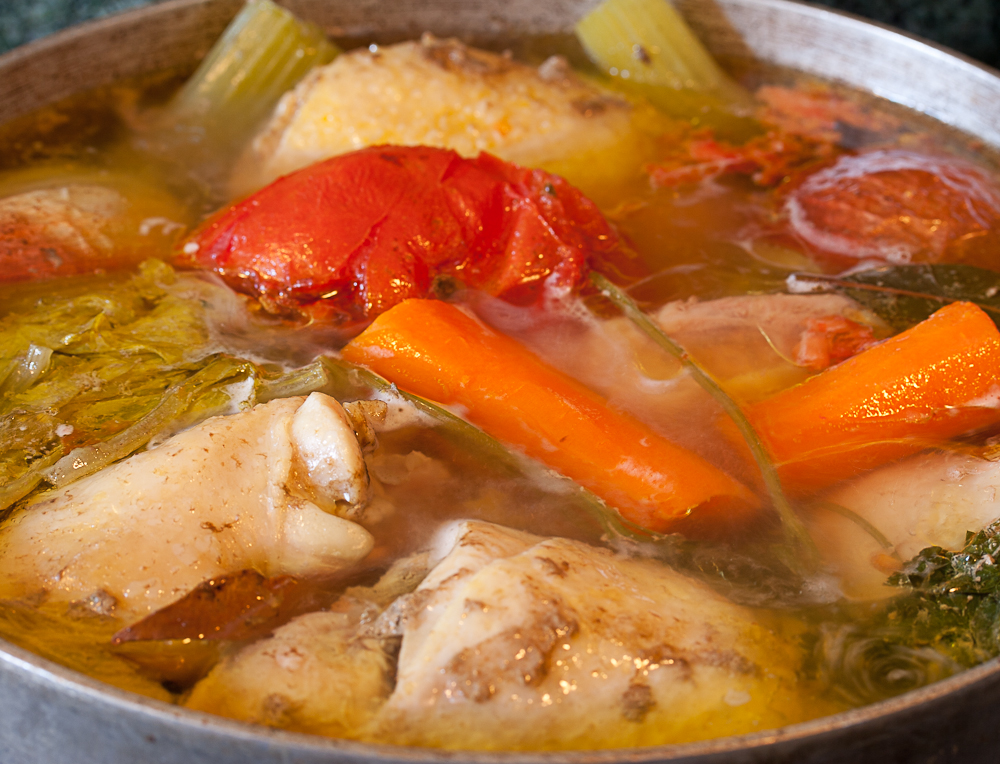
Chicken thighs cooking in stock with vegetables

Green chile chicken stew is in a class by itself. A hot bowl always reminds me of long-ago lunches in the lodges at the top of the runs at Taos Ski Valley or Ski Apache in Ruidoso. Our kids always ask for it when they visit us in Santa Fe, and so we try to have a pot on the stove for them when they arrive from a long cross-country drive. Our usual recipe calls for a whole chicken and makes enough for a large group. This version is quick, but by cooking the chicken in stock along with vegetables the broth becomes especially rich. If you are in a hurry, just skip adding the vegetables. The recipe makes enough for four adults. It is ideal for the late evening arrival of tired travelers.

Ready for your choice of garnishes

RECIPE

 Ingredients

4 Cups chicken stock

4 chicken thighs

1 medium onion, cut in quarters

1 medium carrot, cut in thirds

1 stalk celery cut in thirds

1 handful fresh celery leaves

3 stems fresh parsley

12 whole peppercorns

1 Roma tomato

2 Tablespoons cooking oil

1 medium yellow onion, diced

4 ounces chopped green chiles

2 cloves garlic, minced or pressed

3 Tablespoons all-purpose flour

2 russet potatoes, peeled and cut into ¾ inch cubes

¼ teaspoon ground cumin

2 Tablespoons dried Mexican oregano, crushed

1 teaspoon kosher salt

½ teaspoon ground black pepper

  1. In a large, heavy-bottomed pot, bring the chicken stock to the boil. Add the chicken thighs, onion, carrot, celery, celery leaves, parsley, and peppercorns. Continue to cook at a very low boil for about 45 minutes or until the chicken is cooked through.
  2.  About 10 minutes before the chicken is cooked, squeeze the Roma tomato into the stock and add the pulp.
  3.  Remove from the heat. Strain the stock into a container and allow to cool so that you can remove the fat that gathers on the top. Set aside.
  4.  Remove the skin and bones from the thigh meat, chop the meat into bite-sized pieces and set aside.
  5. Clean the pot and return it to the stove over a medium flame. Heat the oil, and then add the diced onions. Cover and sweat the onions for 5 minutes or until they are soft and translucent. Do not allow them to brown.
  6. Add the green chiles and minced garlic and continue to cook, uncovered. Stir frequently until the moisture has evaporated from the mixture. Add the flour and stir continuously for about 3 minutes so that the onions and chiles are completely coated and the flour has lost its raw taste.
  7. Add the strained, cooled chicken stock and cubed potatoes. Return to the boil, stirring frequently. Continue to cook at a low boil until the potatoes are soft and cooked through – about 20 to 30 minutes.
  8. Stir in the cumin, oregano, salt and pepper. Adjust the seasoning with more salt and pepper if needed and continue to simmer for 10 minutes.
  9. Add the chicken pieces, simmer for another 10 minutes, and then serve in large soup bowls along with your choice of garnishes.

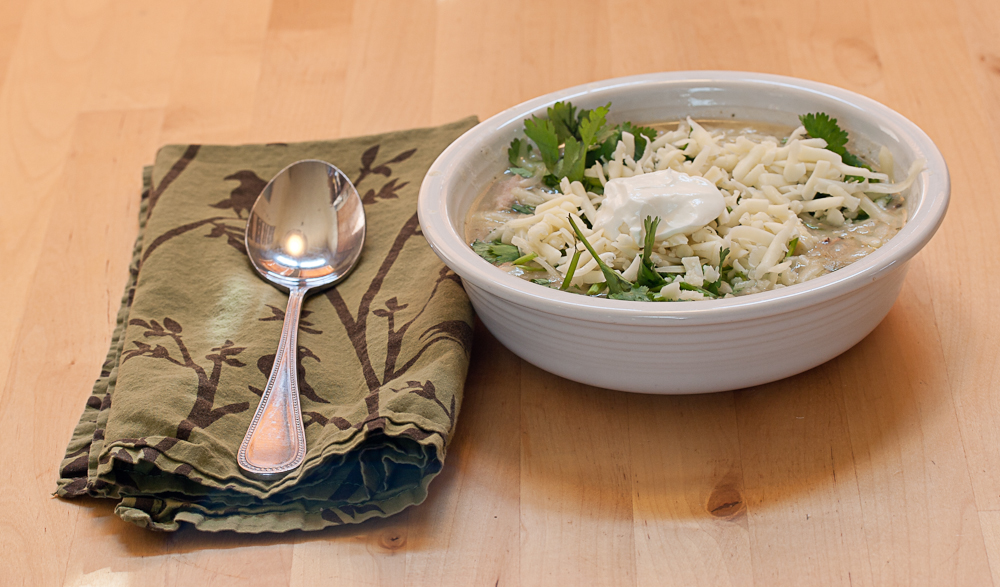
Green chle stew with the garnishes our family likes

Garnishes

There are lots of traditional choices for garnish. We always like to pass bowls of chopped fresh cilantro leaves, thin-sliced, baked corn tortilla strips, grated Monterrey jack cheese, and diced avocados along with hot sauce for those who like their soup spicier. We also like to serve hot tortillas (corn or wheat) or cornbread fresh out of the oven.

2 Comments

Filed under Food, Photography, Recipes

SCHOOL LUNCHES AND BENTO BOXES – WHAT IS A MOTHER TO DO?

When I was growing up, my mother would make a peanut butter and jelly sandwich and put it in a brown paper sack along with some carrot sticks, an apple or orange, and some home-made cookies. When we moved to the suburbs the school had a lunch program. For twenty-five cents children could get a hot meal served in a war surplus Army metal divided tray. For a quarter you got a main dish like spaghetti, a salad, hot bread, fruit, dessert, and a little glass bottle of milk. All the kids loved lunch and lunchtime because the food was good, and it was a break from the classroom. Nobody threw anything away. The reason it was so cheap was that the meal was mostly made from “commodities” which the government had purchased from the farm subsidy program. Cheese, meat, chickens, eggs, butter, and produce were all part of the program, so it was possible to make a tasty meal from high quality ingredients. The other reason the lunches were so popular was that they were made by the “lunch ladies” who usually were mothers of some of the school children. Their kids were often your friends, and the cooks knew everyone’s name. In those days, nobody would dream of wasting food, especially in front of a mother who might tell your mother. Besides, the ladies would often make special treats like home-made potato chips to go with juicy hamburgers and all the trimmings.

My mom became one of those lunch ladies, and for many years she cooked meals which the children loved. Her fresh, hot rolls were famous as were her pumpkin pie and chocolate sheet cake. She loved “her children” and they loved her.

Then something happened. The commodity program shrunk dramatically. School boards across the country decided that they needed to cut payrolls and that they could provide lunches cheaper by contracting with big restaurant firms. The home-made lunches disappeared, and in their place came frozen TV-dinner-like meals that got heated up in the microwave. It was about the same time that a garbage barrel got placed at the end of cafeteria line where kids could dump their uneaten tray and head for the vending machines filled with soft drinks, corn snacks, and candy bars. It was about that time, too, when the decision was made to count ketchup as a vegetable to make sure of the “nutritional value” of the meal, and when childhood obesity began to inch up.

Now some schools have contracted with caterers who have the child choose from a menu of items that are popular with kids. The food is apparently better, but it is still not the solution to having the kids eat a healthy lunch.

In frustration, my daughter Carol decided to do something about it. Peanut butter sandwiches are often no longer allowed. Although she is not really concerned about some of the other food restrictions which have multiplied seemingly geometrically in the last few years –  mercury content of tunafish, dairy products in drinks, estrogens in soy products, gluten in bread – and on and on – she wanted to make a lunch her kids would eat, and so she turned to bento boxes.

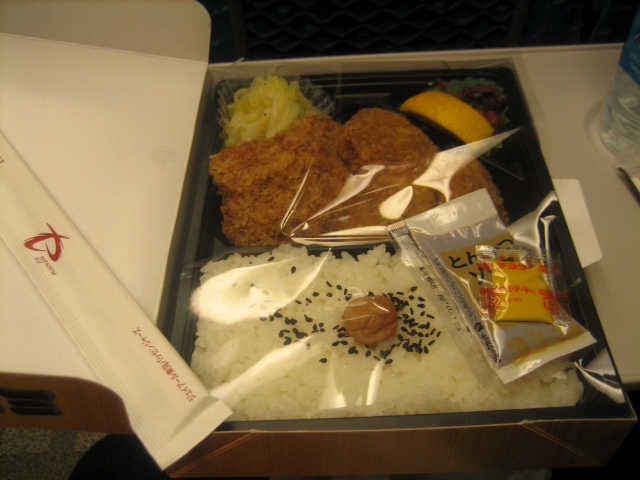
Sarah's authentic bento box from the Kyoto train station

She picked up a copy of “The Just Bento Cookbook” by Makiko Itoh (one of this year’s top ten cookbooks on the Amazon list) and bought some bento boxes. Then she prepared this menu from the book: chicken kijiyaki, pan-steamed sweet potato, cucumber and turnip salad with lime, rice, and apple bunnies.

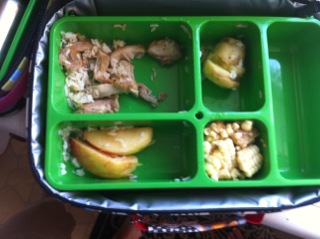
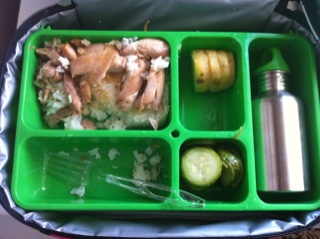
Carol's bento box in the morning

Being the good cook that she is, Carol made a point of seasoning the food to kid tastes and arranging it beautifully in the boxes.

Cameron's bento box in the afternoon

Ciara's bento box in the afternoon

Alas, with all that effort, she felt let down when her kids returned from school with their bento boxes in tow. Now, it’s on to another ploy to get her kids to eat a healthy lunch at school.

RECIPES (adapted from “The Just Bento Cookbook” by Makiko Itoh, published by Kodansha International, 2010)

Chicken Kijiyaki

1 chicken thigh, boned with skin on

1 Tablespoon rice wine vinegar

1 Tablespoon soy sauce

1 teaspoon sugar

  1. Pierce the skin of the chicken with a sharp fork and place it skin-side down on a hot non-stick skillet. Saute until the skin is crisp, turn over and saute the other side until done.
  2. Remove the chicken from the pan, clean the skillet with a paper towel and return the skillet to the heat. Add the mirin, soy sauce, and sugar, stirring until the sugar is melted and the sauce is hot. Return the chicken, turning it to coat it with the sauce. Remove the chicken from the pan, let it cool, slice it, and arrange it in the bento box.

Pan-steamed Sweet Potato

1 small sweet potato, peeled and sliced into 1/2 inch rounds

1/8 teaspoon salt

1 teaspoon honey

  1. Arrange the sweet potato slices in a single layer in a sauce pan. Add enough water to half cover the slices. Sprinkle with salt.
  2. Bring to the boil. Then cover and reduce the heat to low. Cook for about 10 minutes or until the sweet potato slices are tender. Turn once about half way through the cooking.
  3. Drain the water from the sauce pan, drizzle honey over the slices. Then let them cool completely before packing them in the bento box.

Cucumber and Turnip Salad with Lime

1 small cucumber

1/2 turnip, peeled

1 teaspoon salt

zest of 1 lime

1/2 Tablespoon fresh lime juice

  1. Cut the cucumber in half lengthwise and slice very thin half-moons.
  2. Slice the turnip into small, thin slices and combine with the cucumber slices
  3. Rub the vegetables all over with the salt. Let stand for 10 minutes until they are limp. Then squeeze out any excess water
  4. Add the lime zest and lime juice. Place in a covered container, and refrigerate overnight

Apple Bunnies

1 ripe, red apple

juice of 1 lime

1 Cup water

  1. Cut the apple into wedges and remove the core
  2. With a sharp paring knife, score the skin of an apple with the shape of a triangle, its base at the top of the wedge
  3. Again with the sharp knife cut through the apple just below the skin on either side of the triangle
  4. Gently remove the skin from the triangle
  5. Place the carved apple in the lime juice added to the water to prevent discoloration of the cut apple and so that the “ears” curl and

Leave a comment

Filed under Food, Photography