TOUCH OF GRACE BISCUITS

A few years ago, my wife Susan and I compiled a family cook book based upon the hundreds of hand-written index cards in our jammed recipe box. We also asked our children to send us their favorite recipes. Carol, our older daughter, sent us a recipe for “Touch of Grace Biscuits” which she described as one of her favorites. Although she was born in the Mountain West, she grew up in the Deep South, so her palate often favors Southern tastes.  She has perfected Touch of Grace Southern biscuits. There are lots of recipes for biscuits, but few of them seem to rise up tall with a flaky inside.  These definitely do. This recipe is one of Carol’s specialties that she gleaned from a couple of Southern cookbooks.  There are various explanations for the “touch of grace” title, but they all trace back to the noted Southern food expert and cook book author, Shirley O. Corriher. According to Bernard Clayton in his encyclopedic “Complete Book of Breads”, six Atlanta cooks including Shirley Corriher were gathered together by Nathalie Dupree to create the best Southern biscuit from a large collection of recipes. Ms. Corriher offered up her grandmother’s recipe which she described as made with a “touch of grace”. Another version says that the source was a hand-written note in the margin of the recipe. Ms. Corriher herself describes the origin of the name in her own book, “CookWise: the Secrets of Cooking Revealed”. Unable to duplicate her grandmother’s biscuits, Shirley Corriher asked, “Nannie, what did I do wrong?” to which her grandmother replied, “Honey, I guess you forgot to add a touch of grace.” Whatever the real story of the name, these biscuits remain popular and appear in many a Southern baking book.
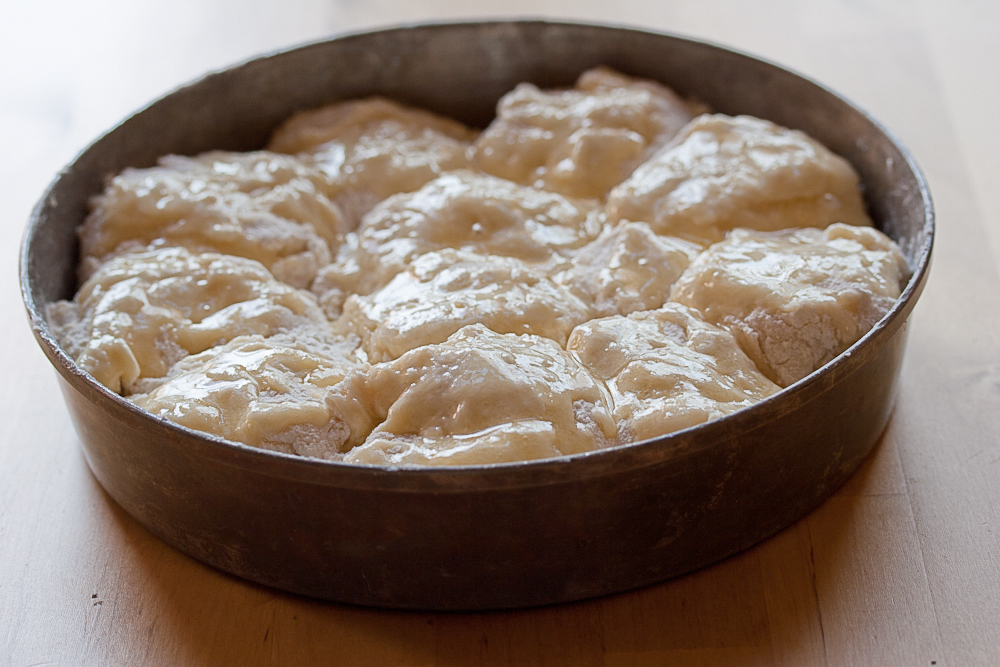
Touch of Grace Biscuits ready for the oven

One of the key ingredients for the recipe is Southern self-rising flour. Most Southern bakers insist that the only flour to use is White Lily flour.  To the dismay of many, the original mill in Knoxville, TN closed in 2008 after operating since 1883.  Production was shifted to two mills in the Midwest by the new owner, the J.M Smucker Company, who insists that the new product is indistinguishable from the old. Blind testers refute that statement and have demonstrated that they can tell the difference. Some Southern home bakers resorted to hoarding the old stuff when they learned of the plan to relocate the mill.  Apparently, there were many reasons that White Lily was different from the flour that you buy at grocery stores outside of the South. Perhaps most importantly, White Lily was made from softer Southern wheat with only about 8 percent protein while Northern and Midwestern flours are milled from wheats with 10 to 12 percent protein. The flour was supposed to be ground more finely, bleached with chlorine rather than other bleaching agents, and sifted several times before packaging. Even without the original White Lily flour, Touch of Grace biscuits are light and delicate. I can only wonder how much better they would be with White Lily.

Touch of Grace Biscuits fresh from the oven

Here is the recipe as my daughter sent it to me. The ingredients are exactly the same as the original by Shirley Corriher with some minor modifications in the method. The dough will be much softer than usual biscuit dough. That is why you don’t cut the biscuits but rather form them into rough balls and dredge them in all-purpose flour before putting them in the pan. Crowding them will make them rise higher.

TOUCH OF GRACE SOUTHERN BISCUITS

Ingredients

1½  Cups              sifted self-rising flour

1/8 tsp                  baking soda

1/3 tsp                  salt

1 Tbsp                   sugar

3 Tbsp                  shortening (not butter)

1¼  Cups             buttermilk

1 Cup                    all-purpose flour

2 Tbsp                  butter, melted

  1. Preheat oven to 475º and spray round cake pan with cooking spray
  2. Combine self-rising flour, soda, salt, and sugar  in large mixing bowl. Work in shortening using a pastry blender until the mixture is a pea-sized meal.
  3. Stir in buttermilk  and let stand for 2 to 3 minutes. The dough should be soft and wet.
  4. Pour the all-purpose flour into a pie pan.  Spoon a lump of the dough into the flour, working and shaping it into a soft round. Shake loose any extra flour and place the round in the greased cake pan, continuing to shape and place biscuits until the pan is full. Have the biscuits touch one another as you fill the pan.
  5. Brush the tops of the shaped biscuits with the melted butter and bake for 15-20 minutes until the biscuits are a golden brown.  Serve immediately.

Yield: About one dozen biscuits
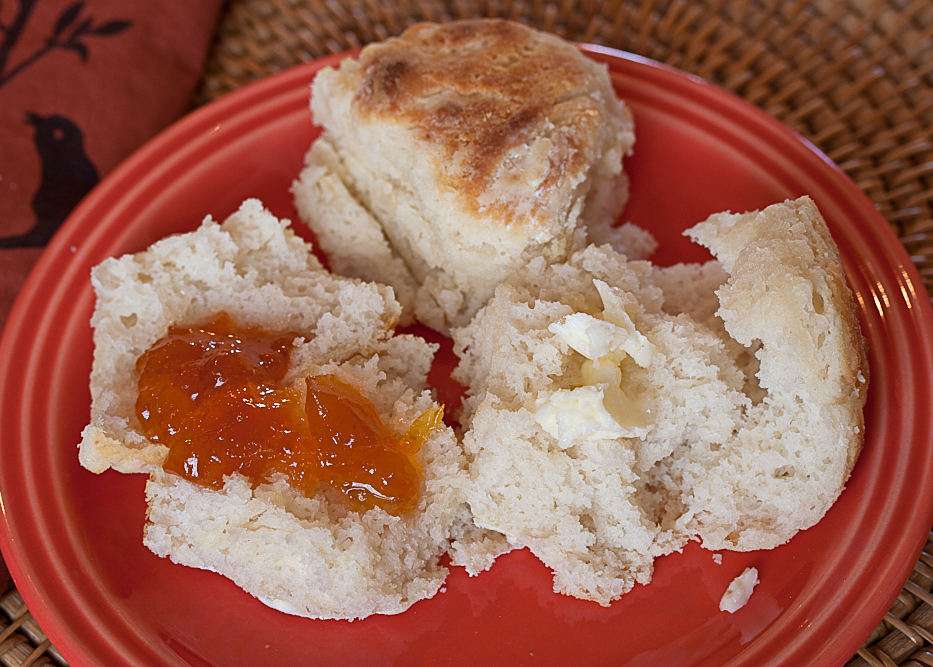
Ready to eat with butter and jam

As an aside, self-rising flour is a fairly standard Southern ingredient which may be relatively un-used or even hard to find in other parts of the country. Exactly what is it? Self-rising flour is a regular flour that has been pre-mixed with baking powder. Because of that, you should not use it when a recipe calls for yeast as a leavening agent. If Southern-style self-rising flour is not available, you can make your own by sifting together 1 cup all-purpose flour, ½ cup “instant” flour (Wondra is a popular brand which contains a mixture of wheat and malted barley flavors) and 1½ tsp baking powder.

Leave a comment

Filed under Food, Photography

GARDEN AND FOOD PHOTOGRAPHY

This last week I spent intensive hands-on study time with the well-known English food and garden photographer, Francesca Yorke. She led a course at the Santa Fe Photographic Workshops for eight of us interested in gardens and food. The course made a sensible progression from making images of flowers and plants along a city street, through visiting some interesting and different gardens, then photographing a bustling farmers market and a garden store, and finally doing some hands-on cooking and photography with Chef John Vollertsen (Johnny Vee) at his Las Cosas Cooking School.

Wildflower on Canyon Road

Francesca Yorke is a superb teacher who is able to give frank and honest criticism without intimidation or belittlement. She has shot some of the most famous gardens and worked with some of the most well-known  food personalities in England, so her experience is rich. Each day she showed us some of her best images, and that provided a wonderful learning experience and inspiration.

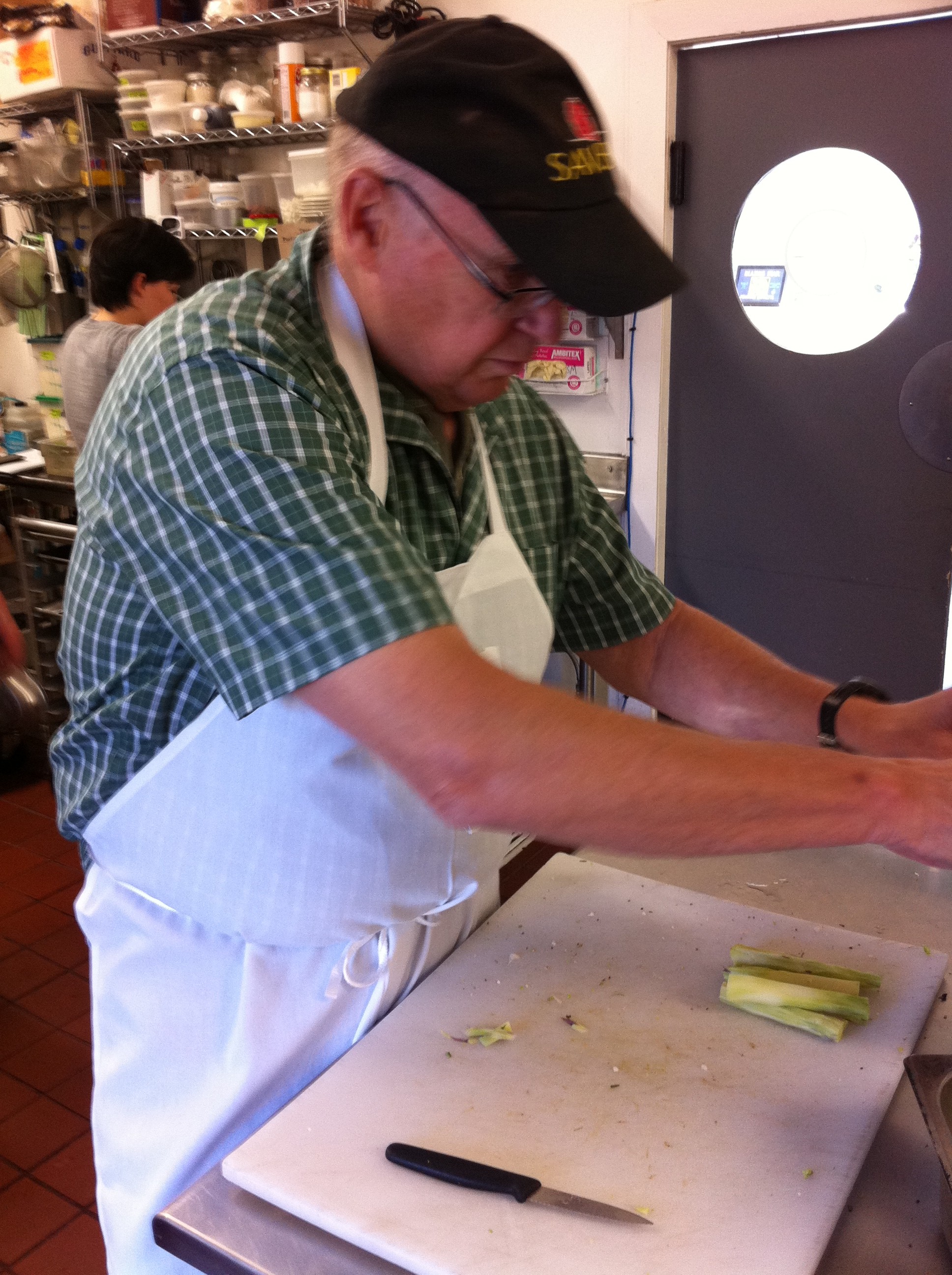
Broccoli

Our first visit was Santa Fe’s famous Canyon Road where we had the opportunity to shoot images of flowers in planter boxes, wildflowers growing in vacant yards, or interesting leaves and berries on shrubs and trees along the sidewalks. Although things had begun to fade in anticipation of the autumn, there was still an abundance of color for all of the student photographers.

Bread and butter at the farmers market

For a couple of days, we traveled to several gardens in the city and in Albuquerque. Grasses were in abundance, there was interesting statuary aplenty, and some of the leaves had begun to change into the radiant hues of autumn – reds, yellows, and dappled oranges. In one garden, there was a menagerie of piglets, sheep, goats, and chickens so that there were lots of action and human interest photo opportunities for those of us who were getting a little bored with flowers.

Roasted tomatoes

The farmers market was a busy place with vendors selling all sorts of fruits and vegetables, chili roasters going full blast, and lots of people who made for terrific photo opportunities. The garden store, too, was a great place for photos not only of flowers, but also of  pots, watering cans, prowling insects, and tools.

Artichoke ravioli with lemon-Parmesan cream sauce

Every day we took time out for lunch at restaurants which Francesca had chosen to reflect good cooking and good eating. Then she took us to her studio where we practiced food styling with a cornucopia of items she had purchased at the local store. We used her collection of bottles, jars, cutlery, bowls, plates, and linens to try our hands at creating photo images that would be suitable for a magazine article or for inclusion in a cookbook. While none of us succeeded in that goal, there were plenty of great shots. Fran looked over our shoulders with helpful suggestions without being intrusive.

Sprinkling powdered sugar on the strawberry shortcake

The last day was clearly the highlight of the whole experience. We traveled to Las Cosas kitchen store where we were met by the enthusiastic Chef Johnny Vee (John Vollertsen). We took turns cooking and photographing a meal prepared from recipes in Johnny’s cookbook, “Cooking with Johnny Vee” (Gibbs Smith Publisher).  The menu was simple but interesting – garden herb focaccia, farmer’s market salad with tomato confit and goat cheese “truffles”, artichoke ravioli with lemon and Parmesan cream, and strawberry buttermilk biscuit shortcake. Everyone participated in the cooking so we all pronounced it delicious. And it was!

Then back to the workshop where we viewed the best of the best images from the class. There were some amazing photos. Francesca had done her job, and the class departed with newly honed photographic skills and a new set of photographer friends.

1 Comment

Filed under Food, Photography

PLUM TART

A while back, I wrote about some of the favorite foods we shared during our annual family rendezvous in Big Sur. Someone asked for the recipe for the plum tart . This is the tart that Sarah made for the adults at our family cookout. Choose whatever sweet plums suits your fancy, although they should be free stone so that you can slice them easily. Use your favorite pie crust recipe, and bake the shell “blind” to receive the filling. The tart is best when topped with crème fraîche, whipped cream, or ice cream.

Plum tart

PLUM TART

(Adapted from Deborah Madison’s Seasonal Fruit Desserts)

Ingredients

1 nine-inch pie crust, baked blind (see below)

1½ pounds fresh free stone plums, skins on

4 teaspoons brown sugar

¼ teaspoon ground cinnamon

¼ teaspoon ground cardamom

¼ teaspoon ground cloves

zest of one orange

⅔ Cup walnuts, toasted in a dry skillet and chopped finely

  1. Line a nine-inch pie pan with your favorite pie crust recipe. Crimp the edges, pierce the bottom several times with the tines of a fork. Line with aluminum foil, and fill with beans or pie weights. Bake for 15 minutes in the middle of a 375° oven. Remove from the oven. Remove the weights and foil and cool on a rack.
  2. In the meantime, slice the plums and set aside.
  3. Combine the sugar, spices, and zest with a mortar and pestle to release the orange oils. Then toss with the chopped walnuts.
  4. Scatter ⅔ of the walnuts in the bottom of the pie shell. Cover with the plum slices, arranging them so that some of the skins are showing.
  5. Scatter the remaining walnuts over the top of the plum slices.
  6. Bake at 375° for about 35 minutes or until the plums have begun to release their juices.

Yield: Serves 6 to 8

Leave a comment

Filed under Food, Photography

BIG SUR (Continued)

In a previous post, I wrote about some of the good family food and eating experiences that we enjoyed during our recent family rendezvous in Big Sur. This time, I want to describe some of our favorite restaurants. There is no lack in Big Sur of good eating choices for every budget and for every time of day. We certainly haven’t tried them all. So often we are on our way to something else and the time is not right. But we have also become creatures of habit, so we come back to our old standbys.

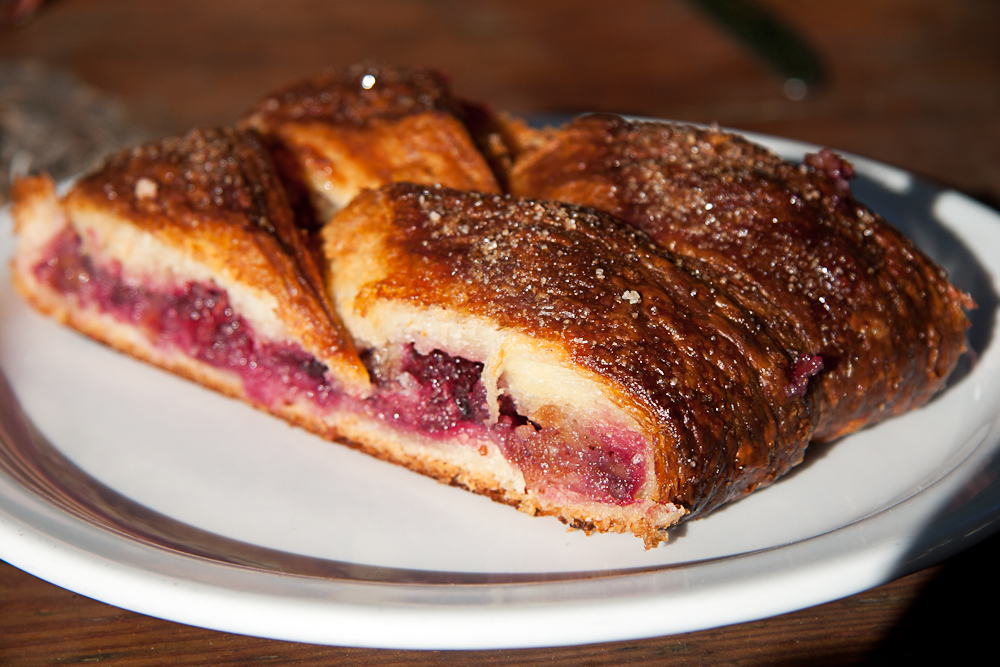
Fresh berry strudel at Big Sur Bakery

Without doubt, the place we visit the most is the Big Sur Bakery. We used to make elaborate home-made breakfasts in the cabin – pancakes, omelets, scrambled eggs and bacon – but no more. Every morning we head to the Big Sur Bakery, often with the younger ones chanting in the background what has almost become a mantra, “Big Sur Bakery! Big Sur Bakery!” The obvious reasons for this change of allegiance are first there is nothing to clean up except for busing your table when you are finished and second the pastries and breakfast dishes are unbelievably delicious. My very favorite is the ham and cheese croissant, but the daily fritatta runs a close second. For those with a sweet tooth, the berry strudel is a pleaser. The pain au chocolat (chocolate croissant) is a popular choice for kids. The citrus bun is also popular with everyone. Beverages are also varied and creative. The barista spends as much effort with the kids’ hot chocolates as he or she (depending on the day) does with the lattes. There is a whole wall full of choices for hot tea, or you can get iced tea or fresh fruit juice. When we first started going to Big Sur, the bakery was popular, but now it has clearly been discovered. If you arrive at 8 AM there is likely to be a line waiting for the doors to open. If you arrive too late – say around 11 – there is a good chance that they will have run out of your favorite. If that happens, hang around for lunch or dinner because their offerings for those meals are creative and delicious.

Cooling off before lunch at the Big Sur River Inn

The Big Sur River Inn is a popular family gathering place for lunch. By noon, the fog has almost always burned off so that the deck is warm and sunny. The choices are all pretty much American – burgers, sandwiches, interesting soups, and salads filled with just about whatever you might want – but they are well prepared, tasty, and generously sized for the price. For the kids (as well as their parents) an unusual advantage of the River Inn is that you can choose to sit in the river. That’s right! There are Adirondack chairs in the middle of the river running behind the restaurant where you can sit and cool your feet in the rushing water while you are waiting for your lunch. The place serves dinner, too, and often has live entertainment later in the evening. The River Inn is at or near the nerve center of the Big Sur because it has one of the best grocery stores with a selection of wine, beer, and liquor and it also is nearby several motels and campgrounds as well as Big Sur’s version of a shopping mall: three or four little shops with clothing, curios, and other odds and ends.

The outside deck at Nepenthe

Nepenthe is quintessential Big Sur. It has been in place for a long time, and to prove it there are pictures around of customers relaxing during the days of Jack Kerouac and before. That means that a lot of today’s older visitors remember the place from their “Hippie Days”. The big attraction is the view, and it is at its best after the fog has gone and before the sun has set, so clearly lunch is a popular time. Arrive when they open, and you will probably be able to get a table outside with a view. Things fill up fast, so you may need to wait, but there are some comfortable waiting areas outside. The food is good but not amazing. The “signature dish”, if there is one, is the Ambrosiaburger topped with a special sauce. The French dip sandwich is straight out of the sixties and reminiscent of the one my mother always prepared for my kids during their visits. The bean salad is much more complex than the three-bean salad you have probably had a hundred times before. It has an herbal taste that complements whatever you have with it.  The soup of the day is always unique. One of my favorites is the curried apple. The name may not sound too exciting, but the soup is outstanding.

There are other very special places including the Post Ranch and Ventana. Those have spectacular views, elegant dining rooms, and amazingly sophisticated foods for being so far from the big cities. For them, you might consider dressing a little better than the usual Big Sur casual, and you should definitely be prepared when the check arrives. Still, the experience makes it seem very much worth it.

French dip sandwich and bean salad at Nepenthe

This list has only scratched the surface of the restaurant experiences that are available to you in Big Sur. Much of the fun is exploring the possibilities on your own.

Leave a comment

Filed under Food, Photography, Restaurants

STUFFED BELL PEPPERS

The first touch of autumn is definitely here, and the bell peppers are abundant at the local farmers market. They come in the standard-issue green along with yellow, orange, red, and variegated colors. And they are big and just begging to be stuffed with your favorite filling. My mother always used her favorite meat loaf mix. That’s pretty much the traditional approach, but you can branch out with whatever filling pleases you, such as rice, mixed vegetables including fresh corn, or even shrimp or crab. Suit yourself, but enjoy one of the real treats of the fall season. This recipe is easy to make and uses Italian sausage to provide not only the protein but also aromatic Italian seasonings. Depending upon your preference, choose hot or sweet (mild) sausages.

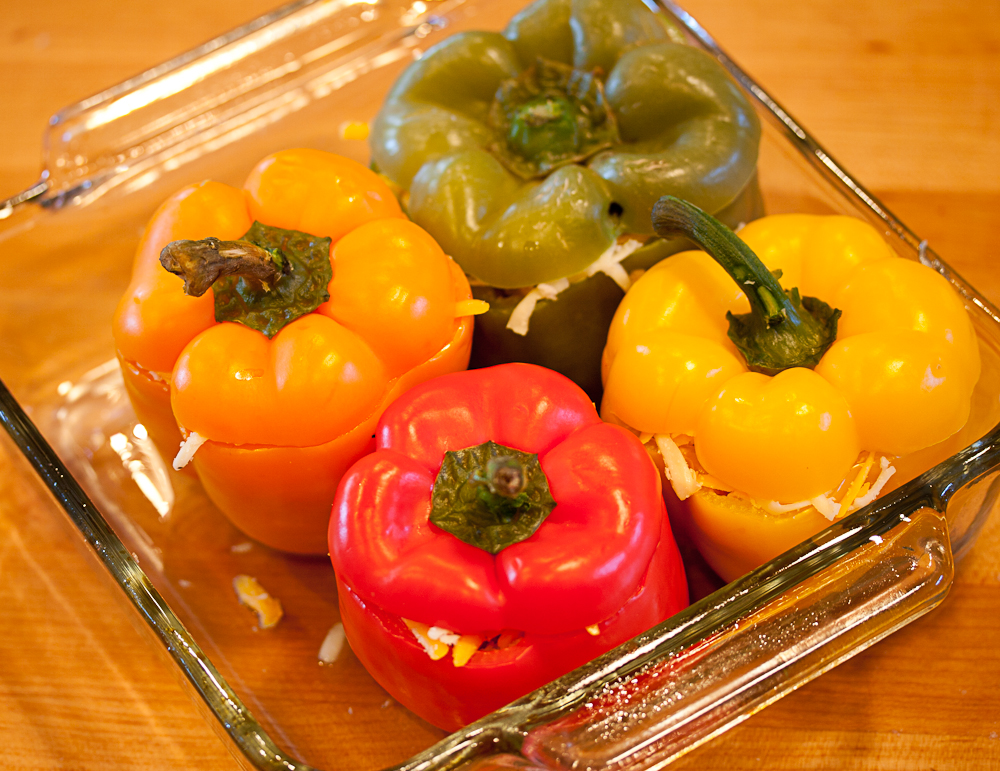
Stuffed peppers ready to bake

RECIPE

Stuffed Bell Peppers
Ingredients
4 fresh bell peppers, free of blemishes
2 Tablespoons olive oil
1 medium yellow onion, chopped
2 large Italian sausages, casing removed
6 white mushrooms, washed and chopped
1 ½ Cups cooked brown rice
2 eggs, lightly beaten
½ Cup panko + more for the top
2 Tablespoons tomato paste
6 ounces cream cheese, softened at room temperature
2 ounces Swiss cheese, grated and divided
salt and pepper to taste
1 Tablespoon butter

1. Prepare pepper casings by slicing off the top to form a cap. Reserve the caps. Remove the seeds and ribs of the peppers. Place in boiling salted water, return to the boil and boil for 10 minutes. Remove, drain, cool, and set aside.
2. In a medium skillet heat the oil on medium and combine the chopped onions. Sauté the onions until they are translucent but not browned. Add the sausage, stirring to break apart, and cook until well browned. Stir in the chopped mushrooms and sauté an additional 3 minutes. Cool
3. Transfer the sausage mixture to a medium bowl and combine the brown rice, eggs, panko, tomato paste, cream cheese, and half the Swiss cheese. Salt and pepper to taste. Stir until well combined.
4. Spoon the stuffing mixture into each of the pepper casings. Sprinkle the tops with the remaining Swiss cheese and panko and dot with butter. Cover with the reserved caps and place in a baking dish sprayed with vegetable oil spray.
5. Bake in the middle of a preheated 350° oven for 45 minutes or until the peppers are slightly blistered and the cheese has melted. Serve while still warm

Ready to eat

Yield: Serves four

2 Comments

Filed under Food, Photography

BIG SUR

Another view of Bixby Creek Bridge

I have been away for a couple of weeks, enjoying our annual family rendezvous in Big Sur. For the last six years or so, we have met at the Pfeiffer State Park, each family laden with food, snacks, and wine. Unfortunately, our son and his family could not join us this time because of school obligations. Those seem to increase as children get older. But the others came prepared for a week of hiking, playing on the beach, enjoying one another’s company,  and getting caught up on events since we last saw one another.
One of our traditions is to bring lots of the family’s favorite snacks – “Texas trash” and old-fashioned Southern cheese straws. The Texas trash is our version of the chex mix recipe that you can find on the back of a box of wheat chex. We add a few more items like different nuts, funny pretzel shapes or whatever and more butter. You can be as creative as you like. The cheese straws come from Craig Claiborne’s classic cook book, ”Southern Cooking”. The only thing we do a little differently is to  put the dough through a cookie press into the form of five-petal flowers. That shape has been obligatory for as long as I can remember.  It has the advantage for the eater of being able to  just bite off one petal  at a time. That way you feel more virtuous even though the recipe calls for practically nothing but butter, cheese, and just enough flour to hold everything together.
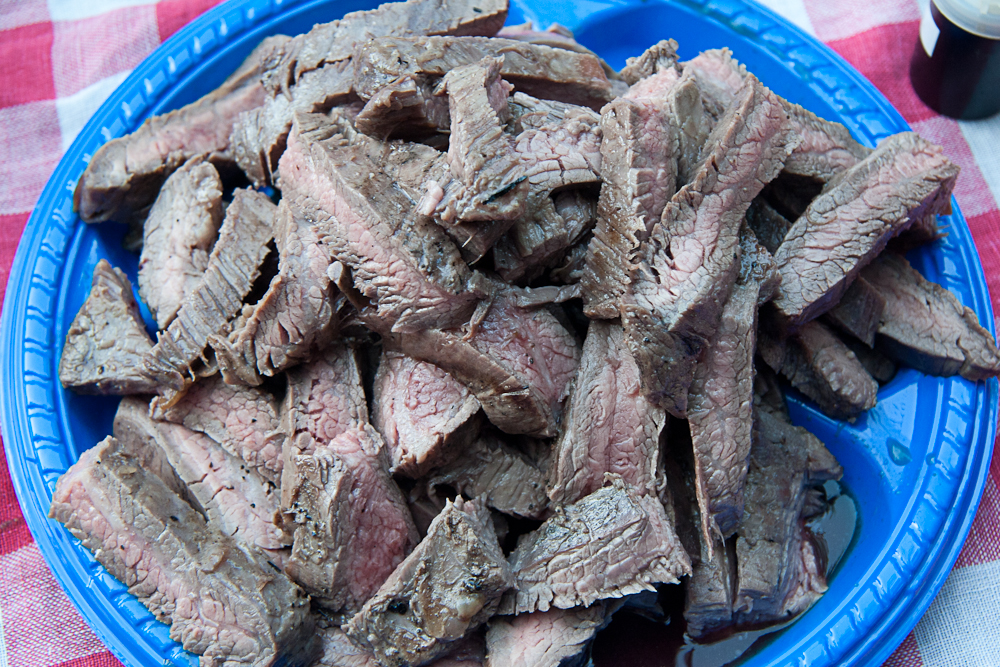
Grilled flank steak

This year, we gathered while my older daughter prepared one of her old standby recipes – “Law School Chicken”. She developed the recipe while she and her husband were both in law school. It was a cheap, easy-to-fix one-dish dinner that could be served to company. It was also a welcome change from instant  ramen. 

Roasted corn fresh from the coals

Carol says it is easy to make. First, she dusts some chicken breasts with flour and sautés them in a little butter and oil until they are cooked through and browned and crispy on the outside. While the chicken is cooking, she caramelizes some fresh peeled peach halves along with some slices of red and white onion. She boils some couscous in chicken stock with just enough of the stock left over to moisten everything. A good squeeze of fresh lemon brightens the taste.  When everything is done, she serves the chicken over the couscous, peaches,  and onions  and completes the meal with a green salad. Delicious. It is so good that, unfortunately I got busy eating and forgot to take a picture for you. Nevertheless, you get the idea.  Give it a try. I think you will add it to your list of tasty meals to make when you are in a hurry.

Plum tart

The next night we had our traditional cookout with steaks, roasted corn on the cob, beverages, and of course, s’mores over the campfire. This year, though, we did it differently, and I would highly recommend our new approach. In the past we have had big steaks for all of the adults and a shared steak for the children. While that sounds wonderful, the problem is always that the steaks have to be grilled in batches because the grills available in the picnic grounds are too small. Some turn out to be too well-done while others are too rare, and some of the adults have finished eating before others have even started. This year my younger daughter suggested flank steak – which turned out to work beautifully. We bought two large flank steaks for six adults and three children, marinated them all day with olive oil, vinegar, salt and pepper, and then grilled them over a charcoal fire. My son-in-law, the chef, grilled them to perfection, sliced them, and served them to everyone at the same time.  

Another change this year was to use charcoal for the main cooking and to save the campfire for later. The charcoal gave us an even fire and also let us put ears of fresh corn in the coals. In preparation, we removed all of the silks from the corn while keeping the husks intact to fold back over the individual ears. 

All got their fill, so it was soon time for s’mores. We put a log on the charcoal fire, waited until it flared up, and then made classic s’mores with toasted (burned) marshmallows, chocolate bars, and graham crackers.  If you have not eaten one of these fabled treats for many years, trust me: only kids can eat one of these sugar bombs, So dessert for adults was a delicious plum tart that Sarah had made with fresh plums from a friend’s back yard.

Tomato jam quiche

Lunch the next day included a delicious quiche from Sarah. She made a jam from tomatoes that we had brought her from our garden. She peeled and seeded the tomatoes and then cooked them down with flavorings into a beautiful jam.  She then ; made a pie shell using a favorite recipe of my wife, Susan, and filled it with a thin layer of caramelized onions, topped it with a custard of cream, eggs, farmer’s cheese, and basil, and baked it. After it had cooled, she covered it with the tomato jam. Beautiful to see and wonderful to eat.

There were a lot more good things to eat, including treats from some of our favorite restaurants in Big Sur. With my next post, I’ll tell you about some of our favorite places to eat in Big Sur

RECIPES

Cheese Straws

1¾ Cups all-purpose flour

8 ounces cheddar cheese, grated on a box grater

1 stick (8 tablespoons) butter, cut into 16 pieces

¼ teaspoon salt

½ teaspoon Cayenne pepper

1 teaspoon Worcestershire sauce.

  1. Add the flour and cheese to the bowl of a food processor. Cover and pulse together  until well combined.
  2.  Add the butter, salt, Cayenne pepper, and Worcestershire sauce. Cover and process until  the mixture comes together as a ball.
  3. Stop the processor and knead the dough briefly to bring together any loose particles. Wrap in plastic wrap and let set at room temperature. Do not refrigerate.
  4. Divide the dough in fourths or enough to fill a cookie press fitted with the patterned plate of your choice.
  5. Push the dough out as individual “cookies” on two ungreased baking sheets.
  6.  Place the baking sheets in an oven preheated to 300° and bake for 20 minutes until the cheese straws are crisp and slightly browned. Bake longer if you wish them to be darker,   but be careful as they burn easily.
  7. Transfer to cooling racks. Store the completely cooled  cheese straws in the refrigerator in an air-tight container.

Yield: Makes about 60 flower-shaped cheese straws

5 Comments

Filed under Food, Photography

POP-UP DINNERS REVISITED

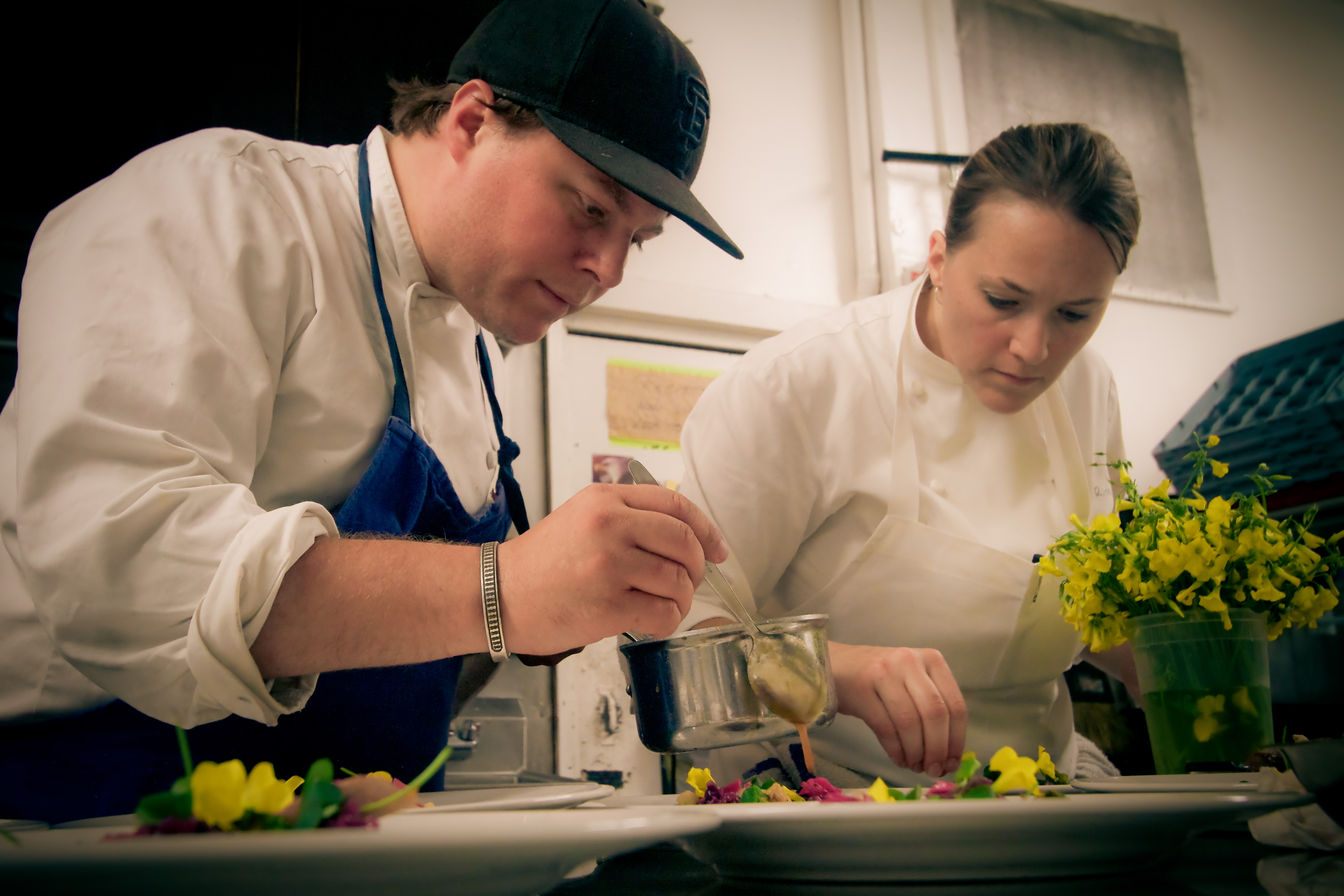
While I was in California the last two weeks, I got to see my daughter and son-in-law’s pop-up dinners first-hand. Not only did I get to give them a little help prepping (We just need to humor poor old Dad.) but also my wife and I got to enjoy the meal that they had prepared. Once again, the dinner was held on Monday night at the restaurant, Radius – a night when the restaurant was usually closed. The space is modern and sparely furnished and located in SoMa, so it attracts a younger crowd, and there were plenty in attendance at the pop-up. The waitstaff were all very capable and friendly. Most of them had known my kids from other venues around town and had volunteered to help on their nights off.

Dad prepping

Evan and Sarah Rich in the kitchen

Of course, as parents of the chef, we were welcomed warmly, but to my eye, everyone was receiving the same attentive service as we were.
The warm-up was a flute of California sparkling wine, Roederer Estate Brut, Anderson Valley, to go with a plate of nearly transparent rice crackers sprinkled with crunchy poppy seeds. Then along came a beautiful amuse bouche of bite-sized corn fritters, nested on a creamy smooth red pepper coulis. The fritters were filled with fresh corn kernels and a creamy filling. They were crispy on the outside because of their coats of artisanal heirloom cornmeal.

Corn fritter and red pepper sauce

Next came a bright salad of tender beets topped with little clouds of goat cheese that had been whipped to an incredible lightness. Flame grapes were displayed along the edges, and snippets of fresh dill fronds made the classic combination of beets and dill.

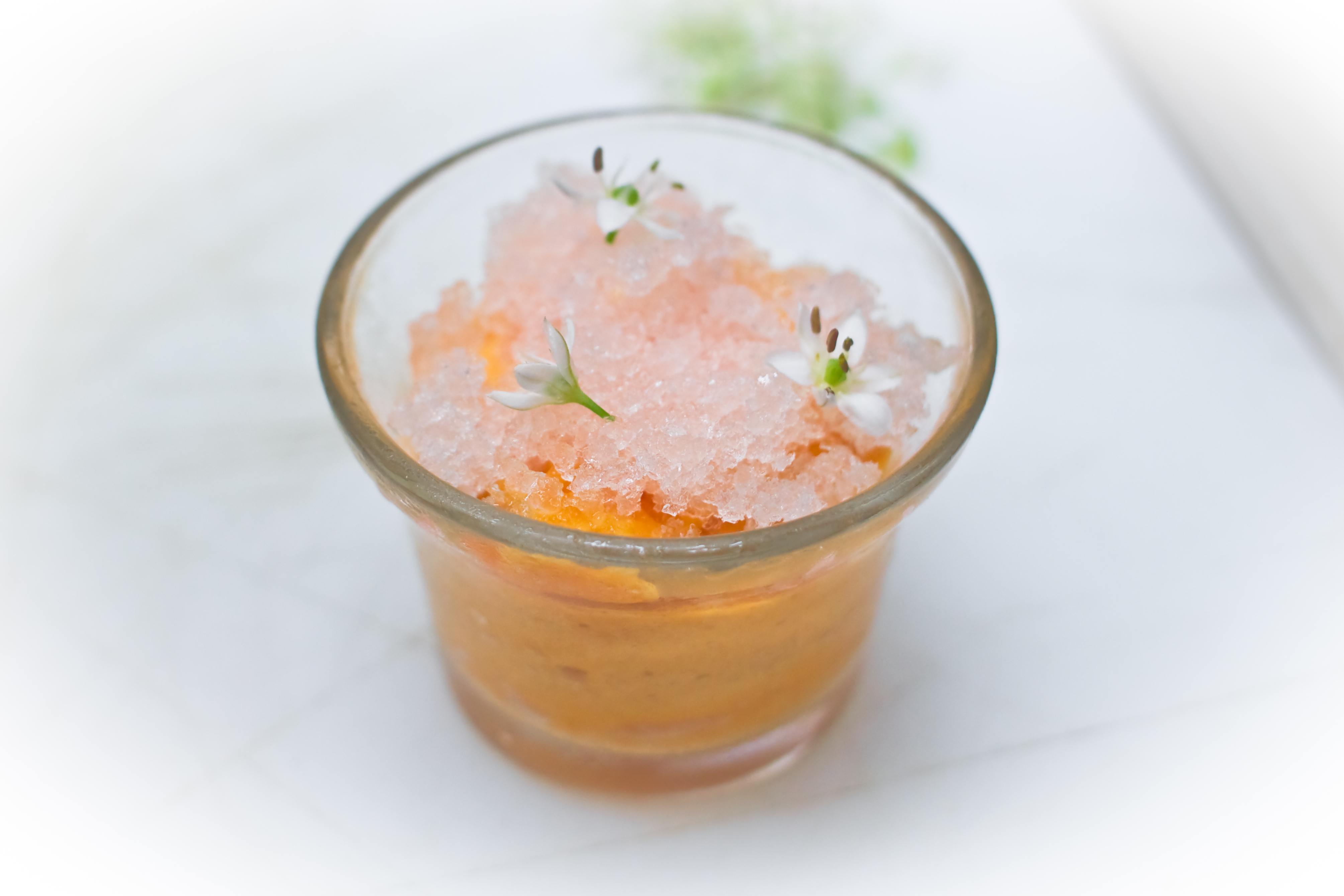
The palate cleanser then made its appearance: a tiny little bowl of gazpacho which had been gelled and infused with air to practically float on the spoon. An icy granite topped the gazpacho, and garlic flowers on top provided the extra bite that made this dish memorable.

Beet and goat cheese salad

Gazpacho with granite and garlic flowers

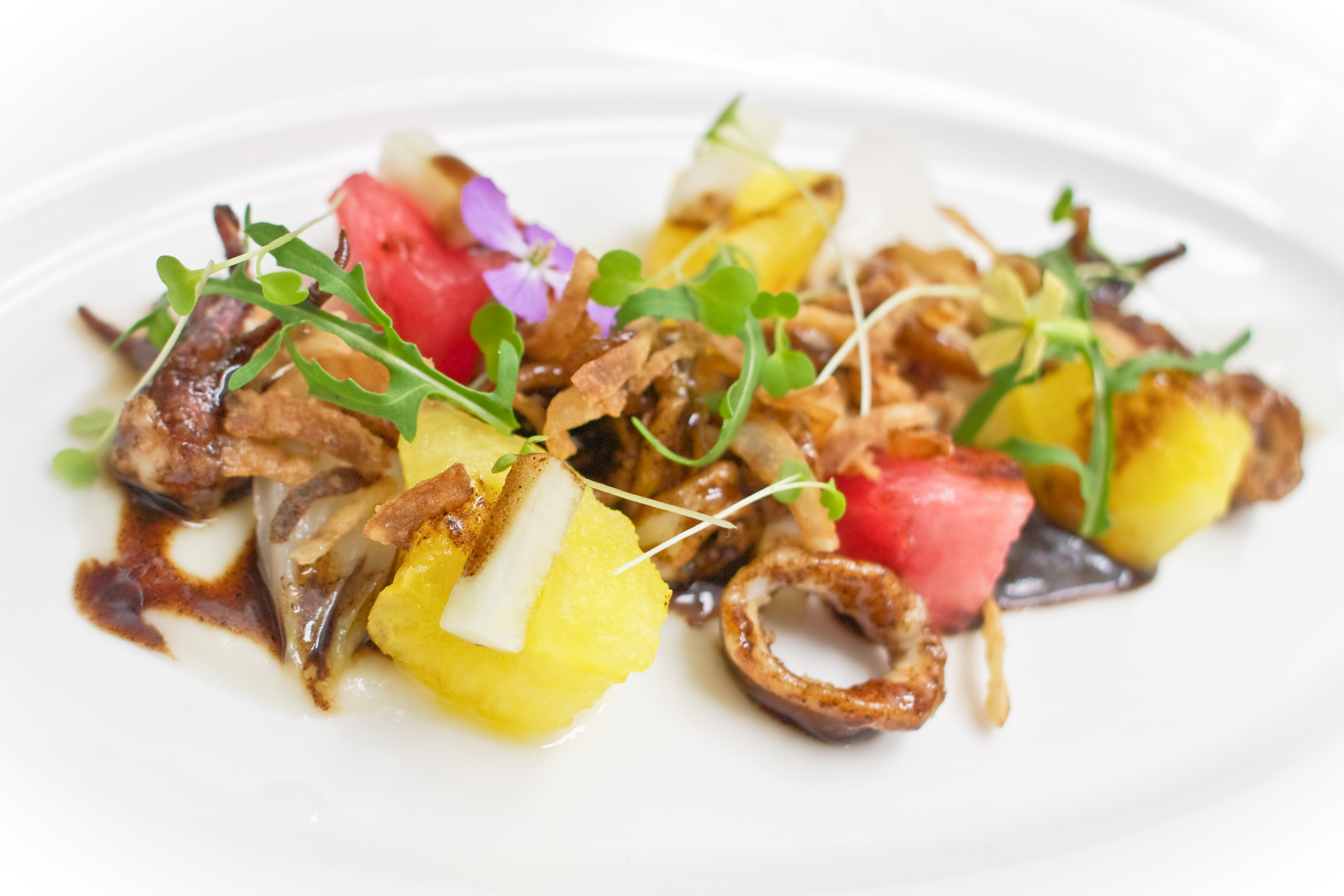
The fish course was composed of perfectly sautéed bites of squid in a black olive vinaigrette and accompanied by the sweetness of red and yellow watermelon and the savor of crispy onions.

The meat course picked up the theme of black with tender, aromatic slices of roasted pork shoulder set in a pool of black garlic puree and covered with a bouquet of edible flowers. Bites of white cauliflower and tiny little heads of Roman broccoli completed the dish. It came with a tray of fennel-pollen-scented baguette. The bread was clearly intended to sop up any extra black garlic. One of the guests at the next table asked for extra bread to make sure his plate was completely clean.

Squid with black olive vinaigrette and watermelon

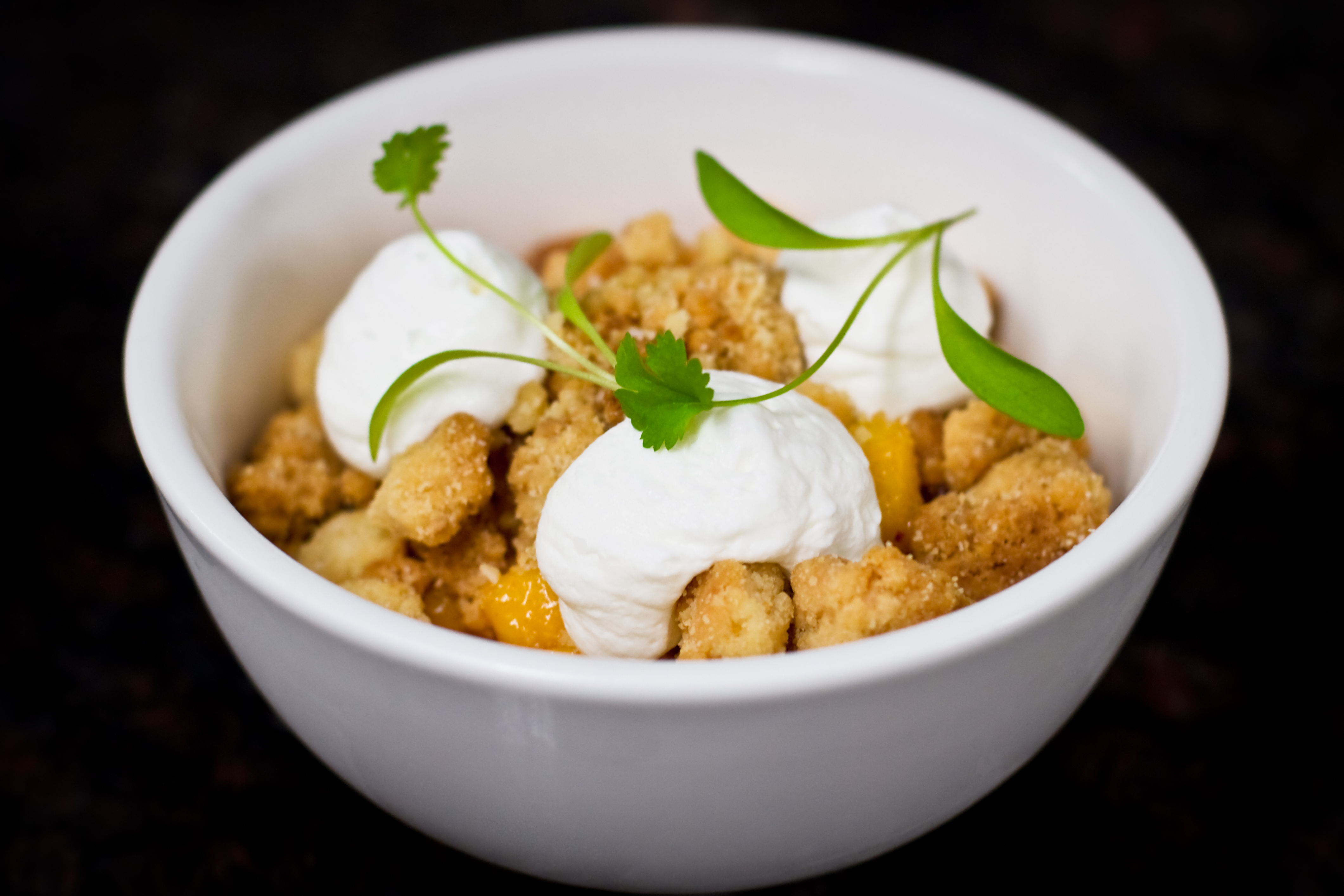
Dessert was labelled as “peach cobbler” on the menu, just to let you know it wouldn’t be your mother’s peach cobbler, and it wasn’t: a delicate panna cotta flavored with baked pie crust, laced with bits of fresh peaches, topped with a streudel that included crunchy bits of corn to return to the theme that started the whole evening.

Then, as if that wasn’t enough, we finished with two beautiful red curls that combined the earthiness of red pepper with the sweetness of candy. It reminded me of the fruit leather of my childhood, but with a sophisticated taste and texture that left those memories far behind.  All in all, it was a wonderful restaurant experience.

I also need to give special credit to two of Sarah and Evan’s friends: Daniel Brooks made these beautiful images while I was busy eating.  Danny is also a private chef in the San Francisco area. Jamie Law has been a constant friend who continues to provide amazing help in publicizing these pop-up events.

"Peach cobbler"

Sarah and Evan will be doing more pop-ups in the near future. If you would like to see the menus or reserve a place, you can check out their Facebook page: http://www.facebook.com/ChefsNightOff or you can email them at chefsnightoff@gmail.com to be put on their mailing list for upcoming events and menus.

2 Comments

Filed under Food, Photography, Restaurants

NOW IS THE TIME TO ROAST PEPPERS

The weather around here is still hot, but the smell of autumn is already in the air. That’s because the chile roasters have set up their stands around the city and have big burlap bags bursting with green chiles to be roasted. There are a couple of popular kinds – Hatch chiles from southern New Mexico and Chimayós from the northern mountains. Whatever the source, the process is the same: the vendor fills up a big mesh cage with fresh chiles and then turns the cage over a blazing hot fire from a blow torch or some other propane-driven device. Gradually the chiles become charred black, and the wonderful, tell-tale aroma wafts into the breezes filling the whole city with this unique smell of early autumn. Then you buy a plastic bag filled with chiles of your choice – mild to incendiary – and take them home to peel and seed and chop (depending upon what you want to do with them) so that they can be frozen away for the winter’s supply for chiles rellenos, green chile cheeseburgers, or just salsa. Of course you can do all of the roasting at home, and many folks do, but we prefer to roast on a much smaller scale.

Red-hot roasting grille

Fortunately, a device has been invented locally to let you roast just a few chiles as you need them. The Santa Fe School of Cooking, http://santafeschoolofcooking.com ,  sells a handy stove-top grill for $29.95. The grill is made of steel mesh stretched across a steel ring with two wooden handles to protect your fingers from the heat. In just a few minutes, you can heat up the grill, char a few chiles, and get ready for a real chile feast. We use the grill for our allotment of Hatch or Chimayó chiles, but we also use it to roast ordinary bell peppers for an easy and delicious appetizer.

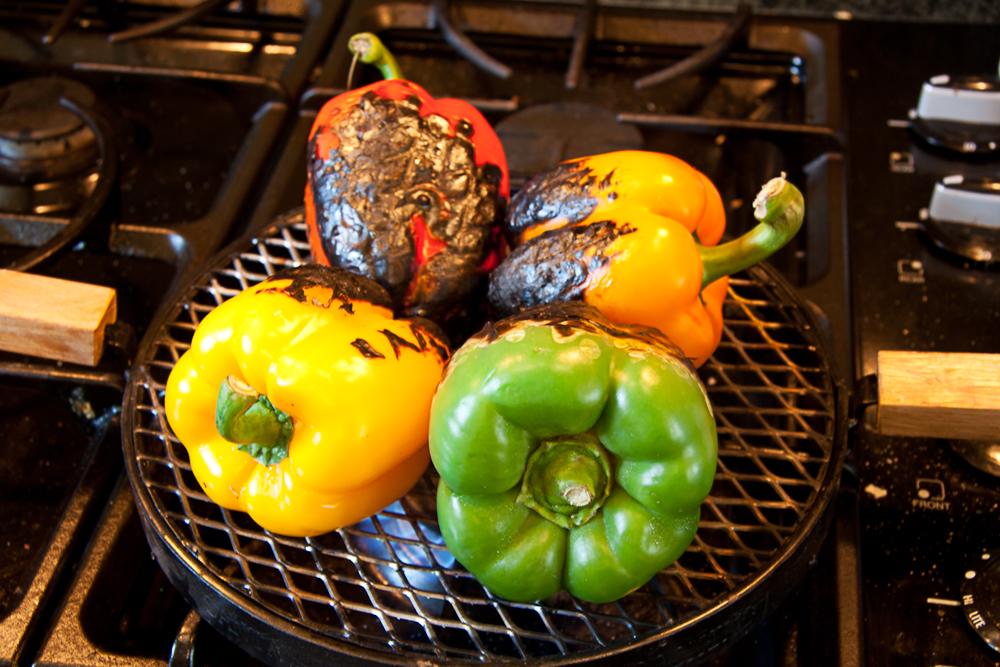
Fresh peppers on roasiting grille

So here’s what you do: Turn your stove burner on high. A gas range works much better than electric. I’m not even sure if you can use radiant heat, because you need to get your grill red-hot. Put the grill over the flame and wait until the steel mesh begins to glow. Then arrange your chiles or bell peppers on top. You can fill up the grill, but don’t crowd it as the skin of every pepper needs to get blistering hot and char. Let the peppers sit undisturbed on the grill until the surface touching the grill has completely charred and turned black. Then turn the peppers to expose another surface. Keep charring and turning until the whole pepper is black. Don’t forget the ends. Put the charred peppers in a plastic bag that can be closed or sealed, and let them cool completely. If you have done your job correctly, the charred skin can be removed easily under a stream of running water. Peel the peppers, core them, and remove the seeds. You are now ready to make smoked peppers in garlic olive oil.

  • 4 roasted bell peppers, preferably one each of green, red, yellow, and orange
  • 3 cloves garlic, peeled and sliced very thinly
  • 1 tablespoon salt
  • 12 to 15  whole black peppercorns
  • extra virgin olive oil, enough to cover the peppers in a bowl

Peppers getting their char

Place the smoked, peeled peppers on a cutting board and cut them into bite-sized pieces. Then place the pepper pieces, sliced garlic, salt, and peppercorns in a bowl that is deep enough to hold them comfortably. Add enough olive oil to cover the mixture, cover the bowl with plastic wrap, and let sit on a kitchen counter at room temperature. Two or three times each day for two days, turn the mixture, re-cover, and let marinate at room temperature.  The peppers should be ready to serve with crackers or thin slices of bread so that each guest can spoon a pepper piece and a little olive oil on the cracker or bread and pop it into his or her mouth. The sliced garlic is good, too.

Marinated peppers with garlic

Yield: Four peppers make enough for 8 persons

Leave a comment

Filed under Food, Photography

STUFFED SQUASH BLOSSOMS

Summer squash season is at its peak in our local farmers market. The same is true for our neighbors who grow a zucchini plant or two. There are lots of delicious recipes for summer squash, but even the biggest fan tends to grow a little weary about now. Zucchini bread and cake can’t be far away. For all of that, now is the time to start cooking with squash blossoms – they are almost as versatile as the fruit itself – you can put them in scrambled eggs, omelets, soups, salads, and quesadillas. But my favorite way to prepare them is to stuff them, dip them in a light tempura batter, and deep fry them.

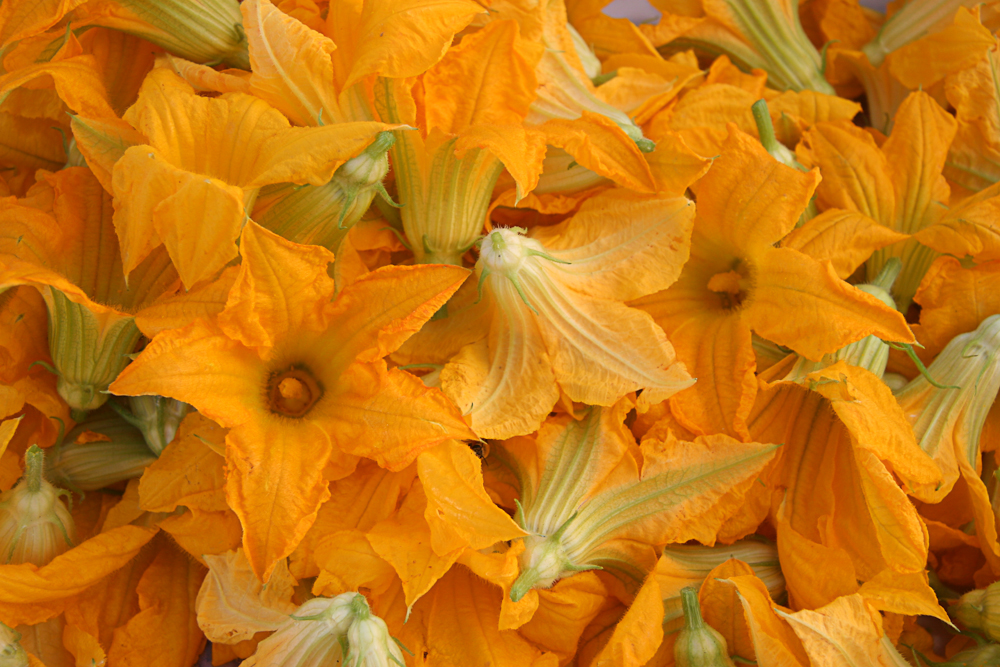
Squash blossoms at the farmers market

Several vendors at our local farmers market specialize in these beautiful offerings, so it is easy to find baskets filled with golden-yellow, delicate blossoms. The farmers usually sell the flowers by the dozen, and you can pick out your choice specimens. If you are a home gardener, you can harvest your own. Select the male flowers (those growing on long stems) so you can keep your harvest of squash (that develop on the female flowers) coming until the cold weather. Whether you buy them or grow your own, you should use the flowers as soon as possible after they are picked. For those from the farmers market, try to use them that same day. They will keep for another day if you keep them in a bag in the crisper of your refrigerator, being careful not to squash them – so to speak.

Some recipes call for removing the long stamen from the center of the flowers before you stuff them, but I prefer to just leave that in (it’s perfectly edible), and my experience is that trying to remove it often leaves you with a mangled flower.

Stuffed squash blossoms ready for batter

When it comes to a choice of stuffing, let your imagination go. Something light probably works best, and don’t use anything that takes a long time to cook, because the battered blossoms will brown in a flash. My favorite stuffing mixtures include cream cheese, good melting cheeses, mushrooms, and nuts.

Stuffed squash blossoms are a perfect accompaniment to cold drinks on the patio, but be sure to make plenty – at least three per person – because they will disappear more quickly than a frosty margarita.

Ingredients
2 Tablespoons butter
4 mushrooms, washed and chopped finely
2 green onions
1/4 Cup unsalted green pepitas, chopped coarsely
1/2 teaspoon salt
1/4 teaspoon black pepper
1/2 teaspoon smoked Spanish paprika
2 ounces cream cheese, room temperature
1/4 Cup Parmesan cheese, finely grated
12 squash blossoms

1 Cup all-purpose flour
2 Tablespoons corn starch
2 teaspoons baking powder
1 teaspoon salt
1 Cup beer, cold
peanut oil for frying

1. In a small skillet over medium heat, melt the butter and then add the finely chopped mushrooms. Cook, stirring frequently, until the mushrooms have released their moisture and it has evaporated.
2. Clean and chop the green onions, including much of the green stems. Then add to the mushrooms, along with the pepitas, continuing to stir frequently for 2 or 3 minutes until the mixture is well combined and evenly cooked. Add the seasonings and remove from the heat to cool.
3. When the mixture is completely cooled, stir in the cream cheese and grated Parmesan, correct the seasoning, and prepare the squash blossoms for stuffing. Do not wash the blossoms
4. One blossom at a time, open the flower gently, spreading the petals so that you can see the deep hollow of the blossom. With your fingers, place about a heaping teaspoonful of the stuffing mixture into the hollow and press it down carefully so that you do not split the petals. Then gently fold the petals over the stuffing, one at a time. You can use a tiny dab of the stuffing mixture to seal the last petal to the little package you have made. Place the stuffed blossom on a plate with the stem pointing straight up.
5. Repeat the process until all the blossoms have been stuffed and arranged on the plate. Transfer the plate to the refrigerator until you are ready to fry the squash blossoms
6. In a medium bowl, combine the flour, corn starch, baking powder, and salt. Then stir in the cold beer. If you prefer, you may substitute a cup of ice water for the beer. The beer will foam up. Don’t worry. The batter will be lumpy. Again, don’t worry – and don’t try to make it smooth.
7. While making the batter, heat enough peanut oil to be about 3 inches deep in a deep-sided pot. Use an instant-read thermometer to make sure the oil is at 350°. You are then ready to fry the blossoms.
8. Remove the blossoms from the refrigerator, dip them in the batter one at a time and transfer them to the cooking oil. You may fry three or four at a time, but be careful not to crowd them. Turn them once while they are frying, and remove them when they are a pale golden brown. Be careful not to let them brown too deeply. Drain them on several thicknesses of paper towels, and serve them immediately while still hot. If necessary, you can hold them for a short time in a 200° oven, but the fresher they are, the better.

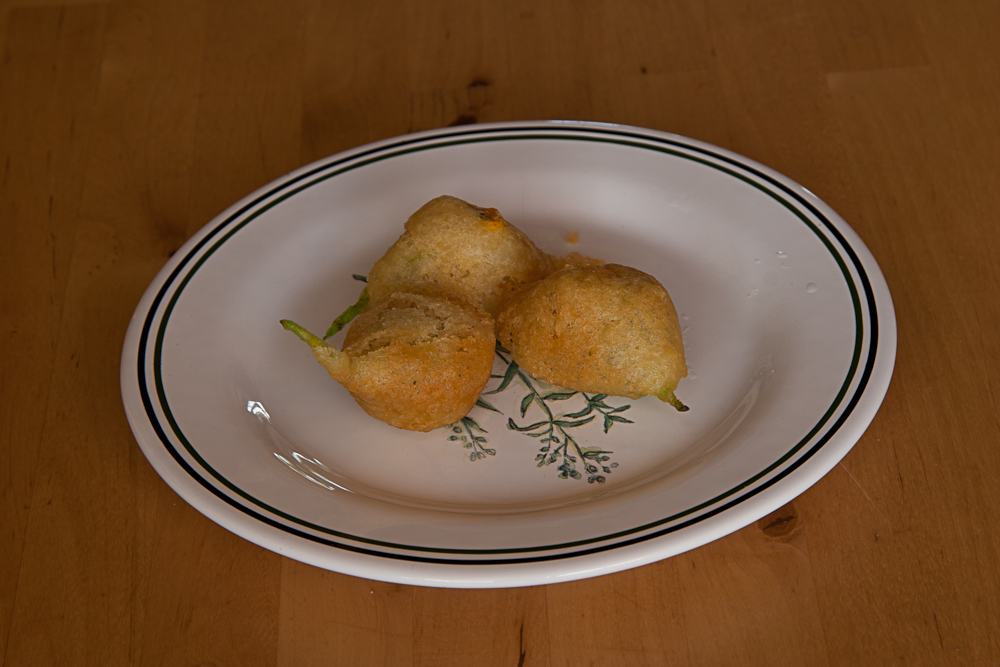
Squash blossoms ready to eat

Yield: Serves four with drinks

4 Comments

Filed under Food, Photography

RETURN OF THE NATIVE – PLANT SOCIETY, THAT IS

Mexican hatsGravlox with Swedish mustard sauceGravlox with Swedish mustard sauce

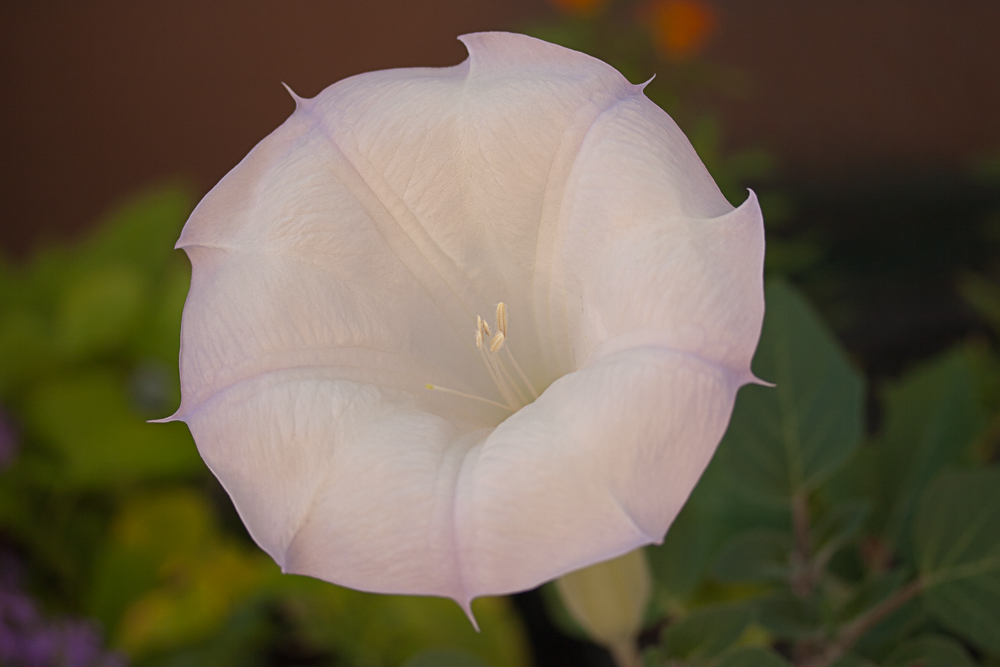
Datura

Butterfly weed

Just the other day we hosted the board of directors of the state chapter of the Native Plant Society. There were forty or fifty people milling around in our backyard, admiring all of the native (and xeric) plants that my good wife has made so much effort to nurture in our drought-plagued high-desert environment. The butterfly weed had begun to fade, but its bright orange flowers created vivid contrasts with the yellows of the evening primroses and desert zinnias. The Mexican hats showed their jaunty heads all around the garden, and the giant blooms of Datura – one of the local “weeds” that Georgia O’Keeffe so favored in her paintings – gradually faded as the evening wore on. Penstemons and salvias attracted the black-chinned and broad-tail hummers even while human intruders marveled at their acrobatics.

Individual caprese with cherry tomatoes

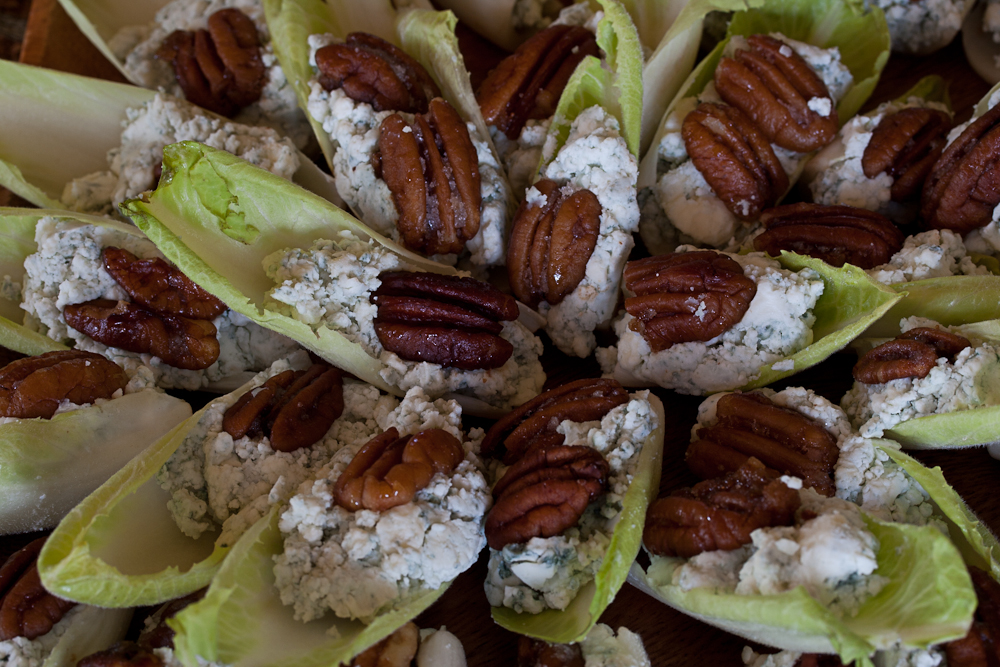
Belgian endive stuffed with goat cheese and pecans

Nature aside, the other highlight of the evening was the food that the local planning committee brought to feed the multitude. I can’t describe them all, but there were beautiful platters of unusual crudités, Vietnamese spring rolls, Belgian endive leaves stuffed with goat cheese and pecans, and little individual capreses made with cherry tomatoes, fresh mozzarella and basil leaves on a stick. My contributions were gravlox made from wild Alaska sockeye salmon, Swedish mustard sauce, and bacon-wrapped dates stuffed with pimentón-dusted marcona almonds. One person worried about possible infections from cured salmon. The risks seem minimal, and there is no consensus on what the risk actually is. Since almost all seafood in our local stores comes to us already frozen, there is probably no risk, but if you are really concerned, freeze it again. The recipe for mustard sauce comes from a dear friend from Sweden.

RECIPES

GRAVLOX

  • 3 to 4 pounds salmon, scaled with skin on (two filets)
  • 1 large bunch fresh dill, washed and shaken dry
  • ¼ cup kosher salt
  • ¼ cup sugar
  • 2 tablespoons black peppercorns, lightly crushed

Gravlox with Swedish mustard sauce

Place  one filet, skin-side down in a deep glass bowl or pan. Cover with the dill. Then sprinkle with the salt, sugar, and pepper. Cover with the remaining salmon filet, skin-side up and cover with plastic wrap. Weight down with a heavy pan or several cans of food, and refrigerate. Turn the fish twice a day for three days. A liquid marinade will develop. Spoon this over the fish as you turn it. Then recover, replace the weights, and return to the refrigerator. When you are ready to serve, remove the salmon from the pan, scrape off the dill and peppercorns, and slice with a very sharp knife held almost flat against the surface of the fish. If you do this correctly, you should get very thin slices without cutting into the underlying skin. A special salmon slicer works best.

ELISABET’S DILL MUSTARD SAUCE
    • ½ cup prepared mustard
    • 3 tablespoons Dijon mustard
    • ¼ cup vinegar
    • ¼ cup sugar
    • ½ cup salad oil
    • 4 tablespoons fresh dill, finely chopped
 Place mustards, vinegar and sugar in a small bowl and whisk until the sugar is dissolved. Add the oil in a thin stream, beating continuously. Stir in the chopped dill. Serve.

1 Comment

Filed under Food, Photography