Category Archives: Recipes

IMPROMPTU PASTA

I’m in San Francisco right now, after the California Chili Cook-Off in Lodi. (More about that in another post.) Last night, Sarah, our chef-daughter, cooked dinner. Originally she planned to go to the grocery store, but ultimately decided to clear out her refrigerator. Needless to say, her made-up dish using leftovers and odds and ends turned out to be better than anything I could have cooked. The dish combines chicken and pork chop (left over from my chili cook-off venture) with pasta in a simple but delicious sauce seasoned with herbs de Santa Fe*. The side dish was a tomato and burrata salad with an herb vinaigrette. It was a delicious dinner with very little fuss.

* Herbs de Santa Fe is a mix of lavender, rosemary, thyme, savory, fennel seed, basil, and marjoram. You could substitute Italian seasoning.

Impromptu pasta

Impromptu pasta

Here’s the impromptu pasta recipe:

RECIPE

Impromptu Pasta

Ingredients

  • 3 tablespoons schmaltz (rendered chicken fat)
  • 2 pork chops, cubed
  • cooked chicken (breast and thigh), cubed
  • herbs de Santa Fe*
  • 1 pint hard apple cider
  • lemon juice
  • olive oil
  • kale, chopped
  • button mushrooms, sliced
  • red onion, diced
  • pasta cooked al dente, drained
  • salt and pepper
  • Parmesan

Method

  1. Heat the schmaltz in a medium sauté pan over medium-high heat. Add the pork and chicken, browning lightly. Stir in the herbs and hard cider and bring to a boil. Reduce the heat to a very slow boil and cook until the liquid is reduced by half. Add lemon juice to taste.
  2. Meanwhile, in a small sauté pan, heat the olive oil. Add the kale, mushrooms, and red onion. Sauté until  cooked through. Set aside.
  3. When the cider has reduced, stir in the sautéed kale, mushrooms, and red onion. Add enough pasta to suit your taste. Correct the seasoning with salt and pepper. Top with freshly grated Parmesan. Serve immediately.


2 Comments

Filed under Food, Recipes

ROASTED GOLDEN BEET SOUP WITH SOUR CREAM AND DILL

Root vegetables are making their mark on the garden scene as autumn begins to blend into winter. All the vendors at the farmers market have an abundance of beets. Even though beets are not among my favorites, it seems a shame not to give them a go. Bright red borscht seems an obvious choice, and for years we have made a clear beet soup that almost gleams. An alternative seemed to be in order. The other thing about red beets is that they stain everything they touch, including your GI tract.

Golden beets seemed like a good alternative choice, and so I bought a nice bunch at a recent farmers market. Even then, there are several choices: beet salad, Harvard beets, or beets and greens. Honestly, the consistency of cooked beets is not pleasing to me, so I opted for soup.

There are a couple of classic partners to beets: dill and sour cream. The recipe below combines those ingredients.

Bunch of golden beets from the farmers market

Bunch of golden beets from the farmers market

Roasted golden beet soup with sour cream and dill

Roasted golden beet soup with sour cream and dill

RECIPE

Roasted Golden Beet Soup with Sour Cream and Dill

Ingredients

  • 1 bunch golden beets, tops removed – about 4 to 5 medium size beets
  • vegetable oil
  • 2 tablespoons olive oil
  • 1 medium onion, chopped
  • 1/3 cup long-grain white rice
  • 2 cups chicken stock
  • water
  • 1/4 teaspoon nutmeg
  • salt and pepper to taste
  • 1/2 cup sour cream + more for garnish
  • 1/2 cup fresh dill fronds, snipped + more for garnish

Method

  1. Wash and dry the beets. Coat generously with vegetable oil and wrap individually in squares of aluminum foil. Place on a baking sheet lined with foil, and roast in the middle of an oven pre-heated to 350 for 30 minutes or until they are easily pierced with a kitchen fork. Remove from the oven, unwrap, and cool until they are easy to handle. The skin should slip off easily between your fingers. Cut the peeled beets into 1/2 inch cubes and set aside.
  2. In a medium saucepan over a medium flame, heat the oil and sweat the onions, covered, for 5 minutes until translucent and the juices have been released. Do not brown. Stir in the rice and cook for a minute or two until the grains are translucent. Ad the chicken stock, and simmer for 30 minutes or until the rice is completely cooked and soft. Add water as needed if the soup is too thick.
  3. Add the beets and simmer for another 10 minutes. Stir in the nutmeg.
  4. Remove from the heat and puree in a blender or with a stick blender until smooth. For aded smoothness, you may pass the puree through a strainer or chinois. Adjust seasoning with salt and pepper.
  5. Stir in the sour cream and dill. Serve hot or cold with a dollop of sour cream and more minced dill as garnish.


6 Comments

Filed under Food, Photography, Recipes

QUINOA CON GANDULES

Quinoa is gaining recognition as a substitute for rice, pasta, and other starches. Most of my experience with quinoa is by itself or as the base for a cold salad. This recipe substitutes it for rice in the traditional Puerto Rican arroz con gandules which I first enjoyed at an office Christmas party in El Paso. One of my co-workers from Puerto Rico brought the dish to the pot luck table. Indeed, arroz con gandules is apparently a traditional Christmas dish.

The hard part of this recipe is finding the gandules aka pigeon peas. They were readily available in El Paso, but not so in Santa Fe. After some detective work, I found a single can on the shelf at the local branch of Talin Market World Food Fare. Quinoa made a great substitute for the rice.

RECIPE

Quinoa con Gandules

Ingredients

  • 1 cup quinoa, rinsed
  • 2 cups water
  • 1 can (15.5 ounces) dry pigeon peas, drained
  • 3 mild snacking peppers, seeds and ribs removed, diced
  • 1 packet Goya Sazón cilantro y achiote
  • 2 tablespoons vegetable oil
  • 1  red onion, diced
  • 2 cloves garlic, peeled and minced
  • ½ cup ham diced
  • ½ cup tomato sauce
  • salt and pepper

Method

  1. Combine the quinoa and water in a medium saucepan. Bring to a boil, stir, cover, and reduce the heat to simmer. Simmer for 20 minutes or until all the moisture is gone. Remove the lid if necessary to finish the cooking. Fluff with a fork, stir in the pigeon peas, diced peppers, and  the Sazón, and set aside.
  2. Heat the oil in a medium skillet over a medium flame. Stir in the onion, garlic, and ham, cooking until the onion is translucent. Add to the quinoa mixture, along with the tomato sauce, and heat over medium flame until everything is warm. Adjust the seasoning with salt and pepper. Serve.

2 Comments

Filed under Food, Photography, Recipes

CREAM OF GLOBE SQUASH SOUP

The weather has definitely shifted to autumn, and the farmers market has begun to wind down. The other day, one of the vendors had piles of different squashes, none of them with labels. I saw a beautiful winter squash that would make a great soup. I thought I was buying a calabaza, but when I got it home it turned out to be a zucchini-like globe squash. Yes, I can hear you saying, “Another zucchini recipe.” I split the squash in half, and roasted it anyway, and it turned out to make a savory soup that was just right for a cool autumn lunch. You can make it vegetarian by using vegetable stock. You could even make it vegan by substituting vegetable oil for the butter and silky tofu for the cream.

RECIPE

Cream of Globe Squash Soup

Ingredients

  • 1 large globe squash
  • 3 tablespoons unsalted butter, melted
  • 1 medium onion, chopped
  • 4 tablespoons olive oil, divided
  • 1/3 cup long-grain rice
  • 2 cups chicken or vegetable stock
  • ½ cup cream
  • nutmeg
  • salt and pepper
  • 1 clove garlic, peeled and sliced thinly
  • 1 slice French bread, crusts removed and cut into cubes
  • mozzarella cheese, grated
  • salted, roasted pumpkin seeds (pepitas)

Method

  1. Cut the squash in half, stem to blossom end, and remove the seeds. Brush the melted butter on the cut surface, and place cut-side down on a lipped baking sheet lined with aluminum foil. Bake for 30 minutes in the middle of a 350°F oven. Check for doneness with a kitchen fork. If the flesh is soft, remove from the oven and scoop the squash into a bowl. Set aside
  2. Meanwhile, in a 4-quart covered saucepan sweat the onions in 2 tablespoons olive oil over medium heat. Do not allow the onions to brown. Add the rice, and stir until the grains have become translucent. Add the stock and bring to the boil. Reduce to the simmer, covered, for 30 minutes or until the rice is completely cooked and soft. Stir in the squash, return to the boil, and then simmer for another 5 minutes.
  3. Remove from the heat, and cool enough to work with easily. Puree with a blender. You may need to work in batches. Return the soup to the saucepan,, add cream, and bring to the simmer. Do not boil. Add nutmeg to taste and adjust seasoning with salt and pepper.
  4. In a small sauté pan, heat the remaining 2 tablespoons olive oil over medium flame. Add the garlic and stir until the garlic starts to brown. Remove the garlic and add the bread cubes. Sauté until crisp and lightly browned. Drain the croutons on paper towels and salt lightly.
  5. Ladle the soup into serving bowls, and garnish with croutons, grated mozzarella and pumpkin seeds. Serve

Leave a comment

Filed under Food, Photography, Recipes

FRIED OKRA

California is experiencing a heat wave, and Los Angeles is especially warm. My grandchildren’s schools decided to close early the other day because of the heat – the 90’s – even though the schools sit on the edge of the ocean with ocean breezes. The classrooms are air-conditioned as well. Never mind, the schools closed and parents were asked to pick up their kids, working or not. This decision set my daughter into a fit of pique, especially because she remembered her days in Louisiana where it gets really hot and humid, and the schools were not air-conditioned because the school board considered that a luxury.

Carol shared her disgust with her siblings via e-mail, and that stimulated a discussion of all the tribulations they endured while growing up. Among these, was the menu in the school cafeteria.

We moved to the South when the two older kids were in elementary school, and they had never had okra. They tasted it for the first time on their first day of school. And the second time…and the third time… and the fourth time… which is to say that stewed tomatoes and okra were served every single day. To this day, none of our kids eats okra.

Okra has a well-earned reputation as being slimy. That is especially so when it is boiled or when it is cooked with stewed tomatoes. As a result of this, many refuse to eat okra even though it is possible to prepare it in such a way as to avoid the slime. Mostly this is done by frying with one or another method.

This last week my wife accompanied me to the farmers market, and for old time’s sake, she bought some okra. The pods were beautiful and small so they promised to be tender and delicious. I deep-fried a batch last night, and neither my wife nor I was disappointed. Not a trace of slime.

Fresh okra pods

Fresh okra pods

Deep-fried okra

Deep-fried okra

RECIPE

Fried Okra

Ingredients

  • okra, leave whole if small or cut into 1 inch slices if larger
  • 1 egg, beaten lightly
  • ½ cup buttermilk
  • ½ teaspoon salt
  • 1 cup all-purpose flour
  • 1 cup yellow cornmeal
  • 1 teaspoon salt
  • ¼ teaspoon ground black pepper
  • peanut oil for deep-frying

Method

  1. Wash okra in cold water and dry on a clean kitchen towel
  2. In a medium bowl, combine the beaten egg, buttermilk, and salt
  3. In a large bowl, mix together the flour, cornmeal, salt and pepper until well combined.
  4. In a deep, heavy pot heat 3 inches of peanut oil to 350° F.
  5. Place the washed and dried okra pods in the egg and buttermilk mixture, coating them completely.
  6. One by one, transfer the okra pods to the flour/cornmeal mixture and then transfer to the heated oil, being very careful not to burn yourself.
  7. Fry the okra pods until they are well browned. With tongs, transfer the fried okra to several layers of paper towel to drain. Salt immediately.
  8. Keep warm in the oven at 170° F until all the okra is fried. Serve while still warm.

Leave a comment

Filed under Food, Photography, Recipes

ZUCCHINI AND FRESH TOMATO LASAGNA

I thought I was finished with zucchini recipes, and then my neighbor brought over three more squash to add to the two in the refrigerator.

That is the origin of zucchini lasagna, which is a riff on eggplant lasagna. I also used fresh tomatoes instead of the usual marinara. With all that squash and fresh tomato, it is easy to anticipate that there is going to be a lot of water. You can deal with that if you plan ahead.

RECIPE

Zucchini and Fresh Tomato Lasagna

Ingredients

  • 5 medium-large zucchini
  • 3 large, ripe tomatoes
  • 2 tablespoons canola oil
  • 1 medium yellow onion, diced
  • 1 pound ground beef
  • 1 pound ricotta
  • 2 eggs
  • 2 cups tomato sauce
  • 3 cups grated mozzarella cheese
  • 2 ounces Parmesan
  • Italian seasoning
  • salt and pepper

Method

  1. With a very sharp chef’s knife, slice the zucchini lengthwise into ¼ inch thick slices. Arrange on a clean kitchen towel covered with several layers of paper towels. Salt the zucchini liberally on both sides and let rest for 45 minutes to release water from the squash. Place the sweated slices in a colander and rinse quickly with running water. Pat dry and set aside for final assembly.
  2. Core and thinly slice the tomatoes. Arrange on a clean kitchen towel to absorb excess water. Set aside for final assembly.
  3. In a large skillet, heat the onions in the olive oil over medium heat until they are translucent. Add the ground beef, and over high heat, brown the meat while stirring frequently to break up any clumps. Add Italian seasoning, salt and pepper to your taste. Drain and transfer to a plate. Set aside for final assembly.
  4. In a medium bowl, stir the eggs into the ricotta until thoroughly combined. Adjust seasoning with salt and pepper. Set aside for final assembly
  5. Assemble the lasagna in a large oven-proof lasagna pan. Spray the pan with cooking spray and then spread 1 cup of the tomato sauce that has been seasoned with salt, pepper, and Italian seasoning to your liking. Arrange a layer of the zucchini slices. Then arrange a layer of tomato slices. Top with half of the ground beef mixture, spreading it evenly. Spread half of the ricotta mixture over the tomatoes and sprinkle with one cup of grated mozzarella. Repeat the process with zucchini, tomato, ground beef, ricotta, and mozzarella. Top with a third layer of zucchini and cover with the remaining cup of tomato sauce, the remaining one cup of mozzarella, and grated Parmesan.
  6. Bake in the middle of an oven preheated to 350°F for 1 hour and 10 minutes. If water from the zucchini and tomatoes has accumulated in the bottom of the pan, pour it off carefully or remove it with a basting bulb.
  7. Let rest for 15 minutes before cutting into serving-sized squares. Serve while still warm.

3 Comments

Filed under Food, Photography, Recipes

MADELEINES AND PROUST

Every week I meet with my writing group to read some interesting poems, write some poetry, and read our work to one another. Sometimes we read bits of really classic writing. Seems like a good platform for reading a little of Swann’s Way from Remembrances of Things Past and thinking about madeleines. Also a good excuse for baking some madeleines. Years ago, I tried making them from one of Julia Child’s recipes, and they were a total flop, so I have never been brave enough to try them again until now. My recipe is a tweek of the version in Marion Cunningham’s Fannie Farmer Baking Book. If you follow the directions carefully, it is an easy effort. You should also have all of the ingredients assembled and equipment at the ready before you start. (remember, mis en place.)

Also, I’ve never read Remembrance of Things Past, so I was anxious to find out what the fuss was all about. Here’s a quote from Proust:

 Many years had elapsed during which nothing of Combray… had any existence for me when one day in winter, on my return home, my mother seeing that I was cold, offered me some tea…She sent for one of those squat, plump little cakes called “petites madeleines,” which look as though they had been moulded in the fluted valve of a scallop shell.. I raised to my lips a spoonful of the tea in which I had soaked a morsel of the cake. No sooner had the warm liquid mixed with the crumbs touched my palate than a shivver ran through me and I stopped, intent upon the extraordinary thing that was happening to me.  An exquisite pleasure had invaded my senses, something isolated, detached, with not suggestion of its origin… I had ceased now to feel mediocre, contingent, mortal. Whence could it have come to me, this all powerful joy? I sensed that it was connected with the taste of the tea and the cake, but that it infinitely transcended those savours, could, no, indeed, be of the same nature.

No wonder everyone wants to  be transformed by a madeleine with tea.

None of the group writes as well as Proust, but I thought we might get some inspiration with a fresh madeleine.

RECIPE

Madeleines

Ingredients

  • 2 eggs at room temperature
  • ½ cup sugar
  • zest of one lemon
  • 1 teaspoon vanilla extract
  • ¼ teaspoon salt
  • 1 cup all-purpose flour placed in a flour sifter
  • 1 stick (8 tablespoons) unsalted butter. melted
  • 4 tablespoons soft butter to coat lining of baking forms
  • confectioner’s sugar (optional)

Method

  1. In a large mixing bowl, combine the eggs, sugar, and lemon zest. Set the bowl in a pan of simmering water. Be sure the level of the water is above the level of the egg mixture. (See my post on seven-minute frosting.) Using an instant-read thermometer, beat on low speed with an electric mixer until the temperature is 130 – 140° F. If it is too cool, the batter will not come together. If it is too hot, the eggs may scramble and you will have to start again.
  2. Remove the bowl from the water bath. Beat with an electric mixer on high speed until the mixture is tripled in volume and is light and fluffy – about 3 minutes.
  3. Stir in the vanilla and salt.
  4. Sift half of the flour over the egg mixture and fold in with a spoon or spatula. Pour in the melted butter, and sift in the remaining flour, folding in gently until the batter is smooth.
  5. Spoon the batter by generous tablespoons into madeleine molds that have been greased generously with the remaining butter. There should be enough batter for 24 regular-sized molds.
  6. Bake for 12 minutes in the middle of an oven that has been pre-heated to 400°F. The edges of the cookies should be golden and lift easily from the molds. Transfer the cookies to a rack to cool. The cookies should be served within a few hours or wrapped and frozen. Sprinkle with confectioner’s sugar if desired.


4 Comments

Filed under Food, Photography, Recipes

TOMATO GRAVY

This time of year, tomatoes are sort of like zucchini except that you can do so many more things with them. Besides, you never get tired of eating the ones from your garden out of hand with a little salt and pepper. On top of that, the season is almost over – at least around here, with color already showing up on the mountains – so you need to take full advantage.

If you are looking for something else to do with your tomatoes, this old-timey, simple recipe is excellent. It is one of my wife’s favorites. She remembers tomato gravy from her childhood. Her mother would often make it for lunch or a light supper, especially when Dad was out of town on a business trip.

Tomato gravy was also a favorite this time of year on our farm in East Texas. I suspect the dish had its origins in the Great Depression. There are several traditional Southern versions using bacon drippings and served over freshly baked biscuits. This is a “Yankee version.”

You can use store-bought tomatoes or even canned tomatoes, but the results will be a pale imitation of tomato gravy made with tomatoes just picked from the garden.

Serves 4 for lunch

RECIPE

Tomato Gravy

Ingredients

  • 2 tablespoons unsalted butter
  • 2 large, ripe tomatoes, sliced
  • 2 tablespoons all-purpose flour
  • 1 cup milk
  • salt and pepper to taste
  • 4 slices toasted bread

Method

  1. Melt the butter in a cast iron skillet over medium heat.
  2. Arrange the tomato slices in the melted butter and sauté over medium heat until soft. Turn once to sauté both sides of the tomatoes.
  3. Stir in the flour and cook for a few minutes to remove the raw flour taste.
  4. Stir thoroughly to make sure the milk and flour are completely mixed. Raise the heat slightly to a gentle boil. Simmer until the sauce is thickened.
  5. Adjust seasoning with salt and pepper
  6. Serve immediately over slices of toast.

9 Comments

Filed under Food, Photography, Recipes

MINI-ME “POPCORN”: POPPED SORGHUM

Our family loves popcorn as a snack. When I was a child, our family made a big batch every Friday evening. When we had our own family, we often made a huge bowl to snack on while we watched a movie on TV. Now all of our children frequently make a batch of popcorn regularly. Our daughter-in-law adds some nutrition to the mix by sprinkling it with yeast powder.

So I was intrigued when Sarah and Evan introduced me to popped sorghum. I had never seen it before.  Sorghum  is a grass that first came from Africa, but is now cultivated world-wide and used as a grain or forage. It is used for flat breads, syrup/molasses, and the production of ethanol. It comes as pepper-corn-sized grains that pop up into little puffs that look just like miniature popped popcorn kernels but have a nuttier taste than regular popcorn. Otherwise, you prepare the two just the same – in hot oil, in a paper bag in the microwave, or with an air popper. Then you can eat plain, salt, add butter, or flavor to your preference.

Sarah and Evan use popped sorghum in creative ways with fresh tomatoes, roasted pecans, pasta, etc., etc. I am not that creative. Besides, I fall back on my childhood ways and just like to eat it with melted butter out of a big bowl.

If you want to give popped sorghum a try, you can order it on the internet from Mini Pops, Inc., Stoughton, Mass.. (Three pounds for $8.49 plus shipping)

RECIPE

Popped Sorghum

Ingredients

  • ¼ cup sorghum grain
  • (3 tablespoons vegetable oil if popping in a saucepan)
  • salt and oil or melted butter to taste

Method

  1. Place sorghum grains in a brown paper lunch bag. Fold the top of the bag and fasten with two staples three inches apart to prevent arcing.
  2. Place the paper bag in a microwave oven (preferably with turntable) set on high for 3 minutes.(It will probably take 2 minutes or less to complete the popping)
  3. Start the microwave and listen carefully to the sound of popping. As soon as it slows down, remove the bag from the microwave. Don’t hesitate or you will wind up with burned kernels.
  4. Transfer to a serving bowl and season with salt and oil or melted butter as desired.
  5. Alternatively, heat 3 tablespoons vegetable oil over high heat in a heavy bottomed 4-quart saucepan with tight-fitting lid. Add 5 grains of sorghum.
  6. When the sorghum grains pop, add the remaining sorghum and cover the pan with the lid.
  7. Shake the pan gently over high heat. Listen for popping. When it slows, remove the pan from the burner, and transfer the popped sorghum to a serving bowl and season as desired.

4 Comments

Filed under Food, Photography, Recipes

CHOCOLATE ZUCCHINI CAKE AND MOCHA SEVEN-MINUTE FROSTING

This is my last blogging effort with zucchini, having chopped, grated, boiled, sautéed. and baked our neighbor’s zucchini in virtually every way I can think of. The beauty of this recipe is that it uses up a fair amount of zucchini and produces a moist cake that doesn’t taste like zucchini.

You will see clearly from the images, that I am a rank amateur when it comes to cake baking, but the opposing view is that anyone can bake this cake. Part of my problem may be that I revised a sheet cake recipe from a useful little baking book if you live at a high altitude, High Altitude Baking edited by Patricia Kendall and published by Colorado State University Cooperative Extension, 2003. If you live at sea level, you will probably need to increase the baking powder.

This post will also have some tips on what cookbooks describe as “that easy, no-fail American classic”, seven-minute frosting. The first time I ever attempted this recipe was when I was about 12 years old. I had decided to surprise my mother with a birthday cake since everyone else in the family got their own birthday cake made by her. After everyone had gone to bed, I moved utensils and ingredients for a cake into the garage. Everything turned out ok except for the seven-minute frosting which the next morning fell off the cake in great blobs. Since then I have tried making the frosting many times without success. Finally, I have learned that my failures can be traced to inadequate instructions. That deficit has been corrected by Ethan Becker in his complete revision of his grandmother’s classic. Check out his instructions in The All New Joy of Cooking, (Scribner, New York), page 1001

Here are Ethan Becker’s tips: 1) Use a stainless steel bowl or double boiler instead of glass as glass heats too slowly, and the top of the cooking frosting (actually a meringue) cools too quickly to cook completely. 2) Immerse the bowl or double boiler pot so that the water level is at the level of the frosting mixture. 3) Make sure the eggs are at room temperature before beginning the process. 4) Do not stop beating the mixture while it is in the hot water bath or the egg whites will overcook. 5) Use an instant read thermometer and be sure the mixture reaches 140° F. 6) Don’t add the vanilla or other flavorings until you have finished beating the frosting.

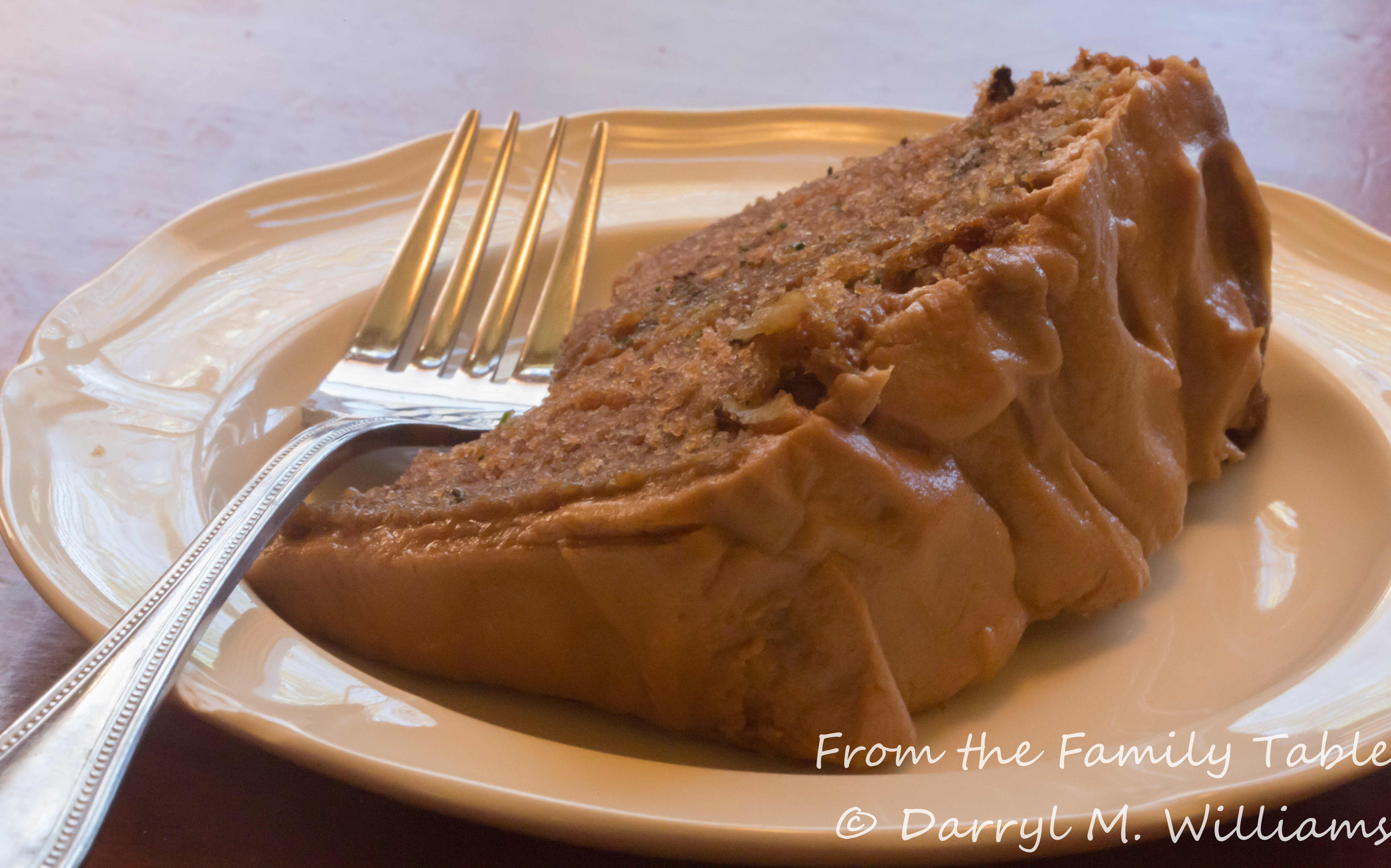
Chocolate zucchini cake with mocha seven-minute frosting

Chocolate zucchini cake with mocha seven-minute frosting

A piece of cake

A piece of cake

RECIPE

Chocolate Zucchini Cake

Ingredients

  • 2½ cups all-purpose flour
  • 1½ teaspoons baking powder (*NB: at sea level you may need to increase to 2 teaspoons)
  • 1 teaspoon baking soda
  • 1 teaspoon salt
  • ¼ cup unsweetened cocoa
  • ½ cup unsalted butter, softened
  • 1¾ cup sugar
  • 2 large eggs
  • ½ cup buttermilk
  • ½ cup vegetable oil
  • 1 teaspoon vanilla extract
  • 2 cups grated zucchini (no need to peel)
  • 1 cup coarsely chopped walnuts

Method

  1. Grease and flour two 9-inch cake pans. Set aside.
  2. In a medium bowl, toss together the flour, baking powder, soda, salt, and cocoa. Set aside.
  3. In a large bowl, cream the butter and sugar, using an electric mixer. Beat until fluffy.
  4. One at a time, beat in the eggs. Then add the buttermilk, oil, and vanilla, beating after each addition until completely mixed.
  5. By thirds, beat in the dry ingredients. Then beat in the shredded zucchini, making sure it is completely incorporated into the batter.
  6. Stir in the chopped walnuts.
  7. Divide the batter equally between the prepared cake pans. Bake in the middle of an oven pre-heated to 350° F for 40-45 minutes or until a toothpick inserted in the center comes out clean.
  8. Remove the pans to a cooling rack for 5 minutes. Then run a thin metal spatula around the rims of the cake pans and turn out the cakes onto a rack to cool completely before frosting.
  9. When the cake is completely cooled, frost with the following seven-minute frosting.

Mocha Seven-Minute Frosting

Ingredients

  • ¾ cups sugar
  • ½ teaspoon cream of tartar
  • 1/8 teaspoon salt
  • 2 egg whites
  • ¼ cup cold water
  • 2 teaspoons vanilla extract
  • 1 tablespoon unsweetened cocoa
  • 1 tablespoon instant espresso coffee

Method

  1. In a large stainless steel bowl or in the top of a stainless steel double boiler, whisk together the sugar, cream of tartar, salt, egg whites, and cold water.
  2. Place the bowl in a large pan or the bottom of the double boiler with simmering water adjusted so that the level of the water is at or above the level of the frosting mixture.
  3. With a hand-held electric mixer, beat for 5 to 7 minutes or until the temperature of the mixture reaches 140° F or the frosting stands in peaks.
  4. Remove from the water bath and continue to beat for 2 minutes more until the frosting stands in smooth peaks.
  5. Beat in the vanilla, cocoa, and coffee powder.
  6. Cool slightly and then frost the cake. There should be plenty for two 9-inch layers.
  7. If this “no-fail” does fail, you can “rescue” it by beating in ¼ -½ cup of confectioner’s sugar.

7 Comments

Filed under Food, Photography, Recipes