Category Archives: Recipes

POPOVER – POPUNDER

Popovers – when they work – are one of the easiest and most impressive quick breads. When they don’t work  they often wind up as a doughy lump that no one wants to eat.

There has been a lot written about what it takes to make a successful popover.

Some insist that the oven needs to be hot. Others say it works just as well to start the popovers in a cold oven. Still others say that the batter needs to be poured into a hot pan before it is put in the oven. I have not done an exhaustive study of the issue, but for me pouring room-temperature batter into a pan that has been heated in the oven as the oven gets to baking temperature has always worked.

Some say that you should only use a special popover pan, usually with six cups. Others say a 12-place muffin pan works better and you wind up with twice as many popovers. Again, I haven’t done a scientific study, but either seems to work just fine.

Some say that the pans must be heavily buttered with at least a tablespoon of butter in each cup. Others say that a little salad oil in each cup works just fine. I have tried both, and while I don’t know the real food chemistry, I believe that a good coat of a solid fat like butter is important to let the batter creep up the sides of the cup. I have had successes and failures with oil, but a good coating of butter (although not the mega dose that some recipes call for) always seems to work.

Some say that a lower constant baking temperature works just as well as a beginning hot temperature reduced to a lower temperature. I favor the latter. I’ve watched through an oven window with the light on many times, and the popping seems to be over at the end of 15-20 minutes of high temperature baking. The lower temperature crisps the popovers without burning them.

Some say you should pierce the popover half way through the baking to make sure the inside loses its “eggy” consistency and flavor. I think that can be dealt with by just baking the popovers a little longer.

You can use different flours or add a teaspoon of grated cheese or other flavoring, but the popovers will probably not rise as impressively.

Finally, I also believe that a well-mixed smooth batter at room temperature is key to success.

Here are some popovers Carol and I made during our recent visit in her home.

Hot from the oven

Hot from the oven

RECIPE

Popovers

Ingredients

  • unsalted butter to coat the baking cups generously (6-space popover pan or 12-space muffin pan)
  • 1 cup all-purpose flour
  • ½ teaspoon salt
  • 2 eggs, beaten
  • 1 cup milk (whole, 2%, 1%, or skim will all work)
  • 1 tablespoon melted unsalted butter

Method

  1. Generously coat the cups of the preferred baking tin with butter. Place in the middle of the oven and turn the oven on to 450°F to heat the pan and the oven.
  2. In the meantime, Combine the four and salt in a 4-cup measuring cup or a large mixing bowl with a pouring spout.
  3. Beat the eggs until light and well-mixed. Stir in the milk and butter. Add the liquid mixture to the dry ingredients.
  4. With  a whisk or mixer beat the batter for a minute or two until well-blended and smooth.
  5. When the oven has reached temperature, remove the heated baking pan to a trivet or heat-proof surface.
  6. Fill each baking cup 1/3 to 1/2 full, distributing the batter evenly to all cups. If you misjudge and run out of batter, you can use a large spoon, moving quickly to redistribute the batter more evenly.  Return the filled baking pan to the middle of the oven
  7. Bake undisturbed for 20 minutes. Then reduce the oven temperature to 350°F and bake for an additional 20 minutes.
  8. Remove from the oven. Loosen each popover by running a thin knife around the edge, and transfer to a serving basket. Serve immediately while still warm, with lots of butter and/or jam.
  9. Yields 6 popovers baked in a popover pan or 12 popovers baked in a muffin pan.

4 Comments

Filed under Food, Photography, Recipes

OYSTER AND ARTICHOKE SOUP

While working on my recent post about baked oysters New Orleans style, I got to thinking about all of the food I have enjoyed focused on oysters: oysters on the half-shell, oysters Rockefeller, oyster po’boys, etc., etc. I also got to thinking about all of the good meals I have enjoyed in New Orleans.

One outstanding oyster dish from New Orleans immediately came to mind: Potage Le Ruth, invented by Chef Warren Leruth and served at his fabled Le Ruth’s Restaurant on the West Bank in Gretna. Before he opened his restaurant, Leruth had gained recognition  as a baker, chef and food innovator. He had been personal chef to General Clark when he was in the army in Korea, and he helped to develop the famous Duncan Hines cake mixes at Proctor & Gamble. So it was not surprising when he decided to open his own place in his home town.

New Orleans is one of those cities where everyone wants the latest gossip about new restaurants and hot places to go. When Le Ruth’s opened in 1966, it caught everyone’s attention with its creative cuisine. Food critics at the time said that Leruth rescued New Orleans dining from itself because all of the old-line restaurants had started to rest on their reputations and the food had become more or less the same. Le Ruth’s changed all of that and soon gained the reputation as being undoubtedly the best restaurant in the city. That was evidenced by the difficulty in snagging a reservation.

It was not the easiest place to get to. You could use the bridge over the Mississippi River, but it was far easier to ride the Gretna ferry from the foot of Canal Street and then catch a cab to the restaurant.

I remember clearly the first time I ever ate at Le Ruth’s. A group of colleagues and I were attending a business meeting in downtown New Orleans. We had made our reservations well in advance, and everyone was looking forward to the experience. We found our way to the restaurant, took our seats at the table and, ordered wine. One of the group stuck two of the corks from the wine bottles in his nostrils  when they were offered to him. He announced that the wine was perfect. We all laughed, but two distinguished ladies at the next table raised their eyebrows. I don’t exactly recall, but I believe that at least the wine taster had spent a sizeable part of the afternoon on Bourbon Street.

It is a good thing we didn’t get tossed out. Le Ruth had the reputation for responding to critical letters with scathing rebukes from an “anonymous” diner. For folks who gave real offense, he would assign four waiters to the corners of the tablecloth of the miscreant. At a signal, they would lift the cloth to form a sack of food, dinnerware, and wine while Leruth would announce that he “had picked up the check” and summarily declare, “Get out of my restaurant!” I am certain that Warren Leruth would know how to handle the current generation of whiners on Yelp.

Le Ruth’s served many delicious and unique dishes, but perhaps the most famous was Potage Le Ruth. Unfortunately, to my knowledge there is no extant authentic recipe. Leruth said that he had  the original locked up in a vault. Nevertheless, imitations – none as good – soon showed up on the menus of most of the other high-end restaurants in New Orleans. Then recipes for oyster and artichoke soup began to appear in local newspapers. Many of the knock-offs used cream, but Leruth bragged that his recipe contained no cream.  The soup is a sort of rich velouté based on a blond roux, so you really shouldn’t need cream.

Surprisingly, some food writers say that Leruth used canned artichokes. My version does, too, although respected New Orleans chefs insist that only fresh artichokes, properly cooked and prepared, will do. If you want to use fresh artichokes, probably four medium are about right. My version is adapted from a recipe that appeared in one of the Shreveport newspapers of the time. Be advised that it is not the real thing. I have taken the additional liberty of adding some whole oysters in the style of an oyster stew. Even though it lacks authenticity, I think you will find it a most delicious soup.

RECIPE

Oyster and Artichoke Soup

Ingredients

  • 4 tablespoons unsalted butter
  • ½ medium onion, chopped finely
  • 1 rib celery, chopped finely
  • 1 small carrot, peeled and chopped finely
  • 14 ounce can artichoke hearts, quartered
  • 3 cups hot fish stock
  • ¼ teaspoon ground thyme
  • 1/8 teaspoon ground bay
  • 1/8 teaspoon cayenne
  • 1 teaspoon salt
  • 1 teaspoon Worcestershire sauce
  • 1 pint oysters
  • 1 teaspoon white vinegar or lemon juice (about)
  • 1 pinch sugar (about)
  • ¼ cup madeira

Method

  1. Melt butter in the bottom of a heavy soup pot over medium heat. Add the onion, celery, and carrots and sauté until the onions are translucent and the other vegetables have wilted. Do not brown.
  2. Add the flour and continue cook over medium heat and stirring frequently until the flour is completely incorporated and the raw taste has disappeared, about 2 minutes.
  3. Drain the artichokes and add to the sautéed mixture.
  4. Stir in the hot stock, thyme, bay, cayenne, salt and Worcestershire sauce. Simmer partly covered for 45 minutes.
  5. Strain the oysters in a fine-mesh strainer to remove any bits of shell and sand, saving the liquid. Set aside about half the oysters to be stewed later, and chop the remainder. Add the chopped oysters to the oyster liquor and then stir into the simmering soup, cooking for another 10 minutes below the boil
  6. With an immersion blender, blend the soup until smooth. Correct seasoning with vinegar and sugar. Add the madeira. If you wish, at this point you may strain the soup through a chinois for an especially smooth soup, or you can omit that step.
  7. Return the soup to medium-low heat and stir in the remaining oysters, cooking until they are firm and the edges are curled.
  8. Serve immediately or cool to serve later. Then, reheat to the boiling point and serve immediately. Grilled farm-style bread makes a good accompaniment.

2 Comments

Filed under Food, Photography, Recipes, Restaurants

THREE CITIES OF SPAIN CHEESECAKE

Mothers’ Day and Susan’s birthday coincided this year, so during our visit to Los Angeles, Carol needed a dessert for our celebration. One of Susan’s favorites is cheesecake, and this is one of Carol’s favorite recipes.

She originally found it in Gourmet magazine, and it has been published widely since then in other magazines and on the internet.

But everyone (or nearly everyone) gives credit to the Three Cities of Spain coffee house in Santa Fe for the original. Many years ago, the popular artists’ street, Canyon Road, was a narrow dirt road heading up the canyon from Paseo de Peralta. The Santa Fe artists’ colony was experiencing a boomlet in the 1950s-1970s, and this was one of the places on Canyon Road where the struggling artists hung out, drinking coffee, smoking, and eating cheesecake. There were nearby bars for more serious drinking at night.

For reasons unknown to me, Three Cities of Spain closed in the 1970s, Canyon Road was paved, and the old adobe home which housed the coffee house was transformed into Geronimo, one of the best and most famous restaurants in Santa Fe. The restaurant was named after the man who built the house in 1756.

I think you’ll like the cheesecake.

hree Cities of Spain cheesecake after the first baking

Three Cities of Spain cheesecake after the first baking

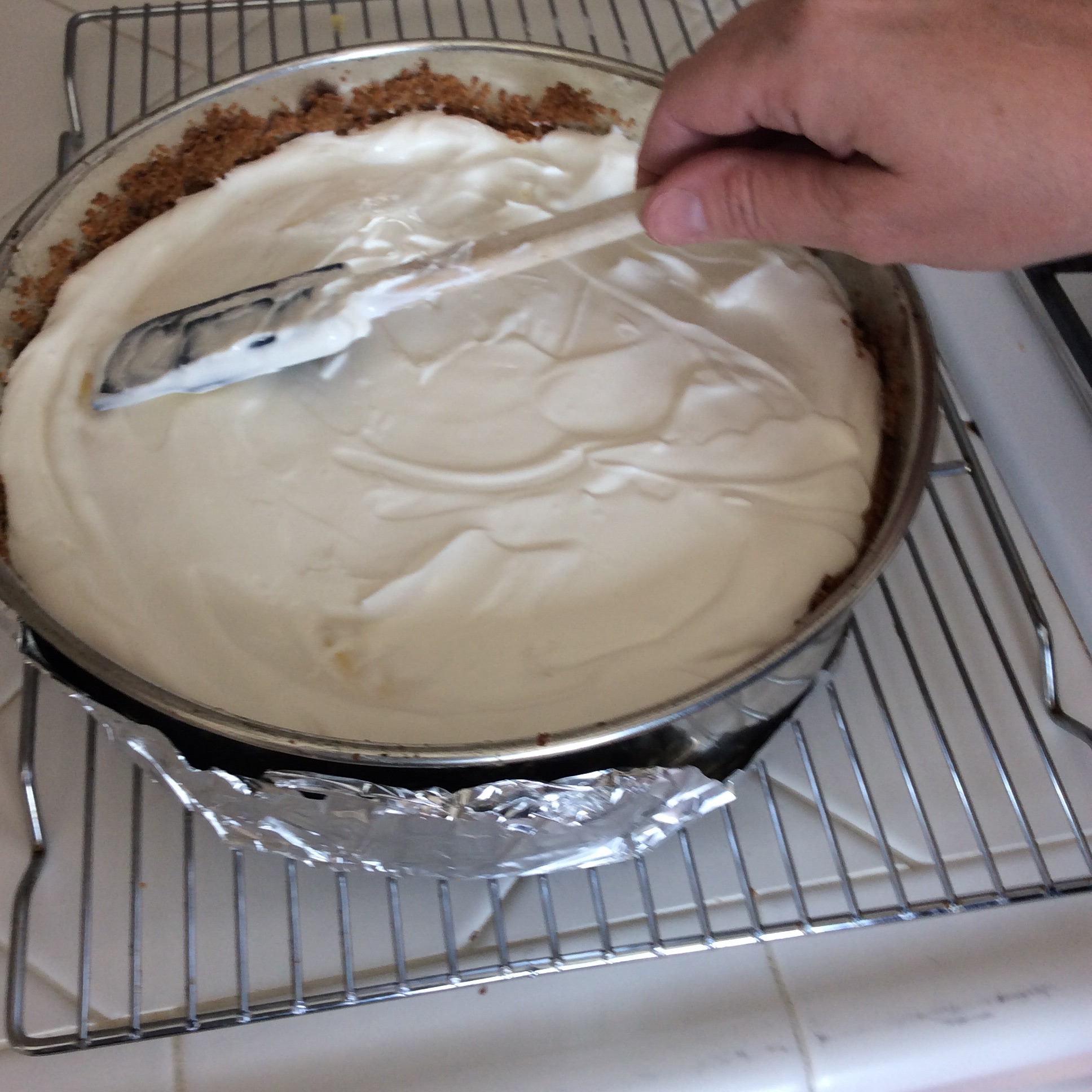
Spreading on the topping.

Spreading on the topping.

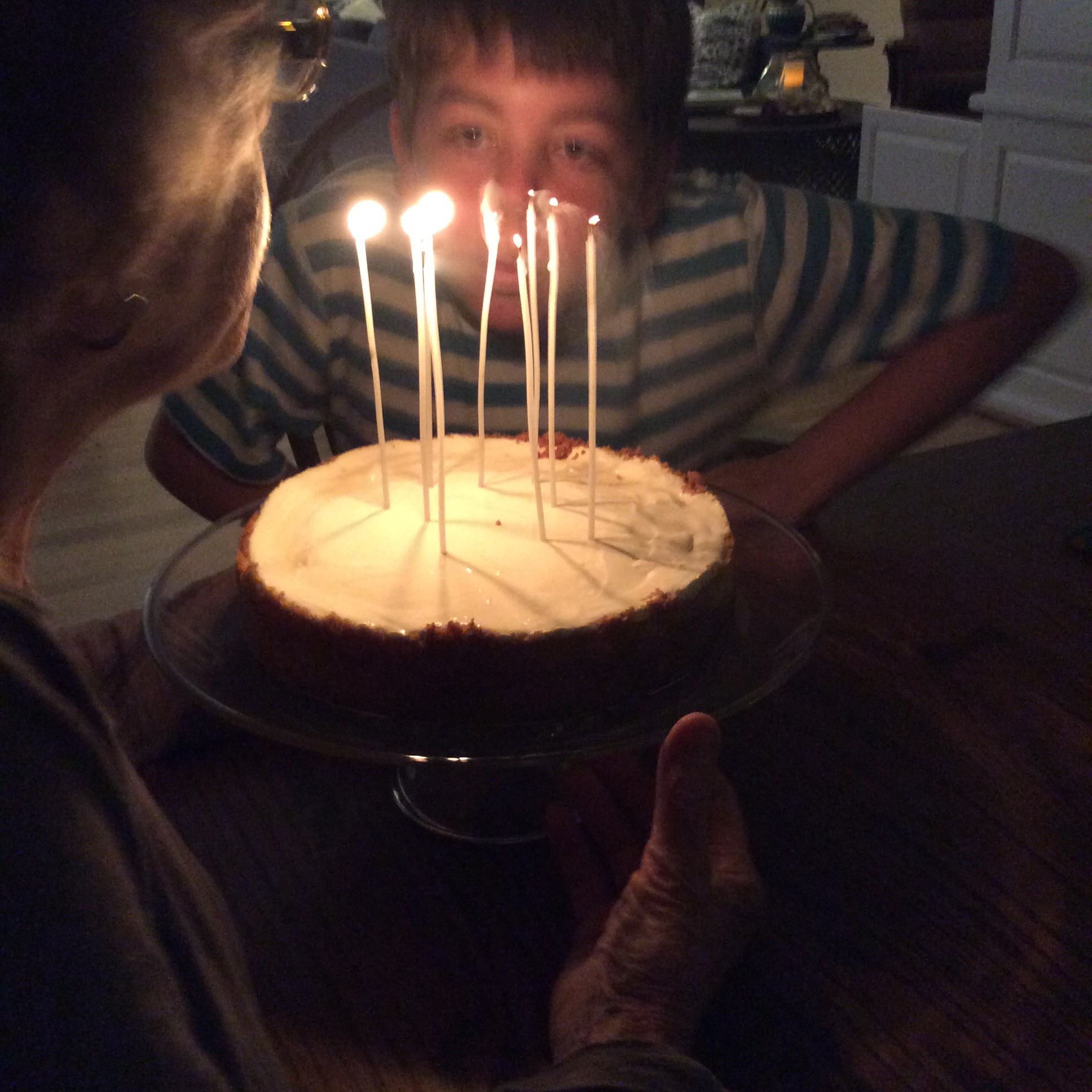
Birthday candles for more mature adults

Birthday candles counted out for more mature adults

Blowing out the candles

Blowing out the candles

Cheesecake with berries

Cheesecake with berries

RECIPE

Three Cities of Spain Cheesecake

Ingredients

CRUST

  • 11 graham crackers, ground fine (1½ cups)
  • 1/3 cup unsalted butter, softened
  • 1/3 cup sugar
  • 1/8 teaspoon salt

FILLING

  • 24 ounces (3 packages) cream cheese, softened
  • 4 large eggs
  • 1 teaspoon vanilla
  • 1 cup sugar

TOPPING

  • 16 ounces sour cream
  • 1 tablespoon sugar
  • 1 tablespoon vanilla
  • berries (optional)

Method

  1. Stir together crust ingredients. Sprinkle half of mixture onto the bottom of a buttered 9½ inch springform pan. Then press the mixture up the side of the pan about 1¼ inches. Sprinkle and press the remaining half of the mixture into the bottom of the pan.
  2. With an electric mixer, beat the cream cheese until light and fluffy. Then beat in the eggs, one at a time. Beat in the vanilla and sugar until just combined.
  3. Pour the cream cheese and egg filling into the crust. Bake for 45 minutes at 350ºF or until the center of the cake is set.  Cool on a rack for 5 minutes.
  4. Stir together the topping ingredients.  Drop by spoonfuls around the edge of the cake and spread gently into the center.
  5. Return to the 350ºF oven for another 10 minutes.
  6. Remove from the oven and cool completely on a baking rack before chilling overnight in the refrigerator.
  7. Serve at room temperature with or without optional berries.

4 Comments

Filed under Food, Photography, Recipes, Restaurants, Travel

BAKED OYSTERS NEW ORLEANS STYLE

At the end of our train trip from Seattle to Los Angeles, we spent a few days with our daughter, Carol, and her family. She is an excellent cook, and she always tries to make some interesting food during our visits. She also knows that Susan loves oysters, and since she grew up in Louisiana, New Orleans style baked oysters seemed perfect – even though it is May. The recipe in her recipe box is called Oysters Mosska, undoubtedly so as not to get in trouble with Mosca’s restaurant in the New Orleans suburb of Westwego and home to the eponymous Oysters Mosca.

Mosca’s is one of the old-line favorite restaurants of local residents, having opened in 1946 and operated by the same family ever since. Part of its charm is that it is not easy to find. It is on Highway 90 a ways after you cross the Huey P. Long Bridge, but it sits back from the road, is a low-slung white-painted clapboard building that looks more like a house, and has only a small, dimly lit sign. When we were living in Louisiana, I drove right by it more than once. An interesting story is that the place was where everyone went after a night spent in the gambling houses that populated this now-lonely stretch of road. As well, rumor has linked the restaurant to the local Mafia, but the Moscas have neither confirmed nor denied that rumor.

Once inside, you are struck by the liveliness of the place. It is brightly lit and filled with families enjoying themselves. Even with a reservation you may have to wait on the straight-backed chairs lined up against the walls.

Th menu is fairly limited but filled with Italian standbys that all have a full quota of garlic. Virtually every table has at least one order of Oysters Mosca. In the old days, the dish would be served in a metal cake pan, and each diner would fish out his or her helping of succulent oysters.

To my knowledge the family has never provided an authorized version of the recipe for Oysters Mosca. We have a made-up version in our family cookbook that is a close approximation. As I mentioned above, this version comes from Carol’s recipe collection and is labelled “Oysters Mosska”, I suspect to protect against any accusations of copyright infringement.

If you do decide to visit the restaurant, be advised that they do not accept checks or credit cards – cash only. But they do have a convenient ATM inside the dining area.

Oysters cooking in liquor/beef stock sauce

Oysters cooking in liquor/beef stock sauce

Ready for the oven

Ready for the oven

Ready to serve

Ready to serve

Baked oysters New Orleans style

Baked oysters New Orleans style

RECIPE

Baked Oysters New Orleans Style

Ingredients

  • 1 tablespoon vegetable oil
  • ¼ cup yellow onion, diced
  • 1½ tablespoons garlic, chopped
  • 1 pint shucked oysters with liquor
  • 1 cup beef stock
  • 1 tablespoon parsley, finely chopped
  • Creole spice
  • salt and pepper
  • 1 cup bread crumbs
  • 2 tablespoons Parmesan cheese, freshly grated
  • 1 tablespoon basil chopped
  • 1 tablespoon olive oil

Method

  1. n a saute pan over mediu heat, cook onions untile translucent. Then add garlic and stir for about 1 minute.
  2. Add the oyster liquor and the beef stock. Bring to the boil and simmer until the liquids are reduced to about one-half.
  3. Add the oysters and parsley. Return to the boil and then remove from heat. Adjust seasoning with Creole spice, salt, and pepper.
  4. Transfer to a metal cake pan or a shallow baking dish.
  5. Combine bread crumbs, Parmesan, chopped basil, 1 teaspoon of Creole spice, and olive oil. Sprinkle over the top of the oysters.
  6. Place under a pre-heated broiler for 8 to 10 minutes or until the top is brown and bubbling.
  7. Serve immediately. 2 or 3 servings

2 Comments

Filed under Food, Photography, Recipes, Restaurants, Travel

FRIED GOAT-CHEESE-STUFFED GREEN OLIVES

The other night we dropped by the bar at Staab House in La Posada Resort and Spa. That was where we had the reception for our younger daughter’s wedding some years ago, so we went back for a bit of nostalgia. It was Happy Hour, so we got their house cocktails. I got Julia’s Manhattan. The drink is named after the resident ghost of the Staab House. (Doesn’t very bar of any age have its own ghost?) and the drink included elderberry liqueur. It was delicious.

We also got some of their bar foods. A standout was the fried green olives stuffed with goat cheese and served with fried Marcona almonds. The olives were so delicious and so unique, that I determined to try them at home. I found some giant olives at the store along with goat cheese. I just bought things off the shelf, but you could get fancy and use olives from the olive bar and artisanal goat cheese.  The major challenge was to figure out how to get the breadcrumbs to stick to the olives. The bread crumbs on the original looked like panko, so that was a place to start.

I tried xanthan gum as the glue, but all I got was a sticky blob of clumped xanthan. Then I tried egg wash made from egg white diluted with a little water. That didn’t work any better than the xanthan gum. I checked my cookbooks to no avail, so I was finally forced to turn to the internet. There, mirabile dictu, were at least ten recipes for fried olives stuffed with all sorts of things including Italian sausage. They all described the dish as “easy”. What was the secret of all of these recipes? The answer seemed to be using classic breading technique – dry the olives, dredge them in flour, coat them in egg, and then dip them in bread crumbs. Regular bread crumbs work, but if you want to use panko, you need to grind them a little finer in a spice mill or with a rolling pin. I tried these suggestions and wound up with this recipe. After all my scouting efforts, I opened my new (May, 2015) cop of Saveur magazine to find yet another recipe for olives stuffed with ground beef and pork (page 57)

Shamelessly, I am posting my own recipe in the face of all of that professional competition. It might be easier just to go back to the Staab House.

RECIPE

Fried Goat-Cheese-Stuffed Green Olives

Ingredients

  • 24 colossal pitted green olives
  • 4 ounces mild goat cheese, softened at room temperature
  • all-purpose flour
  • 1 teaspoon salt
  • ½ teaspoon ground black pepper
  • 1 egg, beaten until smooth
  • 2 tablespoons water
  • dry bread crumbs or crushed panko
  • peanut oil for frying

Method

  1. Drain and dry the olives
  2. Place the softened goat cheese in a pastry sleeve fitted with a ½ inch plain tip. ( Alternatively, you can use a 1/8 teaspoon measuring spoon or your fingers to stuff the olives._
  3. Fill the pitted olives with the goat cheese.
  4. In a pie plate, mix the flour and salt. In a small bowl, combine the beaten egg and water. Sprinkle bread crumbs in a second pie plate.
  5. Dredge the filled olives in a shallow dish filled with flour mixture. Individually, toss the olives in your open hand to remove any extra flour.
  6. Dip the floured olives one by one in the bowl with the beaten egg mixture. Transfer to the pie plate of bread crumbs and toss lightly to coat the olives with bread crumbs. Make sure the cheese stuffing is well-coated.
  7. Dry the olives for 30 minutes on a rack. You can prepare the olives ahead up to this point.
  8. When you are ready to fry the olives, heat enough of the peanut oil in a heavy, high-sided pan to submerge the olives. Heat the oil to 350°F. Use a thermometer to check the temperature.. In batches, fry the olives for just a few minutes, turning occasionally until the crust is golden brown. Drain on layers of paper towels. Keep warm until all of the olives are fried.
  9. Serve while still warm.

8 Comments

Filed under Food, Photography, Recipes, Restaurants

SAUTÉED ASPARAGUS AND SUGAR SNAP PEAS

We just returned from a visit with family in Texas, Susan’s sister and her husband. My sister-in-law has quit cooking because of some health problems, and my brother-in-law doesn’t like or know how to cook. For a while they have been living on frozen dinners and things you can make with a can opener.

During our visit, I was assigned the responsibility of preparing meals. I chose to make old family favorites and some new comfort foods. A new dish for them was spaghetti all’Amatriciana from a cookbook by one of my blogging friends, La Tavola Italiana by Dianne Darrow and her husband, Tom Maresca. The meal was a big hit. Other favorites included shepherd’s pie and sautéed ham, Southern style. The vegetable dish that scored was asparagus sautéed with sugar snap peas. The best dessert was an apple pie whipped up by Susan, the family pie baker.

There is not much to sautéed asparagus and snap peas, but since both vegetables are in season – or almost so – throughout the USA, the dish might make a good addition to your springtime repertoire.

Sautéed asparagus and sugar snap peas

Sautéed asparagus and sugar snap peas

Susan's apple pie

Susan’s apple pie

RECIPE

Sautéed Asparagus and Sugar Snap Peas

Ingredients

  • 2 tablespoons olive oil
  • 2 tablespoons unsalted butter
  • 1 pound fresh asparagus
  • 1 pound sugar snap peas
  • salt and pepper
  • ½ cup grated fresh Parmesan cheese

Method

  1. Trim the asparagus by cutting off the woody ends and, if the stalks are thick, peeling the root ends with a vegetable peeler
  2. In a large skillet over medium-high heat, warm the oil and butter until melted and shimmering
  3. Add the asparagus and sauté for a few minutes until the stalks are nearly cooked through but still bright green
  4. Stir in the sugar snap peas and continue to sauté until the peas are softened, about 5 minutes. A little bit of char is nice.
  5. Adjust seasoning with salt and pepper, and then transfer the vegetables to a serving dish.
  6. Sprinkle with grated Parmesan and serve immediately.

4 Comments

Filed under Food, Photography, Recipes

ROAST PORK AND A HAPPY BIRTHDAY

I celebrated my 77th birthday the other day. For some reason it seemed momentous even though it wasn’t one of those that we all remember – 21st, 30th, 40th, and 65th. I guess by this time, I’m just glad to be celebrating yet another. Susan came up with some nice gifts: cooking classes the next time we get to the Bay Area and pickles from our local Barrio Brinery (I wonder if she was trying to tell me something about my disposition?) All of the children gave me a telephone call, so it was a complete and special day.

But after a big breakfast at one of our favorite French bistros, Clafoutis, an outing in town, and shopping for the fixings, including duck fat,  for a birthday dinner, we didn’t feel like eating.

We – I – finally got around to cooking the other night and had a great menu of roasted pork tenderloin, oven-roasted potatoes, asparagus, and Hollandaise sauce. It was all fairly easy, and it wound up being tasty.

RECIPES

Rosemary-Crusted Roast Pork Tenderloin

It is getting harder and harder to find a traditional bone-in pork roast or a boneless pork roast. Most commonly one finds pre-packaged pork tenderloins. They have several advantages: they cook quickly and they are very tender. The main disadvantage is that they have little or no fat, so if you want to make pork gravy, you have to add some extra fat. I chose to use duck fat, which you can often buy frozen in a little bucket at a well supplied butcher shop, but you can use your favorite.

Ingredients

  • whole pork tenderloin (about 2½ pounds)
  • duck fat
  • salt and pepper
  • rosemary powder
  • 3 stalks celery, cut in half with half diced
  • large carrot, diced
  • ½ large onion, diced
  • 3 cloves garlic, minced
  • chicken stock
  • dry white wine
  • 1 tablespoon corn starch

Method

  1. Dry the tenderloin and tie it with several lengths of butcher’s twine so that it holds its shape
  2. With a basting brush, coat the tenderloin with duck fat and sprinkle it generously with salt, pepper, and rosemary powder
  3. Arrange the three halved celery stocks as a sort of rack in the bottom of a roasting pan just large enough to hold the tenderloin without crowding
  4. Combine the remaining diced celery, carrot, onion, and minced garlic as a mirepoix. Set aside.
  5. Place the tenderloin on the roasting pan in the middle of the oven pre-heated to 425°F.
  6. Roast for 15 minutes. Remove from the oven and add the mirepoix and enough chicken stock to fill the bottom of the roasting pan to about ½ inches. At this point you may also wish to baste the tenderloin with more duck fat. Lower the temperature of the oven to 350°F and return the roasting pan to the oven for about 40 minutes. Put the potatoes (see below) in the oven at the same time. .
  7. When the tenderloin is roasted (145°F with an instant-read thermometer), remove from the oven. Transfer to a cutting board. Cover with aluminum foil, and let rest while you complete the rest of the meal. The temperature will continue to rise a few degrees while the meat rests.
  8. Remove the vegetables from the roasting pan with a slotted spoon. Deglaze the pan over a medium flame with the white wine.
  9. Combine the corn starch with about 2 cups of chicken stock and add to the pan, stirring constantly until you bring it to the boil and the sauce begins to thicken. Correct the seasoning with salt and pepper. Remove from the heat and keep warm until ready to serve.

Oven-Roasted Potatoes

You can use any oil or fat that you prefer to roast the potatoes. A flavorless cooking oil with high smoke point, like canola would work , as would clarified butter. But duck fat gives a very nice flavor.

Ingredients

  • 3-4 3-inch Yukon gold potatoes for each diner
  • salt and pepper
  • duck fat

Method

  1. Wash and dry the potatoes.
  2. Heat about 3 tablespoons of duck fat in a cast iron frying pan just large enough to hold the potatoes. Add the potatoes. Season with salt and pepper. Pour more duck fat over the potatoes, and place in the oven with the pork roast for the last 40 minutes of cooking. During roasting, shake the pan from time to time to keep the potatoes coated with fat.
  3. After about 40 minutes, test the potatoes for doneness with a kitchen fork. When they are cooked, remove from the oven and from the cast iron pan. Keep warm until ready to serve.

Grilled Asparagus with Hollandaise Sauce

Probably everyone has a recipe for fool-proof, quick Hollandaise made in a blender. There are a couple of pointers that get left out of most recipes. First, the butter is very important. It should be unsalted rather than salted, and you should take your time in clarifying it. Most recipes just tell you to melt the butter and skim off the foam and pour off the liquid at the bottom. Remember that the foam is actually milk solids and the liquid at the bottom is water (fat is lighter than water, so water and stuff dissolved in the water sink to the bottom). If you heat the melted butter over a very low heat for an hour or so, the foamy milk solids will become firmer and more granular so that it is easy to skim them off, in contrast to the foam that has not yet become denatured.. Second, the sauce will be thicker if you make the emulsion with egg yolks and clarified butter and then add the lemon juice, rather than adding the lemon juice at the beginning.

Ingredients

  • 1 bunch fresh asparagus
  • olive oil
  • 3 large egg yolks
  • salt
  • pinch of cayenne pepper
  • 1 stick (¼ cup) unsalted butter, melted over very low heat for 1 hour or until the milk solids have firmed up and can be removed with a small spoon
  • juice of ½ lemon

Method

  1. Wash the asparagus and remove the woody ends
  2. Sauté for about 5 minutes in a hot pan drizzled with olive oil. Turn frequently to make sure that all spears cook. Be careful not to overcook
  3. In the meantime, place the egg yolks, salt to taste, and cayenne in the bowl of a blender. Blend. Then, with the blender still running, gradually pour in the warm – not hot – clarified butter, being careful not to pour in the water at the bottom. Add the butter through the smaller stopper in the lid rather without the lid, as the butter will splatter.
  4. Blend in the lemon juice. Adjust the seasoning if you wish.

Final Assembly

  • Slice the pork roast in half-inch slices. Arrange on the serving plates and top with a tablespoon or so of the gravy.
  • Add the potatoes to the plate.
  • Place asparagus spears on the plate. Nap with Hollandaise, and serve immediately.

16 Comments

Filed under Food, Photography, Recipes

COCONUT MACAROONS

It is the perfect season for coconut macaroons. They have no leavening. They have no gluten.  If you are lactose intolerant and can drink goat’s milk, they may work if you use Mexican cajeta instead of sweetened condensed milk. I wish I could say they have no calories. Ah well, you can’t have everything.

Traditional macaroons are usually made from almonds, and some say that coconut is the poor person’s almond. I don’t know where that comment originally came from. As for me, I think I prefer coconut.

It is also said that macaroons were first created by the Sephardim. I don’t know whether that is true, either, but before becoming ubiquitous, macaroons were considered to be a North African/Southern European delicacy.

RECIPE

Coconut Macaroons

Ingredients

  • 3 cups unsweetened shredded coconut
  • ½ teaspoon almond extract
  • 1/8 teaspoon salt
  • 2/3 cup sweetened condensed milk or Mexican cajeta
  • 2 egg whites

Method

  1. In a large bowl, combine the coconut, almond extract and salt.
  2. Stir in the condensed milk to make a thick paste.
  3. Beat the egg whites until they form stiff peaks. Then fold into the coconut mixture.
  4. Using a #50 food scoop or a tablespoon, drop the mixture into mounds about 2 inches apart on baking sheets either lined with Silpat or parchment or greased aluminum foil.
  5. Bake for 10-15 minutes in the top third of an oven preheated to 325°F. until very lightly browned on the edges.
  6. Cool on a baking rack. Peel from the Silpat or the greased aluminum foil.
  7. Makes about 2½ dozen. Serve immediately or store in a container with a tight lid. (If there are any left.)

Leave a comment

Filed under Food, Photography, Recipes

STRAWBERRY GALETTE

It’s beginning to be the season for fresh strawberries in California, but not here in New Mexico where we still anticipate at least one more hard freeze. Even though the grocery store versions of strawberries lack the sweetness and flavor of those at San Francisco’s Ferry Building, they have the advantage of being available year around. That is good, because this beautiful dessert is worth the effort any time of year. If you prefer, you can substitute your choice of other berries or any combination of berries.

Although I have tweaked it a bit, the original recipe comes from one of Deborah Madison’s excellent cookbooks: Seasonal Fruit Desserts From Orchard, Farm, and Market (Broadway Books, New York, 2010, p. 119). Deborah Madison now lives in Santa Fe and is viewed as the doyenne of the local food-writing community  even though she is not nearly old enough for such a title. She began her cooking career in the Bay Area, working at Alice Waters’s Chez Panisse and then eventually serving as the founding chef of what has been called the first high-end vegetarian restaurant, Greens. The restaurant is still popular and definitely worth a visit at its beautiful site on the edge of San Francisco Bay. Since then her cookbooks, including Vegetarian Cooking for Everyone, have won many awards including the James Beard Foundation Book Award.

This dessert fulfills that well-earned reputation.

Just a few minute last-minute pointers: Resist the temptation to overfill the galette with fresh fruit. Make certain that the edges of the dough are well-sealed. Otherwise, it may leak, and you could face a major oven cleanup.

RECIPES

Pastry for Galette

Ingredients

  • 1 cup all-purpose flour
  • 1 cup pastry flour
  • ½ teaspoon salt
  • 1 tablespoon sugar
  • ¾ cup (1½ sticks) chilled unsalted butter, cut in pieces
  • 1 egg yolk
  • 1 teaspoon fresh lemon juice
  • 5-6 tablespoons ice water

Method

  1. In a bowl large enough that you will be able to mix the dough with your hands, mix together the flours, salt and sugar.
  2. With a pastry blender, cut in the chilled butter until the mixture resembles coarse meal. The crust will be flakier if some larger pieces of fat are left unblended.
  3. In a small bowl, combine the egg yolk, lemon juice, and 4 tablespoons ice water. Pour over the dough mixture and work in with your hands.
  4. Add remaining ice water, 1 tablespoon at a time, until the dough comes together. It should not be sticky. Knead lightly; divide into two equal balls. Pat into discs about an inch thick, wrap with plastic wrap, and refrigerate for at least 30 minutes.

Strawberry Galette

Ingredients

  • 4 cups strawberries, washed, hulled, and halved
  • 1/3 cup maple syrup
  • ½ teaspoon lemon juice
  • 2 teaspoons cornstarch
  • 1 teaspoon vanilla extract
  • ½ pastry recipe (above)
  • 1 tablespoon unsalted butter, melted
  • 1 tablespoon cream
  • 1 tablespoon turbinado sugar

Method

  1. In a large bowl, combine the halved strawberries, maple syrup, lemon juice, cornstarch, and vanilla extract.
  2. On a well-floured work surface, roll out one of the chilled discs of dough into a circle at least 13 inches in diameter.
  3. Arrange the rolled-out crust on a rimmed 13 x 18 inch baking pan lined with parchment. Top the crust with the strawberry mixture, leaving a 2-inch margin around the filling.
  4. Fold the edge of the crust over the filling so that it drapes over the filling and any folds are sealed.
  5. Sprinkle the melted butter over the filling.
  6. Brush the crust with cream and sprinkle with turbinado sugar.
  7. Bake in the middle of an oven preheated to 425°F for 35 minutes or until the crust is golden.
  8. Serve warm or cold with heavy cream, whipped cream, or vanilla ice cream.

8 Comments

Filed under Food, Photography, Recipes

SANTA FE-STYLE SODA BREAD

For most people, the Spanish word “mañana” means “morning” or “tomorrow”. But around here, we know the real meaning: “not today”. So here it is, several days late, my effort at a Southwestern version of Irish soda bread. This way I don’t have to make apologies for missing Saint Patrick’s Day.

There are several differences between this recipe and classic Irish soda bread:

First, the predominant flour is whole wheat. There are some soda bread recipes that use whole whet flour, but our family recipe calls for all-purpose flour.

Second, blue corn meal has been substituted for some of the whole wheat flour. These days you should be able to buy it locally. Bob’s Red Mill has unusual flours in most grocery stores, but a local mill, Talon de Gato Farm, takes email orders.

Third, I have added gluten. Corn meal has no gluten, so the additional gluten gives some extra lift in the oven; but if you are leery of gluten, you can certainly omit it. Still, the loaf will not be gluten-free because of the other flours.

Fourth, there is a little bit of baking powder; again to give some extra rising power. Most “authentic” recipes use only baking soda and buttermilk for leavening.

Finally, I have added green chiles and a good melting cheese. I used 4 ounces of canned chopped mild chiles, but you may want more and hotter. Swiss, Cheddar, Monterey jack, and asadero are all good cheese choices. Again, you can add more if you like.

RECIPE

Santa Fe-Style Soda Bread

Ingredients

  • 3 cups whole-wheat flour
  • 1 cup blue corn meal (yellow or white will work if you can’t find blue)
  • 1 cup all-purpose flour
  • 1 teaspoon baking soda
  • ¾ teaspoon baking powder
  • 1 tablespoon kosher salt
  • 1 tablespoon powdered gluten
  • 4 ounces canned, chopped green chiles, rinsed and drained
  • ½ cup grated cheese (Swiss, Cheddar, Monterey jack, or asadero)
  • 2 cups buttermilk

Method

  1. In a large bowl, combine the dry ingredients: whole-wheat flour, corn meal, all-purpose flour, baking soda, baking powder, salt, and gluten.
  2. Stir in the green chiles and grated cheese. Then stir in the buttermilk and mix until well-combined and the dough has begun to come together.
  3. Turn the dough out on a well-floured work surface. Knead for only a minute or two to bring everything together. If the dough is a little sticky, sprinkle sparingly with more flour and fold in.
  4. Shape the dough into a round and place it in a heavily buttered 8-inch cake pan. With a sharp knife, cut a ½-inch deep X in the top of the loaf.
  5. Bake in the middle of an oven preheated to 375°F for 40 to 45 minutes or until it is lightly browned and sounds like a drum when thumped on the bottom with a knuckle.
  6. Remove from the pan and transfer to a cooling rack to completely cool.
  7. Wrap loosely in a barely damp clean kitchen towel for 6 hours. This will help the loaf to firm up so that it can be cut more easily.
  8. For serving, cut very thin slices and serve with soft butter. Jam or other toppings your option.

5 Comments

Filed under Recipes