Tag Archives: Santa Fe

FRITO PIE AND BLUE CORN-GREEN CHILE CORN BREAD

A couple of weeks ago I wrote about the Terlingua International Chili Cook Off.  It was an interesting event with lots of cooks who live and breathe competition chili. I decided right away that I would never be in a chili cook off much less as champion. Still, the excitement got me to thinking about making chili. This is the perfect time of year to make a pot. Nearly everyone has his or her own recipe, and probably everybody believes that his or hers is the best. No doubt that’s how the Terlingua cook off got its start in the first place.

Frito pie with blue corn-green chile corn bread

To me, a bowl of chili is not complete without a handful of Fritos sprinkled on the top, along with chopped onion, grated cheddar cheese and maybe some sour cream and jalapeño slices on top of the Fritos. Hey – I’ve just described one version of Frito pie.

No one knows for sure when Frito pie was invented, but one story traces its start in the 1960s  to the F. W. Woolworth store on the Plaza in Santa Fe. For many years, the Woolworth store was an iconic tourist Mecca because of the pie. Unfortunately, the store is long gone, but Frito pie continues as one of the quintessential dishes of Santa Fe. Many restaurants offer their own version, and people love most of them.  Many charity fund-raisers sell Frito pies with great success.

Frito pie has spread across America, and each region has its claim as to the best and most traditional version. You can put the Fritos on the top; you can put them on the bottom. You can bake a casserole. You can dump some chili in a bag of Fritos. Every version has its proponents. Sadly, you can even use canned chili. But for me the quality of the dish is totally dependent upon the chili you put in it. So I am sharing my recipe for chili. Didn’t I already say that everybody thinks his or her is best?

Frito pie can be eaten by itself, but a warm tortilla or a piece of cornbread put the finishing touch on the meal. So I am also providing a recipe for cornbread made with another New Mexico tradition, blue corn meal. Green chiles, onion, cheese, and piñon nuts combine to make a unique Santa Fe cornbread. The recipe also contains powdered gluten. These days it should be easy to find in the baking section of a large grocery store. Gluten is not necessary, but it gives the cornbread a better rise and lighter texture. Corn contains no gluten, and blue corn meal is very fine so that those two characteristics sometimes make a cornbread that is flat and very crumbly. Gluten gives a crusty loaf with a light, well-textured inside.

RECIPES

Chili

Ingredients

2 Cups dried pinto beans

6 Cups water

1 Tablespoon cooking oil

1 medium onion, chopped

1 pound ground beef, 15% fat

4 Cups beef stock

1 can (14 ½ oz) diced tomatoes

2 cloves, garlic, minced

1 packet (5 grams) Sazón Goya

½ teaspoon ground cumin

2 Tablespoons whole dried Mexican oregano

1-3 Tablespoons chili powder (or more according to taste)

1 teaspoon sugar

2 Tablespoons freshly squeezed lemon juice

3 Tablespoons corn meal

salt and pepper to taste

  1. Soak the dry beans overnight in the water.
  2. In the morning, heat the oil over medium heat  in a heavy-bottomed pot. Add the chopped onions, and cook, covered, until translucent. Do not let them brown.
  3. Add the ground beef, breaking it up as you stir, and brown it completely.
  4. Add the beans with their soaking liquid and stir in the beef stock. Bring to the boil.
  5. Stir in the tomatoes, garlic, Sazón Goya, and cumin. Add the oregano by crushing finely with your hands over the pot. Stir in the desired amount of chili powder and return to the boil, immediately reducing the heat to a simmer.
  6. Simmer, covered,  for two hours or until the beans are soft. Stir frequently, and add water if needed.
  7. About a half hour before you are ready to serve, add the sugar, lemon juice, and corn meal. Simmer uncovered until the corn meal has thickened the gravy.  Adjust the seasonings with salt, pepper, and more cumin and chili powder if desired.
  8. Serve in bowls and pass Frito chips, grated Cheddar cheese, chopped onions, and sour cream for toppings.

Blue Corn Meal Cornbread with Green Chiles, Cheese, and Piñon Nuts

Ingredients

½ Cup piñon nuts

1 Cup all-purpose flour

1 Cup blue corn meal (Do not use atole. It is too finely ground.)

1 Tablespoon gluten powder

1 teaspoon baking powder

½ teaspoon baking soda

1 teaspoon salt

4 oz canned chopped green chiles (choose your heat – mild to hot)

½  Cup grated sharp Cheddar cheese

½ Cup chopped green onions including the tops

1½ Cups buttermilk

2 eggs, lightly beaten

4 Tablespoons butter, melted

  1. Grease a heavy 8 inch cast iron skillet generously and place it in the middle of the oven as you preheat the oven to 425°. Meanwhile prepare the batter.
  2. In a dry skillet over high heat, toast the piñon nuts until the oils are released and the nuts have begun to brown slightly. Be careful not to burn them. Allow them to cool and then chop them coarsely. Set aside.
  3. In a large bowl, combine the corn meal, flour, baking soda, salt, and baking powder.  Add the chopped, toasted nuts, green chiles, grated Cheddar cheese, and green onion. Mix well.
  4. In another bowl, combine the buttermilk, beaten eggs, and melted butter.
  5. Pour the liquid ingredients into the dry mixture and stir together until they are well blended. Do not overbeat.
  6. Remove the preheated skillet from the oven and pour in the batter, working quickly. Return the skillet to the oven and bake for 25 minutes.
  7. Cut into wedges and serve immediately with plenty of butter and honey on the side.

Leave a comment

Filed under Food, Photography, Recipes

GARDEN AND FOOD PHOTOGRAPHY

This last week I spent intensive hands-on study time with the well-known English food and garden photographer, Francesca Yorke. She led a course at the Santa Fe Photographic Workshops for eight of us interested in gardens and food. The course made a sensible progression from making images of flowers and plants along a city street, through visiting some interesting and different gardens, then photographing a bustling farmers market and a garden store, and finally doing some hands-on cooking and photography with Chef John Vollertsen (Johnny Vee) at his Las Cosas Cooking School.

Wildflower on Canyon Road

Francesca Yorke is a superb teacher who is able to give frank and honest criticism without intimidation or belittlement. She has shot some of the most famous gardens and worked with some of the most well-known  food personalities in England, so her experience is rich. Each day she showed us some of her best images, and that provided a wonderful learning experience and inspiration.

Broccoli

Our first visit was Santa Fe’s famous Canyon Road where we had the opportunity to shoot images of flowers in planter boxes, wildflowers growing in vacant yards, or interesting leaves and berries on shrubs and trees along the sidewalks. Although things had begun to fade in anticipation of the autumn, there was still an abundance of color for all of the student photographers.

Bread and butter at the farmers market

For a couple of days, we traveled to several gardens in the city and in Albuquerque. Grasses were in abundance, there was interesting statuary aplenty, and some of the leaves had begun to change into the radiant hues of autumn – reds, yellows, and dappled oranges. In one garden, there was a menagerie of piglets, sheep, goats, and chickens so that there were lots of action and human interest photo opportunities for those of us who were getting a little bored with flowers.

Roasted tomatoes

The farmers market was a busy place with vendors selling all sorts of fruits and vegetables, chili roasters going full blast, and lots of people who made for terrific photo opportunities. The garden store, too, was a great place for photos not only of flowers, but also of  pots, watering cans, prowling insects, and tools.

Artichoke ravioli with lemon-Parmesan cream sauce

Every day we took time out for lunch at restaurants which Francesca had chosen to reflect good cooking and good eating. Then she took us to her studio where we practiced food styling with a cornucopia of items she had purchased at the local store. We used her collection of bottles, jars, cutlery, bowls, plates, and linens to try our hands at creating photo images that would be suitable for a magazine article or for inclusion in a cookbook. While none of us succeeded in that goal, there were plenty of great shots. Fran looked over our shoulders with helpful suggestions without being intrusive.

Sprinkling powdered sugar on the strawberry shortcake

The last day was clearly the highlight of the whole experience. We traveled to Las Cosas kitchen store where we were met by the enthusiastic Chef Johnny Vee (John Vollertsen). We took turns cooking and photographing a meal prepared from recipes in Johnny’s cookbook, “Cooking with Johnny Vee” (Gibbs Smith Publisher).  The menu was simple but interesting – garden herb focaccia, farmer’s market salad with tomato confit and goat cheese “truffles”, artichoke ravioli with lemon and Parmesan cream, and strawberry buttermilk biscuit shortcake. Everyone participated in the cooking so we all pronounced it delicious. And it was!

Then back to the workshop where we viewed the best of the best images from the class. There were some amazing photos. Francesca had done her job, and the class departed with newly honed photographic skills and a new set of photographer friends.

1 Comment

Filed under Food, Photography

NOW IS THE TIME TO ROAST PEPPERS

The weather around here is still hot, but the smell of autumn is already in the air. That’s because the chile roasters have set up their stands around the city and have big burlap bags bursting with green chiles to be roasted. There are a couple of popular kinds – Hatch chiles from southern New Mexico and Chimayós from the northern mountains. Whatever the source, the process is the same: the vendor fills up a big mesh cage with fresh chiles and then turns the cage over a blazing hot fire from a blow torch or some other propane-driven device. Gradually the chiles become charred black, and the wonderful, tell-tale aroma wafts into the breezes filling the whole city with this unique smell of early autumn. Then you buy a plastic bag filled with chiles of your choice – mild to incendiary – and take them home to peel and seed and chop (depending upon what you want to do with them) so that they can be frozen away for the winter’s supply for chiles rellenos, green chile cheeseburgers, or just salsa. Of course you can do all of the roasting at home, and many folks do, but we prefer to roast on a much smaller scale.

Red-hot roasting grille

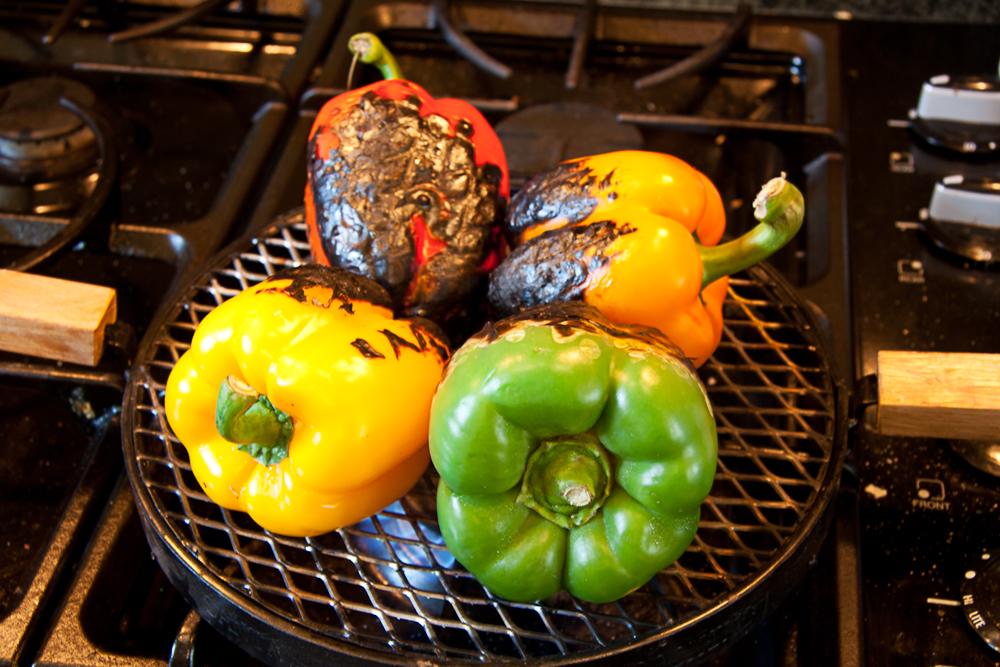
Fortunately, a device has been invented locally to let you roast just a few chiles as you need them. The Santa Fe School of Cooking, http://santafeschoolofcooking.com ,  sells a handy stove-top grill for $29.95. The grill is made of steel mesh stretched across a steel ring with two wooden handles to protect your fingers from the heat. In just a few minutes, you can heat up the grill, char a few chiles, and get ready for a real chile feast. We use the grill for our allotment of Hatch or Chimayó chiles, but we also use it to roast ordinary bell peppers for an easy and delicious appetizer.

Fresh peppers on roasiting grille

So here’s what you do: Turn your stove burner on high. A gas range works much better than electric. I’m not even sure if you can use radiant heat, because you need to get your grill red-hot. Put the grill over the flame and wait until the steel mesh begins to glow. Then arrange your chiles or bell peppers on top. You can fill up the grill, but don’t crowd it as the skin of every pepper needs to get blistering hot and char. Let the peppers sit undisturbed on the grill until the surface touching the grill has completely charred and turned black. Then turn the peppers to expose another surface. Keep charring and turning until the whole pepper is black. Don’t forget the ends. Put the charred peppers in a plastic bag that can be closed or sealed, and let them cool completely. If you have done your job correctly, the charred skin can be removed easily under a stream of running water. Peel the peppers, core them, and remove the seeds. You are now ready to make smoked peppers in garlic olive oil.

  • 4 roasted bell peppers, preferably one each of green, red, yellow, and orange
  • 3 cloves garlic, peeled and sliced very thinly
  • 1 tablespoon salt
  • 12 to 15  whole black peppercorns
  • extra virgin olive oil, enough to cover the peppers in a bowl

Peppers getting their char

Place the smoked, peeled peppers on a cutting board and cut them into bite-sized pieces. Then place the pepper pieces, sliced garlic, salt, and peppercorns in a bowl that is deep enough to hold them comfortably. Add enough olive oil to cover the mixture, cover the bowl with plastic wrap, and let sit on a kitchen counter at room temperature. Two or three times each day for two days, turn the mixture, re-cover, and let marinate at room temperature.  The peppers should be ready to serve with crackers or thin slices of bread so that each guest can spoon a pepper piece and a little olive oil on the cracker or bread and pop it into his or her mouth. The sliced garlic is good, too.

Marinated peppers with garlic

Yield: Four peppers make enough for 8 persons

Leave a comment

Filed under Food, Photography