Tag Archives: Los Angeles

CHRISTMAS EVE TAMALES AND PORTO’S BAKERY

For years, making tamales has been a Christmas Eve tradition in our family. The tradition has been carried over to our children and their families. This year, we are spending Christmas with our daughter, Carol, and her family in Los Angeles, but we decided not to make our own tamales but rather get them from a well-known Los Angeles institution where many of the locals get their Christmas tamal fix.  We drove to Downey where one of three branches of Porto’s Bakery is located.

We tried to get there early, but 8:30 was not soon enough, especially since the store opened at 6:30. We were warned that on Christmas Eve morning the line would be long, but we were not prepared. The line started at the corner next to the traffic light, stretched down the street to the alley, past the bank building on the corner, back up the sidewalk, and a cross a courtyard. Not to worry, we were told, the line would move fast. And it did. After an hour in line, visiting with strangers, accepting business cards from others, and generally having a good time, we made it to the front door.

Inside, there were yet more lines: one for those who wanted only cakes and another – much longer – for those who wanted pastries and other baked goods. The line was cleverly and artfully arranged so that the final pass before you were beckoned to one of the many clerks was right in front of the pastry display. After that, how could you resist ordering one of everything?

Carol placed her order to include caramel eclairs, deep-fried potato balls, and several versions of tarts and cakelets. Unfortunately, by the time we arrived, Porto’s had run out of their famous tamales.


Our Christmas Eve meal was saved by my forethought to bring some frozen tamales from Santa Fe, but the memory of all of that sugar lives on. We also plan to have green chile stew. Carol does not like onion, an essential part of green chile stew, so for this version, the onion will be pulverized in a food processor, but you can just chop it if you prefer.

For Christmas Day, we will be more unconventional. Carol’s oven is seriously broken, so traditional turkey or goose is out of the question. Instead, we will feast on shrimp and grits. Perhaps we have started a new tradition.

In any event we wish all of my blogging friends a very Merry Christmas.

RECIPE

Green Chile Stew

Ingredients

  • 2 pounds pork stew meat, cut into bite-sized pieces
  • 2 tablespoons vegetable oil
  • 1 medium yellow onion, minced
  • 7 ounces canned chopped green chiles
  • 2 cloves garlic, peeled and minced
  • 3 tablespoons all-purpose flour
  • water, enough to cover meat and onions
  • 1 teaspoon cumin
  • 1 tablespoon Mexican oregano leaves, crumbled
  • salt and pepper to taste
  • 2 large russet potatoes, peeled and cut into 1/2 inch cubes
  • 1 large avocado, diced (optional)
  • 2 cups grated Cheddar or Monterey Jack cheese (optional)
  • sour cream (optional)

Method

  1. In a large,  heavy-bottomed pot brown the stew meat in the oil. When it is well-browned, remove to a plate, and dd the onions to the pot, adding more oil if needed. Cook covered over medium heat until translucent but not browned. Return the stew meat to the pot.
  2. Stir in the green chiles and garlic, cooking for a few minutes before stirring in the flour. Cook for a few minutes, stirring constantly, to remove the taste of raw flour. Then add enough water (Use chicken or vegetable stock if you prefer) to cover the meat and onions. Bring the pot to the boil and then reduce heat to a simmer. Simmer covered for about an hour or until the pork is tender.
  3. Stir in the cubed potatoes, adjust the level of liquid with more water or stock as needed, and return to a slow boil for 30 minutes or until the potatoes are cooked. Adjust the seasoning with salt and pepper and more cumin and oregano if needed.
  4. Serve in bowls with diced avocados, grated cheese, and sour cream for garnish.


Leave a comment

Filed under Food, Photography, Recipes

FRIED OKRA

California is experiencing a heat wave, and Los Angeles is especially warm. My grandchildren’s schools decided to close early the other day because of the heat – the 90’s – even though the schools sit on the edge of the ocean with ocean breezes. The classrooms are air-conditioned as well. Never mind, the schools closed and parents were asked to pick up their kids, working or not. This decision set my daughter into a fit of pique, especially because she remembered her days in Louisiana where it gets really hot and humid, and the schools were not air-conditioned because the school board considered that a luxury.

Carol shared her disgust with her siblings via e-mail, and that stimulated a discussion of all the tribulations they endured while growing up. Among these, was the menu in the school cafeteria.

We moved to the South when the two older kids were in elementary school, and they had never had okra. They tasted it for the first time on their first day of school. And the second time…and the third time… and the fourth time… which is to say that stewed tomatoes and okra were served every single day. To this day, none of our kids eats okra.

Okra has a well-earned reputation as being slimy. That is especially so when it is boiled or when it is cooked with stewed tomatoes. As a result of this, many refuse to eat okra even though it is possible to prepare it in such a way as to avoid the slime. Mostly this is done by frying with one or another method.

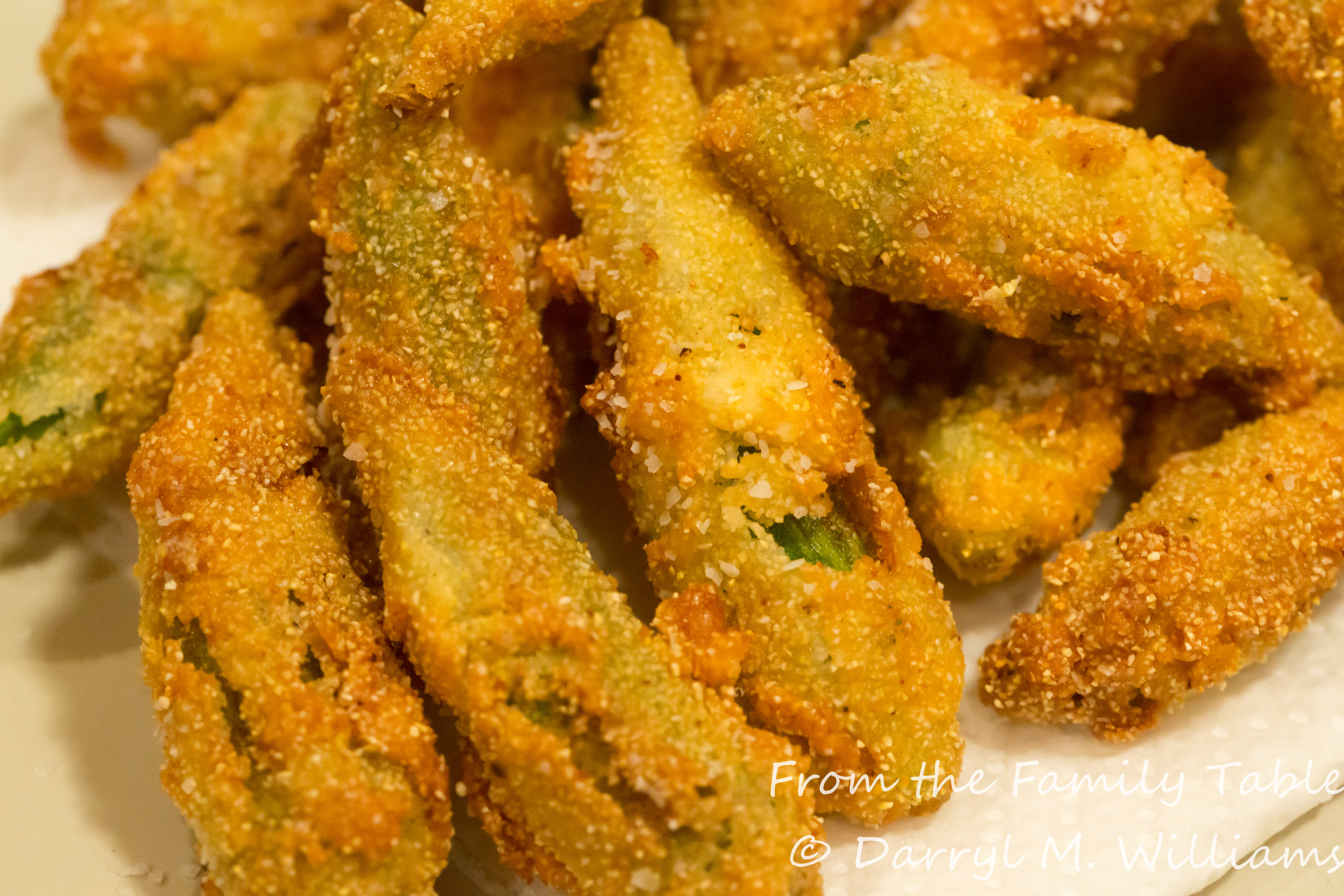
This last week my wife accompanied me to the farmers market, and for old time’s sake, she bought some okra. The pods were beautiful and small so they promised to be tender and delicious. I deep-fried a batch last night, and neither my wife nor I was disappointed. Not a trace of slime.

Fresh okra pods

Fresh okra pods

Deep-fried okra

Deep-fried okra

RECIPE

Fried Okra

Ingredients

  • okra, leave whole if small or cut into 1 inch slices if larger
  • 1 egg, beaten lightly
  • ½ cup buttermilk
  • ½ teaspoon salt
  • 1 cup all-purpose flour
  • 1 cup yellow cornmeal
  • 1 teaspoon salt
  • ¼ teaspoon ground black pepper
  • peanut oil for deep-frying

Method

  1. Wash okra in cold water and dry on a clean kitchen towel
  2. In a medium bowl, combine the beaten egg, buttermilk, and salt
  3. In a large bowl, mix together the flour, cornmeal, salt and pepper until well combined.
  4. In a deep, heavy pot heat 3 inches of peanut oil to 350° F.
  5. Place the washed and dried okra pods in the egg and buttermilk mixture, coating them completely.
  6. One by one, transfer the okra pods to the flour/cornmeal mixture and then transfer to the heated oil, being very careful not to burn yourself.
  7. Fry the okra pods until they are well browned. With tongs, transfer the fried okra to several layers of paper towel to drain. Salt immediately.
  8. Keep warm in the oven at 170° F until all the okra is fried. Serve while still warm.

Leave a comment

Filed under Food, Photography, Recipes

THE TRAIN FROM HELL (OR IS IT TO?)

Our older daughter and her family just moved into a “new” house, so we decided to spend some time with them to help unpack. We have driven the Interstate many times, and it has become very boring. We have also flown to LAX many times, and that also has its own stressors. That inspired us to think about riding the Amtrak from our home station in Lamy, New Mexico to Union Station in Los Angeles. The trip was supposed to start at 2 PM, catching the Southwest Chief that had originated in Chicago at 8 AM and arriving in Los Angeles at around 8 AM the next morning. At least that was what was supposed to happen.

The day before our trip we received an e-mail announcement that the train would be 24 minutes (very specific) late because of delayed connections from the East Coast in Chicago. That seemed innocent enough.

The day of our travel, just as we were about to go out the door to go to the train station, we received another e-mail stating that the train would now be 4 hours late. OK. We hung around home a little while longer and then our neighbor took us for the drive to Lamy. When we arrived, we learned that the train would be even more delayed. The report was that it had been through some very heavy wind and rain storms. The engine struck a fallen tree lying across the tracks, so the engine had to be inspected and a second engine was added just in case. That seemed like cautious good judgment.

Finally, the train pulled into the station at 8 PM, a full six hours late, and we abandoned our plans to enjoy the scenery of New Mexico as the darkness enveloped us even before we got to Albuquerque. Still, we thought we might be able to enjoy the scenery on the other end the next morning. (Barstow??)

We had the car attendant make up our births and we went to sleep, expecting to awaken somewhere in California. That was not to be. The train came to a dead stop in Gallup and didn’t move for two hours. It seems that a drunk had driven his car around the flashing guard gates and smashed his car into the ill-fated engine. He survived without injury, but the engine again was subjected to a careful evaluation. As well, only emergency power was available while they checked the engine. That meant that the toilets did not work and there was no water for 2 hours with a train full of people.  Enough said.

Finally, the train started up again and made it to Winslow, Arizona, a highway distance of only about an hour and a half. Then it ground to a halt. By this time, the engineer and the conductor had used up their travel time so that a new crew had to be brought in from someplace else in order to complete the trip. After another 2 hours or so, the new crew arrived, and the train resumed its travel. By now we were over 12 hours late, but we were assured that the crew “would make up time across the desert.” Nothing like that happened, and the dining car and lounge car staffs were beginning to worry about running out of food as additional provisions had not been arranged.

Which might have been not all bad. It is a pleasure to watch the scenery while you have a meal served with silverware and a cloth napkin, but the flimsy plastic “china and glassware” flew off the table when I tried to puncture one of the slippery whole cherry tomatoes in the salad. In fairness, the staff was very accommodating and just as frustrated as the passengers at being 12 hours late, but their solicitousness didn’t make up for the food.

Unfortunately, I was unable to find a worthwhile food image to make or a dish that I wanted to try to replicate when I got home. On the other hand, my daughter outdid herself with cooking in her new kitchen – barbecue and all the trimmings, panzanella, chocolate velvet ice cream, and cherry-peach crumble. On top of that, she took us to a local seafood restaurant where we feasted on cioppino, raw oysters, and linguine with steamed fresh clams and clam broth.

As to the train, we arrived over 12 hours late, but there turned out to be some very special parts of the trip. We got to see some beautiful scenery around Flagstaff, Arizona, and we met some very nice fellow travelers at the dining table as well as outstanding staff members in the station attendant in Lamy, our railcar attendant, and the wait staff in the dining car. In fact, we would even be willing to chance another trip to Los Angeles.  Surely, there can only be one train from (to?) Hell.


9 Comments

Filed under Food, Photography, Travel

RED VELVET CAKE AKA WALDORF ASTORIA CAKE

We were in Los Angeles to celebrate Thanksgiving as well as my oldest grand-daughter’s thirteenth birthday. Among her food requests was a red velvet cake for her birthday cake. Red velvet cake is a family favorite, making appearances at weddings, birthdays and other celebrations. It is also a Southern favorite for festive occasions. In our family it is also known as Waldorf Astoria cake, based upon an apocryphal story about one of my wife’s favorite aunts.

Supposedly a friend of this aunt was in New York City and happened to dine at the Waldorf Astoria Hotel where she was served this delicious cake. At the end of the meal, the lady asked the waiter if she might have the recipe for the cake. Bowing deeply, the waiter excused himself and then returned a short time later with a sheet of paper inscribed with the recipe. Thrilled, the woman took the recipe back to her home in Delaware and wowed all of her friends with her new, secret, delicious recipe. A short time later, she received a letter from the hotel. When she opened it she found a bill for some absurd amount to cover the cost of providing the recipe.

Enraged, the woman immediately made copies of the recipe and distributed it to all of her friends. Supposedly, my wife’s aunt was one of the luck recipients of the now-not-so-secret recipe. Not likely to be true, but it makes a good family legend.

To be made properly, the cake requires a large amount of red food coloring. In this day and time, some bakers are worried about potential hazards of food coloring. In the USA, commercial red food colorings are either or both Allura Red AC (US FD&C Red 40) and Erythrosine (US FD&C Red 3). There is some concern about Allura as it is an azo dye made from petroleum. It has been associated with hyperactivity  in children, although data are conflicting. Nevertheless, it is banned in Denmark, Belgium, France, and Switzerland. There are no restrictions on Erythrosine. Early studies suggested that in high doses it might cause cancer in rats, but more recent studies have not shown it to be a mutagen.

Still, some bakers would like to avoid the potential risk of these synthesized dyes. The most commonly used “organic” alternatives are beet juice and carmine (also called Natural Red 4), made from powdered female cochineal, scale insects from Mexico and South America that parasitize prickly pear cactuses and their relatives. A common use for carmine is to color lipstick. There is concern that these “more natural” coloring agents may add an undesirable flavor and even cause allergic reactions. Neglected in much of the discussion is that the extraction process for carmine. The substance producing the red color is extracted from ground insects with either ammonia or sodium carbonate. Then it is precipitated as an aluminum salt by adding alum. Stannous chloride, citric acid, borax, and/or gelatin may be added as stabilizers. This raises the obvious question as to what is “natural”?

One of my daughters wanted red velvet cake for her wedding. The vegetarian baker tried repeatedly to use beet juice, but it just wouldn’t work, so my daughter had to choose another cake flavor.

For all of these reasons, if you are worried about food additives, you may not be able to bake – or eat – this cake. That would be too bad, because it is delicious.

There is a final decision: what do you want to use for icing? The family recipe  uses a simple milk and flour base for the frosting while most Southern cooks insist that the only icing that will do is cream cheese icing. I’ve given you both recipes

RECIPES

Red Velvet Cake

Ingredients

  • ½ cup vegetable shortening
  • 2 eggs
  • 1½ cups sugar
  • 3/4 cup red food coloring
  • 2 tablespoons cocoa
  • 1 teaspoon salt
  • 2¼ cups flour
  • 1 cup buttermilk
  • 1 teaspoon vanilla extract
  • 1 teaspoon baking soda
  • 1 teaspoon white vinegar

Method

  1. Using a stand mixer, cream the shortening and sugar until light and fluffy. Then add the eggs, one at a time, mixing well after each addition
  2. In a small bowl, mix the red food coloring and cocoa together to make a paste. Then add to the shortening, sugar, and egg mixture
  3. Sift together the salt and flour. Add in thirds to the batter, alternating with the buttermilk until all combined. Mix well but do not overbeat. Then stir in the vanilla extract.
  4. In a small bowl, mix together the soda and vinegar. They will foam up. Don’t be alarmed, but make sure you have a big enough bowl so that the foam doesn’t overflow. Stir the mixture into the batter until well combined
  5. Pour into two cake pans prepared with baking parchment, greased, and floured.
  6. Bake in the middle of a preheated oven at 350°F (177°C) for 30 minutes. Test for doneness with a toothpick. If the toothpick comes out clean, remove from the oven, cool in the pans for 5 minutes, and then turn out onto a baking rack to cool completely before frosting.

Waldorf Astoria Frosting

Ingredients

  • 2 tablespoons flour
  • 1 cup milk
  • 1 cup butter
  • 1 cup sugar
  • 1 teaspoon vanilla extract

Method

  • Combine the flour and milk in a heavy saucepan over medium heat. Stir constantly until thick and smooth. Set aside
  • With an electric mixer, cream together the butter and sugar until fluffy. Beat in the cooled milk mixture along with vanilla extract. Refrigerate until ready to ice the cake.

Cream Cheese Icing

Ingredients

  • 8 ounces cream cheese, softened
  • 1 box (16 ounces, 2 cups)  powdered sugar
  • ½ cup butter
  • 1 teaspoon vanilla extract

Method

  1. With an electric mixer, cream together the cream cheese, powdered sugar, butter, and vanilla extract. Beat until smooth and fluffy
  2. Ice the cake, Make certain the cake layers are completely cooled

6 Comments

Filed under Food, Photography, Recipes