SCALLION PANCAKES – FAMILY MEAL

One of the great traditions in restaurants – unfortunately tending to die out – is Family Meal. That’s when everyone takes a break from preparative work to gather together, talk about the evening ahead, and  share a meal prepared by one of the cooks. The meal is almost always comfort food made with leftover ingredients or inexpensive ingredients ordered just for the meal. The great thing is that the cooks rotate the assignment so the pressure is on to prepare something that everyone will enjoy. This is definitely not the time or place to embarrass yourself in front of your peers. Often Family Meal will feature food from childhood – a family favorite or Mom’s secret recipe. I have previously written about Sarah’s brisket and biscuits that became so popular the kitchen staff cheered when they appeared on the menu.

During a recent trip to San Francisco I got to spend the afternoon with Sarah in the prep room at Rich Table. That’s where Jonathan Tu whipped up his mother’s recipe for scallion pancakes. Nearly every Asian nation has its own version of this treat, but they all come down to a simple flour and water dough and chopped green scallions.  Kneading, layering with oil, and rolling out the dough a couple of times makes a flaky, multi-layered pancake rivaling puff pastry but without all the hassle.  There are a few little tricks or special touches in rolling out the dough, but in the end scallion pancakes are so simple and so good.

Jonathan served his pancakes with chicken sausage, rice, and a sauce of mustard, soy sauce, sesame oil, and chili flakes, but it’s up to you to choose your favorite dipping sauce or topping.


RECIPE

Scallion Pancakes

Ingredients

  • 2½ cups all-purpose flour
  • 1 cup water
  • kosher salt
  • ½ cup chopped scallions, including green tops
  • sesame oil

Method

  1. In a large bowl, combine the flour and water. Mix until it holds together and forms a ball. Continue to knead for about 10 minutes or until the dough becomes soft and shiny.
  2. Cover the dough with plastic wrap and let rest for 30 minutes.
  3. Divide the dough into four equal balls. On a well-floured work surface, roll out one of the balls to about 1/8 inch thick. Keep the remaining balls covered with a cloth until you are ready to roll them out..
  4. Drizzle the top of the rolled out dough with sesame oil. Sprinkle with ¼ of your chopped scallions and kosher salt. Fold it over and roll it out again.
  5. Roll up the flattened dough like a cigar. Divide the cigar crosswise into two pieces. Coil each piece like a snake or snail. Flatten the coil with your hand and then roll out into a circle with a rolling-pin.
  6. Repeat with the remaining balls of dough. You should have eight pancakes.
  7. Heat a heavy cast iron skillet to medium high or use a heated plancha. Lightly oil the cooking surface, and then transfer one of the pancakes to the skillet or plancha. Cook for two minutes. Then flip and cook the other side for two minutes. The pancakes should be a light golden brown.
  8. Repeat with each of the remaining pancakes. You may keep them in a warm (200°F) oven while you cook the rest.
  9. Cut each pancake into 6 or 8 wedges and serve with dipping sauce or accompaniments of your choice.

3 Comments

Filed under Food, Photography, Recipes, Restaurants, Travel

LEVAIN WITH FENNEL FRAGRANCE

One of the favorites on the Rich Table menu is Sarah’s country style levain. The bread is served warm with house-churned cultured butter. Sometimes the bread is scented with Douglas fir, but the most popular version is when it is flavored with wild fennel “pollen”. The pollen is actually the bright yellow tiny flowers of wild pollen that grows all over Northern California and blooms from mid to late summer. Rich Table has their own forager who brings the pollen in from fields north of San Francisco, and the restaurant has an abundance now. Unfortunately the source is regional and seasonal – that’s one of the reasons for using Douglas fir – but if you don’t happen to live in Northern California, ground fennel seeds can make a workable substitute. The smell and taste are not as delicate, and if you use too much can be overpowering, so use it carefully.

On a recent visit to San Francisco, I watched Sarah make her bread in the basement prep kitchen at Rich Table. The experience inspired me to try to adapt the recipe for the home baker. This is pretty close to the real thing, but Sarah did not share any of her baking secrets with Old Dad.

Sarah’s recipe makes twelve large loves, too much for the home baker. For that reason, I have pared down the ingredients to make two generous loaves. I have made some other modifications to make it easier for the home baker. First, professional bakers weigh their ingredients, while home bakers usually measure things in cups and spoons, so I have set the quantities in the home style. Second, if you have your own sourdough starter, that is great, but if you don’t you can substitute packaged dry yeast. Third, if you have harvested your own wild fennel “pollen” (actually fennel flowers) that’s also great, but you can substitute ground fennel from your spice shelf.  Finally, you can mix the dough by hand, but that is a labor of love, so I have used a stand mixer equipped with a dough hook for the kneading and gluten-release process. Resting times are very important to make sure the gluten releases and supports good lift of the dough.

RECIPE

Levain with Fennel Fragrance

Ingredients

  • 3 cups + ¼ cup water
  • 1 cup levain* or substitute 1 envelope dry yeast
  • 6 cups bread flour
  • ½ cup whole wheat flour
  • ½ cup rye flour
  • 1 tablespoon salt
  • ½ teaspoon ground fennel seeds
  • vegetable shortening or butter for greasing bread pans

* Baker’s note: You can find the method for making your own levain or sour dough starter in an earlier post. If you choose to use yeast instead, increase the water and flour in the recipe by ½ cup each.

Method

  1. Place 3 cups water in the large bowl of a stand mixer. Using the paddle attachment, mix in the levain (it should float in the water, otherwise it has not risen enough) or yeast. You should feed your levain the night before you bake to make sure it has good rising power the next morning.
  2. Slowly mix in the flour, a cup or so at a time.  When the dough becomes stiff enough, change to the dough hook attachment.
  3. Add all the flour. Then beat with the dough hook at a slow speed for 10 minutes until smooth and shiny.
  4. Let the dough rest in the bowl for 30 minutes.
  5. Dissolve the salt in the ¼ cup water.
  6. Beat the salt mixture and ground fennel into the rested dough until completely incorporated.
  7. With a scraper, transfer the dough to a large metal bowl.
  8. Cover the dough with a plastic film and let rest for 30 minutes. Then turn the dough gently in all directions with moistened, clean hands. Recover the dough with the plastic film.
  9. Repeat turning the dough every 30 minutes for three additional times.
  10. Turn the dough out on a well-floured work surface. Divide into two equal pieces. Each piece should weigh a little over 2 pounds.
  11. Shape each piece of dough into a ball and let rest for 5 minutes.
  12. After the rest, shape the dough by lifting the far edge of the ball and pulling it to the center. Repeat this motion in all directions. Pinch closed any seams and let rest, covered with a cloth, for 10 minutes while you prepare the baking pans.
  13. Prepare two 9 x 5 inch bread pans by greasing the insides well with vegetable shortening  or butter.
  14. Arrange the dough pieces, seam side down, in the two bread pans, cover with a clean cloth, and set in a warm place to rise until doubled.
  15. While the bread is rising, pre-heat the oven to 450°F (232 °C)
  16. When the loaves have risen, slash the tops with a sharp knife and transfer to the middle of the pre-heated oven.
  17. Bake for 15 minutes. Then reduce the oven temperature to 350°F  (177°C) and continue to bake for 45 additional minutes. Turn the loaves front to back at least once during the baking.
  18. At the end of the baking time, test for doneness by thumping the bottoms for a hollow sound. Transfer the baked loaves to a cooling rack and allow to cool completely.

7 Comments

Filed under Food, Photography, Recipes, Restaurants, Travel

LIGHT WEIGHT FOOD – BOW HUNTING FOR ELK IN THE WILDERNESS

Our son, Peter, is the outdoorsman in our family. He hikes, rock climbs, skis, canoes, and anything else that will get him into the outdoors. When all the rest of us have opted for a motel room, he will choose to sleep outside in a bag on a ground cloth. He was excited, then, when he was selected in a lottery to bow hunt for elk in one of the wilderness regions of the Jémez Mountains in New Mexico. He drove to our house in Santa Fe almost non-stop from his home in Northern California, stopping for a few hours’ sleep in the Mojave Desert.

We helped him pack food for his expedition, and in a few hours he was off for what turned out to be a five-day adventure. He went to the San Pedro Park Wilderness with much of the trip over dirt roads. When he got to the trail head, he loaded up his back pack and went for a two-mile hike to his campsite. There were no other hunters, and he had planned the hike so that it would not be too far back to the car in case he bagged an elk and needed to pack out the meat. He wound up hiking another two miles to find a good hunting spot.
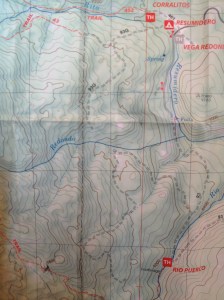
Map of the San Pedro Parks Wilderness

Map of the San Pedro Parks Wilderness

Hiking can be a strenuous activity, especially with a 50-60 pound pack. It’s fairly easy to use up 400 calories an hour, and even possible to use up 1000 calories an hour, never mind the fluid loss. Thus, it is very important to stay well hydrated and to have a good supply of food. Even if you had pure calorie sources – carbohydrate, protein, and fat – at 4, 4, and 9 calories per gram, respectively, you would need at least a pound of food a day to stay in balance. Of course, these days you can buy elaborate dehydrated meals at the outdoor sporting goods store, but they are very expensive and they also take away some of the fun of planning and packing for a wilderness trip.

Using dehydrated or low-weight foods available at the grocery store, we worked up a menu for the expedition. All you need is a good backpacking camp stove and a reliable source of water. Remember to cut instructions off the sides of boxes and drop them in the zippered plastic bag with the food. Put individual dry ingredients in zippered sandwich bags and drop them in the bag of the main dish.

Also pack a small squeeze bottle filled with cooking oil and another small container of butter or margarine. Bring small salt and pepper shakers.

Gorp, more commonly known as trail mix, is a hiking standby. These days you can buy any number of varieties with a wide range of different nuts, dried fruits, and candies. Some of them are extremely expensive and – in my view – not very good It’s just as easy to make your own, and that way you can include ingredients that you like.

Soup made from a packet of dehydrated soup is good while waiting for the main dish to cook.

Macaroni and cheese, especially the boxed kind, is an old-time kids’ favorite. It is nothing but dried ingredients. Add a little dry milk powder and some Spam lights, and you have a dish that can be cooked in just a few minutes. At the end of a hard day of hiking it will please everyone, kids and grownups alike.

Tuna casserole is another standby. With the new packaging of tuna in  foil pouches, this becomes even more light weight. Instant or fast-cooking pasta makes this an easy effort even with just a backpacking stove.

Salmon and rice casserole becomes another possibility with the advent of dry packaging of salmon just like tuna. A can of salmon would weigh over a pound, while the “dry” pack weighs 2.5 ounces

Dried fruit – banana chips and apricots make good desserts, along with chocolate bars.

Energy bars weigh only about 2 ounces each and pack an impressive 250 calories, about 1/3 of it from fat

RECIPES

Gorp

Ingredients

  • 10 ounces sunflower seeds, roasted (880 calories)
  • 16 ounces dry roasted peanuts (2560 calories)
  •  7 ounces “runts” or other candy-coated chocolate candy (715 calories)
  • 6 ounces walnut pieces (1100 calories)
  • 6 ounces whole almonds (935 calories
  • 9 ounces dried cranberries (780 calories)
  • 8 ounces raisins (775 calories)

Method

  1. If the sunflower seeds are raw, roast them by spreading them out in a jelly roll pan and placing them in the middle of an oven preheated to 300° F (177° C). Bake for 15 minutes, turning them frequently. Remove from the oven and cool before adding to the remaining ingredients.
  2. In a large bowl, combine all of the ingredients and mix well.
  3. Place in zippered plastic bags. This makes enough gorp for 4 or 5 bags, one for each day of the trip.

Macaroni and Cheese with Spam Lights

Ingredients

  • 1 box commercial macaroni dinner, including cheese packet
  • 1½ tablespoons powdered milk
  • 2 cups water
  • 1 tablespoon butter
  • 1 pouch Spam lights

Method

  1. Place all of the dry ingredients in separate packages in a larger plastic bag
  2. In a camper’s cooking pot, bring 2 cups of water to the boil. Add the dry macaroni and cook until tender.
  3. Pour off all but about ¼ cup of water. Stir in the contents of the cheese packet and the powdered milk. Add butter.
  4. Drain and stir in the pieces of Spam lights. Cut them up a bit if you wish.
  5. Mix well and serve immediately. Serves one or two hungry hikers.

Tuna Casserole

Ingredients

  • 4 ounces quick-cooking pasta
  • 1 2 ounce packet dehydrated mushroom soup
  • 3 tablespoons dehydrated mashed potatoes
  • 1 2.6 ounce pouch tuna
  • 2 cups water

Method

  1. Place all of the dry ingredients in separate packages in a larger plastic bag.
  2. In a camper’s cooking pot over a camp stove, bring 2 cups of water to a boil. Add the pasta and mushroom soup. Cook until tender.
  3. Stir in the dehydrated mashed potatoes and the tuna, drained.
  4. Eat. Should serve one or two .

Salmon and Rice Casserole

Ingredients

  • 1 cup instant rice
  • 1 envelope dehydrated vegetable soup
  • 1 2.5 ounce pouch salmon
  • 2 cups water

Method

  1. Place all the dry ingredients in separate packages in a large plastic bag.
  2. In a camper’s cooking pot over a camp stove, bring water to a boil. Add the instant rice and dehydrated soup and stir until cooked and the water is absorbed.
  3. Drain the salmon and stir into the mixture.
  4. Eat. Should serve one or two.

For breakfast, be sure to bring tea or instant coffee and packets of instant oatmeal. For lunch, if you want to pack the extra weight, dry Italian salami,  Parmesan or other hard cheese, small cans of Vienna sausages  or Kipper Snacks, along with hard tack or crackers are perfect. Just remember you will have to pack out the cans, and Kipper Snacks can be smelly. Remember, too, if there are bears in the area, the smells will be a magnet. Be sure to secure your food appropriately.

The hunter and some of his elk meat

The hunter and some of his elk meat

The end of this story is that Peter hiked in two miles, set up camp, and then hiked another 2 miles in stocking feet (!!!) to the spot where he got his elk with one arrow at a range of 45 yards. Then he spent a whole day cutting up and packing out the meat in three separate 4 mile (8 mile round trip) hikes to his car. He had a long sleep when he got back to our house.

4 Comments

Filed under Food, Photography, Recipes, Travel

PANNA COTTA

Even though Sarah is trained as a savory cook, by default she has also been doing baked goods and desserts at Rich Table. She doesn’t think of herself as a pastry chef, but her success proves otherwise. Desserts have been among some of the most popular items at Rich Table since it opened over a year ago. There is always pressure to keep some of the old favorites on the menu, but there is also pressure to introduce new items on a fairly constant basis.

Two recent additions are:

Blue corn cake with honey-griddled plums, and vanilla ice cream. This dessert is a riff on Sarah’s favorite cornbread recipe, but made with blue corn meal. I suspect that comes from her interest in New Mexico traditions. She also has a good source for blue cornmeal from  Tierra Vegetables in the farmers market at the San Francisco Ferry Building.

Blue corn cake with honey-grilled plums and vanilla ice cream

Blue corn cake with honey-grilled plums and vanilla ice cream

Bittersweet chocolate ganache with almond butter crunch and passion fruit meringue.

Bittersweet chocolate ganache with almond butter crunch and passion fruit meringue

Bittersweet chocolate ganache with almond butter crunch and passion fruit meringue

Panna cotta is one of the old favorites, but Sarah has come up with lots of variations that have kept it popular and fresh. Some of those variations include buttermilk, coconut, and more recently cream cheese.  Panna cotta is a cousin of flan, crema catalana, and crème brûlée. Those custards are made with eggs which are cooked gently to provide thickening. Panna cotta has gelatin added for the thickening agent. In commercial kitchens, leaf or sheet gelatin is the form most commonly used, but that form is not often available in grocery stores and is a little trickier to use. That’s ok, because a perfectly good panna cotta can be made with the granulated form, although you may need to experiment and cut back on the amount of the gelatin if the finished panna cotta too firm for your taste.

Sarah’s current cream cheese panna cotta is delicious, but if you want to try it at home you will need to tinker with the amount of gelatin you use. The firm texture of the cream cheese sets up too hard with the usual amounts of gelatin.

I think her buttermilk panna cotta is every bit as good. Sarah makes it with fresh cultured buttermilk that the restaurant gets when it house-churns its own butter. That’s not practical at home, but fresh commercial buttermilk will work. That’s my version below.

RECIPE

Panna Cotta

Ingredients

  • ¼ cup water
  • 1 packet unflavored gelatin
  • 1½ cups heavy cream
  • 1½ cups buttermilk
  • ½ cup sugar
  • 2 teaspoons orange blossom water
  • 1 tablespoon Grand Marnier or other orange liqueur (optional)

Method

  1. Place the water in a small bowl and sprinkle the gelatin over the top. Let stand for 5 minutes or until the gelatin softens. Do not let it stand too long or it will turn into a solid blob that is hard to dissolve.
  2. In a medium saucepan, combine the cream, buttermilk, and sugar. Bring to a  boil for 5 minutes. Remove from the heat.
  3. Using a whisk or immersion blender, stir in the softened gelatin. Stir for at least a minute. Make sure that the gelatin is completely dissolved. Otherwise it will sink to the bottom and form a separate gelled layer.
  4. Stir in the orange blossom water and optional Grand Marnier or other orange liqueur.
  5. Pour into 6 6-ounce cups. Cover tightly with plastic wrap and chill in the refrigerator for 3 hours or overnight.
  6. Serve with fresh berries or your choice of toppings.

4 Comments

Filed under Food, Photography, Recipes, Restaurants

NOPALES – WHO WANTS TO EAT CACTUS?

Unless you are from Mexico or the American Southwest, you may have thought that cactus, the big paddles with long razor-sharp stickers were just a sign that you are in the desert. I’m talking about prickly pear with the  regional name, nopal (singular), nopales (plural), or nopalitos (diminutive), and the scientific name, Opuntia sp. (There are lots of different species.) If that’s the case, you will be surprised to learn that prickly pear with its various parts is popular not only as food but also as drink. The cactus can be eaten raw, but most recipes call for cooking. Cooked prickly pear is said by many to taste like okra. That may be a good or bad thing.  Some people eat large quantities of Opuntia because of supposed healing powers for all sorts of illnesses. There is some evidence that eating cactus can lower the blood sugar, but the effect is not strong enough to serve as a treatment for diabetes.

Prickly pear in bloom

Prickly pear in bloom

After flowering in mid- to late-summer, prickly pear sets on fruits on the edges of the paddles. These fruits are also called tunas and are so highly prized that night-time harvesters will strip them from plants growing in the median of streets of many towns and cities. Peeled and eaten without chewing (the seeds can easily break a tooth), tunas substitute for candy because of their sweetness. They can be mashed into pulp and juice for drinks, cocktails (cactus margaritas are popular in some Border bars), syrup, or even dessert.

The key to success in turning the cactus into something you can eat is to get rid of the spines. Sometimes hungry  cattle in dry climates will turn to cactus for food if there is nothing else to eat. The spines can damage bovine intestinal tracts or even blind a cow that gets the spines impaled on a cornea. Those spines can do the same thing to humans. To avoid this, some cooks use a blowtorch to burn off the spines. This approach has the disadvantage of potentially burning the paddles. Others use very sharp knives (along with sturdy gloves to protect hands) to cut off the spines and the thin outer layer of the pad. The easiest way to deal with the problem is to buy prepared nopales in the grocery store.

One of my friends, Jim Hastings, has developed an interest in Southwest native foods and foods prepared from native plants. This has led him to develop a number of his own recipes and to conduct cooking classes on preparing an entire meal from cactus.

My wife and I recently had the opportunity to attend one of Jim’s classes. For that session his menu included Bean Soup with Nopales, Jicama and Nopalito Salad, Nopales and Green Chile Tart and Cheese Cake with Prickly Pear Dessert Topping. The dessert topping can go on cheesecake, as Jim demonstrated, ice cream, pound cake, or whatever you fancy.

The dessert topping requires prickly pear jelly and optional prickly pear syrup. You can order those online from Cheri’s Desert Harvest

In this post, the recipes are Jim’s; the images are mine. If you want to contact Jim Hastings for more information, his internet address is: jimhastings@elp.rr.com


RECIPES

Bean Soup with Nopales

Ingredients

  • 2 cups dry pinto beans
  • 6 cups water
  • 3 strips thick sliced bacon cut crosswise into ½ inch slices
  • Additional vegetable oil and butter if needed
  • ½ medium yellow onion, peeled and chopped
  • 3 cloves garlic, peeled and chopped finely
  • 1 cup chicken broth
  • 1 tablespoon vegetable oil
  • 1 tablespoon butter
  • 2 cups nopales, diced
  • 2 tablespoons chopped cilantro leaves
  • salt and pepper to taste
Bean soup with nopales

Bean soup with nopales

Sautéing nopalitos

Sautéing nopalitos

Method

  1. In a large pot, soak the beans overnight in the water. Set aside.
  2. In another large pot set over medium heat, render the bacon to release the fat but do not crisp. Remove the bacon from the pot.
  3. If needed, add oil and butter to the bacon drippings in the cooking pot and heat over medium flame. Add the onions and cook until soft, about 5 minutes. Do not allow to burn.
  4. Add the garlic, and stir for about 30 seconds. Then add the reserved beans and water. Bring to the boil. Then reduce to the simmer and cook until the beans are tender. Add chicken broth and keep warm
  5. In the meantime, melt oil and butter in a large sauté pan. Add the nopales and sauté until the moisture is completely gone. Be careful not to burn the nopales
  6. Add the nopales to the beans, stir in chopped cilantro, and adjust the seasoning with salt and pepper.
  7. Serve in bowls with salsa or pico de gallo if desired.

Jicama and Nopalito Salad

Ingredients

  • 2½ cups nopalitos cut into 3/8 inch dice
  • ½ pound jicama, peeled and cut into 3/8 inch dice
  • 2 red jalapeños chopped into fine dice. Remove seeds and ribs for milder flavor
  • 1 yellow bell pepper seeded and cut into 3/8 inch dice
  • 2 cucumbers, peeled, seeded and cut into 3/8 inch dice
  • ¼ cup chives finely chopped
  • ¼ cup mint leaves finely chopped
  • ¼ cup cilantro leaves finely chopped
  • raspberry vinaigrette, commercial or homemade


Method

  1. Bring to small pots of water to the boil. Add nopalitos to one of the pots, return to the boil, and boil for 30-45 seconds or until the water starts to thicken. Drain the nopalitos and add to the second pot of water, repeating the process. Drain and rinse with cold water. Do not overcook
  2. In a large bowl, combine the nopalitos, jicama, jalapeños, bell pepper, cucumber, chives, mint, and cilantro.
  3. Toss with raspberry vinaigrette.
  4. Serve on fresh greens.

Nopalito and Green Chile Tart

Ingredients

  • 1 package frozen puff pastry
  • 2 tablespoons olive oil
  • 1 cup nopales cut in ¼ inch dice
  • 1 cup roasted, peeled, and seeded green chiles cut into ¼ inch dice
  • 3 cloves garlic peeled and minced
  • 12 ounces whipped cream cheese
  • 1½ teaspoon dried Mexican oregano, finely crumbled
  • ½ cup roasted, peeled, seeded, and chopped red bell pepper or pimento


Method

  1. Thaw puff pastry according to package instructions. There should be two sheets.
  2. In a small frying pan, heat the olive oil until it is barely shimmering. Add the diced nopales and sauté until olive-green and any slime has evaporated. Remove from the heat and cool.
  3. Stir together the nopales, green chiles, and garlic.
  4. Unfold the two sheets of puff pastry in a 17 x 11 1 inch jelly roll or sheet cake pan. Moisten the seam between the two sheets with a little water and press together to sea. Trim dough to fill the pan using any scraps to fill the sides.  Score the dough lightly around the edge of the pan, about ¼ inch from the edge of the pan
  5. Stir the crumbled oregano into the sour cream Then spread the cream cheese mixture evenly over the dough within the score line.
  6. Spread the nopales, chile, and garlic mixture over the cheese. Then sprinkle with the red peppers
  7. Bake at 400° F (204 ° C) for 10-12 minutes or until the crust puffs and is a golden brown, Remove from the oven and let rest for 15 minutes. Cut into 2 inch squares and serve.

Cheesecake with Prickly Pear Topping

Ingredients

  • 16 ounces sour cream
  • 4 ounces prickly pear jelly
  • prickly pear syrup (optional)
  • 1 cheesecake, homemade or purchased


Method

  1. Stir together the sour cream and prickly pear jelly until smooth and evenly blended.
  2. Spread on top of cheesecake
  3. Drizzle with syrup if desired.
  4. Serve

3 Comments

Filed under Food, Photography, Recipes

BRAISED SWISS CHARD WITH CILANTRO

As summer nears its end with Labor Day, there is a spectacular bounty at our local farmers’ market. Less so in our neighborhood. We have already run out of recipes for zucchini from our neighbors while our little vegetable garden is limited to herbs and chard. The chard, however, is luxuriant with succulent green leaves and bright red stalks.

A few days ago I harvested some of the chard, and then my wife made a recipe out of Deborah Madison’s excellent and encyclopedic Tenth Anniversary Edition of  Vegetarian Cooking for Everyone, Broadway Books, New York, 2007. The preparation is easy, and the cilantro provides a novel balance to the flavor of the chard. Of course, summer is the perfect time for fresh corn on the cob as well. That plus a slice of ham makes a real East Texas mid-day dinner. The only thing missing is the dinner bell.

My thought about chard is that like many greens, it can be bitter. You can overcome that shortcoming and brighten the flavor with the addition of fresh lemon juice and a little sugar. Whether or not you make these additions, long slow cooking is important, and you should plan to use both the leaves and the stems in any preparation.


RECIPE

Braised Chard with Cilantro

Ingredients

  • 2 pounds chard leaves
  • 1½ cups chard stems, diced
  • 1 onion, finely diced
  • ½ cup cilantro, chopped
  • 1/3 cup extra virgin olive oil
  • 1 teaspoon paprika
  • 1 clove garlic, made into paste with 1 teaspoon salt
  • juice of ½ lemon
  • 1 teaspoon sugar
  • ½ cup water
  • salt and pepper to taste

Method

  1. In a large heavy pot with tight lid, combine all ingredients.
  2. Bring to a boil, cover tightly, and cook over low heat for 45 minutes.
  3. Correct seasoning with salt and pepper. Serve immediately.

5 Comments

Filed under Food, Photography, Recipes

LIL’S ICE WATER CRACKERS – SANTA FÉ MONSOONS

At last the summer monsoons (Yes, that’s what they are called.) have come to Santa Fé. Clouds build over the mountains in the early afternoon and develop into towering thunderheads. By late afternoon the clouds darken and horsetails of rain begin to stream in patches over the valleys and mesas. Sometimes you get a shower. Sometimes you don’t. We have been suffering from a severe drought for the past three years, so the rains have been a welcome relief. Even though the drought has not been broken, the new moisture has helped the grasses to green and ripen, and the flowers have been encouraged to bloom. The white clouds and blue skies are an important part of the New Mexico landscape, They are among the things that have attracted so many artists over the years. Georgia O’Keeffe clearly loved the clouds, and that love is captured in her famous series of paintings, Sky Over Clouds. One of the series, Sky Over Clouds IV, has a prominent place in the Art Institute of Chicago, while others hang in museums all over the world.

Georgia O'Keefe's Sky Above Clouds, IV, Art Institute of Chicago

Georgia O’Keeffe’s Sky Above Clouds, IV, Art Institute of Chicago

The rains have brought water to the dry arroyo in our back yard, and the water, lightning, and thunder have encouraged the spade-foot toads from their long sleep in the mud at the bottom of the pond to serenade us all night long.

My digression on monsoons has led me far away from the food topic of this entry, but I wanted to share the good news of moisture at last. Now on to crackers.

One of the food blogs I like to follow is Dinner of Herbs. The author has been trying out a lot of different recipes for crackers lately, so I decided to look through my collection of cracker recipes. I came across an old favorite that I got from Bernard Clayton’s classic, New Complete Book of Breads, (Simon and Schuster, 1987) I’m not sure if the recipe is in the original edition, published in 1973. Marion Cunningham has also been credited with first publishing the recipe. That has some importance because there are a lot of entries on the Internet describing this or that as the “original” version. In any event, Clayton says that he got the recipe from Lillian Marshall, a noted cook and author from Kentucky, hence the name, “Lil’s Ice Water Crackers”. I have made some changes and suggestions about the recipe that you can read in the “Comments” section after the recipe.

Actually, the recipe is NOT for crackers, but instead how to turn plain saltines into something tastier and fit for company. When you read the recipe you will ask yourself how can this turn out to be anything but a pile of glop?

Trust me, you will love the results.

RECIPE

Lil’s Ice Water Crackers

Ingredients

  • 24 single saltine crackers (a sleeve of crackers contains about 36)
  • 1 quart ice water
  • 1 stick butter, melted

Method

  1. Arrange the crackers in a single layer in a 11 x 17 inch jelly roll pan with a turned up edge
  2. Pour the ice water over the crackers and let them stand for 3 minutes.
  3. Carefully remove the crackers with a spatula or slotted spoon and place them on a towel covered layers of paper towels. The crackers will be soggy and fragile so take extra care with this step.
  4. While the crackers are draining, wash and dry the jelly roll pan.
  5. Pour half of the melted butter into the pan and spread with a spatula or your fingers so that the bottom of the pan is completely coated.
  6. Arrange the crackers in the pan and drizzle the remaining butter over them.
  7. Bake in the middle of an oven preheated to 475°F for 15 to 20 minutes, checking frequently to make sure that they don’t burn
  8. Serve immediately while still hot.

Comments

  • A sleeve of saltines contains about 36 crackers, but some of them will probably be broken. Also, 36 crackers may be too many to work with at one time, especially if you are just trying out this recipe. Some of the crackers might begin to disintegrate before you can transfer them. As well, if they are too close to one another, they tend to stick together.
  • The original recipe called for 2 quarts of ice water, You don’t need that much to moisten the crackers, and the amount is a bit unwieldy.
  • Three minutes is tops for the crackers to soak. Some recipes say 10 minutes, but that is too long. The crackers need to swell up, but they will start to disintegrate with long soaking.
  • Wet crackers may stick to a wet paper towel, so be sure to have enough layers of towelling to absorb all of the excess moisture.
  • Allow plenty of space between the crackers so they don’t stick together.
  • If some of the crackers do stick together, don’t worry. They may take longer to crisp than the single crackers, but the way to deal with that is to remove crackers when they are golden and crisp and return the unfinished crackers to the oven until they are fully baked.

4 Comments

Filed under Food, Photography, Recipes

FAJITAS – HIGH SEASON IN SANTA FÉ

It is clearly high season in Santa Fé. Nearly everyone has visitors, and tourists jam the Plaza. Our own first visitors were two of our grandchildren, and so we tried to have kid-friendly meals that they could help make. When their parents came to visit and pick up their kids, we planned an easy meal for their arrival. We needed something that could wait in case their plane was late. Fajitas came to mind, so I started getting them ready the day before their arrival. The first thing to do was to trim and marinate the skirt steak. Skirt steak, called arracheras  by Mexican cooks, is actually the diaphragm muscle which separates the chest and abdominal cavities. It is well-flavored but tough, so it has to be prepared to make it tender. The first thing to do is to strip off the pleura and peritoneum (the linings of the chest and abdominal cavities respectively). That is an easy but necessary step, using a sharp, pointed knife to cut at  the demarcation line between the steak and the fibrous linings. An overnight soak in marinade, followed by grilling over hot coals are additional steps to create a tender meat for the fajitas. I got the recipe for the tequila marinade from The Sunset Southwest Cook Book (Lane Publishing Co., Menlo Park, CA, 1987, p. 45). If you don’t want to use tequila, just substitute more lime juice.

I had to deal with some of the food dislikes within the family. Some don’t like onions or even things that touch onions. Some can’t tolerate piquant chiles because of food sensitivities. Some don’t like avocados. Because of all these variables, I grilled the onions separately from the meat. Instead of classic pico de gallo (rooster’s beak), I made what I call pico de gallina (hen’s beak) without the jalapeños. I omitted the guacamole, but I would encourage you to include it in your choices of fillings.

In the end, everyone seemed to enjoy the modified fajitas.

The next day  we became inveterate tourists, trying to pack in as many events as possible.

There are lots of things to choose from: the Santa Fé Opera is high on the list, the Chamber Music Festival, dancing on the Plaza, riding the Rail Runner train, visiting the Bandelier ruins, hiking in the mountains, visiting the Shidoni Foundry, swimming at the community center, visiting the many museums, and eating, eating, eating.

The first day of the visit we went to one of our favorite restaurants, Babaluu’s Cocina Cubana, a quirky place away from town with great Cuban food. My daughter and I went to Whole Foods for the picnic for our tailgate dinner that evening at the opera. The opera tailgate is totally unlike the ones you may have attended at a football game. People show up in tuxedos and long gowns with candelabra, white tablecloths, fancy silver, and elaborate food on tables in the middle of the parking lot. Years ago we spent hours getting ready a fancy feast, but we now just go to the market for wine and food.

Following our festive meal, some of us went to the opening of La Traviata. It was our twelve-year-old granddaughter’s first opera and she was excited. She watched intently to the end and shed a few tears when Violetta died.

The next day my wife and I visited the Opera Ranch, the grounds of the Santa Fé Opera where singers, musicians, and technicians gather, practice, and enjoy the beauty of the area. Afterward we had lunch at the Tesuque (Te-su’-kay) Village Market, a combination country store, wine shop, gourmet bakery, and rustic café serving typical Northern New Mexico meals like huevos rancheros and green chile cheeseburgers.  It is very popular with locals.

The kids enjoyed the Shidoni Foundry where bronze sculptures are cast on commission from all over the world. The sculpture garden is filled with some amazing, interesting, and beautiful pieces. The foundry is near the end of Bishop’s Lodge Road, named after Archbishop Jean-Baptiste Lamy, a Frenchman who built a French-styled cathedral on the plaza of very Spanish/Mexican Santa Fé. He had a beautiful summer retreat along the road; the retreat has subsequently become a posh resort.  The archbishop was also the model for  the protagonist in Willa Cather’s famous novel, Death Comes for the Archbishop.

The kids and their parents rode the Rail Runner train. We shopped on the Plaza. We took a short hike in the mountains until we retreated in a thunderstorm. We had another great meal at another favorite restaurant,  Taberna La Boca. Finally my daughter made her famous “Law School Chicken” at the kids’ request. My granddaughter specifically forbade me from writing about “their secret family recipe.”

Then time ran out, and the visit was over.

RECIPES

Tequila Marinade

Ingredients

  • ½ cup fresh lime juice
  • 1/3 cup vegetable oil
  • 1/3 cup tequila (may substitute lime juice)
  • 4 cloves garlic, minced
  • 1½ teaspoons ground cumin
  • 1 teaspoon dry Mexican oregano leaves
  • ½ teaspoon ground black pepper

Method

  1. In a small bowl, combine all of the ingredients.
  2. Set aside until ready to marinate skirt steak

Pico de Gallina

Ingredients

  • 2 medium ripe tomatoes, chopped
  • 1 large white onion, chopped
  • 1 green bell pepper, seeded and chopped
  • ½ cup fresh cilantro leaves, chopped
  • juice of 1 lime
  • salt and pepper to taste
  • ½ teaspoon garlic powder (optional)
  • 1-2 fresh jalapeños, seeded and chopped (optional)

Method

  1. Combine all ingredients in a large bowl.
  2. Cover and refrigerate until ready to use

Fajitas

Ingredients

  • 2 pounds skirt steak, trimmed of membranes
  • 1 batch tequila marinade (recipe above)
  • 3 bell peppers (red, yellow, or green) seeded and sliced into strips
  • 2 large yellow onions, peeled and sliced into strips
  • 1 dozen large flour tortillas
  • 1 batch pico de gallina (recipe above)
  • sour cream

Method

  1. Combine the steak and marinade in a plastic zip bag. Refrigerate overnight, turning frequently to coat the steak on all sides.
  2. When you are ready to cook the fajitas, prepare a hot fire in either a charcoal or gas grill.
  3. Place the steak over the hot fire.  Grill for about 7 minutes. Then turn over and grill for an additional 7 minutes. Baste frequently with reserved marinade.
  4. Meanwhile, place the sliced peppers and onions in a fire-proof grilling basket and place on the grill. Stir or turn occasionally until caramelized on all sides.
  5. When the steak is done, transfer to a cutting board. Arrange the grilled vegetables in a serving bowl.
  6. Rest the steak, covered with aluminum foil for 5 minutes before slicing thinly on the bias.
  7. Meanwhile, warm the tortillas.
  8. Invite each diner to make his or her own fajita with sliced steak and grilled vegetables on a warmed tortilla. Add pico de gallina and/or sour cream as desired.
  9. In a group that is not avocado-averse, fresh guacamole is a welcome addition.
  10. Roll and eat.

6 Comments

Filed under Food, Photography, Recipes, Restaurants, Travel

COOKING WITH KIDS, PART TWO – NACHOS

With two of the grandkids here, we cooked together for our dinner on their first evening. The main dish was nachos – who doesn’t like nachos? And they are so easy to make. Everyone got involved in putting things together, but waiting for them to bake made folks a little impatient. When the nachos came out of the oven, we all pitched in on eating them – with milk, of course – and then we had fresh palmiers for dessert.

RECIPE

Nachos

Ingredients

  • vegetable spray
  • 2 tablespoons vegetable oil
  • ½ pound ground beef
  • 1 package taco mix
  • 1 14 ounce can refried beans
  • 1 large bag tortilla chips
  • 1 3.8 ounce can sliced black olives, drained
  • 1 large bag grated Mexican cheese blend
  • salsa
  • sour cream

Method

  1. Spray  a 11 x 17 inch jelly roll pan with vegetable oil
  2. In a medium skillet, brown the ground beef in the oil over medium heat, breaking it up as it browns. Stir in one-half of the taco mix. Set aside.
  3. In a small bowl, combine the canned refried beans with the remaining half of the taco mix. Set aside.
  4. With a table knife or small spatula, spread about a tablespoon of the refried bean mixture on a tortilla chip and arrange on the prepared jelly roll pan. Continue until the pan is filled with tortilla chips and the refried beans have been used up.
  5. Sprinkle the cooked ground beef, sliced black olives, and grated cheese over the pan of tortilla chips
  6. Bake the tray of prepared chips in the middle of an oven preheated to 350°F for 10-15 minutes or until the cheese is melted and the chips are warmed.
  7. Remove the pan from the oven, sprinkle with dollops of salsa and sour cream. Eat immediately while still warm.

4 Comments

Filed under Food, Photography, Recipes

PALMIERS – COOKING WITH KIDS, PART ONE

We had two of our grandchildren visit us for a few days before their parents came to take them back home. The kids wanted to do some cooking while they were here, so I tried to think of recipes that would be not only easy but also tasty. The latter is sometimes a bit of a challenge with kids who are in the process of forming their own likes and dislikes.

I remembered a leftover sheet of puff pastry in the freezer. What could be easier and tastier than a batch of palmiers, the crisp sugary  French cookies? Problem one solved.

The kids and I prepared dinner for their first evening with us. Palmiers would be the dessert, and nachos would be the main dish. All of that seemed simple enough.

We made the palmiers first so that they would be ready as soon as we finished eating the nachos.

We used a recipe from The Fanny Farmer Baking Book by Marion Cunningham (Alfred A. Knopf, New York, 1984, p 262). The only ingredients are puff pastry and sugar. That made it fun for the kids to roll out the pastry dough on a bed of sugar, fold them up, slice them, flatten them a bit with the rolling-pin, and bake them for only a few minutes. The hardest part of the process was resisting eating them before we made the nachos.

RECIPE

Palmiers

Ingredients

  • 1 sheet puff pastry dough, thawed
  • granulated sugar (about one cup)

Method

  1. Thaw frozen puff pastry over night in the refrigerator according to package instructions
  2. Sprinkle a generous layer of granulated sugar on the work surface. The sugar should be spread to a larger size than the sheet of puff pastry
  3. Unfold the thawed puff pastry on the sugar. Roll out the pastry to a thickness of 1/8 inch thick using a rolling-pin and being careful to maintain the rectangular shape of the pastry.
  4. Sprinkle the top generously with more sugar.
  5. Fold the two long sides of the pastry sheet so that they meet in the middle of the sheet. Then fold one side onto the other.
  6. With a very sharp knife, using a sawing motion, cut the pastry roll into ½ inch slices. Then place each slice on one of its cut sides, flatten with the rolling-pin, and arrange on a cookie sheet lined with a Silpat cooking mat.
  7. Bake in the middle of an oven preheated to 400°F for 15 minutes or until the cookies are crisp and lightly browned and the sugar is caramelized.
  8. When the cookies are baked, remove from the oven, and transfer to a cooling rack.

13 Comments

Filed under Food, Photography, Recipes