Monthly Archives: June 2014

PECOS PUEBLO AND BARBECUE

Instead of the traditional, requisite Memorial Day cookout, we decided to take a day trip. After putting the American flag at the mail box, we drove down the interstate to the Pecos Pueblo National Historical Monument. We had not been there for several years, and so we thought it would be a great visit. The weather was beautiful as was the drive up from Santa Fe to Glorieta Pass where the road to the monument takes off. Because the pass is one of the main breaks in the Rocky Mountains in New Mexico between the eastern plains and the Rio Grande basin, it is filled with history.

During the Civil War, the Confederates had organized the Confederate Arizona Territory which included southern parts of what are now Arizona and New Mexico (some things never change) with the ultimate goal of seizing the gold and silver mines of California and Colorado.  Santa Fe had fallen to the Confederates, and things were looking bad for Union forces until the two sides met in Glorieta Pass where the Colorado infantry and the New Mexico militia turned back the Confederates whose supply train was ultimately destroyed, forcing them to give up their effort.

Glorieta Pass is also where the Santa Fe Trail crossed from the prairies into the Santa Fe region. The trail followed earlier native American trails and was established in the late 1700s, but eventually became the main trade route from Missouri settlements in the United States with Mexico, of which Santa Fe was a part until the end of the Mexican War in 1848.

But preceding all of that, the region was the center of trade between the peoples of the plains and the pueblos. Pecos Pueblo sat at the juncture and became a thriving trade center. At its peak, there were over 2,000 individuals living in a five-story dwelling. The Spanish explorers first visited the pueblo in 1640 and immediately set about to convert the population to Christianity. A huge church was built to hold all 2,000 residents at one time. During the Pueblo Revolt of 1680, the church was set on fire and destroyed, but in the re-conquest, another, less grandiose church was built. Over time the pueblo fell on hard times and the population diminished until the few remaining individuals relocated to Jemez Pueblo. The structures fell into ruins – a sight-seeing side trip for folks traveling on the Santa Fe Trail. Now, only ruins remain, but the site is an impressive and interesting glimpse of the local history.

So much for my ramblings. Now it’s on to recipes. We decided to delay our traditional cookout and wound up having barbecued ribs, Susan’s famous brisket, Sarah’s herbed potato salad, coleslaw, and Southern buttermilk cornbread. For the barbecue, I used recipes from a cook book that has been in our family for 50 years: Walter Jetton’s LBJ Barbecue Cook Book (Pocket Books, Inc., New York, 1965, $1.00) Walter Jetton billed himself as caterer to the LBJ Ranch. He was from Fort Worth, but spent a lot of time in Washington, D.C. introducing Hubert Humphrey and other politicians to authentic Texas barbecue. Here are my modest revisions of his recipes for dry rib rub and barbecue mop, two essential condiments for barbecue.
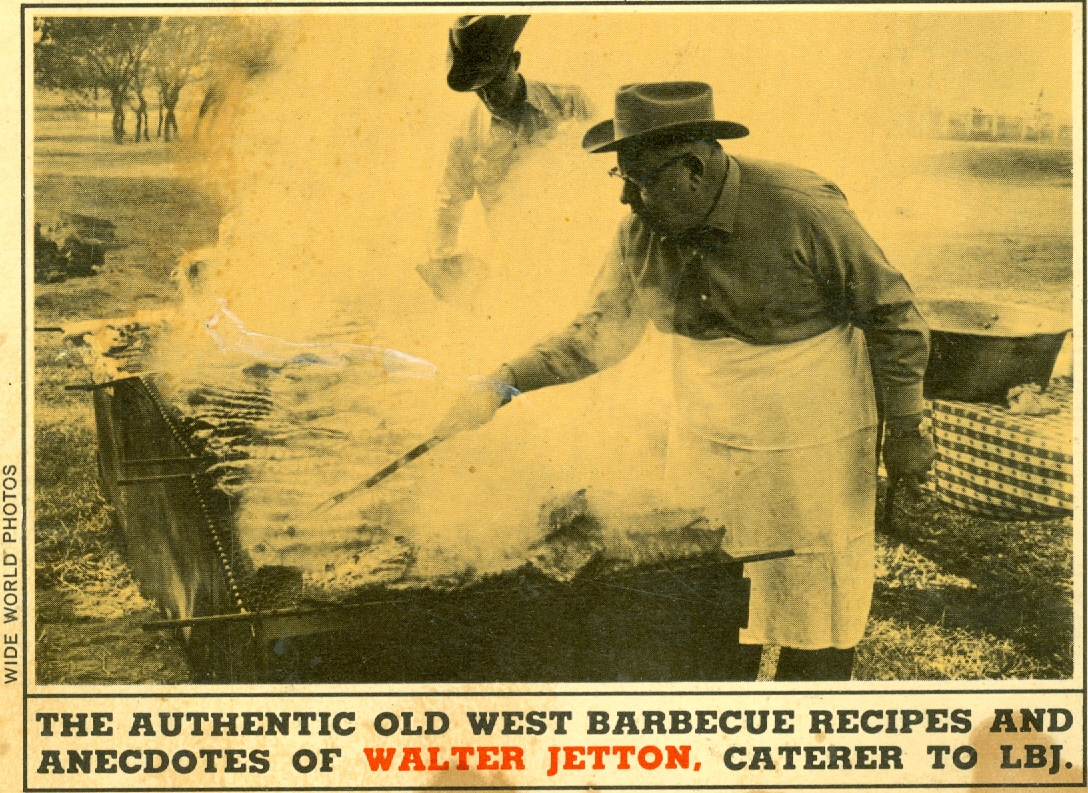
Walter Jetton at the barbecue - from the cover of his 1965 cook book

Walter Jetton at the barbecue – from the cover of his 1965 cook book

RECIPES

Dry Rib Rub

Ingredients

  • 3 tablespoons salt
  • 3 tablespoons sugar
  • 1½ teaspoons lemon powder
  • 3 teaspoons Accent MSG
  • 1 tablespoon ground black pepper
  • 1½ teaspoons paprika

Method

  1. Combine all ingredients in a container with a lid
  2. Rub the mixture generously on all surfaces of the rack of ribs before you place it on the barbecue

Barbecue Mop

Ingredients

  • 1 tablespoon salt
  • 1 tablespoon dry mustard
  • 2 teaspoons garlic powder
  • 1 teaspoon ground bay leaf
  • 2 teaspoons chili powder
  • 1 tablespoon paprika
  • 1 tablespoon Accent MSG
  • 2 teaspoons Louisiana Hot Sauce
  • 1½ cups Worcester sauce
  • ¾ cups white vinegar
  • 1 carton (32 ounces) beef stock
  • ¾ cups vegetable oil

Method

  1. In a large bowl, combine first seven (dry) ingredients
  2. Stir in the liquid ingredients until completely mixed
  3. Cover and let stand overnight at room temperature
  4. With a small (new) dish mop, brush on barbecue meats frequently as you cook them.
  5. Refrigerate any that is left over when you have finished barbecuing. Store it in a tightly-lidded jar. It will last for a long time.

7 Comments

Filed under Food, Photography, Recipes, Restaurants, Travel

ASPARAGUS FRIES AND AIOLI

A few evenings ago, we went with our food-enthusiast friends to a relatively new Santa Fe restaurant, Arroyo Vino. We were excited about the visit, which was a ways out of town, because we had previously been big fans of the Executive Chef, Mark Connell, who had wowed us at a downtown place that is now history. The restaurant is only open for dinner Tuesday through Saturday so reservations can be dicey. But the added feature is that it is attached to a very complete wine shop that is open throughout the week, and with lots of good choices for fair prices. You can even buy a bottle for your dinner if nothing on the menu pleases your palate.

The menu changes frequently and tends to favor the current enthusiasm for the farm-to-market movement. Specials are posted on a blackboard, and they are worth considering in view of the restaurant philosophy.

Asparagus is in season, so you can get it prepared in one of several ways. I didn’t see asparagus ice cream, but the asparagus soup was a keeper, and to my taste the asparagus fries turned out to be a highlight of the evening

The dish was served in a beaker filled with plump asparagus spears lightly dusted with panko and fried just until the panko toasted but not enough to rob the asparagus of its green and crispness. It was lighter than tempura – if you want tempura you do batter – but it begged to be dipped in the accompanying Hollandaise.

When I got home I decided to emulate this very special dish. My effort didn’t come close to the real thing, but it was good enough that there was no asparagus left at the end of dinner. This recipe is also ingredient-efficient because I used egg whites to give the panko something to stick to and then the yolks to make a dipping aioli instead of Hollandaise. Making the aioli also gave me a chance to use one of my new gadgets.

Over the years, I have gone through countless garlic presses. Of course, the pros among you will say, “Don’t put it through a press, just mince it, or make a paste with the flat of a knife, or use a mortar and pestle.” All of those skills have escaped me, but garlic presses have also been a big disappointment. They break; the holes are hard to clean out; the press part doesn’t meet the plate of holes; the garlic doesn’t get extruded; etc. So my wife gave me a JosephJoseph garlic rocker, made by the British firm owned by the twin brothers Joseph and designed by Goodwin Hartshorn. It is a thing of beauty, made of lightly brushed metal with two wings and an indentation of a honeycomb of sharp-edged hexagonal holes. You place the rocker on some garlic, and rocking the wings back and forth, you force the garlic through the holes into the indentation. The garlic may not be as fine as you would like, so just press it through a second time. It works, it’s fun, and it’s easy to clean/dishwasher safe.

Our home meal was finished with corn-on-the-cob and twice-baked potato.

RECIPE

Asparagus Fries

Ingredients

  • 1 bunch fresh asparagus, preferably larger stalks
  • 2 egg whites
  • 2 tablespoons water
  • ½ cup panko
  • 2 tablespoons cornstarch
  • ½ teaspoon baking soda
  • 1 teaspoon salt
  • peanut oil for deep-frying

Method

  1. Wash the asparagus and trim the woody stems so that the stalks are about the same length
  2. Whip the egg whites so that they are frothy and evenly mixed. Whip in the water and transfer to a shallow plate or pan.
  3. In another plate or pan, combine the panko, cornstarch, baking soda, and salt.
  4. Working a few stalks at a time, coat them with egg white and then coat them with the panko mixture. Set on a baking rack for a few minutes to dry until all of the stalks are coated.
  5. Heat a heavy pot with about 3 inches of peanut oil to 350° F. Adjust the heat to maintain temperature because the asparagus will cool of the oil rapidly, and the asparagus will become greasy if the temperature is too low.
  6. Working in batches, transfer the asparagus stalks to the hot oil. Fry for no more than a minute until the panko is lightly browned. Transfer to folded paper towels to drain, and keep warm until all of the asparagus is fried.
  7. Serve immediately with freshly made aioli. You can use the 2 leftover egg yolks for that.

9 Comments

Filed under Food, Photography, Recipes, Restaurants

STOP COOKING AND SMELL THE FLOWERS

Spring has finally come. Or is it summer already? The last big snow storm on the Sangre de Cristos melted a few days ago, and now there is only a tiny sliver of white on the highest peak. Today, the temperature is in the 80s, and tomorrow it is supposed to be over 90.

The western bluebirds and Say’s phoebes have built their nests while the purple house finches are looking for their space. Piñon jays have appeared in great flocks, the first time that has happened in years, perhaps because of the years-long drought and the early spring rains we have had. The spotted towhees are back with their distinctive cheerful sound, and the ravens are brooding in a huge nest built of sticks (too big to be called twigs) in a juniper on the bank of the arroyo. Black-chinned hummingbirds have arrived at the feeders, but it is too early for the more aggressive broad-tails.  It has been a joy to watch the migrants traveling through our yard on their trip up north. Lizards are sunning themselves on the patio wall.

Apricots and peaches put on an early show and then promptly froze, so again there won’t be fruit from the trees in our yard. Lilacs and daffodils have finished their performance, and now the irises and columbines are at their peak with the peonies bowing down as their huge flowers overwhelm the slender stems. The native plants have also begun to color the landscape: evening primroses (both yellow and white varieties), yuccas and their accompanying hawk moths, paintbrush, buckwheat, and Artemisia. The color should start to come in waves now until the winter frost with chollas, fern bushes, desert willows, sacred daturas, desert four-o’clocks, sunflowers, cow pen daisies, and asters joining in at just the appropriate time.

With all of this gong on, it has become harder to cook and to make images in the kitchen, so I decided to take a break and wander around my wife’s beautiful garden. I hope you will forgive this lapse, and I also hope that you enjoy this little break from cooking.

Enjoy your summer ahead.

3 Comments

Filed under Photography